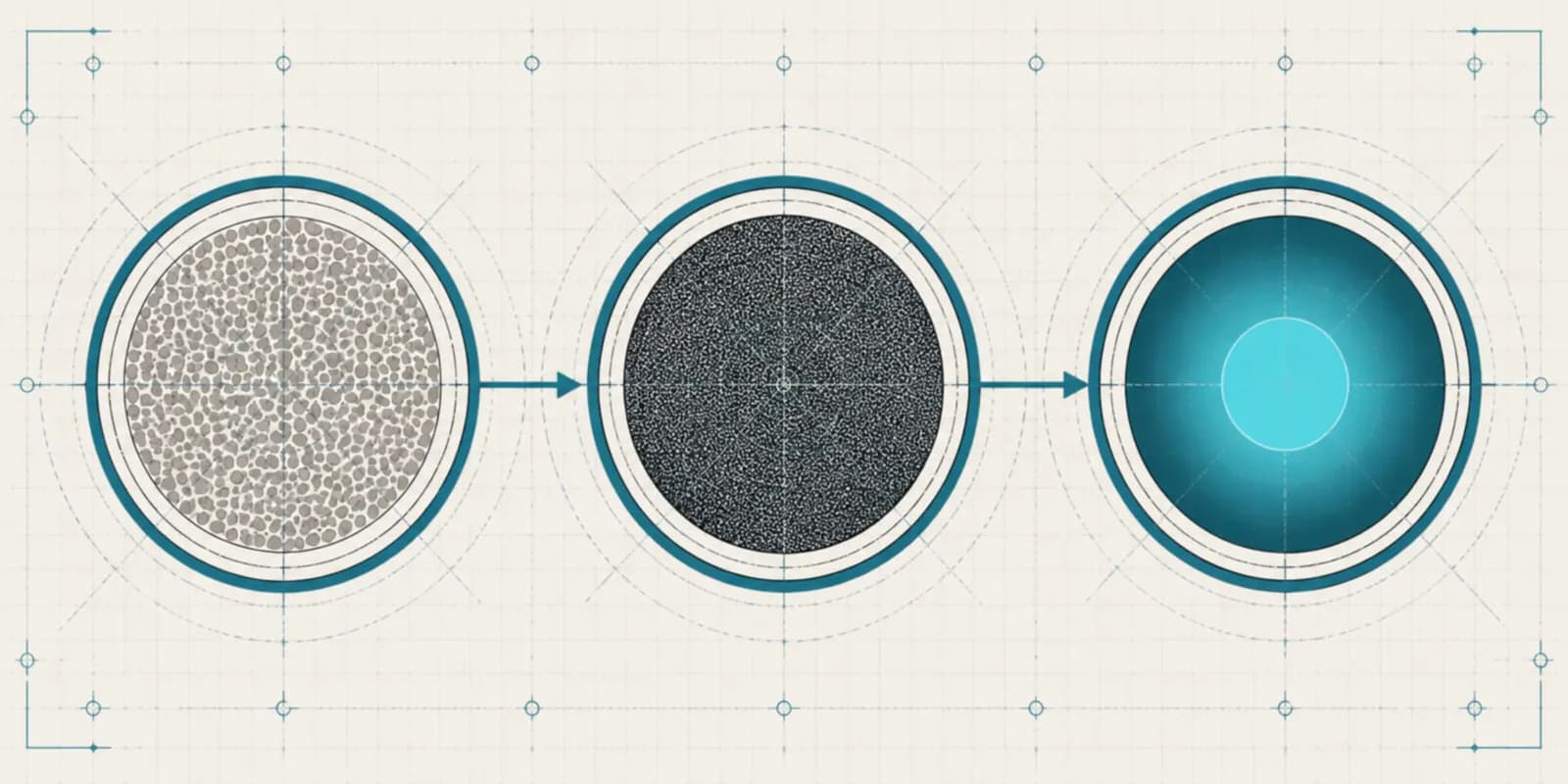
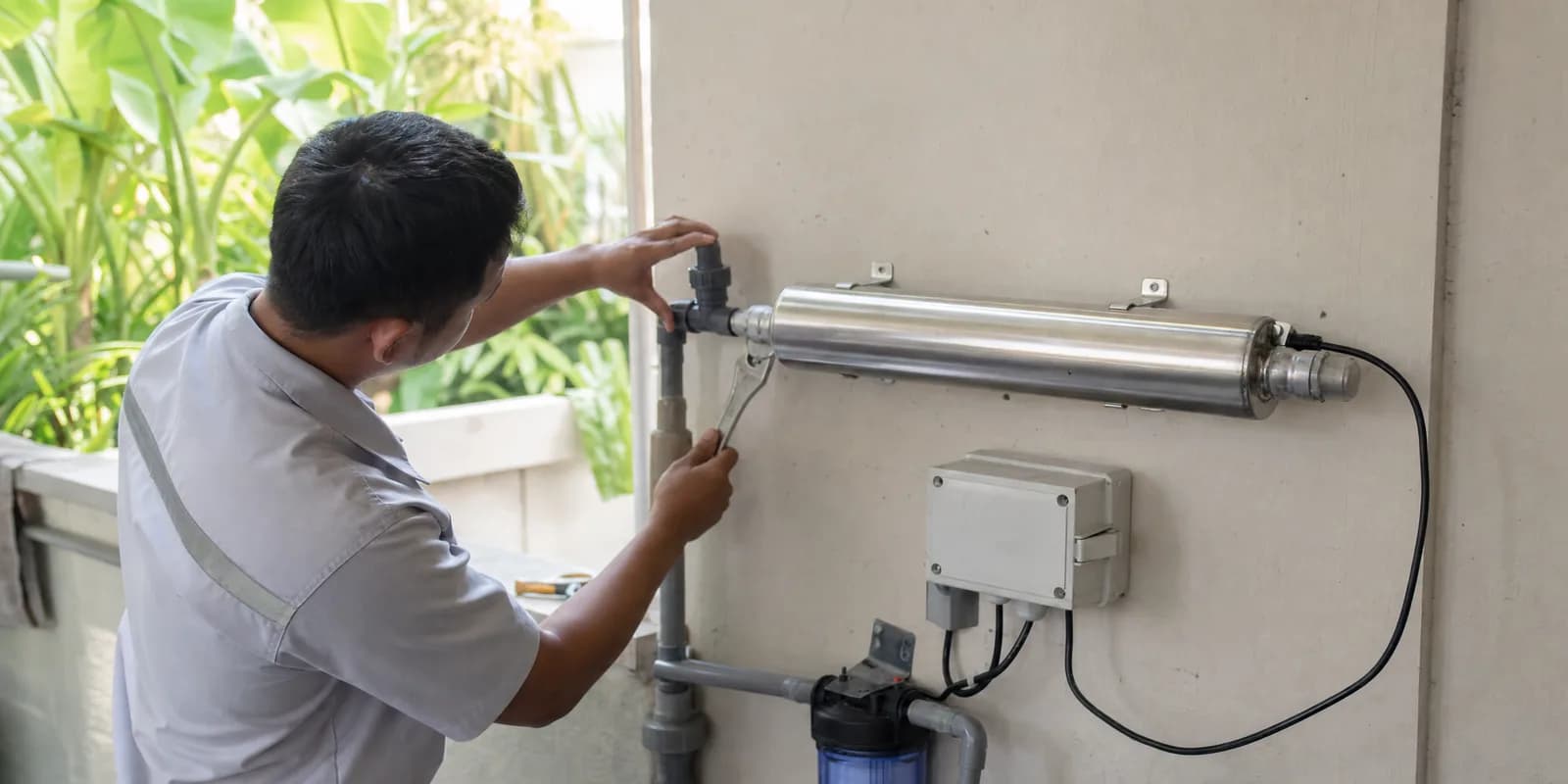
A dose figure and its labels are easily heard as a certified property of the unit, as if the Viqua VH410-F22 simply had a 30 mJ/cm² dose or an NSF/EPA rating. A dose is not a property a unit carries: it is UV intensity multiplied by exposure time, spread over a range inside the reactor, and it exists only at a stated flow, UV transmittance (UVT), lamp state and temperature.[7][8] Viqua's manual puts a note under its dose-flow charts: "Not performance tested or certified by NSF."[8]
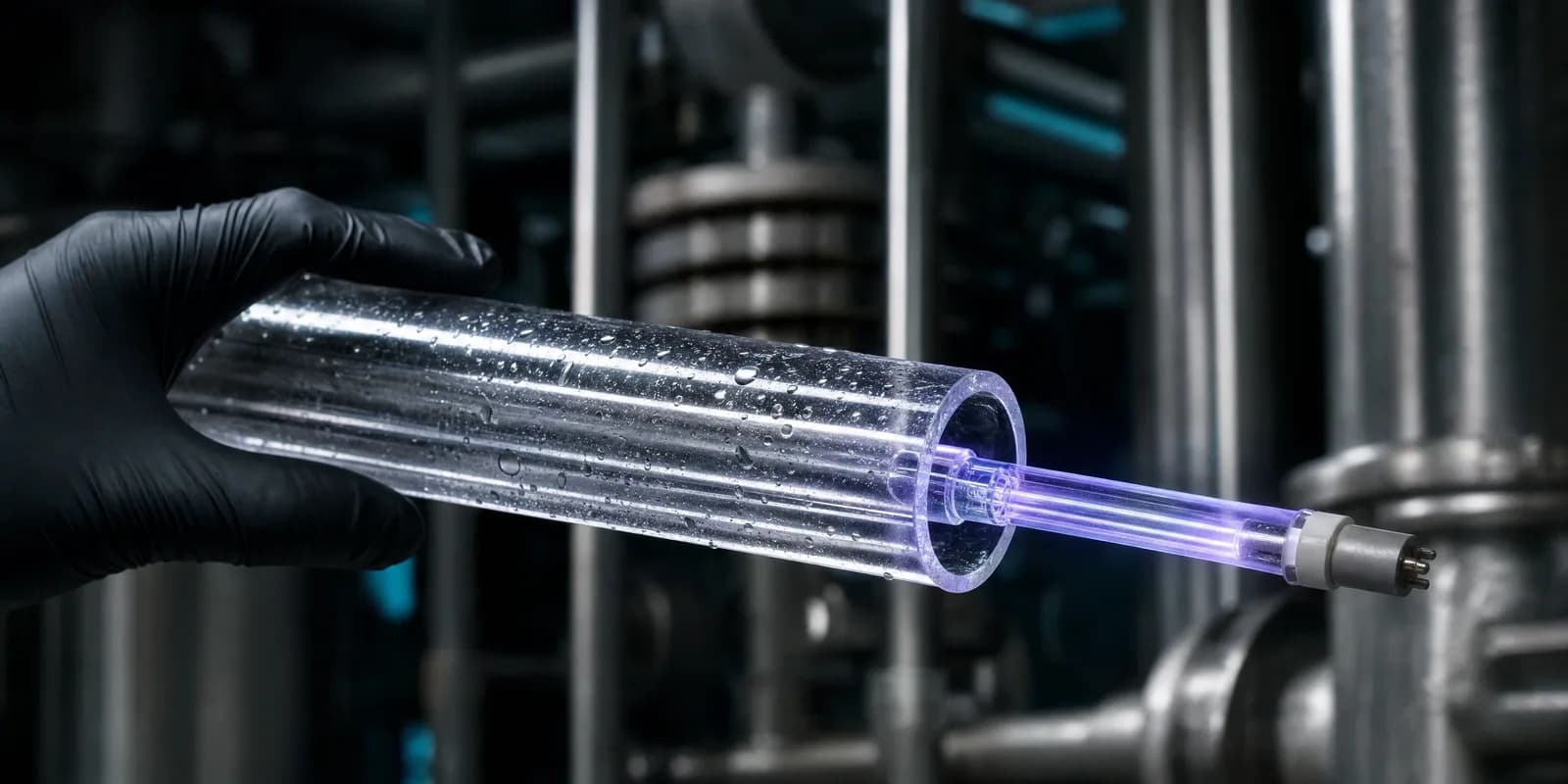
The VH410-F22 (Viqua's words: "Whole Home Integrated UV Water Treatment")[1] puts water past a high-output lamp behind a quartz sleeve in a 304 stainless steel chamber, with a controller that counts lamp days, and Viqua prints its dose at a stated flow three times: 16, 30 and 40 mJ/cm² at 34, 18 and 14 gpm.[2][8]
Four questions follow. What sets the dose, and what moves it? What do the three rows assume, and what does the unit observe? What do Viqua's testing statements, NSF's listings and a clean sample prove? What should a buyer measure and agree on site? Two findings: the dose at a given site's UVT is not published, so ask Viqua in writing and measure; and NSF's Class A and Class B listings, current as of 30 September 2026, show no VH410-F22 under Viqua's entries, so a tender that requires an NSF/ANSI 55 listing needs a unit that is listed or a written answer from Viqua.[5][6] Sizing and fit go to the selection guide, the duty design to the reference design.
Intensity and exposure time set the dose
In the VH410-F22, as in any flowing UV reactor, dose is intensity times exposure time, and intensity at the water is set by UVT, lamp output and sleeve condition (per EPA's UV Disinfection Guidance Manual, written for public water systems, not this product).[7] In a flowing reactor no single value exists: organisms near the lamp get more, those near the wall less, and EPA says average inactivation is strongly affected by those receiving the lowest doses.[7] Viqua's three dose figures are single numbers, and its product page, spec sheet and owner's manual, the documents read here, do not say how they were determined or whether each is an average, a minimum or a reduction equivalent dose.[1][2][8]
Flow sets the time. EPA says lower UVT lowers intensity throughout the reactor, lamps degrade with age and sleeves foul inside and out.[7] Viqua's manual says minerals coat the sleeve, and for its sensored (Plus controller) systems it lists five causes of a low-UV alarm (section 5.2), among them lamp age beyond 9,000 hours, a stained sleeve or sensor window, a voltage drop and a change in influent quality.[8] UVT is usually reported at 254 nm over 1 cm. That suits the F22 only if its high-output lamp emits near 254 nm. This is an assumption, inferred from the shared lamp part S410RL-HO and the sensored systems' 254 nm sensor, because the F22 documents print only high output.[7][2][4][8]
EPA lists humic and fulvic acids, other aromatic organics, iron and anions as absorbers, and its source found no significant 254 nm absorbance from calcium, magnesium or manganese ions; Viqua's manual says minerals in the water form a coating on the sleeve; read with EPA's finding, hardness is a sleeve question here and not a UVT question (this article's reading of the two).[7][8] In EPA's Table 2.5 example, ferric iron at 0.057 mg/L moves UVT from 91% to 90% and ferrous iron needs 9.6 mg/L, 168 times as much (derived here, 9.6 ÷ 0.057), and Viqua's iron level, below 0.3 ppm, does not say which form.[7][8]
More flow, lower UVT, an aged lamp and a fouled sleeve each cost dose. Viqua prints a lamp rating of approximately 9,000 hours, UVT above 75% as an installation level and periodic sleeve cleaning. Those documents print no cleaning interval and no mJ/cm² lost per hour, per mg/L of iron or per grain of hardness.[8]
A lit lamp is not a delivered dose, because UV is invisible: Viqua says, of replacement lamps, that similar appearance and visible blue light do not mean equivalent performance, and that without a UV sensor their output cannot be verified.[8] A glowing lamp is equally consistent with an aged lamp, a stained sleeve or low UVT, which is this article's reasoning from EPA, not a Viqua statement. The check is a UVT measurement, a sleeve inspection, the lamp's age and a microbiological test, or a sensored model.
The rated flows are tied to stated conditions
Viqua's spec sheet heads three rows "Flow rates (@ 95% UVT)"[2] and labels them U.S. Public Health 16 mJ/cm² at 34 gpm (130 lpm), VIQUA Standard 30 mJ/cm2 at 18 gpm (70 lpm) and NSF/EPA 40 mJ/cm2 at 14 gpm (54 lpm); the manual repeats the flows.[8] The product page prints 120 lpm for the first row and no UVT, and its headline "Flow Rate: 18 gpm"[1] is the middle row.
The manual's footnote reads "Flow rates based on UVT=95% and End of Lamp Life; 20°C."[8] So lamp aging is inside the rating according to Viqua, which credits its lamps with "extremely stable UV output over the entire 9000 hour lifetime",[8] while EPA says output declines with age.[7] Those documents do not define End of Lamp Life. Viqua's replacement rule counts 365 days, and Viqua itself equates 9,000 hours with approximately one year; 365 days at 24 hours is 8,760 hours, 240 hours (2.7%) under 9,000 (derived here, assuming an always-on lamp).[8]
Those documents leave out any allowance for sleeve fouling, any dose between 75% and 95% UVT, any temperature other than 20 °C (the sheet prints an influent range of 2 to 40 °C) and the carbon cartridge's limit.[2] The manual's footnote under the flows puts the maximum flow with the carbon filter and gives no number,[8] and no document read prints the assembled unit's maximum, so 34, 18 and 14 gpm are reactor dose-flow rows, not flows the assembled unit is stated to pass (see the selection guide).
The rows trade flow for dose at nearly a constant product, as exposure time falling with flow would give: 16 × 34 = 544, 30 × 18 = 540 and 40 × 14 = 560 mJ·gpm/cm², a spread of (560 − 540) ÷ 560 = 3.6% (derived here). It gives no dose at any other flow.
Flow and UVT are coupled, and only one arm is published. Viqua's rows give less flow, more dose, at 95% UVT. EPA says lower UVT lowers intensity, so the same dose needs less flow, by an unpublished amount. Three bands result. The rating condition (not Viqua's pass line) is 95%. Viqua's installation guidance is above 75%, with "call factory"[8] below. Between the two no table row prints a dose-flow point and the manual prints no derating table. In those documents the only sub-95% points are the VH200-V's and the VH410-V and VH410M-V's: for the VH410-V, 14 gpm at 16 mJ/cm² and 70% UVT with a required flow restrictor and an NSF Class B listing, beside its 34 gpm at 95% in the manual.[4][6][8] That pair is not a derating factor for the F22, because UVT, restrictor and certification all differ.
The rating is also silent on what the unit watches: lamp state, not dose. The F22 rows list a visual power-on indicator, visual lamp life remaining, and audible lamp-failure and lamp-replacement alarms.[2] The controller counts lamp days from 365 to 1, and the manual defines its lamp-failure condition as "no current running through the Lamp".[8] The sheet lists UV sensor N; the manual lists 254 nm UV monitor No and no solenoid output.[2][8] The sensored VH410 models include the VH410M and VH410M-V.[3][4] The alarm does not measure UV output, an inference from the absence of a sensor; EPA says a sensor measures intensity at a point and responds to lamp aging and sleeve fouling.[7] The F22 rows list no means of observing UVT, sleeve condition, flow or delivered dose.[2][8]
The dose figures rest on maker statements
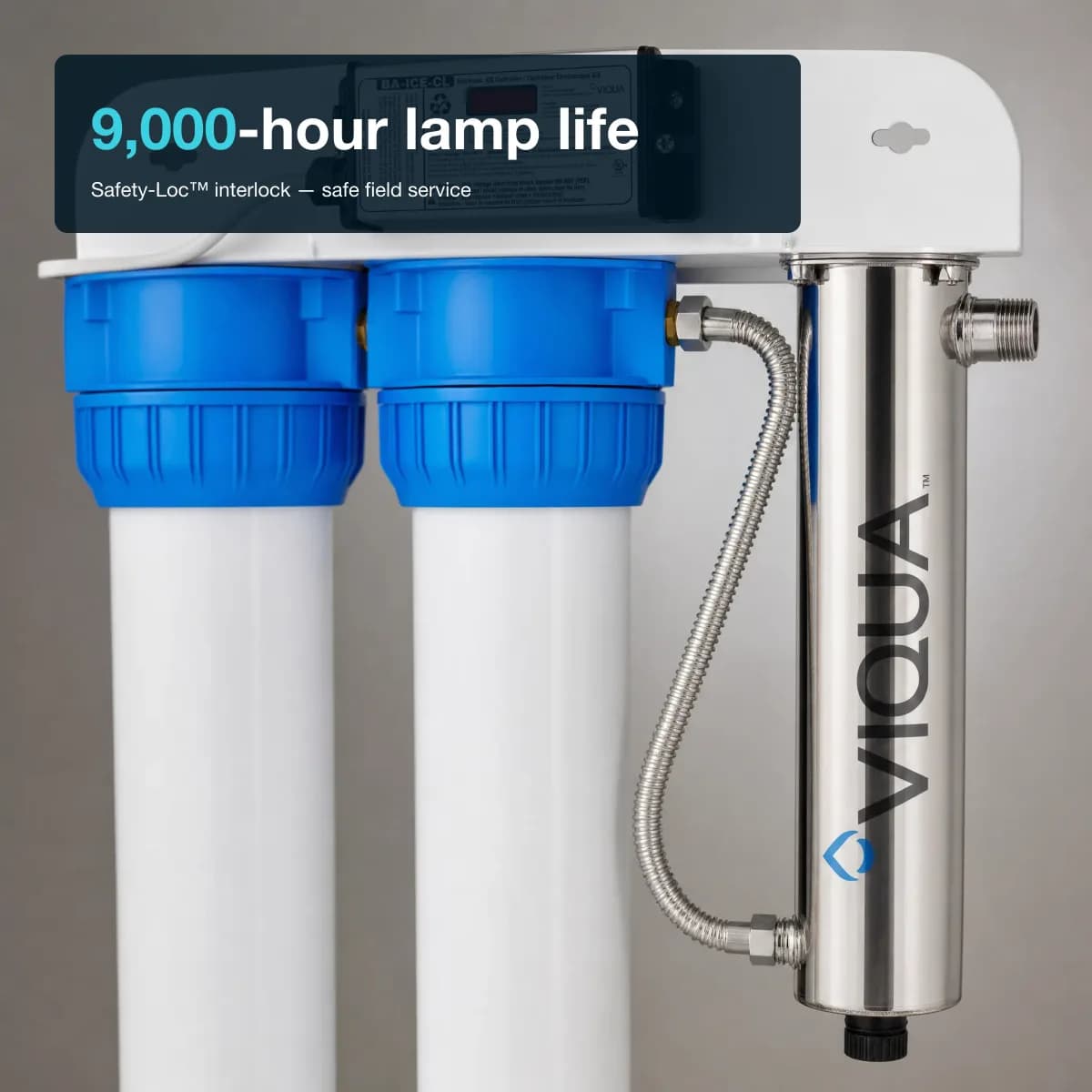
Viqua states the efficacy of its UV systems, on the F22 page, from internal testing with the surrogate MS2 phage, and none of NSF's listings, the manual's chart note or the other documents read adds a third-party dose result for the F22.[1][5][6][8] The product page offers details on request and adds that "no guarantee can be provided of actual percentage of common waterborne pathogens inactivated in an application".[1] The manual's sentence for the VH200-F and VH410-F systems is narrower: Cryptosporidium, Giardia, E. coli and fecal coliform.[8] No validation report, log-inactivation figure or independent laboratory report was retrieved.
The three dose rows are Viqua's labels; the documents read do not show a third-party result behind them. The chart note says "Not performance tested or certified by NSF."[8] The row labels are Viqua's names for points on its chart.[8] NSF's Class A and Class B listings under NSF/ANSI 55, current as of 30 September 2026, list no VH410-F22 or other -F model for Viqua; the search covered Viqua's entries and the model strings VH410-F and -F2x only.[5][6] Viqua's Class A entries are six PRO models at 10 to 30 gpm, and its Class B entries are the Arros -V models, VH200-V, VH410-V and VH410M-V.[5][6]
The WQA fact sheet (2013, secondary) says Class A systems have a minimum dose of 40 mJ/cm² and must include alarms and a UV sensor.[9] Viqua's NSF/EPA 40 mJ/cm2 label shares the number 40 with WQA's Class A minimum; the documents read do not say what the label refers to. The F22 sheet lists UV sensor N, and the F22 is not in the Class A listing.[2][5] EPA describes dose delivery as measured by biodosimetry: a surrogate's log inactivation related to a reduction equivalent dose;[7] the documents read show none for the F22.
One ambiguous reading takes quiet lamp indicators to mean the dose is delivered. The countdown counts days, not output, and the manual defines lamp failure as no current through the lamp.[8] The same quiet screen occurs with an aging or non-genuine lamp, a stained sleeve, UVT below the rating condition or a flow above a printed row (reasoning from the controller description, not a source statement). The check is the lamp's installation date, a sleeve inspection, measured UVT and flow, and a microbiological test.
A second takes a clean tap sample to mean the UV is working. It follows (reasoning, not a source statement) that a supply already clean gives a clean sample with a dead lamp; PUB reports E. coli below 1 cfu/100 mL at plant output for Singapore, not at a tap.[10] It also follows that a sample drawn while the start-up bleach flush (manual section 3.2) is still clearing cannot distinguish a working lamp from a chlorinated sample.[8] Viqua's manual says "The best way to ensure optimum UV performance is to have the water microbiologically tested by a recognized testing agency on a regular basis."[8] Those documents give no frequency, and the product page says efficacy depends on incoming water quality, the pathogen and the age of the bulb.[1]
Accept the dose claim on site data
A VH410-F22 dose claim is reproducible only with its flow, UVT at 254 nm, lamp and sleeve state, temperature and dose basis, and a microbial claim only with its organism or surrogate, counts in and out, method, laboratory and standard. Viqua's rows carry the dose, flow, 95% UVT, end of lamp life and 20 °C but not the organism, dose basis or protocol[2][8], so a sheet figure without its conditions is a misreading.
[ASSUMPTION: each condition has a named instrument; generic measurement practice, not a Viqua procedure and not a source statement; valid as a starting list for a site acceptance plan; invalid as a Viqua specification; promoted by Viqua's written measurement requirements.] No Viqua document says how UVT is measured. UVT: a laboratory spectrophotometer at 254 nm over 1 cm, on a sample from the unit's inlet. Flow: a meter at the unit reading the peak passed, with pressure logged beside it. Temperature: a reading at the inlet. Microbiology: sampling by a recognised agency, with the organism and method named.
The fix for a poor result may lie outside the unit. Viqua's manual says "Proper pre-treatment is essential for the UV System to operate as intended."[8] It says so beside its recommended water levels, so which pretreatment raises a site's UVT is a site question.[8] Viqua's manual handles scale by mild-acid cleaning or softening above 7 gpg and a doubtful lamp by a genuine replacement.[8]
The envelope is limited to: Viqua's three rows as printed, at 95% UVT, end of lamp life and 20 °C; the direction that less flow and higher UVT mean more dose[7][2]; the F22's absence, under Viqua's entries and the model strings searched, from NSF's Class A and Class B listings as of 30 September 2026; and a controller that, in the sheet and the manual, reports lamp state only. It does not cover a dose at any flow other than 34, 18 and 14 gpm, or at any UVT below 95%. Nor does it cover a sleeve-fouling allowance, a certified property of the unit, or any automatic response to a dose shortfall.
The data to send to Viqua is measured UVT at 254 nm, peak flow and pressure, inlet temperature range, iron, hardness, turbidity, manganese, tannins and the lamp and sleeve record. The questions to put to Viqua in writing are the dose at the site's UVT and design flow and its basis; whether a validation report exists, with organism and protocol; the F22 dose-flow curve values; whether the rating includes a sleeve-fouling allowance; and what End of Lamp Life and NSF/EPA mean. The terms to agree are organism and method, agency, sampling points and stress condition, and the re-test trigger when source, season or duty changes.
Viqua VH410-F22
No certifications listedView product →Sources
- [1]Viqua — VH410-F22 product page (retrieved 2026-10-01) — headline flow, three flows with no UVT, internal-testing and no-guarantee footnotes
- [2]Viqua — Spec sheet VH200-F12, VH410-F12 and VH410-F22 (print code 102025) — dose-flow rows at 95% UVT, controller rows, sensor row, temperature range, parts list
- [3]Viqua — Spec sheet VH150, VH200, VH410 and VH410M — sensored VH410M row (sibling model; does not name the VH410-F22)
- [4]Viqua — Spec sheet VH200-V, VH410-V and VH410M-V — 14 gpm at 70% UVT, flow restrictor, sensor rows (sibling models; do not name the VH410-F22)
- [5]NSF International — Certified DWTU database, Class A search results (listing current as of 2026-09-30, read 2026-10-01)
- [6]NSF International — Certified DWTU database, Class B search results (listing current as of 2026-09-30, read 2026-10-01)
- [7]US EPA, Office of Water — Ultraviolet Disinfection Guidance Manual (UVDGM), Nov 2006, EPA 815-R-06-007 — written for public water systems, not for this product
- [8]Viqua — Owner's Manual 520585_RevB (VH, VH-F, VP) — section 8.3 table and footnotes, chart note, controller and alarm sections, lamp and sleeve sections
- [9]Water Quality Association — UV fact sheet (2013, secondary) — NSF/ANSI 55 Class A and Class B on WQA's account
- [10]PUB Singapore — Drinking Water Quality, Jan to Dec 2025 — E. coli at plant output (one clause)