The Viqua VH410-F22 product page prints "Flow Rate: 18 gpm".[1] Does that cover a given building? The figure equals the 30 mJ/cm² row, one of three, and the page states no UV transmittance (UVT).[1] The sheet labels its first row "Flow rates (@ 95% UVT)",[4] the manual's footnote adds "Flow rates based on UVT=95% and End of Lamp Life; 20°C.",[16] and the manual puts the maximum with the carbon filter.[16] The sheet's parts list gives the F22 the C2-02 carbon cartridge,[4] whose page prints 10 GPM.[9] Fit turns on two checks against peak demand: the facility's UVT band and the lowest printed component rating.
The guide can end four illustrative ways: the VH410-F22 at a stated margin; a hold on the dose until Viqua's answer is in writing; a written question on the assembled maximum flow and the C2-02 configuration; or not this product. Scope: the F22 as a point-of-entry unit on municipal supply in Singapore, Malaysia and Indonesia; the light-commercial draw is this guide's assumption. The worked design is in the reference design.
Diagnose first, then measure UVT and flow
UV answers microorganisms in otherwise acceptable water; particles, odour and colour belong to Viqua's sediment filter and carbon block;[1] [ASSUMPTION: a lamp does not replace sediment filtration or a carbon block; general practice, no retrieved source]. Locate a positive upstream, in the unit or after it: Viqua's troubleshooting table has rows for a stained sleeve, a change in feed water quality and possible break-through of sediment through the pre-filter.[16]
Read results as a trend, never one sample. A positive at one tap after a closure can mimic a failed unit: PUB lists stagnant water from infrequent use among causes of discoloured water and says filters "may become a breeding ground for bacteria if they are not cleaned or replaced regularly",[14] but the step to a false positive is this guide's reasoning. Check with paired samples before and after the unit, repeated across flows and seasons.
Viqua's sheet says "for homes or small businesses",[4] its HOME family page "larger homes and light commercial applications",[2] its homepage "Point-of-entry UV systems for homes and cottages" with light commercial under Professional;[3] no Viqua document read names cafes, clinics or hotels. An intermittent draw makes peak simultaneous flow the sizing input.
Eliminate on a written NSF/ANSI 55 requirement and on UVT at or below 75%. Check first the six levels Viqua calls "recommended for installation" (iron below 0.3 ppm, hardness below 7 gpg or 120 mg/L, turbidity below 1 NTU, manganese below 0.05 ppm, tannins below 0.1 ppm, UVT above 75%),[16] which lead to pre-treatment, not a pass or fail. Size on peak simultaneous demand, inlet pressure with flow running and supply temperature; fit on power and wall space.
UVT is a measure of how much 254 nm light passes through the water (EPA).[13] Viqua lists turbidity and UVT as separate rows,[16] so neither stands in for the other. No Viqua document read says how UVT is measured, so method and measurer become a quote clause.
Unit traps: gpm is primary; Viqua's metric figures are rounded (34 gpm is 128.7 L/min, printed as 130, or 120 on the product page).[4][1]
Market context only: PUB's 2025 table is plant output, not a tap;[20] Malaysia's is the Ministry of Health's revised December 2023 table (host copy);[15] Indonesia's Permenkes 2/2023 Tabel 1 is a host copy read by eye.[19] None of these documents speaks on UV devices or UVT,[15][19][20] so meeting a national limit can sit outside the maker's recommendation.
| Parameter, mg/L | Viqua level | PUB plant maximum | Malaysia | Indonesia |
|---|---|---|---|---|
| Iron | below 0.3 | 0.043 | 0.3 | 0.2 dissolved |
| Manganese | below 0.05 | 0.013 | 0.1 | 0.1 dissolved |
| Turbidity, NTU | below 1 | 0.48 | 5 | below 3 |
| Hardness | below 120 | 191 | 500 | not in Tabel 1 as read |
Sources: Viqua levels [16]; PUB [20]; Malaysia [15]; Indonesia [19].
Screen, then size to the lowest rating
Screen on published limits first. The F22 is absent from NSF's Class A and Class B listings, current as of 30 September 2026 (read 1 October 2026; two filtered category pages only).[11][12] The sheet shows CE, cUL us LISTED and TRC ISO 9001 as logos, not independently checked,[4] and Viqua's chart note says "Not performance tested or certified by NSF."[16] Maximum pressure is 125 psi (8.62 bar) on the sheet[4] and 100 psi (689 kPa) in the manual;[16] this guide uses 100 psi until Viqua says which governs. Water is rated 2 to 40 °C and the supply is 100-240 V, 50/60 Hz, 60 W,[4][16] with the flow rows at 20 °C.
UVT gives three bands, and 95% is not Viqua's gate. At 95% or above, the rows apply as far as UVT goes. Between 75% and 95% no table row prints the dose,[16][4] the direction is lower (EPA),[13] and the answer is a written question to Viqua. At or below 75% this guide stops (Viqua says to call the factory below 75%;[16] exactly 75% is this guide's call).
Viqua prints the flow rows at End of Lamp Life and rates the lamp at about 9,000 hours;[16] this guide reads the first as covering the second, which no Viqua document states (EPA says lamps degrade).[13] For the F22's flow rows the documents read state no sleeve-fouling allowance, no temperature other than 20 °C and no UVT below 95%.[4][16] The rows are 34 gpm at 16 mJ/cm², 18 gpm at 30 and 14 gpm at 40, Viqua's labels;[4] its dose-flow chart was not read for values (ask Viqua),[16] and whether the rows share one curve is the dose mechanics article's question.
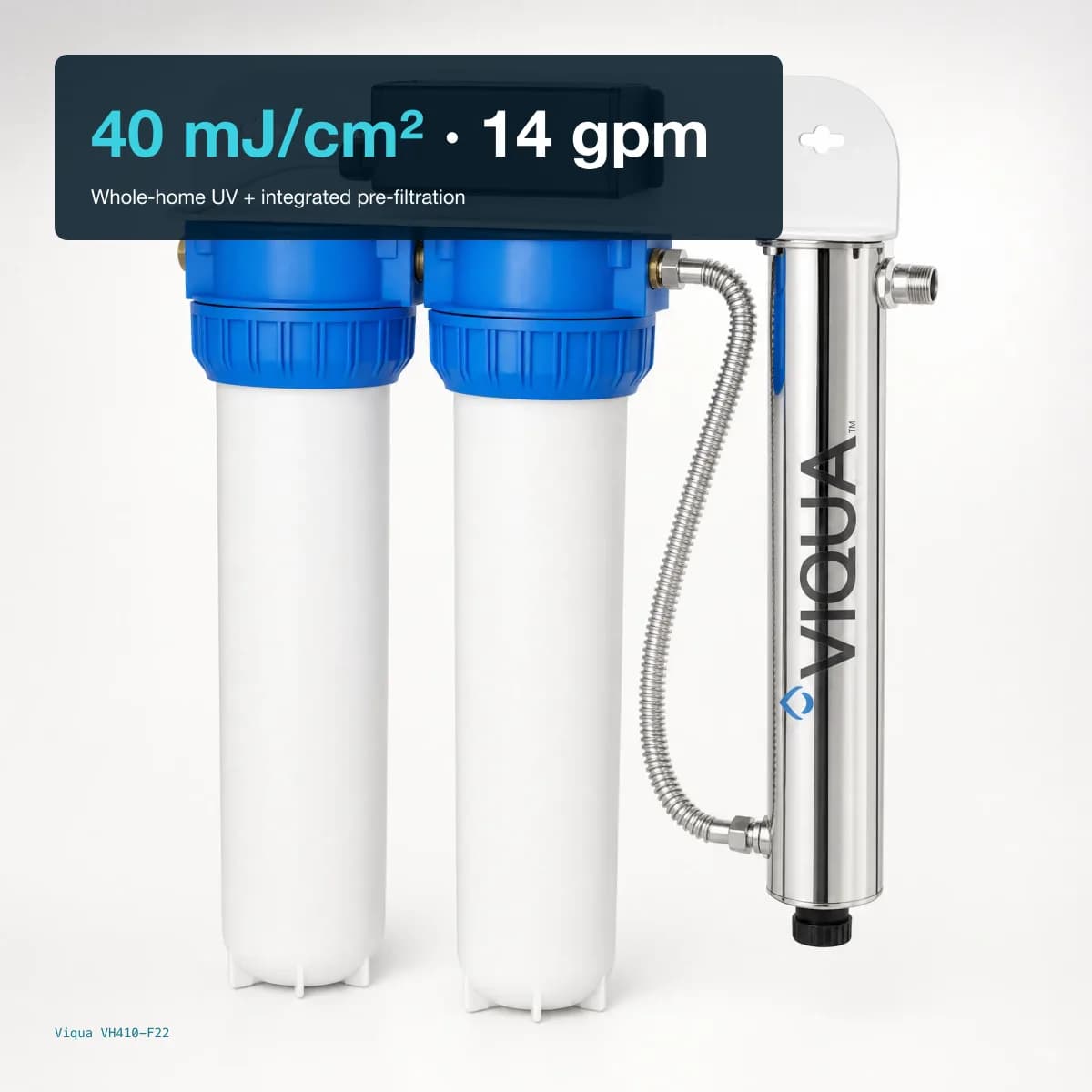
Size to the lowest printed component rating. The C2-02 page prints 10 GPM and offers "regular and high-flow configurations",[9] without saying which ships in the F22. The manual's F22 column lists a 20-inch high-flow filter housing, which is a housing and not a cartridge rating.[16] Its footnote says "The max flow rate is determined by the carbon filter." with no number,[16] and the same footnote sits under the VH410-F20 table,[17] a model with no carbon cartridge.[6] No document read gives the assembled maximum. The sheet's parts list gives the F22 the CMB-520-HF sediment cartridge,[4] which prints 32 GPM,[10] against reactor rows of 14, 18 and 34 gpm. Choosing the dose row first on the 18 gpm headline makes 12 gpm look cleared when it is 2 gpm over the C2-02 page's printed 10 GPM, a figure whose application to the F22's configuration Viqua has not stated.
An intermittent draw adds a question: the manual warns that chamber water can become very hot (about 60 °C) after extended no flow and prints no minimum flow,[16] which is why no-flow hours go in the enquiry (see the reference design).
The run is illustrative, not a rating. [ASSUMPTION: 8 gpm peak demand (30.3 L/min, 1.82 m³/h); 96% UVT; supply water 2 to 40 °C; the five chemical levels (all but UVT) met; 15 to 100 psi at the inlet with 8 gpm running; no written NSF/ANSI 55 requirement; an acceptable municipal supply; valid until the facility meters its demand and measures its UVT; invalid as a product rate.] Margin is (rated − demand) ÷ rated: (10 − 8) ÷ 10 is 20.0% against the C2-02's 10 GPM, the lowest printed rating. No local target dose was retrieved, so the buyer picks the row; EPA defines dose, for constant intensity, as intensity times exposure time,[13] so this guide expects a lower flow to raise the dose, but the F22's own dose at 8 gpm is unpublished. The run ends at the F22 with 20.0% margin and three written items to put to Viqua: the C2-02 configuration and assembled maximum, the governing pressure, and the dose at 8 gpm. This holds only if no stop condition applies.
| Printed rating | Manual's condition | Margin at 8 gpm | Margin at 12 gpm |
|---|---|---|---|
| C2-02 maximum, 10 GPM | F22 configuration not stated | 20.0% | −20.0% |
| 40 mJ/cm² row, 14 gpm | 95% UVT, end of lamp life, 20 °C | 42.9% | 14.3% |
| 30 mJ/cm² row, 18 gpm | same | 55.6% | 33.3% |
| 16 mJ/cm² row, 34 gpm | same | 76.5% | 64.7% |
Ratings: [9], [4], [16]; margins are this guide's arithmetic.
At 12 gpm (45.4 L/min, 2.73 m³/h) [ASSUMPTION: illustrative; chosen to exceed the 10 GPM figure] the C2-02 page's printed 10 GPM is exceeded before any dose row.
At 88% UVT and 8 gpm [ASSUMPTION: illustrative; no UVT retrieved for any ASEAN supply] the dose is held until Viqua's answer is in writing. The options are its dose statement, a sensored model such as the VH410M or VH410M-V,[5][7] or validation on site.
Place the unit, then decode the quote
No Viqua document read ranks placement, so these options are [ASSUMPTION: this guide's option set]; the hot-water, residual and regrowth points are its reasoning. Viqua's layout is "Install the UV System on cold water line only, before any branched lines.",[16] [ASSUMPTION: the order inside the unit is sediment, carbon, then UV; no retrieved source orders the three].
| Placement | Advantage | Blind spot |
|---|---|---|
| Point-of-entry, cold line, UV last | one lamp serves every cold tap | hot water treated only if fed from the treated cold line; no residual follows |
| Point-of-use | leaves less plumbing for regrowth (reasoning) | one lamp per point; a different product from the F22 |
| Before or after storage | after storage treats what leaves the tank | before leaves the tank untreated; after must meet the pump's peak flow |
The buyer supplies the GFCI circuit (required) and surge protection (strongly recommended),[16] and chooses whether to order the by-pass (recommended for off-line maintenance; by this guide's reading, open, it passes untreated water) and the temperature management valve (optional).[16] Copper outlet pipe (recommended)[16] and a softener where hardness exceeds 7 gpg ("should be softened"[16]) fall to the buyer or installer. A backflow device upstream is not included: one warning says it "is required" under AS/NZS 2845.1, while the VH-F installation figure (Figure 7) draws none, and no Singapore, Malaysian or Indonesian equivalent was retrieved.[16] Dimensions conflict (sheet 25.1 × 11.5 × 28.2 in, or 63.75 × 29.21 × 71.63 cm; manual 66.7 × 29.5 × 70.6 cm),[4][16] so the outline drawing is a quote item.
Upsets become quote items, argued in the reference design. The F22 prints no UV sensor (sheet)[4] and no 254 nm monitor or solenoid output (manual), and its controller recognises lamp failure as "no current running through the Lamp".[16] On lamp failure or power loss the unit cannot close a valve;[16] [ASSUMPTION: a fail-closed valve would be an external addition; no retrieved source]. The manual requires 5 minutes before water passes after any power interruption and repeats the chlorine cleaning when the unit has been without power.[16]
The headline flow is a figure to check in a quote: the product page prints no UVT, end-of-lamp-life or temperature condition against its flow rows,[1] while the sheet prints one of the three and the manual all three.[4][16] Viqua's footnote on the product page states that "no guarantee can be provided" of the actual percentage of common waterborne pathogens inactivated in an application.[1] Each quote line states the dose row, its three conditions and the flow.
Ask lifecycle items without price. Lamp: annual replacement and a 365-day countdown, which is 8,760 hours (365 × 24), 97.3% of the 9,000-hour rating, the manual's "approximately 9000 hours".[16] Cartridges: every six months or earlier;[16] the C2-02's stated chlorine capacity of 40,000 gal at 4 gpm, with no chlorine concentration,[9] is reached in six months at 219 gal/day (830 L/day) average (40,000 ÷ 182.5 days), and the documents read print no capacity at other flows, no sleeve interval and no word on whether the C2-02 reduces the monochloramine PUB reports.[20] Warranty: 10 years on the chamber, 3 on electrical and hardware, 1 on lamps, sleeves and sensors, excluding products not installed as the Owner's Manual outlines; separately, Viqua says non-genuine lamps or sleeves void all certifications and may affect coverage.[8] Confirm the voltage and thread variant for the country (the manual marks /2 as 230 V and /WR as BSPT) and the sleeve part (QSO-410; one sheet also lists QS-001).[16][4]
Keep it valid, and know when to stop
Viqua's manual requires chlorine (household bleach) cleaning of the entire distribution system after the UV system, immediately after installation and whenever the UV system is shut down for service, without power or inoperative for any reason,[16] so a sample drawn before it clears cannot be read as a result for the UV (this guide's reading). The manual's cleaning step and its 5-minute no-water note do not obviously reconcile, so the order is a question for Viqua;[16] the acceptance sequence after the cleaning is this guide's: flow and pressure at 8 gpm, UVT by the quoted method, then the sample. Viqua names regular testing by a recognised agency as the best check;[16] the manual prints no frequency. A clean result on supply that is already clean (PUB: E. coli below 1 cfu/100 mL at plant output)[20] proves the supply, not the dose.
Indicators say less than they seem: Viqua notes that without a UV sensor a replacement lamp's output cannot be verified,[16] so a lit lamp or silent alarm is not delivered dose (this guide's inference).
Re-measure UVT, the six levels, peak flow, inlet pressure and supply temperature when the source, season, duty or plumbing changes: PUB's own year runs hardness from 7.24 to 191 mg/L,[20] and no UVT for any ASEAN supply was found.
None of the five stop conditions below fires on the 8 gpm, 96% UVT run. UVT from 75% to 95% is a hold on the dose, not a stop.
- A written NSF/ANSI 55 requirement, because NSF's listings read (30 September 2026) show no F22. Next: Viqua's lines as the listing names them (Class A: PRO10 to PRO30S, 10 to 30 gpm; Class B: Arros 9-V, 15-V and 22-V, VH200-V, VH410-V, VH410M-V).[11][12]
- UVT at or below 75% (Viqua says to call the factory below that).[16] Next: ask Viqua and hold the quote.
- Peak demand above 10 GPM with no written answer on the assembled maximum (the C2-02 page prints 10 GPM).[9] Next: ask which C2-02 configuration ships and what the assembled maximum is.
- Water outside the recommended levels with no pre-treatment (Viqua says proper pre-treatment is essential).[16] Next: pre-treat, then re-test.
- Unsafe or unknown-quality water needing primary disinfection: WQA (secondary) puts such water at Class A, with alarms and a UV sensor,[18] and the F22 appears in neither NSF class listing read[11][12] and prints no UV sensor.[4] Next: the facility states its requirement first.
An enquiry that can be sized sends UVT at 254 nm with method and date, peak demand and no-flow hours, inlet pressure with flow running, temperature, the six levels, any written requirement, source type, power, wall space and country. A competent reply from the supplier names the model and C2-02 configuration, assembled maximum flow, governing pressure, dose statement at the design flow and UVT (see the dose mechanics article), the margin with the rated figure named, the component that sets the maximum and the lifecycle items; it may conclude that pre-treatment, a monitored or certified line, or no UV unit comes first.
Viqua VH410-F22
No certifications listedView product →Request a quote for the Viqua VH410-F22 with this data pack.
Sources
- [1]Viqua — VH410-F22 product page, retrieved 2026-10-01 (card, flow rows, filter sentence, efficacy footnote)
- [2]Viqua — Whole Home category page, retrieved 2026-10-01 (HOME family positioning)
- [3]Viqua — homepage, retrieved 2026-10-01 (category blurbs)
- [4]Viqua — VH200-F12, VH410-F12 and VH410-F22 spec sheet, retrieved 2026-10-01 (heading, rows, pressure, marks, parts)
- [5]Viqua — VH150, VH200, VH410 and VH410M spec sheet, retrieved 2026-10-01 (sibling models; names the sensored VH410M, not the F22)
- [6]Viqua — VH200-F10 and VH410-F20 spec sheet, retrieved 2026-10-01 (sediment-only sibling; names neither the F22 nor a carbon cartridge)
- [7]Viqua — VH200-V, VH410-V and VH410M-V spec sheet, retrieved 2026-10-01 (sibling models; names the -V rating, not the F22)
- [8]Viqua — Terms and Conditions of Sale, warranty section, retrieved 2026-10-01
- [9]Viqua — C2-02 carbon block cartridge page, retrieved 2026-10-01 (maximum flow, configurations, chlorine capacity; does not name the F22)
- [10]Viqua — CMB-520-HF sediment cartridge page, retrieved 2026-10-01 (maximum flow; does not name the F22)
- [11]NSF — Certified DWTU listings, NSF/ANSI 55 Disinfection Performance Class A search, current as of 2026-09-30, read 2026-10-01 (that filtered page only)
- [12]NSF — Certified DWTU listings, NSF/ANSI 55 Disinfection Performance Class B search, current as of 2026-09-30, read 2026-10-01 (that filtered page only)
- [13]US EPA — Ultraviolet Disinfection Guidance Manual, EPA 815-R-06-007, 2006 (written for public water systems, not residential products)
- [14]PUB Singapore — Water Quality page, retrieved 2026-10-01 (tap-water, filters, storage-tank and discoloured-water statements; says nothing about UV devices or UVT)
- [15]Ministry of Health Malaysia — National Standard for Drinking Water Quality, revised December 2023 (host copy on a third-party CDN)
- [16]Viqua — Owner's Manual 520585 RevB for the VH, VH-F and VP series, retrieved 2026-10-01 (some tables read from page images; the dose chart is not used for values)
- [17]Viqua — Owner's Manual 520190 RevP for the VH200-F10 and VH410-F20, retrieved 2026-10-01 (sediment-only sibling; corroboration only)
- [18]Water Quality Association — Ultraviolet (UV) Light Fact Sheet, 2013 (secondary: an industry bulletin, not a standard)
- [19]Indonesia Ministry of Health — Permenkes 2/2023, Tabel 1 drinking-water parameters (host copy on a laboratory website, read by eye from page images)
- [20]PUB Singapore — Drinking Water Quality, January to December 2025 (water produced by the waterworks and desalination plants; not a tap measurement)