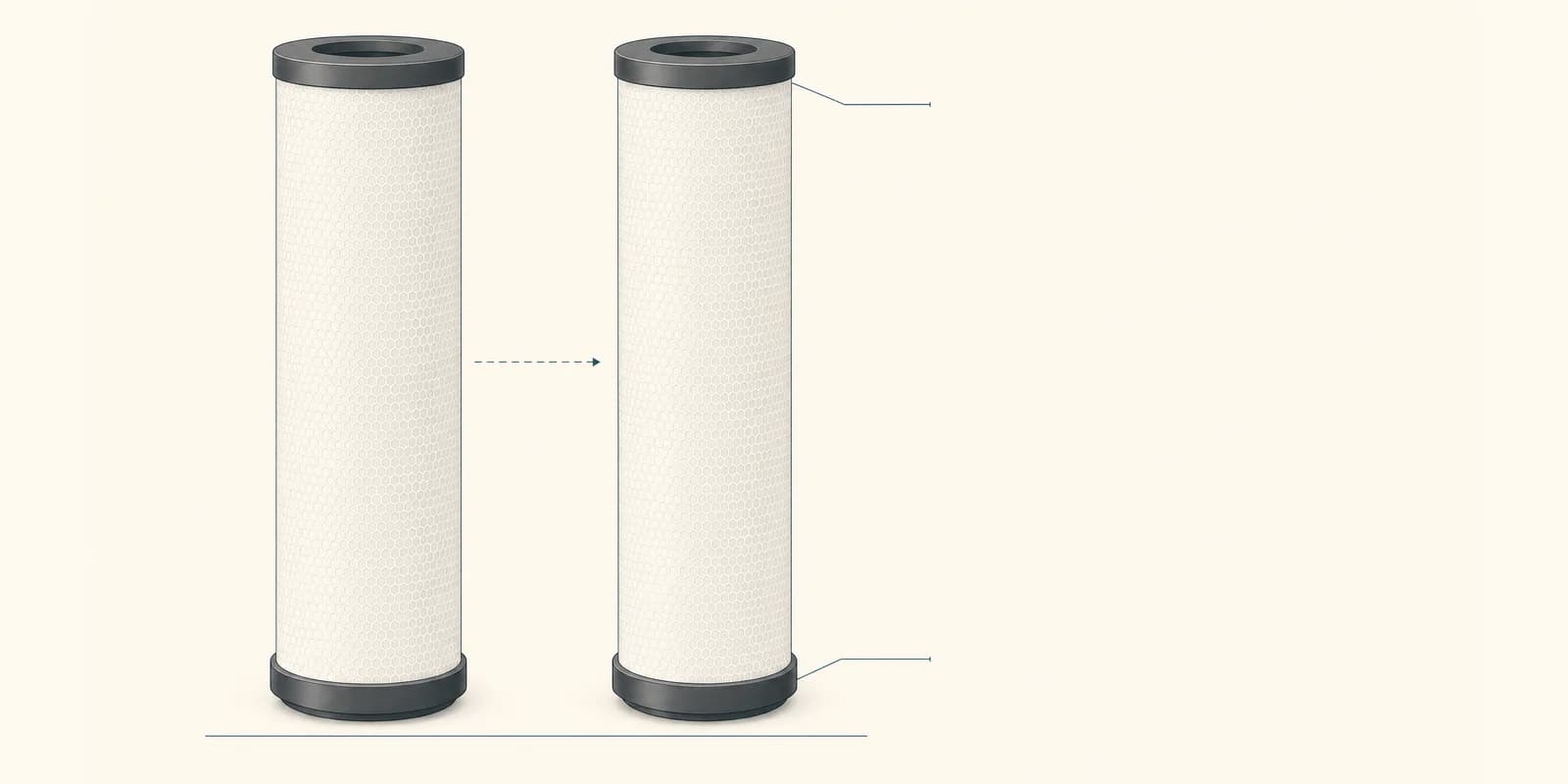
Product pages for the Aquaphor B510 carbon-block replacement cartridges (B510-02, B510-03, B510-07) invite two questions: which micron grade (0.8, 3 or 5 µm),[1][2][3] and how long a cartridge lasts. The question that decides fit is which disinfectant residual, in which form, the downstream unit tolerates. Aquaphor's chlorine claim for these parts is a feature row, "Removes chlorine"[1], marked yes, and the description words "active chlorine"[1] (B510-02) and "chlorine"[2] (B510-03), none with a form, level, flow, temperature or test,[3] and no Aquaphor document read mentions chloramine.[19][1][2][3] Three replacement figures appear in the documents read, none written for these parts: every year, at least once every 1 to 1.5 years, and 8 000 litres.[4][7] Reading any as the B510's life is the misreading this guide replaces.
For one point-of-use stage ahead of a downstream unit, the guide ends in one of three answers: quote with the clauses attached; another stage first, for sediment or iron over a limit or a documented chloramine claim; or not this product. The reference design carries the pressure budget and commissioning; the deep dive what a rating and the chlorine claim prove.
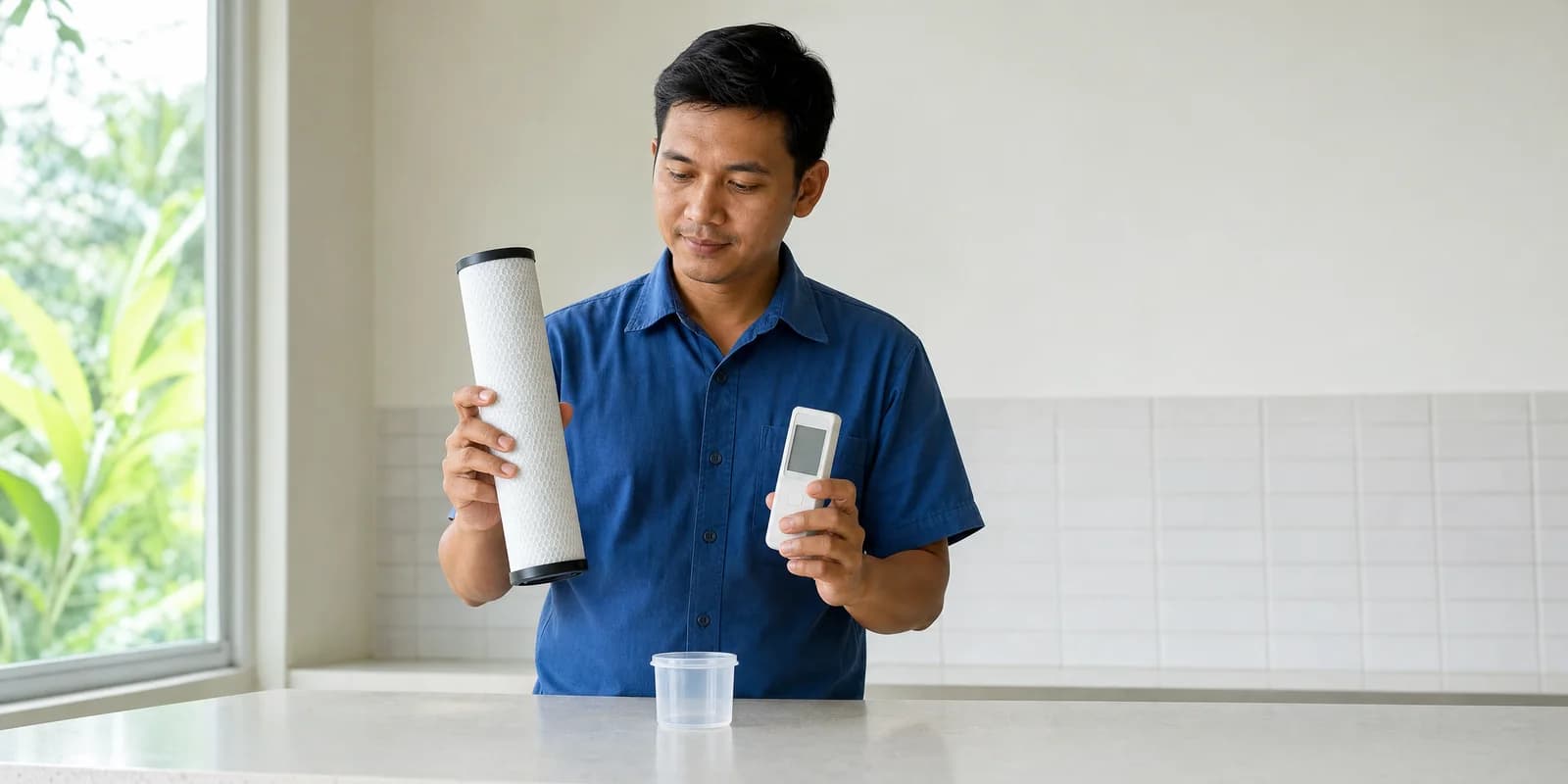
Measure the residual and its form first
PUB, Singapore's national water agency, says tap water is safe to drink and that "there is no need for any point-of-use water treatment or filtering devices to further treat the water."[14] A stage there rests only on the buyer's or equipment maker's reasons, never PUB's: taste or odour preference, a written specification, or protecting equipment such as a reverse osmosis membrane. No source read says Singapore tap water has a taste or odour problem. A downstream unit with a printed oxidant limit is the gating case; a taste preference has none. For Malaysia and Indonesia no residual-disinfectant source was retrieved, so the buyer establishes the form there.
The residual comes in two forms, and Aquaphor's B510 pages define neither. PUB says its supply carries residual chlorine "in the form of monochloramine",[14] and its 2025 table for water produced by the waterworks and desalination plants lists Chlorine at 2.27 mg/L average (range 1.43 to 2.87) and Monochloramine at 2.10 mg/L (range 1.29 to 2.70).[13] The rows are never added or equated: no PUB document read relates them, and they are plant figures, not tap values. The misreading: chlorine and chloramine are one thing, though NSF's leaflet lists separate claims for each.[10] Ask the issuer and the method which form is reported.
DuPont states, for its FilmTec membranes, that dechlorination upstream is required;[8] its TW30-1812-100HR sheet lists a free chlorine tolerance below 0.1 ppm and says oxidation damage is not covered under warranty.[9] DuPont also states that eventual degradation may occur after approximately 200 to 1,000 hours of exposure to 1 mg/L of free chlorine, labelled 200 to 1,000 ppm-h.[8] Illustratively, that is 8.3 to 41.7 days, and 83 to 417 days at 0.1 mg/L, if exposure is concentration times time (0.1 mg/L is the sheet's own bound, not a tolerated state; ppm taken as mg/L; the deep dive carries the arithmetic). No chloramine tolerance is in the excerpt, so no PUB figure is set against 0.1; the buyer's membrane maker's printed figure for the form present governs.
Sediment and iron come next, because a chlorine-reducing stage does not stand in for them: DuPont says chlorine attack is faster when iron is present.[8] [ASSUMPTION: the downstream unit's limits are Aquaphor's printed RO-101S and RO-102S limits, iron at most 0.3 ppm and turbidity at most 1 NTU; valid where the buyer's own manual prints the same; invalid as any B510 limit.][17] PUB's 2025 plant averages, iron 0.009 mg/L and turbidity 0.15 NTU, use 3.0% and 15% of those limits, margins of 97% and 85% (ppm = mg/L here).[13] The tap, not the plant, is measured; a value above a limit means a sediment or iron stage first. NTU is a light reading, not mg/L of solids, and converts only with paired samples (textbook reasoning).
Inputs group by what each decides. Eliminate: the residual's form and level, the downstream unit's printed tolerance for that form, and iron and turbidity against its feed limits. Fit: line pressure at the connection (0.1 MPa is 1 bar is 14.5 psi) against the unit's pressure window, its maker's figure, and whether the draw is continuous or intermittent. Choosing a grade first is buying against an unknown.
Micron grades and life figures cannot size B510
No published limit eliminates any of the three parts. The B510-02, B510-03 and B510-07 pages, the maker's index pages and its 2026 catalogue text layer, as retrieved on 2026-10-02, print no filter life or capacity, flow rate, pressure drop, working pressure, temperature or cold-water statement, dimensions, connection, format, compatible housing or certificate for these parts.[1][2][3][4][5] Four Aquaphor system instructions searched name none of them, the instructions index lists no document under B510, and image-only catalogue pages were not read.[19][5] Gate zero, the housing, stays open until Aquaphor or its channel replies.
| Part | Page says it | Role the page claims |
|---|---|---|
| B510-02 | "filters particles down to 3 microns in size"[1] | AQUALEN fibres for heavy metals[1] |
| B510-03 | "pre-treats the water"[2] and "filters particles down to 5 microns in size"[2] | AQUALEN for sediment-holding capacity and for colloidal and dissolved iron[2] |
| B510-07 | "filters particles down to 0.8 microns in size"[3] | AQUALEN to distribute the flow; "contains silver in its active ionic form"[3], no purpose stated |
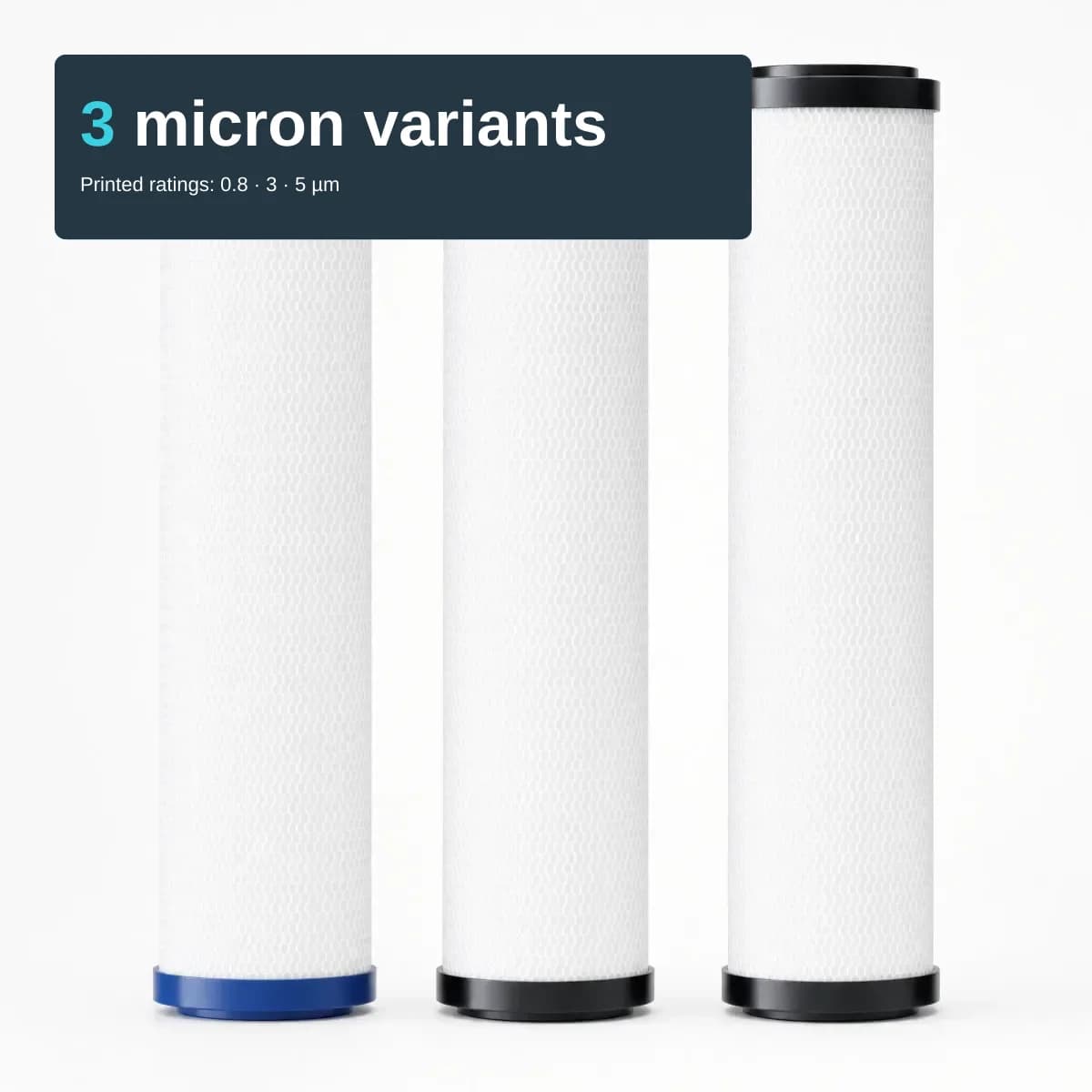
No heavy metal is named for any part, and the iron claim has no figure, capacity or test.[1][2][3] No page says whether a rating is nominal or absolute or gives an efficiency or method; 0.8 µm is the finest only on the assumption that one basis lies behind all three printed ratings. The row "Removes chlorine", marked yes, prints no basis on any page.[1][2][3] The misreading: the three grades are a ladder to buy by. The grade follows from the diagnosis, and no variant can be sized.
Nothing can be sized: with no flow, litres or pressure drop there is no lowest flow-path rating, so no rated-minus-demand margin, and with no connection size, no velocity. Pressure drop against flow is not published and commissioning reads it; no backwash water budget applies, because Aquaphor says a carbon or membrane cartridge cannot be regenerated, only replaced;[4] particle retention is the printed sentence alone. Commercial duty is a quote question, not a stop; no maker statement was read.
Of the three life figures, the maker's pre-filter paragraph says "carbon ones — every year"[4] and that a cartridge should be changed when the water pressure drops, but the B510 parts are filed under under-counter, not pre-filter. Its under-counter sentence says "at least once every 1-1.5 years",[4] read as a latest-by ceiling of 365 to 548 days (1.5 × 365 = 547.5) that names no B510 part and defers to the model's manual. A Latvian online retailer's listing says "Total resource is 8 000 litres" for a three-cartridge set.[7] Aquaphor's Crystal manual prints "8000 liters and maximum 1.5 years" for its K3, K2 and K7 set and 6000 and 4000 litres for other sets,[16] so a litre figure belongs to a named combination, and a series set's life is not the sum of its members' (reasoning). That Crystal set's own two limits coincide at 8000 ÷ 547.5 = 14.6 L/day, above which the litre limit binds first; the figure says nothing about B510. Aquaphor's pages for three other cartridges print 30 000 to 150 000 litres,[6] so a part-number prefix does not fix a life; ask for litres with test basis, flow and temperature.
Derating and turndown are absent: the three parts' pages print no temperature, flow range or cold-water statement,[1][2][3] so both are quote questions, not inferences. One trade-off, in direction only (this guide's reasoning): a longer interval lowers consumable cost and shortens the margin before the residual passes the stage, and sediment shortens carbon life in granular beds (a 2018 trade-journal article);[11] no page read prints either arm.
Worked run, illustrative, on the downstream limits above and a monochloramine supply per PUB: plant-average iron and turbidity pass at margins of 97% and 85%, but the downstream maker's monochloramine tolerance is not in the excerpt read, so that pass number is a question to the membrane maker. B510-12 (another part number, with its own housing)[6] and the K-series (different products)[16] are neighbours, not candidates. Nothing is eliminated or sized and no stop fires, because each stop needs a reply, measurement or requirement the run lacks; the result is a reason to ask Aquaphor, not a fit: quote, with these clauses.
Aquaphor B510 Carbon-Block Cartridge
No certifications listedView product →Place the stage, then make quotes comparable
[ASSUMPTION: these three options are valid for a mains-fed point-of-use unit whose own pre-stage the buyer can read; invalid where the downstream maker bars added stages.] Option A, ahead of the unit's sediment stage, sees the supply first and leaves its cartridges untouched, but draws on the pressure window and adds a change date. Option B, between the unit's pre-stage and the membrane, keeps sediment off the carbon (this guide's reasoning), but sits inside an arrangement the downstream maker did not specify. Option C is one stage, with fewer parts and one pressure loss but both roles, or a ladder that splits them at the cost of a date and an unpublished pressure loss per stage.
The interface split is this guide's, to be confirmed in the quote: Aquaphor or its channel supplies the cartridges; no housing is named for B510 in the documents read, so the housing, fittings, isolation valves, gauges and a flush route come from the site, installer or housing's maker. Upsets are quote items: loss or excess of line pressure (Aquaphor's Crystal manual says, for its system, "If it exceeds 0.63 MPa, install a pressure reducing valve"[16]), an overdue change, an idle period.
The row "Removes chlorine", marked yes, is a specification that can be quoted ambiguously.[1] A quote that repeats it has not stated the form, level, flow, temperature, volume treated or test method, and the same row on six of six cartridge pages read carries none.[2][3][6] A quote that states them for the exact part can be compared; a supplier-page figure starts the enquiry and is never the reader's result.
For B510-02, B510-03 and B510-07, ask for: format, dimensions, connection and compatible housings; filter life in litres with test basis, flow, temperature and cold-water use; pressure drop at a stated flow and maximum working pressure; the chlorine claim's form, level, monochloramine coverage, flow, temperature and test; the metals and iron covered and their test; whether each micron rating is nominal or absolute, with efficiency and method; silver purpose, amount and test in B510-07, and whether B510-03 contains it; any certifier listing and the scope of the company-level ISO 9001 and TUV and SGS lines, which name no particular product;[15][5] any B510-specific instruction document; and whether the quoting party is an authorised channel for the product in the buyer's market.
Lifecycle items sit on the reader's baseline: replacements follow the change trigger, no backwash water is lost because a carbon cartridge is replaced,[4] and replacement supply and terms are a quote item.
Re-test the residual and know the stops
Commissioning follows the maker's wash-in: Aquaphor says cartridges should be washed after purchase to remove coal dust, which "stains the water, contaminates valves and membranes",[4] and the method is attached to each Aquaphor filter, so it sits with the housing's documents. Record line pressure before and after the stage at the duty flow, and the stage-outlet residual in the form present, as the baseline (the reference design sets the sequence). Idle-flush figures differ and neither is B510's: five minutes after more than one week unused (Aquaphor's Crystal manual, for its system)[16] and at least 30 seconds of chlorinated water after five or more days unused (a 2017 Missouri extension publication, US; it says "chlorinated water" and names no residual form);[12] the housing manual's figure governs.
No B510 interval is printed in the documents read. [ASSUMPTION: the change trigger is a drop in line pressure or delivered flow against the commissioning baseline; valid until Aquaphor's housing manual gives its own; invalid as a B510 figure, since no threshold is published.] Aquaphor states the pressure signal for pre-filters,[4] and its RO-101S/102S manual calls reduced water production or slower flow likely overdue.[17] That manual ties a change of its K2 cartridge to a measured free-chlorine value;[17] the rule is written for K2 and free chlorine, B510 has none in the documents read, and cannot be applied to monochloramine without a chloramine statement.
Re-test the residual's form and level, line pressure, iron and turbidity at the tap whenever the supply source, season, storage or pipework, downstream unit or draw pattern changes; PUB's figures are plant averages, so one tap proves that tap on that day. Two readings mislead: a method that reports free chlorine reports one form, and no source read states what such a method would report on this supply, so the method must report the form present at inlet and outlet (this guide's reasoning); a taste or odour change after fitting a new cartridge is a different quantity from a residual the membrane tolerates.
Five stops bound the result; each needs a reply or a measurement to fire.
- Aquaphor or its channel declines or cannot name a housing and format in writing: no order until it does.
- A certifier's reduction listing is required and none was found (WQA's and NSF's searches on 2026-10-02 returned no listing under the Aquaphor names searched, saying nothing about other names or certifiers):[18] the next step is a stage whose maker documents its claim and test, or not this product.
- The downstream maker's tolerance for the form present is not met, or Aquaphor cannot state in writing that its chlorine claim covers monochloramine at the duty: another stage, whose maker documents a chloramine claim and test.
- The water is of unknown quality or doubtful microbiological safety, for example a private or unsupervised source: Aquaphor's Crystal and RO manuals say, for their systems, to boil the water after filtering if in doubt[16] and to use the system only on water that is microbiologically safe,[17] and a Missouri extension publication says a bacteriostatic carbon filter is not adequate for microbially unsafe water,[12] so disinfection or another source comes first.
- A litre or flow figure is required for approval and the quote cannot give one: not quotable until supplied.
The data pack: market (SG, MY or ID), supply source and storage, measured residual with form, method and date, line pressure range, iron and turbidity, the downstream unit's printed tolerances, draw pattern, and the parts, housing and listing wanted. A comparable reply gives per part the quote clauses, binding component, margin as (limit minus measured) over limit, interface split and lifecycle items, or concludes the stage is not needed, not this stage, or not yet. Purionex's quote request carries these questions to the maker or its channel and passes on any written answers received; none is promised.
Request a quote for the Aquaphor B510 cartridges (B510-02, B510-03, B510-07) with this data pack.
Sources
- [1]Aquaphor, B510-02 product page, global website: printed particle, role and feature-row sentences
- [2]Aquaphor, B510-03 product page, global website: printed sentences
- [3]Aquaphor, B510-07 product page, global website: printed sentences and silver sentence
- [4]Aquaphor, replacement cartridges index and guidance text: replacement, regeneration and wash-in sentences
- [5]Aquaphor, Product Catalogue 2026 (text layer): B510-02, B510-03 and B510-07 not named; company-level TUV and SGS sentence
- [6]Aquaphor, B510-12, B515 PRO and B520 PRO pages, global website: contrast set with printed lives and feature rows
- [7]Latvian online retailer, listing for a B510-03-02-07 set (a retailer's statements, not Aquaphor's)
- [8]DuPont Water Solutions, FilmTec Chlorination/Dechlorination manual excerpt: free chlorine, iron and carbon
- [9]DuPont Water Solutions, FilmTec TW30-1812-100HR product data sheet: free chlorine tolerance and warranty note
- [10]NSF International, NSF/ANSI 42 and 53 leaflet (retailer-hosted copy): what each standard's common claims cover
- [11]Battenberg, Water Conditioning and Purification, June 2018: sediment and carbon service life in granular beds
- [12]University of Missouri Extension, EQ104, 2017 (US publication): idle flush and bacteriostatic carbon filters
- [13]PUB, Singapore Drinking Water Quality, January to December 2025: averages for water produced by the waterworks and desalination plants
- [14]PUB, clarification on claims about Singapore tap water: PUB's position and the monochloramine statement
- [15]Aquaphor, global home page quality statement: company-level ISO 9001 sentence
- [16]Aquaphor, Crystal operation manual (K-series cartridges, a different product): set lives, pressure and water-safety sentences
- [17]Aquaphor, RO-101S/102S owner's manual (K2 ahead of the membrane, a different product): printed limits, replacement and water-safety sentences
- [18]WQA and NSF certification lookups for Aquaphor names, run 2026-10-02: five queries and two controls, no listing found
- [19]Search of four Aquaphor system instructions and the instructions index for B510, 2026-10-02: no hit