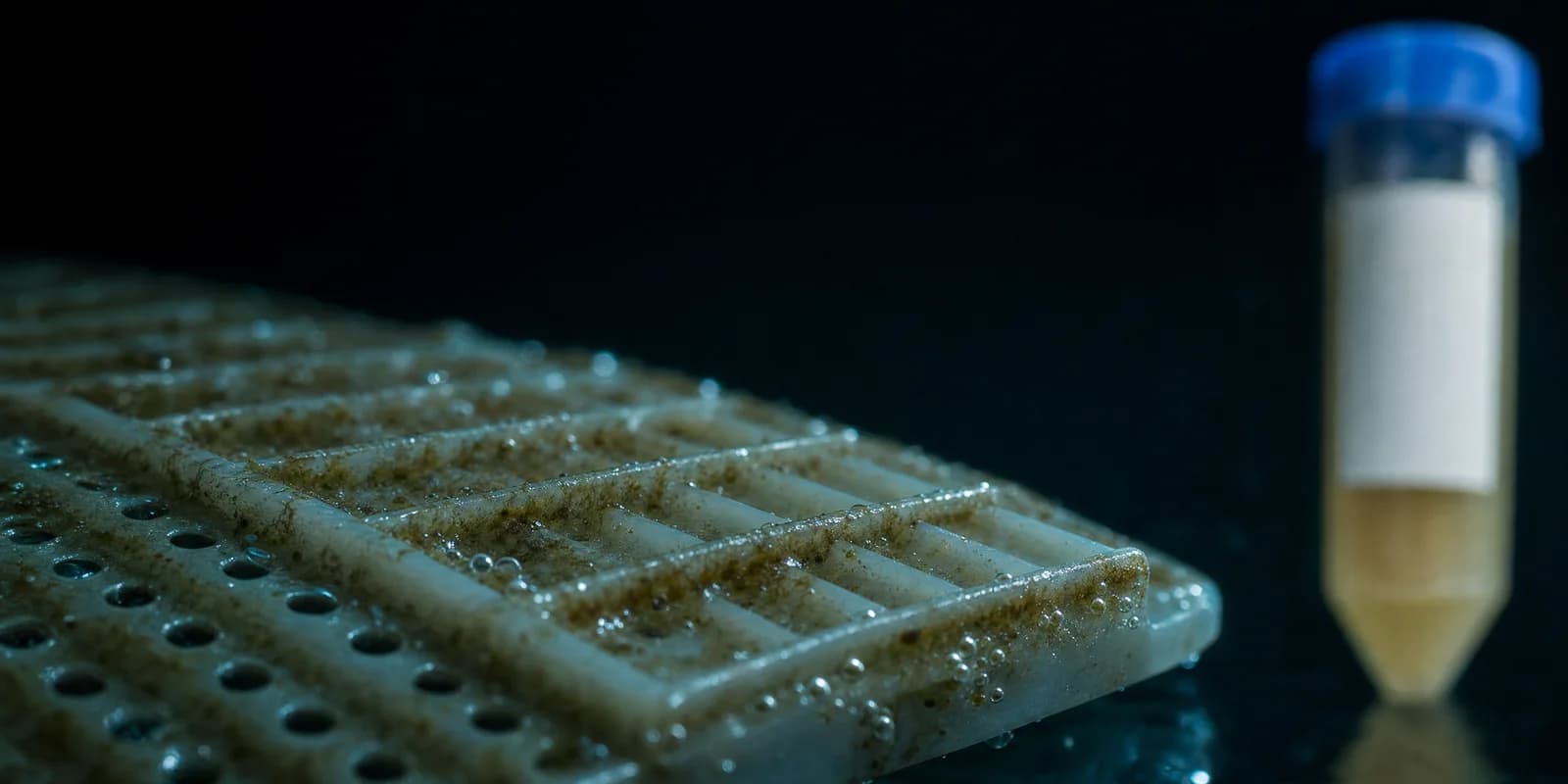
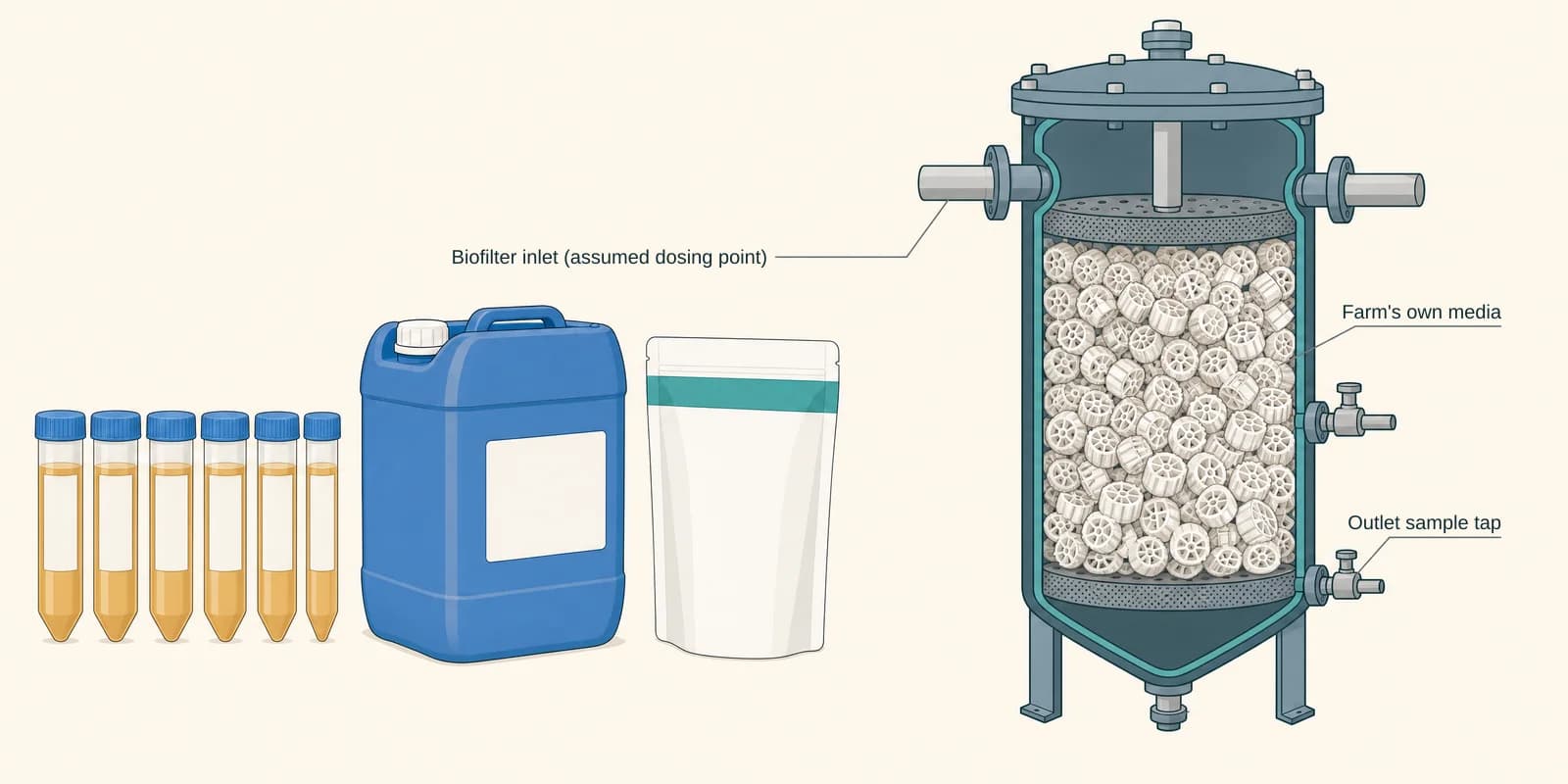
A price list for WaterDoctor's SND cultures (SND, simultaneous nitrification-denitrification: SND CoreLiquid, SND XLiquid and SND DryCore; the SND cultures below) invites a price-per-pack comparison, yet WaterDoctor's brochure prints 1000 g net on the DryCore pouch, a 25 L label on the XLiquid can and, on printed page 14, no volume or count for the CoreLiquid tubes.[3] What decides fit is what one pack stands for: a concentration unit, a dose basis, a defined volume, and the quote's scope. A litre, a kilo or a tube is a quantity of product, not a unit of treatment; reading it as one is the misreading this guide replaces.
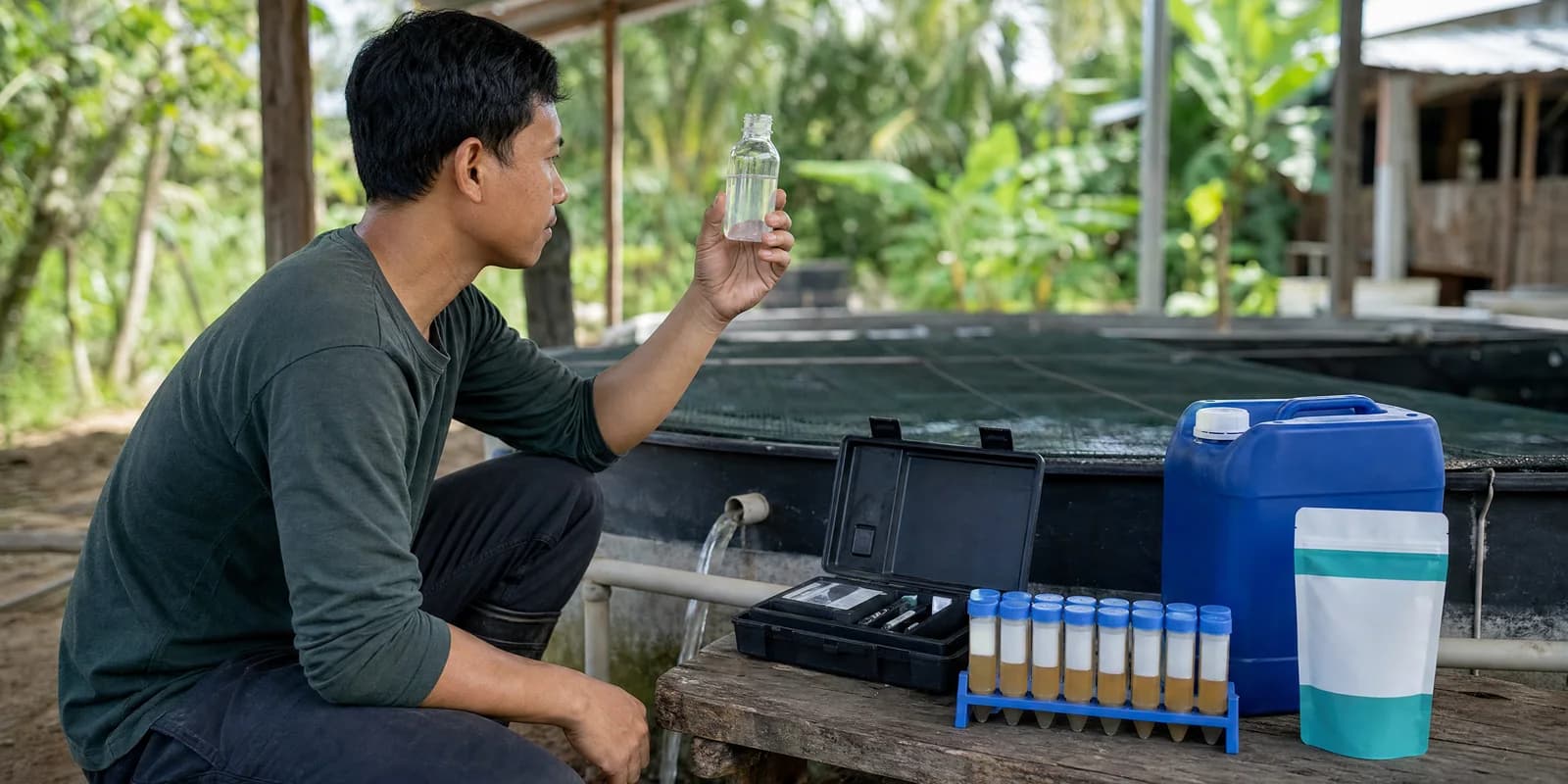
The guide ends in one of four answers: quote one named form with written questions attached; not yet, because a supplier's written reply cannot state the dose basis; fix a shortfall that is not organisms first; or not this product. In the documents read, no limit the guide would normally eliminate on is printed for any form,[3][2] so most of the work is writing questions. The scope is an existing aquaculture water system. The reference design covers the introduction and its acceptance, the technology deep dive what a dosed culture must show, and the container selection guide the nitrogen-load arithmetic.
Confirm organisms are what the biofilter lacks
A culture's stated function is to add organisms: the pouch label in WaterDoctor's brochure calls the powder "a high-activity microbial consortium".[3] No document read states its composition or credits any form with supplying oxygen, biofilm surface or warmth (this guide's reasoning). WaterDoctor sells BufferBase and GrowthBase beside the cultures, a "Compound buffer substrate"[3] and a "Growth-promoting substrate",[3] so a measured alkalinity or carbon shortfall is a quote question about them as well as a reason to fix it first. WaterDoctor's founder[3] says in articles that the organisms "may be outcompeted by faster-growing background microorganisms"[4] when organics run short, winter performance remains "a major engineering challenge",[4] and carbon-to-nitrogen balance is a bottleneck.[4] The misreading is that more culture fixes a failing biofilter. The check is which of oxygen, carbon, alkalinity, surface, solids and temperature have been measured before any culture is priced.
Two discriminations, each read as a trend (this guide's reasoning). Ammonia and nitrite peaks after feeding in a biofilter recently drained, washed or exposed to a disinfectant or antibiotic can indicate missing organisms; the same peaks in a long-stable biofilter with unchanged conditions can indicate load, oxygen or alkalinity. Check the date of the last disturbance against the nitrogen series. Peaks that follow a fall in water temperature can indicate the cold-season limit the founder's article states, that enzyme activity declines in cold seasons, "especially in northern regions";[4] no document read says a further dose removes it, so check the temperature log against the peaks. Ammonia falling while nitrate climbs is nitrification at work, a different question that the container selection guide takes up.
The application class reorders the question. WaterDoctor's site lists recirculating aquaculture systems (RAS), open pond culture and container-based aquaculture as uses.[2][1] A RAS has system water and a separate biofilter vessel, so two volumes exist; an open pond may have no separate vessel, although the site lists it as a use, so the volume a dose is stated against is a quote question (the pouch label, below, says only tank) (this guide's reasoning).
The inputs fall into four groups. To rule in or out: the market and its evidence needs; disinfectant and antibiotic practice; species, stage, salinity and source water. To size: the two volumes in m³, the carrier or media, feed and nitrogen as N. To fit: where a dose goes, delivery and storage space, and who doses. From WaterDoctor only: the concentration unit and method, dose basis, strain identity, storage terms and conditioning-product scope.
1 g per m³ equals 1 mg per litre, and nitrogen is reported as N, as in the container guide. Running this step late means a dose is later fitted to a volume nobody defined.
Quantity of culture is not a comparable unit
In the documents read for this guide (WaterDoctor's site source copy read on 2026-10-02, its brochure and eight insight articles searched for dose and storage terms), none prints a temperature, pH, alkalinity, salinity, species, ammonium-loading or carbon limit for any form.[3][2] The brochure prints dissolved oxygen (DO) 1 to 6 mg/L for the intelligent SND biological system (comparison table, printed p18), not for any of the three forms;[3] other WaterDoctor statements about DO differ in kind, and the technology deep dive sets them side by side. The only environment wording is qualitative: stable operation across a wide range of salinity and water quality (translated),[3] and the FAQ says WaterDoctor's team "selects the optimal bacterial strains and system configuration based on your specific water conditions".[2] So the screen is a list of questions, and an absent limit is a gate, not permission.
The three forms carry no comparable quantity. Printed page 14 gives:[3]
| Form | Container | Printed quantity | Printed concentration phrase |
|---|---|---|---|
| CoreLiquid | tubes | no volume or count | magnitude phrase with a this-or-higher marker (translated) |
| XLiquid | 25 L can | 25 L | shorter magnitude phrase |
| DryCore | pouch | 1000 g net | none |
Neither phrase has a unit (CFU, cells or gene copies per mL is not stated) or a method, and the maker states no quantitative relation between them.[3] The misreading is that a price per litre, per kilo or per tube ranks cultures; the check is a written unit and method for each form, with no times more concentrated figure computed from the phrases. In the documents read, no dose per cubic metre or per any stated water volume is printed for either liquid.[3] One WaterDoctor case article gives liquid quantities for a single installation without naming the form or a concentration,[4] which is not a dose basis, so a litre of liquid cannot become a dose or be set beside the pouch label.
The pouch label gives a dose without a basis. Inside a product picture in WaterDoctor's brochure, the label reads "1 kg per 1000 m³ of biofiltration tank per month",[3] in the same label paragraph as a sentence about biological wastewater treatment. Derived here: 1000 g ÷ 1000 m³ = 1 g per m³ per month, so a tank of V m³ takes V g per month on the label's ratio and one pouch covers 1000 m³ for one month. That is a mass of powder per volume of water, not a cell count or a standing concentration. The misreading is that the ratio is a dose for this system: the label does not name RAS, pond or container, does not define tank, and gives no start-up and maintenance split or scaling statement.[3]
[ASSUMPTION: 300 m³ of system water and a 30 m³ biofilter vessel; arithmetic only, not a farm; valid only to show that the volume definition changes the answer; invalid as a dose, since the label does not say its ratio applies to either volume.] Illustratively, on the label's ratio, 300 × 1 = 300 g per month against 30 × 1 = 30 g per month, a factor of 10 (300 ÷ 30). The volume definition alone moves the answer tenfold, so the reading ends with the questions sent, the first answer and not a stop: no written reply exists yet and no dose basis is in hand. In the documents read, no rating is printed for any form,[3][2] so no rated margin can be computed.
SND Biological Water Treatment Solutions
No certifications listedView product →WaterDoctor's site words its 80%+ as nitrogen removal on the SND page and as NH₄-N, NO₂-N and NO₃-N removal in its hero panel,[2] and the brochure's pilot-outcomes tile words it as ammonia, nitrite and nitrate removal in some RAS projects (translated), footnoted as demonstration-project data that vary with project conditions:[3] the wordings differ, and none of the three prints a baseline or sampling method.[3][2] The site tagline names a single bacterium[2] and the pouch label a microbial consortium,[3] so a one-organism reading ranks nothing either. The technology deep dive owns the basis; the check is to ask for it and treat the figure as an attributed claim.
One ambiguity, read two ways (direction only, this guide's reasoning). Reading the label's volume as the larger raises the monthly powder mass tenfold; reading it as the smaller gives a tenth of that. Which is right is WaterDoctor's to state in writing, and none of the documents read prints a derating, turndown or minimum quantity.[3][2] The check is a written answer to three questions: which volume the label's tank means, whether the ratio is the same at start-up and in maintenance, and whether it scales to a system far below 1000 m³.
Decide where it is dosed, then compare quotes
WaterDoctor's site says to integrate its bacteria into RAS biofilters[2] and the pouch label doses a biofiltration tank;[3] neither states an injection point or dosing method, so the point is a quote item. [ASSUMPTION: an existing freshwater finfish RAS with a separate biofilter vessel; valid for that class, invalid for ponds.] At the biofilter vessel (this guide's reasoning), the culture meets the biofilm surface but shares the vessel with the resident community it may compete with, and nothing read says how much of a dose stays. In the culture tank, it reaches the whole loop but spreads over the full system volume, and no document read says how it interacts with fish, feed or treatments. With the maker's carrier in a treatment unit, the mechanism a WaterDoctor article describes depends on the carrier's structure,[4] but the carrier is a separate product group,[3] compatibility with other media is not stated in the documents read,[3][2] and carrier in or out changes what two quotes compare.
WaterDoctor lists Activator, "Suitable for inoculation, revival, and recovery";[3] BufferBase, "Suitable for startup and stable operation";[3] and GrowthBase, "Suitable for continuous optimization",[3] and its standard edition includes a standardised SOP, which was not read.[3] Whether these are required, and their order and dose, are quote items, not stated in the documents read; by default the farm supplies the dosing method, measuring and laboratory (this guide's interface split; the quote confirms it). The misreading is that an SND culture quote covers the same scope: conditioning products, SOP, carrier, dosing method and any monitoring or dosing platform can each be in or out.[2][3]
The brochure's names disagree: page 12 captions the 25 L can CoreLiquid, while page 14 gives CoreLiquid to the tubes and XLiquid to the can.[3] A line reading CoreLiquid, 25 L could mean either container and either concentration phrase, so the check is which container, name and printed phrase each line means. Strain identity is a second per-form question: a founder's article presents SND5 and SND8 as WaterDoctor's own strains,[4] and no label or product sheet read ties a name to a form.[3]
The quote must declare lifecycle items the documents read do not publish: a start-up and maintenance split for each form, storage temperature, shelf life, life after opening, DryCore rehydration, pack count, minimum order and lead time.[3][2] Beyond the label's per-month ratio, the one numeric replenishment interval printed in the documents read is the FAQ's "periodic replenishment of SND biological media (typically every 6-12 months)".[2] Biological media is undefined and may mean the carrier, which the FAQ calls "biological treatment media"[2] and describes as infused with SND bacteria, so the phrase is not read as a dosing interval for a liquid or powder culture; the check is what is replenished, with what, and at what interval.
The quote clauses: container and name; concentration unit and method; dose basis per form with its volume; start-up against maintenance; strain identity; storage; conditioning products and SOP; carrier; dosing method; any monitoring or dosing platform in or out; regulatory status in the market; certificate or analysis documents; the basis of any performance figure; pack count, minimum order and lead time.
A Purionex quote request carries these questions to the maker or its channel, and any written answers received are passed on; it promises no answer. One request paragraph names the form wanted (SND CoreLiquid, SND XLiquid or SND DryCore) and lists these clauses.
Re-test on change, stop on a missing answer
No WaterDoctor acceptance basis or culture maintenance interval was read, so these checks are this guide's reasoning. Check delivery against the quote (container, name, count, label, date) and record it. Keep the farm's nitrogen series and its dissolved oxygen, pH, alkalinity and temperature logs from before any dose. Read them as recorded, not judged, until WaterDoctor supplies a value; the reference design argues the baseline and the acceptance.
The re-test rule: re-measure the two volumes, the carrier, feed, the nitrogen series, temperature, salinity, oxygen, alkalinity and disinfection or antibiotic practice, and re-ask the clauses, whenever the system, the season, the treatment practice or the supplier changes. Running it late applies an old dose basis to new water. A favourable nitrogen sample soon after a dose is not a result for the culture, since feeding, temperature and the resident community also move; the reference design carries the baseline and the control that separate them. A pack size that matches a monthly dose matches only the volume the quote assumed, which the illustrative 300 against 30 m³ reading shows can differ tenfold.
Four stops can fire, none on the worked reading (no measured farm, no written reply).
- The measured shortfall is oxygen, carbon, alkalinity, surface, solids or temperature: a culture's stated function is to add organisms, so not this product yet. Correct the shortfall first; for a buffer or carbon shortfall, ask whether WaterDoctor's conditioning products are in the quote.
- The supplier's written reply cannot state the concentration unit and method, or the dose basis with its volume definition: quantities cannot be compared or sized, so not yet: ask again, and compare quotes only once it can.
- The market or the buyer's approval route needs registration, certificate or analysis evidence the supplier cannot supply in writing: without it, not this product for that site. The documents read state no requirement or exemption in the three markets,[3][2][4] so the buyer asks the quoting party for the status in writing and confirms it with the competent authority.
- A disinfectant or antibiotic treatment is active or being flushed, and the supplier cannot state compatibility. [ASSUMPTION: a disinfectant or antibiotic can reduce a live culture; valid as a reason to ask, not as WaterDoctor's compatibility statement.] Hold dosing; the reference design carries the reasoning.
The data pack: the form wanted; the measured inputs above, with dates; the nitrogen series as N; the dosing point; delivery and storage; the market's evidence needs; and whether the quote is for culture alone or with conditioning products, SOP and carrier.
A competent reply answers every quote clause per form, gives the dose basis, its volume definition and the start-up and maintenance quantities, and adds the interface split. It may conclude that the culture is not needed, or not yet.
Request a quote for the named WaterDoctor SND culture form with this data pack.
Sources
- [1]WaterDoctor — SND Bacteria live page (applications list), as fetched 2026-10-02
- [2]WaterDoctor — website English source copy (FAQ, SND Bacteria technology page and common site copy), read from the maker's repository 2026-10-02, not the rendered page; the linked SND page is the nearest public page and the FAQ answers cited sit in the repository copy
- [3]WaterDoctor — Corporate Brochure 2026 (printed pages 2, 9, 12 to 14, 18, 26 and 29, and the pouch label shown on page 14), a maker brochure and not a datasheet
- [4]WaterDoctor — insight articles on SND as rendered 2026-10-02 (the maker's own opinion and case writing, not data)