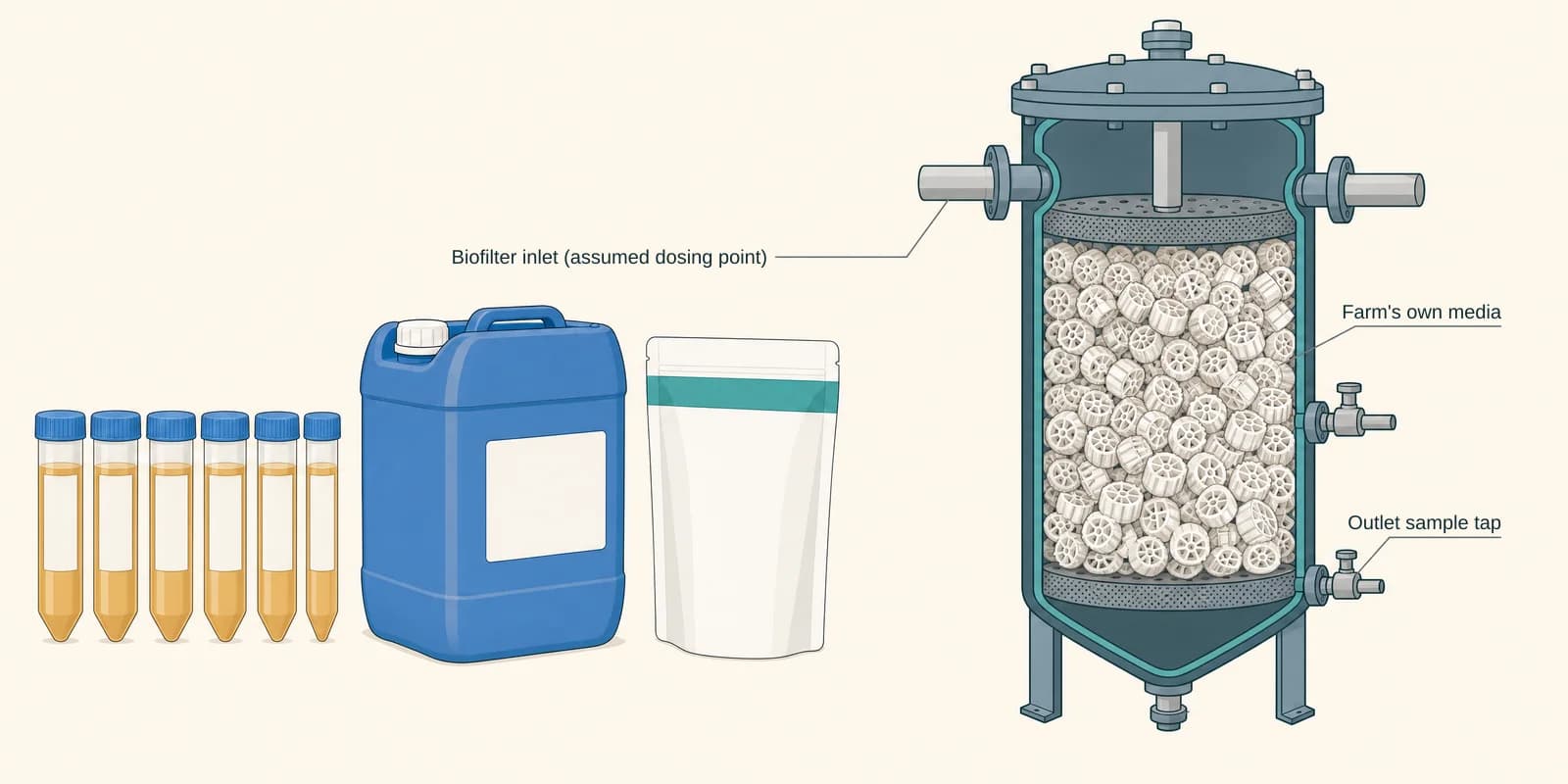
The common misreading is that a culture dosed once settles in and keeps working. Bioaugmentation, the addition of a live culture to a biological system, is shown to work only when total nitrogen leaves the water against a baseline while the dosed organisms are present and persisting (this article's reasoning). WaterDoctor, the maker, prints a role for each form of its SND (simultaneous nitrification-denitrification) cultures (SND CoreLiquid, SND XLiquid and SND DryCore) in a brochure matrix, translated and abridged here: start-up and core inoculation (CoreLiquid), activation and daily replenishment (XLiquid), transport, storage and easy dosing (DryCore).[2]
Four questions follow: what a dosed culture must do and which limits WaterDoctor states; whether its printed figures carry a basis; what a label, a maker article and strain papers prove; which readings on a farm show it working. Dosed and present are not removal, and strain-level work is not product evidence; in the documents read, nothing gives a measurement of persistence for a dosed WaterDoctor culture or the share of any removal it supplies,[1][2][8] so working is shown on the farm's own water, on four readings. If the culture is present and total nitrogen does not move, conditions limit it or it is not performing, and the readings cannot say which until conditions are fixed and read again. The application guide covers quote questions and the reference design the applied introduction.
A dosed culture must establish, compete and persist
A dosed culture changes nitrogen in the water only if it is delivered, present in the system, persisting after the dose and removing. [ASSUMPTION: the four hold in that order and each needs its own reading; general microbiology, valid for the direction and the ladder, invalid for any WaterDoctor organism, dose or farm.] A WaterDoctor start-up account uses the same language: it calls a first-week pattern the "successful establishment"[8] of its community and aims to keep its SND consortium dominant.[8]
WaterDoctor says its bacteria couple direct ammonia oxidation (Dirammox) with heterotrophic nitrification and aerobic denitrification[8] in a single aerobic process.[1] Dirammox is a published process: ammonia is oxidised to hydroxylamine and then directly to nitrogen gas without nitrite or nitrate, heterotrophically, as demonstrated with Alcaligenes species; in an enzyme assay the hydroxylamine-to-nitrogen-gas conversion did not happen under oxygen-free conditions.[7] The misreading is that the name shows the product uses a proven pathway. It is published for Alcaligenes; no abstract read says whether WaterDoctor's strains carry the genes, so that stays WaterDoctor's statement until the supplier names the organisms. The biofilm gradient and the oxygen cost of aerobic SND are argued in the container deep dive.
WaterDoctor ties its high-oxygen result to a carrier: an article says that with the structure of its AquaMats a hypoxic zone forms 100 micrometres into the biofilm matrix,[8] and the commercialisation row of the brochure's comparison table describes the intelligent SND system as culture, carrier and AI platform integrated as a product.[2] The culture alone and the system with its carrier are therefore not one thing; no document read says how a culture performs on a farm's existing media.
WaterDoctor states its own limits: if suitable organics and substrates are short, its consortia "may be outcompeted by faster-growing background microorganisms",[8] and winter performance is "a major engineering challenge".[8] Displacement by less desirable microbes, it says, needs carrier, bioaugmentation and control work, and carbon-to-nitrogen balancing is a bottleneck.[8] NUS's 2020 release notes that in single sewage reactors different microbes compete for resources, a related but different setting.[3] As the maker states them, each limit runs one way, with no value published in the documents read (no temperature window, no carbon-to-nitrogen range)[1][2][8]; carbon alone has a second arm.
The one case among the abstracts read of a dosed strain's abundance is laboratory work on strain MAD1, isolated from a recirculating aquaculture system (RAS): "Repeated amendment of strain MAD1 led to its predominance within the community"[6] at 88.03% relative abundance at 1.5% salinity and 81.09% at 3.5%. That reports what was done and what followed, not what one dose would have done. An abundance is a share of a community, not nitrogen removed, so a dominant strain shows presence and not removal; the check is a removal reading alongside every presence reading.
The maker's printed figures carry no stated basis
WaterDoctor's SND page lists four headline counters, as read from its site source copy: 80%+ nitrogen removal, 10+ years of R&D, 99% stable pH and 0 nitrite accumulation.[1] The 80%+ is not one claim: the SND page counter reads nitrogen removal and the site's hero panel names NH₄-N, NO₂-N and NO₃-N;[1] the brochure's pilot-outcomes tile prints more than 80% removal of ammonia, nitrite and nitrate in some RAS projects (translated), with a footnote that the data come from demonstration projects and results vary with project conditions;[2] the maker's article uses total nitrogen as its acceptance sentence;[8] and the comparison table prints a further use, for nitrite only.[2] On the four counters named above, the pilot-outcomes tile and the comparison table, none prints a baseline, sampling method, duration, scale or dose, and none says what the 99% stable-pH counter measures.[1][2] Each is WaterDoctor's claim, and no document read shows it to be a property of the culture.
WaterDoctor's five statements about dissolved oxygen (DO) differ in kind and do not form one operating range. The brochure prints DO 1 to 6 mg/L for the intelligent SND biological system (comparison table, printed p18), not for any of the three forms.[2] A founder's article gives stable low-to-moderate aeration at 1.5 to 2.0 mg/L[8] and, as an example of high oxygen, DO above 4 mg/L, at which an enzyme the consortia "appear to have evolved"[8] can still work. An analysis article gives the "optimal 2.10 mg/L DO contour"[8] as an example, and a WaterDoctor article says DO above 5 mg/L is essential for fish survival in ponds.[8] They are a window, a setting, an optimum, an enzyme tolerance and a pond need. The misreading is that the maker's range is a rated point. The 1.5 to 2.0 and 2.10 figures sit inside 1 to 6, so the tension lies elsewhere: a wide stable window against the analysis article's statement that a marginal excess of DO breaches the anoxic core and instantly halts denitrification.[8] No window is the product's.
Carbon supply and competition trade against each other. The sourced arm is WaterDoctor's own: with too little organic substrate its consortia may be outcompeted, and its start-up account responds to reduced removal with recommendations for specific substrates and trace-element activators.[8] [ASSUMPTION: organic substrate in the water is available to the resident heterotrophs as well as to the culture; general microbiology, valid for direction only, invalid for any substrate, dose, carbon-to-nitrogen value or organism.] So more substrate supports the culture's footing and also feeds its competitors, which makes the amount a site decision. The brochure says (translated) that the culture reduces external carbon demand, while its pathway diagram draws organic carbon as an input;[2] it lists BufferBase as a "Compound buffer substrate"[2] and GrowthBase as a "Growth-promoting substrate",[2] with no order, ratio or dose. Reduces is not needs none. The check is a written substrate order and dose.
The culture has no sensor or actuator of its own: the water record and a presence assay observe it, and the owner's or the platform's dosing acts on the system. WaterDoctor's platform copy describes sensor data triggering SND dosing schedules without saying which product the dosing delivers,[1] and a brochure sample screen lists an SND gene-copy indicator.[2] No threshold, trigger or quantity is printed in the documents read.[1][2] The printed concentration phrases for the liquids carry no unit or method, and the pouch label's dose carries no basis; both are quote items in the application guide. The check is a written trigger and quantity for any automated dosing.
Strain results do not transfer to the product
A result for one strain under laboratory conditions carries to a product only with its conditions and a stated link, and the documents read give no strain-level link by form. Labels and brochures are maker statements, WaterDoctor's articles are opinion and case writing, and strain papers are a separate tier, published by NUS researchers whom WaterDoctor's brochure lists as advisors.[3][2] Prof. He Jianzhong is the last-listed author of all three papers[4][5][6] and, per NUS's 2020 release, led the team that found SND5;[3] Prof. Yang Kun-Lin is a listed co-author of the 2026 SND5 paper and the MAD1 paper, and WaterDoctor's brochure lists both as advisors.[2] The MAD1 author list includes a Chuansheng Wang, the name of WaterDoctor's founder, a name match only.[6][1] No abstract names WaterDoctor or a product and the full texts were not read, so the papers are not independent proof.
In laboratory reactors with a control, bioaugmentation with strain MAD1 lowered effluent nitrate from 21.76 ± 3.14 to 3.58 ± 2.57 mg-N/L at 1.5% salinity and from 15.55 ± 2.69 to 4.51 ± 2.38 mg-N/L at 3.5%.[6] Derived here, taking the first figure of each pair as the control (the abstract's order and wording indicate it but do not say so): (21.76 − 3.58) ÷ 21.76 = 83.5% and (15.55 − 4.51) ÷ 15.55 = 71.0% lower effluent nitrate. The ± values are undefined and not used; the result is possibility for one strain under laboratory conditions, not removal from influent and not a product result.
Abundance and removal are two numbers on different bases. A pathway paper, a further tier, shows it: in a hydroxylamine-selected laboratory reactor the most abundant Dirammox strain reached 12.65% relative abundance, while its nitrogen removal rate, which the abstract does not define, was 32.35%, against 13.57% and 14.52% for two others.[7] A founder's article on WaterDoctor's site presents SND5 and SND8 as WaterDoctor's own strains while crediting earlier strain isolation work in Prof. He's group,[8] and no label or product sheet read ties a strain name to a form.[2] The misreading is that a named strain is the product's strain in each form.
A first-week sequence with nitrite fluctuations is called the signature of establishment in one WaterDoctor article; another warns that over-aeration breaching the biofilm's anoxic micro-environments may make nitrite surge, and the SND page carries a nitrite-accumulation counter of 0.[8][1] It can be establishment, an upset, a feeding event or the dosed culture dying back (reasoning), and the reference design sets the stop at the owner's fish-side nitrite limit. A presence reading has its own ambiguity: an assay built for the dosed organisms may also count like organisms already in the water, as the 2026 SND5 paper designed primers to quantify SND5 and SND5-like functional populations in a wastewater plant.[5] A rise can mean the dosed organisms persisted, a resident like population or a feeding effect (reasoning); the check is an assay and target agreed in writing with the supplier's identity statement, read against a baseline and an undosed train.
In the documents read (WaterDoctor's site source copy read on 2026-10-02, its 2026 corporate brochure, eight of its insight articles and the cached literature abstracts), none prints a certification, datasheet, safety data sheet, certificate of analysis or release specification for SND CoreLiquid, SND XLiquid or SND DryCore, and none reports an independent trial or validation of the products.[1][2][8] Credentials and history are not product evidence.
Four separate readings show a dosed culture working
By this article's rule, a dosing, presence, persistence or removal figure is reproducible only with its terms. The dosed reading is a written record of form, quantity, date and injection point, plus the supplier's written identity, concentration unit and method; the documents read give none of the last three,[2][1] so the reading is only as good as the supplier's reply.
The present reading is an assay at a fixed point by a stated method, in relative abundance or gene copies per sample, with its target named; a strain-specific assay needs the supplier's identity statement, and a gene count shows presence, not removal. The persisting reading is the same assay before and after each dosing interval, with the interval agreed. No redose interval for a culture is stated in the documents read: the FAQ's periodic replenishment of biological media, typically every 6 to 12 months, does not say whether media means the culture or the carrier,[1] and the printed roles (daily replenishment for XLiquid, revival for the Activator) carry no schedule.[2]
The removing reading is total nitrogen against a baseline, with nitrogen forms as N, flows and a control train where the farm has one; the container deep dive sets out the balance. Elapsed time alone does not separate the culture from ordinary maturation, since WaterDoctor gives 2 to 4 weeks both after activation[1] and for a conventional system's start-up;[8] the reference design sets the timings side by side.
Stops fire on farm data once an assay and target are agreed in writing. Presence low after dosing with nitrogen unmoved leaves the dose, the assay and establishment in question, and the readings cannot say which. Presence high with nitrogen unmoved means conditions limit the culture (oxygen, carbon, carrier or solids) or the dosed organisms are not performing, which fixing conditions and reading again separates. Nitrite past the owner's fish-side limit ends the trial. None fires on the MAD1 arithmetic.
The envelope holds for a dosed culture shown on all four readings. It does not hold for a label dose, a maker headline, a strain paper or a presence count read as removal, for the maker's oxygen statements read as a rated point, or for any certification, since the documents read name none.[2][1][8]
To start, send the baseline record: ammonia, nitrite, nitrate and total nitrogen as N, temperature, DO, salinity, alkalinity, carrier, disinfection and antibiotic practice, and which volume the system volume means. Agree in writing the identity, concentration unit and method, dose basis, redose interval, presence assay and who runs it, sample points and times, and the owner's pass and stop values.
SND Biological Water Treatment Solutions
No certifications listedView product →Sources
- [1]WaterDoctor site source copy (English message files), read from the maker's repository on 2026-10-02, not the rendered page: SND page counters, FAQ, platform copy, team page; the linked SND page is the nearest public page and the FAQ and team text cited sit in the repository copy; the maker's own statements
- [2]WaterDoctor corporate brochure 2026 (transcription) - technology page, product matrix, comparison table, pilot outcomes, advisors, pouch label - the maker's own statements
- [3]NUS News, 9 December 2020, a new multitasking microbe to purify wastewater (release on Thauera sp. strain SND5)
- [4]Wang Q, He J, Water Research 185:116300, 2020 - Thauera sp. strain SND5 (abstract)
- [5]Wang Q et al., Water Research 289, 2026 - genome of strain SND5 and primer-based quantification (abstract)
- [6]Zhu P et al., Environmental Science and Technology 60, 2026 - Marinobacter sp. MAD1 bioaugmentation (abstract)
- [7]Dirammox literature, PubMed records with abstracts: 39662302 (process review), 38904674 (a Dirammox-dominated reactor) and 35970391 (enzyme assay)
- [8]WaterDoctor insight articles on SND, excerpts - the maker's own opinion and case writing, not datasheets