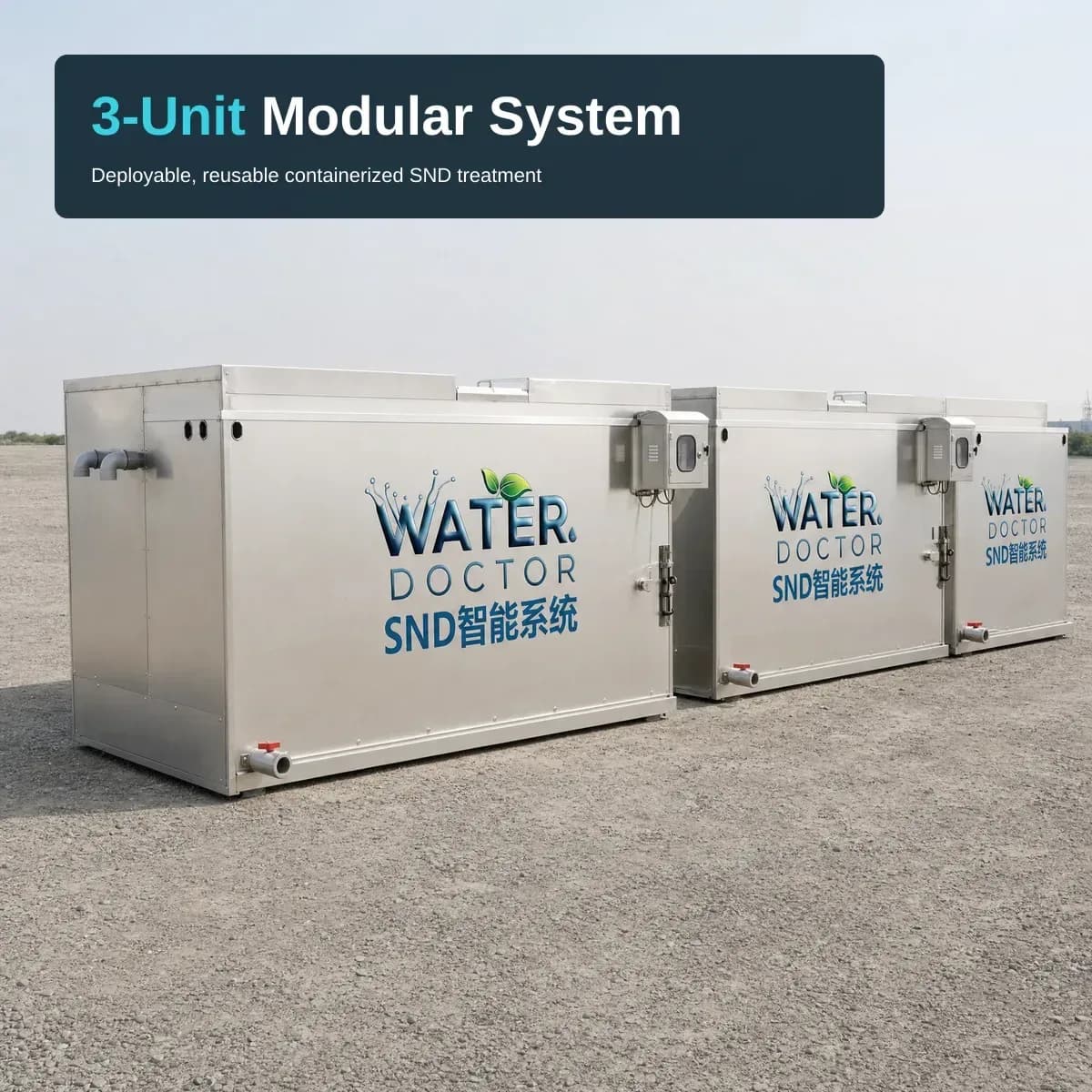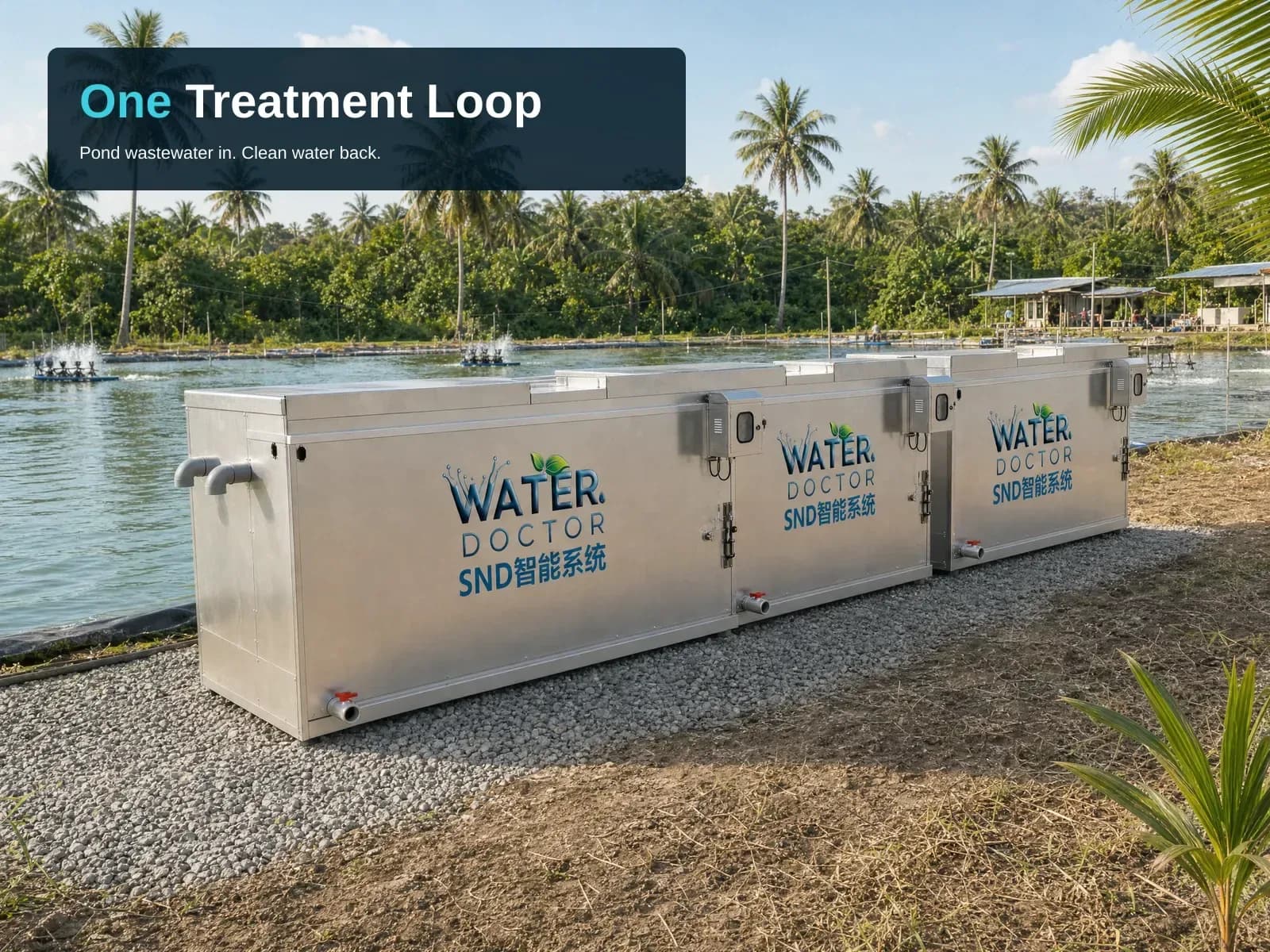
Simultaneous nitrification–denitrification (SND) in WaterDoctor's SND Container System means nitrification and denitrification both taking place in the same system over the same window, and it is shown only when total nitrogen leaves the water. The common misreading is that a falling ammonia reading means nitrogen removed; that holds only when total nitrogen falls too. WaterDoctor describes three units, Pre-Treatment, Core Treatment and Polishing, each listed with IoT sensors, air pumps, "temperature control" and SND bacteria[6], and words the temperature feature a second way. Four questions follow: where denitrification can happen in aerated water; what to ask for when no rated figure is published; what the evidence proves; and what to measure on site. The answers it can end in: plausible but untested, accepted only on a nitrogen balance; ammonia fell but total nitrogen did not, so the unit is nitrifying, the wrong answer to a nitrate problem; or nitrite or total nitrogen rose, which is not this product. Sizing is in the selection guide and a side-stream design in the reference design.
SND can occur in one aerated unit
WaterDoctor says conventional treatment relies on "separate aerobic tanks for nitrification and anaerobic tanks for denitrification"[6], while its bacteria work "in a single aerobic process"[6] and denitrify "in the presence of oxygen"[6]. These are manufacturer statements; the site copy read publishes headline figures for its bacteria but no method or data set behind them. In a biofilm, oxygen is consumed as it diffuses inward, so aerated bulk water can sit beside an outer biofilm with more oxygen and an inner biofilm with less, above the carrier surface the film grows on. [ASSUMPTION: oxygen falls with depth in a diffusion-limited biofilm; nitrification uses oxygen; denitrification needs an electron donor and is inhibited by oxygen in conventional practice; valid for mechanism and direction only, invalid for this container's carriers, biofilm or oxygen profile.]
The arrow labelled oxygen, more to less with depth, runs beside three shaded steps, not a measured curve. Oxygen and ammonia move inward from the bulk water. In the outer biofilm ammonia becomes nitrite, then nitrate, using oxygen (nitrification). Nitrate moves inward. In the inner biofilm, with less oxygen, nitrate is reduced through nitrite to nitrogen gas, which leaves upward; this needs an electron donor (denitrification), and the picture marks the donor's source as a question because none is published. Nitrite is an intermediate in both chains, so none is shown absent. No abstract read here reports a biofilm oxygen profile, and WaterDoctor does not say whether the container holds a biofilm.
A 2002 laboratory-scale reactor for drinking water reported both processes together in a biofilm: a PVA-immobilised biofilm on a silicone tube, aerated with air and fed pure hydrogen through the tube wall, lost only 8% of its denitrification rate as dissolved oxygen (DO) rose from 2 mg/L to saturation, and the authors credit the PVA with protecting the denitrifiers.[1] The abstract reports no oxygen profile, and WaterDoctor publishes no hydrogen supply for the container.
A second route does not obviously depend on a gradient. From batch tests, the authors of a 2020 pure-strain study (Thauera sp. SND5) suggest that nitrogen gas, with hydroxylamine as an intermediate, is the most likely end product of heterotrophic ammonium oxidation, and propose that route.[2] The abstract does not state the DO during those tests; the only operating point stated for the strain is about 0.5 ppm DO, in a later reactor study.[3] No cited source links WaterDoctor's bacteria to that strain, and outlet readings cannot tell this route from the gradient route.
Oxygen has a cost at both ends. Too little starves the step that turns ammonia into nitrite and nitrate, the oxygen the unit's air pumps are listed as supplying[6] [ASSUMPTION: general biochemistry, not from a cited source]; too much costs denitrification rate, as in the 8% loss above (one laboratory result). Neither side gives a threshold. A falling ammonia number can be nitrification alone, sludge export or dilution by make-up water (check: total nitrogen).
No published rated point, so ask for setpoints
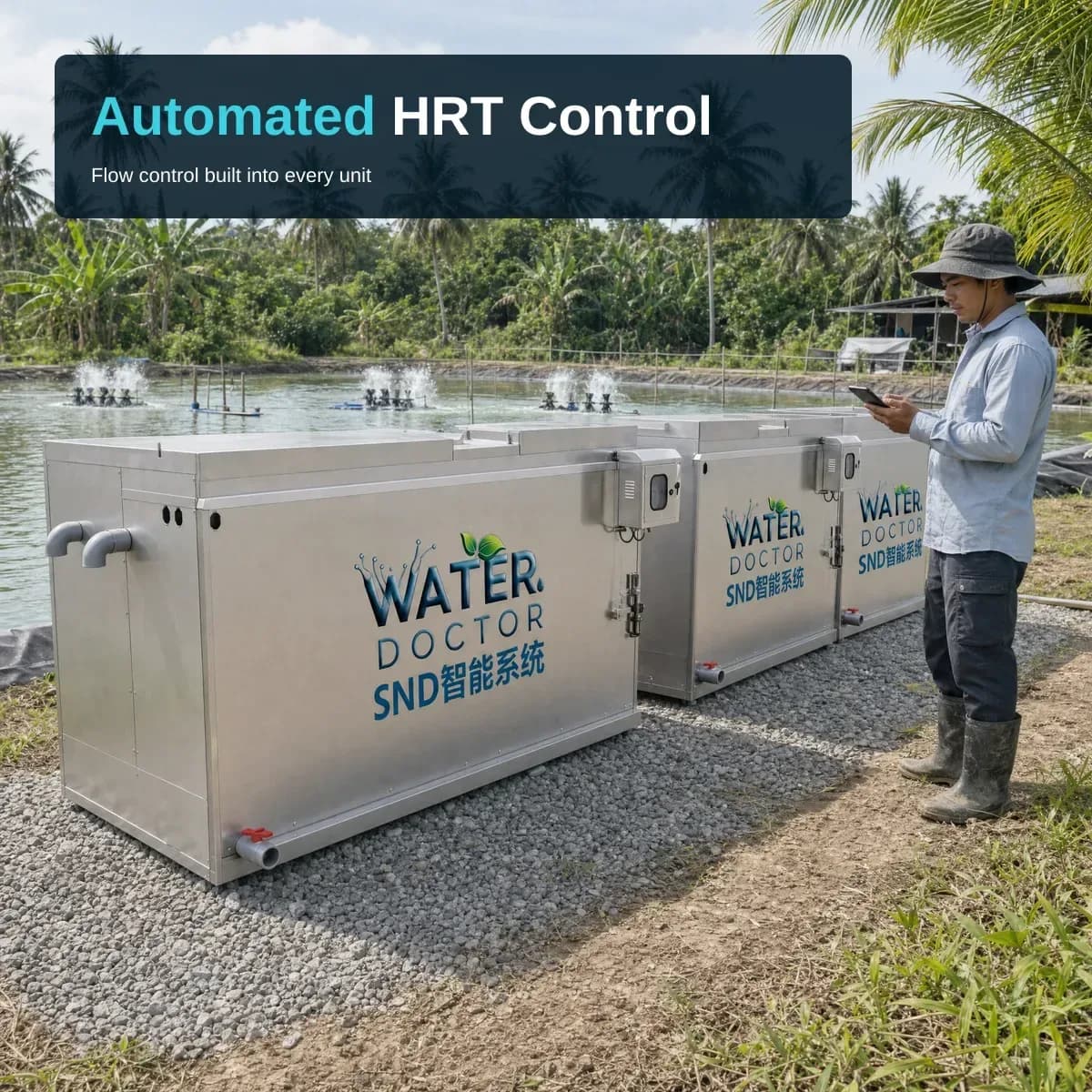
In the site copy read, WaterDoctor publishes what each unit contains, not how it performs. Per unit, the site lists IoT sensors reading "10+ water parameters per unit"[6], air pumps giving "Oxygen supply for SND bacteria"[6], and flow control giving "Automated hydraulic retention time (HRT)"[6]. Temperature is worded twice, as "temperature control"[6] in the unit description and "Real-time thermal monitoring"[6] in the feature list, so neither heating nor monitoring alone can be claimed. AquaOS, the site adds, triggers dosing of SND bacteria and controls the air pumps, with no setpoint stated.[6]
No number sits behind any of it: no removal rate, retention time, oxygen setpoint, air-pump capacity, effective volume, carrier type or loading. There is therefore no rated point. The misreading is to take the listed oxygen supply and automated retention time as proof that the right oxygen and contact conditions are met. Ask for the setpoints and their permitted range in writing.
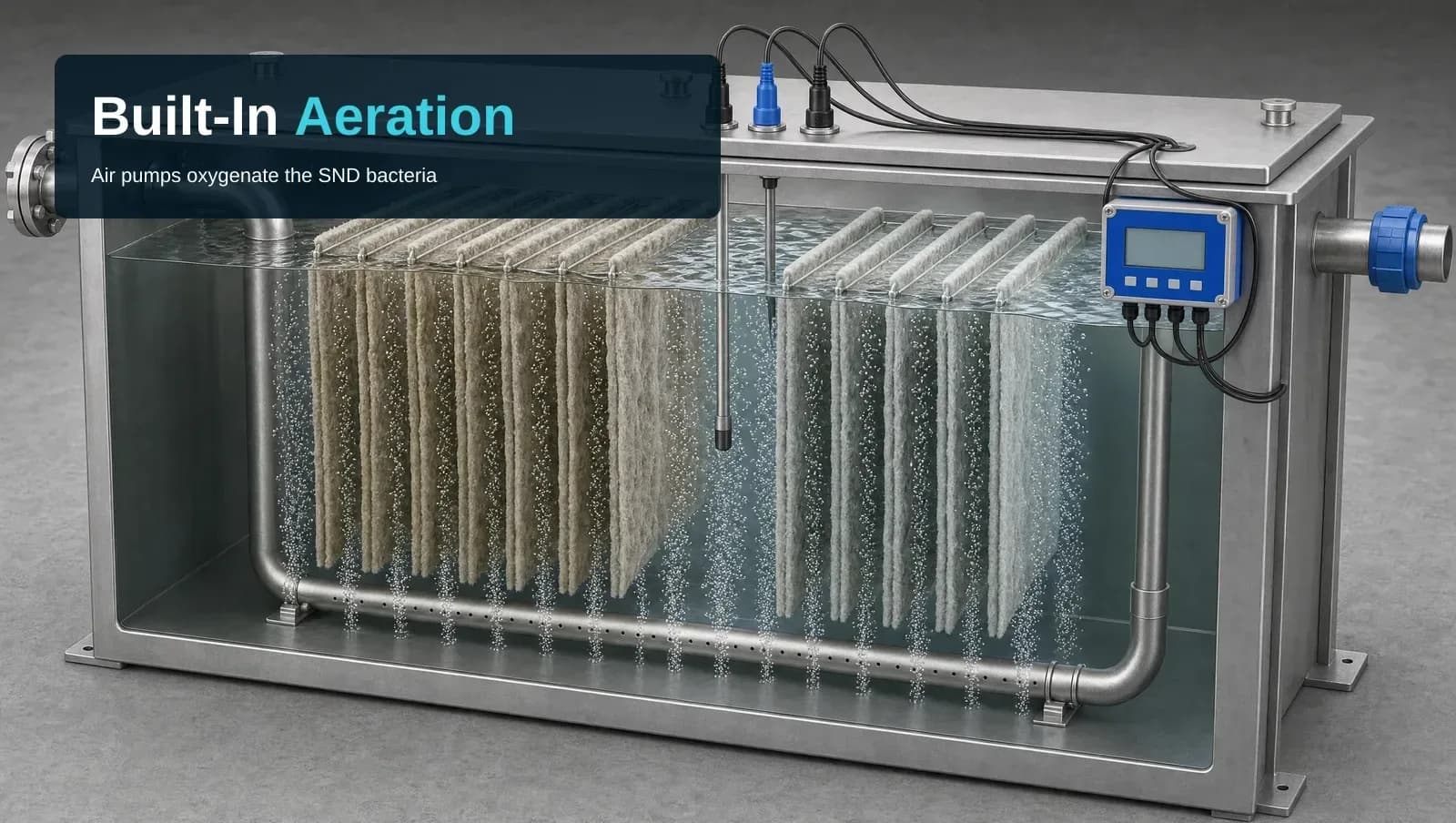
Oxygen and the electron donor trade against each other, and the donor is the open half: WaterDoctor publishes no carbon source, dose or external-carbon need. A 2020 recirculating-aquaculture study names low organic carbon and high DO as why efficient nitrogen removal in aquaculture systems is still a challenge, and met it by an anammox-based route (SNAD), not classical SND.[4] The 2002 reactor was fed hydrogen,[1] and strain SND5, whose authors describe heterotrophic ammonium oxidation, stores carbon in its cells as polyhydroxybutyrate.[2]
The only low-oxygen operating point in the five abstracts is a 3.6-L sequencing batch reactor with SND5 at about 0.5 ppm DO and a carbon-to-nitrogen ratio (C/N) of 2, which removed 90.6 ± 1.2% of total inorganic nitrogen (ammonium plus nitrite plus nitrate), a low-oxygen, low-carbon point for a reactor containing one named strain, not for a container.[3] [ASSUMPTION: more aeration favours ammonia oxidation, shrinks the low-oxygen zone and consumes carbon, and less aeration protects denitrifiers but lets ammonia through; valid for direction only, invalid for any magnitude or threshold.]
A 2023 fixed-bed study of mariculture wastewater reported nitrogen removal that held up across salinity shocks between 0.10 and 30.00 g/L, but the only figures in its abstract are maximum NH₄⁺-N removal rates of 107.31 and 105.42 mg/(L·d) from 120.00 mg/L with carbon-fibre and polyurethane carriers: ammonium only, in reactors whose scale the abstract does not state.[5] WaterDoctor publishes no species, salinity or temperature limit, and no source read here gives a temperature effect.
Retention time is effective reaction volume divided by flow, and the container's outer volume is not its effective volume. [ASSUMPTION: short-circuiting and dead zones reduce the effective reaction volume; valid as general hydraulics, invalid for this unit's layout.] WaterDoctor publishes no volume, flow or solids-handling detail for its first unit, and the 2023 study separately reported clusters of the microbial community tied to sludge position and compartment, which is not a hydraulic finding.[5] So ask for the DO range, carbon source and dose, salinity and temperature range, and effective volume.
No cited evidence tests this container
Thauera sp. strain SND5 removed ammonium, nitrite and nitrate simultaneously at averages of 2.85, 1.98 and 2.42 mg-N/L/h in a 2020 study,[2] and the 3.6-L reactor result above came later; that paper's demonstration-scale part counts genes in a wastewater plant, which is correlation, not treatment performance.[3] This tier shows possibility under those conditions, and nothing about a container.
The 2002 reactor was hydrogen-fed and aimed at drinking water.[1] The abstract of the 2023 fixed-bed study reports ammonium rates only, not total nitrogen or an SND fraction.[5] The 2020 aquaculture reactor ran on the anammox route (SNAD), not classical SND: after day 60 of a 180-day run with no added carbon, its effluent averaged 0.26, 0.75, 0.47 and 0.27 mg/L of ammonia, nitrate, nitrite and COD (the abstract does not state the nitrogen basis), and with no influent given, no percentage removal can be computed.[4] It is a positive result by another route, neither evidence for nor against SND in the container. Nor does a matching ammonium rate show a matching community: the 2023 carriers' maximum rates were within 1.8% of each other, (107.31 − 105.42) ÷ 105.42, while taxa enrichment varied by carrier.[5]
For the container itself the ladder is empty. As of 2026-09-30, the WaterDoctor site copy read (the SND Container System and SND Bacteria blocks) names no certification, datasheet, test data or third-party validation for it.[6] One gallery image is captioned as an SND container deployment at Yangcheng Lake and carries no data, and a project page in the same copy lists a Yangcheng Lake "Modular SND Deployment" with a nitrogen-removal figure; neither says it is this three-unit product.[6] Of the site's several headline figures, the nitrogen one is a technology-level claim: WaterDoctor's SND Bacteria page lists 80%+ as its nitrogen removal rate, for the bacteria, not the container, with no baseline, sampling, duration, scale or water type published in the copy read and no nitrogen form named for that figure; the homepage words the same figure as "One step for +80% NH₄-N, NO₂-N, NO₃-N Removal"[6] with "Proven in field trials" beneath it, which names three inorganic forms, not total nitrogen, and the copy read gives no trial data or basis.[6]
[ASSUMPTION: for any aerated stream, not this container; arithmetic only; ammonium-N falls from 10.0 to 3.0, nitrite-N rises from 0.2 to 0.5 and nitrate-N rises from 5.0 to 11.5 mg N/L at 100 m³/d; organic and particulate nitrogen unchanged; total nitrogen here means the sum of the three inorganic forms; valid for this example only.] Ammonia fell 70%, (10.0 − 3.0) ÷ 10.0, yet total nitrogen went from 15.2 to 15.0 mg N/L, a fall of 0.2, or 1.3% (0.2 ÷ 15.2), because nitrate rose by 6.5 and nitrite by 0.3. At 100 m³/d, flow times change divided by 1000 gives 0.70 kg N/d of ammonia converted and 0.020 kg N/d removed from the water, under 3% of it (0.2 ÷ 7.0). A 0.2 mg N/L difference between two total-nitrogen results also needs the method's uncertainty before it counts as removal. An ammonia fall cannot separate SND from nitrification alone, sludge export or dilution; a total-nitrogen balance can.
Prove it with a total-nitrogen balance
Sample the inlet, each unit outlet and the final return in the same window. Unit 1 is listed as "Initial filtration & SND bacteria"[6], so conversion may begin before the core unit, and the outlets show which unit does what. WaterDoctor publishes no sample taps between units, so unit-outlet points are a quote item; without them only the inlet and final return can be balanced. Units run in series[6], so lag samples by transit time or take composites; that is engineering practice, not a WaterDoctor requirement.
Record the flows in that window: inlet, make-up water, sludge and drain, and any water reaching the outlet without passing all three units (WaterDoctor publishes no such arrangement, so that pipework is the farm's). Removal in kg N/d is flow (m³/d) × concentration difference (mg N/L) ÷ 1000, valid only when flow and both samples describe the same water over the same window; the selection guide sets out the formula and units. Make-up water dilutes, sludge exports nitrogen as solids and unit-skipping flow adds untreated water, so one sample pair cannot separate them.
Measure ammonium, nitrite, nitrate and total nitrogen, all as N so they add up. An ammonium fall is consistent with nitrification but does not prove it, and nitrate rising as it falls shows nitrification running ahead of denitrification. A nitrite that rises then falls may be a transient, an imbalance between the steps or a different sampling time, and a no-accumulation claim needs a detection limit, sampling times and the load changes covered. Only total nitrogen shows nitrogen leaving; whether it left as gas is derived here by difference, total-nitrogen loss less nitrogen in wasted sludge, unless a gas measurement is agreed.
Online sensors help, but the parameter list AquaOS names is platform copy: dissolved oxygen, temperature, pH, ORP, ammonia, nitrate, turbidity, suspended solids and algae, with no nitrite or total nitrogen. The list after "10+ water quality parameters" names nine, and the site does not say which each unit carries.[6] Nitrite and total nitrogen are therefore treated here as laboratory samples, and an online trend as a prompt to sample, not the balance.
What holds is a per-unit list of sensors, air pumps, retention-time flow control and temperature control or monitoring; what does not hold is any rated figure, because none is published. A removal claim is reproducible only with the influent species and load, DO range, carbon source and dose, temperature, salinity, effective volume, run days, feeding phase, sample count and detection limit [engineering judgment]; a no-nitrite claim needs the detection limit, sampling times and load changes covered.
The data to send is a multi-day record of flow, ammonium, nitrite, nitrate, total nitrogen, suspended solids, DO, temperature and salinity for the stream. Agree before the trial the sample points, methods and detection limits, the window and feeding phases, whether start-up counts, who samples, and what result passes. If total nitrogen does not fall beyond the method's uncertainty over that window, removal is not shown for that duty. If nitrite or total nitrogen rises across the container, the answer is not this product, the trigger the reference design applies at its Stage 2. With that record, request a quote or speak with a Purionex application engineer.
SND Container System
No certifications listedView product →Sources
- [1]Ho CM, Tseng SK, Chang YJ — Simultaneous nitrification and denitrification using an autotrophic membrane-immobilized biofilm reactor, Letters in Applied Microbiology 35(6), 2002 (abstract)
- [2]Wang Q, He J — Complete nitrogen removal via simultaneous nitrification and denitrification by a novel phosphate accumulating Thauera sp. strain SND5, Water Research 185, 2020 (abstract)
- [3]Wang Q et al. — Genome-enabled elucidation of nitrogen removal pathways in Thauera sp. strain SND5, Water Research 289 (2026), 124859 (abstract)
- [4]Lu J et al. — Nitrogen removal in recirculating aquaculture water with high dissolved oxygen conditions using the simultaneous partial nitrification, anammox and denitrification system, Bioresource Technology 305, 2020 (abstract)
- [5]Guo P et al. — Improved simultaneous nitrification-denitrification in fixed-bed baffled bioreactors treating mariculture wastewater, Bioresource Technology 385, 2023 (abstract)
- [6]WaterDoctor website English copy (technology.json, common.json and projects.json i18n message files; site source copy, not the rendered page) — SND Container System, AquaOS and SND Bacteria blocks