This reference design shows how WaterDoctor's SND Container System could be configured as a side-stream stage for a freshwater tilapia recirculating aquaculture system (RAS). Fit depends on the nitrogen mass removed from the same water across low, normal and peak feeding, and on whether the return to the fish can be guarded, not on one removal percentage or WaterDoctor's volume ratio. Farm owners and integrators drafting a request for quotation can use it to frame questions for WaterDoctor and to set acceptance checks. It is a hypothetical configuration built from WaterDoctor's published statements and engineering reasoning, with no installation, commissioning date or measured result behind it. It can end in a staged trial, a hold until WaterDoctor answers, or not this product if the trial shows the container adding nitrite or total nitrogen to the return.
A three-unit train with no published performance data
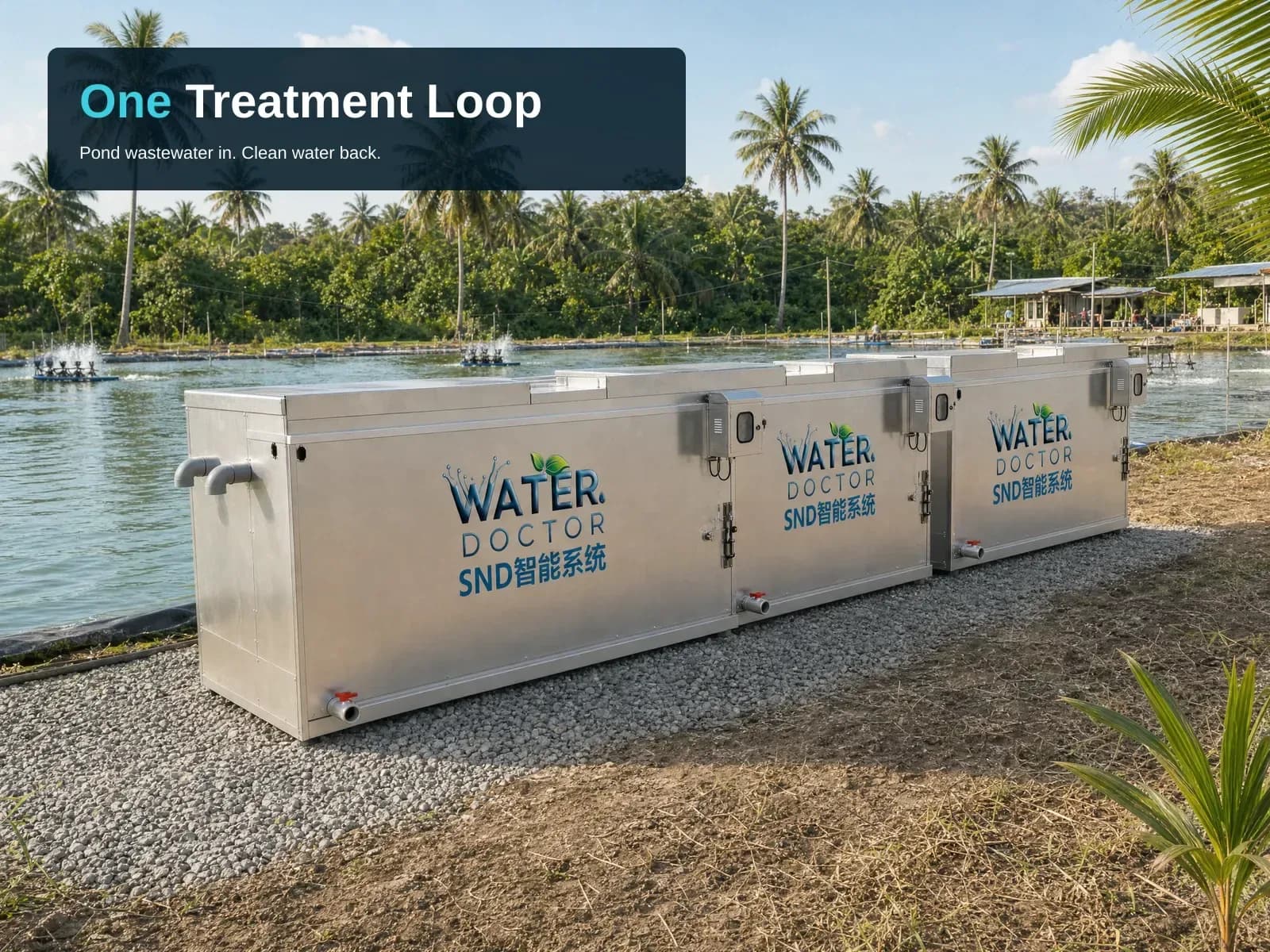
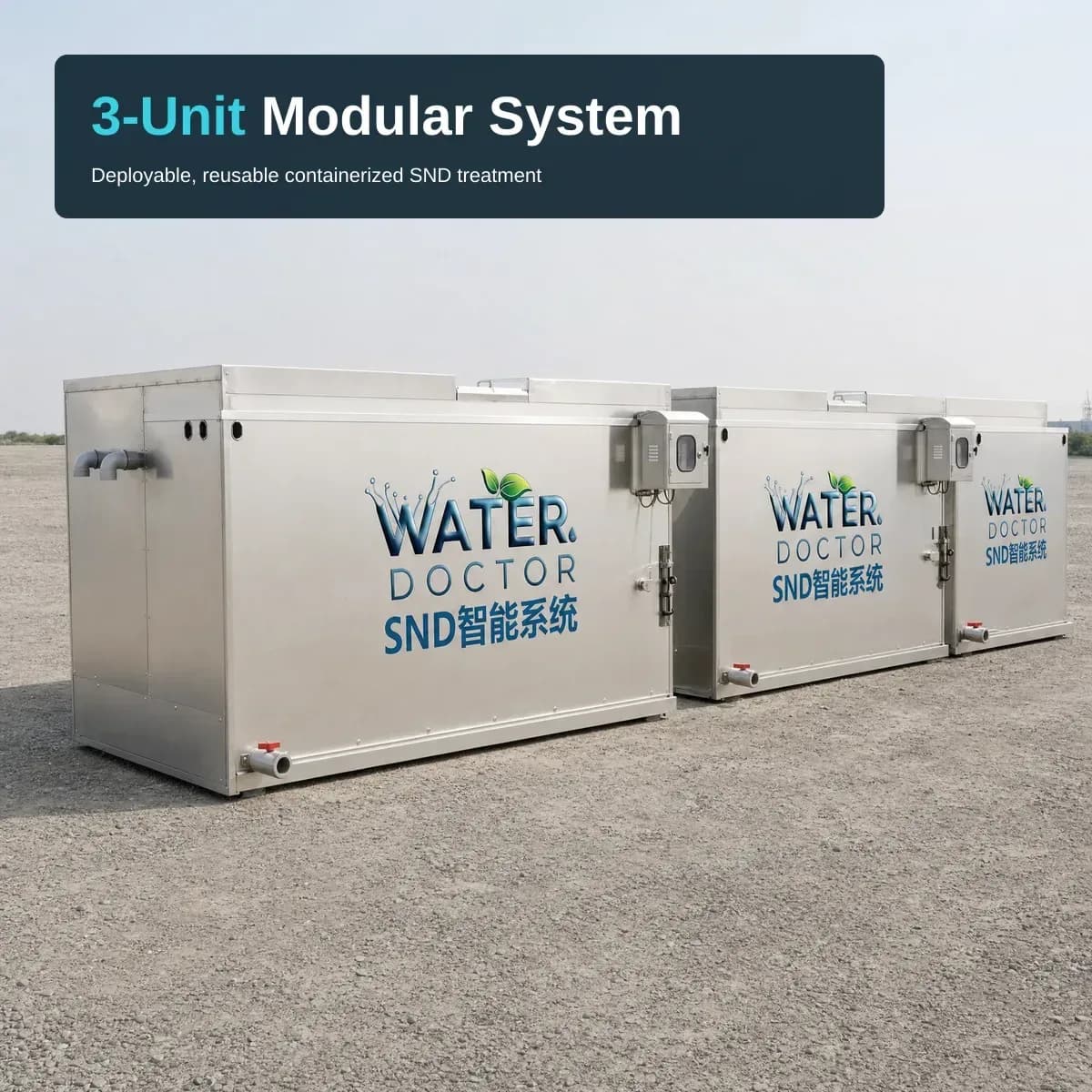
WaterDoctor describes the SND Container System as a modular three-unit containerised treatment system that brings SND (simultaneous nitrification–denitrification) biological treatment, IoT monitoring and its AquaOS platform together in "a deployable, reusable package"[1]. Its page draws five steps: Pond Wastewater ("Drawn into the system"[1]), Unit 1 Pre-Treatment ("Initial filtration & SND bacteria"[1]), Unit 2 Core Treatment ("Active SND biological process"[1]), Unit 3 Polishing ("Final purification & quality check"[1]) and Clean Water Return ("Back to pond")[1]. Those labels are all the page says about the train. Every statement below that WaterDoctor publishes no item is limited to the website copy read for this article, and does not cover any datasheet or brochure WaterDoctor may hold.
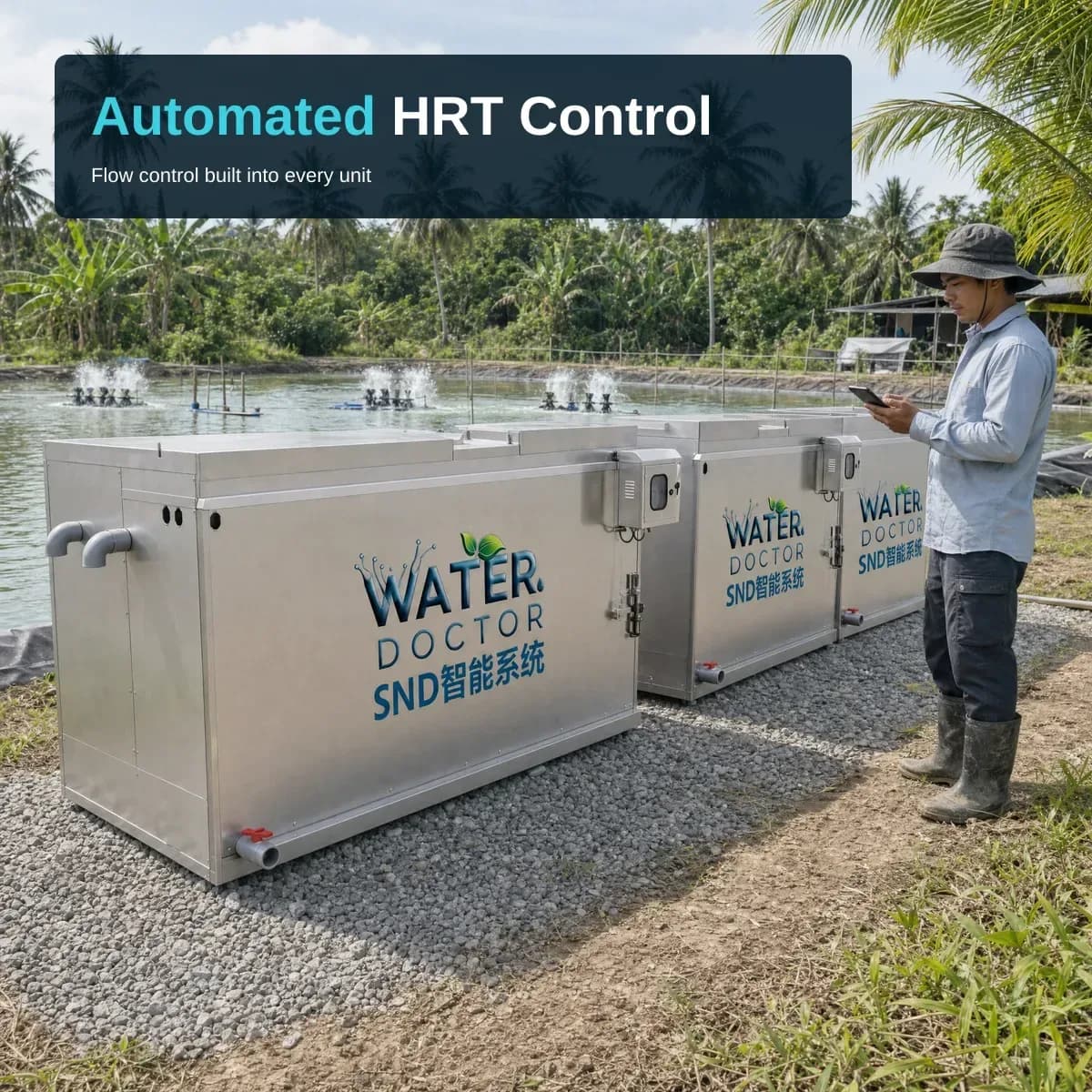
Each unit is listed with "IoT sensors, air pumps, temperature control, and SND bacteria"[1]. The feature list adds "10+ water parameters per unit"[1] for the sensors, "Oxygen supply for SND bacteria"[1] for the air pumps and "Automated hydraulic retention time (HRT)"[1] for flow control. The temperature feature is worded two ways, "temperature control"[1] in the summary and "Real-time thermal monitoring"[1] in the detail, so this article claims neither heating or cooling nor monitoring alone; it is a quote item. Inside each unit, the filter type, any biofilm carriers, the Unit 3 medium, what the "quality check"[1] measures and what happens to water that fails it are not published.
AquaOS is WaterDoctor's cloud platform[1]. Its platform copy lists the parameters the sensors monitor as "dissolved oxygen (DO), temperature, pH, ORP, ammonia, nitrate, turbidity, suspended solids (SS), and algae"[1]. Nitrite and total nitrogen are not on that list, which is written for the platform, not for one container, so both are treated here as laboratory measurements. For the container, the page says the platform "triggers SND dosing, controls air pumps"[1] and provides "a complete dashboard"[1].
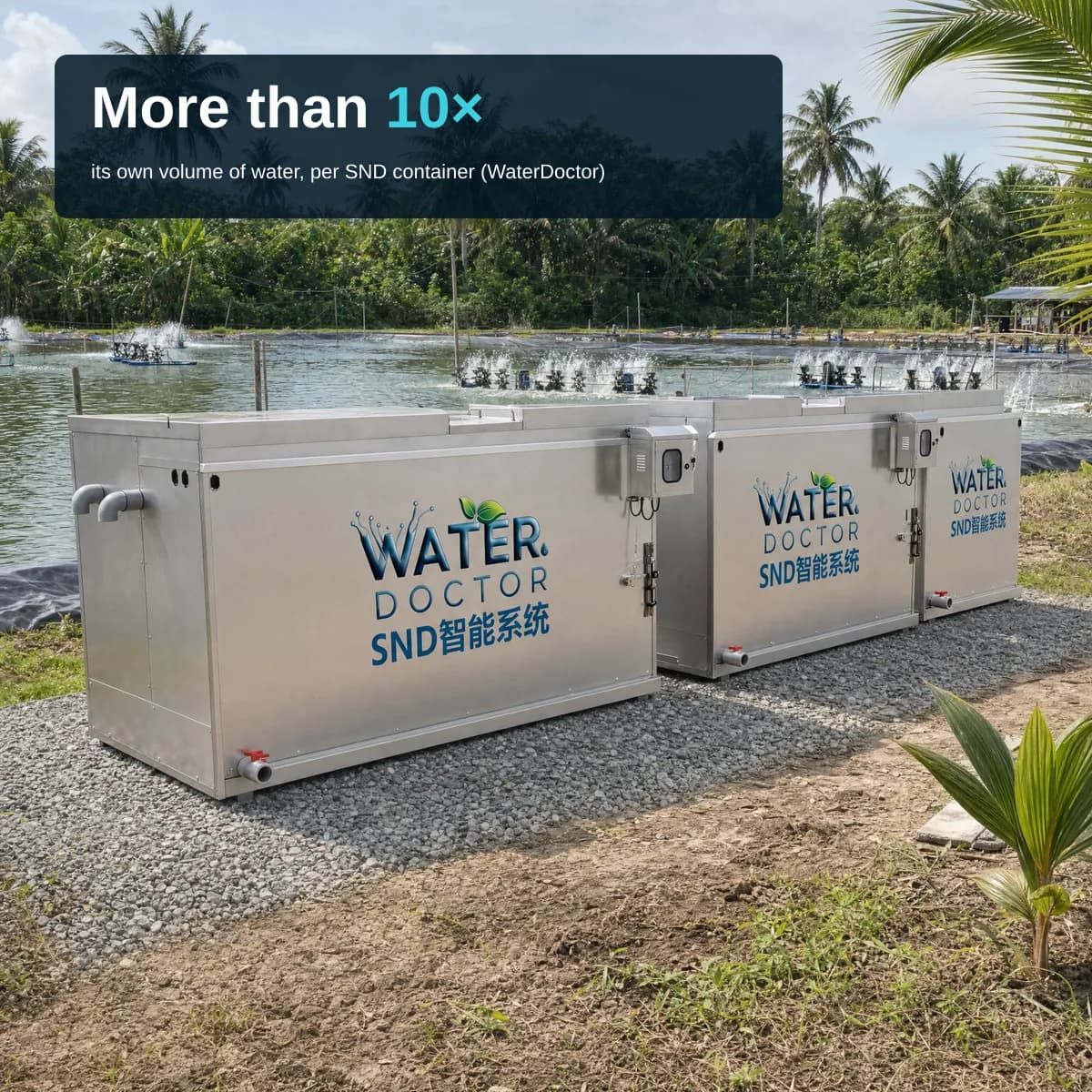
The size statements are the easiest sentences to misread. WaterDoctor's page says: "Each unit only occupies 5 square meters"[1]. The 5 m² is stated per unit, so three units are 15 m² by arithmetic (3 × 5), if all three match, before access and pipework. WaterDoctor has also confirmed, though not on its website, that "one SND container can treat more than 10× its own volume of water"[2]. That is a volume ratio, not a nitrogen capacity. The container volume is not published, so the ratio cannot become a flow, and its time basis is a quote item. This article never compares 240 m³/d with it.
WaterDoctor's SND-bacteria page lists applications including RAS biofilters, open-pond systems and "modular container farms"[1], and the copy read does not say whether the last refers to this treatment container. The same page says AquaOS sensor data "triggers optimal SND dosing schedules"[1]. These are the maker's stated uses of its bacteria technology, not results for this container. The copy read gives no influent, effluent or flow data for this container. Its project pages give headline outcome figures for SND deployments, and one gallery image is captioned as an SND container deployment at Yangcheng Lake, but none is stated to be this three-unit product and none states a baseline or method in the copy read.[1] WaterDoctor also publishes no species, salinity or temperature limit for it.
A tilapia RAS side-stream is taken as an openly hypothetical duty because a side-stream can be isolated without stopping the main loop. WaterDoctor's page draws the loop from pond to pond[1] and publishes no RAS connection, so the tie-in is a choice of this reference design, not a WaterDoctor option.
The design would judge removal by nitrogen mass
Take a freshwater tilapia RAS with an existing biofilter and a side-stream of 240 m³/d, which is 10 m³/h (240 ÷ 24), at 28 °C [ASSUMPTION: all three are design choices, not derived from WaterDoctor's volume ratio, from feed or from any WaterDoctor figure]. The loop's nitrogen load is an owner measurement.
The obvious fix is a finer solids filter, and it misses: a filter changes where solids go and leaves dissolved nitrogen where it is. Nor does a falling ammonia reading show nitrogen removed, because nitrite and nitrate can rise in its place. Every target is therefore written on total nitrogen (TN) and its forms, reported as N (the mass of nitrogen, not of the whole ion), with total ammonia nitrogen written TAN.
The misreading the reference design must not allow is a single removal percentage from one pair of samples. The same percentage of an inlet carrying twice the nitrogen is twice the mass (2 ÷ 1 = 2), and peak feeding is when the inlet carries more. WaterDoctor publishes no removal figure for this container, so this article states none and works none.
The comparison that survives is mass. Removal in kg N/d is the flow in m³/d times the concentration difference in mg N/L, divided by 1000, valid only when the flow and both samples represent the same water over the same window; the selection guide sets out the formula and units. Because the result scales with flow, the flow must be metered. At 6 m³/h [ASSUMPTION: used only as a ratio] instead of 10 m³/h, any given concentration difference is 0.6 of the nitrogen (6 ÷ 10), which is 40% less. WaterDoctor publishes no residence time, so the windows are 24-hour flow-proportional composites repeated over days.
The targets, each with a quantity, a condition and a method, are engineering judgment, because WaterDoctor states no outlet quality. (a) Removal in kg N/d at least the owner's minimum in each of low, normal and peak feeding, judged against the owner's measured loop load, by composites at the container inlet (S0) and outlet (S3). (b) Outlet nitrite-N and TN not above the inlet, by the same composites. (c) Return-water dissolved oxygen, pH, temperature and turbidity inside the owner's fish-side windows, by online instruments at the outlet. (d) Drain and sludge volume inside the owner's discharge consent, by a drain totaliser.
10 m³/h is not a WaterDoctor rating, because WaterDoctor publishes no design flow, minimum flow or effective volume. No margin can therefore be calculated: it is not a 0% margin but an undefined one, and the staged trial exists to close it.
Design basis, farm side only, SND-CONTAINER-RAS-SIDESTREAM-2026-01. Every row is an assumption of this reference design; none is a WaterDoctor figure.
| Item | Value |
|---|---|
| Side-stream flow | 240 m³/d, which is 10 m³/h (240 ÷ 24); a design choice, not derived from WaterDoctor's volume ratio |
| Water temperature | 28 °C; a design choice |
| Water and take-off | Freshwater tilapia RAS; take-off after the existing biofilter, return to the sump upstream of it |
| Flow sensitivity | 6 m³/h, used only as a ratio against 10 m³/h (0.6, so 40% less nitrogen for a given concentration difference) |
| Nitrogen load of the loop | Measured by the owner over several feeding cycles; no number is assumed |
SND Container System
No certifications listedView product →Water would return only through a guard valve
In the reference design, water leaves the RAS after the existing biofilter, passes through the container, and returns to the RAS sump upstream of that biofilter, so returned water is mixed and passes the biofilter again [ASSUMPTION: a typical RAS layout]. Because the branch is off the main loop, closing two isolation valves stops the container without stopping the loop. The selection guide covers the main-loop and effluent alternatives.
The drawing, titled Two valves isolate the container; a guard decides what returns, lets a reader check four things. IV-1 Isolation Valve and IV-2 Isolation Valve isolate the branch, so the existing RAS keeps running when the container stops. The Feed Pump + Flow Meter, set for the 10 m³/h design side-stream (assumption), gives the metered flow the kg N/d arithmetic needs, with S0 side-stream inlet and S3 after Unit 3, before return as the balance points. The Return Guard Valve, driven by a local guard signal (owner or integrator) and not through AquaOS, returns water to the RAS Sump (return point) or diverts it to the Hold Tank / Drain. Only the WaterDoctor supply box, three units and AquaOS, is WaterDoctor's supply as the reference design draws it; every owner or integrator part is the reference design's choice.
The other elements are the EXISTING RAS — OWNER band with the RAS Biofilter Outlet (existing); Unit 1: Pre-Treatment, Unit 2: Core Treatment and Unit 3: Polishing, with S1 after Unit 1 and S2 after Unit 2 (inter-unit sample taps are unpublished, so a quote item); a sludge and backwash (route not published) line from each unit to the Sludge / Backwash Drain; and a legend for WaterDoctor supply, owner or integrator part, and data, signal, divert or drain path. AquaOS links to each unit by a line marked sensor data, air pumps; dosing location not published, since WaterDoctor publishes that the platform triggers SND dosing[1] but not where dosing happens or with what hardware.
WaterDoctor publishes one configuration and no model range. It publishes no flow, pressure or temperature rating, no connection size and no effective volume, so rating fit and residence time cannot be computed. Residence time is the effective reaction volume divided by the flow through it, and the 5 m² footprint is floor area, not volume.
Each unit's label leaves a question open. Unit 1 is labelled "Initial filtration & SND bacteria"[1], yet WaterDoctor publishes no solids handling, backwash or sludge route, so the drain and the solids destination stay with the owner. Unit 2 is the "Active SND biological process"[1], and its air pump capacity, oxygen setpoint, dosing thresholds and carbon need are unpublished. Unit 3 offers a "quality check"[1] that is undefined, so the guard at S3 is separate and cannot stand in for it.
Three units are not redundancy. As WaterDoctor draws them, the three units are stages in series[1], and it publishes no bypass or redundancy, so the reference design treats a stop in any unit as stopping the train and a feed excursion as reaching all three in turn [ASSUMPTION: no per-unit bypass or isolation, since none is published]. The fall-back is therefore the RAS loop's existing treatment, which keeps running when the isolation valves close. On power loss the guard valve is specified to fail to the divert position; the container's own behaviour on power loss is unpublished, so nothing here relies on it.
Returned water leaves at up to 10 m³/h through the guard to the sump, diverted water goes to the hold tank or drain, and any sludge or backwash goes to the owner's drain. No volume is published for the last two, so each is totalised at the install test. If drained, every 1% of the 240 m³/d stream is 2.4 m³/d of make-up water (0.01 × 240).
Guards would divert; sampling would prove removal
In the reference design, the owner's S3 instruments (dissolved oxygen, pH, temperature, turbidity), an inlet turbidity reading at S0 and the inlet flow meter are online and drive the guard and the feed pump. The container's own "10+ water parameters per unit"[1] also stream to AquaOS "in real time"[1], but WaterDoctor does not name them, so which they are is confirmed before ordering. Ammonia and nitrate may trend on AquaOS if fitted[1]. Nitrite-N, TN and TAN are sampled at S0 to S3 and analysed in a laboratory, and nitrite and TN are never treated as online.
The guard sends the return to the hold tank or drain when an S3 reading leaves the owner's window or the signal is lost, and only an operator releases it. The feed pump stops on low inlet flow, a full hold tank, S0 turbidity above the owner's limit, or a guard divert for low oxygen. AquaOS "triggers SND dosing, controls air pumps"[1], but the control variable, any setpoint and the dosing thresholds are not published, so the reference design asks WaterDoctor to state them and fixes them at commissioning [ASSUMPTION: an arrangement, not a WaterDoctor feature]. A rising nitrite or TN result is a human decision, never an automatic action.
None of these signals shows nitrogen removed. Oxygen and pH in window do not show it, low turbidity does not show low nitrite, and a falling ammonia reading does not show falling TN. The guard is built on local instruments because WaterDoctor describes AquaOS as combining sensors, "edge computing" and cloud analytics[1], yet publishes no local-operation, manual-override or power-restart behaviour for the container.
Removal is therefore proved by sampling, in four phases; phase 2 is called biological start-up because WaterDoctor publishes no carriers or biofilm.
| Phase | Where and how | Pass condition |
|---|---|---|
| 1 Install test | Whole line; meter against drain totalisers | No leaks; both isolation valves close; the guard diverts when the S3 signal or its power is removed; the meter agrees with the drain totaliser with the full side-stream sent to drain |
| 2 Biological start-up | S0 to S3 composites; S3 online | S3 nitrite-N and TN not above S0; kg N/d stable over three consecutive windows; guard inside the owner's windows |
| 3 Steady run | S0 and S3 composites, metered flow | The stated targets met in each of low, normal and peak feeding |
| 4 Seasonal re-check | As phase 3 | The same at the coldest and warmest water |
The measurement is a 24-hour flow-proportional composite at S0 and S3 with metered flow, and at least three windows per feeding phase [engineering judgment]. Three windows in each of three phases take at least nine days (3 × 3 × 24 h), and peak feeding may not fall inside the test period. S1 and S2 grabs show where change happens but do not replace S0 and S3. The measured kg N/d is divided by the owner's measured loop load to give the share of that load the container removes; the pass value is the owner's, and no expected figure is proposed. Each result is reported with its inlet range, days run, sample count and method, the reporting rule that the mechanics article explains.
A pass has to exclude what flatters it: start-up days, hours the guard diverted, dilution from make-up water, and nitrogen that left in sludge rather than as gas, so drain solids are sampled or the loss is stated.
The design would stop at WaterDoctor's unpublished volume
The central gap comes first. WaterDoctor publishes no effective reaction volume, no design flow, no container volume and no time basis for its volume ratio, and no container-level removal data. Residence time at 10 m³/h is therefore unknown, and it is the figure whose value would decide go or no-go. It closes only with WaterDoctor's written answer on volume, design flow and the time basis of the ratio, and the trial then tests the duty against that answer.
On the interface list, WaterDoctor supplies the three units, their built-in equipment and AquaOS [ASSUMPTION: supply scope as drawn in the reference design; confirm in the quote]. The owner or integrator supplies the take-off, valves, feed pump and meter, the guard, the hold tank, the S3 instruments, the pad, power, network, drain, make-up water, samples and laboratory. Dosing hardware and the commissioning parameters (oxygen setpoint, dosing thresholds, flow control) are open: the reference design asks WaterDoctor to propose them and the owner to approve them. Also open are who controls flow (the feed pump or the unit's flow control), pipework between units, inter-unit sample taps, dosing consumables and carbon, and drain outlets. No discharge instrument for aquaculture effluent in Singapore, Malaysia or Indonesia was retrieved for this article, so the discharge consent is the owner's to confirm.
Upsets follow the control rules. A sensor loss or an S3 reading out of window sends the guard to divert, and the operator releases it. Low oxygen or an air pump fault does the same and stops the feed pump, and the operator calls WaterDoctor. A solids surge (S0 turbidity above the owner's limit) stops the feed pump. Peak feeding brings no automatic change and is sampled as its own acceptance window. A rising nitrite or TN result is the operator's decision. The owner keeps the guard windows, the nitrite action limit, the alarm recipients, and who, if anyone, may change AquaOS settings remotely, since WaterDoctor publishes neither the settings nor a permission model.
The trial has three stages, and the owner can stop at any of them. Stage 1 characterises the loop without the container. Stage 2 installs the container and sends S3 to the hold tank, so a hold of V m³ allows V ÷ 10 hours of run, and a 240 m³ hold [ASSUMPTION: arithmetic only] is 24 hours. Stage 3 opens the guarded return. Closing the two isolation valves ends any stage without touching the loop. Stage 2 ends at not this product if outlet nitrite-N or TN exceeds the inlet beyond the method's uncertainty.
A side-stream above 10 m³/h has no basis here and needs its own duty and WaterDoctor's flow basis. An owner unable to meter flow and composite-sample S0 and S3 cannot run the acceptance. Without an effective volume from WaterDoctor, the answer stays at Stage 1. The design does not mean a capacity, a nitrogen guarantee, a certified system or a proven tilapia result. No certification, warranty, datasheet, dimensions, power, origin or price is published, and each is a quote item.
The data to send is the loop volume and layout; measured TAN, nitrite-N, nitrate-N and TN over several feeding cycles including a peak; the feed rate pattern; salinity, temperature range and alkalinity; solids load; make-up water, drain routes and any discharge consent; power and network; and the owner's fish-side windows and nitrite action limit. A Purionex enquiry built on that data would ask WaterDoctor for written answers to the quote items above, and would set out the sample plan, the pass values the owner sets and a proposed staged trial, subject to whether WaterDoctor offers a trial unit. Sending the data pack with a quote request to Purionex starts that exchange.
Sources
- [1]WaterDoctor website English copy (technology.json, common.json and projects.json i18n message files; site source copy, not the rendered page) — SND Container System, AquaOS and SND Bacteria blocks
- [2]WaterDoctor — internal confirmation of SND Container System capacity (2026-09-30), not published on the website