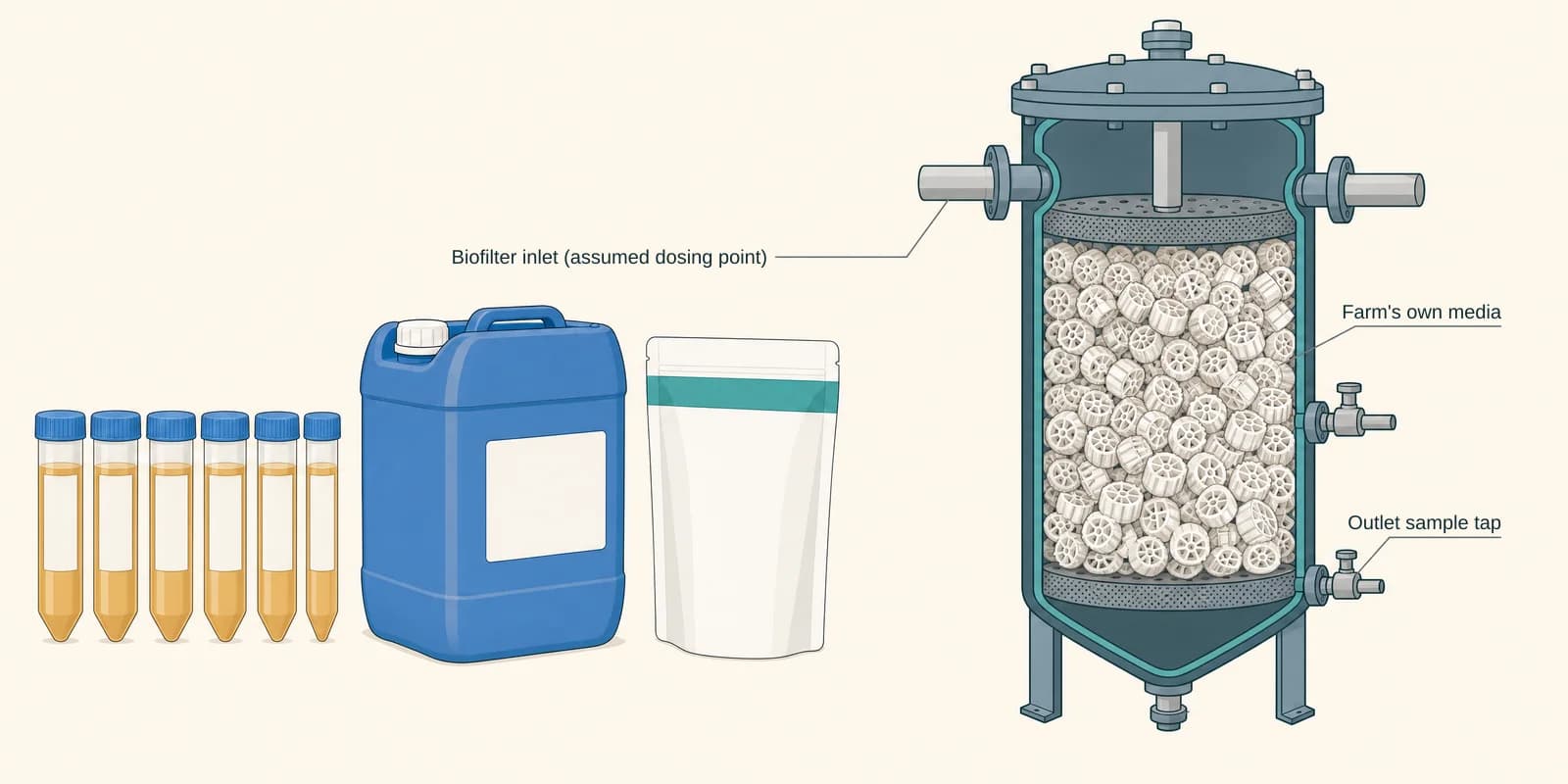
This reference design shows how Aquaphor B510 carbon-block replacement cartridges (B510-02, B510-03, B510-07) could be configured as a stage ahead of one point-of-use reverse osmosis (RO) unit on Singapore's public supply. Fit depends on the disinfectant residual leaving the stage, in the form the supply carries and at duty flow, against the RO membrane maker's printed tolerance for that form, not on a micron grade or Aquaphor's chlorine claim, and on a pressure window whose cartridge drop no document read prints.
Engineers and integrators drafting a quotation request can use it to frame questions for Aquaphor or its channel and acceptance readings. It can end as a bounded two-stage specification with a stoppable commissioning sequence, paired residual readings and a review date the article sets as its own rule; as not this stage, if Aquaphor cannot state in writing that its chlorine claim covers monochloramine at the duty, or pressure, iron, turbidity or housing rules it out; or with items open until Aquaphor answers. The verdict is provisional because no Aquaphor document read mentions chloramine[19]. PUB says Singapore tap water needs no point-of-use treatment[13], so any stage is the buyer's own. It is hypothetical: no installation, commissioning date or measured result stands behind it.
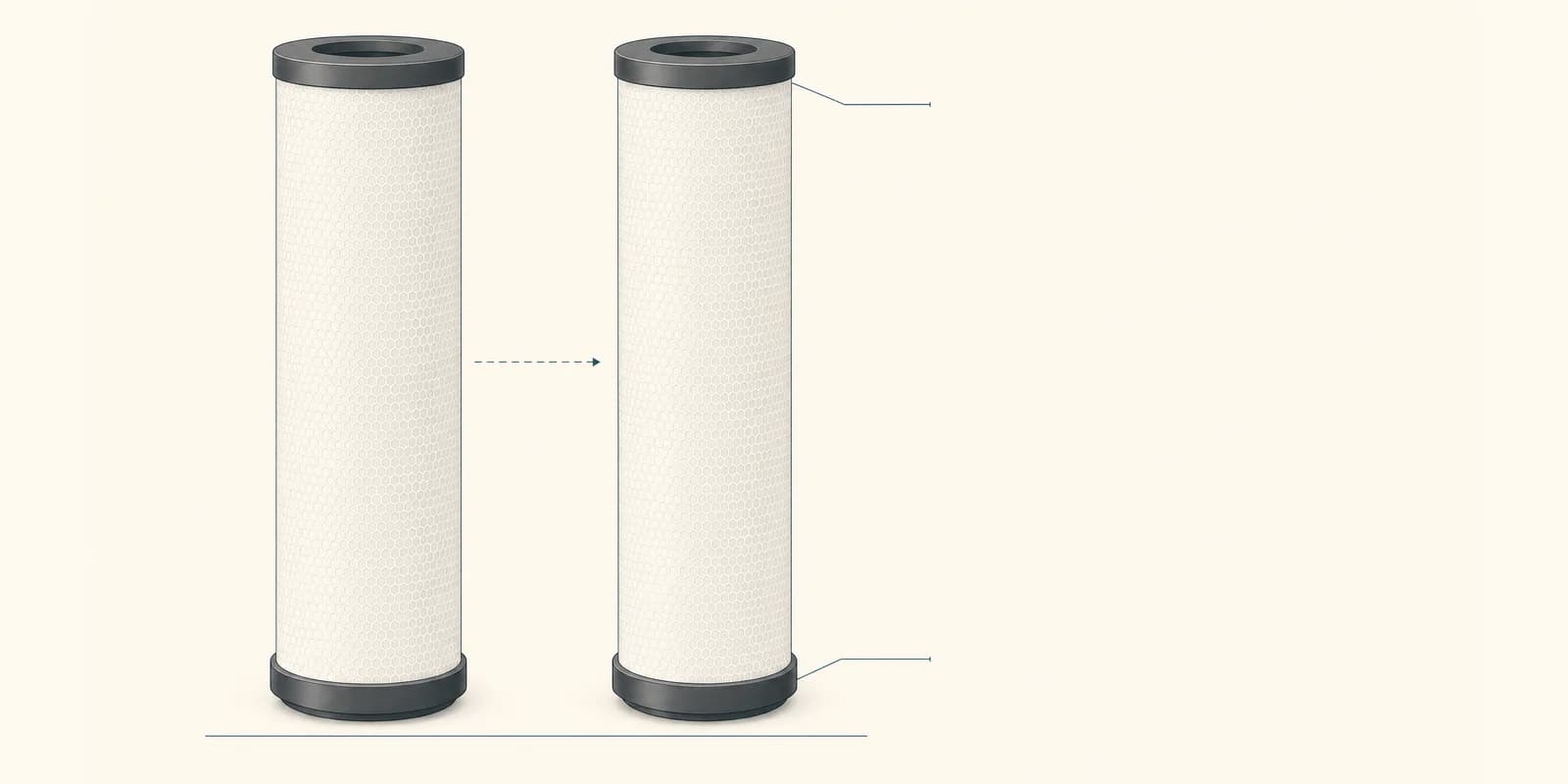
Aquaphor lists three B510 replacement cartridges
Aquaphor's replacement-filter pages list B510-02[1], B510-03[2] and B510-07[3] as three separate cartridges (the B510 cartridges) under "Under counter & RO replacement filters"[1]. Each is a replaceable element, not a housing or a system[1]. Carbon-block is this article's naming, following the Purionex catalogue name: the B510-03 page says "CarbFiber Block technology"[2] and names no carbon source, B510-02 uses the term[1], and B510-07 is an "ultra-dense fibrous carbon block"[3].
- B510-02SOURCEDFinely divided activated coconut shell carbon; organic impurities and active chlorine; filters particles down to 3 micronssource
- B510-03SOURCEDNo carbon source stated; pre-treats the water, removing organic impurities, heavy metals and chlorine; filters particles down to 5 microns; sediment-holding capacity and iron removal claimed, both tied to AQUALEN fibressource
- B510-07SOURCEDPowdered activated coconut shell carbon; removes the residual concentrations of organic contaminants and heavy metals; filters particles down to 0.8 microns; contains silver in its active ionic formsource
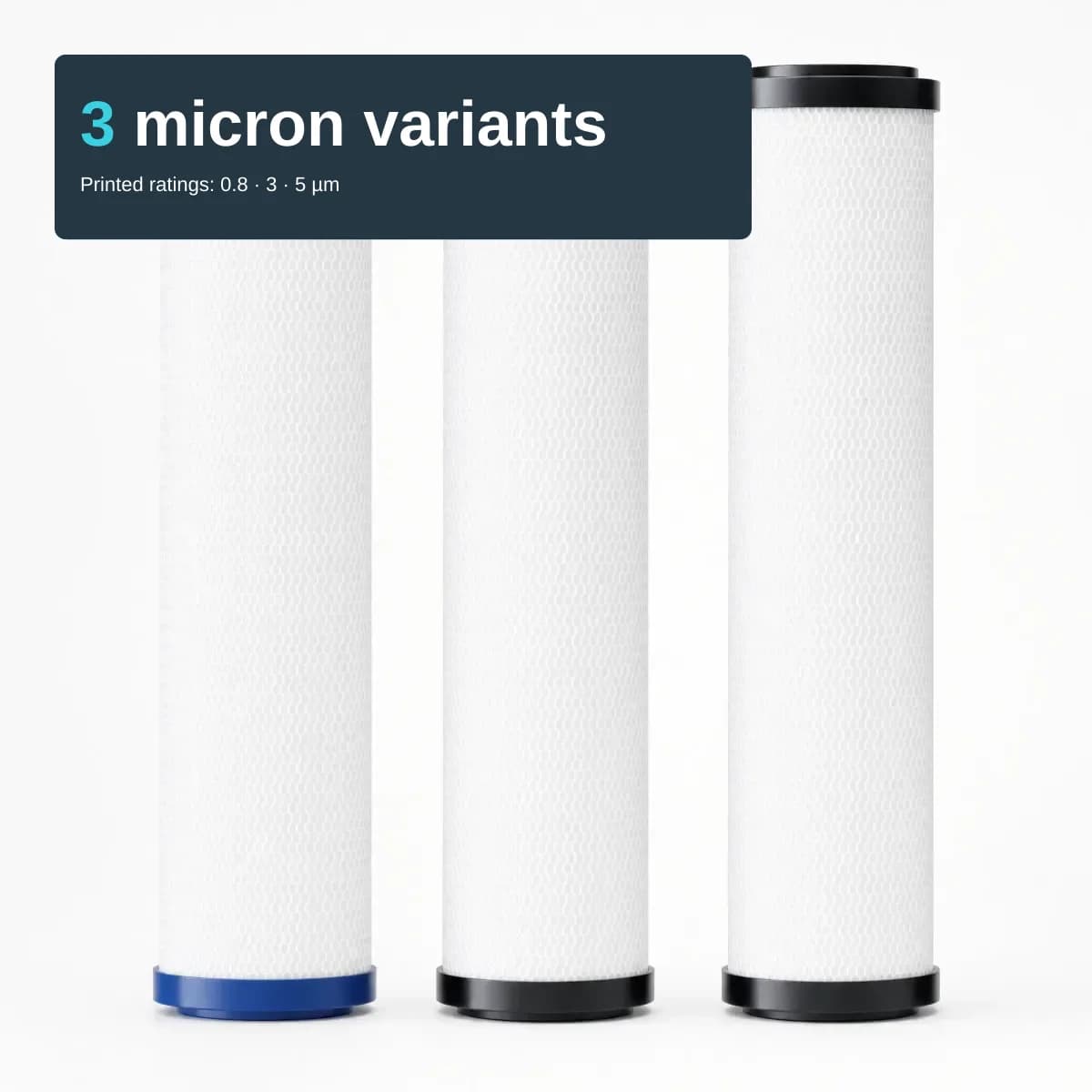
The board sets out what each page prints. The B510-02 description names "active chlorine"[1], and the B510-03 description says it "pre-treats the water"[2], "removing organic impurities, heavy metals and chlorine"[2], with "high sediment-holding capacity"[2]. 0.8 µm is the smallest printed number, and the finest if one basis lies behind all three. Each page carries one feature row, "Removes chlorine"[1][2][3] marked "yes"[1][2][3]. No form, level, flow, temperature, test or basis is printed for the row, that wording or any rating[1][2][3]; the article on the printed claims takes up what they prove.
The page headings are headings, not descriptions: "Deep purification of soft water"[1] (B510-02), "Drinking water pre-filtration replacement cartrige"[2] (B510-03, Aquaphor's spelling) and "Deep purification of drinking water"[3] (B510-07). No hardness figure defines soft[1], so Singapore water is called neither soft nor hard here.
B510 is a part-number prefix[6], and the misreading is that it implies a shared format, media or housing. B510-12 is a different part, filed as a cold-water pre-filter replacement with its own printed life and housing[6]; B510-18 and a retailer's B510-04 are other parts[4][7]. The pages read print no format, connection or compatible housing for the three[1][2][3], so housing is gate zero: nothing is installed until Aquaphor or its channel names each part number's housing. The check is a quote naming the part number and asking for format and housing in writing.
The pages name no application; the only use-like statement is the category label[4], and the index lists nine system names, RO-101S through Trio, without saying which take a B510 cartridge[4]. The RO duty is the article's frame, not a stated use: the label says RO, and Aquaphor's RO-101S and RO-102S manual lists K5 or K1 and K2, other cartridges, ahead of its membrane[17].
Outlet residual, not micron grade, sets the targets
In the Aquaphor B510 carbon-stage reference design for an under-counter RO unit (the B510 stage design), the targets would be set on the disinfectant residual leaving the stage, in the form the supply carries, not on a micron grade. Assumption, duty: one point-of-use RO unit with a storage tank and one carbon stage ahead of it, on Singapore's public supply, flowing only while the tank refills; valid for a monochloramine supply, not as an Aquaphor-stated use. PUB says Singapore tap water is safe to drink and needs no point-of-use treatment[13], so the stage is the buyer's choice, for equipment protection or a written specification. Residential is the scenario's scale; no turndown is printed.
Assumption, downstream envelope: the printed figures of Aquaphor's RO-101S and RO-102S manual[17], listed below, stand in for a hypothetical RO unit of the 50 GPD class whose own pre-stage has no residual-reducing element. Valid when the buyer's RO manual prints the same; invalid as limits of any B510 cartridge.
- TemperatureASSUMPTION5 to 38 °C; cold water onlysource
- Operating pressureASSUMPTION0.19 to 0.63 MPa; above 0.63 MPa a pressure regulator is necessarysource
- Minimum pressure by mineral content (Table 1)ASSUMPTION0.2 MPa at 100.1 mg/L; 0.25 at 200.2; 0.3 at 300.3; 0.4 at 400.4; 0.6 at 500.5; no figure is printed above 500.5 mg/L; at least 0.2 MPa recommended; a booster pump advised below the table valuesource
- Window above the minimum, to 0.63 MPa (derived)ASSUMPTION0.44 MPa at most (0.63 − 0.19; 4.4 bar, 63.8 psi, 44.9 m of water column); 0.43 MPa at the 0.2 row; 0.38 MPa at the 0.25 row (3.8 bar, 55.1 psi, 38.7 m); 0.03 MPa at the 0.6 rowsource
- Iron, turbidity, total dissolved solidsASSUMPTIONAt most 0.3 ppm; at most 1 NTU (nephelometric turbidity unit); at most 2,000 ppmsource
- Membrane maximumASSUMPTION50 GPD (gallons a day) for the RO-101S class, 100 GPD for the RO-102S class, at 25 °C and a constant 0.4 MPa; the 100 GPD class doubles the feed flows derived here (1.31 to 1.84 L/min) and halves the running time (38 to 46 min)source
- Cleaned-to-drain ratio and drawASSUMPTION1:4 to 1:6 for water at least 20 °C; 10 to 12 L/day average consumption of purified water, the manual's basis; feed cut off by a check valve when the tank is fullsource
- Permeate at the 50 GPD maximum (derived)ASSUMPTION50 × 3.785 = 189 L/day = 0.131 L/minsource
- Feed at 1 L of permeate plus 4 to 6 L to drain (derived)ASSUMPTION5 to 7 L per litre: 0.66 to 0.92 L/min while the unit produces at 0.4 MPa, less below it; a 1 L cylinder fills in about 65 to 91 ssource
- Running time at 10 to 12 L/day (derived)ASSUMPTIONAt least 5.3% to 6.3% of a day, 76 to 91 min at the 0.4 MPa maximum, longer below it; the stage otherwise stands full and stillsource
The operating table's 0.19 MPa minimum sits below every row of Table 1[17], which rises with mineral content. PUB's 2025 average total dissolved solids (TDS), 116 mg/L (range 63 to 542, past the table's last row), is a plant figure, not a tap value[12], between the 100.1 and 200.2 mg/L rows. Assumption: the manual's mineralization is read as TDS, which it does not define; the lines read print no rule between rows[17], so the B510 stage design plans on the next row up, 0.25 MPa (engineering judgment), until the measured tap value replaces the plant figure. The window to 0.63 MPa is then 0.38 MPa, against 0.44 MPa at the printed minimum.
The board derives a duty flow of 0.66 to 0.92 L/min of feed[17], a test basis, not a limit; it equals no B510 rating, none being printed.
PUB says the supply carries its residual "in the form of monochloramine"[13]; its 2025 table lists monochloramine at 2.10 mg/L on average (range 1.29 to 2.70) for water produced by the waterworks and desalination plants[12], not tap values, so the inlet is measured, and its separate chlorine row, relation unstated, is never added. DuPont states, for its FilmTec membranes, that dechlorination of free chlorine upstream is required and that oxidation damage is not covered under warranty[8]; one sheet lists a free chlorine tolerance below 0.1 ppm[9]. No chloramine tolerance is in either DuPont document read, so that pass number is a quote item to the buyer's membrane maker, and no ratio of 2.10 to 0.1 is computed: the forms differ.
The obvious fix misses: a micron grade and the chlorine claim are not readings of the residual leaving the stage. Neither prints any of those, and no Aquaphor document read mentions chloramine[1][2][3][4][5][19]; the printed-claims article explains why a rating and a feature row are different kinds of statement. The misreading is that a stage carrying both keeps the residual off the membrane. The check is three targets:
- (a) Outlet residual in the form present below the membrane maker's printed tolerance for that form, at 0.66 to 0.92 L/min, by paired inlet and outlet samples; a pass number exists only for free chlorine, on one example element.
- (b) Unit inlet pressure, chain fitted, by gauge: at duty flow at least the greater of 0.2 MPa and the Table 1 value for the measured mineral content; with the feed stopped, at most 0.63 MPa[17], because cartridge drop vanishes at no flow (engineering reasoning).
- (c) Tap iron at most 0.3 ppm, turbidity at most 1 NTU and the mineral content, measured at the stage inlet sample tap as supply conditions.
Aquaphor B510 Carbon-Block Cartridge
No certifications listedView product →Each added stage would spend the pressure window
The Aquaphor B510 carbon-stage reference design for an under-counter RO unit would put B510-03 ahead of B510-02 on the cold feed line, and every added element would spend the same pressure window, at most 0.44 MPa wide.
A bypass is omitted because it would pass the residual to the membrane. The stage outlet leaves at 0.66 to 0.92 L/min, with a flush to drain at wash-in (a design choice); no waste stream runs in service and no backwash budget applies, because carbon cartridges are replaced, not regenerated[4].
Assumption, transfer: B510-03, B510-02 and B510-07 are taken to share the media and micron grade of K3, K2 and K7 in Aquaphor's Crystal manual. The descriptions are close, not identical: that manual prints silver for all three[16], the B510-02 page and the global B510-03 page print none[1][2], and B510-07 and the Estonian B510-03 page do[3][14]. No Aquaphor document read states the equivalence.[5] Valid when Aquaphor states it in writing; invalid when any B510 document differs and as a rating of any B510 part. No litre, flow, pressure or metal figure crosses under it, and the one interval input is the review date.
B510-03 then B510-02 is the order the B510 stage design decides, not an Aquaphor series: coarse before fine, 5 then 3 µm and B510-03's pre-treatment wording and iron claim[2]. Aquaphor's Crystal manual orders K3, K2, K7 for its Crystal model only[16]; its RO manual lists K5 or K1 and K2 in its preliminary block without assigning flow order[17]; a Latvian online retailer's listing names its set B510-03-02-07 and says B510-03 protects the other two[7]. The misreading is that these are Aquaphor's series in that order; the check is Aquaphor's written equivalence.
B510-07 is left out by choice, not on a finding of unsuitability: as the finest printed rating it would add a pressure loss no document read sizes (reasoning), its silver has no stated function[3], and neither Aquaphor manual shows a K7 ahead of a membrane[16][17]. B510-03 may be dropped only if tap iron and turbidity measure at most 0.3 ppm and 1 NTU and the two-stage drop at commissioning leaves the unit below target (b) while one stage would not, the interstage gauge tap reading each cartridge's drop; the cost, earlier loading of B510-02, is unquantified. The misreading is dropping a stage for pressure alone. B510-03's page also lists chlorine[2], as B510-02's does[1], but neither prints a capacity for it, so the B510 stage design takes credit for neither (engineering judgment); the selection guide covers other placements.
The budget closes only with a term no document supplies. Unit inlet pressure at duty flow is the flowing supply less the drops of meter, valves, gauges and both positions, and must reach target (b). Assumption, worked supply: 0.40 MPa, the manual's test pressure for its membrane maximum[17], a round number, valid as arithmetic only and not a Singapore mains pressure. The board shows what it leaves the chain. The missing term is the cartridge drop at duty flow, which the pages read do not print; commissioning measures it with the gauge pair.
- Flowing supplyASSUMPTION0.40 MPa (4.0 bar, 58.0 psi), the manual's test pressure for its membrane maximumsource
- Left for the whole chain at the 0.25 MPa row (derived)ASSUMPTION0.40 − 0.25 = 0.15 MPa = 1.5 bar = 21.8 psi = 15.3 m of water columnsource
- Left for the whole chain at the 0.2 MPa row (derived)ASSUMPTION0.40 − 0.20 = 0.20 MPa = 2.0 bar = 29.0 psi = 20.4 m of water columnsource
There is no standby and no bypass. The B510 stage design takes no credit for either position, because no capacity is printed for either page's chlorine claim; the outlet reading decides (engineering judgment). A spare helps only after a change-out and nothing senses exhaustion, so the outlet reading and pressure trigger are the only signals, and the B510 stage design counts neither a spare nor a second stage as cover for a failed first (engineering judgment).
Paired inlet and outlet readings would decide acceptance
The B510 stage design would read the disinfectant residual, in its own form, at the stage inlet and outlet and judge it against the membrane maker's printed tolerance, because the documents read print no Aquaphor trigger, sensor or limit for the three parts.
Everything is read by hand: a meter totalling litres, gauges before, between and after the positions, sample taps at the inlet, between the positions and at the outlet, and a stopwatch and cylinder to check duty flow. There is no analyser, ORP sensor (a probe reading oxidising strength), alarm or controller. The stage has no power, so power loss does not apply; manual operation is the valves, and the owner holds every trigger. These are engineering judgment with no Aquaphor basis.
Change-out has three triggers. A loss of line pressure or delivered flow against the commissioning baseline sees loading by sediment (engineering judgment, from the RO manual's reduced-production sentence[17]); no threshold is printed, so it is the owner's setting. A failed outlet test sees a residual breaking through at the moment of the test. The review date bounds the time between. Readings are also taken at the midpoint of the review date and before each change-out (engineering judgment); a fresh cartridge that passes says nothing about later. Idle periods are long at this duty, since the stage stands full and still for most of a day; the flush length is the housing documents' (engineering judgment), and the selection guide gives two idle-flush figures, neither B510's.
Assumption, review date: six months, 182.5 days (365 ÷ 2), a review date and not a life. It is the K2 entry in the RO manual's table, the shortest base figure the table gives, before footnote (1)'s 1 to 3 months[17]; the board sets beside it that table's footnote (1) and Aquaphor's general under-counter sentence, "at least once every 1-1.5 years"[4], read here as a latest-by ceiling. The K2 rule is written for free chlorine, for which no B510 document read prints a rule, so on a monochloramine supply its branch cannot be chosen. Six months holds because early readings and the pressure trigger come first, and the footnote's condition is what the iron and turbidity measurements and B510-03 address. It covers B510-02 by the K2 transfer and B510-03 by choice, since neither sibling manual prints a per-cartridge K3 interval[16][17]. It is valid until Aquaphor gives a B510 interval, and invalid as one. The midpoint is about 91 days.
- K2 text, RO manualSOURCEDOnce a year at 1 ppm free chlorine or less; once in six months abovesource
- K2 and K5 or K1 table entry, RO manualSOURCED6 months; footnote (1): 1 to 3 months where the source water carries large amounts of insoluble impuritiessource
- K5 or K1 text, RO manualSOURCEDEvery three monthssource
- Aquaphor's general under-counter sentenceSOURCEDAt least once every 1 to 1.5 years (365 to 548 days); the maker defers to the filter model's manualsource
- RO manual basis through the pre-stage (derived)ASSUMPTION10 to 12 L/day of permeate at 1:4 to 1:6 = 50 to 84 L/day of feed = 9,125 to 15,330 L in 182.5 dayssource
- Against the Crystal manual's K3, K2, K7 set (derived)ASSUMPTION9,125 to 15,330 L is 1.14 to 1.92 times 8,000 L; that feed reaches 8,000 L in 95 to 160 days. The Crystal manual's other sets print 6,000 and 4,000 L, so a litre figure belongs to a named setsource
The consistency test is derived here, not an input: the board sets the RO manual's own basis beside the 8,000 L that Aquaphor's Crystal manual prints for its K3, K2, K7 set[16]. The two sibling manuals are not on one litre basis, so no litre figure for B510 can be assumed even under the label. The misreading is that the K2 interval or the Crystal litres belong to B510; the check is a quote item for litres and their test basis.
Commissioning is stoppable at each step: housing documents name the part; supply pressure is recorded; new cartridges are washed to drain with the membrane isolated, because coal dust "stains the water, contaminates valves and membranes"[4]; residual is read at inlet and outlet at duty flow to drain before the membrane is exposed (engineering judgment; DuPont recommends removing residual free chlorine before exposure[8]); each position's clean drop is recorded as the trigger baseline; the RO unit is connected last.
Acceptance of the B510 stage design uses those instruments. (a) Paired inlet and outlet residual in the form present, at 0.66 to 0.92 L/min, with a method whose lowest reportable value is at or below the pass number, each reading recording flow, temperature and litres since fitting, passing at the membrane maker's printed tolerance for that form: below 0.1 ppm on DuPont's example sheet for free chlorine[9], a quote item for monochloramine; an outlet check that is engineering judgment with no Aquaphor basis. A method that reports free chlorine reports one form, and no source read says what it would read on this supply, so a reading counts only if the method reports the form present at both points, the rule in the printed-claims article. (b) Unit inlet pressure within target (b) with the chain fitted; a rising drop signals loading, not breakthrough (engineering reasoning, direction only). Empty-bed contact time is volume divided by flow (a granular-bed article[11]); neither is printed, so a reading holds only at its own flow.
Chloramine coverage is the go or no-go gate
The first risk in the B510 stage design is the central gap: no Aquaphor document read mentions chloramine[19], so whether the chlorine claim covers monochloramine at the duty cannot be judged.
That gap is the unpublished figure nearest the outlet objective, and it flips go or no-go. Around it, the three B510 pages, the index pages and the 2026 catalogue text layer, as retrieved on 2026-10-02, print no filter life or capacity, flow, pressure drop, working pressure, temperature or cold-water statement, dimensions, connection, format, compatible housing or certificate for these parts[1][2][3][4][5]; four Aquaphor system instructions searched name none of them and the instructions index lists no document under B510[19]; image-only catalogue pages were not read. Pressure drop is measured at commissioning, no backwash budget applies, and particle retention is only the three printed sentences. None is estimated.
- Housing and format of each part numberGAPNot printed in the documents read; Aquaphor or its channel names them in writing (gate zero)source
- Chlorine claim and monochloramineGAPWhether the claim (the row and the description wording) covers monochloramine, at what residual, flow and temperature, by what test: Aquaphor or its channel, in writingsource
- Pressure drop at a stated flow; maximum working pressureGAPNot printed on the three pages; Aquaphor or its channel; the drop is also measured at commissioning; the housing's pressure rating is the housing manual'ssource
- Temperature, cold-water statement, life in litres and its test basisGAPNot printed on the three pages; Aquaphor or its channelsource
- Silver, B510-07GAPThe page says the filter contains silver in its active ionic form and prints no function; the B510 stage design does not depend on itsource
- Silver, B510-03GAPStated on the Estonian regional page, not on the global page; the conflict is left unresolvedsource
- Membrane tolerance for each residual formGAPThe buyer's RO membrane maker; DuPont's excerpt gives none for chloraminesource
- Data pack from the buyer or integratorASSUMPTIONResidual form and level at the tap, with the test method and its lowest reportable value; iron, turbidity and mineral content measured at the tap; the buyer's reason for the stage (membrane protection or a written specification); flowing and static line pressure (the RO manual says to test it over 24 hours); temperature; the draw; the RO unit's manual with its pre-stage; the housing documentssource
The buyer's RO maker owns the membrane tolerance and the pressure the unit needs; the buyer or integrator owns the tie-in, instruments, measurements and every trigger after handover, and supplies the data pack. A Purionex quote request carries the board's questions to Aquaphor or its channel and passes on any written answers received; none is promised.
On 2026-10-02 searches of WQA's and NSF's listings found none under the Aquaphor names searched, and no Aquaphor page read states a certification for a B510 cartridge[18][1][2][3]; the searches say nothing about other names or certifiers. Aquaphor's home page and catalogue carry company-level sentences on ISO 9001 and on TUV and SGS certification that name no particular product, certificate or scope[15][5].
Each stop is a variable, a threshold and a consequence, and the owner acts on each:
- Stage-outlet residual above the membrane maker's printed tolerance for that form: no membrane exposure; the owner changes or rejects the stage.
- Unit inlet below target (b) once the commissioning drop is read, even with B510-03 dropped: the chain is not buildable at that location.
- Tap iron above 0.3 ppm or turbidity above 1 NTU: a sediment or iron stage is needed whatever the chlorine claim says.
- Aquaphor declines or cannot state in writing that its chlorine claim covers monochloramine at the duty: not this stage. The off-ramp is a stage whose maker documents a chloramine reduction claim, which NSF/ANSI 42 lists among its most common claims[10], and its test; that is what to ask for, not evidence about B510.
- Aquaphor or its channel declines or cannot name a housing in writing: no order for that part.
Gate zero stays open until a reply, and the B510 stage design is provisional meanwhile. None fires on the 0.40 MPa illustration, which leaves 0.15 MPa for a drop not yet known; no stop rests on an unpublished limit.
The owner can stop a staged trial without rework (engineering judgment): Aquaphor's written answers first, then the empty tie-in, then cartridges fitted and washed with the membrane isolated, then the RO unit with the midpoint reading, then the review at 182.5 days. Stopping after the first three stages exposes nothing; whether a wetted cartridge can be returned is a quote item.
The B510 stage design fits one point-of-use RO unit with a storage tank on a public supply, where the buyer specifies keeping the residual off the membrane, once Aquaphor answers. It does not mean:
- that the cartridges reduce monochloramine or that the residual is kept off the membrane;
- any change in water quality, a certification claim, or a life, flow or pressure drop;
- a configuration Aquaphor has reviewed, or that Singapore tap water needs treatment.
It does not apply to a supply whose residual form is unknown (Malaysia and Indonesia are not researched; the buyer establishes the form) or to water of unknown quality or doubtful microbiological safety, for example a private or unsupervised source: Aquaphor's RO manual says "Only use microbiological safe water with your Reverse Osmosis system appliance."[17] Request a quote for the B510 cartridges by part number with the data pack; the buyer asks whoever quotes whether it is an authorised channel for the product in the buyer's market. The printed-claims article covers what the pages prove.
Sources
- [1]Aquaphor global site, B510-02 replacement filter page, as retrieved on 2026-10-02 (maker's own page)
- [2]Aquaphor global site, B510-03 replacement filter page, as retrieved on 2026-10-02 (maker's own page)
- [3]Aquaphor global site, B510-07 replacement filter page, as retrieved on 2026-10-02 (maker's own page)
- [4]Aquaphor global site, replacement cartridges index and guidance text, as retrieved on 2026-10-02 (maker's own page)
- [5]Aquaphor Product Catalogue 2026, text layer, used for the unpublished-envelope scope and the company-level TUV and SGS clause
- [6]Aquaphor global site, B510-12, B515 PRO and B520 PRO pages, used as contrast only (no figure from them is carried)
- [7]A Latvian online retailer's listing for a B510-03-02-07 set (labelled fallback; a retailer's own words, never a maker statement)
- [8]DuPont FilmTec technical manual excerpt on chlorination and dechlorination (Form 45-D01569-en, Rev 11, February 2026)
- [9]DuPont FilmTec TW30-1812-100HR product data sheet (Form 45-D01697-en, Rev. 8, December 2022), one example membrane element
- [10]NSF International leaflet on NSF/ANSI 42 and 53 (retailer-hosted copy; author NSF)
- [11]Battenberg, Activated Carbon: Filtration, Contactor or Both?, Water Conditioning & Purification, June 2018 (practitioner article on granular beds, context only)
- [12]PUB, Singapore Drinking Water Quality, January to December 2025 (water produced by the waterworks and desalination plants)
- [13]PUB, clarification on misleading claims about the quality of Singapore tap water (News Room, Clarifications)
- [14]Aquaphor Estonian regional site, B510-03 page, as retrieved on 2026-10-02 (maker's own regional page; differs from the global page on silver)
- [15]Aquaphor global home page, quality statement (company-level sentence)
- [16]Aquaphor Crystal operation manual (a sibling product's manual, K-series cartridges; not a B510 document)
- [17]Aquaphor RO-101S and RO-102S owner's manual (a sibling system's manual, used as an illustrative downstream envelope; not a B510 document)
- [18]WQA and NSF certification listing searches for the name Aquaphor, five queries and two controls, run 2026-10-02 (negative, with working controls)
- [19]Search of four Aquaphor system instructions and of the maker's instructions index for B510, 2026-10-02 (the search is the source)