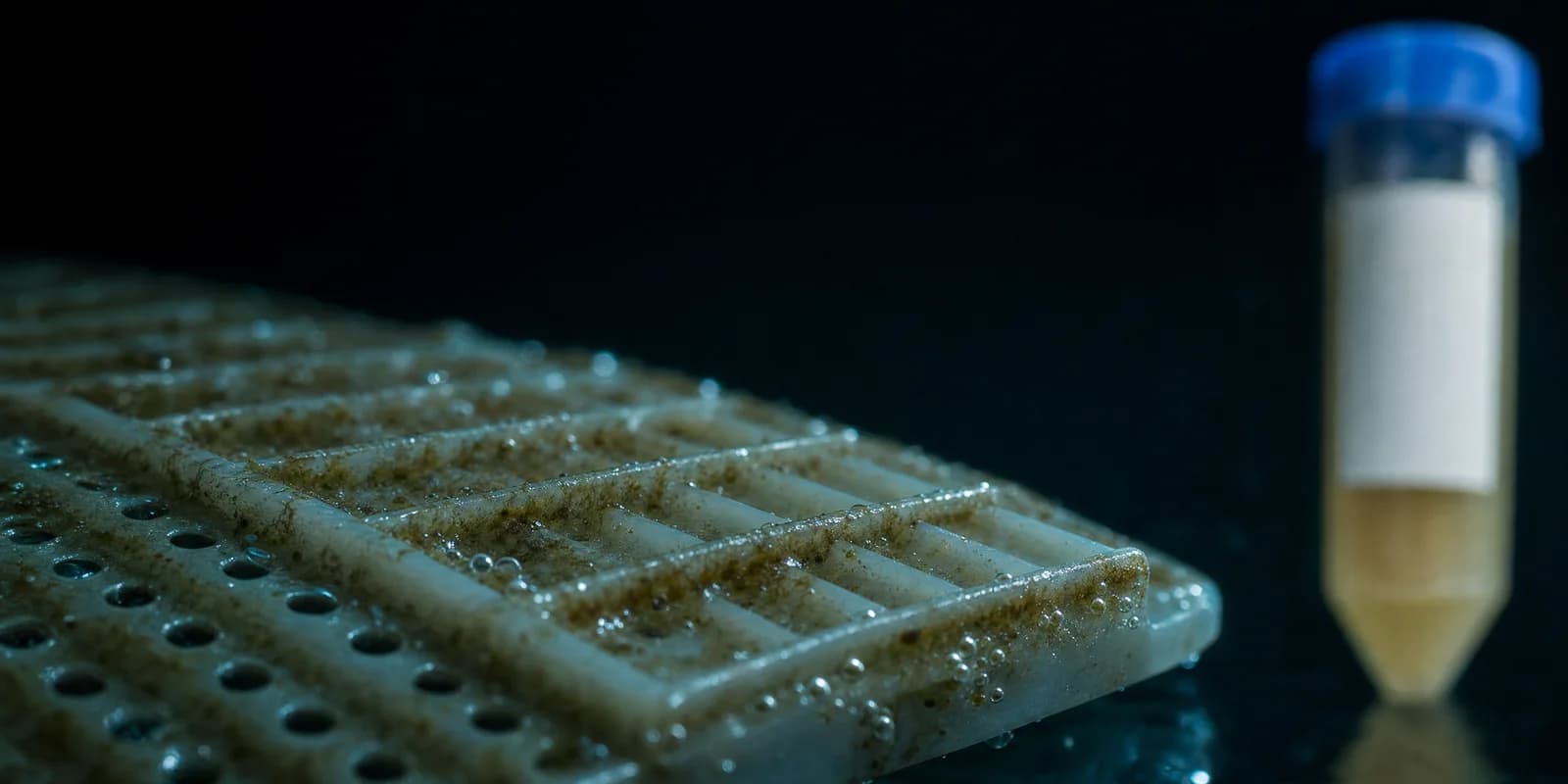
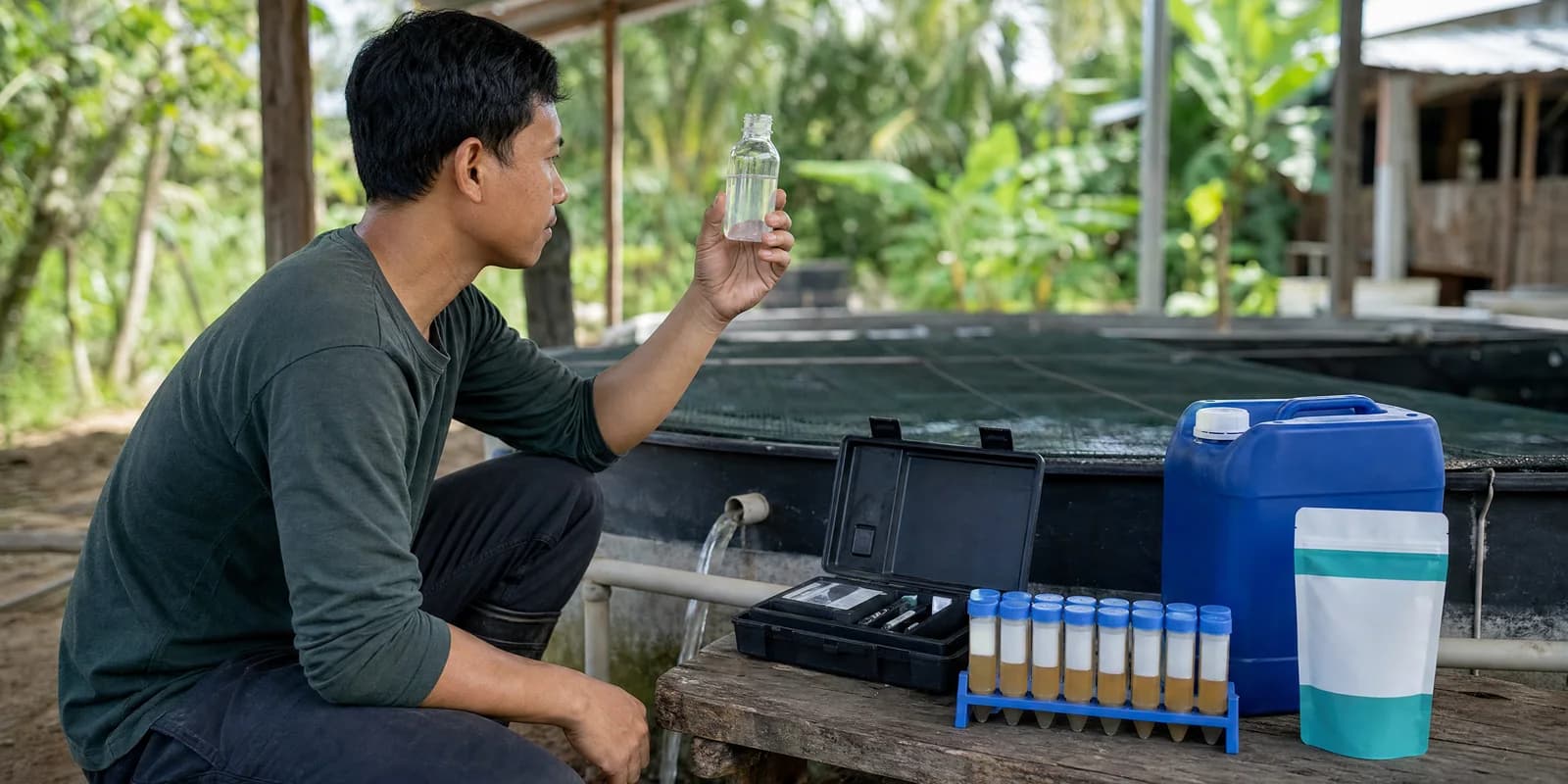
This reference design shows how WaterDoctor's SND cultures (SND CoreLiquid, SND XLiquid and SND DryCore) could be introduced into the biofilter of an existing freshwater finfish recirculating aquaculture system (RAS). Fit depends on what the farm can measure before and after the introduction (a baseline and, with parallel trains, an undosed control), on whether its own media carries the culture, and on what WaterDoctor's documents leave unstated, not on a dose per cubic metre or a maker's percentage. Engineers and farm owners drafting a quote request can use it to frame questions for WaterDoctor; it can end as a staged introduction, a hold for written answers, or not this product here. It is hypothetical, built from a catalogued product and the maker's documents, with no installation, commissioning date, measured result, dose, unit count or start-up time behind it.
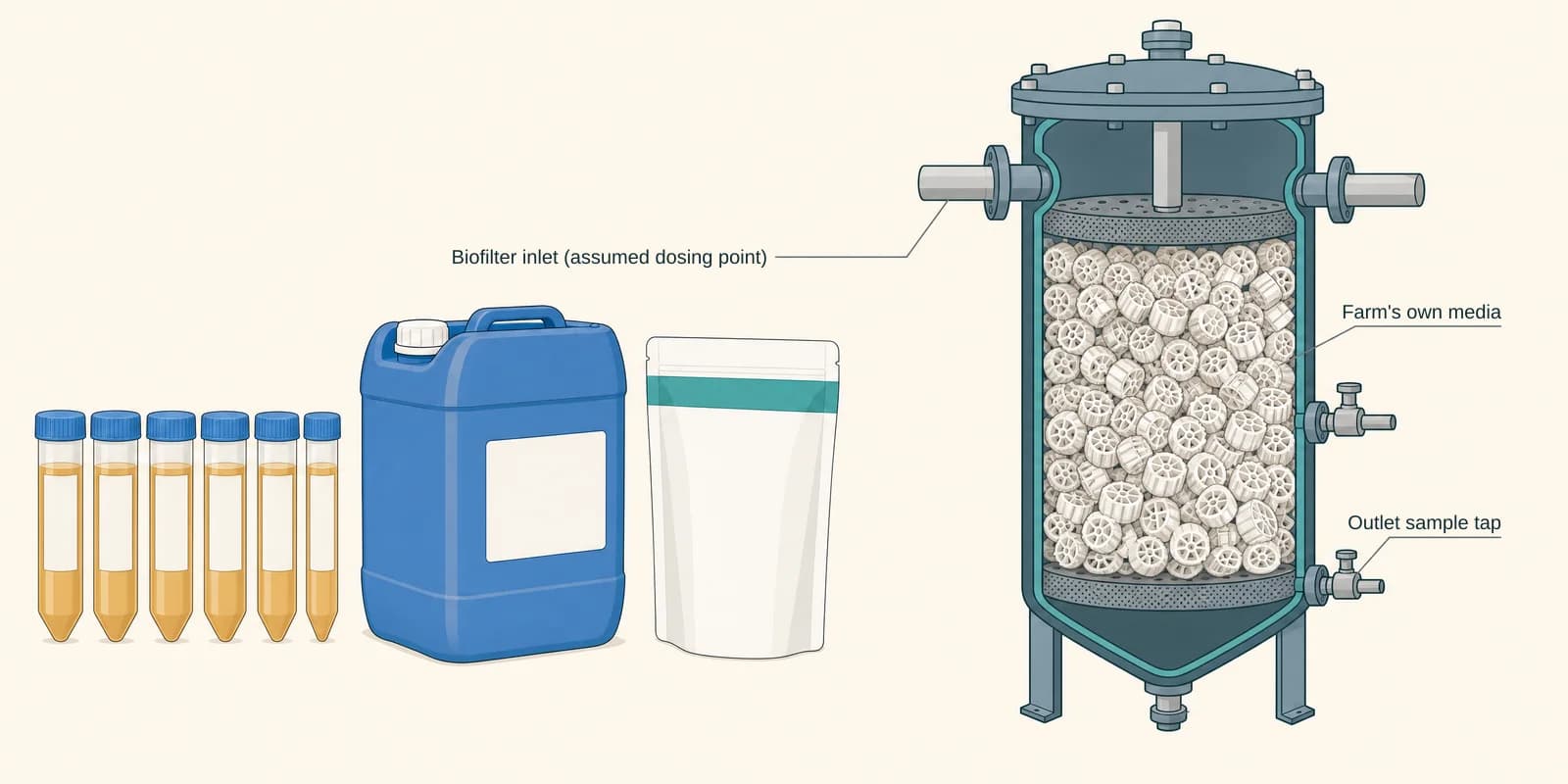
WaterDoctor lists its SND cultures as separate forms
WaterDoctor's brochure lists three forms of its SND cultures under the heading "SND Functional Microbial Agents"[2], and the pouch label on that page calls the powder a microbial consortium[2]. WaterDoctor is the maker, so every performance statement here is WaterDoctor's own, attributed to it.
Printed page 14 gives these roles (translated)[2]; they are not claims that a form suits any farm.
| Form | Pictured as | Printed role (translated) |
|---|---|---|
| SND CoreLiquid | conical tubes | strain scale-up, project start-up and core inoculation |
| SND XLiquid | a can labelled 25 L | system activation, daily replenishment, operation and maintenance |
| SND DryCore | a pouch, 1000 g net | transport and storage, remote delivery and easy dosing |
The tube volume and the number of tubes per box are not printed on that page[2].
Beside the cultures WaterDoctor lists conditioning products: an Activator, "Suitable for inoculation, revival, and recovery"[2]; BufferBase, "Suitable for startup and stable operation"[2]; and GrowthBase, "Suitable for continuous optimization"[2]. Its cooperation-model page describes a standard product edition (translated) bundling cultures, ecological components, sensors and a standardised operating procedure[2]. The documents read for this article do not say whether the cultures need these products or can be dosed alone, so the options are three: the culture alone, with conditioning products, or the maker's full system with carrier and monitoring. A quote adding conditioning products makes the introduction a package, and a result then reads as the package's, so the quote request names the exact form and what is included.
WaterDoctor's FAQ says that "The SND biological treatment system can be retrofitted to existing ponds and recirculating aquaculture systems (RAS)"[1]. The commercialisation row of the brochure's comparison table describes the intelligent SND biological system as culture, carrier and AI platform integrated as a product (translated)[2], and a WaterDoctor article ties denitrification at high bulk oxygen to its AquaMats carrier[3]. Two statements name no carrier: the website says to "Integrate SND bacteria into RAS biofilters"[1], and the pouch label doses a "biofiltration tank"[2]. No document read says how the culture performs on a farm's existing media, so that scenario is this article's own and a null result there cannot be read against the culture. The misreading is that the culture on the farm's media is the system WaterDoctor describes; the check is to ask WaterDoctor whether it supports that. WaterDoctor's AquaMats carrier, a separate product, is excluded[2].
WaterDoctor's technology page lists RAS biofilters, open pond culture and container-based aquaculture as applications[1], and its brochure names aquaculture and water treatment[2]. These are stated uses, not results; this article takes the first. The SND Container System is a different product[2], and nothing here says it uses these forms.
An existing freshwater RAS biofilter has a feed and a discharge where samples can be taken, and the tie-in adds only two taps, a dosing line with an isolation valve and a flow reading where missing (engineering judgment), so an introduction can be judged without rebuilding the loop. WaterDoctor says its strains were "developed for both freshwater and saltwater environments"[1], but the documents read print no numeric salinity limit for any form, so freshwater is this article's own choice.
SND Biological Water Treatment Solutions
No certifications listedView product →Farm measurements, not a dose, would set targets
In the WaterDoctor SND culture introduction reference design (the introduction design), the targets would be set from the farm's own measurements, because in the documents read WaterDoctor prints no dose basis and no outlet limit for any form[2][1].
Assumption, duty: a generic freshwater finfish RAS with an existing nitrifying biofilter on the farm's own media, where nitrate climbs between water exchanges and nitrite episodes occur now and then; no species, volume, feed rate or temperature is stated, and no outside number enters the basis. Valid as a frame for a quote discussion; invalid as a farm or as a use WaterDoctor describes.
The obvious fixes are to dose more or to read the pouch label as a recipe, and both miss. The label shown in the brochure's product picture carries a dose line in wastewater wording, with its tank volume left undefined (the vessel or the system's water) and no split between start-up and maintenance[2], so no dose follows for a RAS; the guide to reading a quote reads it, and here the dose is a quote item. A falling ammonia reading after dosing is not nitrogen removed either, because nitrite and nitrate can rise in its place. Targets are therefore written on total nitrogen (TN) and its forms, all as nitrogen (N).
Four targets follow, each with a quantity, a condition and a method, all on the farm's own instruments:
- Total nitrogen change across the biofilter, inlet minus outlet, in mg-N/L and as a mass from metered or timed flow, against the baseline's own spread; method: laboratory TN on paired grabs.
- Nitrite-N at the biofilter outlet and in the loop, at or under the owner's fish-side limit; method: laboratory or the farm's nitrite method.
- Dissolved oxygen (DO), pH, temperature and alkalinity inside the owner's windows, logged beside every sample; method: the farm's own instruments.
- What was delivered, in writing: form, lot, quantity, date and method; method: a delivery and dosing record.
Every pass value is the owner's, set from the baseline before any dose. No document read prints a rating for any form[2], so the margin is undefined and the baseline is what defines a pass. The misreading is that a quantity of culture, or a maker percentage, is a target; the check is that each target is paired with an acceptance check on the same quantity at the same point.
The introduction design does not test the culture's own window. No document read prints a numeric temperature, pH, alkalinity, salinity or carbon window or a species limit for any form[2][1]; the brochure prints DO 1 to 6 mg/L for the intelligent SND biological system (comparison table, printed p18), not for any of the three forms[2]. Other WaterDoctor statements about DO are different in kind, and the technology deep dive sets them side by side.
The cultures would enter at the biofilter inlet
The WaterDoctor SND culture introduction reference design would add the cultures at the biofilter inlet, with the In tap upstream of the dosing point and the Out tap after the media, so the dose does not contaminate the inlet reading. WaterDoctor's website says to integrate its bacteria into RAS biofilters[1] and its pouch label doses a biofiltration tank[2], but neither states an injection point or a dosing method in the documents read, so the point and the method are quote items. A liquid dose may also carry nitrogen, which would reach the Out sample and not the In sample, lowering the dosed train's TN drop against the culture; its size is a quote item, and the bias only makes a pass harder to reach (engineering judgment). Other introduction points are compared in the guide to reading a quote.
The role map takes WaterDoctor's stated roles and no more[2]: SND CoreLiquid for the introduction event (start-up and core inoculation, not strain scale-up), SND XLiquid for activation and any later top-up the quote defines, and SND DryCore where delivery or storage is the constraint.
No count or neighbour arithmetic follows. The two liquids print a magnitude phrase with no unit or method on printed page 14[2], DryCore prints no count, and WaterDoctor's FAQ says its team selects the strains and the system configuration from the water conditions[1], so no quantity can be sized and no form eliminated by arithmetic. The misreading is that three forms are three sizes or a standby chain; no document read presents one form as a standby for another, and none prints a conversion between forms[2]; the check is that the quote names the exact form and its quantity basis.
The tie-in demands four items from the owner, none of them a WaterDoctor feature (engineering judgment): an isolation valve on the dosing line, a dosing point that can be shut without stopping the loop, a flow meter or timed volume on the biofilter feed, and the two taps. No document read prints a redundancy statement for any form; what all forms share is the farm's own water, feeding and any disinfectant or antibiotic event, which reach the culture whichever form was dosed.
What leaves is nothing new: the dosing adds product and, for the liquids, an unstated volume, and the farm's drain and water-exchange routes carry on.
A baseline and a control would decide acceptance
The WaterDoctor SND culture introduction reference design would be accepted on a baseline and, where trains allow, a control, because WaterDoctor's own start-up statements cannot separate the culture from ordinary biofilter maturation by elapsed time.
Acceptance runs in four phases: baseline, introduction, acclimation and steady state, with window lengths set by the baseline spread (engineering judgment). A WaterDoctor article describes the start-up of its AquaMats system as inoculation, a first-week signature, then acclimation with substrate and trace-element recommendations[3]; no figure, outcome, date or farm is carried.
WaterDoctor's timings cover different things, and none is stated in the documents read as measured for the culture alone[1][3].
| Statement | What it covers | Value |
|---|---|---|
| FAQ installation[1] | project duration: assessment, equipment, an inoculation-and-activation step, calibration, training | 2 to 4 weeks overall; the step 7 to 14 days |
| FAQ stability | time to stability after activation | "optimal performance within 2-4 weeks after activation"[1] |
| A WaterDoctor article | start-up of a conventional system | "typically requires a 2 to 4 week start-up phase"[3] |
| Another article | remedying a carrier biofilm that had grown poorly, at a farm it does not name, by acid washing and slurry inoculation | a further 21 days[3] |
The FAQ words the step as SND bacteria inoculation and biological system activation[1]. Its four steps sum to 13 to 27 days (1+3+7+2 to 3+7+14+3), against 14 to 28 days for 2 to 4 weeks (derived here). The stability figure and the conventional start-up are equal as numbers and about different things, so elapsed time alone cannot separate the culture from ordinary maturation (engineering reasoning).
The control for causation is a second train: hold feeding, aeration and make-up water as steady as the farm can, log them, and, with parallel trains, dose one and leave the other undosed. Engineering judgment: a train is an undosed control only while no culture reaches it. Trains sharing a sump or culture tank are cross-seeded, which can only narrow the paired difference, so there the result is a lower bound and the off-ramp is not read until the owner shows the trains share no biomass. The misreading is that improvement after dosing is the culture's, when feeding, temperature and the resident community move too.
Assumption, illustrative readings: no farm, not an expectation, valid as a method where the trains share no biomass and invalid as a prediction.
The paired spread, the scatter of the difference between the two trains' TN drop over the baseline samples, is 0.1 mg-N/L, and one train's own scatter is 0.2 mg-N/L. Before dosing, both trains show a TN drop of 1.0 mg-N/L; afterwards the dosed train shows 2.0 mg-N/L and the undosed train 1.6. The apparent improvement is 2.0 − 1.0 = 1.0 mg-N/L and the shared drift is 1.6 − 1.0 = 0.6, leaving 1.0 − 0.6 = 0.4 mg-N/L attributable, which is 40% of the apparent improvement and four times the paired spread (0.4 ÷ 0.1). The pass rule is engineering judgment with no maker or standard basis: attribute a gain to the culture only when it exceeds twice the baseline paired spread (2 × 0.1 = 0.2 mg-N/L), so 0.4 passes. A single train would read the whole 1.0, five times its own scatter (1.0 ÷ 0.2) and 2.5 times the attributable amount (1.0 ÷ 0.4). With one train there is no control: a change above twice its own spread (0.4 mg-N/L) shows the water changed, not that the culture did, so a single-train result can end at not this product here but cannot show that the culture caused a gain.
The maker's acceptance sentence is not the pass value. One WaterDoctor article says that a TN removal rate "consistently exceeding 80% without nitrite or nitrate accumulation", with a stable pH, shows the path from ammonia to nitrogen gas is operating[3]; the sentence gives no baseline, no definition of the percentage and no sampling[3], so it cannot be a pass value.
Online, the introduction design reads the farm's own DO, pH and temperature and a flow reading. Sampled, it takes total ammonia nitrogen (TAN), nitrite-N, nitrate-N and TN at the In and Out taps (engineering judgment). DO and pH within their windows do not show nitrogen leaving the water. The acceptance logic of nitrogen mass in the same water over the same window is that of the reference design for a side-stream tie-in with sample points and a guarded return. On power loss a dosing pump, if used, stops and the missed dose is logged, not caught up; manual dosing follows a method the quote must state, since no document read prints a WaterDoctor failure state.
The week-1 signature is ambiguous. A WaterDoctor article expects a first-week rise and fall of ammonia, then nitrite fluctuation and a later settling of total nitrogen, as a sign that the SND microbial community is establishing[3]. Another WaterDoctor article warns that after over-aeration breaches the anoxic micro-environments within the biofilm, "nitrite levels may surge to lethal thresholds rapidly"[3]. A week-1 nitrite movement is therefore neither a pass nor, by itself, a fail: the owner's fish-side nitrite limit decides a stop, and dosing halts there.
The dose basis is the first open item
The first risk in the WaterDoctor SND culture introduction reference design is the central gap: in the documents read, none prints a unit or method for either liquid's concentration, a count for DryCore, a dose per cubic metre or per any stated water volume for either liquid, or a basis for the dose line on the pouch label[2]. One WaterDoctor case article gives liquid quantities for a single installation without naming the form or a concentration,[3] which is not a dose basis. The documents read are WaterDoctor's site source copy read on 2026-10-02[1], its 2026 corporate brochure, and eight of its insight articles as rendered[3]. The gap closes only by WaterDoctor's written answer, and a Purionex quote request carries the question and passes on any written answer received. The acceptance does not depend on a dose, so the acceptance plan can be written with the gap open; the introduction waits for the written answer of stage 1. The misreading is that a dose per cubic metre makes an introduction a design; no target or acceptance check here uses one.
WaterDoctor or its channel would state the concentration unit and method, the dose basis per form for start-up and for maintenance, whether the 7 to 14 day inoculation-and-activation step applies when only the culture is dosed, whether conditioning products and the procedure are required, and the strain identity per form. The owner or integrator supplies the biofilter, dosing method, taps, meter, laboratory, baseline and every stop limit.
Compatibility with chlorine, ozone, UV or antibiotics is not stated in the documents read. Assumption, general microbiology: a live culture is not dosed while a disinfectant or antibiotic treatment is active or being flushed, valid as a reason to ask and invalid as a WaterDoctor compatibility statement. The misreading is that the culture can be dosed whatever else is in the water; the check is to ask first. The documents read state no storage temperature, shelf life, life after opening or rehydration, and the brochure's picture of tubes in a foam box is not a storage statement[2].
The documents read do not state whether the culture needs registration, approval or import documents in Singapore, Malaysia or Indonesia, and they name no certificate, safety data sheet or certificate of analysis[2][1][3]. No claim is made either way: the buyer asks in writing and confirms with the competent authority.
The stops that can fire, each with a variable, threshold and consequence:
- Basis: WaterDoctor declines or cannot state a concentration unit and dose basis in writing; the quote stops.
- Capability: the farm cannot run laboratory TN or measure flow; the introduction cannot be accepted.
- Requirement: registration or certificate evidence is required and the supplier cannot supply it; the product is not quotable.
- Nitrite: nitrite-N reaches the owner's fish-side limit at any sample; dosing halts and the owner's own fish-side response applies.
- Window: DO, pH, temperature or alkalinity leaves the owner's windows; dosing is held until it is back inside (engineering judgment).
- Off-ramp: no change above the pass line (twice the baseline paired spread, on separate trains; on a single train, twice its own spread) across sampling periods agreed before dosing (engineering judgment) and no earlier than any inoculation-and-activation period WaterDoctor confirms for the culture alone; read as not this product here, or a cause elsewhere.
None fires on the illustration: 0.4 mg-N/L is above the 0.2 mg-N/L pass line.
The owner can stop the staged trial at any early stage. Stage 1 is paper, WaterDoctor's written answers; stage 2 the baseline with no dose, which also measures the spread; stage 3 a dose to one train only, or the single train; stage 4 a steady-state read; stage 5 extension to all trains. Stopping before stage 3 leaves no culture in the system and nothing to recall. After the first dose a stop ends further dosing, but no document read reports a measurement of whether the culture already in the media persists (engineering judgment: assume it may). The off-ramp is a different fix where the cause is oxygen, carbon, surface, alkalinity or solids rather than a shortage of organisms.
The introduction design fits an owner with an existing freshwater finfish RAS biofilter who can run laboratory TN, meter or time the flow, log feeding and aeration, and set fish-side limits. It does not mean a rated or proven removal, a dose, a start-up time, a certified or registered product, or a system WaterDoctor has approved. To frame the request, send the media type, system and biofilter volumes, flows, feeding, the nitrogen series over several feeding cycles, disinfection and antibiotic practice, any parallel trains and the market. Request a quote for WaterDoctor's SND cultures with that data pack; the acceptance plan and staged trial stay the owner's to run. The guide to reading a quote sets out the quote clauses, and the technology deep dive what a dosed culture must show.
Sources
- [1]WaterDoctor Pte Ltd website, English copy (technology and FAQ message files), site source copy read from the maker's repository on 2026-10-02, not the rendered page; the linked SND page is the nearest public page and the FAQ answers cited sit in the repository copy; maker's own text
- [2]WaterDoctor Corporate Brochure 2026, bilingual, image-only PDF read as a transcription by printed page (p12, p13, p14, p18, p29, and the pouch label on p14 read from a crop); maker's own document
- [3]WaterDoctor's own insight articles, five of eight rendered captures excerpted (maker opinion and case writing, not data), captured 2026-10-02