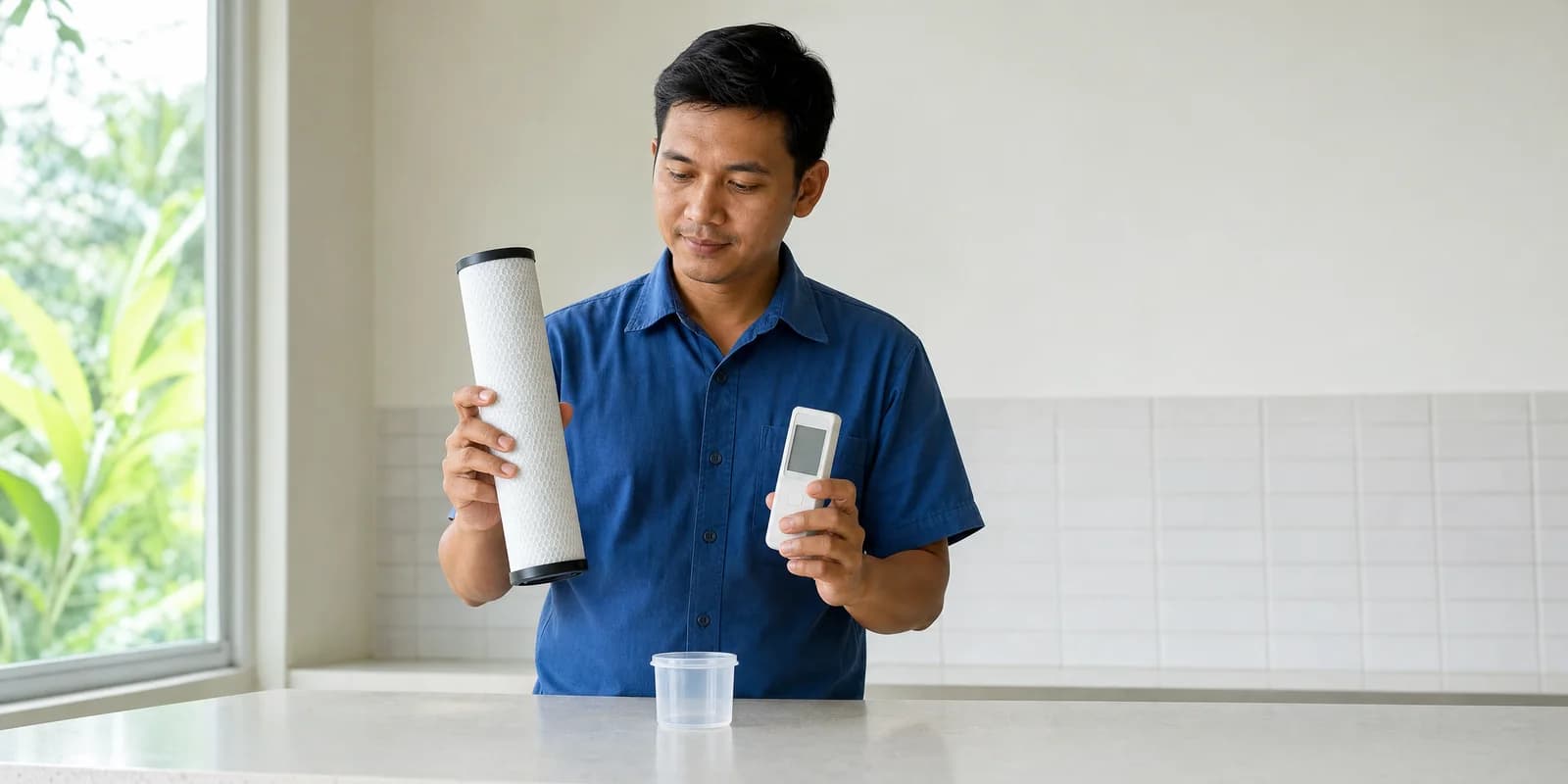
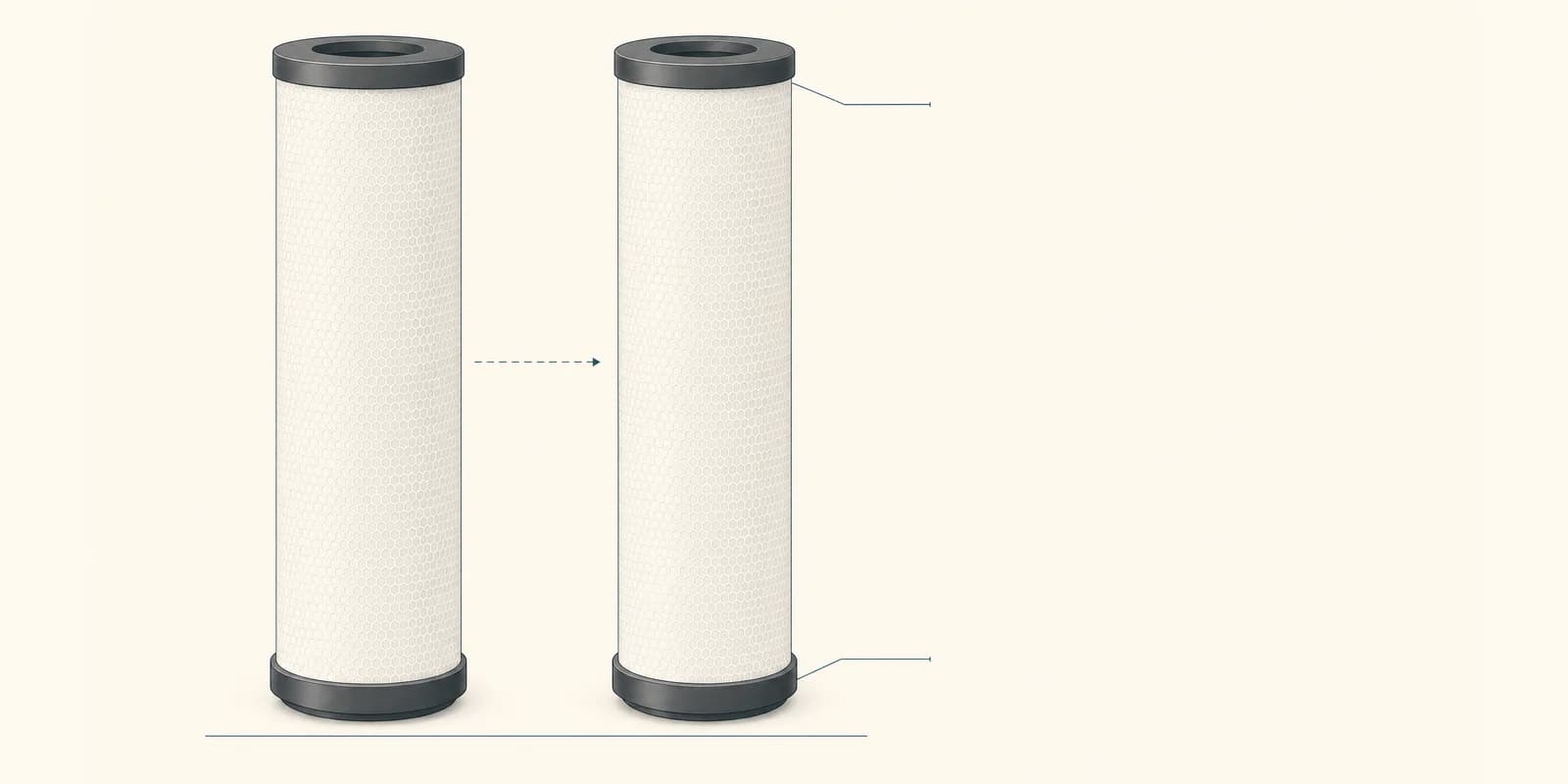
A carbon-block cartridge such as the Aquaphor B510 carbon-block replacement cartridges (B510-02, B510-03, B510-07) can make two kinds of claim[10], each shown by its own measurement (reasoning): a particle rating by the share of a stated particle size held back, and a chlorine reduction by the concentration of a named form of chlorine in and out at a stated flow[11], temperature and volume treated. Aquaphor names CarbFiber Block technology on B510-02 and B510-03, an ultra-dense fibrous carbon block on B510-07, and AQUALEN fibres on all three;[1][2][3] below, the B510 cartridges means these three parts.
The misreading is that a finer micron figure means more thorough treatment, and that the chlorine claim, the feature row Removes chlorine (value yes) and the description wording on two pages, is a rated reduction. Four questions follow: what limits the carbon, what each claim assumes, what the evidence proves, what to measure on site. The answers: neither printed claim is a result; the chlorine claim is open for monochloramine; no WQA or NSF listing was found under the names searched on 2026-10-02[19]; Aquaphor must supply any rating or reduction figure, with its terms.
Screening and quoting are in the application guide; the applied stage is in the reference design.

Two printed claims answer two different questions
Aquaphor words the particle sentence and the chlorine claim as statements about two different things. The sentences read "It filters particles down to 3 microns in size."[1] (B510-02), "It filters particles down to 5 microns in size."[2] (B510-03) and "It filters particles down to 0.8 microns in size."[3] (B510-07). The feature row reads Removes chlorine, value yes, on all three.[1][2][3] The B510-02 and B510-03 descriptions also say active chlorine and chlorine.[1][2] No page states a relation between the micron figure and the chlorine claim (the row or the description wording), so a finer figure is not shown to mean more thorough treatment and says nothing about a dissolved residual (reasoning).
Two independent sources describe the carbon step, neither of a block. Battenberg, an industry technical-support specialist writing in a 2018 trade journal about granular activated carbon beds (backwash filters and contactors), defines adsorption as a physical process "in the absence of a chemical reaction".[11] DuPont's FilmTec dechlorination excerpt (Rev 11, February 2026) prints C + 2 Cl2 + 2 H2O → 4 HCl + CO2 for an activated carbon bed in RO feedwater, carbon on the reactant side.[8] This article names no mechanism for the B510 cartridges. The misreading is that carbon removes chlorine by sticking to it; the check is Aquaphor's own account of how its block reduces chlorine, which no page read gives.
The three pages give AQUALEN three roles. On B510-02 Aquaphor says the ion-exchange fibres "deeply and irreversibly purify the water from heavy metals".[1] On B510-03 they contribute to "high sediment-holding capacity"[2] and allow it to "effectively remove colloidal and dissolved iron".[2] On B510-07 they "distribute the water flow in the ultra-dense filter medium",[3] and that page does not call the fibre ion-exchange. No page names a heavy metal, a concentration, a capacity or a test[1][2][3]; the B510-03 page names iron with no figure, capacity or test. No independent source on block structure or chelating fibres was retrieved. The misreading is that AQUALEN does one job on all three pages.
The carbon is finite, and what loads it shortens its life. A 2017 University of Missouri extension publication says a carbon filter loses effectiveness as it saturates and must be replaced regularly,[13] and Battenberg says sediment can plug granular carbon and shorten its service life.[11] Both are general statements about activated carbon; the pages read print no B510 life. One reading proves less than it seems: unchanged pressure across the stage. Saturation and plugging are different causes, and pressure across a block follows plugging by solids (reasoning), so a steady pressure does not show that the carbon still reduces the residual. The pages read print no B510 pressure drop; the check is an outlet residual test by form.
A chlorine claim holds at a stated flow
Per part, Aquaphor's three B510 pages print a particle sentence (3, 5 and 0.8 µm), the chlorine row and, on B510-02 and B510-03, description wording about chlorine.[1][2][3] Those pages, Aquaphor's index pages and its 2026 catalogue text layer, as retrieved on 2026-10-02, print no filter life, flow rate, pressure drop, temperature, dimensions, housing or certificate for these parts, the instructions index lists no document under B510, and four Aquaphor system instructions searched name none of them.[1][2][3][4][5][20] Every condition under which either figure would hold is a stated absence.
- B510-02SOURCEDParticle sentence: filters particles down to 3 microns in size. Chlorine word in the text: active chlorine. Feature row: Removes chlorine, yes. AQUALEN role: heavy metals, ion-exchange fibres. Silver: no sentence on the page.source
- B510-03SOURCEDParticle sentence: filters particles down to 5 microns in size. Chlorine word in the text: chlorine. Feature row: Removes chlorine, yes. AQUALEN role: sediment-holding capacity and colloidal and dissolved iron. Silver: no sentence on the global page.source
- B510-07SOURCEDParticle sentence: filters particles down to 0.8 microns in size. Chlorine word in the text: none, the feature row only (Removes chlorine, yes). AQUALEN role: flow distribution in the dense medium, not called ion-exchange. Silver: states silver in its active ionic form.source
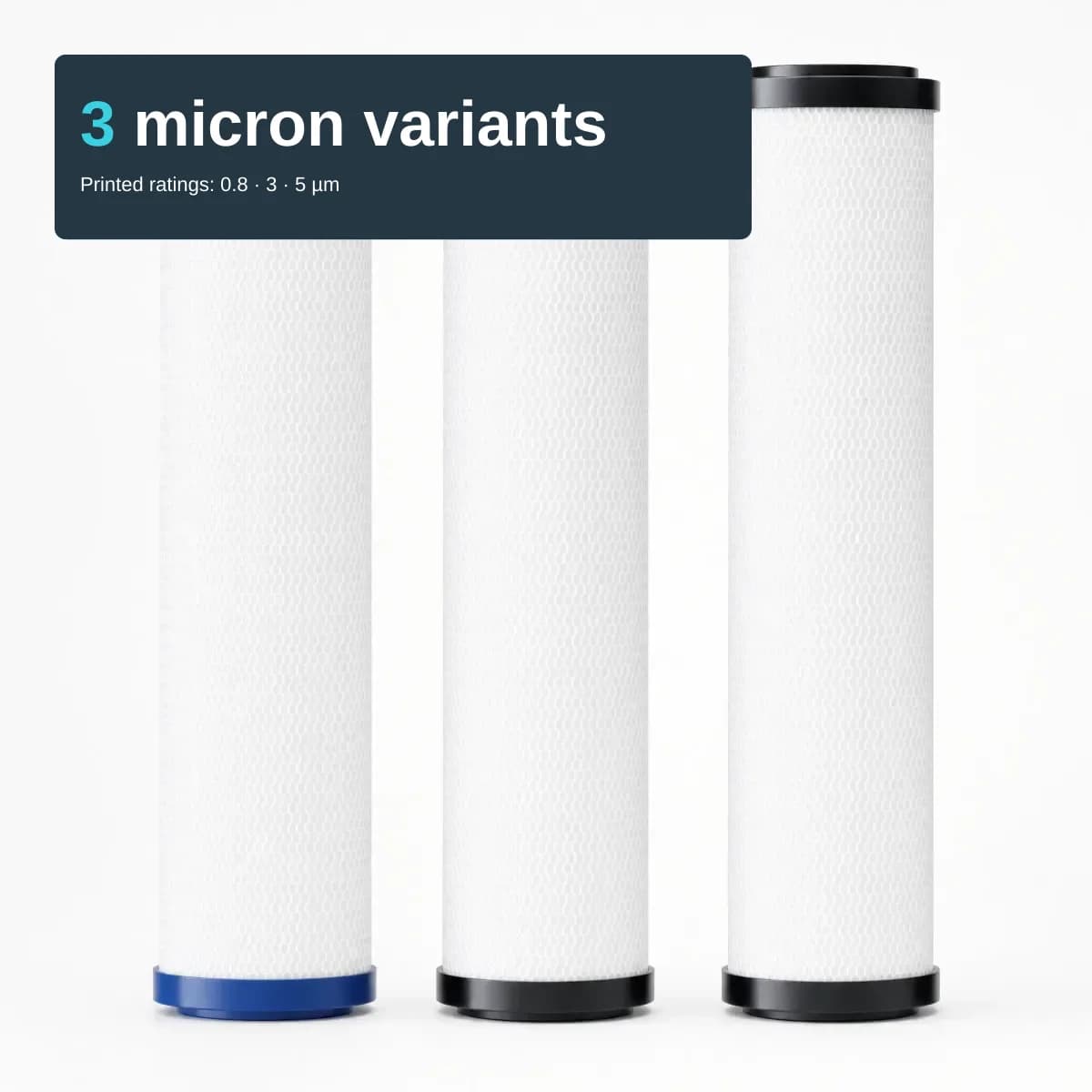
No indicator, sensor or controller is described in the pages read[1][2][3], so the pages give no way to read exhaustion from the cartridge itself (reasoning).
The micron sentence's form, filters particles down to a number of microns in size, gives no label (nominal or absolute), efficiency, method, flow or pressure. By number alone, 0.8 µm is the finest of the three printed ratings. [ASSUMPTION: the three printed ratings share one basis because Aquaphor uses one sentence form on all three pages. Valid unless Aquaphor says otherwise; invalid as a statement of any basis.] Aquaphor's Crystal manual states, for its K3 and K7 cartridges, "up to 5 microns"[17] and "larger than 0.8 microns",[17] another product's ratings by number, not a basis for this one. The misreading is that a rating holds on site as it reads on the page.
The chlorine claim assumes a target it does not name. Aquaphor's text says active chlorine on B510-02,[1] chlorine on B510-03[2] and on B510-07 has the row alone;[3] none is defined, no form, level, flow, temperature or test is printed, and no Aquaphor document read mentions chloramine[20]. The same row, value yes, is on B510-12, B515 PRO and B520 PRO, which print different filter lives,[6] so it is on six of six cartridge pages read and does not rank them. The misreading is that the chlorine claim is a rating. Singapore's PUB says "there is no need for any point-of-use water treatment or filtering devices to further treat the water"[14] and describes its residual chlorine as "in the form of monochloramine".[14] A buyer adds a stage for equipment protection or their own specification, and for that buyer the form is the question.
The coupled pair is flow against contact time. The trade-journal article states "EBCT is equal to the volume of the empty bed divided by the flowrate."[11] For a block of fixed volume, doubling the flow halves the contact time (derived here). The article adds that chloramine removal "requires more contact time with carbon"[11] and tabulates 1 to 2 minutes for free chlorine against 3 to 4 minutes for chloramines in granular activated carbon beds;[11] a block is not a bed, and no figure transfers. The pages read print neither the block's volume nor a flow[1][2][3], so contact time cannot be read off the pack. Lowering the flow raises contact time but cuts the flow at the tap (reasoning), so a claim stated at one flow is not stated at another; the check is to ask Aquaphor for the volume and the flow behind its chlorine claim.
DuPont states, for its FilmTec membranes, that eventual degradation may occur after approximately 200 to 1,000 hours of exposure to 1 mg/L of free chlorine, labelled 200 to 1,000 ppm-h.[8] With ppm read as mg/L (arithmetic only), hours are ppm-h divided by concentration and days are hours divided by 24 (derived here): 200 to 1,000 hours, or 8.3 to 41.7 days, at 1 mg/L. DuPont prints hours only at 1 mg/L; at 0.1 mg/L, assuming exposure is concentration times time (the meaning of ppm-h), the same arithmetic gives 2,000 to 10,000 hours, or 83 to 417 days. DuPont's data sheet for one household element prints a free chlorine tolerance below 0.1 ppm,[9] so 0.1 mg/L is that sheet's bound, not a tolerated state. A tenfold change in level moves exposure tenfold, so a chlorine claim with no level cannot say which line applies; the figures are illustrative.
No listing was found behind the B510 claims
On 2026-10-02 WQA's product-listing search returned no listing for the brand name and a transliterated spelling, and NSF's drinking-water-treatment-unit search returned no match for company name or trade name aquaphor.[19] None of the Aquaphor pages read states an NSF/ANSI, WQA, CE or food-contact certification for a B510 cartridge.[1][2][3] This says nothing about other names, other certifiers, pending applications or older listings. Two company-level lines are not product certificates: Aquaphor's home page cites ISO 9001: 2015 without naming a certifying body,[16] and its catalogue dates TUV and SGS certification of its products and production facilities from 2006.[5] Neither names a particular product, a certificate number or a scope, so neither reads as a B510 certificate.
NSF's leaflet, hosted on a US retailer's server, describes NSF/ANSI 42 as covering aesthetic claims, with chlorine and chloramines among its common claims as two separate claims, and an NSF-marked replacement element's mark as naming the standard, the model and the substance.[10] That is what a buyer could ask for, not evidence about the B510 cartridges, since even a listing holds at its own test conditions (reasoning) and a feature row is not a rated reduction.
Aquaphor's Crystal manual describes K3, K2 and K7 cartridges with the same micron ratings by number as the B510 parts,[17] and its RO-101S/102S manual a K2 cartridge;[18] neither names a B510 part, and no Aquaphor document read says the products are the same, so none of their figures is a B510 figure. No test report, field record or independent laboratory record for B510 was retrieved.
Four parties describe silver's role, none Aquaphor's for B510. Aquaphor's B510-07 page states "The replacement filter contains silver in its active ionic form."[3] with no purpose, amount or test; its Estonian regional page says the same for B510-03 and its global page does not, an unresolved conflict.[15][2] A Latvian online retailer's listing says silver is there "as a bactericide",[7] Aquaphor's Crystal manual says of its own technology that active silver is used "as a bactericide".[17] The Missouri publication says US EPA registers such filters as bacteriostatic and that one "is not adequate to treat water that is microbially unsafe".[13] A 1990 University of Kentucky bulletin reports studies where silver-impregnated carbon "made little difference"[12] to heterotrophic plate count (HPC) bacteria, with lower counts only "in the first month of use".[12] Both extension passages are US, dated and about silver-bearing carbon filters; silver amount, release and rules in Singapore, Malaysia and Indonesia were not researched. The misreading is that the silver sentence says what the silver does.
A clear, odour-free sample after fitting a new cartridge is an ambiguous signal. The Kentucky bulletin describes activated carbon as intended to remove "organic compounds that impart taste, odor or color",[12] and NSF/ANSI 42 groups chlorine with taste and odour as aesthetic claims,[10] but a taste change is an aesthetic reading and not a residual measured by form (reasoning): organics may be reduced while the residual is unchanged; the check is an outlet residual test by form.
Site proof needs paired readings and written terms
By this article's rule, a chlorine reduction is reproducible only if the figure carries the form (free chlorine or monochloramine), the levels in and out in mg/L, the flow in L/min, the temperature in °C, the volume treated in litres and the method; NSF's separate chlorine and chloramine claims[10] and Battenberg's flow and contact-time identity[11] are its supports. The pages read print none of these for the chlorine claim (the row or the description wording), so the question is whether the claim covers monochloramine, at what residual, flow and temperature, by what test. By the same rule a particle rating needs its label (nominal or absolute), efficiency at that size, method, and the flow and pressure at which it holds; no source read defines a cartridge rating, and the pages read print none for 3, 5 or 0.8 µm.[1][2][3]
A low free-chlorine reading at the outlet is an ambiguous signal. A free-chlorine method reports one form, and PUB describes the residual in its supply as monochloramine,[14] so a low reading before and after the stage says little about the form present (reasoning); no source read establishes how such a method reads on this supply. The misreading is that a free reading proves the stage works. The check is a method that reports the form present, on paired same-time samples at inlet and outlet at the duty flow and temperature, as the reference design applies it to acceptance.
Holds: a particle sentence (3, 5 or 0.8 µm) and a chlorine row per part (and chlorine wording on two), three AQUALEN roles, silver on B510-07 (and on B510-03 on one regional page), finite carbon and flow-set contact time. Not shown by the pages read: a micron figure as retention efficiency or as a ranking of treatment, the chlorine claim as a reduction rating or as coverage of monochloramine, silver as a statement of its function, ISO 9001 or TUV and SGS as product certificates, a K-series figure as a B510 figure, any certification found, or any mechanism for the block.
To start, send Purionex the part number, the supply's residual form and measured level, the line pressure, the duty flow and the temperature. Terms to agree in writing, which a Purionex quote request carries as questions to the maker or its channel (any written answer received is passed on; none is promised): the chlorine claim's coverage and test; the particle rating's label, efficiency and method; the metals and iron covered and their test; the purpose and amount of silver in B510-07 and whether B510-03 contains it; any listing or certificate; and, asked of whoever quotes, whether the quoting party is an authorised channel for the product in the buyer's market.
Aquaphor B510 Carbon-Block Cartridge
No certifications listedView product →Sources
- [1]Aquaphor - B510-02 product page (global site, retrieved 2026-10-02) - particle sentence, AQUALEN sentence, chlorine row
- [2]Aquaphor - B510-03 product page (global site, retrieved 2026-10-02) - particle sentence, AQUALEN sentence, chlorine row, no silver sentence
- [3]Aquaphor - B510-07 product page (global site, retrieved 2026-10-02) - particle sentence, AQUALEN sentence, silver sentence, chlorine row
- [4]Aquaphor - replacement cartridges index pages (retrieved 2026-10-02) - scope of the unpublished-envelope clause
- [5]Aquaphor - Product Catalogue 2026 (text layer) - scope of the unpublished-envelope clause; TUV and SGS company-level sentence
- [6]Aquaphor - B510-12, B515 PRO and B520 PRO pages (contrast set) - the same chlorine row on other cartridge pages
- [7]A Latvian online retailer's listing for a B510 set (fallback, not Aquaphor) - the word bactericide for the silver
- [8]DuPont Water Solutions - FilmTec Chlorination/Dechlorination manual excerpt (Rev 11, February 2026) - free-chlorine exposure and the carbon-bed reaction
- [9]DuPont Water Solutions - FilmTec TW30-1812-100HR product data sheet (Rev. 8, December 2022) - free chlorine tolerance line of one household element
- [10]NSF International - NSF/ANSI 42 and 53 leaflet (retailer-hosted copy) - claim scope and replacement-element mark
- [11]Battenberg, Activated Carbon: Filtration, Contactor or Both? (Water Conditioning & Purification, June 2018) - adsorption, contact time, sediment
- [12]University of Kentucky - IP-6, activated carbon filters (issued 1990) - taste and odour, silver and HPC bacteria
- [13]University of Missouri Extension - EQ104 (2017, US) - carbon saturation, silver filters registered as bacteriostatic
- [14]PUB (Singapore) - clarification on misleading claims about tap water - monochloramine residual and the no-filter statement
- [15]Aquaphor - Estonian regional page for B510-03 (retrieved 2026-10-02) - silver sentence absent from the global page
- [16]Aquaphor - home page quality statement (retrieved 2026-10-02) - the ISO 9001 company-level sentence
- [17]Aquaphor - Crystal operation manual (K-series cartridges; a different product) - ratings wording and the silver sentence
- [18]Aquaphor - RO-101S/102S owner's manual (K2 cartridge; a different product) - names no B510 part
- [19]WQA product-listing searches (three keywords) and NSF drinking-water-treatment-unit searches (company name and trade name), run 2026-10-02, with controls - no listing under the names searched
- [20]Search of four Aquaphor system instructions and of the instructions index for B510, run 2026-10-02 - no hit