The question a farm asks first is how much water a container can treat. WaterDoctor's statement, confirmed internally on 2026-09-30 and not published on its website, is that "one SND container can treat more than 10× its own volume of water".[3] That is a ratio to the container's own volume, and WaterDoctor publishes no container volume, no time basis and no influent quality,[3] so it cannot decide fit. What decides fit is the nitrogen the water carries, in kilograms of nitrogen per day from a flow and a concentration measured in the same water; the solids arriving with it; and where the container connects: the main loop, a side-stream or the collected effluent. The guide can end in four answers: a side-stream trial of this container; optimise the existing solids capture or biofilter first; this container at a named connection point with the guards that connection needs; or not this product. Most limits are unpublished, so they become questions for the quote. A tilapia side-stream reference design works one connection end to end.
Tell solids, biofilter and nitrate problems apart
Water volume and nitrogen load are different quantities. Two farms with the same daily flow can need very different biological work, because load is flow multiplied by concentration; the fit question is the load, and the flow figure comes after it.
These discriminations are general water-treatment reasoning, not WaterDoctor statements [ASSUMPTION: general reasoning, not from a cited source; each is a screening rule for what to check first]. Cloudy water, or solids in the sample, means particles that need mechanical capture; the check is suspended solids in mg/L and turbidity in NTU as two series against feeding and filter-cleaning dates. Ammonia and nitrite peaks after feeding point at the existing biofilter's capacity or conditions; the check is its dissolved oxygen, pH, alkalinity, temperature and retention time. Low ammonia with nitrate still climbing means nitrification is working but nitrogen is not leaving the water; the check is total nitrogen. Only the third asks for more nitrogen removal; the first two have fixes on the existing system to rule out first.
When nitrate keeps climbing, check organic carbon and dissolved oxygen before blaming any equipment. Authors of a 2020 study of a different route, simultaneous partial nitrification, anammox and denitrification (SNAD), in recirculating aquaculture water say low organic carbon and high dissolved oxygen are why efficient nitrogen removal in aquaculture systems "is still a challenge", and their abstract reports effective removal under high dissolved oxygen.[1] That is a reason to check two conditions, not a caution against simultaneous nitrification–denitrification or evidence about this container; the mechanics article covers what the studies show.
Read trends, not single samples: compare feeding peaks, filter cleanings and temperature changes. Nitrate can rise because less make-up water is diluting the tank, or because two laboratories report on different nitrogen bases, so keep make-up and drain volumes and sample times beside every result.
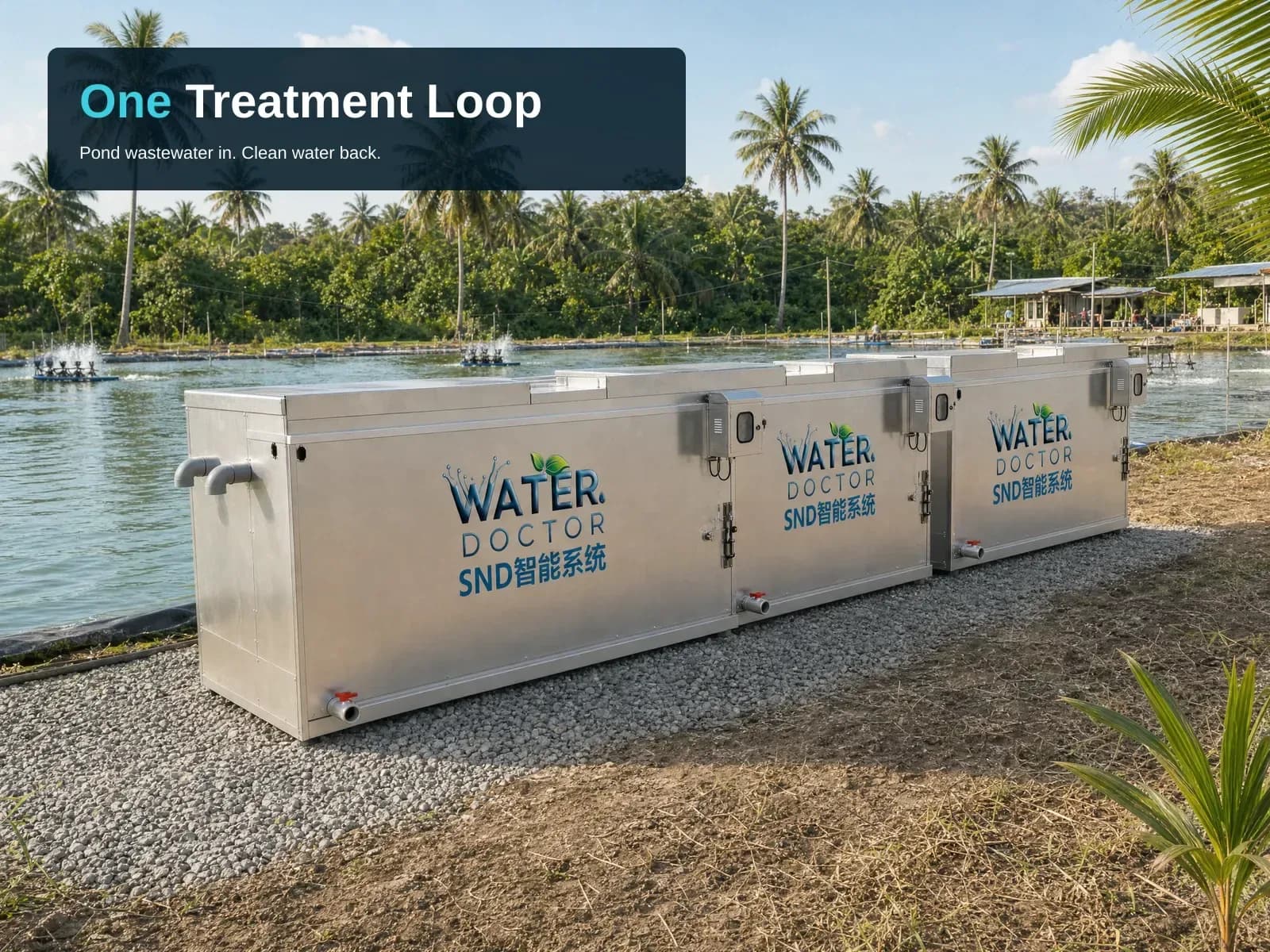
In a main loop, fish safety comes first. In a side-stream, the loop's hydraulic exchange rate must be known. For collected effluent, the discharge or reuse destination and its end-point parameters come first. WaterDoctor's copy labels the incoming water "Pond Wastewater"[2] and does not distinguish main-loop, side-stream and effluent duties, and one label for all three duties makes quotes hard to compare unless the connection point is stated.
To rule in or out: species, stage, salinity and source water. To size: pond or loop volume, feed, make-up and drain volumes, design and peak flow, and laboratory results for total ammonia nitrogen (TAN), nitrite-N, nitrate-N, total nitrogen (TN), COD, pH, alkalinity, temperature and solids. To fit: power, area, lifting access, pipe diameters, sludge destination and staffing. This is an engineering minimum, not a WaterDoctor requirement.
Report nitrogen as N: nitrate as the ion is 4.43 times nitrate-N (62 ÷ 14), so 44.3 mg/L nitrate ion is 10 mg NO₃⁻-N/L, and entering the ion figure as N overstates a load 4.43 times. Turbidity in NTU is an optical reading, not suspended solids in mg/L; the two are not interchangeable and are not converted without a site-specific correlation.
Size by nitrogen load, not volume ratio
The order is published limits, then nitrogen load, then hydraulics, then fit, because arithmetic on a unit that a limit excludes is wasted. In the site copy read for this guide, WaterDoctor publishes no species, salinity, temperature, pH or influent limit, so each becomes a question the quote must answer before any sizing, not a box the farm passes.
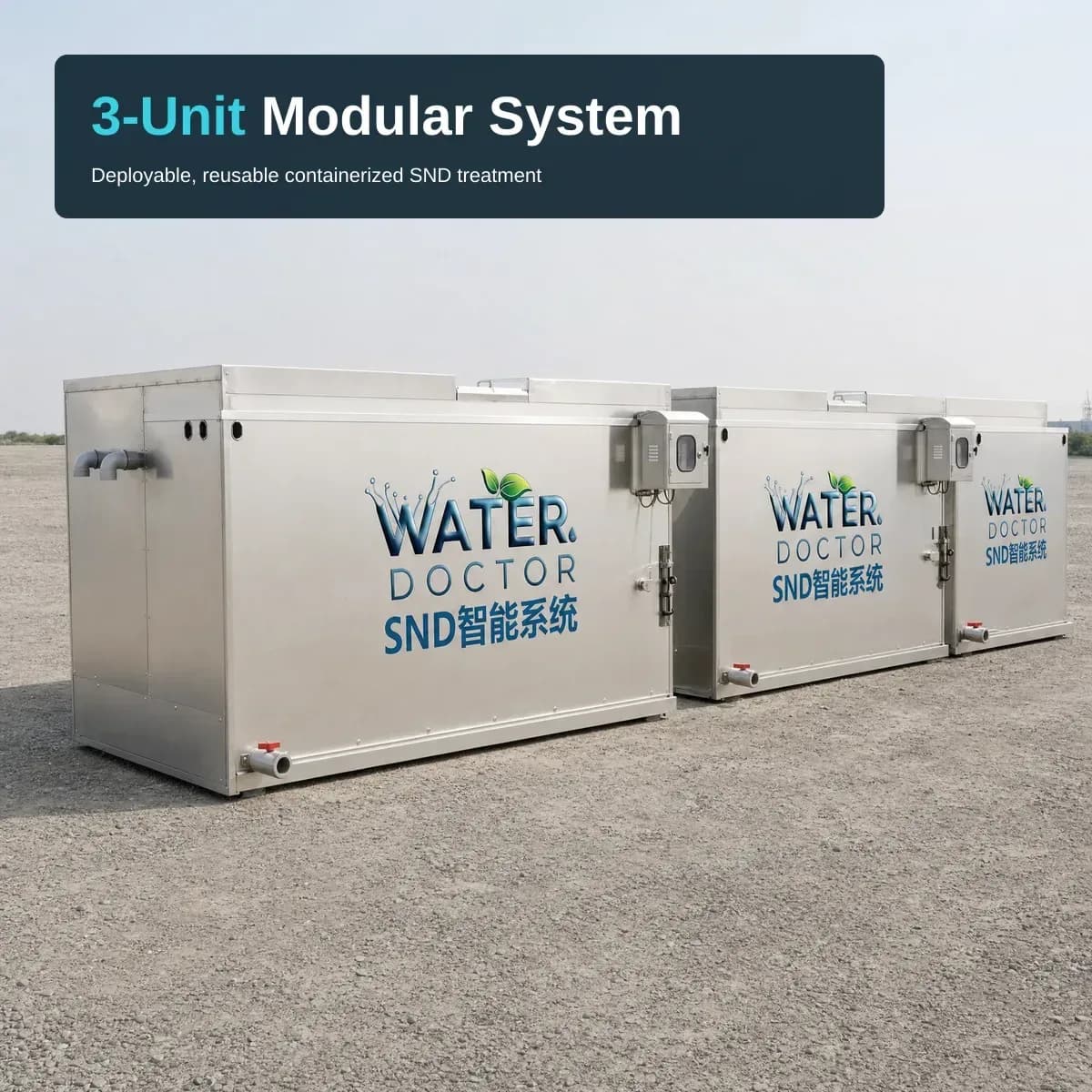
A ratio of the container's own volume is not a nitrogen capacity, and the statement leaves out three things. It has no time basis, so a ratio of ten or more may describe a batch, a day or an hour; that basis is a quote item. It has no container volume, so the ratio cannot become cubic metres without WaterDoctor's figure. It names no influent quality.[3] The three units are published as stages in series, "Initial filtration & SND bacteria"[2] in Unit 1, "Active SND biological process"[2] in Unit 2 and "Final purification & quality check"[2] in Unit 3, so they are not three parallel modules. WaterDoctor's site gives a footprint of 5 m² per unit;[2] 3 × 5 = 15 m² is arithmetic, not a published total. [ASSUMPTION: a 100 m³ volume and the concentrations 2 and 10 mg N/L; arithmetic only.] Then 100 m³ holds 100 × 2 ÷ 1000 = 0.2 kg N at 2 mg N/L and 100 × 10 ÷ 1000 = 1.0 kg N at 10 mg N/L, a fivefold difference from the same volume.
The working quantity is mass load: removal in kg N/d = flow (m³/d) × concentration difference (mg N/L) ÷ 1000. [ASSUMPTION: a 100 m³/d stream and a target reduction of 10 mg N/L; arithmetic only, not a rating and not a prediction for this container.] These inputs give 100 × 10 ÷ 1000 = 1.0 kg N/d. The formula holds only when the flow and both samples describe the same water over the same window, and it must use total nitrogen, not ammonia alone, because an ammonia fall can be nitrate rising in its place.
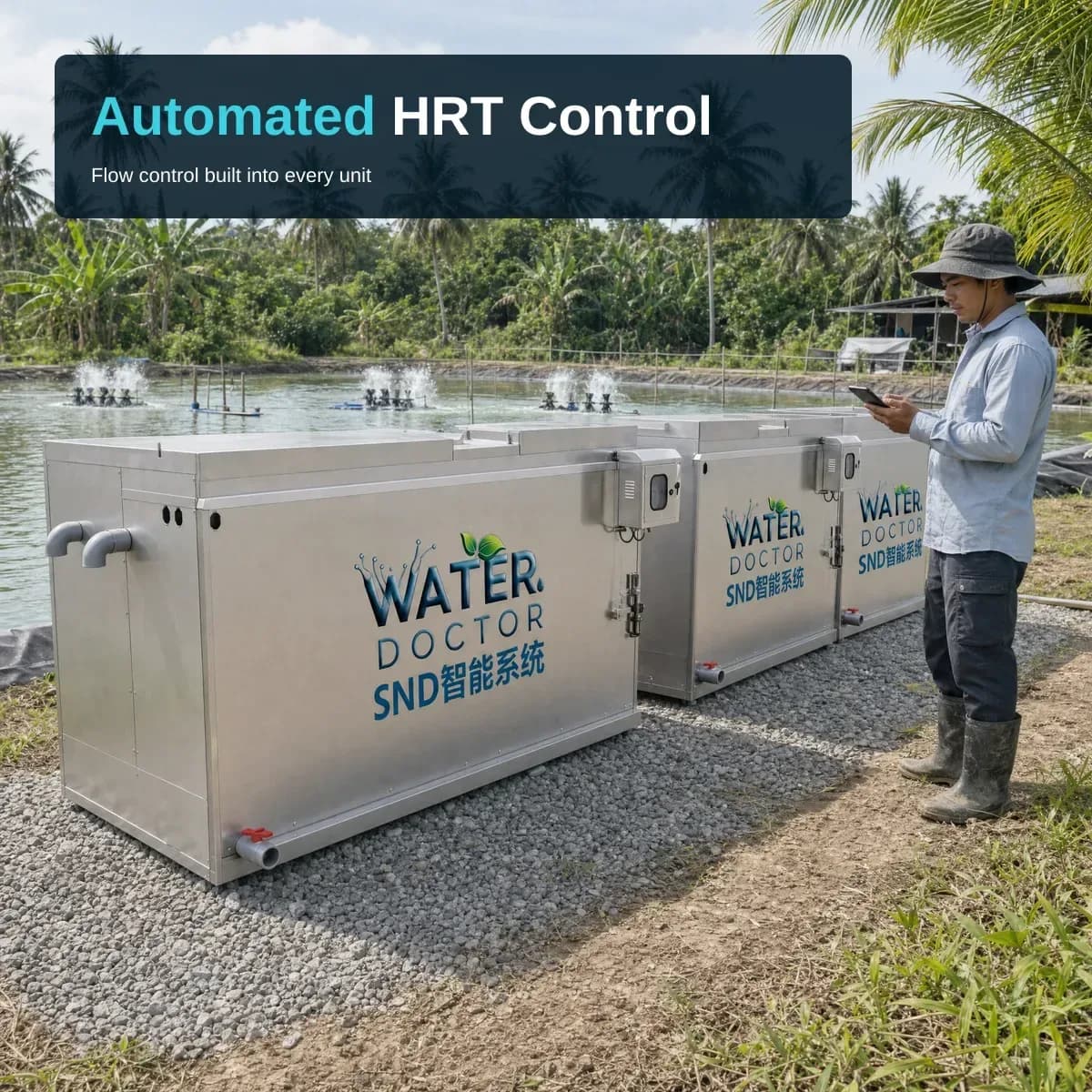
Hydraulic retention time (HRT) is the effective reaction volume divided by the flow through that unit. The container's outer volume is not its effective volume, and WaterDoctor publishes no volume, so HRT cannot be computed from the 5 m² or the volume ratio. WaterDoctor lists "Automated hydraulic retention time (HRT)" under Flow Control without a value or a range.[2] Halving the flow through a unit doubles its HRT at a fixed volume, so a higher flow buys daily load at the price of retention time, and it delivers more solids as well. Both arms are unpublished, so no numbers are given. In a side-stream, the flow through the unit is the diverted flow, not the loop flow.
Call one train Units 1 to 3 in series, as WaterDoctor's flow shows them. The count is the design peak load divided by the removal one train achieves on the farm's water, rounded up, and the margin is (rated − demand) ÷ rated. WaterDoctor publishes no removal per train, so the worked run stops at not yet: the count needs WaterDoctor's written rate at the farm's water, or a measurement from a side-stream trial. Whether trains share one control, or whether Unit 1 is offered where the farm already captures solids, is unpublished too.
No rating with a stated basis is published, and so no derating, no turndown and no minimum flow either. The freshwater and saltwater captions on WaterDoctor's bacteria page concern the bacteria, not the hardware's materials.[2] The absence is a gate, not permission: the quote must state the conditions its figure holds at.
Fix the connection point first
Connection point decides what the container risks, which guards it needs and where the mass balance can be measured. The three options below are this guide's option set, not WaterDoctor configurations: its site describes pond water in, three units and water "Back to pond", with no bypass, divert, valve list or P&ID.[2]
Main loop. Advantage: it treats the water the fish live in, so tank quality responds most directly. Blind spot: the container now sits in the fish's life-support path, so a blockage, trip or restriction reaches the tanks. The farm therefore needs isolation valves, a bypass pipe able to carry the loop while the container is off, and a guard on the outlet before water returns to the tanks, with the container after the existing biofilter and a sample port at its outlet. The bypass is the farm's pipe, not a WaterDoctor item. WaterDoctor does not publish what Unit 3's "quality check"[2] measures or what happens to water that fails it, so the guard's trigger and action are the farm's design. This option does not solve solids overload, and the air pumps are published as "Oxygen supply for SND bacteria", not as tank aeration.[2]
Side-stream after the existing biofilter. Advantage: the main hydraulics stay intact and the branch is isolated by closing two valves, which makes it the natural place to prove the process. Blind spot: the branch's removal, q × ΔC ÷ 1000 with q the diverted flow, has to exceed the measured rate at which nitrogen enters the water, or nitrogen accumulates. The number that settles it comes from WaterDoctor in writing or from the trial; none is published. An outlet guard still checks branch water before it rejoins the loop, but no bypass is needed: closing the two valves leaves the loop running. The branch also cannot answer a sudden ammonia or nitrite spike in the tanks, because only part of the loop passes through it each day.
Collected effluent. Advantage: the fish are not in the path, and inlet and outlet composites at one point, with the effluent flow metered over the same window, give the cleanest mass balance at the point that meets a discharge target. Blind spot: it is end-of-pipe, so nitrate keeps accumulating in the tank, and effluent flow can be intermittent and solids-heavy, which may strain Unit 1 [ASSUMPTION: Unit 1's solids capacity is not published], whose solids route is also unpublished. WaterDoctor's published flow returns water to the pond and shows no discharge path[2], so the destination, the buffer volume and the divert-or-hold arrangement are the farm's design.
Because none of the three is published, the interface list is a quote item for every option: who supplies isolation, bypass, sample ports, the sludge and drain route, and the trigger of the outlet guard. Read a volume-ratio quote by asking for the container volume, the time basis, design influent range, expected effluent, peak flow, effective volume, power, carbon or chemical demand, consumable cycle and civil interface. WaterDoctor's figure starts the enquiry and is not a guarantee for this farm; the conditions any published figure must carry are set out in the mechanics article.
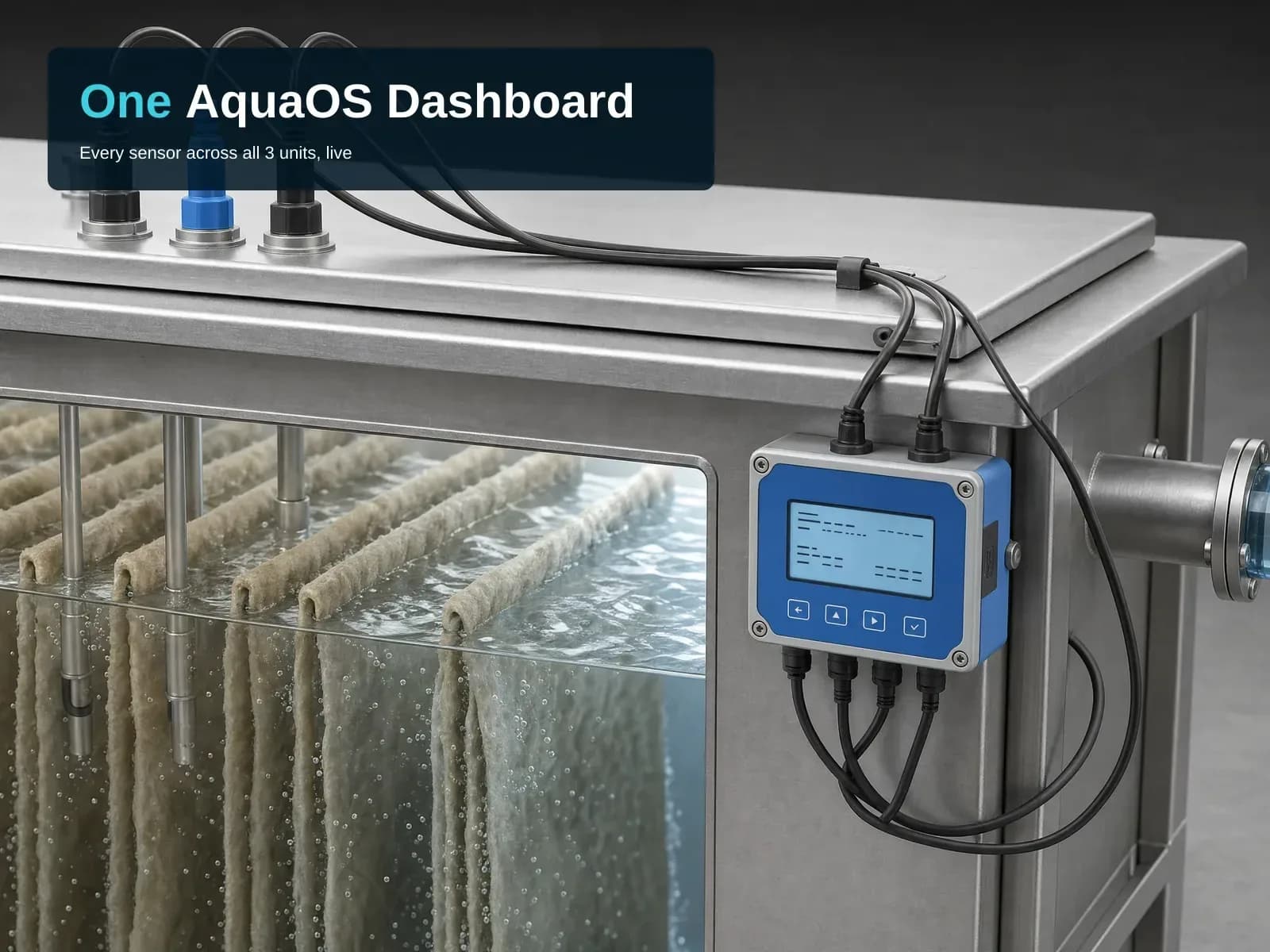
The AquaOS platform copy lists "dissolved oxygen (DO), temperature, pH, ORP, ammonia, nitrate, turbidity, suspended solids (SS), and algae", with no nitrite and no total nitrogen.[2] The container copy says only "10+ water parameters per unit" and names none,[2] so ask which sensors each unit carries and what ammonia means, TAN or NH₃. Nitrite and total nitrogen are treated in this guide as sampled laboratory measurements. AquaOS "triggers SND dosing, controls air pumps";[2] manual override and behaviour when the network or power drops are not published. Whether it heats or cools is unclear: WaterDoctor's copy says "temperature control"[2] in one line and "Real-time thermal monitoring" in another.[2] Certification, warranty, datasheet, dimensions, power, origin and price are also quote items.
Trial first, and know when to stop
When the data is thin, a side-stream trial comes before scale-up. WaterDoctor publishes no trial unit, so availability is a quote question. Agree the trial water source, daily run hours, any carbon addition and how feeding is logged. Keep the original system as the safeguard, and cover start-up, a normal load and if possible a peak or a planned filter cleaning. Record inlet and outlet, flow, aeration hours, power, drain and sludge, so that biological removal, physical capture and dilution can be told apart. A trial's success does not scale by volume ratio: effective volume, distribution, aeration and drain are re-derived at full size.
Proof is mass load in the same water over the same window, on total nitrogen, across low, normal and peak feeding. WaterDoctor publishes no calibration, consumable, dosing or sludge interval, so the maintenance regime is a quote item. Repeat the data pack and the mass load whenever species or stage, feed, salinity, temperature, season or connection point changes; a late re-test means the old load is quietly used for new water. Two results mislead: a removal percentage from one sample pair, and an ammonia fall while total nitrogen has not moved.
The right reply is not a price in seven cases. Not this product, or optimise first:
- The problem is solids. Solids need mechanical capture and coat biofilm (reasoning offered here), and Unit 1's filtration is unspecified. Next: fix capture, then re-measure.
- The existing biofilter is under-performing for fixable reasons, its oxygen, pH, alkalinity or retention. Next: correct those, then re-measure.
- The problem is not nitrogen but, for example, tank oxygen or carbon dioxide. Next: address the variable that is failing.
Not yet:
- There is no flow measurement and no laboratory TAN or TN series. Without them the mass load cannot be computed. Next: run a measurement campaign.
- A main-loop connection is wanted without a bypass pipe and a guarded outlet. A fault would sit in the fish's water path, and WaterDoctor publishes no failure behaviour. Next: redesign, or start as a side-stream trial.
- The supplier cannot give the container volume and time basis behind a volume ratio, the effective volume or the design influent range. Next: repeat the request with the volume-ratio quote questions.
- The discharge or return target is not a measurable parameter. What Unit 3's check measures is unpublished, so the target cannot be borrowed from it. Next: set the end-point parameter first.
A sendable enquiry carries the data pack above, the connection point wanted and the target. A competent reply gives the design load in kg N/d, the number of trains and the margin as (rated − demand) ÷ rated, the retention time, sample points, the interface split, lifecycle items and a trial plan. It may conclude optimise first, not yet or not this product.
SND Container System
No certifications listedView product →Request a Quote for the SND Container System with this data pack and ask for the items above.
Sources
- [1]Lu J, Zhang Y, Wu J, Wang J (2020), Bioresource Technology 305:123037 — SNAD bioreactor in recirculating aquaculture water (abstract only; PubMed record)
- [2]WaterDoctor website English copy (technology.json, common.json and projects.json i18n message files; site source copy, not the rendered page) — SND Container System, AquaOS and SND Bacteria blocks
- [3]WaterDoctor — internal confirmation of SND Container System capacity (2026-09-30), not published on the website