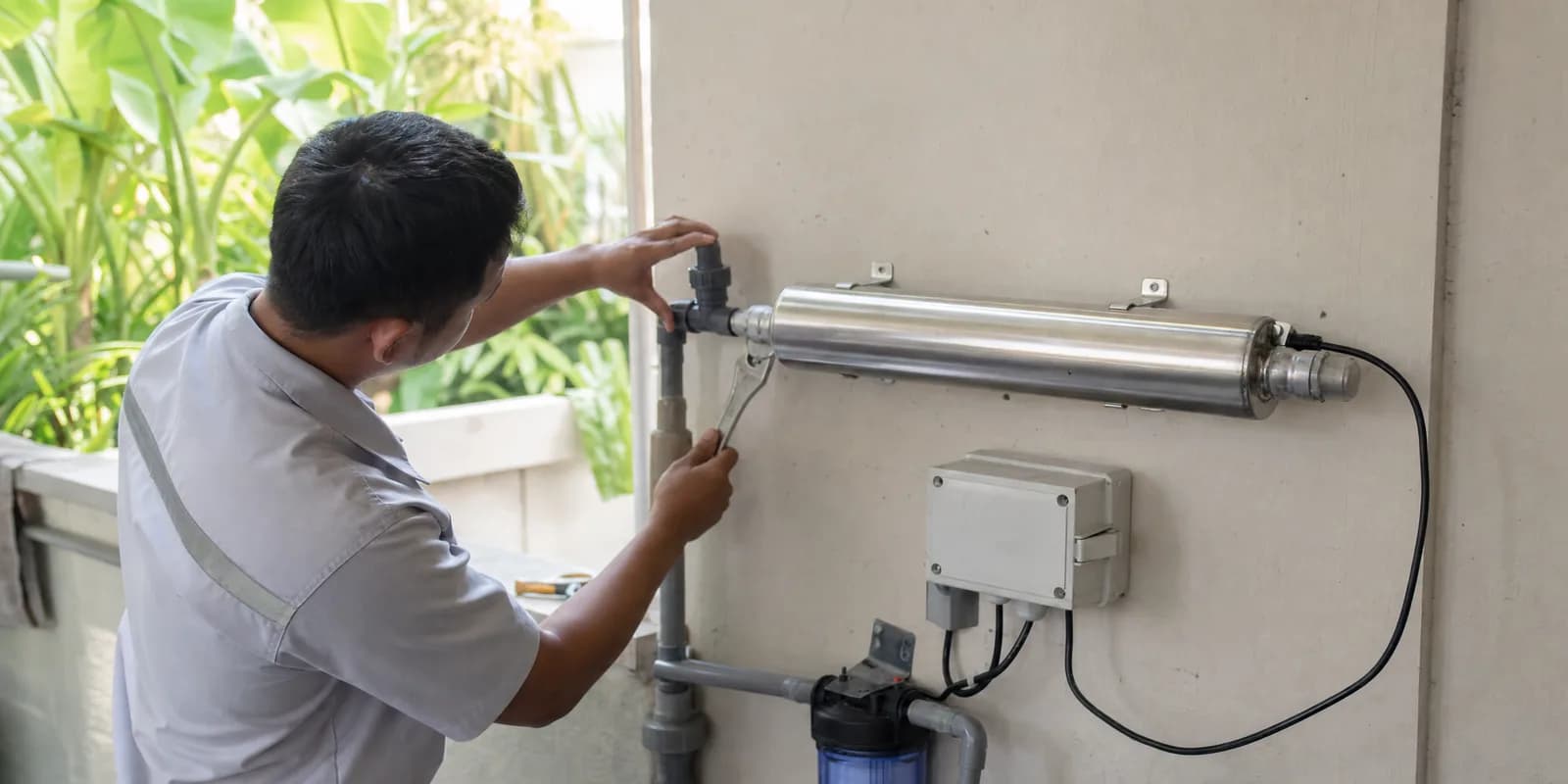
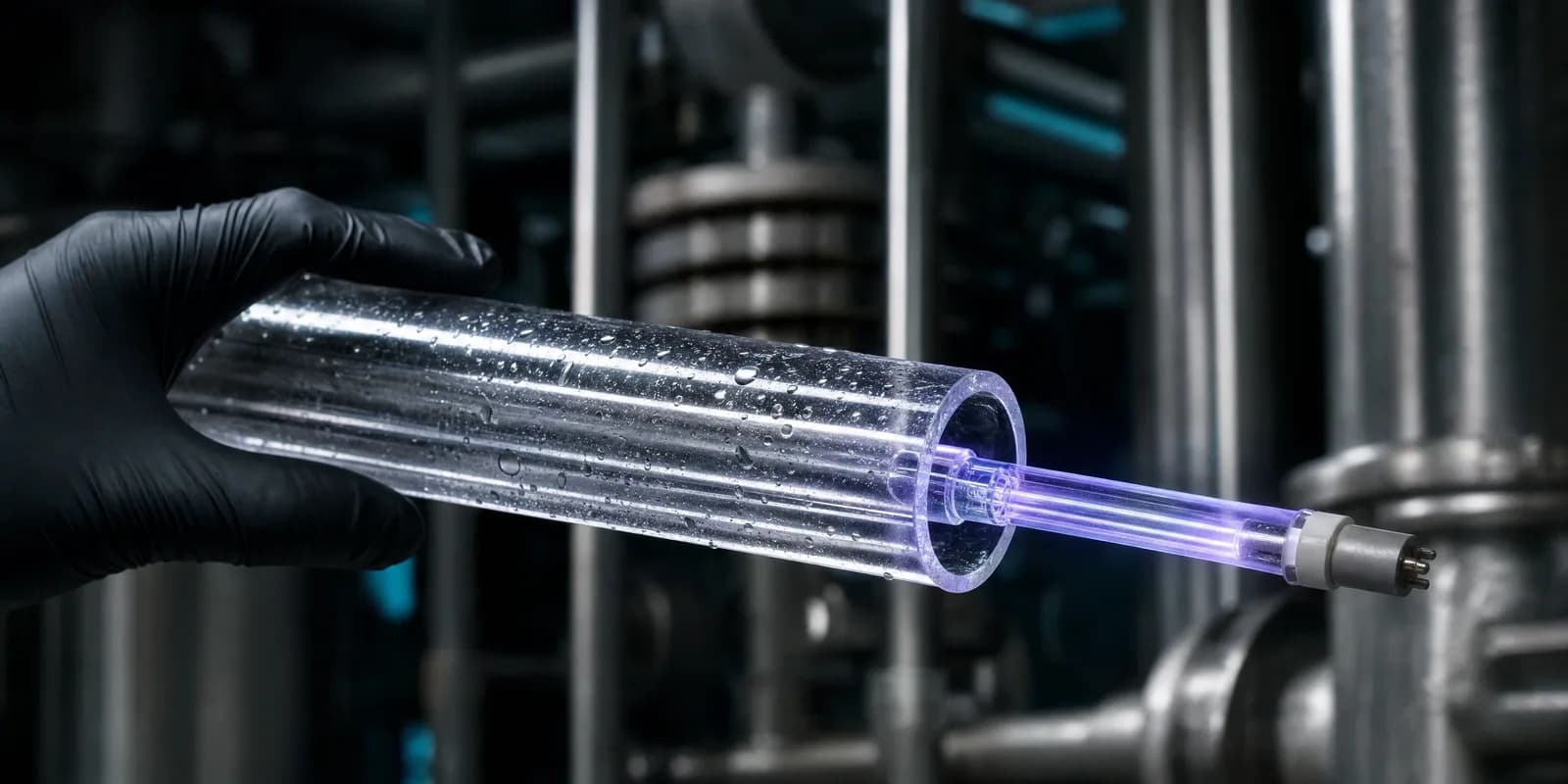
This reference design shows how one Viqua VH410-F22 UV system could be configured as an added disinfection step at the cold-water entry of a small facility on Singapore supply, for a design peak demand of 8 gpm (30.3 L/min, 1.82 m³/h) that arrives in bursts with many hours of no flow between them. Fit does not rest on a duty label such as light commercial (in the title, the design's assumed duty class, not a Viqua use), or on the 18 gpm on the product card. It rests on peak flow against the lowest printed component rating, on a chamber that Viqua says can become very hot (about 60 °C) after extended periods of no flow, which an intermittent draw may produce, on water that, as far as the documents read show, keeps flowing if the lamp fails or power is lost, and on a unit whose listed features observe neither dose nor how much UV light the water passes (its UV transmittance, UVT). This reference design can end in a fit, with Viqua's written dose answer in hand, or in not this product, for the reasons in section 5. Engineers and integrators drafting a request for quotation can use it to frame questions for Viqua and set acceptance checks. It is a hypothetical configuration built from a product listed in the Purionex catalog and from published sources, with no installation or measured result behind it.
The VH410-F22 and its stated uses
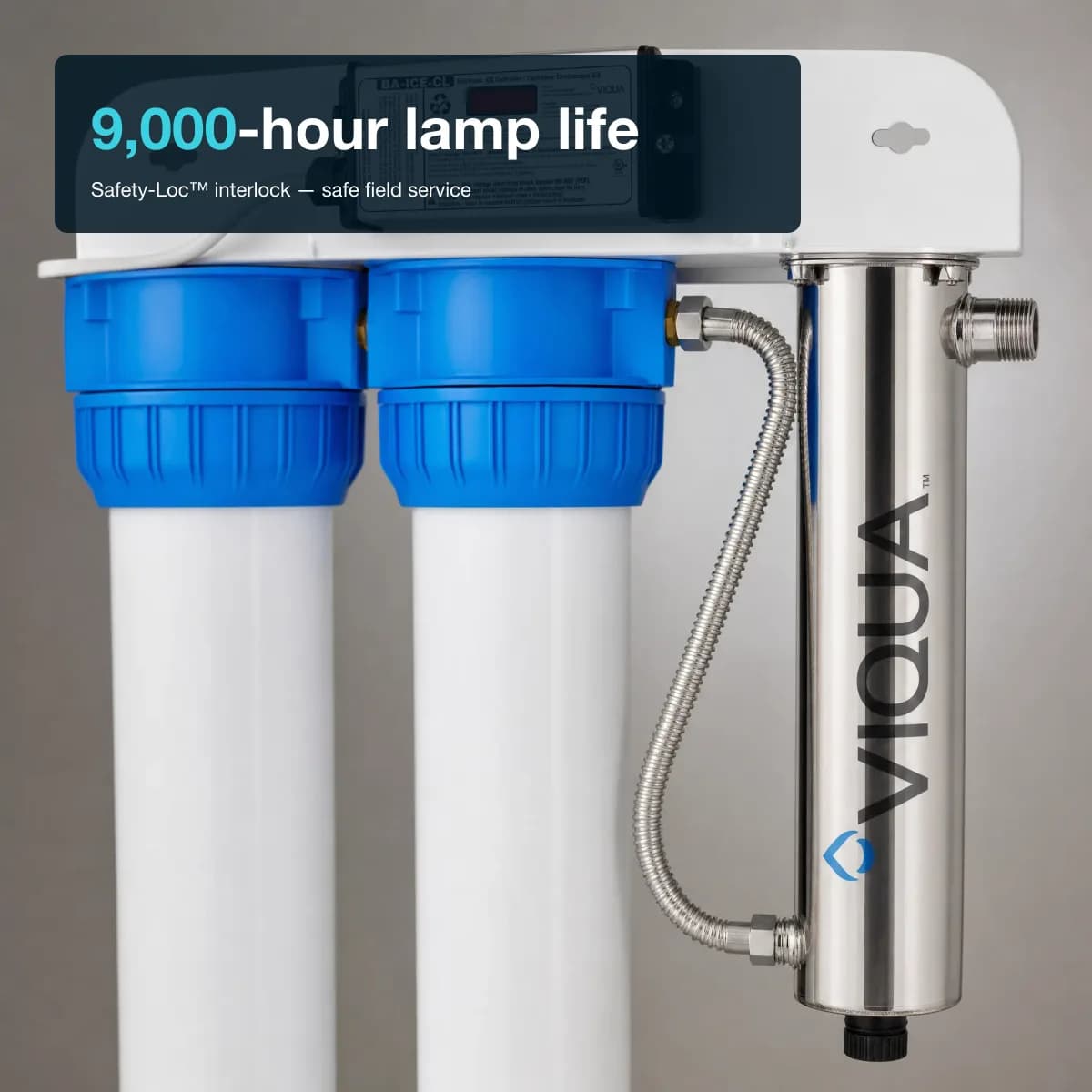
Viqua describes the VH410-F22 as "Whole Home Integrated UV Water Treatment"[1], a UV chamber with two 20 in filter sumps from its HOME family.[4] Its phrase "Premium three-piece filter housing for easy removal of the sump"[1] reads as a feature of the sump; the manual's Figure 7 and parts table show two sumps and a separate chamber, read from page images.[13] The UV dose mechanics article covers how UV inactivates organisms; this section stays on what the product is.
- UV chamberSOURCED304 stainless steel; 45 W high-output lamp S410RL-HO; quartz sleeve QSO-410; controller BA-ICE-CLsource
- Sediment sumpSOURCEDHolds a CMB-520-HF cartridge, 5 micron inner and 15 micron outersource
- Carbon sumpSOURCEDHolds a C2-02 cartridge, 10 micron, described by Viqua as for taste and odoursource
- PortsSOURCED3/4 in FNPT inlet; 3/4 in FNPT / 1 in MNPT outletsource
- Supply and waterSOURCED100-240 V, 60 W; water 2 to 40 °Csource
- Controller signalsSOURCEDPower on and lamp life remaining shown; lamp-failure and replacement alarms sound; the manual lists no 254 nm monitor and no solenoid outputsource
- Family and sheetsSOURCEDThe sump sheet covers the VH200-F12, VH410-F12 and VH410-F22; the VH410-F12 and VH410-F22 print the same three dose-flow rows and differ at least in the sediment housing (10 in against 20 in) and the sediment cartridge, both on the sump sheetsource
- Optional parts on the sheet's diagramSOURCEDBy-pass assembly, temperature management valve, flow restrictor, water softener; the sheet's parts list names none for the F22source
- Variants in the manual's footnotesGAP/2 for 230 V; /WR with BSPT connections; which are supplied for Singapore is not stated in the documents readsource
The F22 sits in Viqua's HOME family of compact UV systems with integrated prefiltration.[4] The model prefixes VH200 and VH410 suggest two reactor sizes, which no document read states. Viqua's validated (-V),[6] sensored (M)[5] and Professional[3] lines are other products, not options here, and no document read defines the -F22 suffix, so the composition is stated as printed. The manual recommends the by-pass for off-line maintenance, names the temperature management valve as the remedy for a hot chamber, and requires a restrictor on validated (-V) and WaterMark systems.[13]
Viqua's sheet offers systems at 9 to 18 gpm for "homes or small businesses"[4], and its Whole Home page calls its point-of-entry UV systems (the Arros and HOME families) ideal for anything from small homes and cottages to "larger homes and light commercial applications"[2]. The homepage puts "High-performance UV systems for large homes and light commercial"[3] under Professional, and the sheet's introduction says "virtually any residential application"[4]. These sentences are family-level or brand-level and name no F22 use; no Viqua document read names a cafe, clinic, dental office, hotel or ice machine. The manual limits use to "potable water applications", not where exposed to the weather or to freezing.[13] The misreading is a duty label taken as fit; the check is whether the facility's flow, idle pattern and risk match the unit's printed conditions.
A small facility draws in bursts with long idle periods, when the manual's warnings about a very hot chamber after extended no flow, a start-up wait and an always-on lamp matter most.[13] At peak flow, the card's "Flow Rate: 18 gpm"[1] and the family's light commercial wording invite a reader to match demand to the unit. The facility type is the reference design's assumption. The verdict is provisional: the dose at 8 gpm is not printed in any table row read, two Viqua documents print different maximum pressures (125 and 100 psi),[4][13] and no document read gives the assembled unit's maximum flow.
Viqua VH410-F22
No certifications listedView product →Peak flow and UVT would set the targets
In the Viqua VH410-F22 reference design for a small facility's 8 gpm UV duty (the F22 design), the unit would be judged by the flow it carries against the lowest printed rating on its path and by the UVT of the water, because the card's 18 gpm is one row of a rating, and the documents read do not show that the assembled unit passes it. The scenario is hypothetical: treated Singapore supply, a cold-line entry after the meter, a design peak demand of 8 gpm (30.3 L/min, 1.82 m³/h) that equals no printed rating, and an assumed pattern of bursts of draw with no-flow periods of many hours, the unit powered and its lamp always on, since Viqua does not define "extended periods of no water flow"[13].
The role is an owner-chosen added barrier, not a requirement: PUB says "Water is safe for drinking directly from the tap without any further filtration."[12] and reports E. coli below 1 cfu/100 mL at plant output.[15] The unit's reach ends at its outlet: PUB leaves storage-tank maintenance to building owners, tells customers to flush stagnant service-pipe water before potable use, and says filters "may become a breeding ground for bacteria if they are not cleaned or replaced regularly"[12], a point this article, not PUB, applies to the unit's sumps. No Singapore document read sets a UV dose for a private device, so the buyer or regulator states the target dose.
The card's "Flow Rate: 18 gpm"[1] is one row of a rating at 95% UVT, the 30 mJ/cm² row of a table headed "Flow rates (@ 95% UVT)",[4] and the documents read do not show that the assembled unit passes it. The lowest flow rating printed in the documents read for a part of the F22 path[4] is the C2-02 page's "10 GPM (38 lpm) (2.3 m3/hr)"[7], and which configuration ships, and what the assembled unit passes, are open (see the selection guide). So 10 GPM is not established as the unit's limit, and 18 gpm is not established as what it passes. The manual's table for this model bases its flow rates on 95% UVT and end of lamp life at 20 °C, and its footnote says the maximum flow rate is determined by the carbon filter, with no figure printed.[13] The F22 design is judged against the lowest printed rating: (10 − 8) ÷ 10 = 20.0% margin. No margin is stated against a dose, because no table row gives one at 8 gpm. At the same UVT, lamp state and temperature, a flow of 8 gpm would be expected to give a higher dose than the 14 gpm row, because dose is intensity times exposure time[11] and slower flow lengthens exposure; the size is not stated here.
The board holds the flow, pressure and temperature targets. The printed pressure maxima differ, 125 psi on the sheet[4] and 100 psi in the manual's filtered-model table,[13] so the F22 design takes 100 psi as its own rule until Viqua says which governs.
Three UVT bands are documented, and nothing sits between them: Viqua rates its flows at 95% UVT, its installation guidance is UVT above 75% with "call factory"[13] below, and no table row prints a dose-flow point between the two, so 95% is not Viqua's pass line and 75% is not a rating. UVT is the share of light that passes the water, measured at 254 nm over a 1 cm path in the EPA guidance, unless it notes otherwise;[11] the F22 design assumes no value, as none was retrieved for any ASEAN supply. Viqua also calls pre-treatment "essential for the UV System to operate as intended"[13] and speaks of "allowable limits"[13], so the stop on levels without pretreatment rests on those words. PUB reports no tannins or UVT,[15] and its plant output, on the board, is scale only, so the facility's own analysis is the check.
The microbiological target is the F22 design's judgment, since no document read prints a Viqua pass level: no E. coli detected in 100 mL at the unit outlet. The manual advises testing "by a recognized testing agency on a regular basis"[13], so commissioning names the organism and method.
- Peak demandASSUMPTION8 gpm = 30.3 L/min (8 x 3.7854) = 1.82 m³/h (8 x 0.22712); a site input that equals no printed ratingsource
- Printed dose-flow rowsSOURCEDHeading 'Flow rates (@ 95% UVT)': 34 gpm at 16 mJ/cm², 18 gpm at 30, 14 gpm at 40; the card's 18 gpm is the 30 mJ/cm² rowsource
- Lowest printed ratingSOURCEDC2-02 page: 10 GPM, so the margin at 8 gpm is (10 - 8) / 10 = 20.0%source
- Flow at the unitASSUMPTIONNo higher than 8 gpm at peak, by meter or timed drawsource
- Inlet pressureASSUMPTION15 to 100 psi (103 to 689 kPa; 6.89 bar) with 8 gpm running, read at a temporary gauge at the unit inlet (an owner item); 15 psi is the manual's minimum and 100 psi its maximum, taken as the F22 design's rule (the sheet's 125 psi is stated in the paragraph above the board); assumed: a supply that can exceed 100 psi needs a pressure-limiting device (generic practice, no retrieved source)source
- Water temperatureSOURCED2 to 40 °Csource
- UVTSOURCED95% is the rating condition; above 75% is the installation guidance; below 75%, Viqua says to call the factory (exactly 75% is the guide's stop); between 75% and 95% no table row prints the dosesource
- Six recommended levelsSOURCEDIron under 0.3 ppm; hardness under 7 gpg (120 mg/L); turbidity under 1 NTU; manganese under 0.05 ppm; tannins under 0.1 ppm; UVT above 75%source
- PUB 2025 plant output against the levelsASSUMPTIONIron to 0.043 mg/L (14% of 0.3); manganese to 0.013 (26% of 0.05); turbidity to 0.48 NTU (48% of 1); hardness average 42.7 mg/L = 2.5 gpg and top 191 mg/L = 11.2 gpg, 1.6 times 120 mg/L (17.12 mg/L per gpg); plant output, not a tapsource
- Distribution system after the unitSOURCEDViqua's manual asks that the plumbing after the unit be chemically cleaned so that it is free of contaminants; the unit's reach ends at its outletsource
- Microbiological targetASSUMPTIONNo E. coli detected in 100 mL at the unit outlet; the F22 design's judgment, not a Viqua criterionsource
- DoseGAPNo target set; no table row prints a dose at 8 gpm; the buyer or regulator states the targetsource
A single unit on a cold line
In the Viqua VH410-F22 reference design, one unit would sit last in a cold-line train after the meter, shut-off and a backflow device, because 8 gpm is 20.0% under the lowest rating printed on its path and Viqua's layout puts the UV system last. Figure 7 runs supply, shut-off, optional softener, optional by-pass, the unit, an optional temperature management valve and the cold-water outlet (order read from the figure image), and the manual says "Install the UV System on cold water line only, before any branched lines."[13] Where hot water is made is the owner's to confirm. The F22 design adds a backflow device, which the manual requires and the F22 layout omits, plus the by-pass and the valve, which Viqua draws as options, and a sample tap downstream, the F22 design's own since Viqua draws none. The order sediment, carbon, UV inside the unit is an assumption. The selection guide compares point-of-use placement, storage and parallel units.
- Backflow deviceGAPRequired upstream of the inlet, to AS/NZS 2845.1, supplied by others; no Singapore, Malaysian or Indonesian equivalent was retrievedsource
- Outlet pipeSOURCEDMetal fittings and at least 10 in of copper pipe on the outlet, recommended by Viquasource
- Drip loopsSOURCEDHighly recommended by Viqua on all controller cordagesource
- Controller positionSOURCEDRequired: horizontal, higher than the chamber and away from water, because moisture running down the cordage is a fire hazardsource
- PowerSOURCEDCustomer-supplied GFCI circuit, required; surge protector strongly recommendedsource
- Sample tapASSUMPTIONDownstream of the unit and the valve; the F22 design's own, not in Viqua's figuresource
- Hot chamber and the 40 °C ratingSOURCEDThe sheet labels 2 to 40 °C the influent water temperature and the manual labels it ambient water temperature; on its sensored models the manual treats chamber water above 40 °C as an over-temperature condition, usually from extended no flow, while the F22 warning puts chamber water near 60 °C; the documents read list no over-temperature display for the F22source
- Dimensions on the sheetSOURCED25.1 x 11.5 x 28.2 in (63.75 x 29.21 x 71.63 cm)source
- Dimensions in the manualSOURCEDFigure 7: about the same (25.12 in long, 11.52 in deep, 28 in high); manual table: 66.7 x 29.5 x 70.6 cmsource
- Clearance, mounting, massSOURCEDFigure 7 marks a minimum of 4 in (10 cm) and a clearance equal to the chamber length, as read from the figure image; mounted with lag bolts (not provided); ships at 13.2 kg (29 lbs), a manual figuresource
- SparesSOURCEDLamp S410RL-HO and sleeve QSO-410; the sheet also lists sleeve QS-001source
One unit carries the peak. The 8 gpm sits inside every rating printed on the path[4], including the CMB-520-HF page's 32 GPM,[8] with 20.0% margin to the lowest, the C2-02 page's 10 GPM, so the cartridge, not the reactor rows, is what the margin is judged against. The pressure and temperature windows of section 2 are checks at the facility, not findings: the supply pressure and temperature are not assumed, and the unit's pressure drop is unpublished. Any demand above 10 GPM waits for Viqua's written answer on the assembled maximum.
One unit is also one point of failure. Service means the by-pass, which passes untreated water whenever it is open, or an interruption; the by-pass is assumed closed in normal operation, and the operator must know its position. An open or present by-pass is not continuity of treatment. One lamp, one power supply, one controller and one sleeve serve everything the unit does. On lamp failure or power loss the F22 lists no solenoid output and no UV monitor,[13] and the documents read describe no valve or interlock that stops the flow. Viqua's name for the condition is "UV LAMP FAILURE (no current running through the Lamp)"; the display goes blank and the audible alarm sounds.[13] Nothing in the documents read says power loss stops the water, so the design assumes it continues. No F22 document read describes a fail-closed valve; adding one, or a second unit as duty and standby, is an owner option outside the F22 design, and a closed valve stops supply.
The manual's dimension table is 2.95 cm longer than the sheet's 63.75 cm (+4.6%, 2.95 ÷ 63.75), so both are shown and the outline drawing is a quote item. The F22 chamber length is not printed in the documents read, so no vertical clearance is stated; the mounting surface is a site check.
With no flow the chamber warms, since the lamp is always on. Viqua warns that the water "can become very hot (Approx. 60 °C)"[13] after extended no flow, with a scalding risk, and names a temperature management valve at the outlet, or running water until it clears, as the remedy; the word extended is not defined. The documents leave open whether a chamber near 60 °C is within the rating (see the board), and no document read says what it does to the 20 °C rating basis[13] or whether the F22 tolerates it, so outlet temperature after a no-flow period is a question for Viqua, not only a commissioning value. The F22 design fits the valve as its own choice, not a Viqua requirement; its setting is a commissioning value, and the first draw after a closure is flushed.
The lamp is watched, the water sampled
In the Viqua VH410-F22 reference design, the controller would watch the lamp circuit and a day count, and everything that bears on dose would be read by hand or sampled. The controller shows lamp life remaining as a countdown from 365 days to 1 and sounds a reminder at 0 days and a lamp-failure alarm.[13]
A lit lamp and a silent alarm show current in the lamp, not UV reaching the water. Lamp output, sleeve state, UVT and flow all move the dose, and the F22's listed features observe none of them, as the UV dose mechanics article explains. Viqua says "Minerals in the water slowly form a coating on the Lamp Sleeve."[13] and that without a UV sensor "it is not possible to verify the UV (invisible) output of replacement Lamps."[13] The 365-day count is 8,760 h (365 × 24), 97.3% of the 9,000 h lamp rating[13], though Viqua writes approximately for both, and it counts powered days, not days of flow.
On power loss the lamp goes dark, and the documents read describe nothing that stops the flow. Viqua says to pass no water for at least 5 minutes after power is applied, including after interruptions;[13] no document read describes an interlock that enforces it, so it is a posted procedure and an owner duty. Of those the page images show, the only valves in Figure 7 that stop or divert the water, read from the figure image, are the main shut-off and the by-pass; the controller's reset button defers the end-of-life alarm, and the documents read describe no effect on flow.[13] Since "the audible alarm can be deferred up to 4 separate times"[13] by seven days each, the operator can run the lamp 432 h (4.8%) past its 9,000 h rating on 24-hour power, by the arithmetic on the board. The F22 design's rule is to replace the lamp at the first alarm and not to defer.
Acceptance follows Viqua's stages, each with an instrument on the board. Viqua requires a whole-system bleach flush at start-up and after service and says "DO NOT consume water until complete system has been flushed."[13] Its end-point is smell, so a chlorine test kit at the sample tap, the F22 design's own check, clears the flush before the microbiological sample. The order of flush and 5-minute wait is the F22 design's assumption, since the manual's start-up steps and power warning do not reconcile. The acceptance record names the organism, method and testing agency; the rule for what a dose figure must carry is in the UV dose mechanics article.
A sample drawn before the flush clears says nothing about the UV. A clean sample on clean supply (the F22 design's assumption, resting on PUB's plant output, not the facility's tap)[15] is expected with or without a working lamp, so a negative result proves the supply and plumbing at that moment, not the delivered dose. A lit lamp excludes only a dead lamp, and 8 gpm on the meter does not prove a dose. Sampling is tied to the six-monthly cartridge change and the annual lamp change, a design choice, since no document read gives a frequency. A positive result is read as a trend against the records and the in-building causes PUB gives for discoloured water (stagnant service pipes, corroded pipes, heater corrosion).[12]
- Leak checkASSUMPTIONAt operating pressure, by inspectionsource
- ControllerSOURCEDPower on with no alarm, by inspectionsource
- Bleach flushSOURCEDViqua's whole-system flush: a 30-minute wait before the final flush, then every cold and hot tap run until bleach can no longer be smelled, minimum 5 minutessource
- Alarm deferral arithmeticSOURCED4 deferrals x 7 days = 28 days = 672 h; 365 days x 24 = 8,760 h; 8,760 + 672 = 9,432 h; 9,432 - 9,000 = 432 h, which is 4.8% of 9,000 h; an upper bound that assumes the lamp is powered all 28 dayssource
- Chlorine residualASSUMPTIONTest kit at the sample tap before the microbiological sample; the F22 design's own check, not a Viqua stepsource
- Restart waitASSUMPTIONNo water for at least 5 minutes after power is applied; its order against the flush is the F22 design's assumptionsource
- FlowASSUMPTIONNo higher than 8 gpm at peak, by meter or timed drawsource
- Inlet pressureASSUMPTION15 to 100 psi with flow running, at a temporary gauge at the unit inlet (an owner item)source
- UVTASSUMPTIONMeasured at 254 nm by a laboratory or instrument, its band named (75% or below; above 75% and below 95%; 95% or above); re-measured when source or season changessource
- Six levelsSOURCEDLaboratory analysis of iron, hardness, turbidity, manganese and tannins, recorded against Viqua's levelssource
- Outlet temperatureASSUMPTIONThermometer at the sample tap after a no-flow period with the valve fitted; within the valve setting fixed at commissioningsource
- MicrobiologyASSUMPTIONNo E. coli detected in 100 mL at the sample tap once the flush is cleared; recognised testing agency, organism and method namedsource
- DoseGAPNo pass condition: no table row prints a dose at 8 gpmsource
Who owns what, and what stays open
In the Viqua VH410-F22 reference design, the central gap comes first: no table row in the documents read prints the unit's dose at 8 gpm at a supply UVT between 75% and 95%, so the printed rows cannot be applied there. The F22 rows exist only at 95% UVT (the -V sheet's 70% row belongs to the validated models),[4][6] and the dose-flow charts were not read for values; if the manual's chart prints a 95%-UVT dose at 8 gpm, the gap narrows to UVT below 95% and the other rating conditions. No dose is interpolated from the three rows. Lower UVT or a fouled sleeve each cost dose,[11] and the rating's allowance for a fouled sleeve is not stated. If Viqua's written answer at the measured UVT is a dose the buyer's criterion cannot accept, the answer is a monitored model or another product.
Responsibility is split on the board; after handover the operator owns every setting: the valve setting, the test schedule, the by-pass position, the response to an alarm and the spare-lamp stock. Lamp failure sounds an audible alarm, and the documents read describe nothing that stops the flow; the operator stops potable use or shuts supply per the owner's rule; a countdown at 0 days is answered by replacement; a by-pass found open is untreated supply. Viqua says "It is recommended to change the filter cartridge every six months, or earlier depending on water quality and usage."[13] That sentence names the filter cartridge, not the carbon cartridge alone; a gradual pressure drop after the filtration device is Viqua's sign that the pre-filter cartridges are nearing the end of their useful life.[13] The C2-02 page gives "Chlorine capacity: 40,000 gal @ 4 gpm (150,000 L @ 15 lpm)"[7], which over six months (assumed to be 182.5 days) is 40,000 ÷ 182.5 = 219 gal/day (830 L/day) of average throughput, so the facility's meter tracks throughput. Capacity at 8 gpm, and whether the cartridge reduces the monochloramine PUB reports (2.10 mg/L at plant output),[15] are not stated. UV is assumed to leave no residual disinfectant; no Viqua document read states it. Regrowth after the unit is the owner's, and a positive tap result is neither proof that the lamp failed nor that the unit worked.
A stoppable trial runs in a scheduled window, before the facility depends on the unit. The unit is installed on the by-pass arrangement with the facility's draw isolated or off, and UVT is measured on the supply. The start-up flush, the 5-minute wait, the flow and pressure check at 8 gpm and the microbiological sample at the sample tap after the flush all run through the unit in that window. The facility's draw moves to the unit only after those results. Stopping means reversing the valves to the by-pass; whether the downstream plumbing needs another flush before by-pass supply resumes is a question for Viqua and the owner, unstated in the documents read. UVT at or below 75%, a Viqua answer that sets a dose the buyer cannot accept, or a failed check ends the trial.
The F22 design suits treated supply, a measured UVT above 75% with Viqua's dose answer in hand, a peak at or below 8 gpm (20.0% under the C2-02 page's 10 GPM; a metered peak between 8 and 10 GPM reruns the margin before any quote), recommended levels met or pretreated, and an owner who accepts a barrier that, in the documents read, does not stop flow. UVT between 75% and 95% is a hold on the dose claim, not a stop; the stops are on the board. NSF's Class A and Class B search results for Viqua, read on 1 October 2026, list no VH410-F22.[9][10] Nothing here is a Viqua endorsement of the F22.
- Supplied by others or the ownerSOURCEDBackflow device (not included), GFCI circuit (surge protector strongly recommended), copper outlet pipe and metal fittings (recommended), lag bolts (not provided), and a softener if hardness exceeds 7 gpg; the by-pass assembly and temperature management valve are optional in the manual, which does not say who supplies them; the sample tap is the F22 design's ownsource
- Supplied by Viqua and its supplierSOURCEDThe unit, lamp, sleeve and cartridges; genuine lamps and sleeves only, since other parts may compromise performance and affect warranty coverage; warranty terms are in the selection guidesource
- Stop: UVTSOURCEDUVT at 75% or below is the guide's stop; Viqua says to call the factory below 75%source
- Stop: flowSOURCEDA peak above 10 GPM with no written answer on the assembled maximum flowsource
- Stop: waterSOURCEDWater outside the recommended levels with no pretreatment, including hardness above 7 gpg with no softener plannedsource
- Stop: certificationSOURCEDA written NSF/ANSI 55 requirementsource
- Stop: controlSOURCEDA need for an automatic stop or a logged dose: a monitored model or an external valve, both outside the reference designsource
- Stop: unsafe waterSOURCEDUnsafe or unknown water that needs primary disinfection; WQA places drinking water of unknown quality at Class Asource
- Marks on the sheetSOURCEDCE, cUL us LISTED and TRC ISO 9001 shown as logos, read from a page image and not independently checkedsource
- Chart noteSOURCEDViqua's note under the dose-flow charts says they are not performance tested or certified by NSFsource
- Pathogen claimSOURCEDFootnotes say efficacy was shown in internal testing with a surrogate organism, MS2, and that no guarantee of an actual percentage inactivated can be given; the product page and sheet print no log or percentage figure for the F22source
- Homepage statementSOURCEDA brand-level 99.99% statement about UV in general that names no model; not an F22 resultsource
- Data pack inASSUMPTIONMeasured UVT at 254 nm; analysis of the six levels; metered peak and daily demand; longest no-flow period; pressure at the tie-in with flow running; supply temperature; where hot water is made and any storage downstream; power circuit with GFCI; mounting surface and clearance; any tender text on certificationsource
- Ask Viqua: doseGAPThe dose at 8 gpm for the measured UVT, and whether the rating includes sleeve foulingsource
- Ask Viqua: flow and pressureGAPThe assembled unit's maximum flow and which C2-02 configuration ships; which maximum pressure governs, 125 psi or 100 psisource
- Ask Viqua: unit detailsGAPThe F22 chamber length and an outline drawing; the sleeve part number and its cleaning and replacement intervals; the variants supplied for Singaporesource
- Ask Viqua: heat and validationGAPThe outlet temperature of the chamber water after extended no flow; whether a validation report existssource
The quote request sends the data pack; the listed questions are the ones to put to whichever supplier answers, in writing. The selection guide holds the sizing method and quote clauses, and the UV dose mechanics article the rule for what a dose figure must carry.
Sources
- [1]Viqua — VH410-F22 product page, as retrieved 2026-10-01: card text, parts list, pathogen footnotes
- [2]Viqua — Whole Home category page, as retrieved 2026-10-01: HOME family positioning
- [3]Viqua — homepage, as retrieved 2026-10-01: brand-level category blurbs and the 99.99% statement
- [4]Viqua — spec sheet VH200-F12, VH410-F12 and VH410-F22 (print code 102025): specification table, parts, installation diagram labels
- [5]Viqua — spec sheet VH150, VH200, VH410 and VH410M (sibling models; does not name the VH410-F22)
- [6]Viqua — spec sheet VH200-V, VH410-V and VH410M-V (validated sibling models; does not name the VH410-F22)
- [7]Viqua — C2-02 carbon block cartridge page, as retrieved 2026-10-01: maximum flow, capacity, configurations
- [8]Viqua — CMB-520-HF sediment cartridge page, as retrieved 2026-10-01: maximum flow and micron ratings
- [9]NSF International — Product and Service Listings, NSF/ANSI 55 Disinfection Performance Class A search, current as of 2026-09-30
- [10]NSF International — Product and Service Listings, NSF/ANSI 55 Disinfection Performance Class B search, current as of 2026-09-30
- [11]US EPA — Ultraviolet Disinfection Guidance Manual, EPA 815-R-06-007 (2006): UVT definition, dose, lamp aging and sleeve fouling (guidance for public water systems, not for this product)
- [12]PUB, Singapore's National Water Agency — Water Quality page, as retrieved 2026-10-01: tap-water statement, filters, storage tanks and stagnant water
- [13]Viqua — Owner's Manual 520585 Rev B (VH, VH-F and VP series): safety, installation, maintenance, controller, section 8.3 table for the VH410-F22; some tables and figures read from page images
- [14]Water Quality Association — Ultraviolet (UV) Light Fact Sheet (2013), a secondary industry source: NSF/ANSI 55 Class A and Class B descriptions
- [15]PUB — Singapore Drinking Water Quality, January to December 2025: plant-output table (not a tap measurement)