This reference design shows how an Amiad Spin Klin 2-inch irrigation battery with 130 µm discs could be configured as first-stage filtration for a pressurised drip block assumed to draw 50 m³/h of open canal water. In this reference design, fit is tested against the pressure the battery needs to clean itself and the pressure the pump station can hold during a flush; the 20 to 400 µm and 10 to 90 m³/h printed on Amiad's page[2] are a range, not a fit test. Amiad's internal-source and external-source manuals print a minimum back-flush pressure of 3 bar for 130 µm discs[4][5] without saying where it is read, so this reference design sizes the supply to 3 bar at the battery inlet as its own rule. Irrigation designers and integrators drafting a request for quotation can use it to frame questions for Amiad and to set acceptance checks. Called the drip battery design below, it is hypothetical, with no installation or measured result behind it. It fits if the pump station holds 3 bar at the battery inlet in every flush and Amiad answers its open items in writing. It does not fit if the station cannot, if solids or sand have no separation stage, or if the duty or the tender goes beyond what Amiad publishes, and it stops if chlorine is planned ahead of the battery until Amiad answers in writing. The verdict is provisional because Amiad's governing manual, unit count, chlorine tolerance and retention were not found in the documents read, and Amiad's online catalogue could not be read.
The Spin Klin irrigation battery and its uses
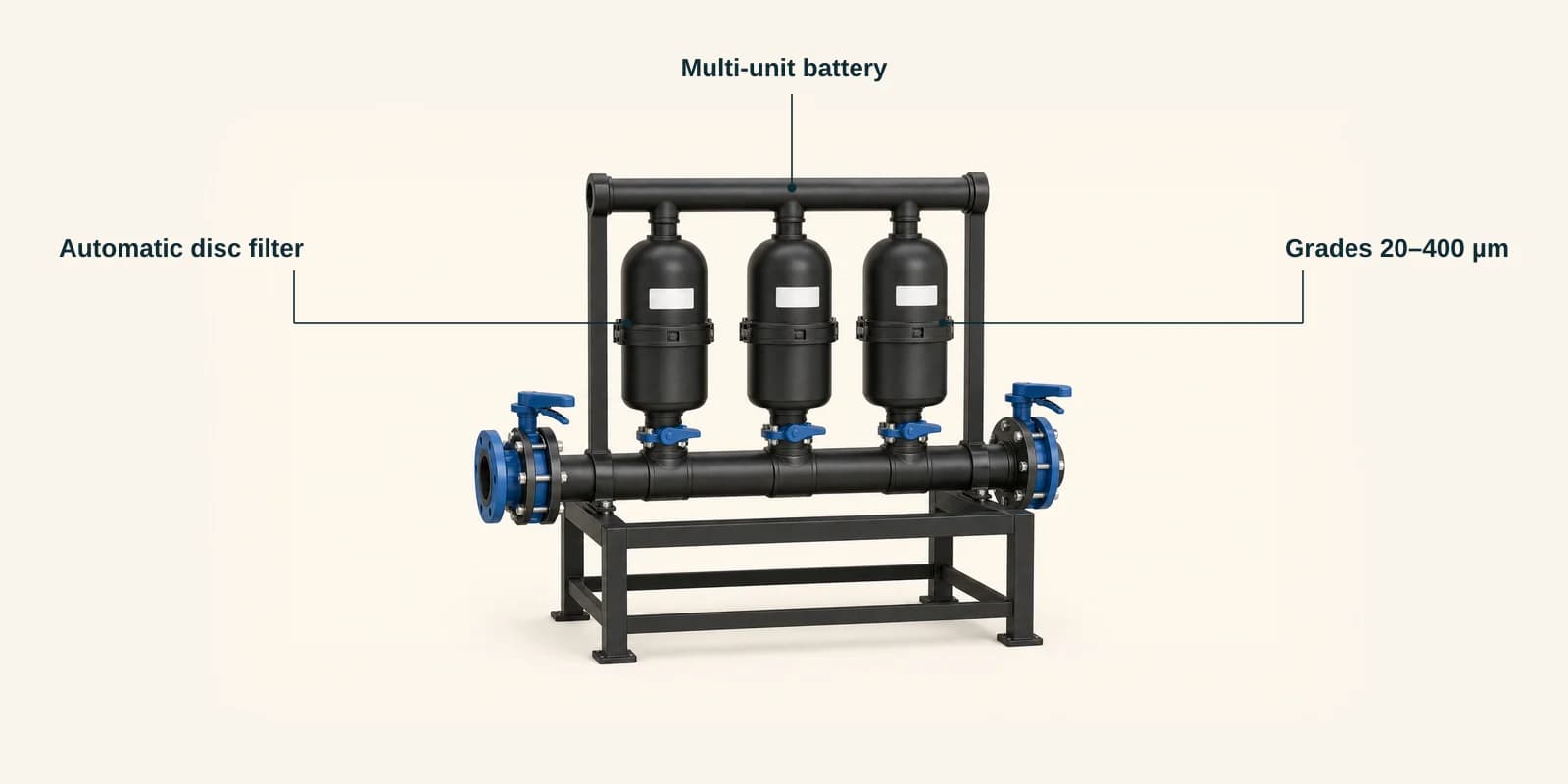
Amiad lists the 2-inch Spin Klin for irrigation as a disc-technology, automatic filter with a filtration degree of 20 to 400 µm and a flow rate of 10 to 90 m³/h, and this reference design uses that page[2]. The page ties the range to no configuration, pressure or pressure drop and gives no unit count and does not label its 10 m³/h lower figure a minimum or turndown, so it is read here as a range for a battery, not a rating for one unit. It calls the system "all polymeric"[2]; the 2024 internal-source manual's parts list also includes a stainless clamp[4], and the page does not say whether the irrigation battery uses it.
Amiad's 3-inch irrigation page prints 20 to 180 m³/h[3], its 2-inch industrial page a grade down to 10 µm[1], and a 2021 catalogue older, different ceilings[10].
The irrigation page names no configuration; the industrial page names external-source and air-aided ones[1]. Amiad's manuals cover internal-source (06.2024)[4], external-source (05.2017)[5], air-aided (05.2022)[6] and "LCE" (05.2017) batteries, the last never saying what the letters stand for[8], plus an Arkal-branded 2013 manual that prints different figures[7]. The irrigation page links a Battery IOM and an LCE IOM[2], so which governs is not stated. The misreading is that one Spin Klin means one set of figures; the check is the edition and configuration behind each number.
The page says the system is "mainly used to protect irrigation emitters"[2], a stated use naming no water source, emitter type or result. A benefit heading and sub-line such as "High dirt load capacity, ideal for removing organic matter"[1] is not a test result. The 2-inch irrigation page also says the filter "permanently eliminates the need to replace filter media"[2]; that speaks of replacing media, the 2024 manual lists monthly checks and seasonal manual disc cleaning[4], and the page mentions neither.
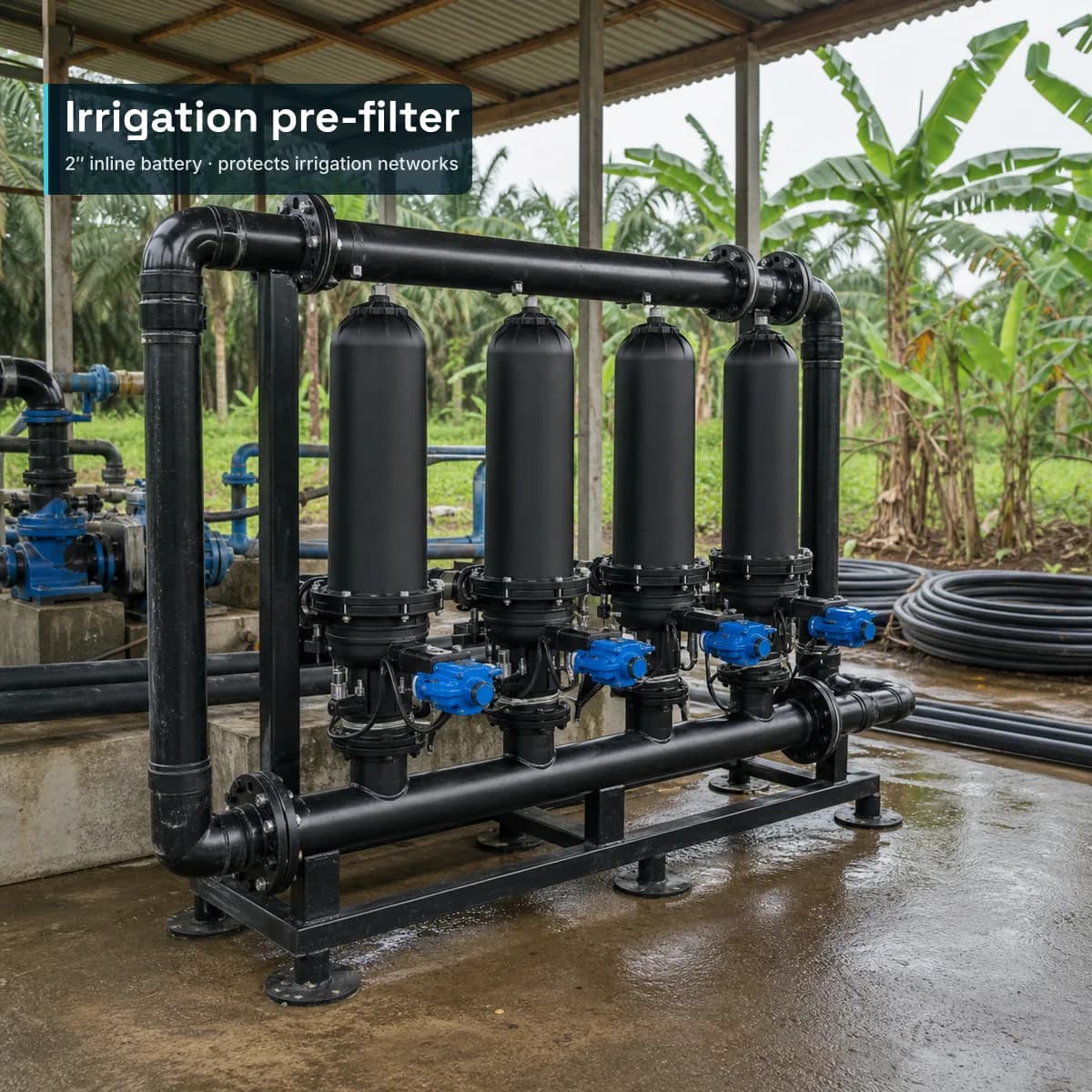
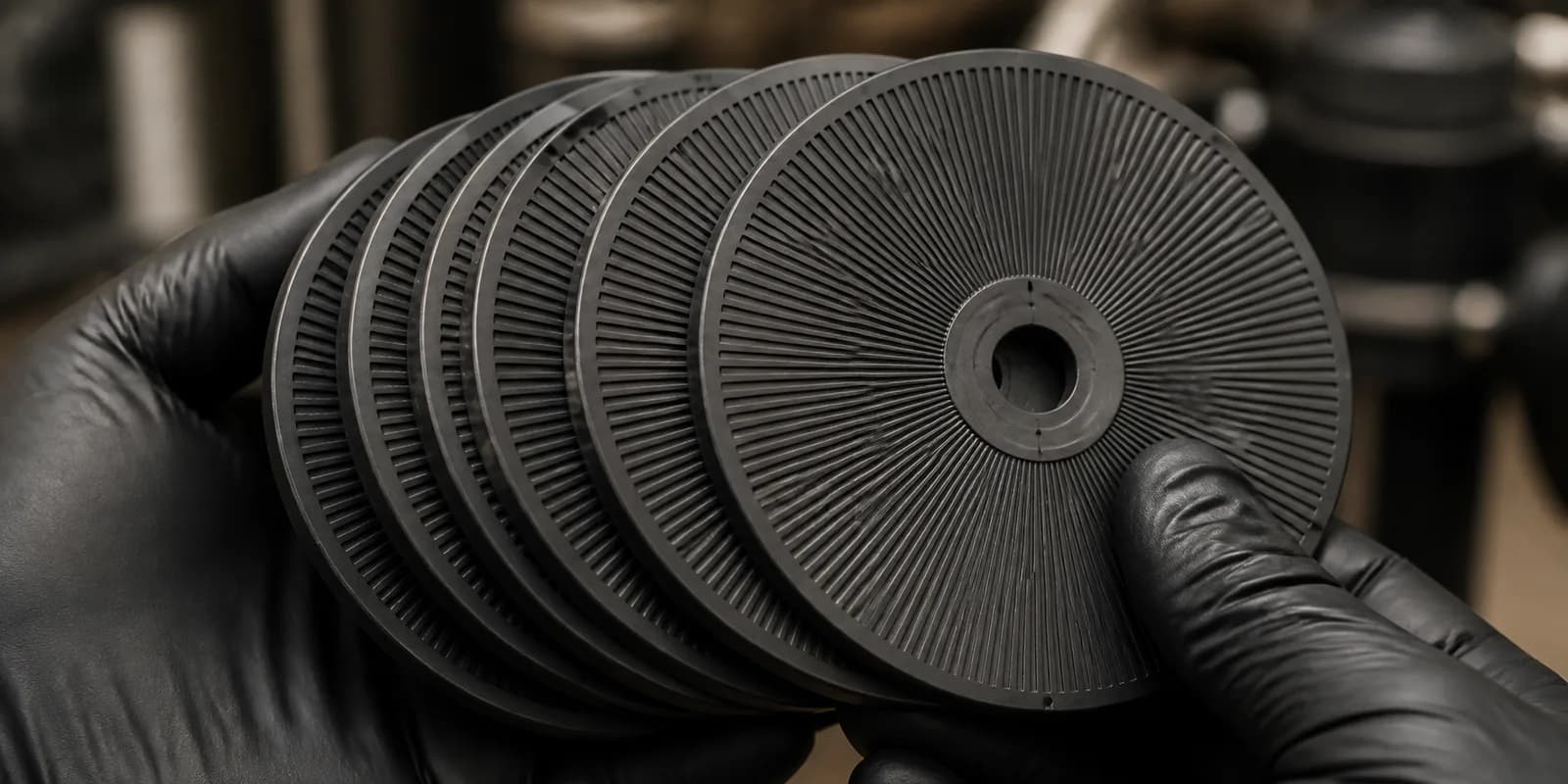
ASABE says canals generally contain organic contaminants and particulate matter[13], and Virginia Cooperative Extension says surface water often needs media or disc filters[14]; these are their statements, not Amiad's. The 2-inch is taken because its back-flush flow is 10 m³/h "per single spine" (the part the disc stack is compressed on) at 130 µm[4], against 20 on the 3-inch (910101-000512, 04.2021)[9].
Spin Klin Disc Filter
Back-flush pressure would decide fit
In the Amiad Spin Klin canal-fed drip reference design, the battery would be judged by the pressure it holds at the inlet during a flush and by the grade the emitter maker sets, because the page's ranges are an envelope, not a fit test. The duty is 50 m³/h (13.9 L/s, derived here) for one irrigation shift [ASSUMPTION: a design point, replaced by the metered flow in any quote], matching no Amiad figure. The margin is (90 − 50) ÷ 90 = 44.4% against the 2-inch page's 90 m³/h[2], 58.3% against the 2021 catalogue's 120[10], and 72.2% and 75.0% against the 3-inch page's 180[3] and the 2021 catalogue's 200[10]. Read at the 60 m³/h inlet in a flush, the room is (90 − 60) ÷ 90 = 33.3%, (120 − 60) ÷ 120 = 50.0%, (180 − 60) ÷ 180 = 66.7% and (200 − 60) ÷ 200 = 70.0%. The page does not say whether its range is read at the inlet or on filtered flow, so the drip battery design reads it at the inlet, the stricter case.
The obvious reading misses this: finding 130 µm and 50 m³/h inside the ranges does not test line pressure. The 2024 manual's back-flush minimum rises with the grade: 3 bar for 400 to 130 µm, 3.5 bar for 100 to 70 µm, 5 bar for 50 to 20 µm[4]. Extension sources agree for the class: ASABE says filter operation needs pressures above the normal system pressure[13], Virginia Cooperative Extension says disc filters "may require backflushing pressures as high as 50 psi"[14], and UC ANR says a separate booster pump may be required[15]. These are class statements, not Amiad figures. The check is the pressure at the battery inlet while a unit flushes.
The grade belongs to the emitter maker. Netafim's PC on-line dripper specification prints "Recommended filtration: 130 micron / 120 mesh"[11], and Rivulis gives 130 micron only as an example[12]. Two fallback rules bracket the maker's figure for Netafim's 1.04 to 1.60 mm water passages[11]: particles larger than "one-tenth the diameter of the smallest opening in the emitter"[14], and a size "four times smaller than the emitter's passageway"[17]. Taking 1.04 mm as the smallest opening is an [ASSUMPTION: Netafim does not call it that]. That gives 1,040 ÷ 10 = 104 µm and 1,040 ÷ 4 = 260 µm, 2.5 times apart, and the maker's 130 µm between them. The drip battery design takes 130 µm [ASSUMPTION: a Netafim PC-type dripper], which the real emitter datasheet replaces; 100 µm is the sensitivity.
The pressure target is 3.0 bar at the battery inlet in every back-flush. For 130 µm discs Amiad documents print 1.5 bar (the 2024 manual's LCE annotation)[4], 2 bar (the 2017 LCE manual)[8] and 3 bar (the 2017 external-source[5] and 2024 manuals); the 2013 manual separately prints a minimum pressure of 2.8 bar, with no disc grade and no statement that it is a back-flush figure[7]. No document retrieved on 2026-10-01 says which governs an irrigation battery or whether the figure is read at the battery inlet or at an external supply. The drip battery design's rule [ASSUMPTION: the highest non-LCE figure for the grade, measured at the battery inlet] is 3 bar.
The back-flush also needs flow: Amiad prints 10 m³/h (44 gpm) "per single spine" for 400 to 130 µm[4]. The drip battery design takes one spine per unit [ASSUMPTION: the 2013 manual says per unit[7]] and one unit flushing at a time, so a flush is 10 ÷ 50 = 20% of the duty. It takes internal source [ASSUMPTION covering the 60 m³/h inlet, the 3 bar rule and the drain and air items]. The 2024 manual says only "internal source water"[4]; the 2013 manual describes outlet-manifold water filtered by the other units[7], which the drip battery design assumes. The inlet then carries 50 + 10 = 60 m³/h in a flush, and pump and main are checked at 60 m³/h and 3 bar.
The grade is coupled to the pressure. From 130 to 100 µm the printed pressure rises from 3.0 to 3.5 bar (0.5 ÷ 3.0 = 16.7%) and the flush flow from 10 to 11 m³/h (+10%)[4], taking the flush share to 11 ÷ 50 = 22%. The misreading is a finer grade as free margin; the check is what it asks of the pump station.
An internal-source battery would need pump pressure
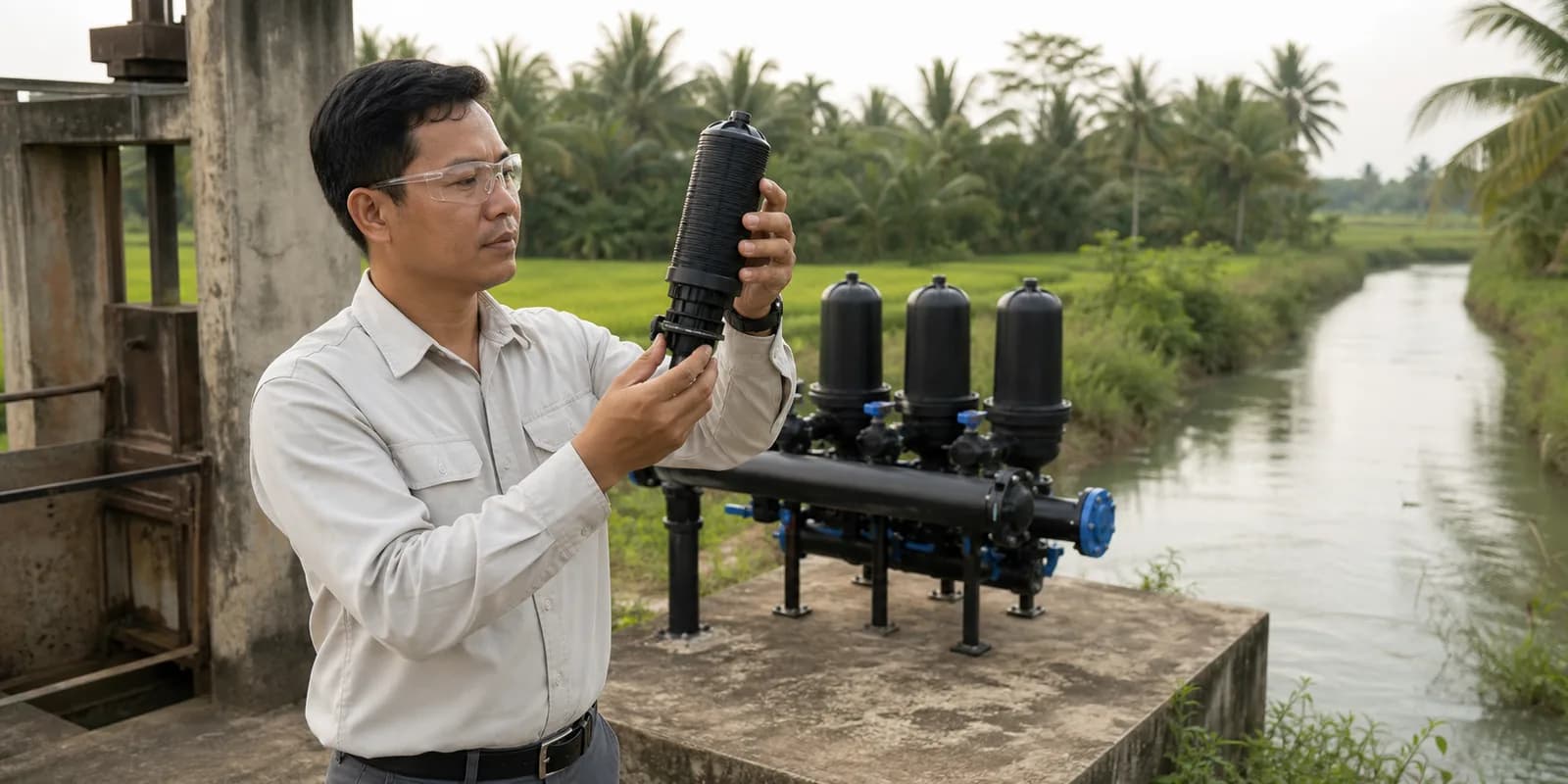
In the Amiad Spin Klin canal-fed drip reference design, the battery would sit after the pump station and a screened intake, because its back-flush water is internal source water taken, by assumption, at the outlet manifold, so the line must deliver at least 3 bar at the inlet at every flush. From the canal the train is a coarse screen on the pump intake, which Virginia Cooperative Extension says is generally required[14]; the pump station; a sand separator if sand is a concern[14]; then the battery, with an air release valve, manual cut-off valves, a pressure release or drainage valve[4] and gauges on both sides[13]. A drain manifold leads to the owner's drain route, and compressed air feeds the controls[4]. No Amiad document retrieved on 2026-10-01 prints a screen mesh or sand-separator threshold. For the open-water, pump-fed intake, submergence, approach velocity past the screen and worst-case net positive suction head available at the canal's highest measured temperature are assigned here to the pump supplier [ASSUMPTION: this reference design's allocation of duties, not a sourced one]; none is specified here and no value is invented. Pressure regulation from the battery outlet to the emitters' working range is the irrigation designer's [ASSUMPTION: this reference design's allocation of duties, not a sourced one], is outside the sources, and the emitter datasheet sets it (Netafim's PC drippers print 0.5 to 4.0 bar[11]).
Internal source is the configuration taken, as an assumption, and it demands pressure; the irrigation page names none. The external-source manual prints the same 3, 3.5 and 5 bar figures without saying where they are measured, and describes its jets as pumped at high pressure[5], so it does not settle whether external source answers low line pressure. The check is where Amiad measures the minimum. The application guide on disc filter selection for canal-fed irrigation compares internal and external source.
The 3 bar minimum sits under a printed maximum of 10 bar at 25 °C that includes pressure surge[4], so (10 − 3) ÷ 10 = 70%, or 7 bar, is shared between operating pressure and surge. The 10 bar is a maximum, not an operating pressure, and the rating at the canal's temperature was not found in the documents retrieved.
The unit count is Amiad's sizing: the pages print battery ranges, and the manual draws 2- to 8-unit batteries without a per-unit flow[4]. The drip battery design assumes the other units keep filtering and carry the 60 m³/h inlet [ASSUMPTION: units are isolated one at a time], so the count is requested with 60 m³/h and the grade, not 50.
A battery is not a standby: the units share the inlet and drain manifolds, controller, air supply and pump pressure, and Amiad's troubleshooting list points a battery that fails to back-flush to its pressures, air, controller and drain[4].
At Amiad's printed defaults, which it says may require adjustment[4], 10 m³/h for 15 s[4] is 10,000 × 15 ÷ 3,600 = 41.7 L per spine-cycle, one spine per unit assumed, a lower bound, not a maker volume. The flush stream goes to the owner's drain route; Indonesian discharge rules were not retrieved.
Acceptance would be read at the battery
In the Amiad Spin Klin canal-fed drip reference design, the battery's own switch would only signal loading, and the drip battery design's inlet pressure, sequence log, flush volume and filtrate sample would test whether it works. A differential-pressure switch starts a back-flush at the recommended 5 m (7 psi), a timer is the backup, and any trigger, a manual start included, resets the timer[4]. The defaults are a 15 s flush, a 5 to 10 s dwell and a typical 1 to 3 hour interval, all open to adjustment[4]. Amiad's start-up check expects a clean difference of at most 2 m (3 psi)[4], which leaves a climb of at least 3 m to the 5 m trigger, at least 60% of the trigger (derived here); 5 m of water column is 0.49 bar [ASSUMPTION: 0.0981 bar per metre of water column]. The flush starts without early warning[4], and no manual retrieved on 2026-10-01 prints a curve of pressure drop against flow, so the flow at which a unit reaches 2 m is unstated. The deep dive on how disc filtration works holds the mechanism.
Online, as design items [ASSUMPTION: design instruments, not Amiad features]: inlet and outlet pressure and their difference, the controller's sequence log, a feed flow meter and a drain flow reading. Sampled: canal water, the filtrate at the battery outlet and the flush stream. Amiad's controller varies with the order and its manual describes no log[4], so recording is a design item, and the inlet pressure is a logged transmitter read in step with that log, not a gauge read by eye during a 15 s flush. Two design alarms carry no automatic action: inlet pressure below 3.0 bar during a flush, and a pressure difference that stays above the trigger after a full sequence. The pump station designer owns them, then the operator after handover [ASSUMPTION: this reference design's allocation of duties, not a sourced one]. None of the online items listed measures what particles pass.
A rising pressure drop can be fine loading, sand lodged between discs[14] or [ASSUMPTION: a blocked drain keeps the back-flush from clearing the discs] a drain obstruction. A normal pressure drop does not show the filtrate meets 130 µm. The misreading is a gauge in range read as water quality.
Amiad's manual has an authorised technician commission the battery[4], and its start-up list then confirms the back-pressure in a back-flush: "Verify that the back-pressure reading during back-flushing is according the recommended pressure for your system specific filtration degree."[4] It also confirms a clean difference of at most 2 m and a 5 m trigger[4]. The drip battery design adds checks, none an Amiad requirement: inlet pressure at least 3.0 bar during each unit's flush; clean difference at most 2 m at the metered 50 m³/h; sequence and interval from the controller log; flush volume per unit, from the drain flow over 15 s or a calibrated tank, against the derived 41.7 L (no tolerance is published, so a difference is a question for Amiad); and a filtrate sample read against 130 µm by laboratory particle size. That last check has no maker basis: no document retrieved says whether Amiad's grade is nominal or absolute, or gives retention, so the owner agrees the criterion with the emitter maker and Amiad before the trial. Each reading must carry the disc grade, manual edition, pressure point, flow, temperature and time since the last flush, this design's rule (the deep dive sets out why a Spin Klin reading is reproducible only with its conditions); a pressure at the pump discharge is not one at the battery inlet during a flush.
Where it would fit, and what stays open
In the Amiad Spin Klin canal-fed drip reference design, the central gap comes first: in the documents retrieved, Amiad does not say which of its documents governs the irrigation battery's minimum back-flush pressure or the line it is measured on, so 3 bar is a decision rule, not a maker requirement. If the answer sits above what the pump station holds, the drip battery design does not fit as drawn. It goes to Amiad in one written request with the other open items: the governing edition, unit count and per-unit flow for 60 m³/h at 130 µm, the pressure-drop curve, nominal or absolute grade and retention, chlorine tolerance, temperature rating at flush pressure, air pressure, behaviour on power or air loss, and drain and pre-screen guidance. No such figure is in the documents retrieved; Amiad's online catalogue, said to hold technical data and drawings[2], could not be read.
A trial the owner can stop at any point has three stages. Stage 1 obtains Amiad's answers and analyses the canal with the emitter datasheet. Stage 2 commissions the battery with logged pressures and sequence, one measured flush volume per unit and an outlet sample read against the emitter maker's grade. Stage 3 connects the emitter lines once those checks hold. A pressure drop that does not recover after flushes, a sample outside the agreed reading, or any stop condition below ends the trial, and the response is a different configuration, grade or pre-separation.
The drip battery design assigns the duties as follows [ASSUMPTION: this reference design's allocation, not a sourced one]. The pump station designer holds 3 bar at the inlet at every flush, 60 m³/h and the 10 bar maximum including surge; the irrigation designer holds regulation from the battery outlet to the emitters; the owner holds the drain route and any discharge consent, air and power. Amiad's authorised technicians commission and service; commissioning without one may affect warranty coverage[4]. The 12-month warranty also excludes intake water outside standards agreed in a written document Amiad approves[4], so that standard should be sent to Amiad before order.
On sand, Virginia Cooperative Extension says that where sand is a particular concern one may avoid disc filters or choose a media filter, and that with a disc filter a sand separator should be considered ahead of it[14], and the canal analysis decides whether this block is such a case, so the fit statement needs sand removed upstream if the analysis finds it. On chlorine, UF/IFAS CIR1039, in a copy of a page its publisher withdrew, says "Chlorine should be injected before (upstream of) the system filter(s) so that any precipitates that form can be trapped in the filters."[16] It also says to check with the component maker first[16], so the drip battery design asks Amiad. No document retrieved gives a continuous chlorine limit for the discs; the hypochlorite soak is an off-line recipe for removed discs[4]. Any plan to chlorinate ahead of the battery stops the drip battery design until Amiad answers in writing.
The drip battery design would suit a block whose pump station holds at least 3 bar at the battery inlet at every flush, whose emitter maker sets 130 µm, whose canal sand is removed upstream, and with no chlorine ahead of the battery. It stops at less than 3 bar (3.5 at 100 µm) with no booster, pressure-sustaining valve or other flush supply; chlorine planned ahead, until Amiad answers in writing; solids above ASABE's 100 mg/L[13] or, if the emitter is a Netafim PC type, sand above Netafim's 2 ppm[11], with no separation; a duty near the top of the page's 90 m³/h range once the 10 m³/h flush is added at the inlet, which Amiad must confirm in writing; or a tender needing a written figure not found in the documents retrieved.
Nothing here is an Amiad endorsement, a guarantee or a yield, uptime or saving, and the flush volumes are not Amiad figures. The quote request should state configuration and edition, unit count and per-unit flow, back-flush pressure and its measurement point, controller, commissioning plan and a statement on chlorine; the application guide holds the quote list. Send the data pack and the quote statements with a quote request; the items above are the questions to put to whichever supplier answers, Purionex included.
Sources
- [1]Amiad — 2-inch Spin Klin (industrial) product page, as retrieved 2026-10-01: configurations named, benefit headings, site menu
- [2]Amiad — 2-inch Spin Klin for irrigation product page, as retrieved 2026-10-01: grade and flow ranges, stated use, download links
- [3]Amiad — 3-inch Spin Klin for irrigation product page, as retrieved 2026-10-01: grade and flow ranges
- [4]Amiad — 2-inch Spin Klin battery, internal source, installation and operation instructions, 910101-000854 / 06.2024
- [5]Amiad — 2-inch Spin Klin battery, external source, installation and operation instructions, 910101-000652 / 05.2017
- [6]Amiad — 2-inch Spin Klin with air-aided flushing, user guide, 910101-000616 / 05.2022 (cited for one alternative)
- [7]Arkal (Amiad) — 2-inch Spin Klin battery service and maintenance manual, 910101-000597 / 08-2013; older edition whose figures differ
- [8]Amiad — 2-inch Spin Klin LCE battery, installation and operation instructions, 910101-000960 / 05.2017; the document never expands LCE
- [9]Amiad — 3-inch Spin Klin battery, internal source, installation and operation instructions, 910101-000512 / 04.2021 (cited for the 3-inch flush flow)
- [10]Amiad — Filtration Products for Industry catalogue, 910101-000235 / 01.2021 (regional-site copy; older than the 2026 pages and differing from them)
- [11]Netafim — PC on-line dripper product specification 06-0724-DRP-PS-0026-EN (an emitter maker, not Amiad)
- [12]Rivulis — Knowledge Hub, Micron and mesh (an irrigation maker's educational page)
- [13]ASABE — Design and Operation of Farm Irrigation Systems, Chapter 17, Microirrigation Systems (copy hosted by irrigationtoolbox.com, not the publisher; secondary)
- [14]Virginia Cooperative Extension — Filtration, Treatment, and Maintenance Considerations for Micro-Irrigation Systems, 442-757
- [15]UC ANR — Maintenance of Microirrigation Systems, Disc Filters (a class statement, not about Amiad)
- [16]UF/IFAS Extension — CIR1039, Treating Irrigation Systems with Chlorine (copy of a publication the publisher has withdrawn from its site; secondary)
- [17]UF/IFAS Extension — WI009, Screen Filters in Drip Irrigation Systems