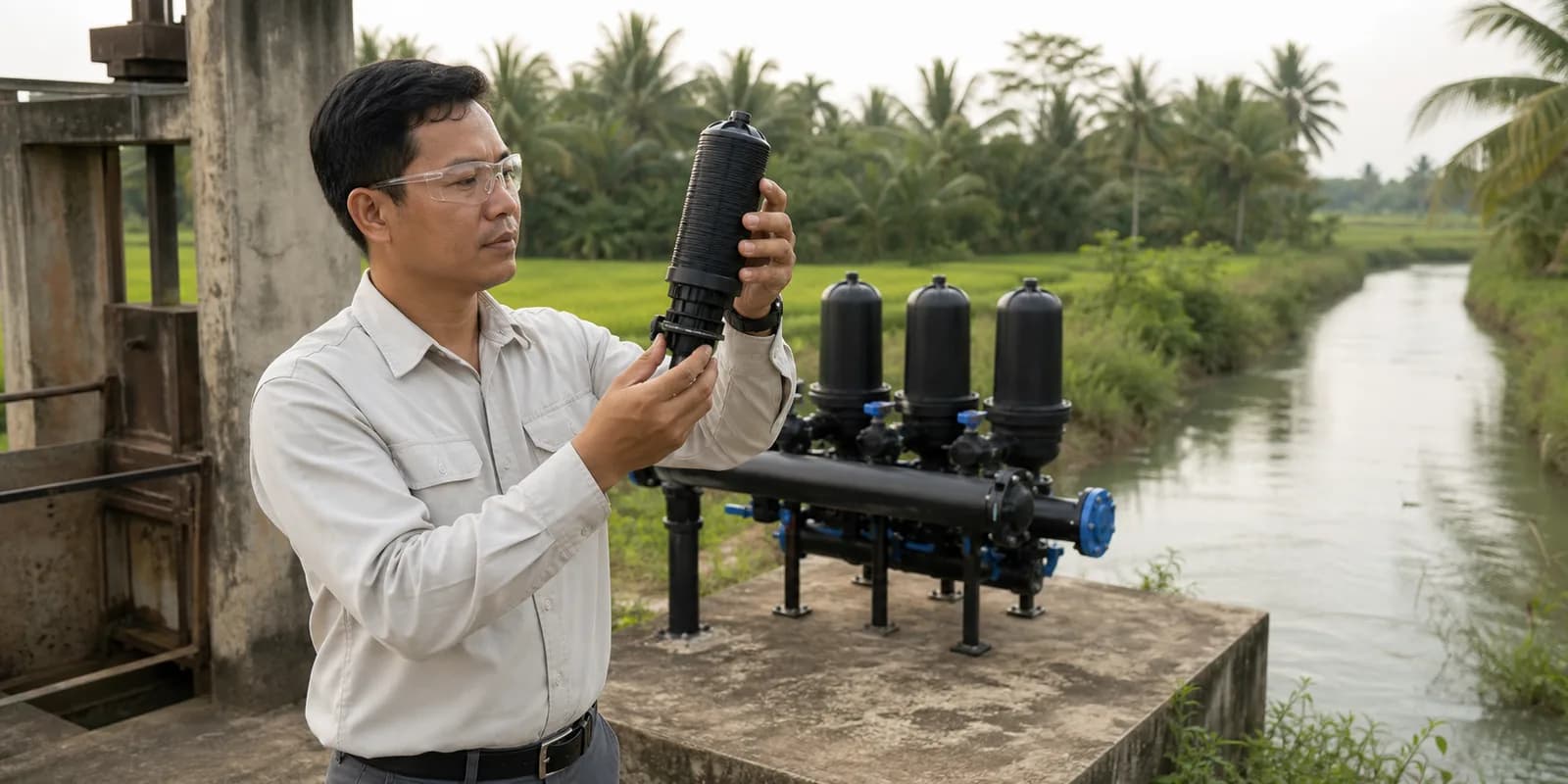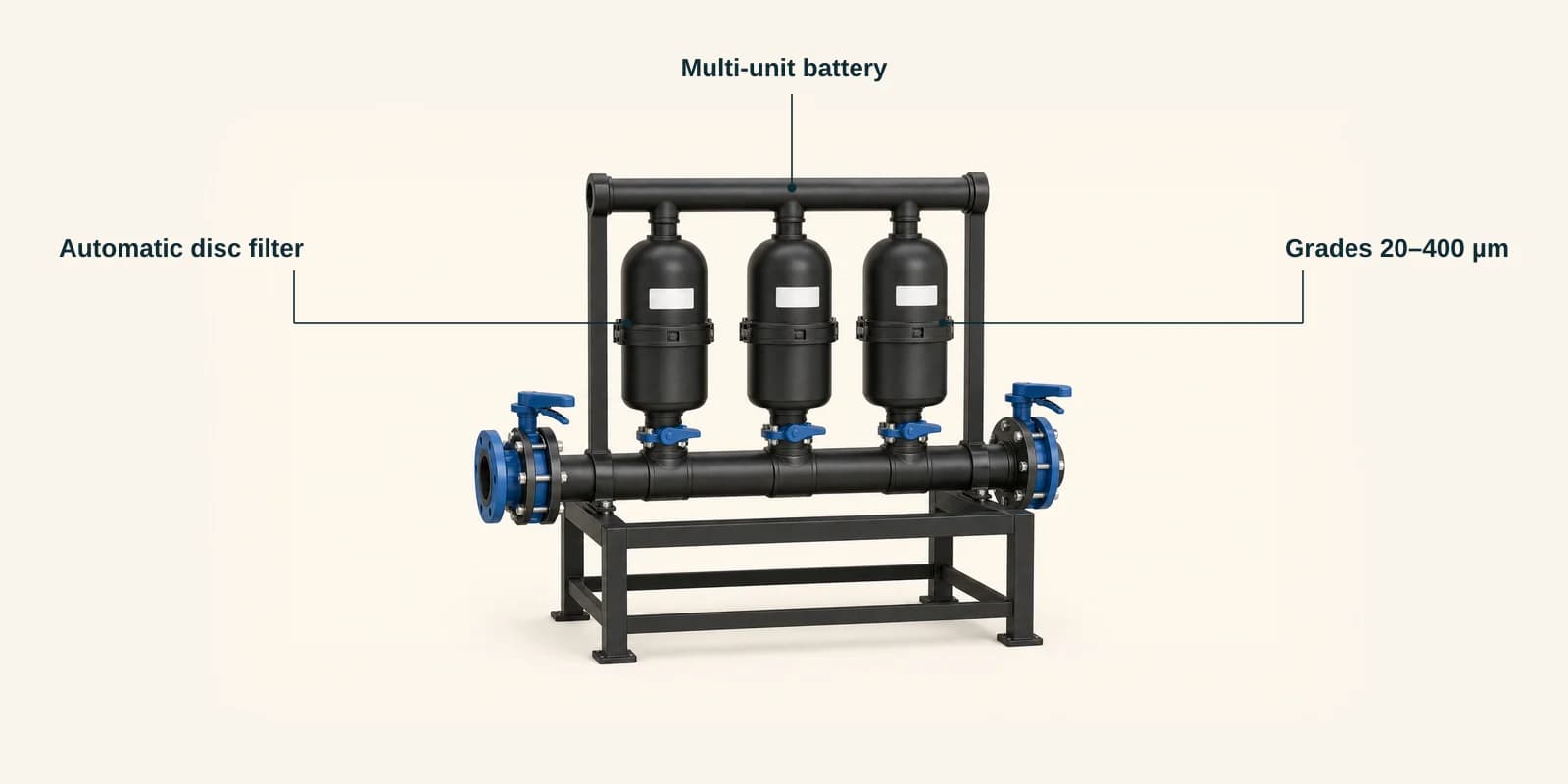
An Amiad 2-inch Spin Klin is an automatic disc filter that, in Amiad's description, traps solids in the crossed grooves of a compressed stack of polypropylene or nylon discs and cleans the stack by releasing it and spinning the discs under water jets.[6] Two readings are used here to judge whether it works, the pressure difference across the stack, which rises as solids load, and the particles that reach the outlet, each valid only at a stated grade and flow, the second being the installation's own reading, not an Amiad rating. Amiad heads its 2-inch industrial page with Micron-Precise Depth Filtration[1] and gives its 2-inch and 3-inch industrial pages the benefit heading "High dirt load capacity, ideal for removing organic matter".[1][2] A reader could take these to mean that the micron figure is a removal rating, and that the stack holds solids as a sand bed does. The Amiad documents retrieved on 2026-10-01 print a grade in microns and a back-flush routine, and no removal efficiency or holding-capacity figure.[6][1] Four questions follow: what cleans the stack, what a finer grade costs, what the evidence shows beside sand, and what to measure. Sizing is in the selection guide; the grade and pressure pair is applied in the drip reference design.
Spin Klin back-flush releases and spins the discs
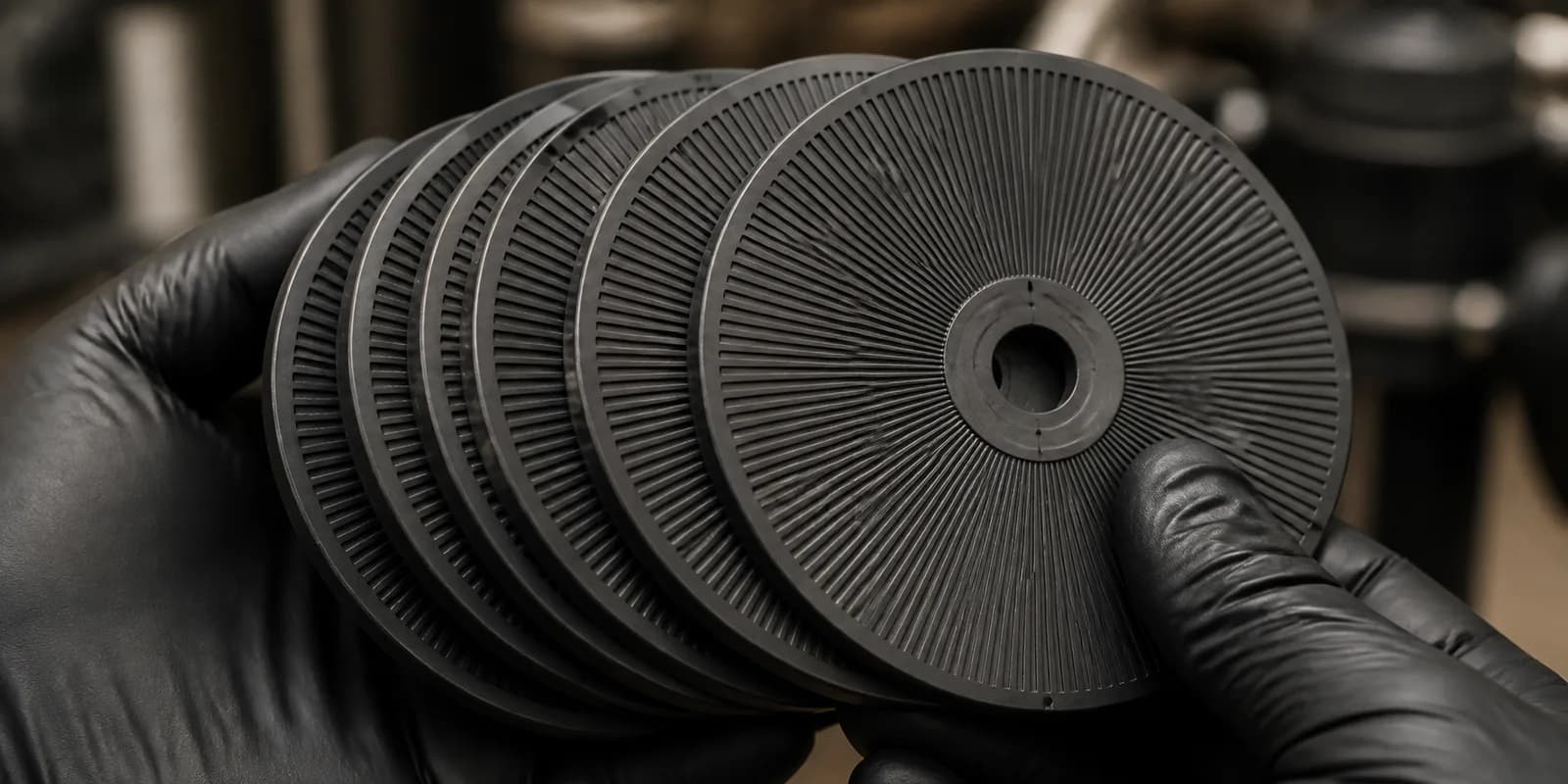
In Amiad's description, a Spin Klin stack is cleaned by releasing its compression and spinning the discs under tangential jets.[6] Amiad's manual describes colour-coded discs grooved diagonally on both faces, the groove on top opposite to the one below, held compressed on a spine by a spring and the pressure difference. Water percolates from the outer diameter to the inner diameter, past 18 stopping points in each track on a 400 micron disc and 32 on a 20 micron disc, which is 32 ÷ 18 = 1.78 times as many.[6] In the internal-source manual, "During backwash the discs are released by releasing the inlet hydraulic pressure."[6] Nozzles then spray tangentially, the discs spin and the solids go to the drain, and the units are flushed one after another.[6] The external-source manual says the jets are clean water pumped at high pressure in the opposite direction through the nozzles, and it and the air-aided manual add that the spring is released and the spine piston rises.[7][8] A sand filter is cleaned by reversing flow through one tank with water from another, so it needs at least two tanks.[18] UC Agriculture and Natural Resources says most disc filters are cleaned by hand, with automatic back-flush types available, so automatic back-flush is a feature of some disc filters, not the class default.[17]
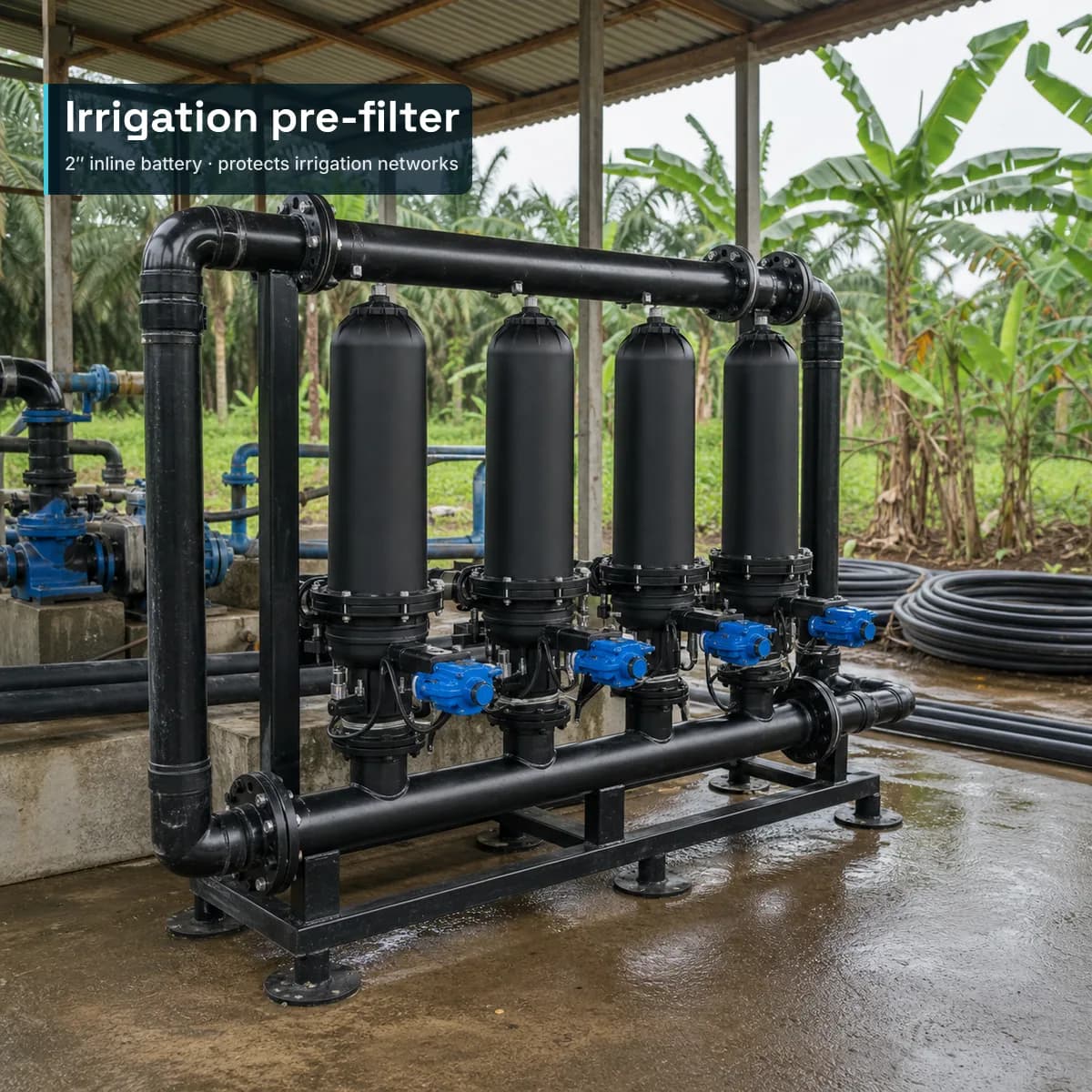
No sentence about the Spin Klin flush supply holds across all documents. The internal-source manual uses water from internal Water Source, a term it does not define.[6] The external-source manuals say clean water is pumped at high pressure from an external source.[7][12] The 2013 irrigation manual says outlet-manifold water filtered by the other units, though its introduction says external source, and the air-aided guide pushes accumulator water with air.[9][8]
The controller starts a flush on pressure difference or on time. Amiad's 2017 to 2024 manuals recommend a 5 m (7 psi) trigger,[6][7][10][11][12] and the 2013 manual prints 5 to 7 m.[9] The recommended flush setting is 15 s with a 5 to 10 s dwell and a typical interval of 1 to 3 hours, settings Amiad says may need adjusting.[6][7][10][11][12] The air-aided guide prints a 7 s flush with a 25 s dwell, and the 2013 manual a 20 s flush with a 10 s dwell.[8][9] The Spin Klin manuals cited here describe sensing of pressure difference and time only. None describes a particle sensor or an automatic check that a flush worked.[6][7][8][9][10][11][12]
In Amiad's manual, depth means a groove path with 18 to 32 stopping points per track, not a bed.[6] The documents retrieved print no groove geometry beyond the grade, no disc count, no spring force and no holding-capacity figure.[6] The check is to ask Amiad for loading capacity at a stated solids concentration and pressure difference. Loading raises the pressure difference between flushes, so flushes should come sooner, which is reasoning here. A difference that stays high after a flush is, per the manual, a reason to check for failures or an excessive flow, and no maximum solids is printed.[6]
Amiad's finer disc grades need more back-flush pressure
Amiad's 2-inch Spin Klin pages print 10 to 90 m3/h (44 to 396 gpm) and the 3-inch pages 20 to 180 m3/h (88 to 792 gpm), a range the pages tie to no pressure, pressure difference or grade, read here as a battery range because the 2021 catalogues print it against batteries, while its manuals print the flush pressure for each grade.[6][1][2][3][4] Two Amiad catalogues print up to 120 for 2-inch batteries and up to 200 for 3-inch, and the US-hosted copy up to 60 for the 2-inch air-aided battery.[13][14] The Spin Klin manuals retrieved print no flow for one unit and no unit count for a given flow.[6]
The 10 bar maximum is printed at 25 °C and includes pressure surge.[6] The 60 °C maximum is printed at 4 bar beside 158 °F, but 158 °F is (158 − 32) × 5 ÷ 9 = 70 °C and 60 °C is 140 °F.[6][7] The 2013 irrigation manual, an older edition, prints 70 °C,[9] and the 3-inch reinforced-polypropylene option prints 50 °C,[11] so the 2017 to 2024 manuals disagree with their own Fahrenheit print.[6][7][11] No document retrieved prints the temperature rating at 5 bar, the pressure a fine grade needs, which is reasoning here.
The coupled pair is in the manuals. Minimum back-flush pressure is 3 bar for 400 to 130 micron discs, 3.5 bar for 100 to 70 and 5 bar for 50 to 20, with back-flush flow of 10, 11 and 11 m3/h per 2-inch spine and 20, 22 and 22 on the 3-inch.[6][11] From 130 to 50 micron it costs 2.0 bar more (2.0 ÷ 3.0 = 66.7%, derived here) and 1 m3/h more (10%, derived here). The other arm is reasoning, not a Spin Klin figure: a finer grade gives a load less room, so it should reach the trigger sooner.
One grade has three figures and one ungraded row. For 130 micron the standard manuals print 3 bar,[6][7] the 2017 LCE manual 2 bar,[10] and an LCE annotation in the 06.2024 manual 1.5 bar.[6] The 2013 irrigation manual prints a single "Minimum Pressure" of 2.8 bar with no grade and no stated purpose, so it is not counted as a 130 micron figure.[9] LCE is never expanded in the documents retrieved,[6][10] and the tables do not say where the pressure is measured.[7] Until Amiad states which edition governs, this article's own rule is to size for the highest figure printed for the grade, 3 bar. Read it at the battery inlet during a flush, which is an assumption because the measuring point is unprinted.
Flush volume is flow times time, derived here and not Amiad's for the water-fed configurations; the air-aided guide prints its own figure of 12 to 22 L per single filter.[8] At the recommended 15 s, 10 m3/h is 2.778 L/s, so 41.7 L per spine-cycle at 130 micron, assuming one spine per unit because no document retrieved states the number of spines per unit. Then 11 m3/h gives 45.8 L, the 3-inch spines 83.3 L and 91.7 L, and the 2013 manual's 8 m3/h for 20 s 44.4 L.[9]
Pressure drop against flow is a published pair and a missing curve: clean at most 2 m, trigger 5 m, and nothing between in the documents retrieved. The manual does not say at what flow the clean value is reached, and no point is interpolated.[6] The check is to ask Amiad in writing which edition governs and where the pressure is measured.
Retrieved Amiad documents print a grade only
Amiad's pages and manuals print a micron grade and a back-flush routine, and the documents retrieved on 2026-10-01 print no removal efficiency, so no removal rating can rest on them. Amiad's pages say high retention of solids.[1][2] UC Agriculture and Natural Resources says disc filters as a class may remove organic matter but tend to clog more rapidly than sand.[17] The Florida sheet says disk filters act somewhat like screen filters and also target inorganic particles,[19] and Virginia Cooperative Extension calls them a hybrid of screen and media filters.[16] The documents retrieved print no nominal or absolute statement, test method, maximum solids or holding-capacity figure. No laboratory report or field record was retrieved, and that is a finding. The industrial pages link two case studies that were not opened,[1][2] and the 2021 catalogue installations name no 2-inch or 3-inch Spin Klin.[13]
Disc against sand can be set side by side on three variables, as a class comparison, unscored. The back-flush trigger is Amiad's 5 m (7 psi) against about 10 psi for sand, so 7 ÷ 10 = 70% of it, derived here.[6][18] The clean differential is at most 3 psi against a sand design drop of 3 to 5 psi.[6][18] Flush time is Amiad's recommended 15 s per unit, dwell excluded, against 60 to 90 s per cycle for a typical sand filter, a cycle the source does not define: 15 ÷ 60 is 25% and 15 ÷ 90 is 17%, derived here and not a ranking.[6][17] The same source gives about 10 s for most automatic disc filters, so 15 s is Amiad's recommended setting, not the class figure.[17] Amiad's flows are per spine and sand's per square foot of filter area, so flows are not compared.[6][11][18] The deciding variable, as reasoning here, is how fast loading arrives against the cost of recovering from it.
Amiad's EC Declaration of Conformity CE-110004-2023-03, issued at Amiad, Israel on 18 December 2023 under Directive 2006/42/EC, is the manufacturer's own declaration for seven listed entries: the 2-inch filter, battery, air-aided battery and external-source battery, and the 3-inch filter, battery and external-source battery.[5] Amiad's NSF/ANSI/CAN 61 Official Listing C0099479, recorded 30 September 2019, names other product lines and no Spin Klin; the current NSF database was not checked.[15] Amiad's US catalogue describes a different Spin Klin, the 10-inch Super Galaxy, as NSF 61 approved in one installation example; that is not the 2-inch or 3-inch.[14] The declaration names Directive 2006/42/EC and the standards listed with it, and makes no water-contact or performance statement,[5] and it extends to no variant it does not list.
Two readings are ambiguous. A pressure difference that rises, or flushes that grow more frequent, may be fine loading. It may equally be sand lodged between discs, which one extension source says can reduce the effective mesh size of the filter (that it would also raise the difference or the flush frequency is reasoning here),[16] a flow that is too high,[6] a blocked drain line, which is reasoning here, or a back-flush pressure below the grade's figure, which is reasoning here. The check is to log pressure difference with flow, read the back-flush pressure, inspect the drain, then the discs. A clear filtrate is the second. It can mean the grade works, that the water had few particles near the grade, or that finer particles passed unseen. With the grade basis unpublished, clarity does not show retention. The check is to compare inlet and outlet on an agreed particle or turbidity measure, not by eye. Where a duty needs a stated removal efficiency, the answer is not shown by the documents retrieved until Amiad supplies test data.
Accept a unit on logged site readings
A Spin Klin reading is reproducible only with its conditions. A pressure reading needs the grade, configuration, document edition and measuring line. The manual's own start-up step is to check that the pressure during back-flush matches the figure for the grade, 3, 3.5 or 5 bar.[6] Record the gauge position, which the documents retrieved do not print.
A pressure-difference reading needs the flow, the units in service (one unit at a time is out of service, which is reasoning) and the gauge positions. Clean should be at most 2 m (3 psi), with the indicator set at 5 m (7 psi).[6] The Amiad documents retrieved do not print the flow at which its clean value holds, so the installation's reading is the first data point, not a comparison.
A sequence reading needs the trigger, the interval and a measured flush volume per unit flushed. Log whether each flush came from pressure difference or time, and measure the drain volume with a meter or a timed collection, which is generic practice and not an Amiad procedure. Compare with 41.7 or 45.8 L on the 2-inch and 83.3 or 91.7 L on the 3-inch per spine-cycle, derived for the water-fed configurations at recommended settings that the manual says may need adjusting.
A filtrate reading has nothing to be accepted against, because none of the documents retrieved states a retention figure. The terms are agreed with the manufacturer or supplier before ordering: the sampling point, the particle or turbidity measure, and what counts as a pass.
The fix for a poor reading may lie outside the disc pack. The manual names an excessive flow for a high pressure difference, and lists the air supply and the drain manifold among the checks when a flush does not run;[6] line pressure and the pump are reasoning here. The data to send Amiad or the supplier is the duty flow, the grade needed, the pressure at the battery during a flush, temperature, solids and organics, and any chlorine plan. The terms to agree are the governing edition and measuring line, unit count and per-unit flow in writing, nominal or absolute grade with retention data, the pressure-difference curve, and temperature and chlorine limits at the working pressure.
Spin Klin Disc Filter
Sources
- [1]Amiad — 2-inch Spin Klin industry product page (retrieved 2026-10-01) — benefit headings, grade and flow range, configurations
- [2]Amiad — 3-inch Spin Klin industry product page (retrieved 2026-10-01) — grade and flow range, product description
- [3]Amiad — 2-inch Spin Klin irrigation product page (retrieved 2026-10-01) — grade and flow range, intended use
- [4]Amiad — 3-inch Spin Klin irrigation product page (retrieved 2026-10-01) — grade and flow range
- [5]Amiad — EC Declaration of Conformity CE-110004-2023-03, Spin Klin 2-inch to 3-inch Filter Series, issued 18 December 2023 (manufacturer's own declaration)
- [6]Amiad — 2-inch Spin Klin Battery Internal Source, Installation and Operation Instructions, document 910101-000854, edition 06.2024 (paraphrased)
- [7]Amiad — 2-inch Spin Klin Battery External Source, Installation and Operation Instructions, document 910101-000652, edition 05.2017 (paraphrased)
- [8]Amiad — Arkal Spin Klin 2-inch with Air Aid Flushing user guide, document 910101-000616, edition 05.2022 (paraphrased)
- [9]Arkal (Amiad) — Spin Klin 2-inch Battery Service and Maintenance Manual, document 910101-000597, edition 08-2013 (older edition; paraphrased)
- [10]Amiad — 2-inch Spin Klin LCE Battery Installation and Operation Instructions, document 910101-000960, edition 05.2017 (paraphrased)
- [11]Amiad — 3-inch Spin Klin Battery Internal Source, Installation and Operation Instructions, document 910101-000512, edition 04.2021 (paraphrased)
- [12]Amiad — 3-inch Spin Klin Battery External Source, Installation and Operation Instructions, document 910101-000929, edition 08.2022 (paraphrased)
- [13]Amiad — Filtration Products for Industry catalogue, document 910101-000235/01.2021 (AU-hosted copy)
- [14]Amiad — Filtration Products for Industry catalogue (US-hosted copy, undated; February 2021 upload path)
- [15]Amiad — certificate index and NSF International Official Listing C0099479, recorded 30 September 2019 (listing PDF: https://es.amiad.com/wp-content/uploads/2020/07/NSF-61-International-Listing-of-Amiad-Products.pdf)
- [16]Virginia Cooperative Extension — Filtration, Treatment, and Maintenance Considerations for Micro-Irrigation Systems, publication 442-757
- [17]UC Agriculture and Natural Resources — Maintenance of Microirrigation Systems: Disc Filters
- [18]UC Agriculture and Natural Resources — Maintenance of Microirrigation Systems: Sand Media Filters
- [19]University of Florida IFAS Extension — SL 265/SS487, Dealing with Iron and Other Micro-Irrigation Plugging Problems