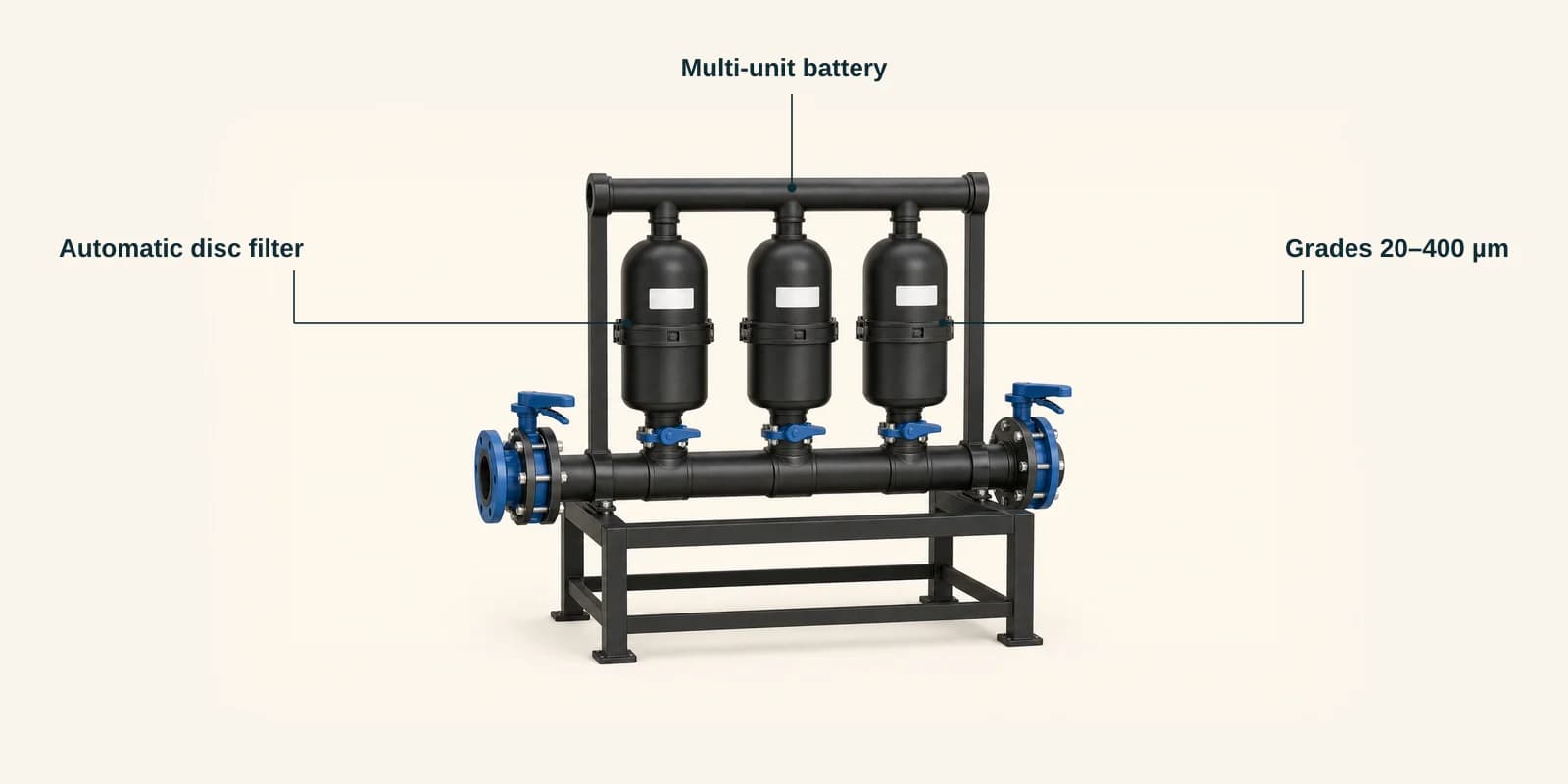
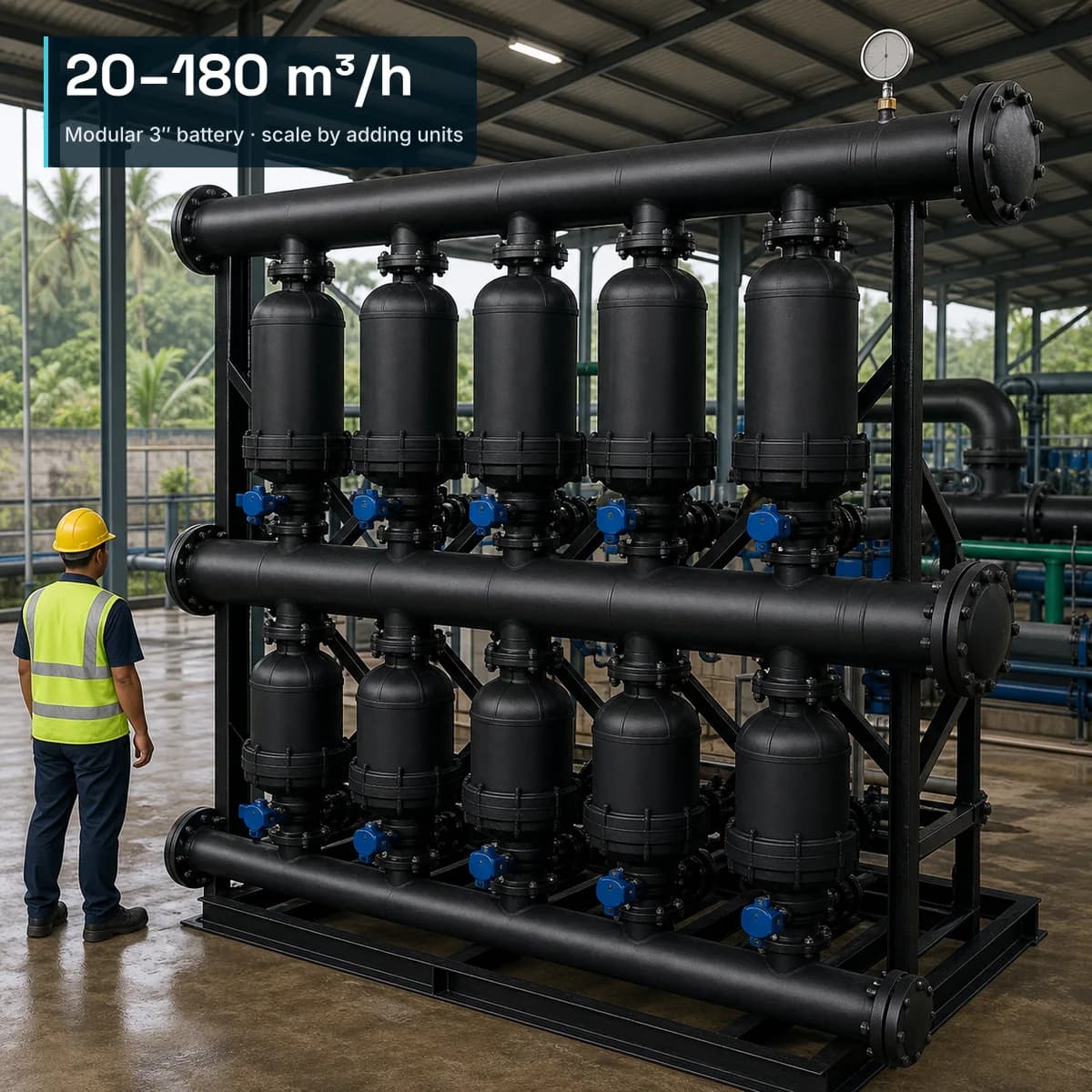
A Spin Klin product page invites one question: which size gives my flow? As retrieved on 2026-10-01, Amiad's irrigation pages print 10 to 90 m³/h for the 2" and 20 to 180 m³/h for the 3" without saying what the range covers.[3][4] Amiad's 2021 catalogues print up to 120 and 200 m³/h against batteries,[13][14] and this guide reads the page range the same way, as a battery range rather than one unit's capacity or a sizing metric. A unit here is one filter and spine, and no document retrieved gives one unit's service flow or a unit count. What decides fit first is whether the site can hold, at the battery and during a flush, the back-flush pressure the grade needs, and whether the inputs a sizing reply needs have been measured. The manuals Amiad links from its industrial pages print 3 bar for 130 µm and coarser, 3.5 bar for 100 to 70 µm and 5 bar for 50 to 20 µm.[5][10][1][2] The 3" irrigation page links an older 2013 manual that prints one 2.8 bar minimum with no grade, a 2013 2" manual prints the same, and which edition governs an irrigation battery is not stated.[4][12][8]
The guide ends in a 2" or 3" battery at a stated grade with the unit count a question for Amiad; in a pressure, separation or chlorine answer first; or in not this product. The illustrative run (assumed inputs: 75 m³/h, 4.5 bar available) clears the back-flush pressure screen at 130 and 100 µm and is 0.5 bar short at 50 µm. Scope is the 2" and 3" Spin Klin on open canal water; Malaysia is the only market with a water-quality source here, and Indonesia and Singapore are stated gaps.
Measure the canal and the duty first
A disc filter answers particles; this guide treats iron and microbial growth as separate stages [ASSUMPTION: the guide's reading]. Amiad's irrigation pages say the filter is "mainly used to protect irrigation emitters".[3][4] UF/IFAS rates iron below 0.1 ppm slight, 0.1 to 1.5 moderate and above 1.5 severe, and describes oxidising the iron first, then trapping the scale in filters, disc filters among them.[21] A UF/IFAS chlorine publication (a mirror copy) says of filtration that "this alone cannot effectively remove microorganisms",[20] so control of microbial growth is a separate stage.
A deposit is one case: Amiad's cleaning section applies its cleaning procedure to organic, metal-oxide and carbonate deposits if pretreatment cannot eliminate them; whether a finer disc is wrong is the guide's reasoning.[5] Frequent or non-stop back-flushing is the other: Amiad says a high pressure difference can mean the flow is too high, and its non-stop chart checks pressures, gauge and controller before the drain manifold.[5] A rising difference read as excess flow, sand lodged between discs,[18] a blocked drain or fine loading is the guide's reasoning.
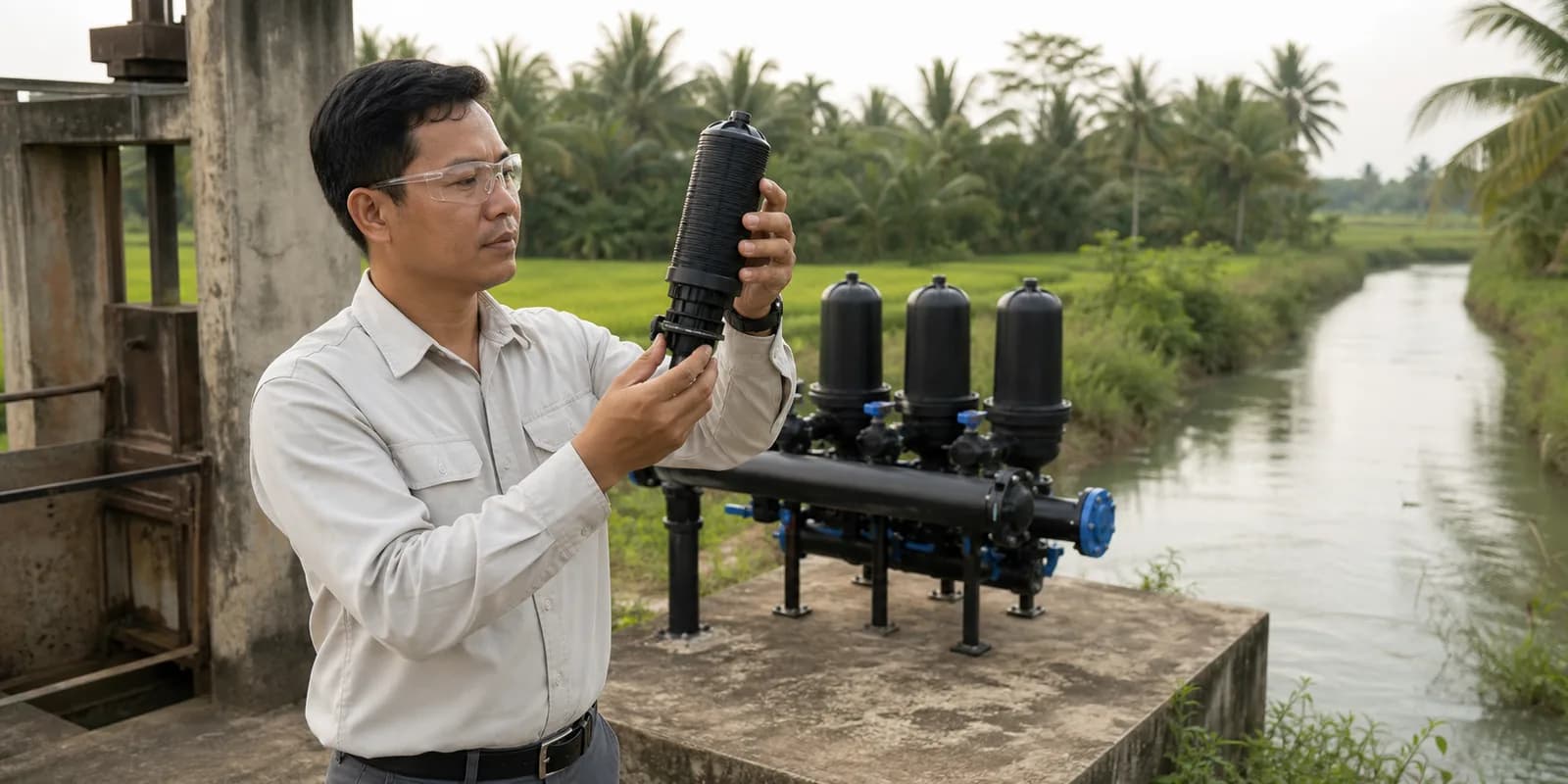
Open canal water is read at its peak. Virginia Cooperative Extension (VCE) applies its criteria to the maximum measured concentration from a representative sample, rating suspended solids above 100 ppm severe.[18] ASABE (a mirror copy) says that in microirrigation, above 100 mg/L "will require extraordinary filtration systems".[17] Malaysia's interim national water quality standards (an undated WEPA copy) give total suspended solids bands from below 25 mg/L in Class I to above 300 in Class V.[23] The guide reads these as ambient water classes, not an intake design basis, with no monsoon peak.
Inputs group by what each decides. Eliminating inputs: pressure at the battery in a flush, the chlorination plan, peak solids and sand, and iron. The stop thresholds, 100 mg/L peak solids and 1.5 ppm iron, come from ASABE and the extension severe band [ASSUMPTION: the guide's, not Amiad limits]. Sizing inputs: hydraulic capacity at the battery in m³/h and the emitter maker's grade. Fit inputs: drain route, air, controller, power and space. The documents retrieved do not give the rest: one unit's flow, the unit count, a continuous-chlorine tolerance and the drain size.
The page's 90 m³/h is the 396 gpm printed beside it,[3] and 5 m of head is 7 psi.[5] Extension sources print ppm and ASABE mg/L, read here as one number for water; NTU is not suspended solids. ASABE says a design should aim to supply about 120% of peak crop water use where economical and practical;[17] the guide takes the owner's capacity as already carrying that margin and adds none [ASSUMPTION].
Size by back-flush pressure, then flow
Two sets of figures exist, and the guide reads neither as one unit's. The pages as retrieved print 10 to 90 m³/h (2") and 20 to 180 (3"); Amiad's 2021 catalogues print up to 120 and 200.[1][2][3][4][13][14] The online catalogue could not be read on 2026-10-01.[1] No page calls 10 or 20 m³/h a turndown floor or ties its upper figure to a stated condition.
Screen on back-flush pressure first, a published gate a buyer can test before asking Amiad for the flow. The same industrial manuals print the opening's figures as the minimum for a flush, with 3 bar covering 400 to 130 µm.[5][6][10][11] That is not an operating range (the internal-source manuals print a minimum working pressure of 1.0 bar[5][10]), and the start-up check reads it during the flush: "Verify that the back-pressure reading during back-flushing is according the recommended pressure for your system specific filtration degree."[5] The same tables print a back-flush flow per single spine of 10, 11 and 11 m³/h on the 2" and 20, 22 and 22 on the 3" (130, 100 and 50 µm);[5][10] one spine per unit is assumed [ASSUMPTION]. VCE's "as high as 50 psi" for disc filters is a class statement, level with Amiad's 3.5 bar and below its 5 bar (75 psi in the 2" manual).[18][5] The 3" irrigation page links a 2013 manual (910101-000494) whose notice restricts reliance to authorised Amiad technicians unless Amiad permits otherwise,[12] and the 2" link could not be matched to a document; the 3" answers use the industrial 3" manual.[10]
For 130 µm the documents conflict. The 2017 to 2024 manuals print 3 bar,[5][6][10][11] the 2017 LCE manual 2 bar,[9] and the 06.2024 internal-source manual 1.5 bar annotated LCE.[5] The 2013 manual prints one Minimum Pressure of 2.8 bar that names no grade and does not say whether it is a working or a back-flush minimum.[8] In the documents retrieved, Amiad does not say which governs a battery or where the pressure is read; LCE is never expanded, is not offered at 50 to 20 µm and is a quote question.[9] The decision rule is the guide's own [ASSUMPTION: size for the highest non-LCE figure for the grade, read at the battery inlet in a flush, until Amiad answers in writing]; 3 bar governs either way.
The 10 bar maximum is printed at 25 °C and includes surge, and the 3" reinforced-polypropylene (RPP) housing prints 6 bar and 50 °C.[5][10] The manuals print 60 °C (@4 bar) beside 158 °F,[5][6] so the two printed units are not equivalent (158 °F is 70 °C). None is an oxidant rating, and no document retrieved publishes a derating curve. Two pressure-difference points are published: at most 2 m (3 psi) clean and 5 m (7 psi) to trigger,[5] a climb of at least 3 m, at least 60% of the trigger (3 ÷ 5); the curve against flow is a gap.
[ASSUMPTION for an illustrative run, not a rating: system hydraulic capacity 75 m³/h (about 330 gpm), 4.5 bar available at the battery in a flush, no chlorination, peak solids below 100 mg/L, no sand, iron below 1.5 ppm, no need to control microbial growth.] The grade is 130 µm, the figure Netafim prints for one dripper family and Rivulis gives as an example; the buyer's emitter datasheet governs [ASSUMPTION], and 100 and 50 µm are screened for pressure only.[15][16] Against the 2" page's 90 the margin is (90 − 75) ÷ 90 = 16.7%; the 3" gives 58.3% on 180.
| Grade | Flush minimum | Margin on 4.5 bar available, (4.5 − required) ÷ 4.5 |
|---|---|---|
| 130 µm | 3 bar | 33.3% |
| 100 µm | 3.5 bar | 22.2% |
| 50 µm | 5 bar | −11.1% |
At 50 µm the battery is 0.5 bar short, 10% of the 5 bar needed. During a flush on internal source the inlet carries 75 + 10 = 85 m³/h on the 2" at 130 µm (flush share 10 ÷ 75 = 13.3%) or 75 + 20 = 95 on the 3" (26.7%). The pages do not say whether the 90 and 180 range is read at the inlet or on filtered flow; read at the inlet, the 2" margin is (90 − 85) ÷ 90 = 5.6%. The inlet sum is derived here, assuming 75 is the flow delivered downstream and the flush water comes from the same supply; the 2013 manual draws it from the outlet manifold,[8] the 2024 manual from an "internal Water Source" it does not define.[5]
Grade and pressure are coupled. Going from 130 to 100 µm costs 0.5 bar (+16.7%) and 1 m³/h of flush flow (+10%); 100 to 50 µm costs 1.5 bar (+42.9%) with the flush flow unchanged. The emitter maker sets the grade; VCE's one-tenth fallback[18] and UF/IFAS's one-quarter, both given in screen-filter guidance,[22] differ by a factor of 2.5, as the drip reference design works through.
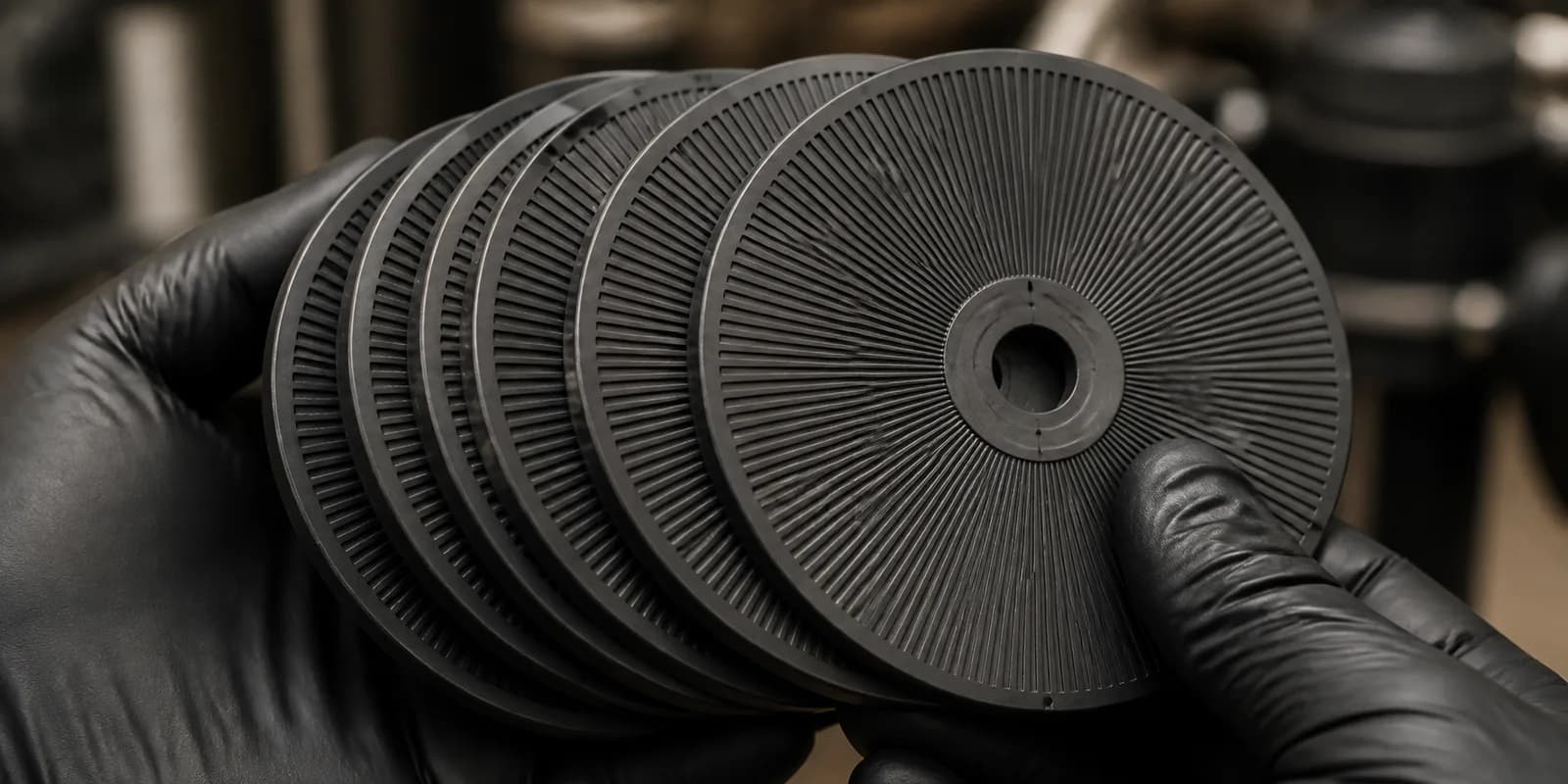
Spin Klin Disc Filter
Choose the tie-in, then compare quotes
The back-flush supply decides the tie-in, and the documents name three routes. Internal source: the 2024 manual names an internal water source,[5] but the pump station must hold the grade's pressure during every flush, and VCE and UC ANR say a booster or pressure-sustaining valve may be needed.[18][19] External source: the flush comes from external source water (the manuals' term), but its manuals print the same 3, 3.5 and 5 bar without saying where they are read,[6][11] so it is not a documented cure for low line pressure. Air-aided, a 2" configuration in the documents retrieved, needs air at 6 to 8 bar, and the user guide recommends an air compressor;[7] the 2021 US catalogue puts its ceiling at 60 m³/h,[14] a margin of (60 − 75) ÷ 60 = −25.0% at 75 m³/h that is a quote item, because the pages tie no envelope to a configuration.
Separation sits upstream. VCE says "coarse mesh screens are generally required on the pump intake" and, where a source carries a lot of sand, a sand separator may be required and, if so, goes upstream of any filtration unit.[18]
The owner supplies the drain route and the air source. The quote states the per-order controller and the internal-source air pressure (none retrieved states them) and the manual cut-off and air release valves.[5][6] The manual warns that a flush starts automatically, without early warning.[5]
In every quote, 10 to 90 or up to 120 is a range from a named document and date, not a unit and not turndown. Ask for the document number and edition behind each figure, the grade, the back-flush pressure and the line it is read on, and the unit count against the duty at that pressure. The mechanics article gives the rule for what a figure must carry. In the documents retrieved on 2026-10-01 these were not found: the drain-line size, a pre-screen or sand threshold, mounting orientation, whether the grade is nominal or absolute, any retention figure and, for internal or external source, the real flush volume per cycle.
Automatic still carries a maintenance schedule. The irrigation pages say the filter "permanently eliminates the need to replace filter media",[3] which is a statement about media; the 2024 manual still schedules monthly pressure, drain and controller checks and a seasonal section on cleaning the discs when required.[5] Its warranty runs 12 months from delivery and excludes intake water outside a standard Amiad approves in writing and maintenance not following Amiad's instructions.[5]
Keep it valid, and know when to stop
Commissioning and servicing are by authorised technicians.[5] Four steps of the manual's start-up list matter: vent the air; read the back-flush pressure during a flush against the grade's figure (the guide reads it at the battery inlet); check that the clean difference does not exceed 2 m (3 psi), which the guide reads at the site's flow because the manual prints no flow condition; set the indicator at a recommended 5 m (7 psi) according to the site conditions; the manual's safety section adds retightening bolts after the first week.[5] The manual says to set a 15 s flush, a 5 to 10 s dwell and typically a 1 to 3 hour interval, with the timer a backup for the differential-pressure switch.[5] No document retrieved prints a disc or seal replacement interval. Re-measure peak solids and sand, battery pressure in a flush, hydraulic capacity, the emitter grade and the chlorination plan whenever the source, season or duty changes.
A pressure read at standstill, or before the flush draw starts, overstates what the grade sees, since the manual's own check is during back-flushing (the guide's reasoning). Five stop conditions apply; none fires on the pressure and chemistry screens for the chosen 130 µm grade, and 50 µm is eliminated in the run.
- Back-flush pressure at the battery below the grade's figure, with no booster, pressure-sustaining valve or air-aided battery planned, and no written statement from Amiad of where an external-source figure is read. Next: raise the pressure, add a booster, or ask Amiad in writing; an external supply is not settled by the manuals.
- Continuous or upstream chlorination planned with no written disc-pack and seal tolerance in the quote. The extension guidance says "Chlorine should be injected before (upstream of) the system filter(s)",[20] and Amiad's soak recipe for removed discs is not a tolerance.[5] Next: do not inject ahead of the battery until Amiad answers in writing.
- Peak solids above ASABE's 100 mg/L, or sand with no separation planned. Netafim prints a hydrocyclone ahead of the main filter where sand exceeds 2 ppm, for its PC dripper family,[15] and VCE says a media filter may be the better choice where sand is a concern.[18] Next: add the screen, separator or settling stage first.
- A duty above the 3" page's 180 m³/h (200 in the 2021 catalogue), or a pressure no documented configuration meets. Next: ask Amiad in writing; its larger classes[13] are outside this record.
- Iron above 1.5 ppm or a need to control microbial growth. Next: a separate oxidation or disinfection stage, whose oxidant then raises condition 2.
An enquiry that can be sized sends hydraulic capacity and its basis, the emitter maker's grade, battery pressure read in a flush, peak solids and sand, iron, the chlorination plan, temperature, drain, air, power and controller, and country. A reply from whichever supplier answers should name the size and configuration, the unit count, the margin as (rated − demand) ÷ rated with the rated figure named, the component that limits flow or pressure and the governing document and edition.
Request a quote for Amiad Spin Klin 2" or 3" irrigation batteries with this data pack.
Sources
- [1]Amiad — 2" Spin Klin (industrial) product page, retrieved 2026-10-01 (flow range, configurations, linked manuals)
- [2]Amiad — 3" Spin Klin (industrial) product page, retrieved 2026-10-01 (flow range, external-source configuration, linked manuals)
- [3]Amiad — 2" Spin Klin (irrigation) product page, retrieved 2026-10-01 (flow range, duty statement, linked manuals)
- [4]Amiad — 3" Spin Klin (irrigation) product page, retrieved 2026-10-01 (flow range, duty statement, linked manuals)
- [5]Amiad — 2" Spin Klin Battery Internal Source, Installation and Operation Instructions, 910101-000854 / 06.2024 (paraphrased; one operative sentence quoted)
- [6]Amiad — 2" Spin Klin Battery External Source, Installation and Operation Instructions, 910101-000652 / 05.2017 (paraphrased)
- [7]Amiad (Arkal) — 2" Spin Klin with Air Aid Flushing (AAF) user guide, 910101-000616 / 05.2022 (paraphrased)
- [8]Arkal (Amiad) — Spin Klin 2" Battery Service and Maintenance Manual, 910101-000597 / 08-2013, an irrigation-era edition; whether it is the document the 2" page links is not established (paraphrased)
- [9]Amiad — 2" Spin Klin LCE Battery (Internal Source) Installation and Operation Instructions, 910101-000960 / 05.2017 (paraphrased)
- [10]Amiad — 3" Spin Klin Battery Internal Source, Installation and Operation Instructions, 910101-000512 / 04.2021 (paraphrased)
- [11]Amiad — 3" Spin Klin Battery External Source, Installation and Operation Instructions, 910101-000929 / 08.2022 (paraphrased)
- [12]Arkal (Amiad) — Spin-Klin 3" Battery Installation, Operation and Maintenance Instructions, 910101-000494 / 08.2013 (existence, reliance notice and the one minimum-pressure line only)
- [13]Amiad — Filtration Products for Industry catalogue (AU-hosted English copy), 910101-000235 / 01.2021
- [14]Amiad — Filtration Products for Industry catalogue (US-hosted letter copy, 2021-02 upload; the 2-inch air-aided row)
- [15]Netafim — PC on-line dripper product specification (one emitter family: recommended filtration and sand trigger)
- [16]Rivulis Knowledge Hub — Micron and mesh (130 micron / 120 mesh given as an example)
- [17]ASABE — Design and Operation of Farm Irrigation Systems, Ch. 17 Microirrigation Systems (mirror copy hosted by irrigationtoolbox.com)
- [18]Virginia Cooperative Extension — Filtration, Treatment, and Maintenance Considerations for Micro-Irrigation Systems (VCE 442-757)
- [19]UC ANR — Maintenance of Microirrigation Systems: Disc Filters
- [20]UF/IFAS Extension — CIR1039 Treating Irrigation Systems with Chlorine (mirror copy; the publisher page returned HTTP 410 on 2026-10-01)
- [21]UF/IFAS Extension — SL 265/SS487 Dealing with Iron and Other Micro-Irrigation Plugging Problems
- [22]UF/IFAS Extension — AE61/WI009 Screen Filters in Drip Irrigation Systems (written for screen filters)
- [23]Interim National Water Quality Standards for Malaysia — WEPA database copy (undated secondary copy; DOE index classification table)