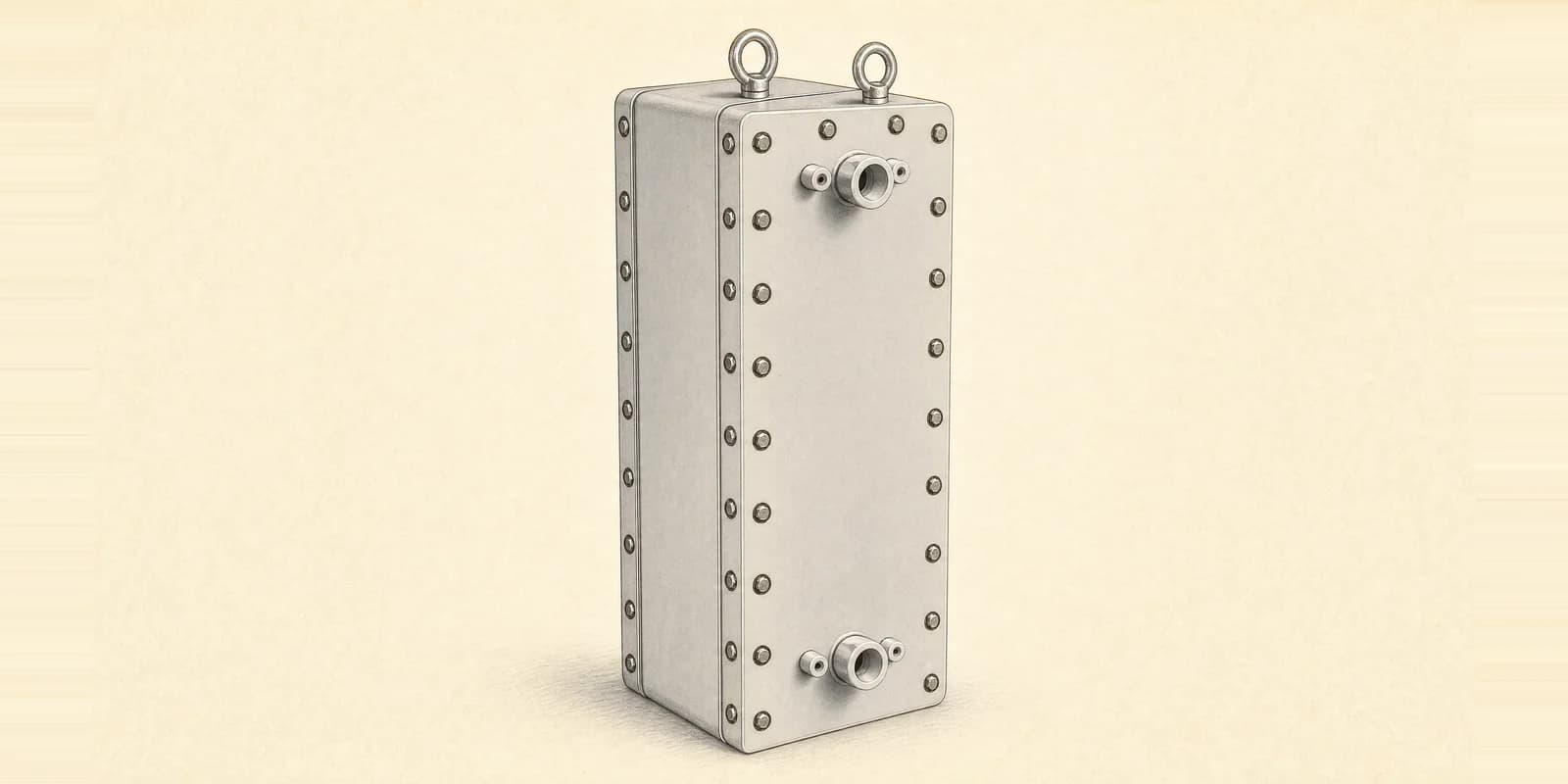
SnowPure's product page lists the Electropure EXL block of electrodeionization (EDI) modules at 2.3 to 10 m³/h[1] and each EXL datasheet prints a design flow,[3][4][5][6] so the nameplate asks how many modules a flow needs. The question that decides fit is which reverse osmosis (RO) route, feed water and feed table that flow assumes. The design flow for 1-pass RO plus a gas-transfer membrane is 12% to 25% below the 2-pass one (derived here), none of the four EXL sheets says which of the feed values it prints either flow assumes,[3][4][5][6] and seven SnowPure documents print three differing sets of feed values.[2][8][11] Reading a design flow as what the module delivers on the site's water is the misreading this guide replaces.
The guide measures the RO permeate, screens it against printed limits, sizes with the margin stated and turns each open basis into a question for SnowPure. It ends in one of three answers: quote an EXL model with the questions attached; fix the feed first; or not this product. The technology deep dive covers mechanism, feed tables and recovery routes; the reference design works a boiler makeup duty with its upsets and control.
Measure the RO permeate before reading any flow
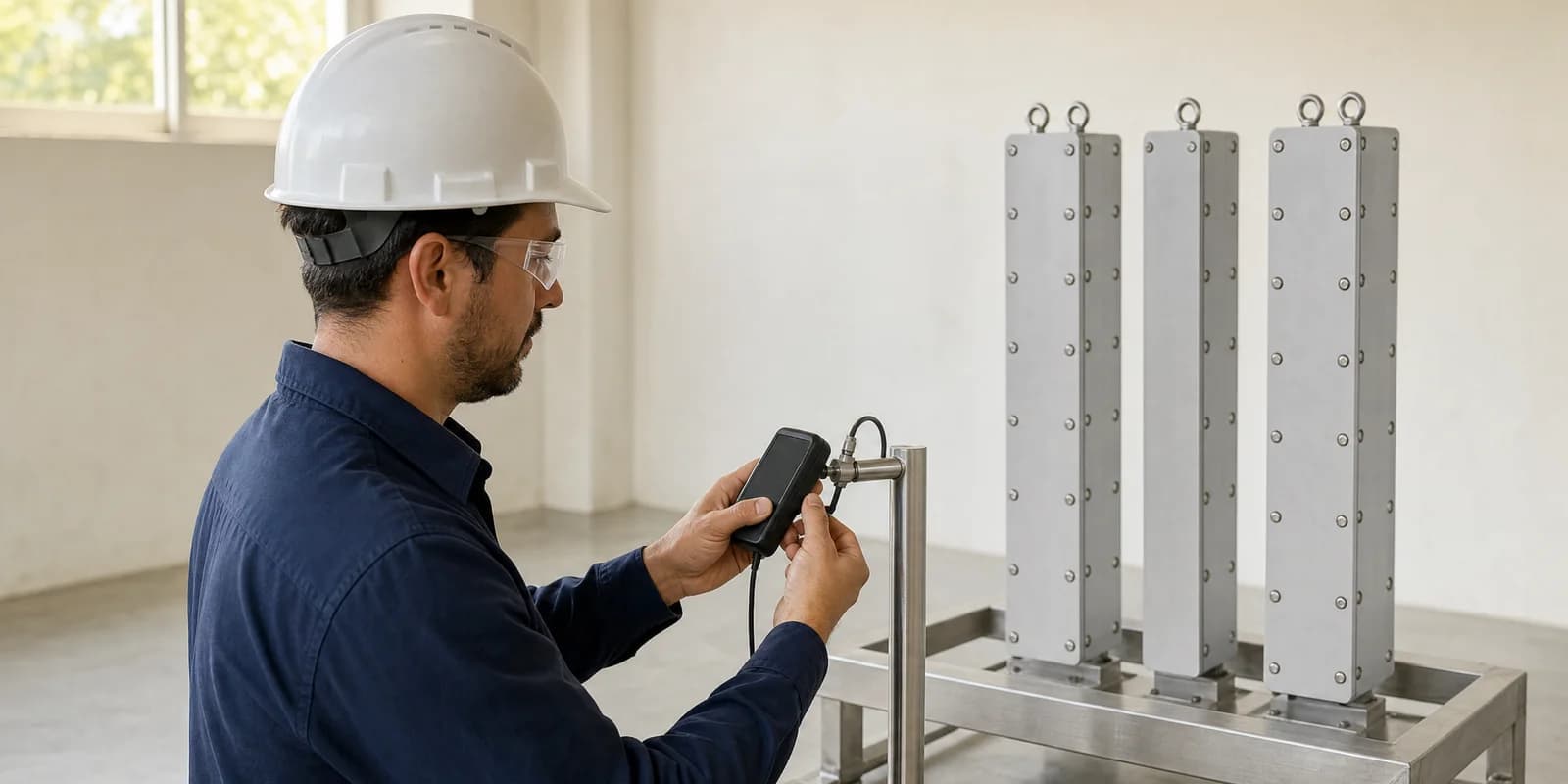
EDI polishes RO permeate, so the first sort is a polishing gap or an upstream problem. SnowPure's FAQ says "High quality RO permeate (only) must be fed to the EDI",[7] so raw-water hardness, chlorine or cloudiness is settled upstream and no module count answers it (this guide's reasoning). Check: name the complaint (resistivity or silica short after RO, or something earlier) before reading any flow.
Product quality below target is a trend against the feed, not yet a module fault: check RO permeate conductivity, total CO₂ (CO₂ plus bicarbonate) and silica first. The generic feed-water sheet prints total CO₂ below 5 mg/l, optimum below 2.[8] Voltage, steady state and temperature compensation are further causes, listed in the deep dive. A 2003 brief from Membrana, a gas-transfer membrane maker, hosted on SnowPure's site, calls excessive CO₂ "the leading cause of an EDI system not meeting design specifications".[14] SnowPure says a normal CO₂ test kit measures one of three species and so "often underestimates the load on an EDI system",[9] which can make a feed look cleaner than it is (this guide's reasoning).
Current has two opposite symptoms. For a high current SnowPure's FAQ names a high FCE (feed water conductivity equivalent) or a low concentrate flow, which is a high recovery; for a very low to zero current it says a concentrate conductivity under 10 µS/cm means ions are not being removed well.[7] One ammeter reading cannot separate a high FCE from a low concentrate flow without the concentrate sample (this guide's reasoning). Check: sample the concentrate and read its conductivity beside the feed.
Inputs sort by what they decide. Eliminate: oxidants, hardness and the recovery route it assumes, total organic carbon (TOC), iron, manganese, sulfide, silica, pH, any need for hot-water sanitising, the drain route and any declaration the site needs. Size: product flow in m³/h, the RO route, conductivity in µS/cm, total CO₂ in mg/l, silica in ppm, the temperature range and the duty pattern, since SnowPure says EDI "may be run continuously or intermittently"[2] and stops carry restart work.[10]
Fit: inlet pressure, supply input, drain and vent routes. No Singapore, Malaysian or Indonesian permeate figure was retrieved, so the reader's samples govern.
FCE in µS/cm is a weighted sum of conductivity, total CO₂ in mg/l and silica in ppm,[8] not a meter reading. The EXL-550 sheet's two design-flow rows in gpm sit about 9% below its m³/h rows (derived here); this guide uses the m³/h column.[4][2]
Design flow depends on the RO route
Eliminate on printed limits first, per document and never averaged. Seven SnowPure documents print three different sets of feed values. The 2018 manual and the generic feed-water sheet (2022 in the file name) print the same rows: FCE below 33 µS/cm, 5 bar and a 1 µm particle line.[2][8] The four EXL sheets print FCE below 43, 7 bar and no particle row.[3][4][5][6] The EXL installation checklist's last page (2021 in the file name) prints FCE below 43, 7 bar and a 5 to 10 µm particle line.[11] No document read says which table governs. Check: ask which table, document and date applies to the module quoted; counting first counts on the wrong table.
The FCE row binds before the rows it sums. At the generic table's maxima together (20 µS/cm conductivity, 5 mg/l CO₂, 0.5 ppm silica) FCE = 20 + 2.79 × 5 + 1.94 × 0.5 = 20 + 13.95 + 0.97 = 34.92 µS/cm, above 33 and below 43.[8] That is an upper-side illustration: the table does not say the maxima occur together. Misreading: meeting each input row (conductivity, CO₂, silica) means meeting the FCE row. Check: compute FCE from measured inputs with SnowPure's CO₂ weight of 2.79; the 2003 Membrana brief prints 2.66 and counts bicarbonate separately, while SnowPure's 2.79 applies to total CO₂;[14][8][2] a quoted FCE must state its weight and CO₂ basis.
Each EXL sheet prints a design flow for 1-pass RO plus a gas-transfer membrane and another for 2-pass RO; the first is 25.0%, 20.0%, 14.3% and 11.8% below the second for the EXL-550, EXL-650, EXL-750 and EXL-850 (3.0 against 4.0, 4.0 against 5.0, 6.0 against 7.0 and 7.5 against 8.5 m³/h; derived here, no cause printed, not carried to other lines).[3][4][5][6] None of the four EXL sheets (file-name year 2022) prints the conductivity, CO₂, silica or FCE at which its design flow is rated, for either RO route, and no sentence ties either flow to the recommended or the maximum column.[3][4][5][6] The manual's standard test water, run at "the published nominal" flows,[2] is a test condition no document read ties to these design flows.
[ASSUMPTION: design flow is read as a product flow, applying the FAQ's phrase "rated EDI product design flow"[7] to all four EXL sheets, which name no assumed feed; valid if SnowPure confirms, invalid if it is a feed flow, when counts may rise.] The 10 m³/h at the top of the product page's EXL block is the EXL-850's maximum recommended flow; the others peak at 4.5, 6.0 and 8.0.[1][3][4][5][6]
Lower flow is five statements and no turndown. For the EXL-850 the manual's recommended range starts at 6.0 m³/h;[2] the FAQ puts the minimum feed flow at "approximately half of the rated EDI product design flow"[7] (3.75 or 4.25, derived here); the product page lists 2.3 for the whole EXL block;[1] the regeneration table starts at 4.5, in regeneration mode;[2] and the power-supply sheet's band starts at 7.5, equal to the 1-pass design flow (derived here).[12] None of the four EXL sheets prints a lower flow[3][4][5][6] and none of the five is a turndown ratio; which governs normal duty is a quote question, not a stop. Misreading: a band is turndown. No flow derating for temperature or FCE is printed in the documents read.
[ASSUMPTION: a continuous product duty of 14 m³/h, for arithmetic only, not a plant or a SnowPure rating.] Two EXL-850 give 2 × 8.5 = 17.0 m³/h on 2-pass, a margin of (17.0 − 14) ÷ 17.0 = 17.6%, and 2 × 7.5 = 15.0 on 1-pass plus a gas-transfer membrane, (15.0 − 14) ÷ 15.0 = 6.7%, at 7.0 m³/h per module (equal split assumed): above four lower-flow statements, below the supply band's 7.5. The margin sits about eleven points apart by route, and with no feed tied to either flow an effective-flow cut above 6.7% leaves two modules short.
An illustrative permeate of 6.0 µS/cm, 3.0 mg/l CO₂ and 0.15 ppm silica gives FCE = 6.0 + 2.79 × 3.0 + 1.94 × 0.15 = 14.7 µS/cm, 1.63 times the optimum 9 and under 33 and 43, with each input inside the generic table's rows;[8][11] hardness, TOC, metals and oxidants are the reader's. [ASSUMPTION: that permeate is read as 1-pass plus gas-transfer-membrane output, to show the method; invalid as a typical feed or as a 2-pass permeate, so the 2-pass margin shows only how far the rating moves with the route.] A screen, not a fit: the stop conditions apply first.
Neighbours (derived here): no other model reaches 14 m³/h with two modules on 1-pass plus a gas-transfer membrane.[3][4][5][6]
| Array | 1-pass with gas-transfer membrane, m³/h (margin) | 2-pass, m³/h (margin) |
|---|---|---|
| EXL-850 × 2 | 15.0 (6.7%) | 17.0 (17.6%) |
| EXL-750 × 2 | 12.0, short | 14.0 (0%) |
| EXL-750 × 3 | 18.0 (22.2%) | 21.0 (33.3%) |
| EXL-650 × 3 | 12.0, short | 15.0 (6.7%) |
| EXL-650 × 4 | 16.0 (12.5%) | 20.0 (30.0%) |
| EXL-550 × 4 | 12.0, short | 16.0 (12.5%) |
| EXL-550 × 5 | 15.0 (6.7%) | 20.0 (30.0%) |
SnowPure Electropure™ EDI — EXL Series
No certifications listedView product →Ask every quote what its flow assumes
Against service exchange and mixed bed, no document read gives a crossover flow or a cost, chemical-dose or footprint figure. SnowPure's dealers page, on EDI against portable exchange deionization (PEDI), estimates "approximately 10% to 15% of PEDI accounts may benefit",[19] for standardised 1 to 7 gpm systems (0.23 to 1.6 m³/h at 4.4 gpm per m³/h, converted here),[2] below every EXL design flow. Misreading: EDI wins above some flow. Check: put the reader's own baseline in the enquiry.
Each route has SnowPure's stated advantage and a blind spot, this guide's reasoning unless attributed. [ASSUMPTION: one array fed from an RO train with a feed pump; invalid where no RO precedes the module.] 1-pass RO to EDI has "lower cost and lower complexity"[10] in SnowPure's words, but the four sheets print no design flow for it without a gas-transfer membrane.[3][4][5][6] SnowPure recommends adding one where CO₂ is high or silica critical[16] and sells the contactor;[10] no contactor size, pressure drop or outlet CO₂ for an EXL flow appears in the documents read. 2-pass RO has "much greater purification"[10] and, for the EDI after it, "very little maintenance"[10] in SnowPure's words; the blind spots are a second membrane stage (reasoning from SnowPure's lower-cost claim for 1-pass) and, for a permeate under SnowPure's 1 µS/cm line,[10] a concentrate that may lack conductivity, which the reference design argues.
SnowPure puts system design on the OEM, its name for the system builder,[17][10] and supplies components only, not complete water systems.[18] SnowPure sells the module, DC supplies with interlock contacts[15] and some flow switches, flowmeters and meters,[10] so who supplies the manifold, interlock logic, electrode-gas vent, grounding and operator training is a quote line. Power without water flow,[15] a pretreatment excursion and a reversed pressure order[10] are answered by naming who supplies the interlock and what it trips on.
The checklist says the EXL torque is preset at 20 ft-lb (27 N-m) and the design removes the need to re-torque;[11] the manual says no torque is required for EXL.[2] SnowPure's statement printed Jan 2021 says "All EDI modules conform to CE: meeting the 2014/35/EU Directive"[13] and names the product lines EXL, XL and Zapwater, but carries no signature or model numbers;[13] the 2018 manual's 2017 EC Declaration is signed and lists ZAP and XL model numbers, not EXL.[2] No EC declaration of conformity naming an EXL model, UL or CSA listing or third-party certificate was found in the documents read. Check: ask for the document for the exact model and market.
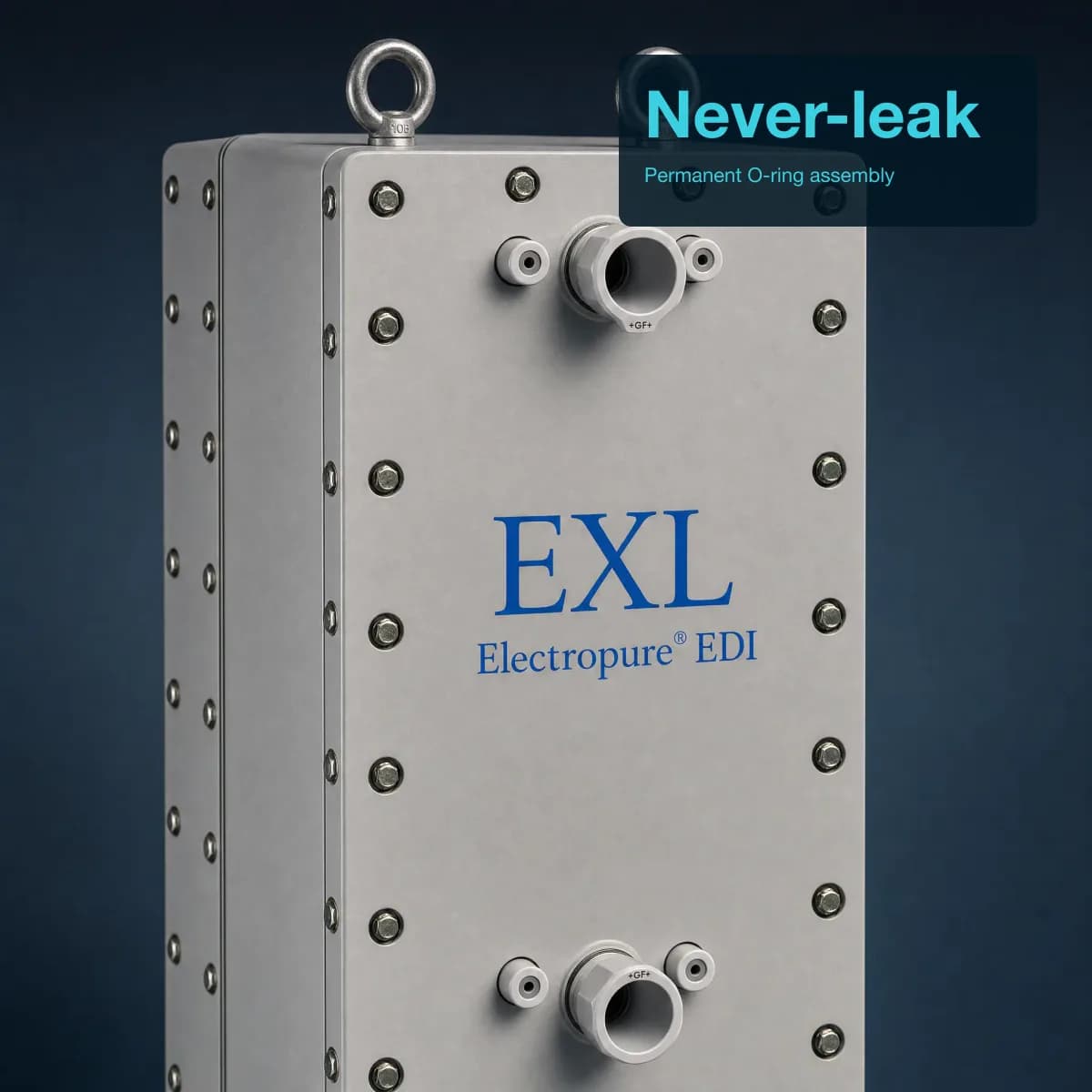
A quote for the EXL-850, with the EXL-750 and EXL-650 as comparisons, is comparable only if it states product or feed flow, RO route, the feed assumed, the table by document and date, design or maximum flow, the concentrate route and setpoint basis, the supply item and who supplies the interlock and instruments. A supplier's figure is a lead, never the reader's result; confirm with SnowPure only what no printed figure derives. Lifecycle declarations: module replacement, spares, water to drain by route, cleaning chemistry and energy.
Retest the permeate, and know when to stop
The checklist says current falls to nominal and resistivity reaches the "design criteria"[11] within 1 to 2 hours (the manual says about 1 hour),[10] without defining the criteria, so commissioning is recorded, not judged. Every module should show a similar current, and the concentrate should be about 10 to 11 times the feed conductivity at 90% recovery.[11][10] Instruments: an ammeter per module, a temperature-compensated resistivity meter, concentrate sample valves;[10][2] no service interval beyond cleaning triggers is printed in the documents read. For intermittent duty SnowPure's suggested matrix for general industrial and power adds restart work: "Startup with Regen"[10] for 1 to 7 days and sanitising on shutdown from 8 days.
Re-measure (this guide's rule) conductivity, total CO₂, silica, hardness, oxidant, temperature and flow whenever RO membranes are replaced or age, the RO route, antiscalant or pretreatment changes, or the source, season or demand changes. A pass on new RO membranes proves the day: SnowPure's manual says to design in excess current capability "if RO permeate conductivity increases with system age".[10]
Six stop conditions apply; none fires on the worked run.
- Oxidants that cannot be held not detectable (all four EXL sheets print not detectable as the recommended and maximum value):[3][4][5][6] fix upstream, or not this product.
- FCE above the maximum SnowPure confirms for the model (33 or 43 by document): reduce the dominant term (a gas-transfer membrane if CO₂ dominates, a second RO pass if conductivity does; this guide's reasoning), or not this product.
- Hardness above the limit for the chosen route, printed below 1.0 ppm at 90% recovery in three documents, below 0.5 and 1 ppm with no recovery named on the EXL sheets:[2][8][11][3][4][5][6] soften further or take the 90% route.
- Hot-water sanitising needed, which the manual says to avoid except on HTS designs,[10] a separate line outside the EXL-550 to EXL-850 modules this guide covers: ask for that line, or another product.
- A drain route the authority will not consent to (Singapore requires the Public Utilities Board's written consent for trade effluent into a public sewer;[20] Malaysia and Indonesia are a buyer check, with no figure here): recover the concentrate or find another route.
- A written refusal of a supply route for the quoting party or of the declaration the site needs: another route, or not this product for that site. A stop fires on a written refusal, never on a gap.
If SnowPure declines or cannot say in writing which feed the quoted design flow assumes, the count stays provisional: a not yet, not not this product.
The data pack holds the dated permeate conductivity, total CO₂ (or FCE with its weight), silica, hardness, oxidant, pH and temperature, the product flow range, RO and concentrate routes, duty pattern and longest stop, feed pressure, supply input, drain route, market (SG, MY or ID) and any declaration needed. A complete reply gives the feed basis by route, the table by document and date, the count with margin (rated − demand) ÷ rated, the lower flow, the supply item, the interlock supplier, the declaration and lifecycle items, or concludes that EDI is not needed or not yet. A Purionex quote request carries the listed questions to the maker or its channel and any written answers received are passed on; whether the quoting party is an authorised channel for the product in the buyer's market is a question for whoever quotes.
Request a quote for an EXL-series EDI stage with this data pack.
Sources
- [1]SnowPure — Electrodeionization EDI Modules XL & EXL product page (web page read 2026-10-01) — the EXL block's flow row
- [2]SnowPure — OEM Engineering Manual, Electropure XL & EXL Series EDI, version 3.5 (February 2018) — duty pattern, feed table, current table, regeneration table, declaration page
- [3]SnowPure — Electropure EDI EXL-850 datasheet (2022 in the file name; no printed date) — design flows, maximum flow, feed table
- [4]SnowPure — Electropure EDI EXL-550 datasheet (2022 in the file name; no printed date)
- [5]SnowPure — Electropure EDI EXL-650 datasheet (2022 in the file name; no printed date)
- [6]SnowPure — Electropure EDI EXL-750 datasheet (2022 in the file name; no printed date)
- [7]SnowPure — FAQs, Electrodeionization (web page read 2026-10-01) — RO permeate feed, minimum flow, current causes
- [8]SnowPure — EDI Operating Feed Water Specifications (2022 in the file name; no printed date) — generic feed table and FCE formula
- [9]SnowPure — How to measure total CO2 for EDI (page footer September 2014) — what a CO2 test kit measures
- [10]SnowPure — OEM Engineering Manual v3.5 (February 2018), further passages — components, 1-pass and 2-pass RO, supply, shutdown matrix, sanitising
- [11]SnowPure — EXL Module Installation Checklist (2021 in the file name; no page prints a date) — start-up, torque, cord, feed table on page 5
- [12]SnowPure — Industrial ediPureSource DC power supplies (2022 in the file name; no printed date) — supply items and flow bands
- [13]SnowPure — statement on US FDA, RoHS and CE (printed Jan 2021) — SnowPure's own statement
- [14]Membrana-Charlotte — Liqui-Cel TechBrief Volume 46 (August 2003), hosted by SnowPure — third-party CO2 statement and FCE weight
- [15]SnowPure — ediPureSource DC power supplies page (web page read 2026-10-02) — supplies include interlock contacts for flow switches and pressure switches
- [16]SnowPure — Liqui-Cel page (web page read 2026-10-02) — where SnowPure recommends RO, gas-transfer membrane, EDI
- [17]SnowPure — Applications index (web page read 2026-10-02) — qualified-OEM sales model
- [18]SnowPure — Semiconductor and electronics page (web page read 2026-10-02) — components only
- [19]SnowPure — EDI for dealers, a complementary technology to portable exchange DI (web page read 2026-10-02; no printed date)
- [20]PUB Singapore — Requirements for discharge of trade effluent into the public sewers (file name June23; no printed date) — consent requirement, Singapore only