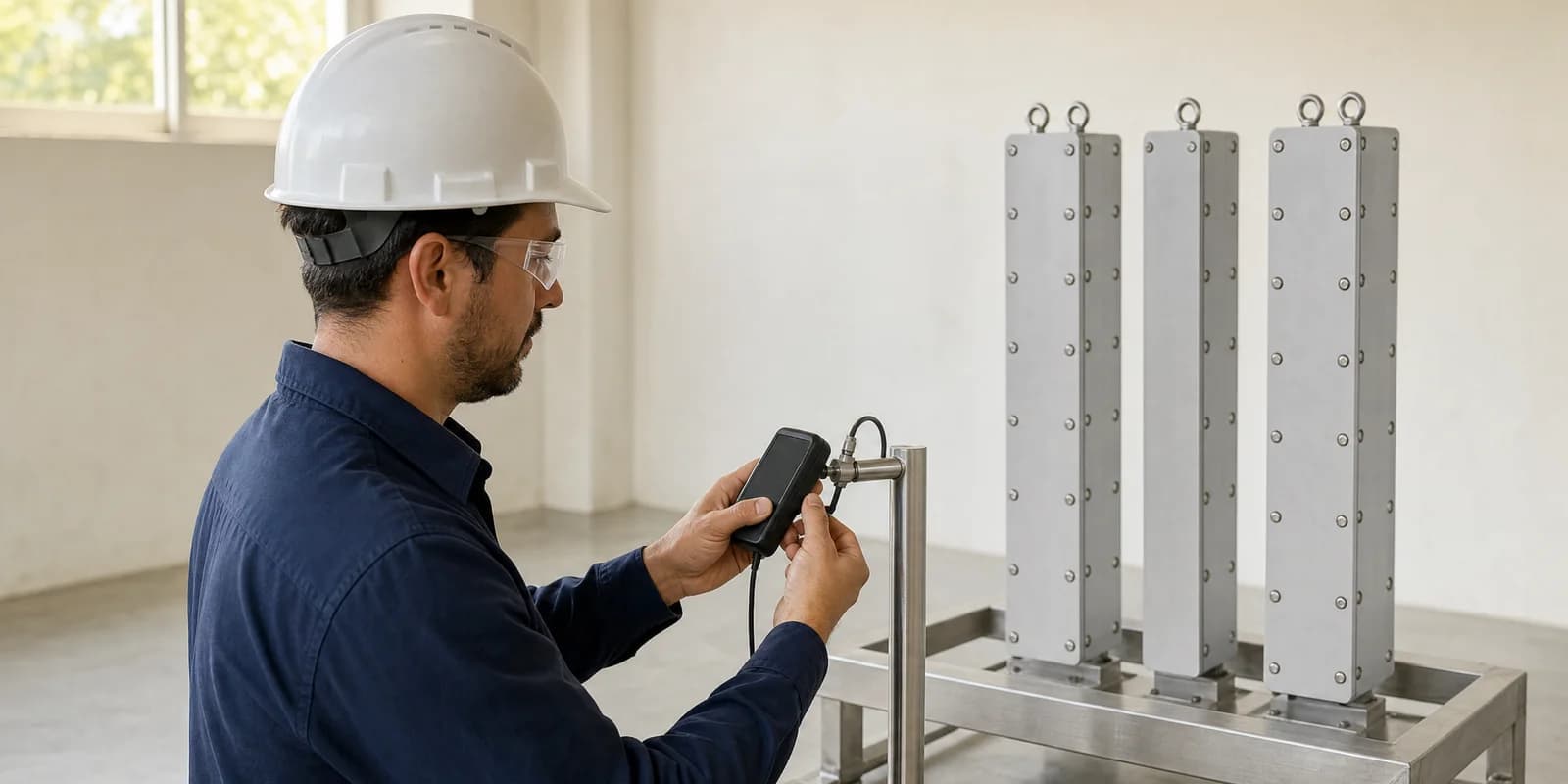
This reference design shows how SnowPure's Electropure EXL-850 electrodeionization (EDI) modules could be configured for boiler makeup polishing behind a two-pass reverse-osmosis (RO) train. Fit depends on how clean the RO permeate is at its floor, on which feed SnowPure's printed design flow assumes (the four EXL sheets print a feed table, but none says which column a design flow rests on, and no document read ties the manual's test water to one),[3][4][5][6][2] and on where the concentrate goes, not on the 10 m³/h at the top of the product page's EXL block, the EXL-850's maximum recommended flow.[1][3] Integrators and engineers drafting a request for quotation can use it to frame questions for the maker or its channel. It can end as three modules at a thin margin that SnowPure's answer could erase, as not this product, or with items held open until SnowPure answers in writing. It is hypothetical, with no installation, commissioning date or measured result behind it, and stays provisional until the feed basis is confirmed.
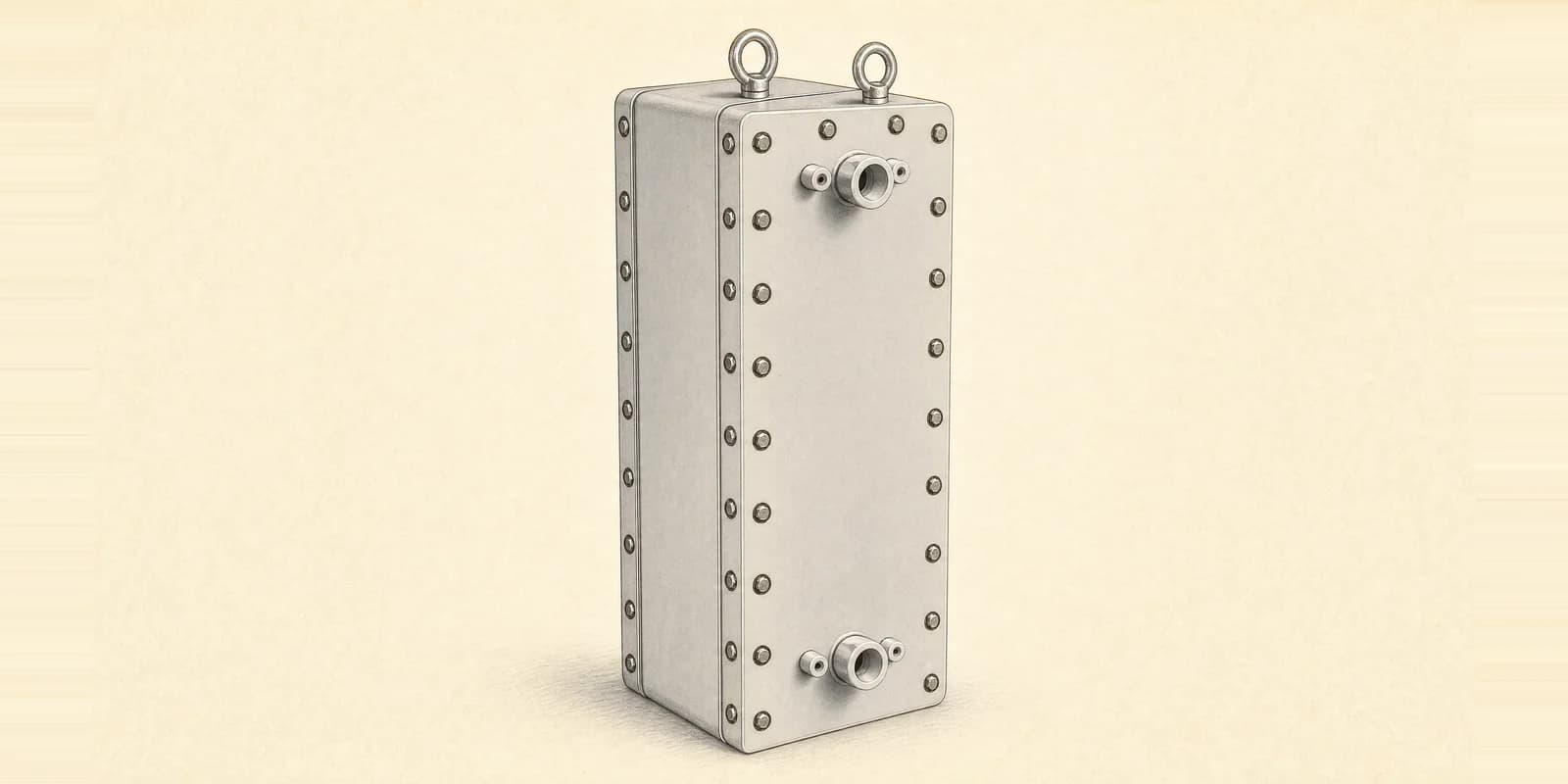
The EXL is a plate-and-frame EDI module
SnowPure's Electropure EXL is a plate-and-frame electrodeionization module: a stack of cell pairs between two electrodes that combines electrodialysis with ion-exchange resin and, SnowPure says, needs no regeneration chemicals.[2] The technology deep dive covers how it removes ions. Each module is an upright block, 314 × 606 mm on the face and 244 to 457 mm deep by model, 68 to 114 kg in operation on datasheets with 2022 in their file names and no printed date,[3][4] with two lifting rings, four mounting points and upward feed and concentrate flow.[11][3] Siting is indoor only, at 5 to 45 °C ambient.[2]
The EXL-550, 650, 750 and 850 are the four standard models.[1] The variant used here is the EXL-850 at its 8.5 m³/h 2-pass design flow.
| Model | Design flow, 1-pass RO plus gas-transfer membrane (GTM) / 2-pass RO, m³/h | Maximum recommended flow, m³/h | Operating weight, kg |
|---|---|---|---|
| EXL-550[4] | 3.0 / 4.0 | 4.5 | 68 |
| EXL-650[5] | 4.0 / 5.0 | 6.0 | 83 |
| EXL-750[6] | 6.0 / 7.0 | 8.0 | 97 |
| EXL-850[3] | 7.5 / 8.5 | 10 | 114 |
The EXL-550 sheet's two design-flow rows in gpm sit about 9% below its m³/h rows (derived here); this article uses the m³/h column.[4][2]
The product page lists the EXL block at 2.3 to 10 m³/h,[1] but the 10 is the EXL-850's maximum recommended flow; the other three models peak at 4.5, 6.0 and 8.0. Reading the block's range as every model's is the misreading; the check is to name the model and RO route wherever a flow is quoted. SnowPure's EXL-HTS (high-temperature stable) models are a separate hot-sanitising line, outside this configuration.[10]
The feed and product ports take +GF+ unions, d32/DN25 on the EXL-550 and 650 and d40/DN32 on the 750 and 850 as the checklist (file-name year 2021) recommends, or sanitary connectors; one fitting comes with the module, mating pieces are options, and the order sets which ships.[11][21] Concentrate and electrode ports are push-to-connect.[11] The system around the module is built by an OEM, SnowPure's word for a pure-water system integrator.[16]
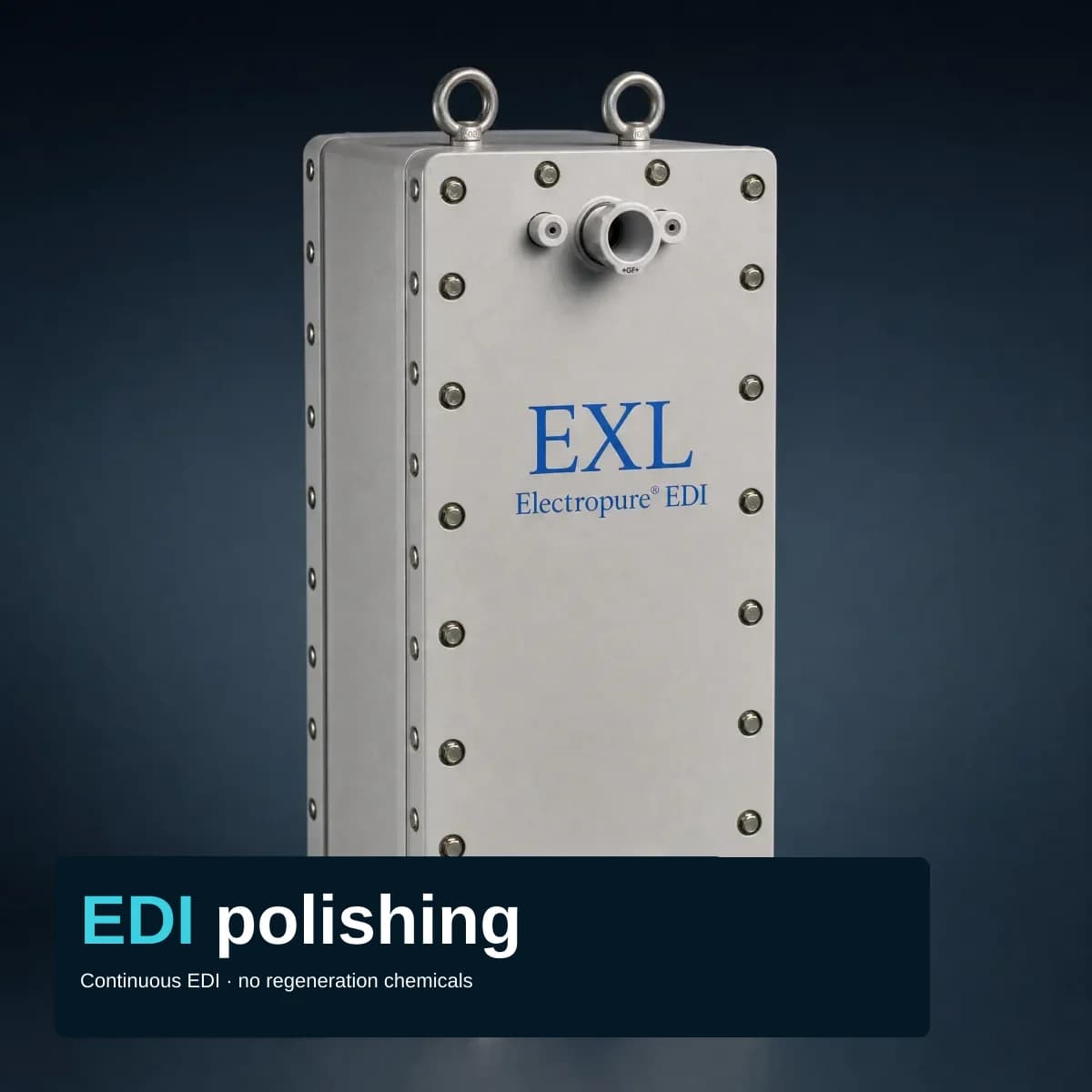
The product page heads the EXL block "EXL: High Flow EDI for Power Generation, Industrial, and Pharmaceutical Water",[1] and the manual (version 3.5, February 2018) lists boiler water makeup among ultrapure-water uses.[10] SnowPure's power page says it is able to serve a greater share of the boiler feedwater market with its high-capacity EXL product and lists plants with RO plus EDI systems of 100 to 200 gpm, 22.7 to 45.5 m³/h (derived here at 4.4 gpm per m³/h), without naming a module line.[17][2] These are stated uses, not results: no document read ties an EXL model to a named installation or result.
Boiler makeup polishing is the duty taken here because SnowPure's documents point to it: the EXL block heading names power generation, and the manual says 2-pass RO is "often used for power plants and electronics, where silica levels are critical".[10] Three duties are set aside as a choice made here, not a finding about the product: pharmaceutical, because the configuration defines no pharmaceutical water grade and the manual says to avoid hot-water sanitising unless the module is an HTS design, though SnowPure also lists the EXL-550 to EXL-850 under a sanitary pharmaceutical EDI heading;[10][1] semiconductor, because SnowPure's own architecture adds ultraviolet treatment and local polishing;[18] and laboratory, because the product page's laboratory line is Zapwater, not EXL.[1]
Clean permeate can leave little concentrate headroom
In this article's EXL-850 reference design for boiler makeup polishing (the EXL makeup design), the targets start from the permeate's floor, because SnowPure's typical two-pass permeate sits at the bottom of the band its manual calls no problem.[10]
The duty is an assumption: 24 m³/h of EDI product, continuous, from one array fed directly by 2-pass RO permeate at 30 °C, with stops under a day. The count is sized on the 2-pass design flow, because none of the four EXL sheets says whether it or the maximum recommended flow governs continuous duty;[3][4][5][6] on the maxima, three EXL-850 would rate 30 m³/h, and three EXL-750 or four EXL-650 would sit exactly on 24.
At SnowPure's concentrate of 10% of product flow, 24 m³/h of product needs 26.4 m³/h of feed and recovery is 90.9%; read on feed flow, recovery is 90.0%.[2] Concentrate and electrode flows are derived from SnowPure's general statements, not printed EXL setpoints.[2]
- Duty pointASSUMPTION24 m³/h, a round number inside the 60 m³/h ceiling of SnowPure's supply sheet and the 22.7 to 45.5 m³/h of its power page; not a plant, a site or a SnowPure ratingsource
- Design flow read as a product flowASSUMPTIONSnowPure's FAQ calls the figure the rated EDI product design flow and none of the four EXL sheets says which feed it assumes; valid if SnowPure confirms; if it is a feed flow that includes the concentrate, 26.4 to 26.7 m³/h of feed is 8.8 to 8.9 m³/h on each of three modules, above 8.5, and the count is four (derived here)source
- Feed temperatureASSUMPTION30 °C, inside the datasheets' recommended 10 to 35 °Csource
- Permeate windowASSUMPTION1 to 5 µS/cm, SnowPure's band for operation that can continue with no problem, so its lower edge is SnowPure's typical 2-pass value; invalid under SnowPure's 1 µS/cm linesource
- Duty patternASSUMPTIONContinuous, stops under a day, the shutdown matrix's normal-startup case; invalid for intermittent makeupsource
- Feed flowASSUMPTION26.4 m³/h with the concentrate at 10% of product flow (24 + 2.4); 26.7 m³/h with it at 10% of feed flow (24 ÷ 0.90)source
- Concentrate flowASSUMPTION2.4 m³/h (0.10 × 24); 2.67 m³/h on the feed-flow basis; both to drainsource
- Electrode streamSOURCEDAbout 10 l/h per module, always to drain: 30 l/h for three modulessource
- Water to drain from the EDI streams (RO reject not included)ASSUMPTION58.3 m³/day on the product-flow basis ((2.4 + 0.03) m³/h × 24 h); 64.7 m³/day on the feed-flow basis ((2.667 + 0.030) m³/h × 24 h)source
- Target: product flowASSUMPTION24 m³/h of product, read at the product-line flow metersource
- Target: per-module flowASSUMPTION8.0 m³/h per module, read from a per-module flow readingsource
- Target: outlet qualityASSUMPTIONResistivity and silica against the buyer's own boiler specification, which depends on boiler pressure: temperature-compensated resistivity at the product line, silica by laboratory samplesource
- Target: concentrate conductivitySOURCEDInside SnowPure's ideal goal of 10 to 100 µS/cm, by sample at each modulesource
- Target: recoveryASSUMPTIONRecorded from the product, concentrate and electrode flow readings, not promisedsource
The manual's boiler-water table prints typical values of 10 to 13 MΩ·cm and 5 to 20 ppb total silica and says "specifications depend on boiler pressure and use",[10] and SnowPure's power page prints silica figures of below 1-5 ppb for EDI beside below 10 ppb for turbines, with no feed, module or test stated.[17] Neither is an EXL measurement or a target; reading either as what an EXL will deliver is the misreading.
The misreading is that a cleaner feed is simply easier, so any count and any concentrate route works. SnowPure's manual says a typical 2-pass RO system is "often around 1 μS/cm"[10] and, separately, that too low a feed may leave the concentrate without enough conductivity, "leading to high stack electrical resistance".[10] Its rules of thumb: 1 to 5 µS/cm of permeate "can continue with no problem",[10] under 1 µS/cm "some special system configurations might be considered",[10] and a concentrate outlet goal of "ideally 10-100 μS/cm".[10] The risk sits at and below the bottom of that band. At the manual's about 11 times the feed at 90% recovery,[2] 1 to 5 µS/cm of permeate gives 11 to 55 µS/cm of concentrate, inside the goal; the goal's floor of 10 µS/cm is reached at 10 ÷ 11 = 0.91 µS/cm on the product-flow basis used here, or 1.0 on the feed-flow basis and the start-up step's "about 10 times",[2] so read the threshold as 0.9 to 1.0 µS/cm (derived here). SnowPure lists five configurations for permeate under 1 µS/cm; the EXL makeup design selects none.[10] The check is the permeate's measured conductivity range across the seasons the owner can cover, set against 0.9 to 1.0 µS/cm, before the count is fixed.
The lever that eases this has a price. Halving the concentrate flow, SnowPure's 95% route, which its FAQ ties to 2-pass feed of "very low FCE",[7] lifts the factor from 11 to 21, so 1 µS/cm of permeate becomes 21 µS/cm of concentrate, as the technology deep dive derives. FCE is SnowPure's weighted sum of conductivity, carbon dioxide and silica, not a meter reading.[2] But the printed hardness limit, below 1.0 ppm, is tied to 90% recovery in the manual, the feed-water sheet (file-name year 2022) and the checklist,[2][8][11] and no document read prints one at 95% or 99%. The EXL makeup design takes drain at about 90%.
Three EXL-850 modules would leave a thin margin
This article's EXL-850 reference design for boiler makeup polishing would take direct feed from the second RO pass and carry 24 m³/h on three EXL-850 modules at a 5.9% margin, against a design flow that no EXL datasheet ties to a feed column. SnowPure says all streams may be fed directly from RO permeate of 1 to 20 µS/cm.[10] Direct feed demands pass-2 pressure that covers the module's drop, whose required inlet pressure the documents read do not print, and concentrate and electrode streams to drain with no back pressure on the concentrate outlet, as SnowPure's simplest system asks;[10] the EXL makeup design adds a pressure relief valve from SnowPure's component list.[10] The 2-pass route is a choice made here; SnowPure's Liqui-Cel page recommends RO, gas-transfer membrane, EDI where CO₂ is high or silica critical, as in power generation,[15] and the application guide takes that route and the other tie-ins.
Three EXL-850 modules carry the duty at a 5.9% margin: 3 × 8.5 = 25.5 m³/h against 24, and (25.5 − 24) ÷ 25.5 = 5.9%, putting 8.0 m³/h on each module, 94.1% of 8.5.[3] A count that closes on the arithmetic is not yet a design: the margin is thin and rests on a rating no EXL sheet ties to a feed column. If SnowPure's answer for the real permeate lowers per-module flow by more than 5.9%, three modules are short and the count is four. On the 1-pass-plus-GTM design flow of 7.5 m³/h, 11.8% below 8.5 (derived here), three rate 22.5 and are short, so the RO route is an input; the check is SnowPure's written feed basis.
- EXL-850 × 2ASSUMPTION17.0 m³/h rated, short: the duty is 41% above rating; 12.0 m³/h per module, 120% of the 10 m³/h maximum; 228 kgsource
- EXL-850 × 3 (selected)ASSUMPTION25.5 m³/h rated, 5.9% margin; 8.0 m³/h per module, 80% of the 10 m³/h maximum; 342 kgsource
- EXL-850 × 4ASSUMPTION34.0 m³/h rated, 29.4% margin; 6.0 m³/h per module, 60% of maximum; 456 kg; clears every limit at one more module and a larger supplysource
- EXL-750 × 3ASSUMPTION21.0 m³/h rated, short: the duty is 14.3% above rating; 8.0 m³/h per module, exactly on the 8.0 maximum; 291 kgsource
- EXL-750 × 4ASSUMPTION28.0 m³/h rated, 14.3% margin; 6.0 m³/h per module, 75% of maximum; 388 kgsource
- EXL-650 × 4ASSUMPTION20.0 m³/h rated, short: the duty is 20% above rating; 6.0 m³/h per module, exactly on the 6.0 maximum; 332 kgsource
- EXL-650 × 5ASSUMPTION25.0 m³/h rated, 4.0% margin; 4.8 m³/h per module, 80% of maximum; 415 kgsource
- EXL-550 × 5ASSUMPTION20.0 m³/h rated, short: the duty is 20% above rating; 4.8 m³/h per module, 107% of the 4.5 maximum; 340 kgsource
- EXL-550 × 6ASSUMPTION24.0 m³/h rated, 0% margin; 4.0 m³/h per module, 89% of maximum; 408 kgsource
- EXL-550 × 7ASSUMPTION28.0 m³/h rated, 14.3% margin; 3.43 m³/h per module, 76% of maximum; 476 kgsource
Six EXL-550 give exactly the duty, a 0% margin that proves nothing: a duty set equal to a rating is circular; the supply sheets (file-name year 2022) list no item for four EXL-750.[12] Four EXL-850 clear every maximum-flow limit and the design flow, but at 6.0 m³/h each they sit on the manual's lower figure[2] and below the supply sheet's 7.5, a quote question, not a stop.[12] At 8.0 m³/h the chosen modules sit above all five lower-flow figures in SnowPure's documents (2.3 product page, 4.5 regeneration table, 3.75 or 4.25 FAQ, 6.0 manual, 7.5 supply sheet, all m³/h); none is a turndown ratio.[1][2][7][12]
Standby is not claimed. With one of three out, two modules carry 12.0 m³/h each, 141% of 8.5 and 120% of 10, and no document read says one module can be isolated while the others run. A fourth module idle as a spare is the EXL makeup design's reasoning, not a SnowPure statement: SnowPure's suggested shutdown matrix describes a planned shutdown of a system, where a startup after 1 to 7 days may include 1 to 4 hours in regeneration mode and 8 to 31 days adds sanitising.[10] What three modules share reaches all alike: one supply, one interlock, the feed and the headers, so a trip on one module's flow takes DC off all three while water keeps flowing. The array follows SnowPure's printed guidance, a symmetric manifold where possible, pressure-drop variation under ±15%, no dead legs, sample valves, and per-module current and fusing;[10] the EXL makeup design adds a flow switch on each of the three streams of each module, because a switch on a main stream sees only the total flow.
One supply carries the array on voltage control, sized for the maximum if possible, as the manual says.[2] The misreading is that typical current sizes the supply, or that the supply sheet's 22.5 to 30 m³/h label is the module rating: the label is 3 × 7.5 to 3 × 10, a description of the supply.[12] The electrode stream carries gas, so no regeneration chemicals does not mean no vent; the dilution-air figure is a magnitude, not a vent design, and SnowPure puts the vent with "the OEM and customer".[10] The misreading on pressure is that the 7 bar maximum is pressure available at the outlet: after the printed 3 bar drop it leaves at most 4 bar, and the 2 to 3 bar typical inlet leaves none.[3][8] Assumptions: the 3 bar is a new-module feed-to-product drop with manifold losses extra; the 2.7 bar moves the manual's generic 0.90 factor onto that sheet point;[2] gas volumes are at 25 °C with complete mixing. The EXL makeup design relies on no inlet above 5 bar; required inlet pressure and downstream demand are missing terms.
- Typical currentSOURCED9 A for three modules at 3 ppm of RO feed, a ppm-of-RO-feed basis, not µS/cm, so not converted to this duty's permeatesource
- Typical powerASSUMPTION500 V × 9 A = 4.5 kW DC (2018 manual voltage and current); about 5.0 to 5.3 kW AC at 85% to 90% supply efficiency (4.5 ÷ 0.90, 4.5 ÷ 0.85); the 2022-named EXL-850 sheet prints 550 V recommended, which with 9 A would give 4.95 kW, a mixed-edition pairsource
- Maximum powerASSUMPTION24 A at 15 ppm of RO feed and 600 V = 14.4 kW, an upper bound from two printed maxima not stated to occur together; SnowPure's item is 0 to 600 V, 0 to 24 A, 15 kW, 400 or 480 V AC three-phasesource
- Electrode hydrogenASSUMPTION7.6 ml/min per ampere at the cathode (60 ÷ 96,485 × 0.5 × 24.465 l/mol, Faraday's law at 25 °C)source
- Dilution air to under 1% hydrogen (v/v)ASSUMPTIONAbout 0.761 l/min per ampere (7.607 ÷ 0.01 ml/min): 6.8 l/min at 9 A, 18.3 l/min at 24 Asource
- Pressure budgetASSUMPTION3 bar drop at 8.5 m³/h and 25 °C: a 7 bar inlet leaves at most 4 bar at the product outlet, 5 bar at most 2; about 2.7 bar at 30 °C (3 × 0.90); the EXL makeup design relies on no inlet above 5 bar, the lower of the 5 bar in the manual and generic feed-water sheet and the 7 bar on the EXL sheetssource
- WeightSOURCED114 kg per module in operation, 342 kg for threesource
Protection and acceptance would rest on OEM instruments
This article's EXL-850 reference design for boiler makeup polishing would put its protection and acceptance readings in the OEM's instruments, because no document read describes a sensor inside an EXL module, whose own electrical reading is its current. SnowPure lists seven system measurements and alarms, from flows to RO conductivity, temperature and pretreatment, and the manual prints no alarm value.[2] The EXL makeup design adds instruments, as design choices, to read what acceptance needs; SnowPure's option list names rotameters for single-module systems only,[10] so the per-module meter type is a quote item.
One action is automatic: DC off on no water flow, through a flow-switch interlock on a supply held on voltage control with the current left to float.[10][14] Power without flow "will certainly result in irreversible damage to the EDI module",[2] and SnowPure calls it one of two common field failures.[14] No alarm value or supply restart behaviour is printed in the documents read, so both are commissioning items. An optional AutoFlush mode diverts RO product to drain until quality is reached; fitting it is the OEM's choice.[10]
If the feed pump and the DC supply stop together, the interlock is satisfied. Flow with power off is a second hazard: the resin loads with ions and needs regeneration,[2] and SnowPure's approximate guide starts an EXL-850 at 4.5 m³/h of product, 700 l/h of concentrate and 550 to 600 V,[2][10] which is regeneration mode, not a normal minimum flow.
Current is not water quality. A falling resistivity has several causes that the technology deep dive lists, and a reading without temperature compensation misleads: ion-free water reads 31.8, 18.2 and 11.1 MΩ·cm at 15, 25 and 35 °C.[2] A normal CO₂ test kit often under-reads total CO₂,[9] and unequal module currents may mean unequal concentrate flows, so each module's concentrate is sampled.[11] The misreading is that a supply display in range shows a good product; the check is compensated product-line resistivity and a laboratory silica sample.
SnowPure's start-up text gives the stages: flush and hydrostatic check before connection, minimal water before power, air bled by pulsing, DC applied promptly, then design flows and pressure drops checked on all three streams of every module.[11][10] For product resistivity the checklist says it should rise to "design criteria"[11] and the manual to "the proper level",[10] and neither document defines its phrase.
- Instruments: each module, three streamsASSUMPTIONA flow switch on each of the product, concentrate and electrode streams, wired in series to the supply interlock; a switch on a main stream would see only the total flow (design choice)source
- Instruments: each module, outlets and leadASSUMPTIONSample valves on the concentrate and product, current measured, pressure gauges at the feed inlet and product outlet, and a flow meter or rotameter on the product, concentrate and electrode lines (design choice); SnowPure puts the control valves and rotameters for concentrate and electrode flow upstream of the module and says any back pressure affects product quality, so where each switch or meter sits on a stream is a quote itemsource
- Outlet pressure orderASSUMPTIONSnowPure's feed table asks for concentrate and electrode outlet pressures lower than the product outlet pressure; with the 2 to 3 bar typical inlet and the printed 3 bar drop (at 8.5 m³/h and 25 °C) the product outlet would sit at or near drain pressure, so the order is not assured until SnowPure states the required inlet pressure (derived here, on the pressure budget's assumption); read at the product outlet gauges at start-up and after any change to the drain lines (design choice)source
- Manual operationASSUMPTIONAn operator can stop the feed and switch the supply off by hand; no document read describes running an array by hand beyond SnowPure's approximate regeneration guide, or isolating one module while the others run, so a hand procedure is agreed at commissioning (design choice)source
- Instruments: feed headerASSUMPTIONTemperature and pressure, with a conductivity monitor on the pass-2 permeate ahead of it (design choice)source
- Instruments: product lineASSUMPTIONA flow meter and a temperature-compensated resistivity meter (design choice)source
- GroundingASSUMPTIONSnowPure's checklist says to ground the module through its DC lead and frame and recommends grounding the conductive water streams (the feed between the module and any permeate instruments, the concentrate outlet, the electrode inlet and outlet), says not to ground the product stream, and warns that a probe can misread through a stream's ground; the EXL makeup design follows it and leaves the ground points to commissioningsource
- Start-up: current, checklistSOURCEDFalls to a nominal level within 1 to 2 hours; module currents should be about the samesource
- Start-up: current, manualSOURCEDDrops to a nominal level within 1 hour; modules should have similar currentssource
- Start-up: concentrate, checklistSOURCEDApproximately 11 times the feed conductivity at 90% recoverysource
- Start-up: concentrate, manualSOURCEDAbout 10 times the feed concentration at 90% recoverysource
- Start-up: steady stateSOURCED8 to 24 hours after a change; silica up to 2 to 4 weekssource
- Acceptance, EXL-850: product flow, 24 m³/hASSUMPTIONProduct-line flow meter; pass condition is the buyer's tolerance, agreed before ordersource
- Acceptance, EXL-850: per-module flow, 8.0 m³/hASSUMPTIONPer-module flow reading and pressure gauges at each module's feed inlet and product outlet; pressure-drop variation between modules inside the printed ±15% and similar module currentssource
- Acceptance, EXL-850: concentrate conductivityASSUMPTIONSample valve on each module's concentrate; about 10 times the feed in the manual's start-up text (the checklist row above gives 11) and inside SnowPure's ideal goal of 10 to 100 µS/cmsource
- Acceptance, EXL-850: recoveryASSUMPTIONProduct, concentrate and electrode flow readings; recorded, not a targetsource
- Acceptance, EXL-850: product resistivity and silicaASSUMPTIONTemperature-compensated resistivity meter on the product line and a laboratory silica sample at the product valve; the buyer's boiler specification, read at start-up, after 24 hours and again after weekssource
The resistivity and silica pass numbers are the buyer's, because the documents read print none; the readings, their points and their schedule are the EXL makeup design's engineering judgment. SnowPure's standard test water is a test condition, not an operating limit.[2]
Which feed the design flow assumes stays open
The first risk in this article's EXL-850 reference design for boiler makeup polishing is the central gap: none of the four EXL sheets (file-name year 2022) prints the conductivity, CO₂, silica or FCE at which its design flow is rated, for either RO route, and no sentence ties either flow to the recommended or the maximum column.[3][4][5][6] A SnowPure answer that cuts effective per-module flow by more than 5.9% moves the count from three to four, which covers a cut of up to 29.4%. A second gap is which feed table governs an EXL: the manual prints FCE below 33,[2][8] the EXL sheets and the checklist below 43,[3][11] carried per document and never averaged; the application guide takes the question up.
SnowPure says "The system design is the responsibility of the OEM".[10] Its manual puts safe design, installation and operator training on a party it calls "customer"[10] without defining it; elsewhere the manual uses the word for the OEM's own client,[10] and SnowPure's terms of sale use it for the module buyer, the OEM.[2] Which party carries each duty is a quote question. SnowPure sells "exclusively to qualified OEMs (pure-water system integrators) worldwide"[16] and supplies "components only, not complete water systems",[18] with training the first requirement for qualification;[19] the manual says SnowPure's warranty is invalid on modules sold to OEMs not expressly Qualified;[2] no document read says what else such a buyer receives.
The drain is the owner's decision: the concentrate and electrode streams total 58.3 m³/day on the product-flow basis and 64.7 on the feed-flow basis, and Singapore's public sewer is one market's example. Chloride cannot be computed, no pH or chlorine value for the electrode stream is printed in the documents read,[2] and for Malaysia and Indonesia the local rule is a buyer check with no figure.
Power without flow is answered by the interlock. One module's lost flow trips all three on the shared supply, and the other two then run with flow and no power until the OEM's controller or the operator restores power or stops the feed. RO conductivity above its maximum and a pretreatment alarm are on SnowPure's list with unprinted values.[2] The EXL makeup design has no online chlorine or ozone analyser: the activated carbon bed, which SnowPure describes as removing chlorine and some chloramines, is SnowPure's listed protection,[10] and the owner samples total chlorine and ozone. An electrode pressure drop much above about 15 psi may mean a fouled or blocked inlet.[10] Seven limits end the answer or change the EXL makeup design; it is continuous, needs no hot-water sanitising and fixes no oxidant, discharge or vent value, so none fires on it.
- OxidantsSOURCEDChlorine and ozone cannot be held at not detectable: not this productsource
- Hot-water sanitisingSOURCEDNeeded: the separate HTS line, outside this configurationsource
- Stops beyond a daySOURCEDRegeneration or sanitising on restart: the duty pattern changessource
- DrainSOURCEDThe authority will not consent: no concentrate route, so a different polishing routesource
- VentSOURCEDHydrogen cannot be dispersed under 1% (v/v): no designsource
- Permeate floorASSUMPTIONA measured range reaching below about 0.9 to 1.0 µS/cm: one of SnowPure's five special configurations, or another duty; the window's lower edge, 1 µS/cm, has no headroom on the 10-times reading but is not under the linesource
- FCE above the maximum SnowPure confirmsASSUMPTIONBelow 33 µS/cm in the manual, and a higher maximum on the EXL sheets and the checklist (stated above); with CO₂ at 5 mg/l and silica at 0.5 ppm on the 1 to 5 µS/cm window, FCE is at most 5 + 2.79 × 5 + 1.94 × 0.5 = 19.9 µS/cm (derived here), above the recommended 9 and under both maximasource
- Singapore example: consentSOURCEDWritten consent of the Public Utilities Board is required before trade effluent enters the public sewersource
- Singapore example: limitsSOURCEDTotal dissolved solids 3,000 mg/l; chloride 1,000 mg/l; pH 6 to 9; temperature 45 °C at entrysource
- Singapore example: concentrate magnitude, EDI streams aloneASSUMPTION11 to 55 µS/cm is about 5.5 to 27.5 mg/l at SnowPure's rule of about 2 µS/cm per ppm, extended here to 55 µS/cm: 109 to 545 times under the solids limit, on the product-flow basissource
A feed-basis answer that lowers flow is a sizing outcome, not a stop, and lower flow, inlet pressure and the particle line are quote questions.
The owner can stop a staged commissioning trial, its stages being engineering judgment because the documents read print none: written answers; permeate logging with no module; an empty skid with instruments, interlock and vent checked; one module on the manifold; three modules; the makeup tank last. Stopping after a module stage carries whatever SnowPure's shutdown matrix assigns. The off-ramp is a different polishing route.
The EXL makeup design fits one array of three EXL-850 on direct feed behind 2-pass RO, continuous, at a duty the owner replaces for 24 m³/h. It does not mean a SnowPure design, an offer or availability, boiler-water compliance, an outlet quality, a vent or discharge design, or a standby. SnowPure's statement printed Jan 2021 says "All EDI modules conform to CE: meeting the 2014/35/EU Directive"[13] and names EXL among the products it covers; its FDA wetted-materials statement rests on supplier letters;[13] the 2017 declaration in the manual lists no EXL model;[2] no EC declaration of conformity naming an EXL model and no third-party certificate was found in the documents read. The data pack is the permeate's conductivity range, temperature, CO₂, silica, hardness, total organic carbon (TOC), iron, manganese, oxidant and pH; boiler pressure and specification; the demand pattern; the drain and vent routes; and the local electrical code. The questions for SnowPure are the feed basis, the governing feed table, the required inlet pressure, the concentrate and electrode setpoints, alarm values, lower flow and module isolation. A Purionex quote request carries the listed questions to the maker or its channel and any written answers received are passed on; whether the quoting party is an authorised channel for the product in the buyer's market is a question for whoever quotes.
SnowPure Electropure™ EDI — EXL Series
No certifications listedView product →Sources
- [1]SnowPure, Electrodeionization EDI Modules XL & EXL, product page (read 2026-10-01): EXL block uses, flow range, port options
- [2]SnowPure, OEM Engineering Manual, Electropure XL & EXL, version 3.5 (February 2018): construction, current table, feed table, protection, start-up, regeneration, terms of sale, glossary
- [3]SnowPure, Electropure EXL-850 datasheet (2022 in the file name; no printed date): flows, maximum flow, pressure drop, dimensions, weight
- [4]SnowPure, Electropure EXL-550 datasheet (2022 in the file name; no printed date)
- [5]SnowPure, Electropure EXL-650 datasheet (2022 in the file name; no printed date)
- [6]SnowPure, Electropure EXL-750 datasheet (2022 in the file name; no printed date)
- [7]SnowPure, FAQs on electrodeionization (web page read 2026-10-01): rated product design flow, recovery routes
- [8]SnowPure, EDI Operating Feed Water Specifications (2022 in the file name; no printed date): generic feed table, hardness at 90% recovery
- [9]SnowPure, How to measure total CO2 for EDI (page footer September 2014): what a normal CO2 test kit measures
- [10]SnowPure, OEM Engineering Manual v3.5 (February 2018), further passages: components, arrays, 2-pass RO options, power supply, start-up, shutdown matrix, safety
- [11]SnowPure, Electropure EXL Module Installation Checklist (2021 in the file name; no printed date): handling, connectors, start-up, fourth feed table
- [12]SnowPure, ediPureSource industrial DC power supplies (2022 in the file name; no printed date): three-module EXL-850 supply item
- [13]SnowPure, US FDA, RoHS and CE Compliance in Electropure EDI Modules (printed Jan 2021): what the maker's statement says and relies on
- [14]SnowPure, ediPureSource DC power supplies page (read 2026-10-02): voltage control, flow interlock
- [15]SnowPure, Liqui-Cel page (read 2026-10-02): where SnowPure recommends RO, gas-transfer membrane, EDI
- [16]SnowPure, applications index (read 2026-10-02): sells to qualified OEMs
- [17]SnowPure, power generation page (read 2026-10-02): EXL named once, plant examples, silica figures
- [18]SnowPure, semiconductor page (read 2026-10-02): RO, EDI, UV architecture with local polishing; components only
- [19]SnowPure, OEM training page (read 2026-10-02): training as the first requirement for qualification
- [20]PUB (Singapore), Requirements for discharge of trade effluent into the public sewers (file name June23; no printed date)
- [21]SnowPure, Product Fittings with Options (2022 in the file name; no printed date): one fitting included, mating pieces optional