Electrodeionization (EDI) is a continuous electrochemical deionization process; SnowPure's manual says its Electropure design "combines two well-established water purification technologies—electrodialysis (ED) and ion-exchange resin deionization."[1] A module shows it working in two numbers, product resistivity and recovery. Each holds only for a stated feed, voltage and concentrate route: SnowPure prints resistivity as up to 18.2 MΩ·cm in one passage and 10 to 18.2 MΩ·cm "depending on feed and operating conditions" in another,[1] and its EXL sheets print recovery as "Up to 99%" with a footnote naming a route.[2][4][5][6]
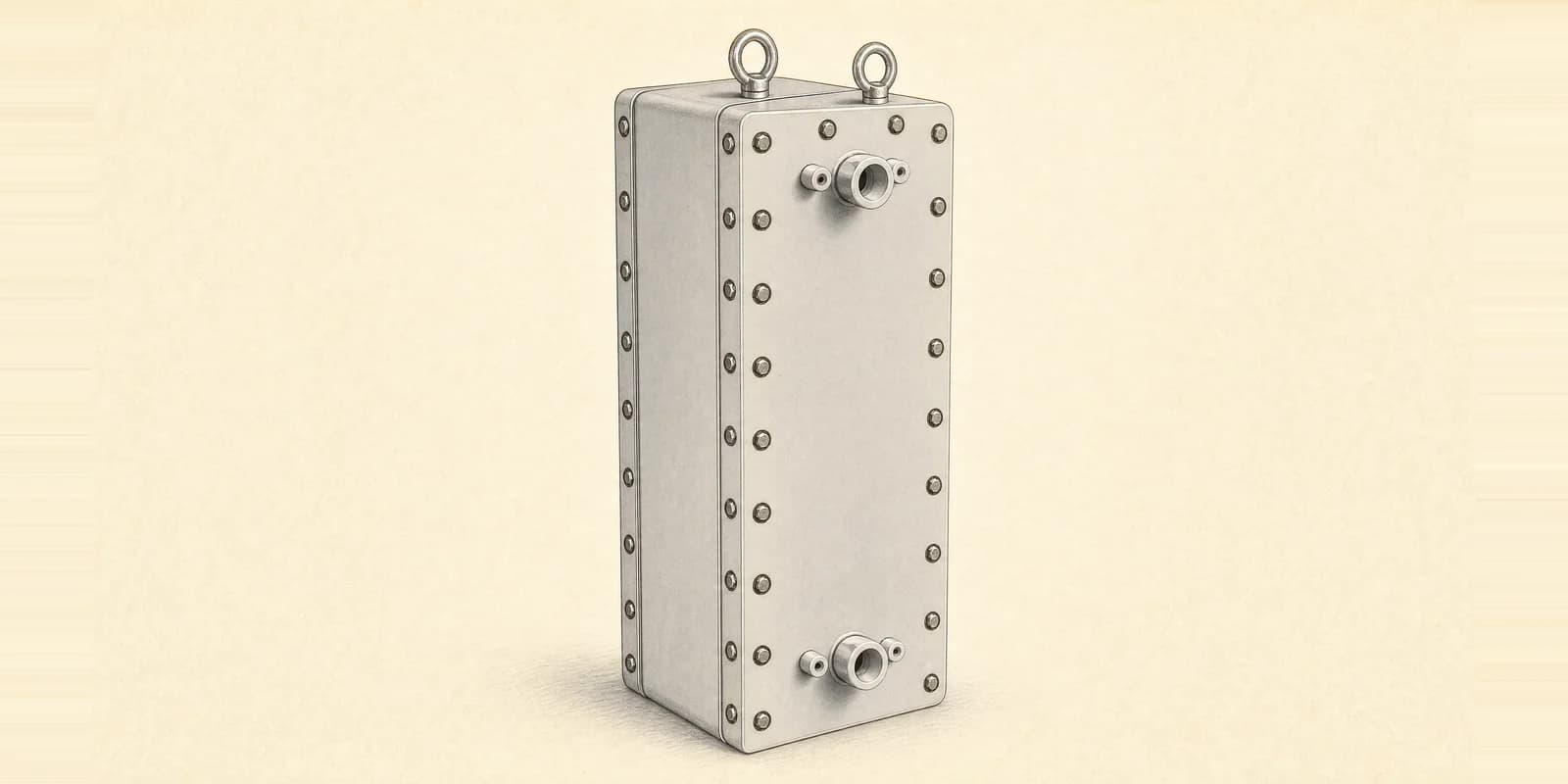
SnowPure positions EDI as a replacement for mixed-bed deionization (DI);[1] the manual's mechanism shows it is not a vessel that removes whatever ions arrive. The manual describes a plate-and-frame stack of cell pairs between two electrodes, fed with reverse osmosis (RO) permeate and regenerated continuously by the electric field.[1] SnowPure says its process needs no regeneration chemicals; cleaning and sanitising chemicals are still prescribed when needed.[1]
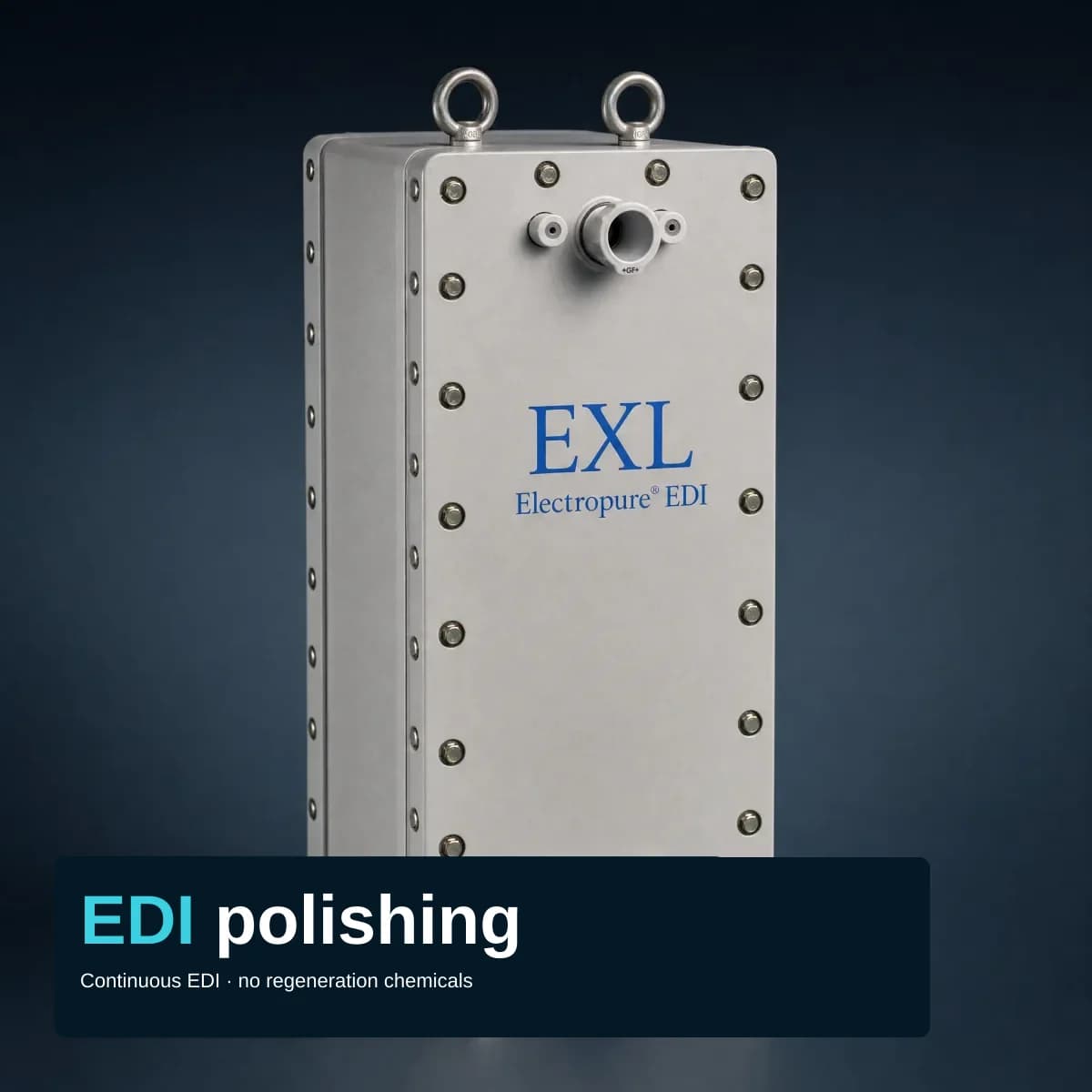
The finding: an EXL module's product quality is set mainly by the feed's conductivity equivalent including carbon dioxide and silica, by voltage and by concentrate flow, with product flow, pH and temperature also named in the manual. Its recovery is set by where the concentrate goes and how much of it is drawn.[1][9] In the documents retrieved, neither is printed as a result for any EXL model. The manual is version 3.5 of February 2018; the EXL datasheets and feed-water sheet carry 2022 in file names only; web pages were read on 2026-10-01. The manual covers XL and EXL modules, so its mechanism statements are family-wide;[1] model values here come from the EXL sheets. Fit, sizing and certification scope are outside this article.
Polishing depth decides product purity
In SnowPure's account, ions leave the water in order: the easy ions (H+, OH-, Na+, Cl-, Ca2+, SO4 2-) first, in the working bed; carbon dioxide with bicarbonate next; silica and boron last. The second and third sections together are the polishing bed, so easy ions that load the working bed leave less polishing bed.[1] The FAQ places boron fourth in series where the manual groups it with silica, so no boron position is stated.[9][1] The manual calls continuous regeneration of the polishing bed critical for the highest resistivities; no neutral document describing EDI was retrieved.[1]
Carbon dioxide, silica and boron are weakly adsorbed, so "the applied voltage has little driving force".[1] For the highest resistivity and lowest silica, SnowPure lists six settings that keep the polishing bed deep: ionic load minimised, product flow at the high end, voltage at the optimum, concentrate flow correct, carbon dioxide (with bicarbonate) minimised, and pH 7.0.[1]
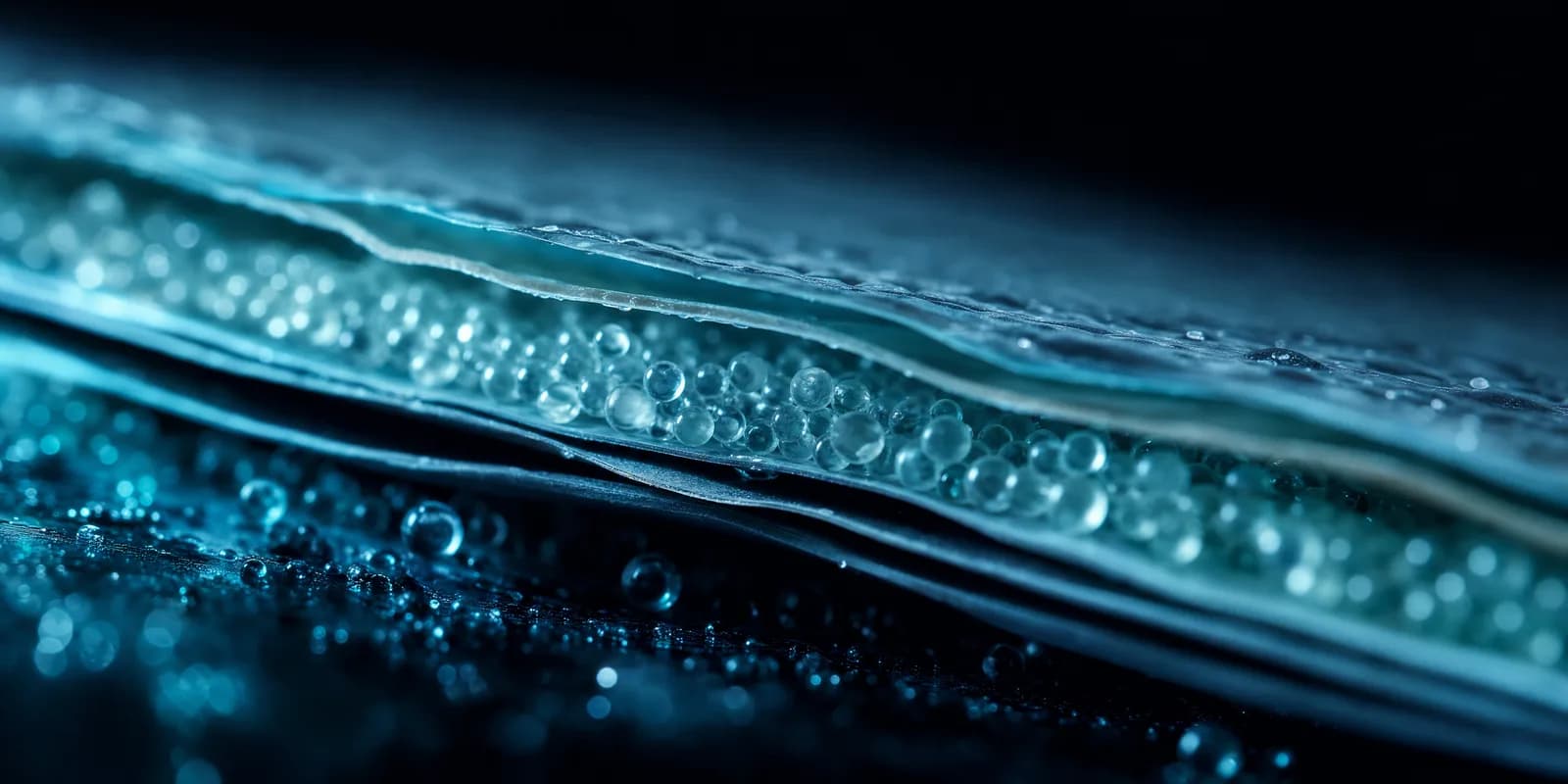
SnowPure's manual says water splitting regenerates the resin: at localised high potential gradients the field splits water into H+ and OH-, which "results in constant replenishment of the resins and membranes without the addition of chemicals"[1] and keeps the polishing resin in H and OH form. The 10 to 15 seconds in the manual is the water's residence time in the module, on this reading not the time ions need: adsorbed ions move under the field.[1]
The manual gives a normal operating range of about 5 to 8 V per cell and says purity is highest at an optimum voltage within the module's range, lost on both sides of it.[1] Too low, and ions are not carried across the resin bed and membranes before the product leaves; too high, and excess water splitting makes excess current and concentration back-diffusion, which lowers resistivity.[1] The optimum moves with temperature, concentrate conductivity and concentrate flow, and falls with higher ion load and recovery.[1]
The manual gives 8 to 24 hours for a new steady state after a change, up to 2 to 4 weeks for silica.[1] A good first product after start-up proves little: the module starts with high-quality water because its polishing resin begins in H and OH form.[1] Check: read again after 24 hours, and for silica after weeks.
SnowPure's manual and sheets treat each contaminant separately:[1][2]
| Contaminant | What it breaks | Printed limit |
|---|---|---|
| Chlorine, ozone | De-crosslinks resin, which disintegrates; pressure drop rises | Not detectable |
| Hardness | Scale in concentrate chambers | Below 1.0 ppm at 90% recovery (manual); below 1 ppm, no recovery named (EXL sheets) |
| TOC | Adsorbs; stack resistance rises | Below 0.5 ppm (manual) |
| Iron, manganese | SnowPure says they may adsorb strongly and permanently, even at sub-ppm | Below 10 ppb (EXL sheets: below 0.01 ppm, with sulfide also below 0.01 ppm) |
| Carbon dioxide | Affects resistivity and silica and boron removal, even below 5 mg/l | Manual: high quality possible below 5 mg/l; above 10 mg/l interferes |
| Particles | Plug membranes and resin | None printed; particle-free permeate or 1 µm pre-filtration recommended |
Recovery trades against polishing depth and scale
The EXL sheets rate each model at a design flow, a feed table and a recovery of up to 99%, and each rests on conditions that differ by document, model and concentrate route (all flows in m3/h).[4][5][6][2]
| EXL model | 1-pass RO + gas-transfer membrane design flow | 2-pass RO design flow | Maximum flow | Flow at 3 bar drop (25 °C) |
|---|---|---|---|---|
| 550 | 3.0 | 4.0 | 4.5 | 3.5 |
| 650 | 4.0 | 5.0 | 6.0 | 5.0 |
| 750 | 6.0 | 7.0 | 8.0 | 7.0 |
| 850 | 7.5 | 8.5 | 10 | 8.5 |
The four sheets print no lower flow bound; the manual starts the 550 at 2.0 m3/h and the FAQ puts minimum feed flow at about half the design flow.[1][9]
FCE, the feed's conductivity equivalent, is a weighted sum, not a meter reading: conductivity + 2.79 × CO2 (mg/l) + 1.94 × SiO2 (mg/l), weights the manual does not explain.[1] The manual's example (5.0 µS/cm, 3.5 mg/l, 0.5 mg/l) gives 5.0 + 9.765 + 0.97 = 15.735, printed 15.7 µS/cm, of which carbon dioxide supplies 62.1% (computed here).[1] A meter reads 5.0, inside the 1 to 6 optimum for plain conductivity, yet 15.735 ÷ 9 = 1.75 times the FCE optimum of 9, which is inside the 33 and 43 maxima.[1] That example is arithmetic, not a site that meets the table; the EXL sheets print FCE only.[2]
SnowPure's documents print two FCE maxima, 33 and 43 µS/cm, across three groups of documents, and none of these documents says which governs an EXL module:[1][10][2][8][7]
| Document | FCE recommended / limit | Pressure | Temperature |
|---|---|---|---|
| Manual (2018), feed-water sheet | below 9 / below 33 (working range) | 5 bar maximum | 5 to 35 °C |
| EXL-550, 650, 750, 850 sheets | below 9 / below 43 (maximum) | 7 bar | 10 to 35 recommended, 5 to 45 maximum |
| XL-R datasheet, XL/EXL-HTS brochure | below 9 / below 33 | 5 bar (XL-R) | 5 to 35 °C (XL-R) |
The 43 is on all four EXL sheets;[2][4][5][6] the feed-water sheet, XL-R datasheet and XL/EXL-HTS brochure print 33.[10][8][7] The manual introduces its table as "requirements to operate within SnowPure’s limited warranty".[1]
Recovery follows where the concentrate goes: to drain, about 90%; with 2-pass RO feed of "very low FCE", halving the concentrate flow gives 95% (FAQ); to a break tank and pumped to the RO inlet, about 99%.[9][1] The EXL sheets' up to 99% carries the footnote "with electrode flow to drain, and concentrate flow recovery",[2] which this article reads as the concentrate being recovered. The electrode stream always goes to drain.[1] The concentrate share is typically 10% of feed flow or of product flow[1]; computed here, electrode stream ignored: 1 − 0.10 = 90.0% recovery on the feed basis, 1 ÷ 1.10 = 90.9% on the product basis.
Lowering the concentrate flow lowers stack resistance and shrinks the polishing bed; the manual cautions that "the risk is hardness scaling in the concentrate".[1] At 90% recovery the manual puts the concentrate's conductivity in the polishing section at about 11 times the feed's, and a start-up step says about 10. Derived here, assuming essentially all feed ions leave in the concentrate and ignoring the electrode stream: with the concentrate at 10% of product flow, (1 + 0.10) ÷ 0.10 = 11; at 10% of feed flow, 1 ÷ 0.10 = 10. Halving it to 5% for the FAQ's 95% gives (1 + 0.05) ÷ 0.05 = 21, about 1.9 times as concentrated.[1][9] The printed hardness limit is tied to 90% recovery in the manual and feed-water sheet and the EXL sheets name no recovery, so 95% and 99% are a question for the quote.[10][2]
No document retrieved gives an energy per cubic metre or a running cost for an EXL module. SnowPure calls for an automatic interlock that cuts power on no water flow,[1] because power without water flow "will certainly result in irreversible damage to the EDI module".[1]
Published ratings are not EXL results
Every tier of evidence retrieved on EXL modules is SnowPure's own, and none is a measured purity or recovery result for an EXL model on a stated feed. The datasheets are ratings; the manual, FAQ and web pages are SnowPure's engineering account. Its factory test uses standard water and "Results of this test are available for each module",[1] but none was retrieved, nor any independent laboratory report or field record. The EDICAD software "does not infer any cost or performance guarantees".[12]
Certification is a finding about what was retrieved, as of 2026-10-01. The manual's example label (an XL-500-HTS) shows a CE mark, RoHS compliance and IP34, and its 2017 EC Declaration, a manufacturer's own declaration under Directive 2014/35/EU, lists ZAP and XL model numbers and no EXL model.[1] No EXL-specific declaration or third-party certificate was found, which does not say none exists.
Mixed-bed DI is the neighbouring technology, and the contrast tested here is how the resin is regenerated. Veolia's handbook describes cation and anion resin in one vessel, separated by backwash and regenerated with acid from the bottom distributor and caustic above the bed.[3] EDI regenerates by water splitting instead.[1] No document retrieved gives a figure for, or an independent comparison of, the capital cost, operating cost, chemical dose or footprint of EDI against mixed-bed DI. SnowPure's manual says the operating cost and other process advantages favour EDI and that an EDI system's capital cost may be higher than a resin bed system's, without a figure for either.[1] Continuous means no regeneration shutdown, not never offline: the manual prescribes cleaning, and regeneration after extended shutdowns.[1]
A resistivity reading cannot be compared without its temperature compensation. The manual prints the resistivity of ion-free water as 31.8, 18.2 and 11.1 MΩ·cm at 15, 25 and 35 °C, so the same water is 31.8 ÷ 18.2 = 1.75 times higher at 15 °C and 1 − 11.1 ÷ 18.2 = 39% lower at 35 °C.[1] The correction is 5 to 7% per °C for ultrapure water and about 2% per °C for RO permeate.[1] Check: a meter with accurate temperature compensation, and the temperature logged beside every reading.
A falling product resistivity proves less than it seems. On the manual's account, voltage off the optimum, a higher FCE, rising RO permeate conductivity, an ionic front still moving after a change, developing hardness, organics or oxidant, or a compensation error can each cause it.[1] Checks, in an order this article suggests: RO permeate conductivity, total CO2 and silica; the meter's compensation temperature; the module's current against its expected value; a concentrate sample; then steady state.
Prove purity and recovery on site water
A purity result is reproducible only with its conditions: feed conductivity, total CO2 and silica (so the FCE), pH, temperature and the meter's compensation, voltage and current, product and concentrate flows, the recovery route, and hours since the last change. SnowPure's standard test water (RO at 65% recovery, 18 to 35 °C) is the reference for a retest. It is a test condition, not an operating range.[1] A recovery result needs its route (drain, about 90%; halved concentrate with 2-pass feed, 95%; break tank and pump to the RO inlet, about 99%), the electrode stream to drain, the concentrate flow setpoint with its basis, and the feed's FCE and hardness. The fix for a low reading may lie outside the module. Check the RO permeate conductivity; carbon dioxide removal ahead of it; feed pH near 7.0; product pressure above concentrate and electrode pressures; flows above their minimum; and the power interlock. A module fed outside its table is not evidence about the module.[1][9]
Each EXL sheet's printed operating conditions are the reference: a feed with oxidants not detectable, FCE under the maximum SnowPure confirms for that model, and hardness under 1 ppm,[2][4][5][6] with particles removed as the manual recommends.[1] They are not a purity or recovery result for any EXL model, for hardness at 95% or 99%, or a certificate. Among the conditions to resolve with SnowPure before quoting are oxidants that cannot be kept not detectable, FCE above the confirmed maximum, and hardness above the sheet's below 1 ppm. One more condition rests on a recommendation: particles that cannot be brought to particle-free or 1 µm. The manual's worked example specifies only FCE inputs, so only that condition is tested; 15.7 is under 33 and 43.[1] Where SnowPure will not confirm which feed table applies, the rating cannot be tied to a stated feed.
Data to send: RO permeate conductivity range, total CO2 (carbon dioxide plus bicarbonate, per the manual[1], which a normal CO2 test kit often underestimates),[11] silica, hardness as CaCO3, TOC, iron, manganese, sulfide, oxidant status, pH, temperature and flow ranges, and the recovery route intended.
Terms to agree: which feed-water table and manual edition apply to the model quoted; the model's minimum flow; the per-module factory test record and a retest on request[1]; who supplies and warrants the module, since the limited warranty covers only "modules purchased directly from SnowPure LLC, or its authorized distributor" used within the specified operating conditions, and is invalid on modules sold to OEM customers not expressly Qualified by SnowPure;[13] this page does not state Purionex's status with SnowPure, which should be requested in writing; the sample valves, meters and no-flow interlock on the OEM system; and whether a manual newer than the 2018 edition exists.
SnowPure Electropure™ EDI — EXL Series
No certifications listedView product →Sources
- [1]SnowPure — OEM Engineering Manual, Electropure XL & EXL Series EDI, version 3.5 (February 2018) — mechanism, feed table, recovery routes, current, protection, certification pages
- [2]SnowPure — Electropure EDI EXL-850 datasheet (2022 in the file name; no printed date) — flows, up to 99% footnote, feed table
- [3]Veolia Water Technologies — Ion Exchange & Water Demineralization Handbook, Chapter 8 (read 2026-10-01; no date on the page) — mixed-bed mechanism only
- [4]SnowPure — Electropure EDI EXL-550 datasheet (2022 in the file name; no printed date)
- [5]SnowPure — Electropure EDI EXL-650 datasheet (2022 in the file name; no printed date)
- [6]SnowPure — Electropure EDI EXL-750 datasheet (2022 in the file name; no printed date)
- [7]SnowPure — XL/EXL-HTS brochure (2022 in the file name; no printed date) — HTS feed table, not the standard EXL
- [8]SnowPure — XL-R datasheet (2022 in the file name; no printed date) — XL-R feed table
- [9]SnowPure — FAQs, Electrodeionization (web page read 2026-10-01) — recovery routes, order of removal, minimum flow
- [10]SnowPure — EDI Operating Feed Water Specifications (2022 in the file name; no printed date) — generic feed table and FCE formula
- [11]SnowPure — How to measure total CO2 for EDI (page footer September 2014) — what a normal CO2 test kit measures
- [12]SnowPure — About EDICAD v3.9 (2022 in the file name) — prediction software disclaimer
- [13]SnowPure — Limited Warranty, EDI (January 2022) — who is covered