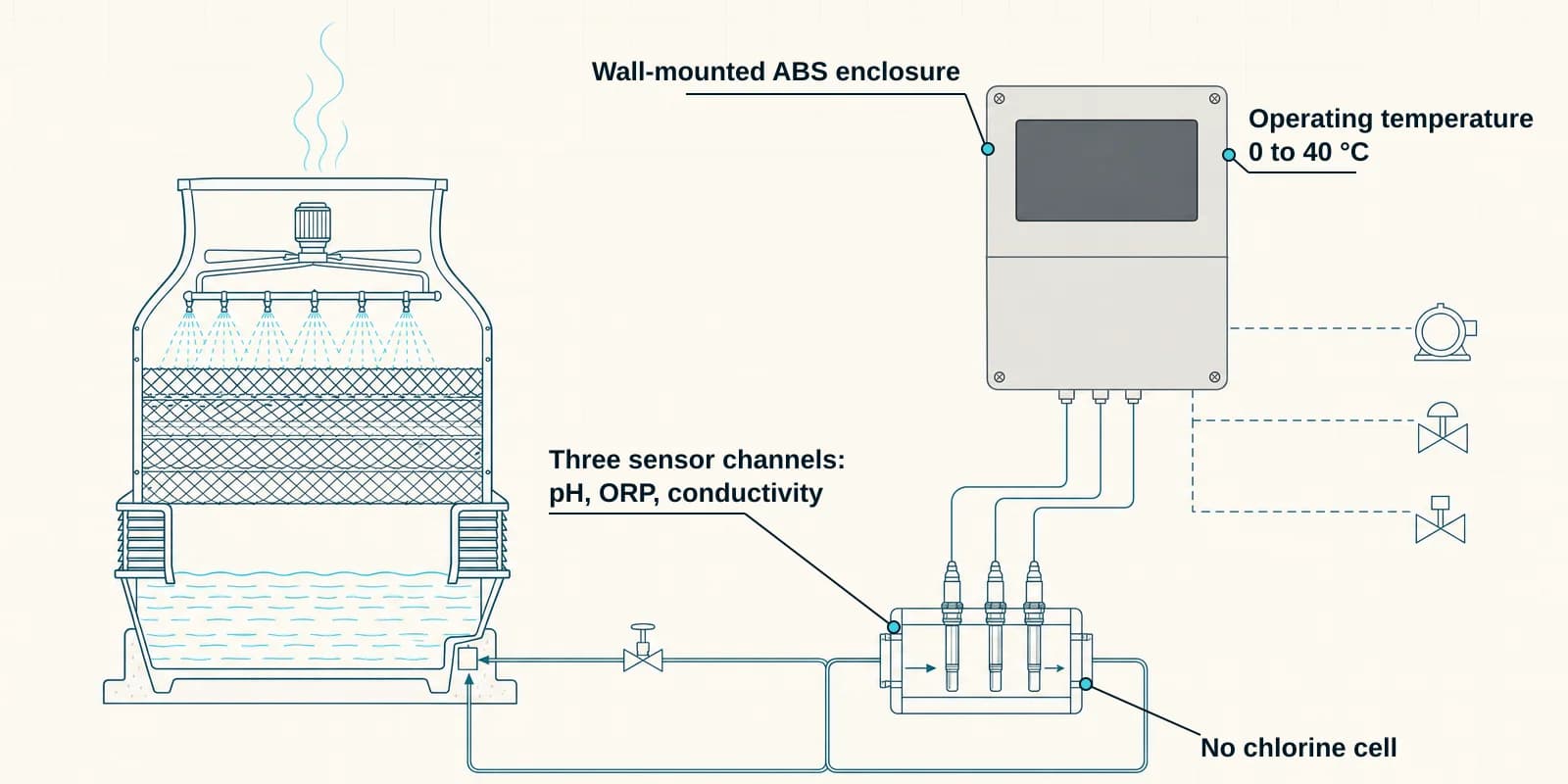
SEKO's datasheet for the SEKO Kontrol 800 in its pH, ORP and conductivity build (SEKO build code K800L05, the Kontrol 800 L05 below) prints a conductivity span of "0,054÷200.000 µS" and an accuracy of ±2%.[2] Its product page adds "Capable of up to six simultaneous measurements".[1] The Kontrol 800 L05 has one conductivity channel, on the tower side in this design,[2] so the make-up conductivity it never reads moves cycles more than the printed accuracy would once the swing exceeds it: 0.36 to 0.44 cycles at an illustrative ±10%, against 0.08 if ±2% is of reading. SEKO also prints three relays in one place and six in another.[2] For one open recirculating tower with one controller, this guide ends in one of three answers: this build for three functions; another build, or a second measurement, first; or not this product.
Tell a bleed fault from a treatment fault
High water use with tower conductivity under target points to over-bleeding (this guide's reasoning; the US Department of Energy's guidance, DOE below, is US federal practice and supplies only the check): "Check the ratio of conductivity of blowdown and make-up water."[7] On the worked tower, whose inputs are all illustrative (evaporation 10 m³/h, make-up 200 µS/cm, target 4 cycles), the tower should read 200 × 4 = 800 µS/cm. A reading of 600 µS/cm is 600 ÷ 200 = 3 cycles and bleeds 10 ÷ (3 − 1) = 5.0 m³/h instead of 10 ÷ (4 − 1) = 3.33 m³/h (derived from DOE's make-up balance, drift neglected).[7]
Scale, corrosion or slime complaints with the ratio on target point first to the treatment chemistry, although a pH or inhibitor fault is also possible (this guide's reasoning). The Kontrol 800 L05 has no inhibitor sensor: its matrix marks pH, ORP and conductivity only.[2] An ORP reading at setpoint is a signal, not a residual: Chem-Aqua, a chemical supplier, states that "The ORP reading itself is not as important as the oxidizer residuals in the system."[8] Sensorex, a sensor maker, adds that no universal ORP setpoint guarantees Legionella control in every tower.[9] Check the operator's own residual and inhibitor tests.
A drifting reading is not always the controller or the probe: a changed make-up supply gives the same symptom, and so may a dry or fouled probe (this guide's reasoning; Chem-Aqua sources only the wet requirement, "ORP sensors must remain wet at all times.")[8] Sample the tower water and the make-up together: compare the controller's tower reading with an independent measurement of the tower sample at the same temperature, and measure the make-up separately. Duty class reorders the priority (this guide's reasoning): an intermittent tower risks a dry ORP probe, a continuous one the make-up sample first.
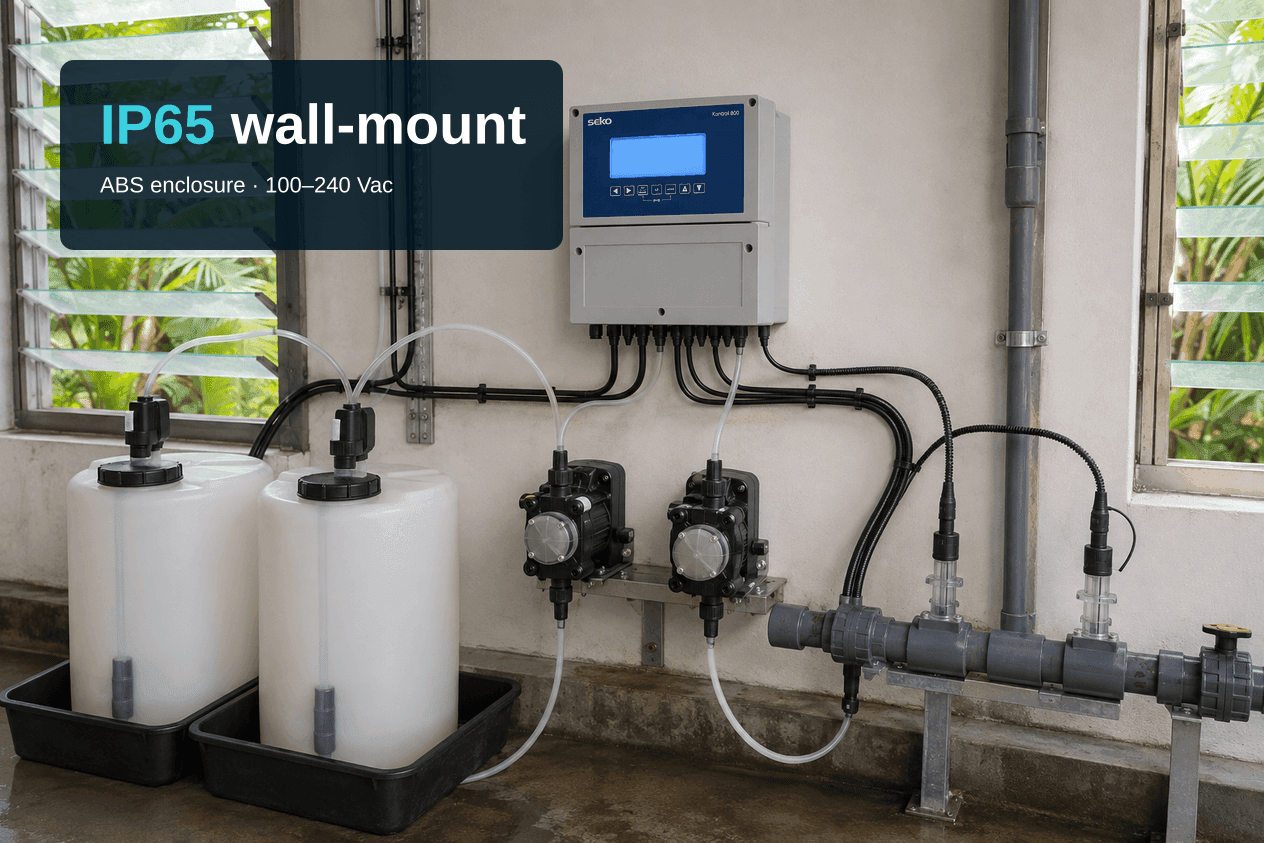
Four inputs eliminate a build. Measurements: pH, ORP and conductivity fit the L05, pH and conductivity only is build L15, and a chlorine residual needs L18, L19 or another instrument.[2] Certification: none is named in the SEKO documents retrieved, read 2026-09-30.[2][1][4] Operating temperature: SEKO prints "Operating temperature: 0 to 40°C, relative humidity 0 to 95% (without condensation)", read here as the air around the controller.[2] Supply: 100 to 240 Vac.[2]
Three inputs size the duty. Make-up conductivity comes first, in µS/cm from site samples across the seasons; no Singapore, Malaysian or Indonesian value was retrieved, so none is assumed typical. The water-treatment specialist sets the design cycles and tolerated band (this guide's reasoning); DOE reports many systems at two to four cycles, with six or more possible.[7] The third input is the number of actuated functions. Two unit traps: SEKO prints µS with no /cm,[2] and conductivity is not dissolved solids. The misreading is that a conductivity setpoint fixes cycles: it fixes tower-side conductivity, and cycles is that value divided by a make-up value the controller does not read.
Screen by channels and relays, size by cycles
SEKO's matrix gives K800L05 and K800L11 the same three sensor channels and does not say what differs;[2] the reference design sets out the other builds. The product page's six measurements are stated for the Kontrol 800;[1] the L05 row of the matrix dots three sensor channels, and page 1 lists one reed flow input and one Hold input for the series (this guide's reading).[2] Reading six as this build's count is the misreading; the matrix and page 1 are the check.
The bullet that lists six relays prints 250 Vac 7 A, and no rating is printed for the narrative's three; current outputs carry 500 Ω at most.[2] No derating curve is printed; a controller has no water path, so no flow margin or turndown applies.
The first capacity check is the relay count: three in the datasheet's description and six in its technical list,[2] and a third arrangement in an older SEKO catalogue, which includes "One Alarm remote dry contact".[3] This guide designs to three until SEKO confirms; that is its own rule, not a ruling between documents. Bleed, oxidizer feed and pH correction fill three relays with none spare, and a fourth function is short by one. [ASSUMPTION: one relay is driven by a conductivity setpoint for bleed; valid while SEKO's manual for the exact code confirms it; otherwise this is not the product.] The frequency and current outputs are not counted; their assignment is a quote item.
Worked run, the instrument. At 4 cycles on 200 µS/cm make-up the setpoint is 200 × 4 = 800 µS/cm, and 800 ÷ 200,000 = 0.4% of the printed span. The datasheet read prints no accuracy basis: the conductivity footnote is missing on all four datasheet pages.[2] If ±2% is of reading, the error is 800 × 0.02 = ±16 µS/cm, or 16 ÷ 200 = ±0.08 cycles, which is 0.08 ÷ 0.5 = 16% of an illustrative ±0.5-cycle band, a margin of (0.5 − 0.08) ÷ 0.5 = 84%. If it is of the printed span, it is 200,000 × 0.02 = ±4,000 µS/cm, or 4,000 ÷ 800 = 500% of the reading, which cannot be what a working controller means (plausibility, not SEKO's statement).
Worked run, the make-up. A ±10% swing, illustrative and not a supply statistic (180 to 220 µS/cm), at the same 800 µS/cm setpoint gives:
- Make-up 220: 800 ÷ 220 = 3.64 cycles, 0.36 below 4, 72% of the band (margin 28%); blowdown 3.79 m³/h.
- Make-up 180: 800 ÷ 180 = 4.44 cycles, 0.44 above 4, 88% of the band (margin 12%); blowdown 2.90 m³/h.
- Make-up 180, controller reading 2% low: the tower sits at 800 × 1.02 = 816 µS/cm, so 816 ÷ 180 = 4.53 cycles (0.5333 above 4, unrounded), 106.7% of the band, a margin of −6.7%.
Blowdown at the fixed setpoint is 10 ÷ (800 ÷ make-up − 1). Cycles move by the make-up's relative change (−9.1% and +11.1%), so if ±2% is of reading any swing above about 2% outweighs the instrument; the 10% only sets how much band is spent. With a perfect instrument the band is spent when make-up falls to 177.8 µS/cm (800 ÷ 4.5; 11.1% below 200) or rises to 228.6 µS/cm (800 ÷ 3.5; 14.3% above). The Kontrol 800 L05 stays a candidate inside stop conditions 1 to 5 below, and only while SEKO's manual confirms the conductivity-set-point relay (stop condition 4), if make-up is sampled, the swing stays inside those bounds and a site routine re-sets the setpoint.
SEKO Kontrol 800 Multi-Parameter Controller
No certifications listedView product →Higher design cycles trade blowdown against limits the controller cannot see. At 3, 4 and 6 cycles the tower bleeds 10 ÷ 2 = 5.0, 10 ÷ 3 = 3.33 and 10 ÷ 5 = 2.0 m³/h (derived from DOE's make-up balance), and DOE advises maximizing cycles for water efficiency.[7] The cost, in direction only, is a setpoint nearer corrosion[7], scale (this guide's reasoning) and the trade-effluent limits of Singapore's cooling-tower Legionella code of practice (4th edition, March 2001, as hosted by NEA, dated).[6] No conductivity-to-dissolved-solids or chloride factor was retrieved, so the specialist sets any maximum setpoint from a make-up analysis.
Probe position and what each quote must state
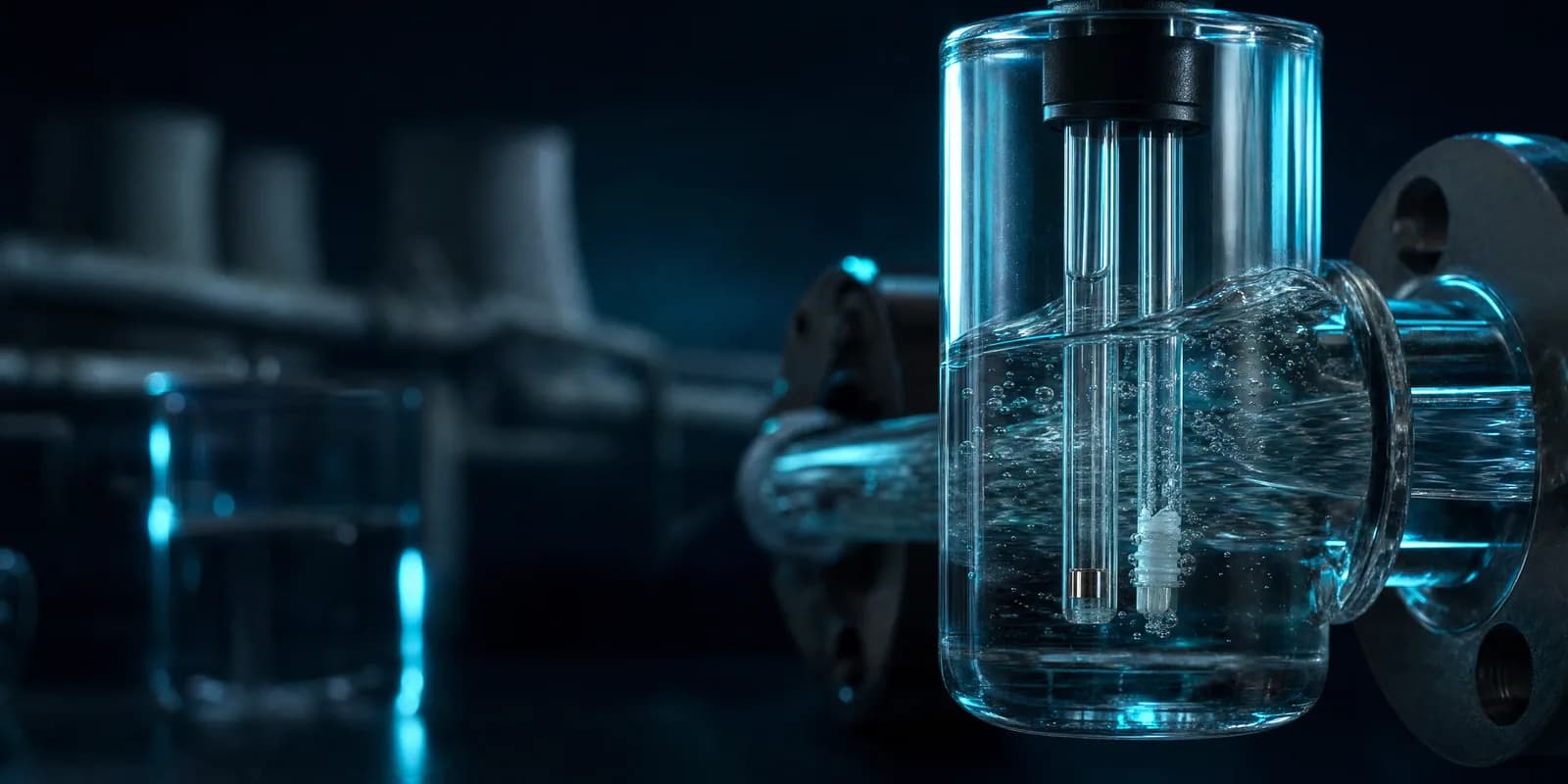
Of two assumed options, a by-pass sample line lets probes be isolated and removed without entering the basin (this guide's reasoning); SEKO names flow-through and in-line holders and a pre-assembled Panel, a different product, with a by-pass probe holder.[5][4] Its blind spot is a line that empties with the tower off, leaving the ORP probe dry against Chem-Aqua's wet requirement.[8] Immersion: SEKO names immersion holders and no line can empty; its blind spot is access and a position that represents the loop (this guide's reasoning).[5] Rule (this guide's reasoning): take the by-pass line only where the holder stays flooded with the tower off; otherwise immerse. No holder rating, cell constant or probe pairing is stated for the Kontrol 800 L05 in the documents retrieved (the one holder rating found belongs to another holder), so all three are quote items.[3]
A quote supplies the controller, and probes and holders if quoted; the site or installer supplies the sample line, bleed valve, dosing pumps, tanks, power, a plant-room or shaded mounting and an external isolation for the chemical feeders (this guide's split; confirm in the quote). With the three relays assigned, a scheduled non-oxidizing biocide and any inhibitor feed would sit outside the controller. An older SEKO catalogue lists one alarm dry contact and a disable input,[3] but the current datasheet retrieved does not describe alarm or Hold behaviour for this build, so confirm both on the quote, with output states and any dose limit.[2]
The printed "0,054÷200.000 µS" spans 200,000 ÷ 0.054 = 3.7 million to one, more than six orders of magnitude, so what the one printed span covers is a quote item (reasoning, not SEKO's statement).[2] The datasheet writes a dot for thousands and a comma for decimals, so 200.000 is 200,000.[2] An older SEKO catalogue lists three sub-ranges topping out at 200, 2,000 and 20,000 µS without saying what selects one; 800 µS/cm lies outside the first and inside the second and third.[3] The quote must state whether ±2% is of reading or of span, the probe and cell constant, the range that gives, and temperature compensation (the channel matrix has no temperature column).[2]
K800L05 and K800L11 are not assumed interchangeable; an older SEKO catalogue prints Kontrol PR+EC 800 against K800L05 only, and the order code decides.[3][2] [ASSUMPTION: the Purionex Kontrol 800 listing, which names the K800L05 build, is that build as supplied; valid while the listing names that build; invalid if the supplier names another code; promoted by the supplier's statement of the code supplied.] The flow range "0,00÷99.999 Liters/Sec." is about 100,000 litres per second, or 99,999 × 3.6 = 359,996 m³/h, not a tower flow.[2] [ASSUMPTION: the accuracy is printed in Hz and its footnote is missing, which points to a scaling limit of a reed pulse input; valid until that footnote is read.]
The outputs listed under "Output Modules associated with the chemical measurements" are not said to drive pumps.[2] Pump-input compatibility with the open-collector NPN/PNP output and the 500 Ω loop (20 mA × 500 Ω = 10 V) are quote items.[2]
Every open item becomes a written quote line, and the supplier's answer decides whether this is the product. One request-for-quote paragraph names the Kontrol 800 L05 and asks for the exact order code and manual revision, the relay assignment table, control modes, alarms, Hold behaviour, output states on power loss and probe failure, the conductivity basis, the Modbus register map and any conformity declaration for the exact code in the market. Answers should carry the conditions in the article on reading ORP and conductivity. The reply must restate SEKO's printed ±2%, 250 Vac 7 A and 0 to 40 °C, whose conditions the datasheet read does not print, for the exact code.
When to re-check, and when to stop
No SEKO commissioning procedure was retrieved for this build; these checks are this guide's reasoning. Agree a tolerance before the order, then repeat the independent comparison at the same temperature. Bench-test each relay function against the exact order code. Correlate the ORP reading with the operator's own residual test, assuming no millivolt target: Chem-Aqua states that the correlation is required on each individual system.[8]
No SEKO service or cleaning interval was retrieved. Probe care rests on Chem-Aqua's general statements, not SEKO's: probes stay wet, storage in deionised water degrades them, and a properly maintained probe can last 12 to 18 months.[8] The Singapore code edition retrieved (4th edition, March 2001, dated) states a monthly standard plate count, a Legionella count at least every three months, samples taken before biocide dosing, a record book and accessible sampling points.[6] These are laboratory and record duties, not the controller's log, and no compliance is claimed.
Re-sample make-up conductivity and re-derive the setpoint whenever the supply, the season or the design cycles change. Re-check the ORP correlation when make-up quality, inconsistent cycles, prebleed, bleed lockout times (Chem-Aqua's terms, undefined there), added high-pH chemicals or organic loading change.[8] Two readings mislead: a conductivity that matches a hand-held on the day while make-up has moved to 220 µS/cm (3.64 cycles), and an ORP at setpoint is not a residual on target.
Five stop conditions bound the worked result:
- A fourth function or alarm contact. Reason: on the three-relay design basis it is short by one relay, and no Modbus register map was retrieved.[2] Next step: SEKO's assignment table and register map in writing, or a separate device.
- A chlorine residual as the controlled variable. Reason: the L05 has no chlorine cell, and ORP is a proxy.[2] Next step: L18, or L19 once SEKO confirms which cell it carries, or another instrument.
- A named certification or declaration. Reason: no SEKO document retrieved names one, which does not prove none exists.[2] Next step: a written declaration for the exact code and market; without it, not this product.
- A SEKO manual showing no conductivity-set-point relay. Reason: the bleed function is this guide's assumption, not SEKO's statement. Next step: not this product for a conductivity-driven bleed.
- A make-up swing beyond the band with automatic cycles hold required. Reason: the band is spent at −11.1% or +14.3% make-up even with a perfect instrument. Next step: a site routine that re-samples make-up and re-sets the setpoint, or a separate make-up measurement.
A competent reply gives the order code and manual revision, relay assignment, conductivity basis, the cycles error against the agreed band as (allowed − error) ÷ allowed, the binding component and acceptance checks, and may conclude that this is not the product, or not yet. The data pack holds the order code wanted; each function's load current and voltage against the 250 Vac 7 A printed in the six-relay bullet;[2] pump input types; seasonal make-up and tower-side conductivity in µS/cm; the specialist's cycles and band; ambient; and the market.
Request a quote for the SEKO Kontrol 800 in its pH, ORP and conductivity build with this data pack.
Sources
- [1]SEKO — Kontrol 800 product pages, Singapore and US catalogue pages, retrieved 2026-09-30 (six-measurements feature line)
- [2]SEKO — Controller Instrument Kontrol 800 technical data sheet, four pages (footer tags R8 and R9), read 2026-09-30
- [3]SEKO — older Kontrol 800 catalogue pages 06, 07 and 23, distributor-hosted, edition and date not printed (fallback source)
- [4]SEKO — Kontrol 800 Panel page and CT-panel news item (different products), retrieved 2026-09-30; cited for the by-pass probe holder and for the absence of a certification statement
- [5]SEKO — probe and probe-holder product pages (names only, no ratings), retrieved 2026-09-30
- [6]Singapore — Code of Practice for the Control of Legionella Bacteria in Cooling Towers, 4th edition, March 2001, as hosted by NEA (dated; current instrument not retrieved)
- [7]US Department of Energy FEMP — Best Management Practice 10, Cooling Tower Management (US federal water-efficiency practice, not an ASEAN requirement)
- [8]Chem-Aqua — Technical Bulletin 2-061, Understanding How ORP Is Used in Cooling Water Treatment (chemical supplier guidance, not a standard)
- [9]Sensorex — ORP Sensors in Cooling Tower Biocide Optimization (sensor maker web article, corroborating tier only)