This reference design shows how the SEKO Kontrol 800 in its pH, ORP and conductivity build (SEKO build code K800L05) could be configured for one open recirculating cooling tower. Fit depends on how many actuated functions the controller's outputs can carry, whether SEKO's manual confirms a conductivity set-point relay, and what stays outside the controller, not on the number of sensor channels. It can end in three places: three functions with no output spare, not this product, or an item held open until SEKO answers. It is hypothetical, built from a catalogued product and published sources, with no installation, commissioning date or measured result behind it.
A wall-mounted pH, ORP and conductivity controller
SEKO describes the Kontrol 800 as "a dedicated multi-parameter controller for complex applications that require a number of chemical parameters to be checked at the same time"[2]. It is a controller, not a sensor, valve or pump. SEKO's datasheet lists a wall-mounted ABS enclosure (278 × 285 × 139.5 mm) marked IP65 with no test standard named, a 4-line display, seven keys, 100–240 Vac at 15 W, RS485 with ModBus, a clock with backup battery, and data logging and probe quality checking as existence only[2]. These characteristics are printed once for the whole Kontrol 800, so the exact order code presumably fixes the options (reasoning). SEKO is headquartered in Rieti, Italy[6]; no document retrieved states where this controller is made.
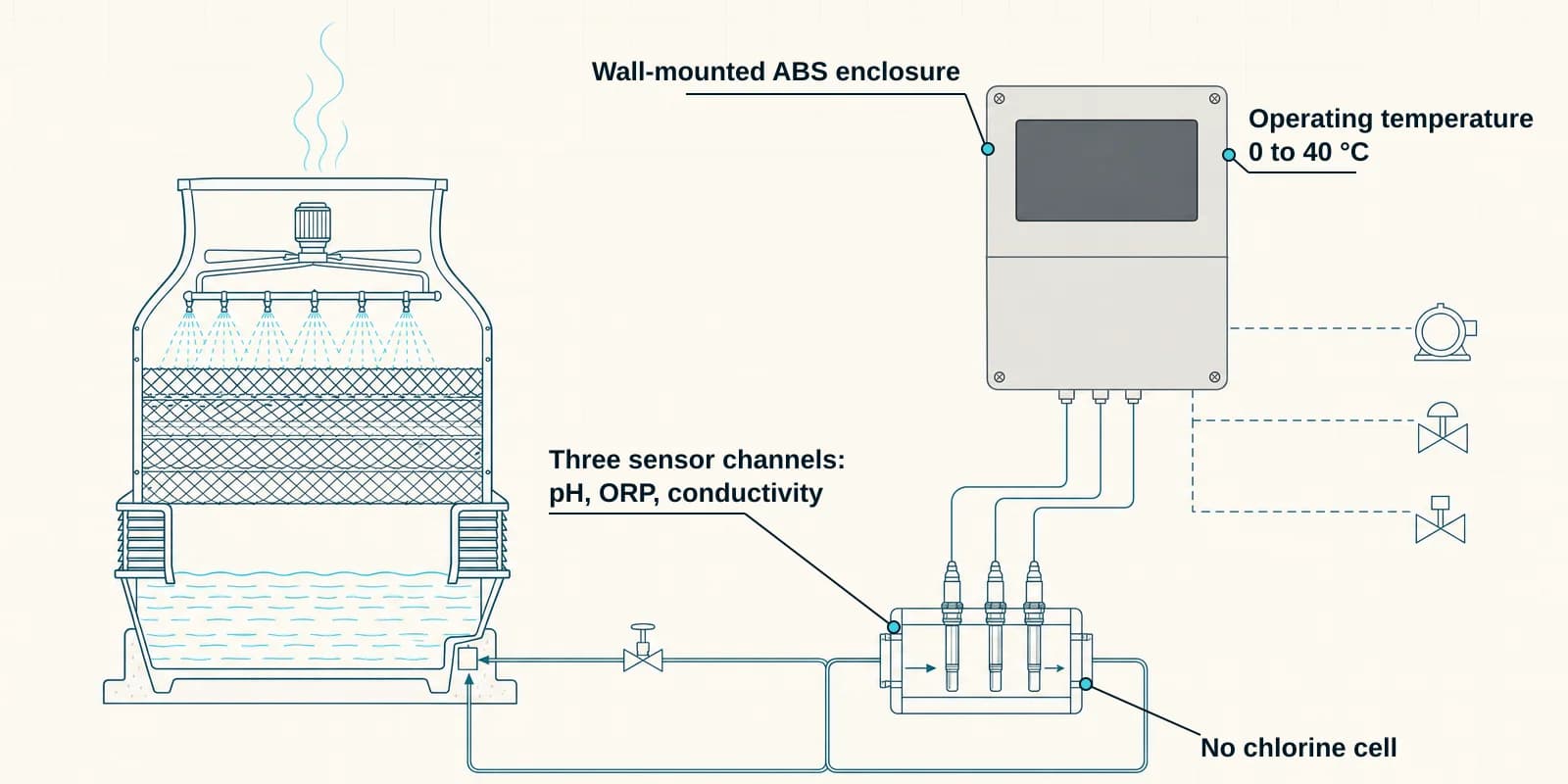
The variant is the build SEKO's ordering key describes as "pH/ORP and Conductivity"[2], code K800L05, called the Kontrol 800 L05 from here. SEKO's matrix marks three sensor channels for it, pH, ORP and conductivity, and no chlorine cell[2]. The Purionex catalogue lists the product as SEKO Kontrol 800 Multi-Parameter Controller, with its inputs given as the K800L05 build. Only an undated SEKO catalogue hosted by a distributor, called the older catalogue from here, prints Kontrol PR+EC 800 against K800L05[3]; the current datasheet and product pages read do not use the name. Mapping the listing to the L05 remains an assumption, promoted when the supplier confirms the code supplied.
SEKO's matrix, not a rating, separates the neighbours: a controller has no throughput rating, so no margin exists. L15 has no ORP channel, so it cannot run an oxidizer loop on ORP. L18 and L19 add a chlorine cell this duty does not use, amperometric for L18 and, in the matrix, potentiostatic for L19, whose key label reads In-mA1, so the article states both[2]. L11 has the same three channels as the L05. SEKO does not say what the label (Cooling Tower) on L11, L15, L18 and L19 means, so it is neither evidence of a cooling-tower function nor of its absence[2]. Whether L11 is the code SEKO intends for towers, and whether that changes the conductivity set-point relay, is a question for SEKO's manual and goes in the quote. The Kontrol 800 Tech is a different product[4]; none of its figures is used.
SEKO's key prints power option M as 80–265 Vac against 100–240 Vac in its characteristics, and its L02 worked example prints an unexplained A in the power position[2], so the full order code is a quote item and the reference design uses the narrower range. The enclosure option is wall type and four positions are free or custom[2]. SEKO names pH, ORP and conductivity probe families and holders, but publishes no range, temperature, pressure or cell constant on the pages read and does not say which probe pairs with the L05[5].
SEKO's product page gives "cooling tower control systems" as its example of a complex water-treatment application[1]. The datasheet's application list has 17 printed entries, 16 distinct, and covers the whole Kontrol 800 series, not the L05; it includes Legionella disinfection, which does not make the controller a Legionella control[2]. The product page also says "Capable of up to six simultaneous measurements"[1], yet the L05 matrix shows three sensor channels. These are stated uses and family figures, not performance results.
Cooling tower is the only application SEKO's ordering key labels against build codes, none of them L05[2]; the product page gives it as an example use[1], so this reference design takes one open recirculating evaporative tower serving a commercial building's chilled-water plant.
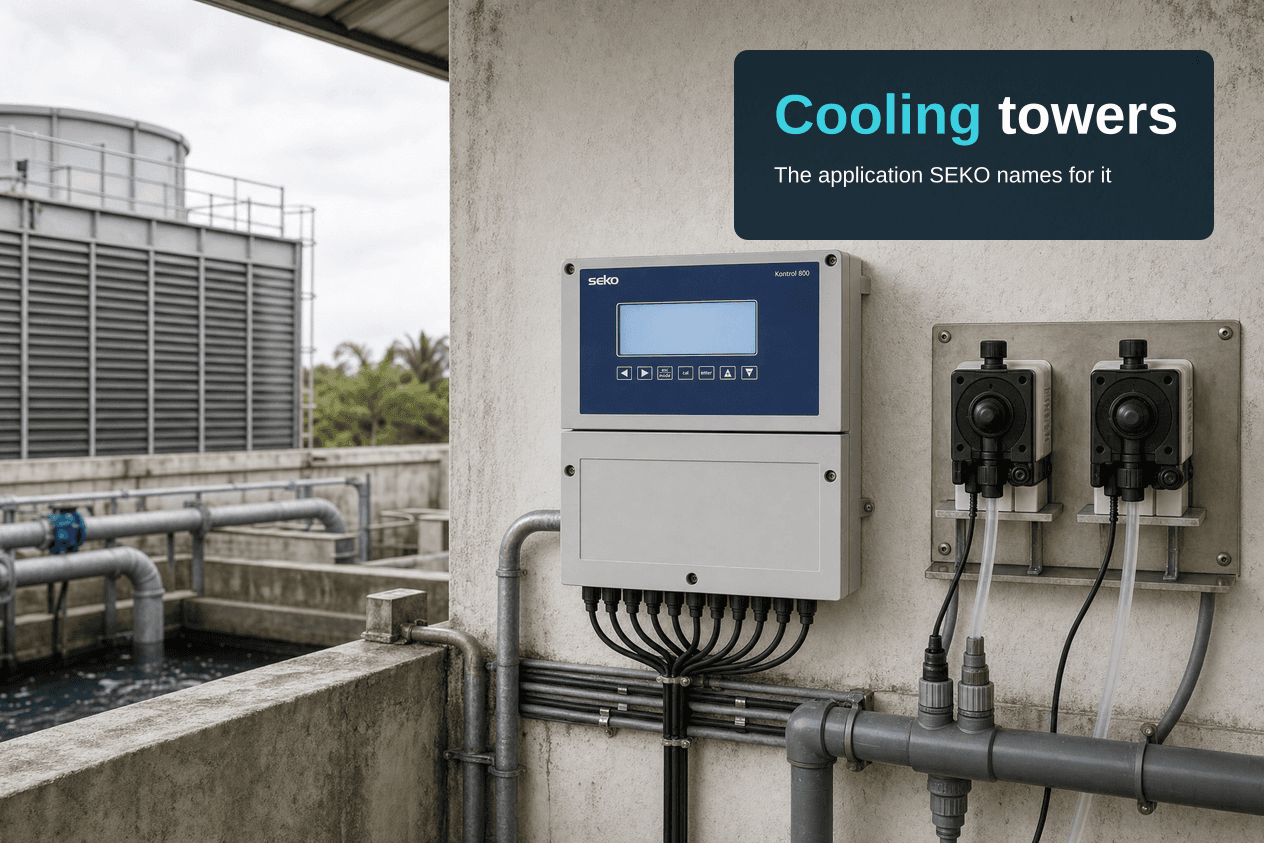
SEKO Kontrol 800 Multi-Parameter Controller
No certifications listedView product →Three channels are not three control loops
In the SEKO Kontrol 800 L05 reference design for one cooling tower (the L05 tower design), the controller would be judged on the water it holds and the signal it maintains, because a sensor channel is an input and a control loop also needs an output and a stated control mode. SEKO prints the outputs but no assignment of measurement to output and no mode per channel, naming only "independent proportional control output measures"[2] and "Multi-method relay activation"[1]. Three channels, or the product page's up to six measurements, therefore do not buy three loops.
Evaporation of 10 m³/h at design load and a make-up conductivity of 200 µS/cm are round numbers chosen so every figure can be checked, neither a tower size nor a typical supply, and no Singapore, Malaysian or Indonesian make-up conductivity was retrieved.
The water target is cycles of concentration, the ratio of dissolved solids in the tower water to those in the make-up, which DOE's cooling-tower guidance says is checked through the ratio of their conductivities[8]. DOE reports many systems at two to four cycles and six or more as possible[8], as US federal practice, not an ASEAN requirement. The L05 tower design takes 4 cycles, with 3 and 6 for comparison. With drift neglected, which would only lower blowdown, blowdown is evaporation ÷ (cycles − 1) and make-up is evaporation × cycles ÷ (cycles − 1); every figure is derived here and illustrative.
| Cycles | Tower-side conductivity, µS/cm | Blowdown, m³/h | Make-up, m³/h |
|---|---|---|---|
| 3 | 200 × 3 = 600 | 10 ÷ 2 = 5.00 | 30 ÷ 2 = 15.00 |
| 4 | 200 × 4 = 800 | 10 ÷ 3 = 3.33 | 40 ÷ 3 = 13.33 |
| 6 | 200 × 6 = 1,200 | 10 ÷ 5 = 2.00 | 60 ÷ 5 = 12.00 |
The specialist sets the real cycle count. The illustrative band is 4 ± 0.5 cycles, which at 200 µS/cm make-up is 700 to 900 µS/cm tower-side (3.5 × 200 and 4.5 × 200), or ±100 µS/cm, 12.5% of 800. A conductivity set point does not fix that band: the Kontrol 800 L05 has one conductivity channel, on the tower side, and cycles also depends on the make-up conductivity, the owner's sample. A swing in make-up conductivity moves cycles at a fixed set point, an effect the selection guide for the Kontrol 800 L05 works through.
The oxidizer target is a residual, not an ORP reading. Sensorex states that ORP does not directly measure ppm of chlorine or bromine and that "There is no universal ORP setpoint that guarantees Legionella control in every cooling tower"[10], and Chem-Aqua that ORP values must be correlated with the halogen residual on each individual system[9]. Neither gives a millivolt figure: the owner measures a halogen residual and finds the ORP set point by correlation. No target residual was retrieved, so the pass value is the treatment programme's; the Singapore edition sets none for normal running, and clause 10.4(a) is for cleaning[7]. No tower pH is set; the specialist sets a window or makes pH monitor-only. Each target has an independent check, and the controller's display is not the acceptance instrument.
Designed to three relays, none spare
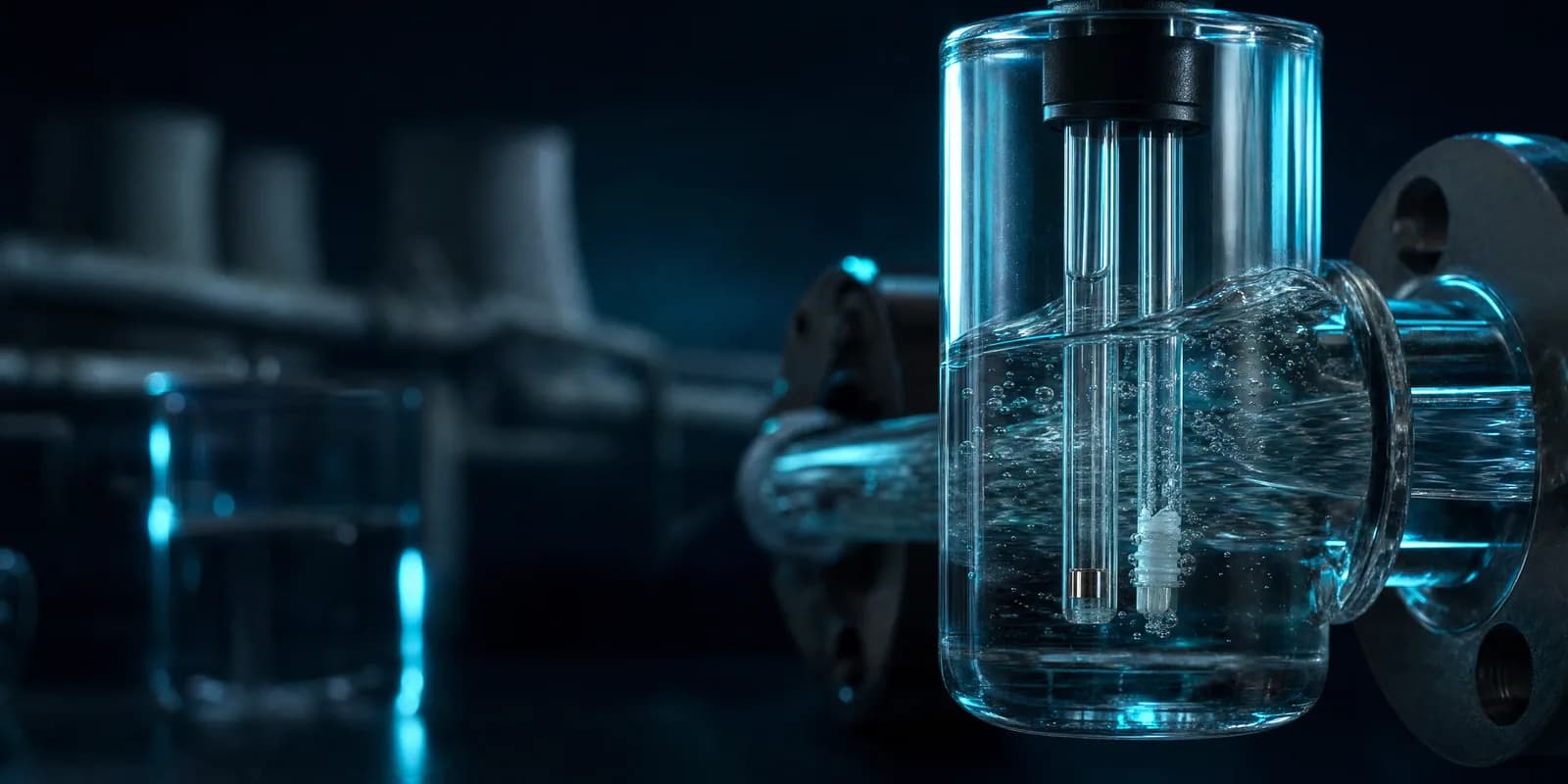
The SEKO Kontrol 800 L05 reference design for one cooling tower would put the pH, ORP and conductivity probes in a by-pass sample line with a probe holder and wall-mount the controller in a plant room or shade; the actuators are the owner's. The by-pass line is an assumption: SEKO's Panel, a different product, includes a by-pass probe holder[4]. Chem-Aqua states that "ORP sensors must remain wet at all times"[9], so the line must not drain when the tower is off. SEKO prints 0 to 40 °C, humidity to 95% without condensation, as the operating temperature[2]; the controller has no water path, so this article reads it as the surrounding air (reasoning). No Singapore ambient figure is stated. No holder rating is published for these probes (the one found, in the older catalogue, is for a chlorine-probe holder[3]); line flow and probe pairing also go to the quote. Immersion mounting is the alternative, covered in the selection guide for the Kontrol 800 L05; several towers on one controller change the relay budget and are outside the L05 tower design.
The relay count is a conflict: the datasheet's description says the unit features "three relays outputs"[2], while its characteristics list "Relays: Six (250 Vac 7 A); Four 100 to 240V Power relays and Two dry contact relays"[2]. The older catalogue prints another arrangement, among its lines "Three (3) independent relais"[3]. The L05 tower design therefore works to three relays until SEKO confirms, this article's own decision and not a ruling between the documents.
Three functions on three relays leave (3 − 3) ÷ 3 = 0% spare, which proves nothing about whether three suffice, because the basis was chosen to fit. The assumed assignment is relay 1 for bleed on conductivity, relay 2 for oxidizer on ORP and relay 3 for pH. A fourth actuated function would be short by one relay: three of four functions (75%) are covered. The rating and the other outputs do not enlarge that budget. The datasheet prints 250 Vac 7 A only inside the six-relay bullet, so the rating is itself a quote item[2] and the loads are the owner's. SEKO lists two frequency outputs and two current outputs under "Output Modules associated with the chemical measurements"[2], but not which measurement drives which, so no function depends on them. The frequency outputs are open collector NPN/PNP, 0 to 120 pulses per minute, 2.0 Hz at the upper bound[2] (the older catalogue prints the range from 1[3]); the current outputs are 0/4 to 20 mA into 500 Ω maximum, 10 V at 20 mA[2]. There is one controller and no standby. Loss of power, of the controller or of the shared sample line takes bleed, oxidizer and pH together (reasoning). No output state on power loss or probe loss is stated in the documents retrieved, so the owner chooses each valve's and pump's failure position. A second controller on the same line would share it (reasoning).
What leaves is blowdown, 3.33 m³/h at 4 cycles (10 ÷ 3), to the public sewer. The Singapore code of practice, fourth edition, March 2001, as hosted by NEA and read on 2026-09-30, states that "Discharge of effluent water from cooling towers shall be into the public sewers"[7], within the 1999 trade-effluent limits as that edition prints them, among them pH 6–9, total dissolved solids 3,000 mg/L, chloride 1,000 mg/L and 45 °C[7]. The current regulations, and any Malaysian or Indonesian source, were not retrieved. The controller cannot see chloride, and no conductivity-to-solids factor was retrieved, so no maximum set point follows from those limits. The oxidizer residual in the blowdown against any local discharge limit is the owner's to check; none was retrieved.
Acceptance against independent samples
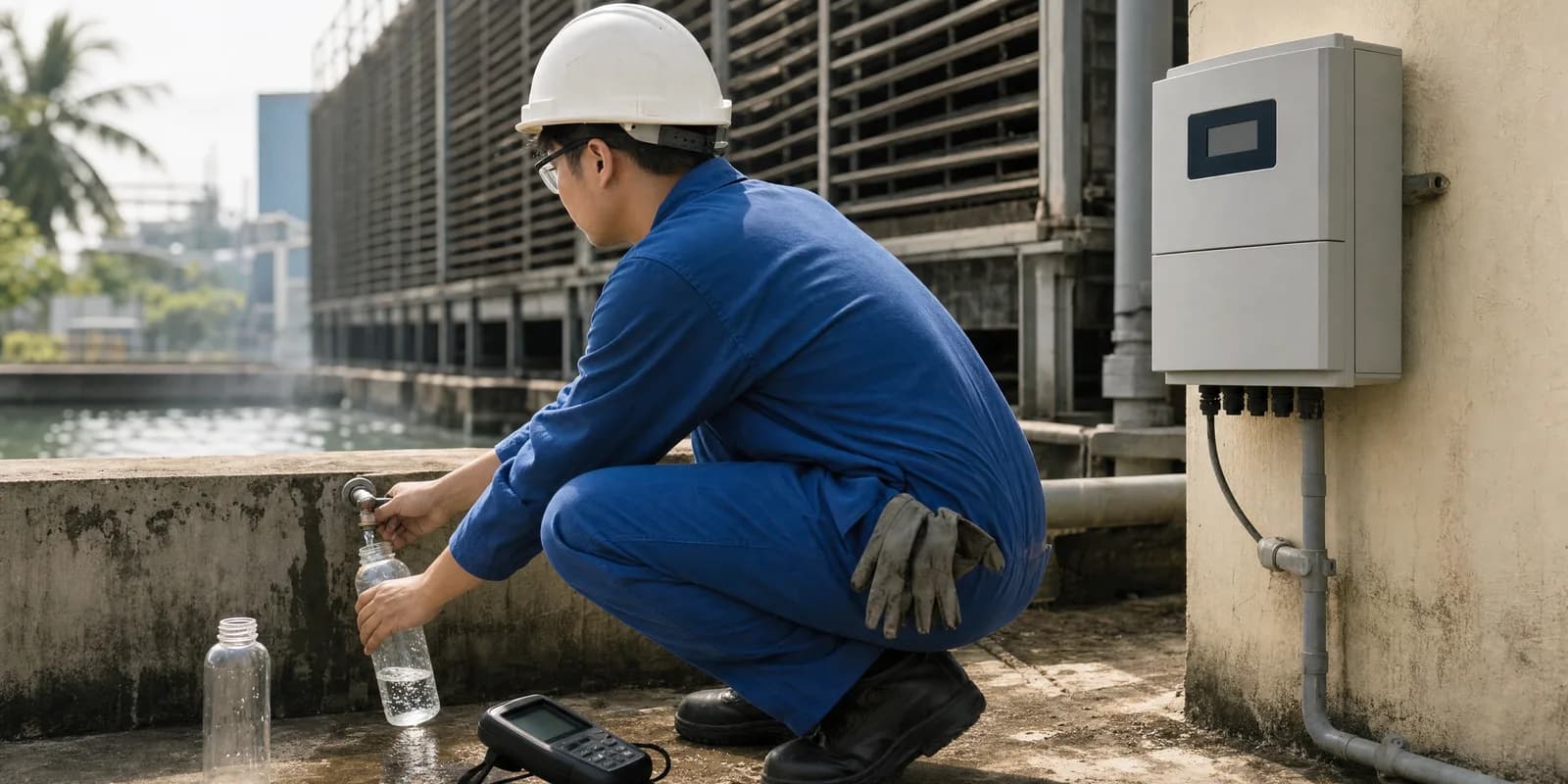
In the L05 tower design the controller would read tower-side pH, ORP and conductivity from the sample line. Make-up conductivity, the halogen residual, the blowdown and make-up flows and the microbiological counts the code names[7] would be the owner's samples and meters. The single reed flow input's function is unpublished[2], and one input cannot meter both make-up and blowdown (reasoning). The matrix marks no temperature channel for the L05, so none is assumed.[2] Conductivity depends on temperature in general (reasoning), so with no compensation published the set point may hold a reading, not a cycle count, as tower water warms or cools.
Three actions are assumed. Relay 1 would open the bleed, the blowdown stream, when tower-side conductivity passes a set point, the generic function DOE describes for a conductivity controller[8], not one SEKO describes for this build; relay 2 would start the oxidizer pump when ORP falls below a set point; relay 3 would correct pH. The older catalogue lists "On/OFF, Timed, Proportional routine function setting"[3], but no document retrieved gives a mode or parameters per channel. The L05 tower design claims no controller alarm, dose limit, dose timeout, bleed lock-out or supervisory link. The older catalogue lists "One Alarm remote dry contact"[3] and a digital input to "disable all function controller output"[3]; the current datasheet retrieved describes neither alarm nor Hold behaviour for this build, Hold being an input it lists without describing. Output states on power loss or probe loss are quote items nothing relies on. The operator can run bleed and dosing by hand; manual override at the controller is not described.
A low ORP reading is not proof of a low residual. Chem-Aqua states that "A higher pH will see a smaller ORP response to oxidizer feeds"[9] and that "the higher the temperature, the lower the ORP"[9]. No source retrieved says which way a dried-out or degraded probe errs, so none is claimed; the assumed ORP relay would act on whatever the probe reads, with no published dose limit, a stated risk and not a protection. The functions interact: Chem-Aqua says that when pH varies "due to changes in makeup water quality, inconsistent cycles, extended prebleed, bleed lockout times, or high pH chemical additions", the ORP set point that holds a residual also varies[9]. Bleed also removes dosed chemical with the water (reasoning, not Chem-Aqua's statement), and no SEKO document retrieved states a lock-out for this build. Nothing in the L05 tower design interlocks the bleed valve with the external shot dose or the oxidizer feed. Whether a bleed hold-off during a dose is needed is an open item for the treatment specialist, since Chem-Aqua lists "bleed lockout times" among the causes of pH variation[9]. The ORP and conductivity readings article sets out the mechanism.
The Kontrol 800 L05's conductivity reading is compared with an independent reference on the same sample at the same temperature, with the tolerance agreed before order and not derived from the printed ±2%, whose basis the datasheet read does not print[2]. Cycles pass when the ratio of paired, same-day tower and make-up conductivity is 3.5 to 4.5, which is 700 to 900 µS/cm tower-side at the illustrative 200 µS/cm make-up. Flows are checked on the owner's meters against 3.33 m³/h blowdown and 13.33 m³/h make-up at design load. The oxidizer is checked by the owner's residual test at the ORP set point found, repeated after a pH change. Readings just after a dose or bleed are set aside (engineering judgment). The article on reading ORP and conductivity holds the rule for what each figure must carry. No SEKO start-up procedure was retrieved, so the stages are engineering judgment; the data log is not relied on.
Open items and what stays outside
The central gap comes first: the current SEKO datasheet retrieved for this build states nothing on which measurement drives which output, the control modes, alarm or Hold behaviour, output states on power or probe loss, or a conductivity-driven bleed. SEKO's login-only document hub was not opened[5], and the only blow-down function wording in the pages read is in a news item for a cooling-water panel, another product[4]. The L05 tower design assumes a conductivity set-point relay for bleed. SEKO's manual for the exact order code, covering both L05 and L11 since SEKO prints the same channels for each, plus a bench set-point test would close that (engineering judgment). If the manual shows no conductivity set-point relay, the Kontrol 800 L05 is not this product.
The edition of the Singapore code retrieved states that "A complete automatic water treatment shall be installed for accurate dosing"[7], that at least two biocide types are used alternately on a weekly basis[7], and that the shot or slug dose method adds biocides directly into the basin using an "automatic control system"[7]. An ORP set point holds an oxidizing signal between scheduled doses; it does not deliver a slug dose and cannot see a non-oxidizing biocide (reasoning). Rotation and shot dosing stay with an external timer, pump schedule or the owner's treatment programme, and the L05 tower design does not claim the controller is the code's automatic control system. The article on reading ORP and conductivity covers what the code says about instruments.
The same edition lists, as one step of its emergency procedure for an outbreak, to "discontinue the regular chemical treatment programme (corrosion inhibitor, scale inhibitor) and shut off the chemical feeders"[7]. In the L05 tower design that stop is an external isolation of the feeders, operated by the owner, and Hold is never the stop because its behaviour on this unit is not described[2]. Clause 14.5(a) of that edition separately calls for sodium hypochlorite to be added to the system water to a measured 50 mg/litre of free chlorine[7], which is not a benchmark for normal running. After handover the owner holds the set points, the oxidizer, the biocide schedule and the isolation.
The trial can be stopped at any stage, and its first three stages cost hardware: SEKO's manual and assignment table on paper; the three relays on a bench with no water; probes and a holder in the sample line with the owner's actuators isolated, compared with references. Then come bleed on closed loop, checking cycles; oxidizer on ORP; and pH last, or left monitor-only. Stopping before bleed goes automatic leaves a controller, probes and a sample line, and nothing dosed. Whether SEKO or a dealer supplies a trial unit is unknown. The off-ramp is a different controller.
The L05 tower design fits one open recirculating tower with one controller, at most three actuated functions on loads inside 250 Vac 7 A if SEKO confirms that rating for the three relays used, a controller location between 0 and 40 °C, and cycles inferred from a sampled make-up conductivity. It stops at a fourth actuated function, a bleed hold-off or other interlock the controller cannot supply, a controlled chlorine residual (L18, L19 or another instrument), a controller alarm or building-system link, several towers on one controller, or a needed conformity declaration. It does not mean Legionella control, code compliance, free-chlorine control, a cycles measurement, a certification or a SEKO-endorsed configuration.
The data pack is the make-up conductivity across the year, the specialist's design cycles, the treatment programme, load voltage and current, each pump's input type, sample-line pressure and temperature, ambient temperature, local discharge limits, the market's conformity requirement and the exact order code. SEKO's documents read on 2026-09-30 name no certification, standard or declaration[2], and a missing statement is not proof there is no mark.
A Purionex quote would state the exact order code priced, the relay count and rating as SEKO confirms them, and every item above that SEKO has not confirmed as open. Request a quote for the SEKO Kontrol 800 in its pH, ORP and conductivity build, with the data pack above.
Sources
- [1]SEKO — Kontrol 800 product page, Singapore catalogue with US page cross-check, retrieved 2026-09-30 (stated example use, family feature list)
- [2]SEKO — Controller Instrument Kontrol 800 technical data sheet, 4 pages (footer tags R8 and R9) — primary product datasheet
- [3]SEKO — older Kontrol 800 catalogue pages 06, 07 and 23, undated, hosted by a distributor (labelled fallback)
- [4]SEKO — Kontrol 800 CT Panel news item (22 December 2022) and related Panel and Tech product pages (different products, not used for any Kontrol 800 figure)
- [5]SEKO — probe and probe-holder product pages (model names only; no numeric specification published)
- [6]SEKO — contact page (headquarters in Rieti, Italy; no country of manufacture stated)
- [7]Singapore — Code of Practice for the Control of Legionella Bacteria in Cooling Towers, fourth edition, March 2001, as hosted by NEA (regulator; currency not established)
- [8]US DOE FEMP — Best Management Practice 10: Cooling Tower Management (US federal water-efficiency guidance, not an ASEAN requirement)
- [9]Chem-Aqua — Technical Bulletin 2-061, Understanding How ORP Is Used in Cooling Water Treatment (chemical supplier guidance, not a standard)
- [10]Sensorex — ORP Sensors in Cooling Tower Biocide Optimization (sensor maker web article, corroborating tier only)