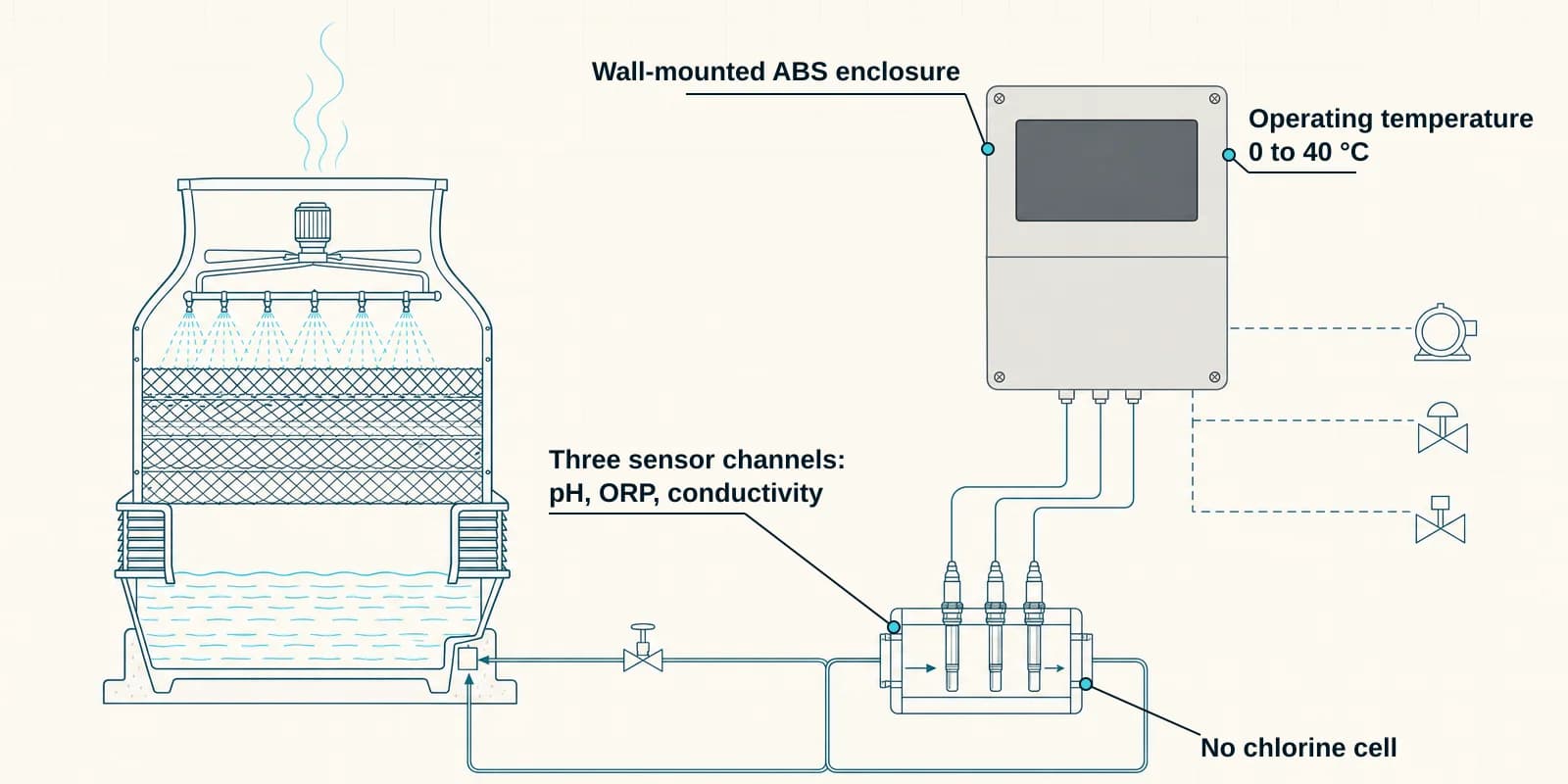
Oxidation-reduction potential (ORP) control of an oxidizing biocide in a cooling tower uses the electrical potential between a probe's sensing and reference electrodes, in millivolts, as a control signal for oxidizing strength.[9] By Chem-Aqua's account, the result it has to deliver is a halogen residual that a site test confirms.[8] The SEKO Kontrol 800 in its pH, ORP and conductivity build (SEKO build code K800L05, the Kontrol 800 L05 below) does not itself read that residual.[2] The misreading is to take a millivolt figure for ppm of chlorine or bromine: Sensorex says ORP does not directly measure either and describes it as a control signal for oxidizing strength.[9] SEKO's datasheet opens its description with "The Kontrol 800 is a dedicated multi-parameter controller for complex applications that require a number of chemical parameters to be checked at the same time."[2] Four questions follow: what a millivolt reading means; what the printed envelope covers and what more cycles of concentration cost an ORP loop; what evidence stands behind the controller; and what a figure must carry on site. Sizing and fit sit in the selection guide and the applied duty in the reference design.
ORP reads in millivolts, not ppm
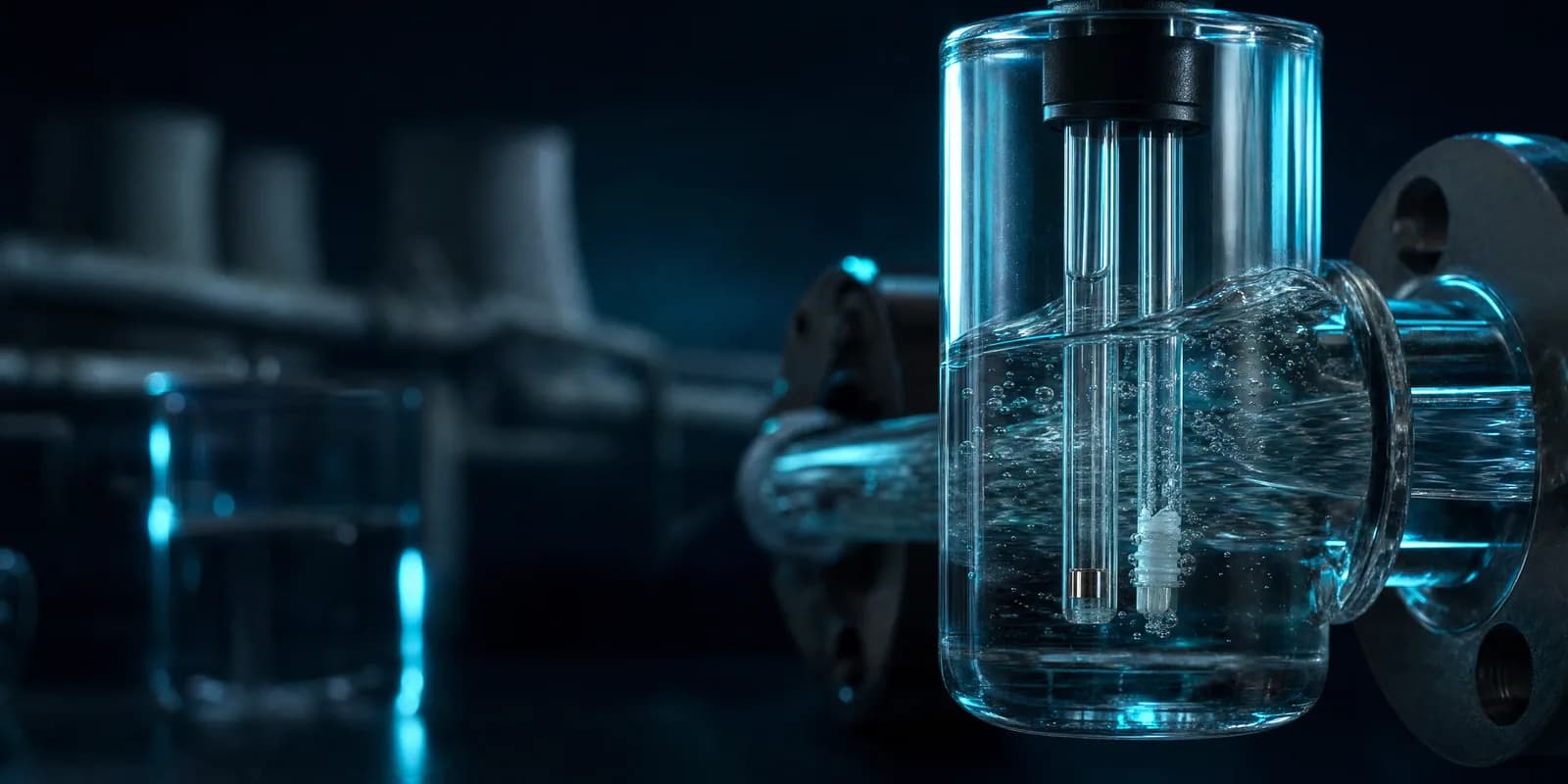
SEKO writes that an ORP probe "consists of a measuring electrode in contact with the solution and a reference electrode with stable potential."[4] SEKO prints ±2000 mV at ±1 mV for ORP on the Kontrol 800 L05,[2] but the range says only what the electronics can span. Chem-Aqua defines ORP as a system's ability to oxidize or reduce a substance in the water, so a millivolt figure names no species and no concentration (reasoning).[8]
The misreading is to read that figure as ppm. Chem-Aqua states: "The ORP reading itself is not as important as the oxidizer residuals in the system."[8] The Kontrol 800 L05 has no chlorine cell in SEKO's matrix, so a residual comes from the site's own test and not from the controller (reasoning from the matrix).[2]
The same dose can give different readings. Chem-Aqua states "A higher pH will see a smaller ORP response to oxidizer feeds."[8] It adds that the free and total chlorine residuals do not vary with pH. It ascribes the smaller response to more of the less active hypochlorite and hypobromite relative to the acids.[8] Joseph Covey's Wastewater Digest article reports the hypochlorous acid share of free chlorine falling from 75% to 10% between pH 7.0 and 8.5. It calls that range typical for drinking water, so the figure shows direction only.[7] Chem-Aqua also states that ORP falls as temperature rises.[8] SEKO's matrix has no temperature column for any build, and its range table prints a series temperature range of 0 to 100 °C without tying it to a code, so whether the L05 takes a temperature input or compensates is not stated in the datasheet read.[2] The reading is therefore not stated to be temperature-corrected. The limit is that no setpoint transfers between towers (this article's synthesis). Sensorex states "There is no universal ORP setpoint that guarantees Legionella control in every cooling tower."[9] Chem-Aqua states "Correlating ORP values with the target free and total halogen residuals on each individual system is required to control an oxidizer program with ORP controls."[8] No document read, SEKO's included, gives a millivolt target, so neither a too-low nor a too-high edge of the setpoint carries a number here.
One signal is ambiguous: ORP falls while the residual test does not. Chem-Aqua lists a higher pH, warmer water and extra oxidizer demand from stabilizer, excess ammonia in chloramine-treated make-up or organics in a dirty tower.[8] Other conditions can make any reading unreliable (this article's summary). Chem-Aqua states "ORP sensors must remain wet at all times."[8] It adds that deionised-water storage degrades a probe's life and performance and that a properly maintained probe can last 12 to 18 months. That is a general supplier figure, not SEKO's.[8] No source says which way such a probe errs, so none is claimed. The check is to log pH and temperature beside ORP and test the residual on the same sample. The L05 supplies pH.[2] The residual test is the site's, and so is the temperature if the controller does not take it.
What more cycles save and what stays unseen
SEKO's datasheet prints, for the channels the L05 carries, pH 0÷14,00 at ±0,01 pH, ORP ± 2000 mV at ±1 mV and conductivity 0,054÷200.000 µS(1*) at ±2%.[2] It prints no probe, temperature or sample condition against any of them.[2] The datasheet uses decimal commas, writes 200.000 for 200,000 and prints µS with no /cm; this article writes 0.054 and µS/cm. The text of footnote (1*) is missing on all four pages, so the conditions of the conductivity range are not printed in the datasheet read. The basis of the ±2% is a quote item taken up in the selection guide. The one condition printed, 0 to 40 °C at 0 to 95% relative humidity without condensation, belongs to a controller with no water path, so this article reads it as the surrounding air, by reasoning.[2]
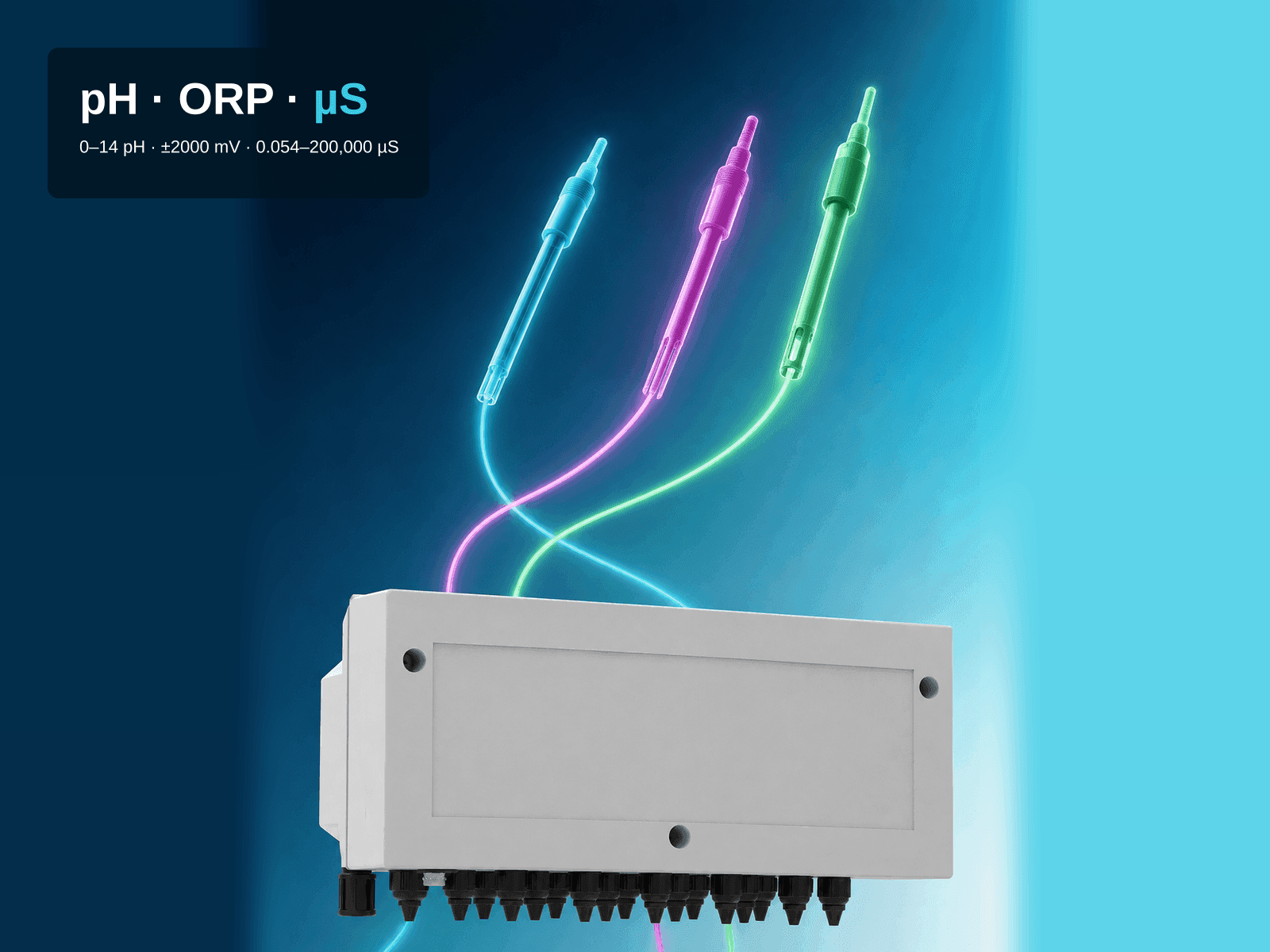
What the L05 senses is narrower than the tower's chemistry. SEKO's key and matrix give it pH, ORP and one conductivity channel; the datasheet lists a reed flow input and a Hold input for the series.[2] It cannot see a halogen residual, because its matrix row has no chlorine cell. It reads one conductivity channel, one dot in the matrix. The US Department of Energy (DOE) defines cycles of concentration as the ratio of dissolved solids in the blowdown to those in the make-up water and says to check the ratio of blowdown to make-up conductivity.[6] No function that computes cycles on the L05 is described in the documents read: a cycle count needs the make-up value as well, and that value is a site sample. The current SEKO datasheet states no output assignment, control modes per channel, alarm or Hold behaviour or failure states. A conductivity-setpoint bleed is DOE's generic function: a controller discharges water only when the set point is exceeded.[6] [ASSUMPTION: this build offers that function, because it has a conductivity input; valid if SEKO's manual for the exact order code confirms it, invalid if it does not.]
The water saving is derived here from DOE's balance, make-up equals evaporation plus blowdown plus drift,[6] at steady state with dissolved solids leaving with blowdown and drift, which carries tower water. [ASSUMPTION: illustrative inputs, evaporation E of 10 m³/h, make-up conductivity of 200 µS/cm and drift neglected; valid for arithmetic only, invalid for any real tower or supply, since no tower rating or local make-up conductivity was retrieved.] With N cycles, the balances reduce to:
make-up = E × N ÷ (N − 1)
blowdown = E ÷ (N − 1)
At N = 3 the make-up is 10 × 3 ÷ 2 = 15.0 m³/h, the blowdown is 10 ÷ 2 = 5.0 m³/h and the tower water sits at 200 × 3 = 600 µS/cm. At N = 6 the make-up is 10 × 6 ÷ 5 = 12.0 m³/h, the blowdown is 10 ÷ 5 = 2.0 m³/h and the tower water sits at 200 × 6 = 1,200 µS/cm. Make-up falls by (15.0 − 12.0) ÷ 15.0 = 20%, which DOE also reports for three to six cycles.[6] Blowdown falls by (5.0 − 2.0) ÷ 5.0 = 60%, while DOE's page reports 50%.[6] On that balance, with the same drift at both cycle counts, drift can only raise the 60%. One quantity that does fall by 50% is blowdown as a share of make-up, from 5.0 ÷ 15.0 = 33.3% to 2.0 ÷ 12.0 = 16.7%, which DOE does not state. This article does not say which quantity DOE meant; DOE's page is US federal water-efficiency practice, not an ASEAN requirement.
The 20% saving is derived. The cost arm is Chem-Aqua's: its bulletin names changes in make-up water quality, inconsistent cycles, extended prebleed, bleed lockout times and high-pH chemical additions among the causes of pH variation. It states that when pH varies the ORP setpoint needed for a particular oxidizer residual also varies.[8] Chem-Aqua does not say that a higher cycle count changes pH, or in which direction, and it sizes no effect. This article's own reasoning, not Chem-Aqua's statement, is that a deliberate change in cycles or bleed practice is a change the setpoint should be re-checked against with a residual test. Reading the water saving as free is the misreading this prevents.
More cycles leave more dissolved solids in the tower water: DOE names calcium, magnesium, chloride and silica remaining after evaporation and says they can lead to corrosion problems.[6] It sets no conductivity ceiling, so the ceiling is a site decision the controller can neither derive nor see (reasoning).[6] Fewer cycles cost more make-up and blowdown by the same balance. If the residual proves unstable, the fix may lie outside the controller, in the residual test, the make-up sample or the setpoint.
The evidence read is SEKO's own datasheet
The evidence found for the Kontrol 800 L05 is SEKO's own four-page datasheet, tagged R8 on page 1 and R9 on pages 2 to 4, and its product pages, which state ranges and name cooling tower control systems as an example application.[2][1] That is a stated use, not a result. Beyond SEKO's datasheet and product pages, no SEKO test, field record, independent laboratory report or customer record was read.
The misreading is to treat a datasheet range as evidence of performance. A span whose footnote is missing is an instrument span whose probe and cell conditions the datasheet read does not print.[2]
Chem-Aqua's bulletin is a chemical supplier's guidance, issued October 2021 and June 2022,[8] Sensorex's article is a sensor maker's web page,[9] and DOE's page is US federal water-efficiency practice;[6] none mentions the Kontrol 800.
The Singapore code is the regulator tier here. The edition read is the fourth, March 2001, as hosted by the National Environment Agency (NEA) on 2026-09-30, and its current status was not established. The pages read, printed pages 1 to 16 and Appendices A to C, were read from page images with no text search run. The words conductivity, ORP, redox and cycles of concentration did not appear in the clauses read, and no controller product or make is named in them.[5] The edition read therefore neither supports nor rules out an ORP or conductivity loop. What it requires of a tower is set out in the reference design.
SEKO's four-page datasheet, product pages and cooling-tower panel news, read on 2026-09-30, name no certification, standard or declaration of conformity; IP65 is SEKO's own statement, with no test standard named.[2][1][3] A missing statement is not proof that no mark exists, and SEKO's login-only document hub was not opened.[3]
One reading on site is ambiguous: the tower-to-make-up conductivity ratio does not equal the cycles the flows imply. Cycles are defined on dissolved solids and conductivity is the check DOE gives,[6] so the ratio holds only while solids concentrate in proportion to conductivity. Other causes are a stale or changed make-up sample, drift, chemical additions that raise conductivity and scale deposit that lowers it (both reasoning), and temperature, whose compensation on the L05 the datasheet read does not state. The check is same-day make-up and tower samples at the same temperature, compared with the flow balance.
Prove it on site with paired samples
By this article's rule, which draws on Chem-Aqua's and Sensorex's statements, an ORP reading from the Kontrol 800 L05 holds as a control signal only when it carries five things. First, the oxidizer and biocide programme, because ORP does not name the species.[9] Second, the pH and temperature at the time. Third, the residual test method on a same-time sample. Fourth, the probe's condition, kept wet, not stored in deionised water and aged against Chem-Aqua's general 12 to 18 months.[8] Fifth, the site's own correlation of ORP with the target residual,[8] checked again after a change in make-up quality, cycles or bleed practice (this re-check is reasoning).
By this article's rule (DOE's balance, the datasheet's gaps), a conductivity-to-cycles claim holds only when it carries four things: a same-day make-up sample, a stated temperature basis (not stated in the datasheet read for the L05), the conditions behind the printed range and the basis of the ±2% in SEKO's written words,[2] and a flow balance that closes, make-up equal to evaporation plus blowdown plus drift.[6] Even then the ratio equals cycles only while dissolved solids concentrate in proportion.
The Kontrol 800 L05 reads pH, ORP and one conductivity channel over the spans SEKO prints, whose measurement conditions the datasheet read does not print; those spans are the maker's statement, not a demonstrated result. ORP serves as a control signal against a site correlation at the pH and temperature of that correlation. The envelope does not hold for ORP read as ppm of chlorine or bromine, for a setpoint moved from another tower, or for cycles from the L05 alone, and the documents read support no certification or code-compliance claim. Fit and sizing sit in the selection guide.
Acceptance is two paired readings, and SEKO's written answers close the rest. The data to send is dated make-up and tower conductivity samples with temperature, a pH and ORP log, residual results with method and time, the oxidizer and biocide programme, probe type and age, the exact SEKO order code (K800L05 or K800L11) and the market. The terms to agree are who owns the ORP setpoint and how it is correlated, the sampling routine, the acceptance comparison for ORP and for conductivity, and SEKO's written answers to the quote items in that guide.
SEKO Kontrol 800 Multi-Parameter Controller
No certifications listedView product →Sources
- [1]SEKO — Kontrol 800 multi-parameter water-treatment controller, product pages (SG and US), read 2026-09-30
- [2]SEKO — Controller Instrument Kontrol 800 technical data sheet, 4 pages (page 1 tagged R8, pages 2 to 4 tagged R9), read 2026-09-30
- [3]SEKO — Kontrol 800 CT Panel for Cooling Water Treatment news item (22 December 2022) and related Kontrol 800 variant pages, read 2026-09-30 for certification statements and the login-only document hub
- [4]SEKO — Probes for ORP product page, read 2026-09-30
- [5]Institute of Environmental Epidemiology, Ministry of the Environment, Singapore — Code of Practice for the Control of Legionella Bacteria in Cooling Towers, fourth edition, March 2001, as hosted by NEA (read 2026-09-30; current status not established)
- [6]US Department of Energy, Federal Energy Management Program — Best Management Practice #10: Cooling Tower Management (US federal water-efficiency guidance)
- [7]Joseph Covey — Dealing with pH Dependence, Wastewater Digest, 30 April 2007 (trade-press article, sensor-industry author)
- [8]Chem-Aqua — Technical Bulletin 2-061, Understanding How ORP Is Used in Cooling Water Treatment (issued October 2021 and June 2022), a chemical supplier's guidance
- [9]Sensorex — ORP Sensors in Cooling Tower Biocide Optimization (sensor-maker web article)