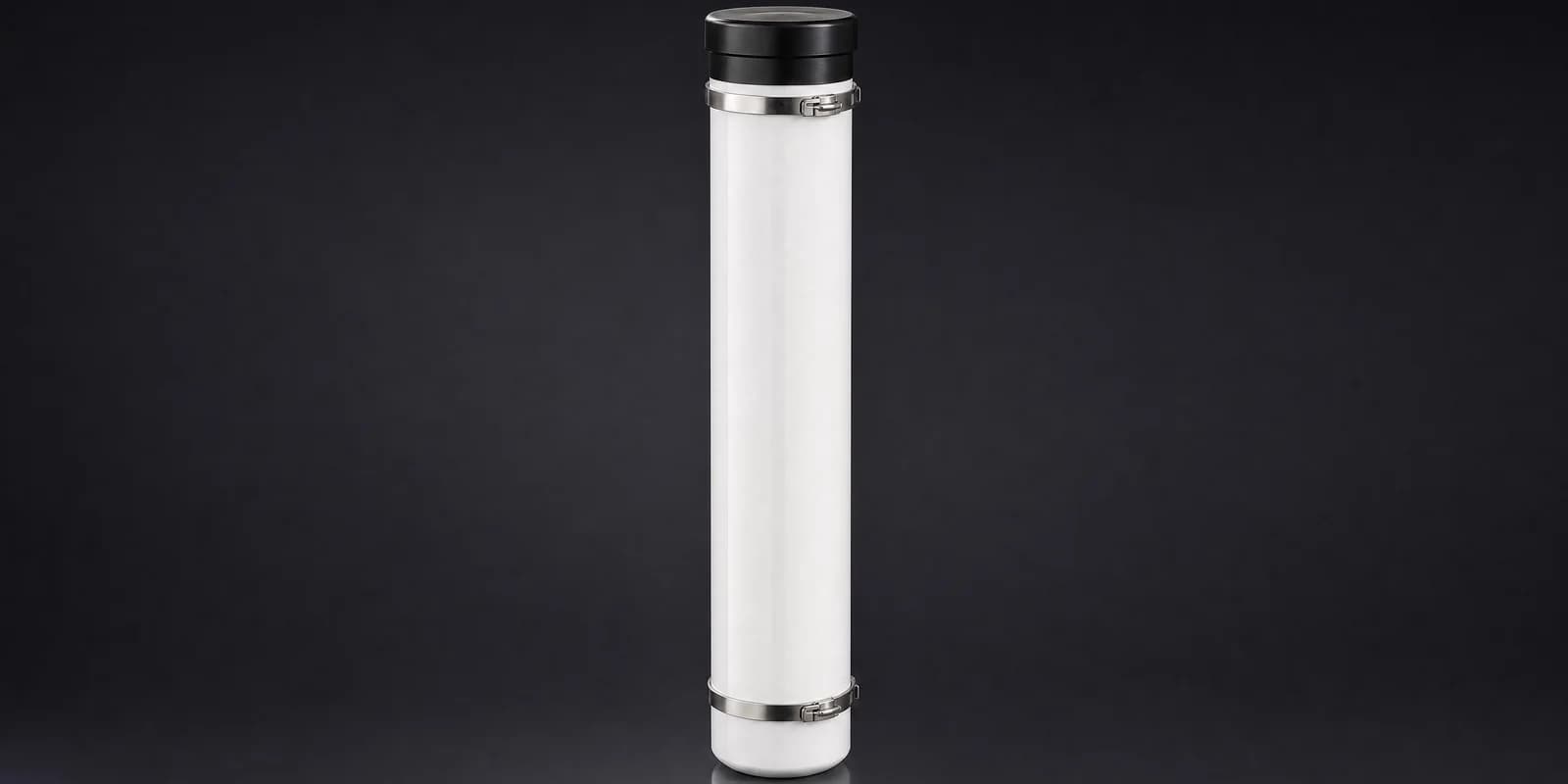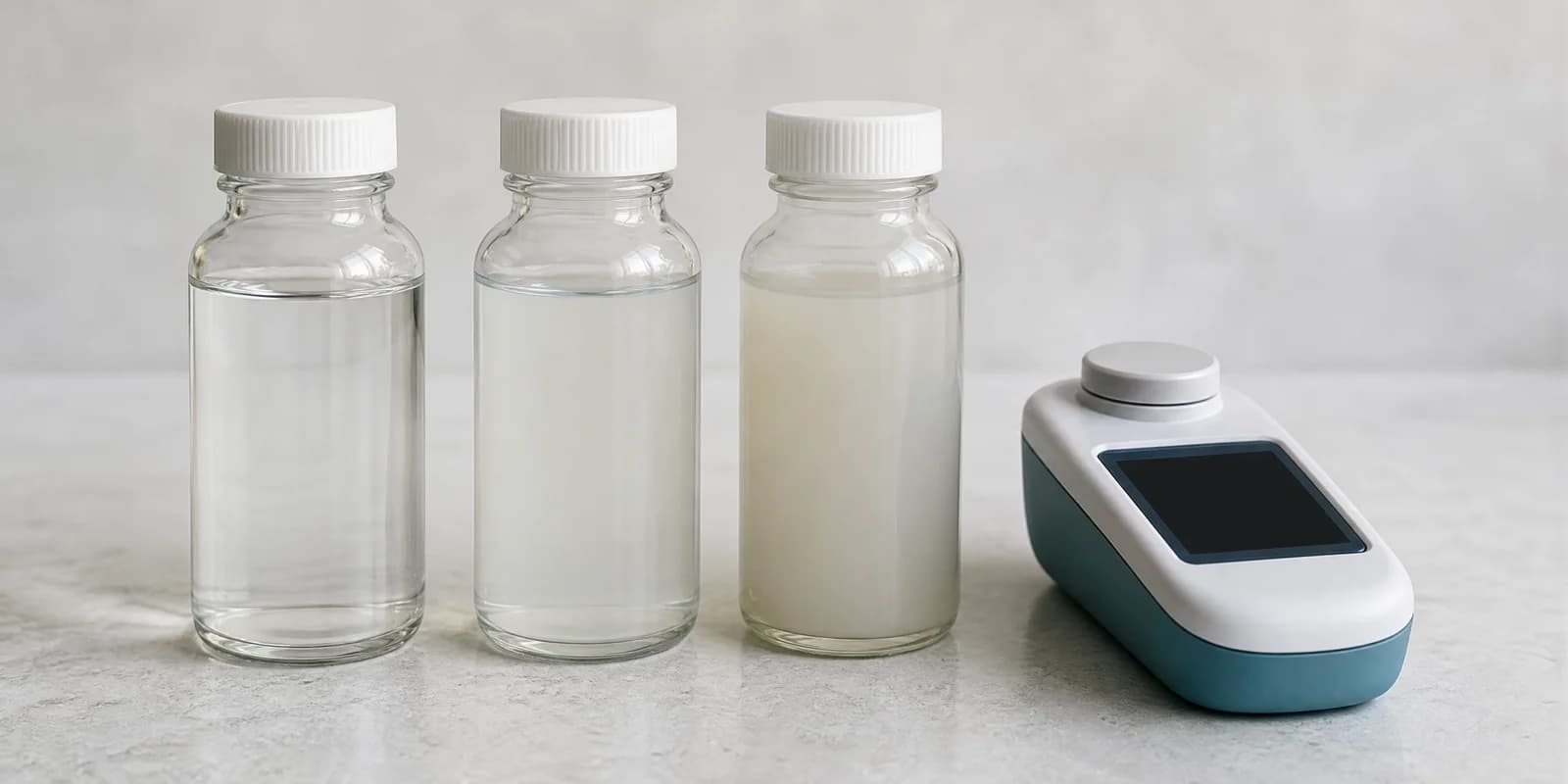
Litree's LH3-1060-V prints a Volume of 2.4 to 6.4 m³/h.[1] Fit comes first, though: does the feed sit inside a limit for turbidity, temperature, pH and oxidant, and who printed it? For Litree's inside-out PVC alloy UF membrane module, LH series (LH3-0650-V, LH3-1060-V, LH4-1080-V), the Litree pages read print no feed limit for any of the three models.[1] The nearest figures sit on seller listings. One listing of a 12-module LH3-1060-V system prints a feed pressure, a TMP (the pressure across the membrane wall), a temperature, a pH and a turbidity figure, and listings of a 40 m² module print pH strings that disagree, and one a chlorine string.[2] Reading any of them as the module's published feed limits is the misreading this guide replaces.
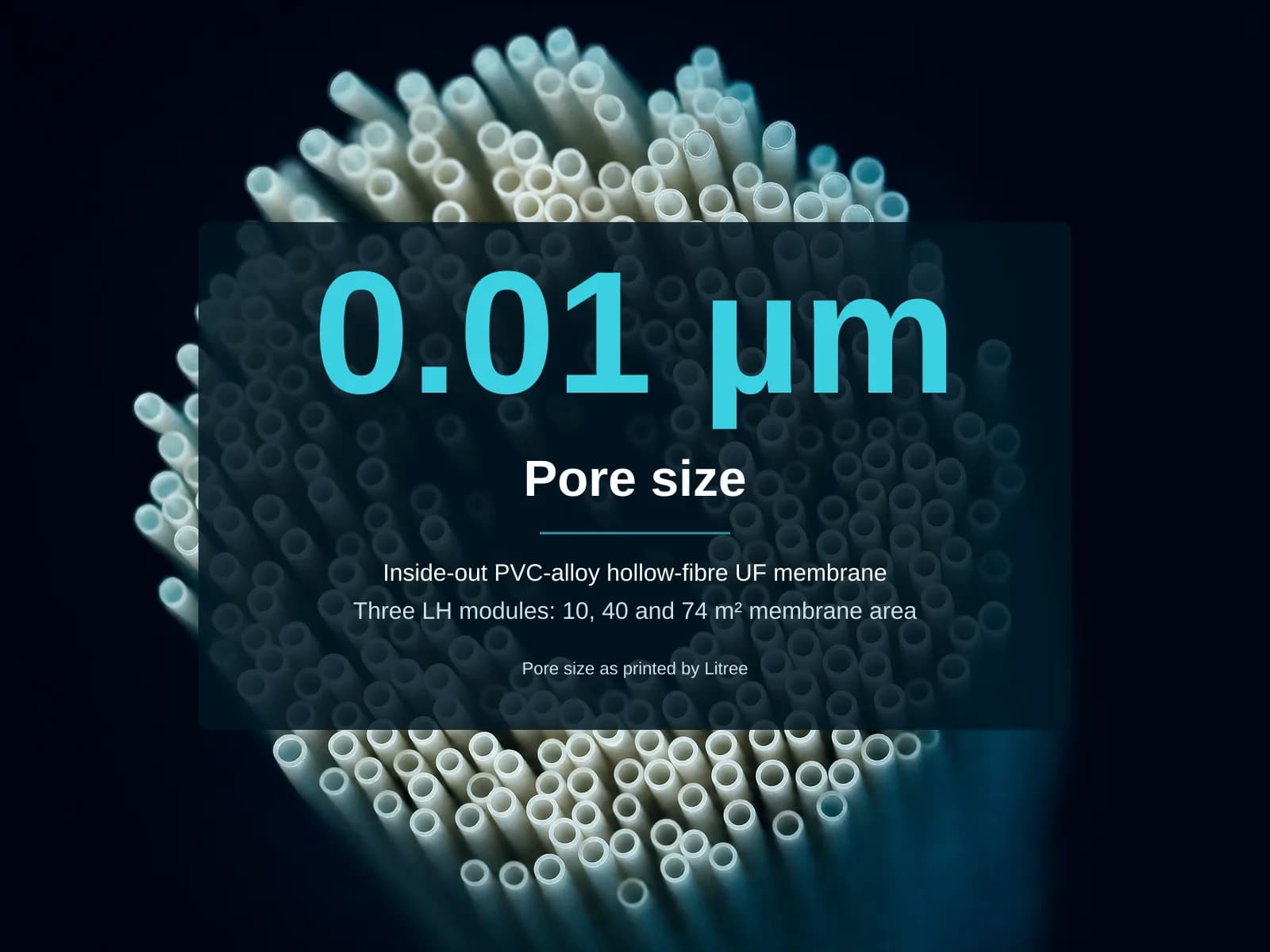
The procedure: measure the feed, screen it against the seller's system figures as context only, size with the printed range, and send Litree written questions. It ends in one of three answers: quote the LH3-1060-V with the questions attached; ask Litree for limits before anything else (the listings read carry no feed or operating limits for the LH3-0650-V, and none carries the LH4-1080-V);[2] or not this product. Count arithmetic and rack design sit in the reference design; what a 0.01 µm pore rating[1] does and does not prove sits in the pore-rating deep dive.
Measure the feed before reading any Volume figure
A UF stage answers a particulate problem, so sort the complaint first. Dissolved ions such as hardness and salinity pass a UF membrane, so a complaint caused by them is not a UF problem (this guide's reasoning). Turbidity, a light reading in NTU, set against a dissolved measure taken by the site's own method, separates a cloudy feed from a clear-but-wrong one (this guide's reasoning). Dissolved colour stays open, since a seller's 50,000 Dalton cut-off may hold back part of it.[2] A feed whose problem is dissolved ions ends the enquiry early (the same reasoning): the LH modules are not needed.
Turbidity is a trend across rain, season and pump starts, never one grab sample. A sample from a stagnant line can read high, and cloudiness that clears on standing may be air or settleable solids rather than fine suspended particles (this guide's reasoning), so take repeated samples at the intake and run a standing test before any number enters the screen. A feed that swings with rain or season is screened on its worst value across the year, a steady supply on its range (this guide's reasoning for both). No regional typical turbidity is assumed; none was retrieved for Singapore, Malaysia or Indonesia.
Litree lists the three LH modules under its Industry group as "Pressure UF Membrane" and the pages read name no application.[1] [ASSUMPTION: the duty is a feed to a pressure UF stage, the frame for every example here; valid as an illustration; invalid as Litree's stated use.]
The inputs fall into three groups. Eliminate: highest turbidity in NTU, highest temperature in °C, pH range, any oxidant residual and its form, and any certificate or contact-material evidence the market needs. Size: filtrate demand in m³/h and the mode, dead-end or cross-flow. Fit: the feed pressure the site can supply in bar, where backwash water comes from and drains to, and the downstream stage's own feed requirement, the downstream maker's figure, with no number here. Litree alone can supply the Volume basis and every per-module limit.
NTU is a light reading, not mg/L of solids, and no conversion holds without paired samples from the same site. A 2008 trade article's figure of "typically less than 50 mg/L" belongs to its authors' own process and is no Litree limit.[4] Volume is m³/h for one module, not for a system.[1] Screening before the feed is measured screens an invented feed.
Seller system figures screen, they do not limit
Published limits eliminate nothing here, because the Litree pages read (the three LH pages, the category page and the home page, as archived on 2026-05-15 and 2026-07-02) print no TMP, feed pressure, flux basis, backwash interval, volume or trigger, recovery, temperature, pH, chlorine, turbidity or SDI (silt density index) limit, cleaning chemistry, lifespan, warranty, weight, connection size or datasheet; the LH4-1080-V page names backwashing as a process step with no figure, and the home page's 2022 item, that Litree's products won an enterprise standard "leader" certificate, names no issuer, standard or LH module and is not a product certification for these modules.[1] The brochure page and two images on those pages were not obtained.[1] The pages print a Volume range and a Size: LH3-1060-V 2.4 to 6.4 m³/h on 40 m², LH4-1080-V 3.7 to 14.8 on 74 m², LH3-0650-V 0.6 to 1.6.[1]
Litree's own storefront on Made-in-China.com, a marketplace listing and not the maker's site or a datasheet, lists a 12-module LH3-1060-V system. It calls two lines suggested: "Suggested feed pressure: ≤ 0.3 MPa"[2] (3.0 bar, 43.5 psi) and "Suggested TMP: 0.02-0.08 MPa"[2] (20 to 80 kPa). Its other lines read "Working temperature: ≤ 40ºC",[2] a pH range of 2 to 13[2] and "Feed-in turbidity: ≤ 20 NTU".[2] These are figures on one system listing, not module limits.
They do not carry to the LH3-0650-V or the LH4-1080-V, and no storefront listing read carries the LH4-1080-V.[2] [ASSUMPTION: the storefront's 40 m² name Aries-40, which no page read ties to the LH3-1060-V, matches it on area, dimensions and range; valid as this guide's reading only; the strings are context, not limits.] Nor is the listing a datasheet: its 380 kg dry and 680 kg wet weights are below twelve times the 37 kg net and 58 kg wet module weights that other listings print (444 and 696 kg),[2] though a system should not weigh less than its modules (this guide's reasoning). Check: ask Litree for per-module limits.
[ASSUMPTION: Volume is permeate per hour, so Volume divided by Size, read as membrane area, is a flux; valid when Litree confirms in writing a permeate basis at a stated feed and temperature; invalid if Volume is feed flow or depends on feed quality in a way Litree has not stated.] On that reading the LH3-1060-V gives 60 to 160 L/m²/h (2.4 ÷ 40 and 6.4 ÷ 40) and the LH4-1080-V 50 to 200 (3.7 ÷ 74 and 14.8 ÷ 74). Top over bottom is 4.0 for the LH4-1080-V (14.8 ÷ 3.7) against 2.667 for both LH3 sizes (6.4 ÷ 2.4, 1.6 ÷ 0.6). Litree does not call the ratio a flux, prints no feed or temperature behind it and gives no reason for the wider LH4 band;[1] the seller's "Designed water flux" row of 60 to 160 L/m²/h belongs to its Aries-40 and Aries-10 listings.[2] The wider band is a quote question and makes an LH4-1080-V count less certain.
A worked screen, illustrative: 12 NTU, 30 °C, pH 7.5. [ASSUMPTION: round numbers inside the seller's figures, to show the method; not a typical feed for any site.] Against the seller's system figures that leaves (20 − 12) ÷ 20 = 40% on turbidity, (40 − 30) ÷ 40 = 25% on temperature, and pH 7.5 inside 2 to 13 by 5.5 units each end. The LH3-1060-V is not excluded by the seller's system figures, a reason to ask Litree, not a fit.
At an illustrative 20 m³/h the top figure gives 20 ÷ 6.4 = 3.1, so 4 LH3-1060-V modules; the bottom figure gives 20 ÷ 2.4 = 8.3, so 9, each then at 2.22 m³/h, under the printed bottom: the counts bracket the printed figures and are not a range of fits. With one out for backwash that is 5 to 10, of which 5 to 9 modules in total stay inside the printed range and 10 does not, on the reference design's labelled assumptions: permeate basis, dead-end, one module out at a time, least count with no module above the printed figure. The LH3-0650-V needs 13 to 34 modules in service, 3.25 to 3.78 times the LH3-1060-V count, and is set aside on count; the reference design carries that elimination. The LH4-1080-V stays in, at the cost of a wider band and no seller figures.
Litree PVC-Alloy Hollow-Fibre UF Module
No certifications listedView product →No derating curve and no turndown floor are printed in the documents read. The bottom of the printed range is not a stated minimum, and the 40 °C line is a working temperature, not a derating. A colder feed gives less permeate at the same pressure (this guide's reasoning).
Litree lists dead-end and cross-flow and does not say which one Volume describes.[1] A 2008 trade article by a UF-process supplier says dead-end operation passes all of the feed to filtrate and uses less energy only while fouling can be avoided, and that a periodic backwash is necessary.[4] For a cross-flow duty the pages read give no recirculation rate to size from (stop condition 4).
Compare quotes only on a stated Volume basis
[ASSUMPTION: one rack ahead of a downstream stage with a feed pump available; invalid for a gravity-fed rack with no pump or no room for a tank.] Modules fed through a protective strainer into a filtrate tank with its own downstream pump keep a backwash or an outage away from the downstream stage for the time the tank can cover, but the tank's volume cannot be derived while backwash volume is unpublished. Modules feeding the downstream stage directly save a tank, but every backwash and every outage reaches that stage. The strainer is this guide's engineering reasoning from a fibre inside diameter that seller listings print as 1.0 mm on some and 0.85 mm on another,[2] not a Litree requirement, and its rating is a quote item.
Litree's LH4-1080-V page, and no other LH page, says a steel belt and card holder come with the module for fixing it to the device bracket.[1] The split is this guide's, to be confirmed in the quote: the site or installer supplies the bracket and rack, strainer, feed pump, valves, filtrate tank, backwash water source and drain, controls and instruments. A second module out, a lost backwash source or a failed integrity check are upsets the quote must answer, and the reference design argues them.
A fair quote states, for the exact model, whether it is permeate or feed, at what feed quality and temperature, and in which mode. Two quotes that print 6.4 m³/h for the LH3-1060-V without that basis are not quotes for the same thing; a seller's table row is a lead, never the reader's result. A quote accepted before its basis is stated cannot be compared with the next.
Three more storefront strings read as limits and are not. A pH range of 2 to 13 appears on one listing that prints a 40 m² area, on one that names Aries-40 without an area and on the 12-module system listing, against 1 to 13 on another 40 m² listing.[2] The pH strings disagree with each other; the chlorine string appears on one listing only. One listing prints "Tolerance To Chlorine: 500ppm For Short-Term",[2] with no free or total distinction and no duration. Certification fields are seller-entered text, and no certificate document was read.[2] Under the US EPA's membrane filtration rule (a US rule, not a Singapore, Malaysian or Indonesian requirement) a removal figure must be established through a "product-specific challenge test and direct integrity testing",[3] which the pore-rating deep dive sets out; this guide names no storefront removal figure.
A quote must declare lifecycle items the pages read do not publish: backwash water per cycle and frequency, cleaning chemistry and frequency, feed pressure and TMP, module replacement interval, strainer rating, and the integrity test Litree specifies with its pass limit.[1] Pressure drop against flow and backwash water share are likewise absent from the pages read, and none is estimated.
One request-for-quote paragraph names the LH3-1060-V, with the LH4-1080-V and LH3-0650-V as comparisons. It asks for the Volume basis per model; per-module limits for feed pressure, TMP, temperature, pH, chlorine (free or total, and duration) and feed turbidity; the backwash method and whether one module or a bank backwashes at a time; the integrity test and its pass limit with any challenge-test report and its conditions; and certificates for the exact model and market. Cleaning chemistry, strainer rating and rack details are confirm-with-Litree items.
Re-measure the feed, and know when to stop
No Litree commissioning procedure, cleaning interval or lifespan was read, so these checks are this guide's reasoning. Record permeate flow per module with a flow meter, feed and filtrate pressure with gauges, temperature with a sensor and filtrate turbidity with a turbidimeter, all against the basis Litree confirms in writing. Treat every reading as recorded, not judged, until Litree supplies a figure.
Re-measure turbidity, temperature, pH and oxidant residual whenever the source, the season, upstream dosing or the demand changes. A dry-season sample of 12 NTU sits inside the seller's system figures while a wet-season feed above 20 NTU would sit outside the same screen, so a pass at commissioning proves the day, not the selection. A clean filtrate turbidity reading is likewise no integrity result, as how a pore rating is proved explains.
Five stop conditions bound the result, each with its reason and next step:
- A measured feed value beyond a module limit Litree has confirmed in writing. Reason: a confirmed limit is the only figure the module can be held to. Next step: pretreatment ahead of the LH modules, or not this product for that feed.
- Litree cannot state the Volume basis in writing. Reason: every count depends on it. Next step: not this product for a sized enquiry.
- The site needs contact-material or product-certification evidence Litree cannot supply. Reason: no certificate document was read. Next step: a written document for the exact model and market, or not this product.
- The feed needs cross-flow and there is no recirculation rate in the pages read. Reason: the hydraulics cannot be sized. Next step: Litree's rate in writing, or not sizeable.
- The site's approval needs the maker to name a duty for the LH modules. Reason: the pages read name none. Next step: Litree's written statement, or not quotable.
A measured value outside the seller's system figures is not a stop. It is the first quote question: ask Litree for that limit before any price. The worked screen fires none of the five; stops 2, 3 and 5 wait on Litree or the site.
The data pack holds the dated feed measures (turbidity in NTU, paired solids in mg/L if any, temperature, pH, oxidant and form), filtrate demand in m³/h, mode, feed pressure in bar, backwash source and drain, the downstream stage, the market and any certificate evidence.
A competent reply gives the Volume basis per model, per-module limits, backwash and cleaning terms, the strainer rating, the integrity test and pass limit, any certificate document, the interface split and the lifecycle items. It names the binding component with its margin against the measured feed as (limit − measured) ÷ limit. It may also conclude the LH modules are not needed, or not yet.
Request a quote for the Litree LH3-1060-V with this data pack.
Sources
- [1]Litree — LH3-0650-V, LH3-1060-V and LH4-1080-V product pages, Pressure UF Membrane category page and English home page, Internet Archive snapshots of 2026-05-15 and 2026-07-02
- [2]Litree storefront listings on Made-in-China.com, seller listings and not the maker's site or a datasheet, retrieved 2026-10-01
- [3]US EPA — Membrane Filtration Guidance Manual, Overview and Summary, ASDWA-hosted copy (US rule, not a Singapore, Malaysian or Indonesian requirement)
- [4]Wastewater Digest — Ultrafiltration Gains Performance Edge, Gilbert and Koerber, 6 March 2008 (trade article by a UF-process supplier, definitions only)