This reference design shows how Litree's inside-out PVC alloy UF membrane module, LH series (LH3-0650-V, LH3-1060-V, LH4-1080-V), could be configured as one UF stage ahead of a reverse-osmosis (RO) train. Fit depends on what Litree's printed Volume range means, on the count with one module out for backwash, and on an operating envelope not in the Litree pages read, not on dividing demand by the range or on the 0.01 µm pore. Integrators drafting a quote request can use the reference design to frame questions for Litree. It can end as a bounded sizing for one rack, as not this module, or with items held open until Litree answers in writing; it is provisional until then. It is hypothetical, built from a catalogued product and published sources, with no installation, commissioning date or measured result behind it.
Litree lists one inside-out module in three sizes
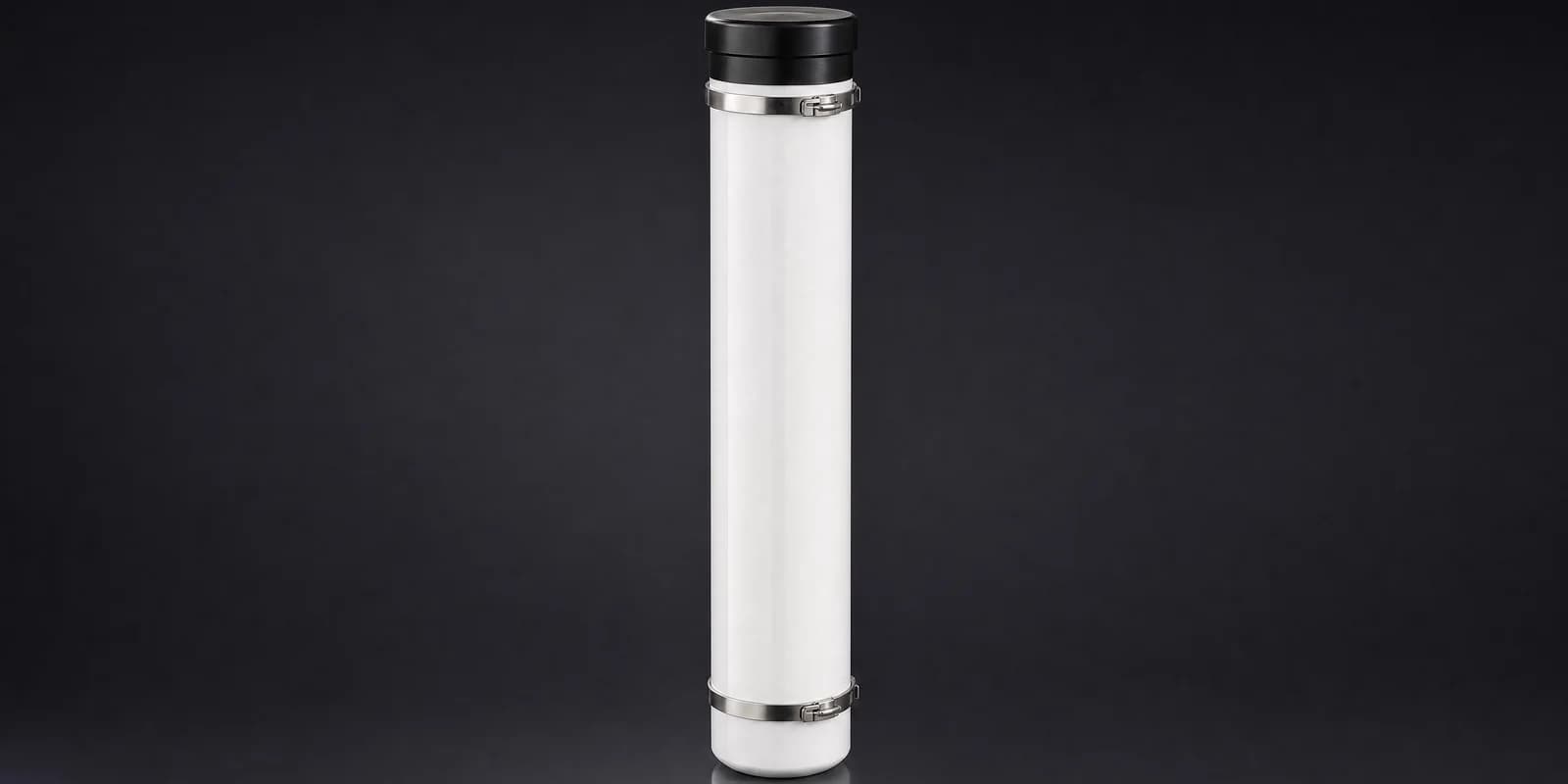
Litree's description, on its LH3-0650-V page, calls the module an "inside-out ultrafiltration membrane module"[1]. A 2008 trade article by authors from a supplier of a different UF process defines the term as feed pumped to the fibre bore with filtrate collected on the shell side[4]; the article on the 0.01 µm rating takes up the mechanism. Litree's table gives the membrane material as PVC alloy, its description says the filament is made of PVC material, and the shell is PVC[1]; Litree does not say what the alloy is. The pore is 0.01 µm as Litree prints it, with nominal, absolute or cut-off not printed in the pages read[1].
Litree's description lists "good hydrophilicity, small pore size, uniform distribution, acid and alkali resistance" in the same sentence that gives the pore size[1]. The page assigns none of these to the filament or the alloy and gives no further number or test. The LH4-1080-V and LH3-1060-V pages open with a sentence that names LH3-0650-V[1], so the description is read from the LH3-0650-V page; whether its repeat under the other two is template reuse or a statement that all three share the properties is not printed.
Litree's parameters tables print a Volume range in m³/h, a Size in m² and dimensions in mm for each model[1].
| Model | Volume, m³/h | Size, m² | Dimensions, mm |
|---|---|---|---|
| LH3-0650-V | 0.6 to 1.6 | 10 | φ187 × 1,398 |
| LH3-1060-V | 2.4 to 6.4 | 40 | φ277 × 1,715 |
| LH4-1080-V | 3.7 to 14.8 | 74 | φ305 × 2,315 |
No basis is printed beside Volume on the three pages[1], and the length basis (end caps, ports) is not defined; Volume is Litree's word, never read here as capacity or rated flow. The variant used is LH3-1060-V, with LH4-1080-V as the comparison. For LH3-0650-V, one listing on Litree's storefront on Made-in-China.com (not its website or a datasheet) prints 11 m²[2], as does a directory listing[3]; Litree's page prints 10 m²[1]. Two outside-in models on Litree's category page are not considered[1].
Litree lists "Dead-end filtration or cross-flow filtration" for all three models without saying which mode Volume describes[1]. Under an LH Series heading on the LH4-1080-V page it lists three process steps, filtration and production, backwashing and maintenance cleaning, with no volume, frequency, flux, duration or chemical; the LH3 pages carry none of this text[1]. The installation text on that page recommends a 3 mm rubber gasket between the lower end cover and the support base[1]; port function and orientation are not printed.
Litree lists the LH modules in its Industry group, under "Pressure UF Membrane"[1]. The three LH pages name no application, and the home page's company-level tabs name no LH module[1]. That placement, Litree's only use-like statement in the pages read[1], is not a performance result.
The RO duty is therefore the article's own frame. Litree's storefront lists "Pretreatment and post-treatment of reverse osmosis" among the applications of its Aries listings[2]. The Aries sizes match LH3-0650-V and LH3-1060-V on area, dimensions and ranges[2][1], but no page read says the Aries listings are the same product.
Litree PVC-Alloy Hollow-Fibre UF Module
No certifications listedView product →The targets need a stated Volume basis
In the Litree LH3-1060-V reference design for an RO pretreatment rack (the LH rack design), the targets would be set on a stated Volume basis, because Litree prints Volume as a range and no feed, temperature or mode behind it[1].
As an illustrative assumption, the duty is one rack with one UF stage ahead of one reverse-osmosis train, delivering 20 m³/h of filtrate continuously while modules are in service. Net delivery over a full cycle depends on a backwash volume that is not printed, so the counts that follow are least counts. The 20 m³/h is a round number chosen so the arithmetic checks, not a plant, a site or a rating; it equals no printed Volume figure, so no rating margin exists. No turndown is printed in the pages read[1], and the duty is continuous. The RO maker's filtrate requirement is an input, with no number written.
The obvious fix is to divide demand by Volume, and it fails on the basis, not the arithmetic. Litree does not call Volume ÷ Size a flux. Assumption, flux reading: Volume is permeate per hour and Size is membrane area, so Volume ÷ Size is a flux range in L/m²/h. The end points come out round at the printed areas: LH3-1060-V gives 60 to 160 (2.4 ÷ 40 and 6.4 ÷ 40, times 1,000), and LH3-0650-V the same at 10 m² (0.6 ÷ 10 and 1.6 ÷ 10). The storefront's table prints a 60 to 160 row for two sizes of its Aries listings[2]. At 11 m², LH3-0650-V would give 54.5 and 145.5, so the arithmetic supports Litree's 10 m² without being a Litree statement. The assumption is valid when Litree confirms it in writing, and invalid if Volume is feed flow or depends on feed quality in a way Litree has not stated.
LH4-1080-V's band is wider, with no reason printed or supplied here: 14.8 ÷ 3.7 = 4.0, against 6.4 ÷ 2.4 = 2.667 for LH3-1060-V and 1.6 ÷ 0.6 = 2.667 for LH3-0650-V[1]. In flux terms it reads 50 to 200 L/m²/h (3.7 ÷ 74 and 14.8 ÷ 74) against 60 to 160. It is a quote question, and one reason the LH rack design takes LH3-1060-V.
The mode is dead-end, as a labelled assumption. The 2008 trade article states that "With dead-end operation, all of the feed passes through the membrane material, thus becoming filtrate"[4], so a Volume figure is wholly filtrate and no recirculation flow enters the sizing. In cross-flow part of the feed leaves as a waste stream[4], so Volume read as feed flow or as permeate would differ by a factor Litree does not print. The assumption is valid when Litree confirms that Volume applies to dead-end operation.
Each target has a quantity, a condition and a method:
- Filtrate of 20 m³/h while modules are in service, on the rack filtrate meter, with net delivery to the RO train over a full cycle recorded against backwash volume.
- Each module's flow with one module out, inside the figure Litree confirms in writing, by per-module meter or timed volume.
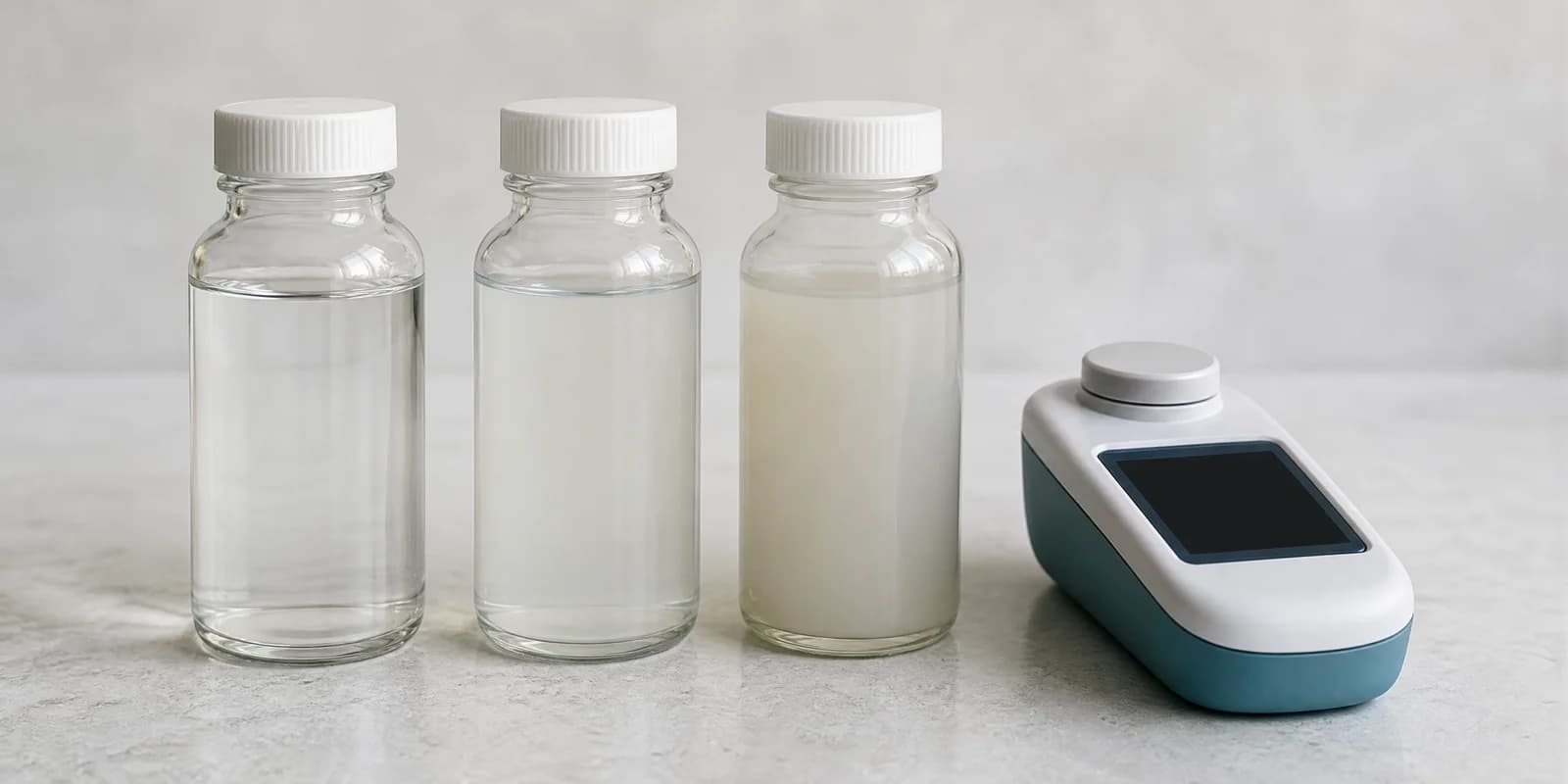
- Filtrate turbidity at the rack outlet against the RO maker's requirement once stated, by turbidimeter.
- Recovery, recorded and not targeted, because backwash volume is not printed (100% less the backwash waste share).
The misreading is that a pore size or a Volume range is a target. The rack is not designed for drinking water, contact with drinking water, municipal supply or any guarantee of filtrate quality, and none of the three LH pages states any of these for the LH modules[1].
Backwash staging would move the module count
The LH3-1060-V RO-pretreatment reference design would stage backwash one module at a time, and taking one module out moves the least count at 20 m³/h from 4 to 9 modules to 5 to 10 (5 to 9 inside the printed range).
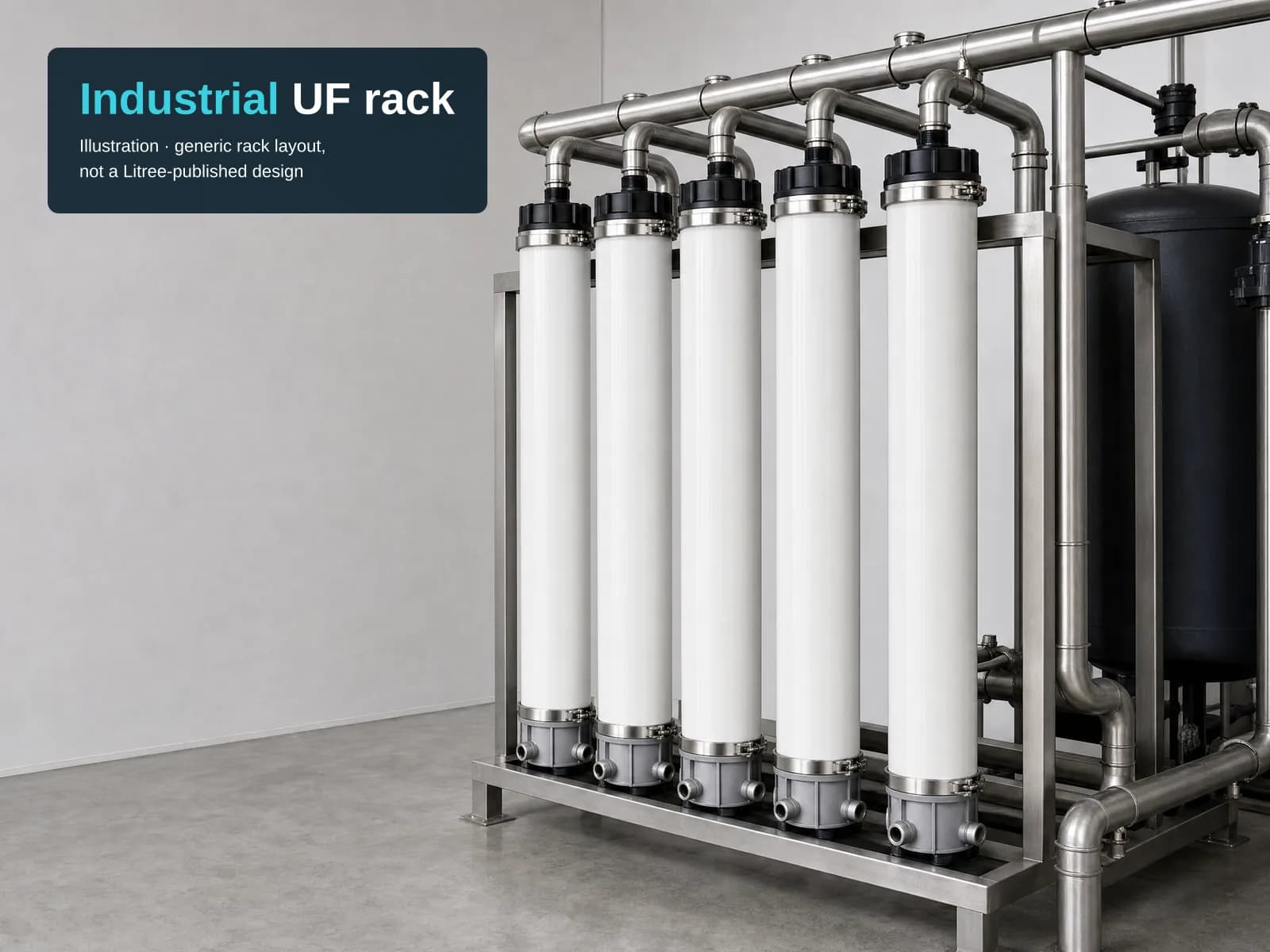
A dead-end rack takes feed from a tank through a pump and a protective strainer to parallel vertical modules, each with its own isolation valve, air release, drain and filtrate sample point, and one isolation valve on the rack feed line; these are the article's choices, not requirements Litree states in the pages read.
Backwash and cleaning paths are shown because Litree's LH Series text names those steps, on the LH4-1080-V page only[1]; the drain path is the article's own. Feed pressure, pump head, strainer rating and the backwash and cleaning terms are quote items, so the pressure budget does not close. The vertical rack is an assumption resting on the LH4-1080-V page's installation text, which names a lower end cover and support base and is not an orientation statement. The strainer is an assumption on general reasoning: the storefront's Aries-40 listings print a fibre inside diameter of 1.0 mm on some and 0.85 mm on another[2], and no page read says Aries-40 is the LH3-1060-V, so a particle of that order could lodge in a bore. It is not a Litree-stated requirement, and no micron figure is written. Other placements are in the guide to screening a feed for the Litree LH modules.
Dividing 20 m³/h by a figure of the printed range and rounding up gives the least count at which no module exceeds it. Assumption, backwash draw: the in-service modules carry the full 20 m³/h with no backwash draw added, because none is printed; where backwash water comes from filtrate, they would carry more. The misreading is that the division gives the count, and the check is which figure Litree confirms.
| Model | Printed Volume, m³/h | Count at top figure (one out) | Count at bottom figure (one out) |
|---|---|---|---|
| LH3-1060-V | 2.4 to 6.4 | 4 (5) | 9 (10) |
| LH4-1080-V | 3.7 to 14.8 | 2 (3) | 6 (7) |
| LH3-0650-V | 0.6 to 1.6 | 13 (14) | 34 (35) |
For LH3-1060-V, 20 ÷ 6.4 = 3.125 and 20 ÷ 2.4 = 8.33 round up to 4 and 9, a spread of 9 ÷ 4 = 2.25 times in service (10 ÷ 5 = 2.0 with one out). LH3-0650-V needs 3.25 to 3.78 times as many modules in service (13 ÷ 4, 34 ÷ 9) and is set aside by count. LH4-1080-V needs fewer, but two with one out would put 20 m³/h on one module, 35% above 14.8 (20 ÷ 14.8 = 1.35).
Two assumptions govern the offline case: the top figure is a ceiling on per-module Volume, valid if Litree states it and invalid if it is an average or short-term value; and modules are backwashed one at a time, valid if Litree confirms the method and invalid if it requires the whole rack or a bank together, when a filtrate buffer is needed and its volume is a quote item. Four modules cannot lose one: 20 ÷ 3 = 6.67 m³/h each is 0.27 (4.2%) above 6.4. Five can, at 20 ÷ 4 = 5.0 each with one out against 20 ÷ 5 = 4.0 with all in, 6.4 − 5.0 = 1.4 m³/h (21.9%) under the top figure. That headroom is against a printed figure read as a ceiling, not a rating margin, and before any backwash draw from filtrate. With one out, 5 to 9 modules in total stay inside the printed range; 10 is the first count past it, putting each in-service module at 20 ÷ 9 = 2.22 m³/h, under the 2.4 bottom figure, which says nothing about operation.
The standby covers one module out for backwash, not a bad feed, a second outage or an integrity failure. With two out, five modules carry 20 ÷ 3 = 6.67 m³/h each, again 4.2% above 6.4, and ten carry 20 ÷ 8 = 2.5. The feed tank, pump, strainer, backwash source and cleaning path reach every module alike, and per-module isolation helps only a failure local to one module.
What leaves is filtrate at 20 m³/h to a tank or the RO train and backwash and cleaning waste to a drain. With backwash volume unprinted, no recovery is written; the backwash source, drain capacity and cleaning waste handling are quote items.
The printed diameter times the count gives a zero-gap width, 5 × 277 = 1,385 mm and 10 × 277 = 2,770 mm for LH3-1060-V, a lower bound only if the diameter is the body and not fittings or clamps, which the page does not state; pitch, headers and clearance are not printed. The storefront[2] and a directory listing[3] print 58 kg wet for LH3-1060-V, so 290 kg for five and 580 kg for ten, modules only. The count does not settle footprint or floor load; Litree's weights and connection sizes are the check.
Acceptance would wait for Litree's confirmed basis
The LH3-1060-V RO-pretreatment reference design would read flows, pressures, temperature and filtrate turbidity online and record them, and would judge none of them until Litree supplies the figures.
Online, the LH rack design has a flow meter on the rack filtrate line, a flow meter or timed volume per module, pressure on the feed and filtrate sides, temperature, and an online turbidimeter with a grab sample point at the rack outlet. The owner records feed turbidity and temperature at each reading, the RO maker's filtrate parameters, and backwash volume per cycle from a meter or timed tank volume. These are engineering judgment with no Litree basis.
The LH rack design claims no automatic backwash trigger, high-pressure trip or turbidity alarm, because no Litree trigger, pressure limit or turbidity limit is in the pages read[1]. An instrument on the rack is a reading, not a protection. After handover the owner holds the backwash trigger and the isolation. On power loss the feed pump stops and each valve goes to the position the owner chose; Litree prints no failure state[1], so nothing relies on one. A module can be isolated by hand at its own valve; manual backwash is not described.
Filtrate turbidity on the common line is diluted by the other modules: with equal flows and all in service, a failing module is 1 of 5 (20% of the flow) or 1 of 10 (10%); with one out, 1 of 4 (25%) or 1 of 9 (11.1%). A reading in range is an indirect signal, not an integrity proof, and the article on the 0.01 µm rating sets out what does prove it.
Each in-service LH3-1060-V module is read with one module isolated: 5.0 m³/h each is expected with five installed and one out, and Litree's confirmed ceiling is the pass condition; backwash volume per cycle is read against production volume. Any pass number on pressure, backwash or turbidity needs Litree's figure; until then the reading is recorded, not judged, and the module-flow tolerance is agreed before order.
The rule for what a Volume or removal figure must carry is in the pore-rating article. The rack's own conditions, engineering judgment with no Litree basis, are the modules in service, temperature and feed turbidity beside each flow, the time since the last backwash, the same instrument and position each time, and whether a flow is read net of the backwash draw.
The open envelope is the design's finding
The first risk in the LH3-1060-V RO-pretreatment reference design is the central gap: the Litree pages read print no operating envelope, so nothing in the rack can be judged against a Litree limit.
The Litree pages read (the three LH pages, the category page and the home page, as archived on 2026-05-15 and 2026-07-02) print no TMP (the pressure across the membrane wall), feed pressure, flux basis, backwash interval, volume or trigger, recovery, temperature, pH, chlorine, turbidity or SDI (silt density index) limit, cleaning chemistry, lifespan, warranty, weight, connection size or datasheet[1]. The LH4-1080-V page names backwashing as a process step with no figure, and the home page says Litree's products won a 2022 enterprise standard leader certificate[1], an item that names no issuer, standard or LH module and is not a product certification for these modules; no product certificate was among the documents read. The Brochure page and two images, the operating-process diagram and the typical output water quality, were not obtained. Pressure drop against flow, backwash water share and removal by particle size are not in the documents read; none is estimated. The Volume basis sits nearest the 20 m³/h objective and would flip the count, so Litree must answer it first; the backwash regime comes next, because it decides net filtrate.
In the LH rack design the questions on the Volume basis, the limits, the backwash and cleaning method, the protective-filtration requirement and the integrity method go to Litree; the rack, strainer, backwash source, drain, instruments and sampling are the integrator's; the filtrate requirement is the RO maker's. Litree's storefront lists a 12-module LH3-1060-V system with a feed pressure and TMP it calls suggested, and a working temperature, pH range and feed-in turbidity[2]. That listing sets none of this rack's pressures and is not a module limit; the guide to screening a feed takes it up.
The staging answers one module out for backwash; a second out is not covered by five modules. A feed-quality excursion has no Litree limit to trip on, so the owner isolates the rack by hand at its feed isolation valve. A suspected integrity failure is answered by isolating the module and sampling its filtrate against the others, since Litree's method and pass limit are not in the pages read.
The limits, each a variable, threshold and consequence:
- Volume basis: if Litree declines or cannot give one, or it shows Volume is feed flow or feed-dependent, every count lapses and the quote stops; until a reply arrives the LH rack design is provisional.
- Top figure: an average or short-term value means five modules are recomputed, a re-sizing and not a stop.
- Backwash method: whole-rack or bank backwash lapses the staging and adds a buffer tank, its volume a quote item.
- Mode: cross-flow with no recirculation rate in the listings read cannot be sized from published data.
- Duty: a need for a product certificate or a potable claim is not quotable until Litree supplies a document.
None fires on the 20 m³/h illustration: four modules fall short with one out and five resolve it, a sizing outcome. A stop on TMP, feed pressure, temperature, pH or turbidity cannot be written, because the Litree pages read print none; each is a quote question.
The owner's staged commissioning trial can be stopped after any early stage with the rack and instruments intact, and its stages are engineering judgment because no Litree start-up, storage or wetting text was read: Litree's written answers on paper; the rack frame with instruments verified and no modules; one module on its isolated leg on the owner's water, readings recorded and not judged; the full count on a recorded run against Litree's confirmed basis; and the RO train last. A wetted module's return is a quote item. The off-ramp is a different UF module.
The LH rack design fits one rack, dead-end and vertical, at a demand the owner substitutes for 20 m³/h, once Litree answers the quote items. It does not mean a rated flow, a validated count, a recovery figure, a potable or certified system, or a configuration Litree has approved. The data pack is the owner's feed turbidity, temperature, pH and chlorine measurements, the RO maker's filtrate requirement and train flow, rack space and the discharge route for backwash and cleaning waste. Request a quote for the Litree LH3-1060-V with that data pack, and ask that the open items above, starting with the Volume basis and the backwash method, go to Litree in writing.
Sources
- [1]Litree (Hainan Litree Purifying Technology Co., Ltd.) — English pages for LH4-1080-V, LH3-1060-V and LH3-0650-V, the Pressure UF Membrane category page and the home page, as archived by the Internet Archive on 2026-05-15 (home page 2026-07-02); maker's own pages, live pages not read
- [2]Litree's own storefront on Made-in-China.com — seller-edited listings, not Litree's website and not a datasheet (labelled fallback; the listings disagree with each other)
- [3]Deeprocess.com supplier listing naming Litree (a directory listing with supplier-supplied text; labelled fallback)
- [4]Gilbert and Koerber (Kruger), Ultrafiltration Gains Performance Edge, Wastewater Digest, 6 March 2008 — trade article by authors from a supplier of a different UF process, used for definitions only, names no Litree product