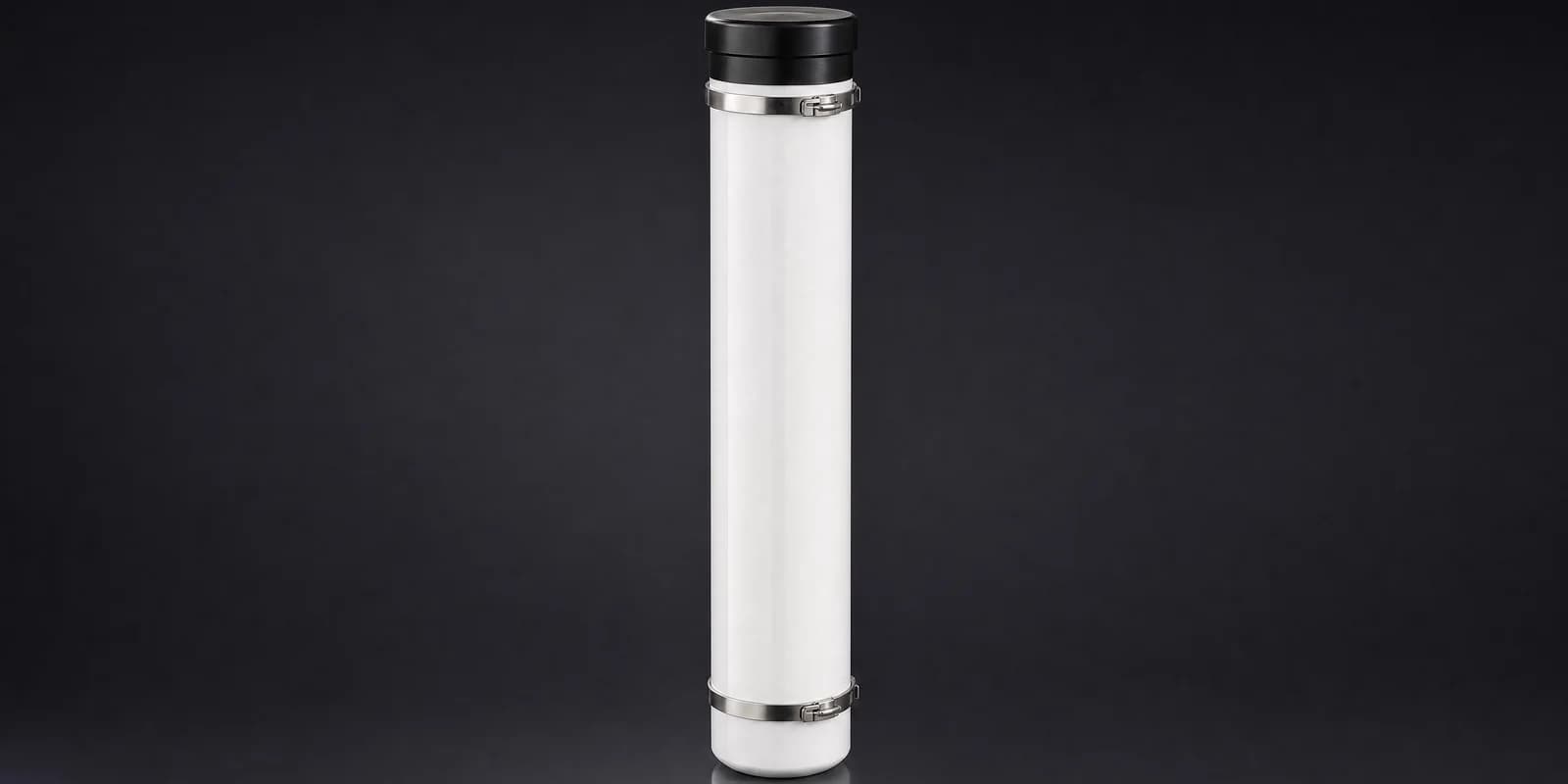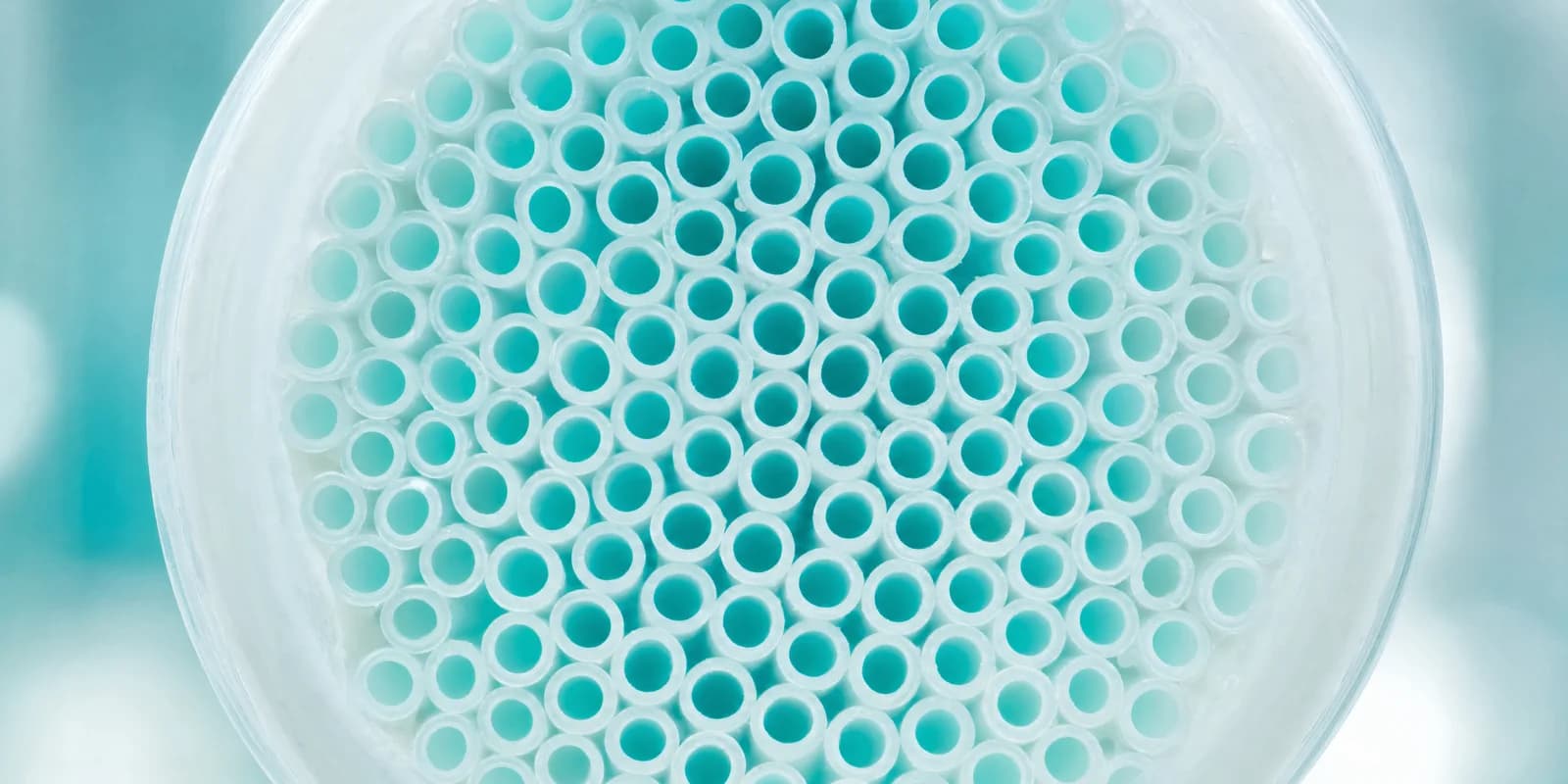
Inside-out hollow-fibre ultrafiltration, as in Litree's inside-out PVC alloy UF membrane module, LH series (LH3-0650-V, LH3-1060-V, LH4-1080-V), pumps the feed into the bore of each fibre[5] and holds back at the fibre wall what is too large to pass.[4] The measurable result is the share of a challenge particle kept out of the filtrate, which in the US EPA's model is established by testing and which a printed pore size alone does not give (reasoning).[4] Below, the Litree LH modules means these three models. Litree describes its filament as "self-developed hollow fiber membrane filament made of PVC material"[1] and prints Pore 0.01 μm for all three models.[1] This article calls that printed figure a rating, which is its own word; Litree does not use it.[1] The misreading is to take the rating as a removal guarantee or as a log-removal figure. A pore size says where a wall can hold particles back by size. Removal is a measured result, and the Litree pages read show none for an LH module. Four questions follow: where an inside-out fibre separates and what builds up there; what the printed pore, Volume and mode assume; what evidence of removal exists; and what a site should measure and agree. Screening a feed is covered in the application guide, and the applied rack in the reference design.
Feed enters the bore and the wall sieves
In an inside-out hollow-fibre module, a 2008 trade article by a UF-process supplier writes, "With inside-out operation, feedwater is pumped to the lumen of the fiber, and filtrate is collected on the shell side."[5] The fibre wall is therefore the barrier, and the bore is where what it holds back collects (reasoning from that definition). The article is supplier-authored, 18 years old and generic: it names no Litree product and serves here for definitions only.[5] Outside-in is the reverse, with the feed presented to the shell side.[5] The two are not one idea under two names. The surface the feed meets is the bore wall in one and the outer surface in the other, so the place where retained solids collect differs too (derived from the definitions).
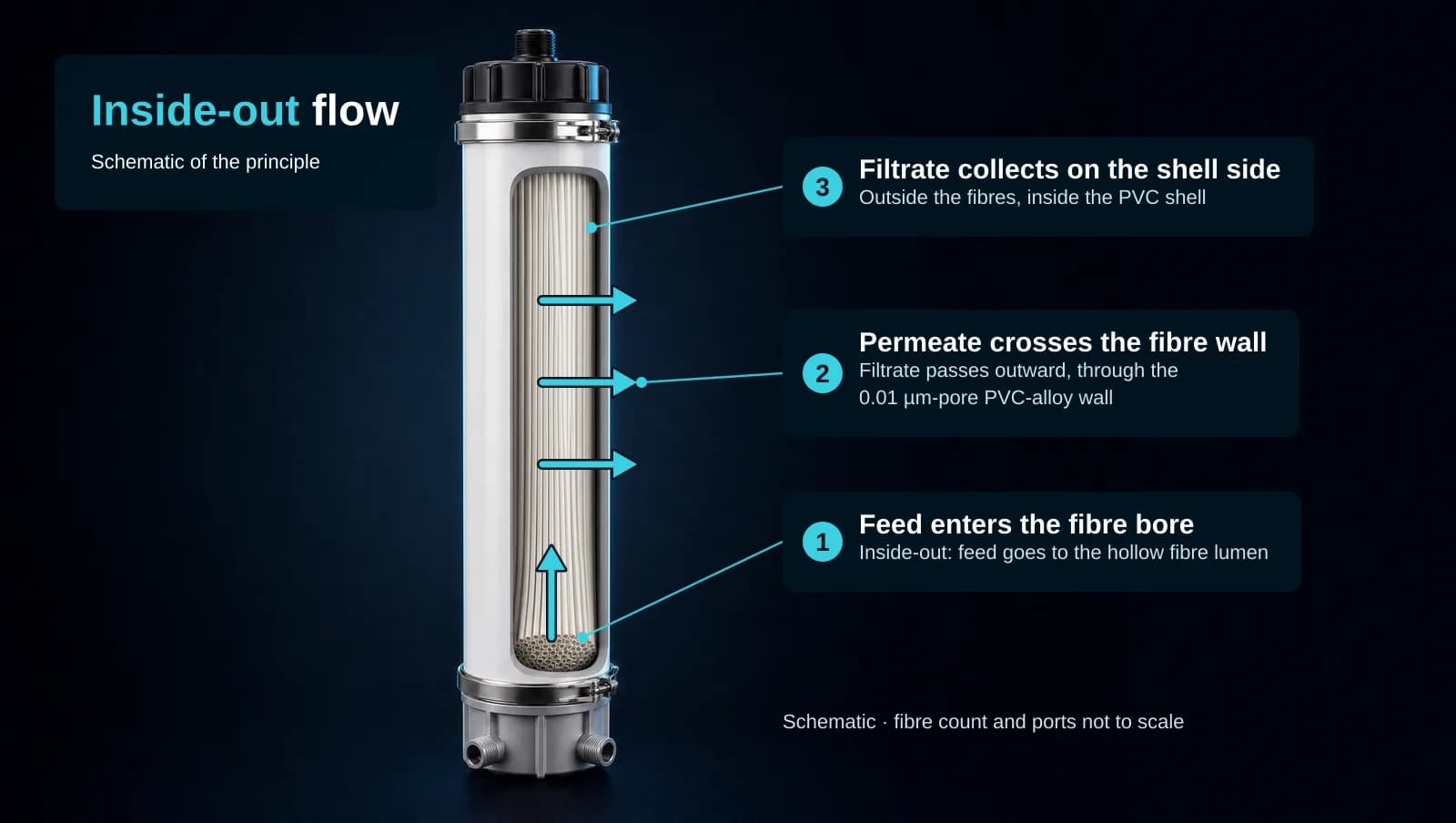
In the US EPA's definition, the wall separates primarily by size exclusion: membrane filtration rejects particulate larger than 1 µm.[4] In dead-end operation, the trade article writes, "With dead-end operation, all of the feed passes through the membrane material, thus becoming filtrate."[5] Nothing leaves as waste during filtration, so everything the wall holds back stays on the membrane surface, which in an inside-out fibre is the bore wall (derived).[5] The same article writes, "A periodic backwash is necessary in dead-end and quasi-dead-end and is sometimes employed in cross-flow."[5] The cost of holding solids is therefore their accumulation and the periodic backwash that is necessary against it, plus the cleaning Litree lists as a step.
Litree's side of this is claims with one number. Its page text follows the 0.01 μm pore figure with a list of characteristics, "good hydrophilicity, small pore size, uniform distribution, acid and alkali resistance."[1] Beside hydrophilicity, uniform distribution and acid and alkali resistance, no value, test or range is printed in the Litree pages read, meaning the three LH pages, the category page and the home page as archived on 2026-05-15 and 2026-07-02. The 0.01 μm is the only number in that description, and it carries no test or tolerance.[1] "PVC alloy" does not name the material either.[1] Litree's parameter table says PVC alloy, its description says PVC material, and neither says what the alloy is.[1] This article attaches no property to the alloy beyond Litree's own claim sentence. Under an LH Series heading on its LH4-1080-V page, Litree lists three steps: filtration and production, backwashing and maintenance cleaning. The other two LH pages carry no process text, and the pages read print no backwash volume, frequency or chemistry.[1]
One reading proves less than it seems: filtrate flow per module is normal. In an inside-out module the wall and the end seals separate the bore from the shell side (reasoning). At a given pressure a breach adds filtrate flow while fouling removes it, so a normal flow can hide a small breach (reasoning from the flow definitions). The EPA's overview says currently available direct integrity test methods are the most sensitive means of detecting integrity breaches, and that indirect monitoring is generally less sensitive.[4]
Litree prints a pore size without its basis
Litree prints a Pore, a Volume range and a filtration mode for each of LH3-0650-V, LH3-1060-V and LH4-1080-V, and prints no feed quality, temperature or pressure beside any of them.[1]
- LH3-0650-VSOURCEDPore 0.01 μm; Volume 0.6~1.6 m³/h; Filtration: Dead-end filtration or cross-flow filtration; no basis printedsource
- LH3-1060-VSOURCEDPore 0.01 μm; Volume 2.4 ~ 6.4 m³/h; Filtration: Dead-end filtration or cross-flow filtration; no basis printedsource
- LH4-1080-VSOURCEDPore 0.01 μm; Volume 3.7~14.8 m³/h; Filtration: Dead-end filtration or cross-flow filtration; no basis printedsource
Each model keeps its own figures, and none is averaged. Three bases are open, and each is a question for Litree and not a description of the product. The first is the pore basis: the figure does not say whether it is nominal, absolute or a cut-off. The second is the Volume basis, meaning feed or filtrate, at what feed quality, temperature and pressure. The third is the mode: Litree lists two, dead-end and cross-flow, and does not say which one the Volume figures describe.[1] Litree's own storefront on Made-in-China.com, a seller listing and not its website, adds a molecular weight cutoff of 50,000 Daltons for two LH-named modules.[2] A cutoff in daltons and a pore in µm are different quantities in different units, and no document read converts one to the other, so this article does not.
The misreading is that Volume is what any mode delivers as filtrate. During filtration in dead-end operation, all the feed becomes filtrate, so a feed figure and a filtrate figure coincide.[5] In cross-flow, the trade article writes, "In cross-flow operating mode, only a portion of the feed stream passes through the membrane while the rest leaves the system as a continuous waste stream."[5] Litree prints no recirculation or bleed rate in the pages read. [ASSUMPTION: a waste share of 10% of the feed, this article's own input, not Litree's and not typical; valid for arithmetic only, invalid as a statement about any LH module or any recirculation.] At that share, the top figure printed for LH3-1060-V, 6.4 m³/h, read as feed would give 6.4 × (1 − 0.10) = 5.76 m³/h of filtrate, which is 0.64 m³/h less. Volume has no stated basis here, so the line shows only that the reading matters.
The two modes trade against each other. The trade article writes, "The major advantage of dead-end membranes is lower energy consumption because there is no cross-flow stream to recirculate."[5] It adds that this holds as long as fouling can be avoided.[5] The cost is the solids that accumulate and the periodic backwash described above. In cross-flow the turbulence keeps solids off the surface, at the cost of the recirculated stream and its energy.[5] The trade article gives no figure for either side, and Litree's pages read print neither side's number, so the trade cannot be sized from published Litree data.[5][1] Litree names no sensor, controller, trigger or alarm for any LH module in those pages.[1]
The check is a written answer from Litree on all three bases. It changes how every other figure is read.
Under the US rule, tests establish removal
The US EPA's overview of its membrane rule says the rule does not prescribe a specific removal credit and bases credit on challenge testing, which seeds the feed with Cryptosporidium or an acceptable surrogate, verified by direct integrity testing.[4] This article reasons, from the passages of the overview read, that because they give no pore size as a basis for credit, a pore figure on its own gives no removal credit. The overview is a US drinking-water rule seen through an undated summary hosted by a third party. It is not Singapore regulation, not the duty of an RO pretreatment stage and not an acceptance criterion here.[4]
Credit under that model is the lower of the removal shown in the challenge test and the highest log removal value the direct integrity test can verify.[4] The challenge test is one-time and product-specific. It runs at the maximum design flux and maximum design system recovery that the module maker specifies, and log removal is the log of the feed concentration minus the log of the filtrate concentration.[4] Litree's pages read give no flux basis for Volume and no recovery, so no figure on them can be taken as the flux such a test would use (an inference from the US summary, valid for the documents read and invalid if Litree states the test flux).
The arithmetic, derived here, separates two numbers. The rule's 1 µm threshold is 1 ÷ 0.01 = 100 times the printed pore.[4] The rule's integrity test must have a resolution of 3 µm or less, which is up to 3 ÷ 0.01 = 300 times it.[4] Resolution is the size of the smallest breach the test can reveal, and the pore is a wall property, so the numbers measure different things and neither is a removal figure.[4]
Two of Litree's storefront listings print removal percentages: one prints 99.9999% bacteria removal and 99.99% virus removal, and a 12-module system listing prints at-least figures of the same two values.[2] Other listings print, for coliform groups, "No detection in each 100 ml water sample".[2] As arithmetic, 99.9999% is −log10(1 − 0.999999) = 6-log and 99.99% is 4-log. The listings name organism classes, namely bacteria, virus, coliform groups and, in one system listing, what appears to be E. coli (printed "E-coil").[2] They print no strain or surrogate, no test method and no challenge concentration, and the percentages print no test volume; the coliform string states 100 ml per sample. These are listing claims, not LH results. "No detection" is also an ambiguous signal. It can mean the module removed the organism, that the feed held too little of it to detect, or that the sample volume was too small to catch what remained (reasoning), so a figure proves nothing until the challenge concentration, method and detection limit are in a test report.
The Litree pages read (as archived on 2026-05-15, home page on 2026-07-02), the storefront listings and the directory listing, as retrieved on 2026-10-01, name no product-certificate document, and the storefront's certification fields are seller-entered text.[1][2][3] A 2022 home-page news item says Litree's hollow-fibre UF products won an enterprise-standard leader certificate; the page names neither the issuer nor the standard, and the item does not name the LH modules.[1] The Litree pages read (the three LH pages, the category page and the home page, as archived on 2026-05-15 and 2026-07-02) print no TMP, feed pressure, flux basis, backwash interval, volume or trigger, recovery, temperature, pH, chlorine, turbidity or SDI limit, cleaning chemistry, lifespan, warranty, weight, connection size or datasheet, and the LH4-1080-V page names backwashing as a process step with no figure;[1] seller listings print some of these, with conflicts, and are not carried here. The brochure page and two images on the Litree pages, the operating-process diagram and the typical output water quality, were not obtained. No challenge-test, integrity-test or log-removal result for an LH module was found.
Site proof starts with Litree's written test terms
The US summary's challenge-test terms are the organism or surrogate, the feed and filtrate concentrations, the maximum design flux and recovery, a tested module identical in material and similar in construction, and the number of modules sampled, with the lowest value taken when fewer than 20 are tested.[4] This article's rule, not the EPA's, is that a removal figure for the Litree LH modules is reproducible only with such terms in view. Acceptance therefore starts with Litree's written test terms: ask for the report that carries them, and none was found. A Volume figure is reproducible only with its written basis, meaning filtrate or feed, dead-end or cross-flow, feed quality, temperature and pressure. With that basis, the site records a flow meter reading or timed volume per module, pressure on the feed and filtrate sides, and temperature. It records them without judging until Litree's figures are confirmed, because no pass number was found in the documents read.
Filtrate turbidity is an indirect signal, and the misreading is that a clean reading proves integrity. The EPA's overview uses filtrate turbidity as continuous indirect monitoring: one reading at least every 15 minutes, a control limit of 0.15 NTU, and a direct integrity test once a unit stays above it for more than 15 minutes.[4] That limit belongs to the US rule and is never a target here. A rising reading can come from a breach, bubbles, or a sample or instrument fault (reasoning). A low reading shows only that no change large enough to move turbidity occurred, not that the barrier is intact (reasoning). The check is a grab sample on a bench turbidimeter, then a direct integrity test by the method Litree specifies, with its pass limit, which no document read gives.
The Litree LH modules are inside-out hollow-fibre modules with a printed 0.01 µm pore, a size-exclusion barrier whose retained solids need removing, and Volume holds as the filtrate of a mode only once Litree writes its basis. The envelope does not hold for a pore size read as a log-removal figure, a storefront percentage read as an LH result, Volume read as filtrate in any mode, a clean filtrate turbidity reading as proof of integrity, a certificate, a drinking-water duty, or the US rule as a requirement here. Screening a feed is in the application guide, and the applied rack is in the reference design.
To start, send Litree the model, the mode, the feed turbidity in NTU, the temperature and the filtrate demand. Agree in writing the Volume basis, the challenge-test report with its conditions, the integrity-test method and pass limit, and which readings will be recorded and which judged.
Litree PVC-Alloy Hollow-Fibre UF Module
No certifications listedView product →Sources
- [1]Litree (Hainan Litree Purifying Technology) - LH-series product pages, category page and home page, Wayback snapshots 2026-05-15 and 2026-07-02 - pore, Volume, filtration modes, description, process step names
- [2]Litree storefront on Made-in-China.com (seller listings, not the maker's site), retrieved 2026-10-01 - MWCO, removal percentage claims
- [3]Deeprocess.com supplier directory listing naming Litree (supplier-supplied text), retrieved 2026-10-01
- [4]US EPA - Membrane Filtration Guidance Manual: Overview and Summary (US rule summary) - removal credit, challenge test, integrity test, turbidity monitoring
- [5]Wastewater Digest - Ultrafiltration Gains Performance Edge (6 March 2008), trade article by a UF-process supplier - flow direction, operating modes, backwash