A Filtersafe Trident E page invites two questions: which model carries my flow, and how much TSS can it take? Max Capacity (180, 280, 400 and 600 m³/h by model) is a table entry, and the brochure qualifies it: "Dependent on filtration degree, water quality and inlet size. Contact us for more information."[5] The phrase "high loads of TSS" in Filtersafe's applications sentence carries no mg/L figure, no particle size tied to it and no grade.[1] Fit is decided by the intake's own TSS distribution, the protection the downstream stage needs, the pressure at the filter inlet in every state, and what Filtersafe confirms in writing.
This guide is a procedure: read the maker's TSS wording for what it is, size from the buyer's data, read the approvals for what they list, then stop or ask. It can end three ways: a model at a stated margin on a ceiling of unstated basis (an illustrative 300 m³/h run gives one TRE0096, a 25.0% margin on its Max Capacity, conditional on Filtersafe's written capacity at the buyer's grade); Filtersafe's written answer first; or not this product, when a specification requires an approval the documents do not list, or a written retention or removal figure Filtersafe cannot give.
Scope: a buyer deciding whether a Trident E suits an intake duty. The maker lists a surface-water intake for irrigation among the installations its catalog lists for its filter series.[6] The documents retrieved (Filtersafe's product page, brochure, catalog, certifications page and support page, and two DIN Media pages, read 2026-10-01) name no installation region, site or case, so the guide claims none. The reference design works the configured intake and the technology deep dive the cleaning mechanism.
High TSS is a description, not a limit
Filtersafe's applications sentence lists greenhouses, drip irrigation and "other Industrial and Municipal needs with high loads of TSS".[1] The product page, brochure and catalog retrieved tie no mg/L figure, turbidity figure or particle size to a TSS statement and set no limit on fibre, oil or algae,[1][5][6] so the phrase is a description, not a quantified capability. The maker does make qualitative claims. The catalog says its filters effectively remove high volumes of TSS and organic matter,[6] and the product page says EVER CLEAR gives "unparalleled" removal rates of both.[1]
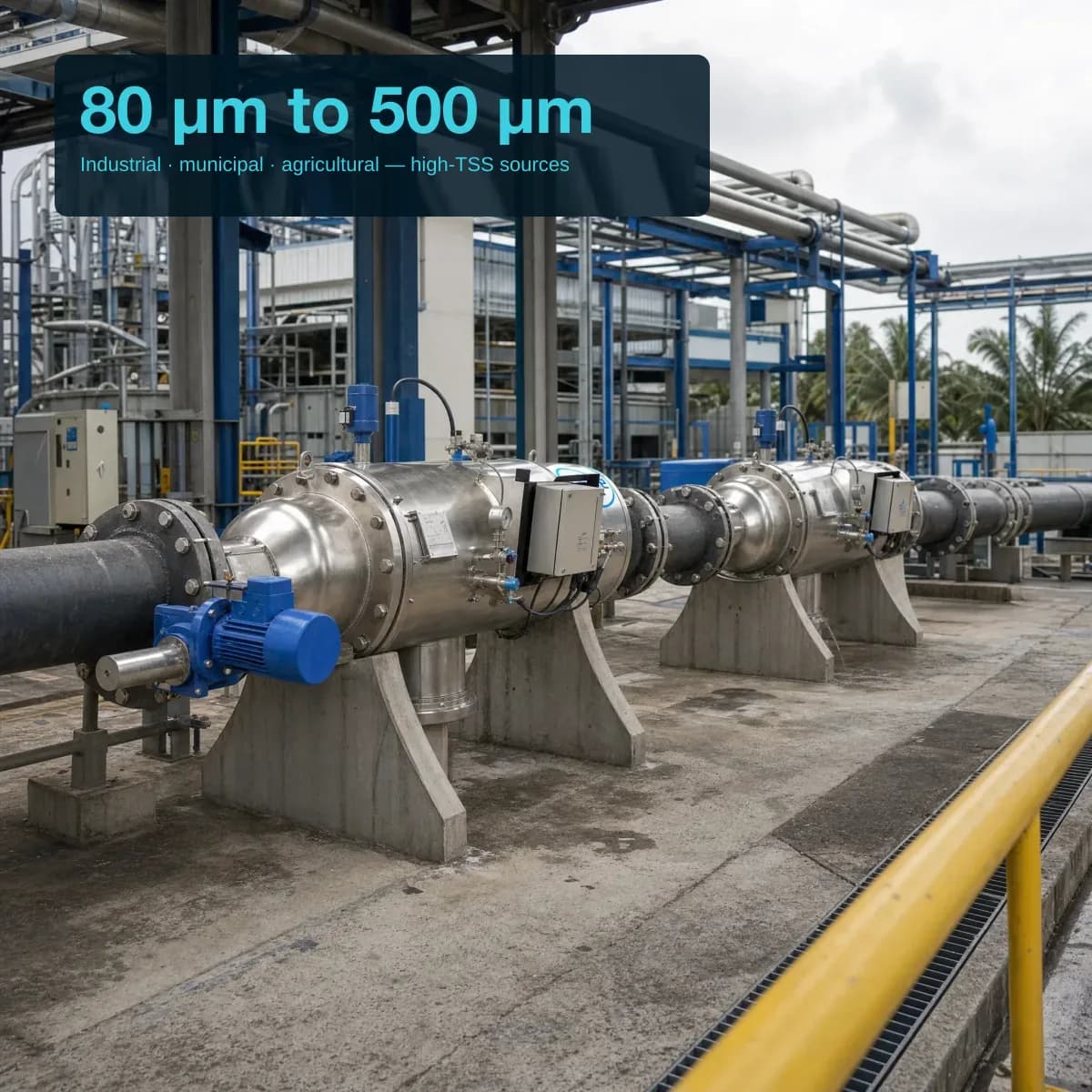
Such as introduces examples: the list is not closed and not an exclusion. Nothing in the documents retrieved excludes membrane pretreatment, heat-exchanger, cooling-tower, desalination or marine duty, and nothing tests or limits the Trident E for them.[1][6] The catalog introduces six items under "Typical Installations Includes" as the variety of its filter series, among them cooling-tower prefiltration and seawater filtration, and captions photos for pre-filtration, industrial process water and mining de-dusting, without saying whether the units shown are Trident E.[6] The product page's technology copy mentions seawater, brackish water and industrial wastewater, ballast tanks and desalination pretreatment, and states no test, limit or rated capacity for them.[1] These duties are a gap, not an exclusion and not a suitability statement.
High TSS has to become three inputs that only the buyer holds: a TSS distribution in mg/L across seasons and events (a stream-quality guideline or one grab sample is not an intake distribution); the protection the downstream stage needs, in micrometres; and what the solids are (sand, fibre, oil or algae), since the documents retrieved give no content limit. TSS in mg/L is a mass of solids per litre, turbidity in NTU is a light-scatter reading, and neither converts to the other (this guide's reasoning; no conversion is used).
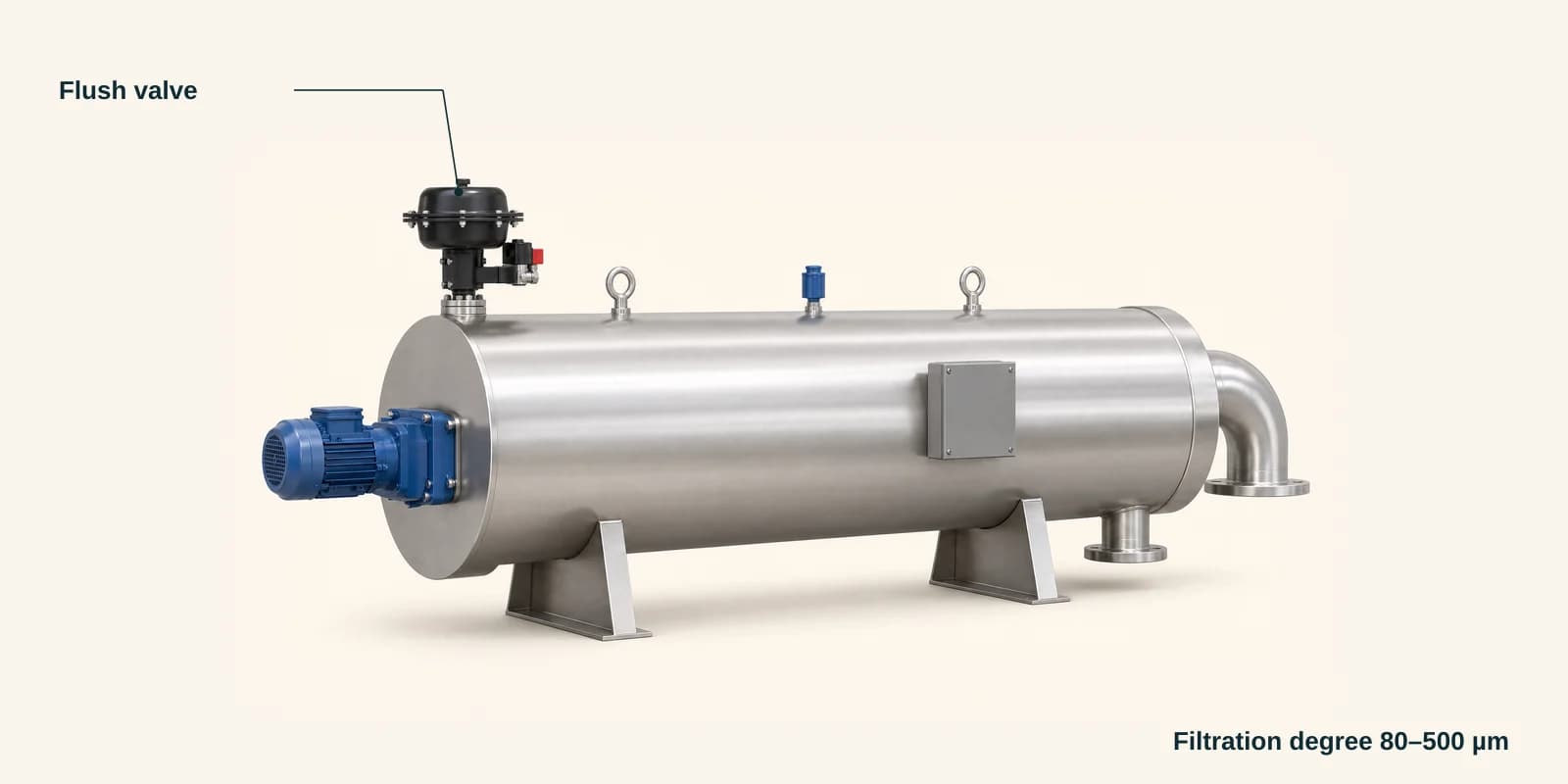
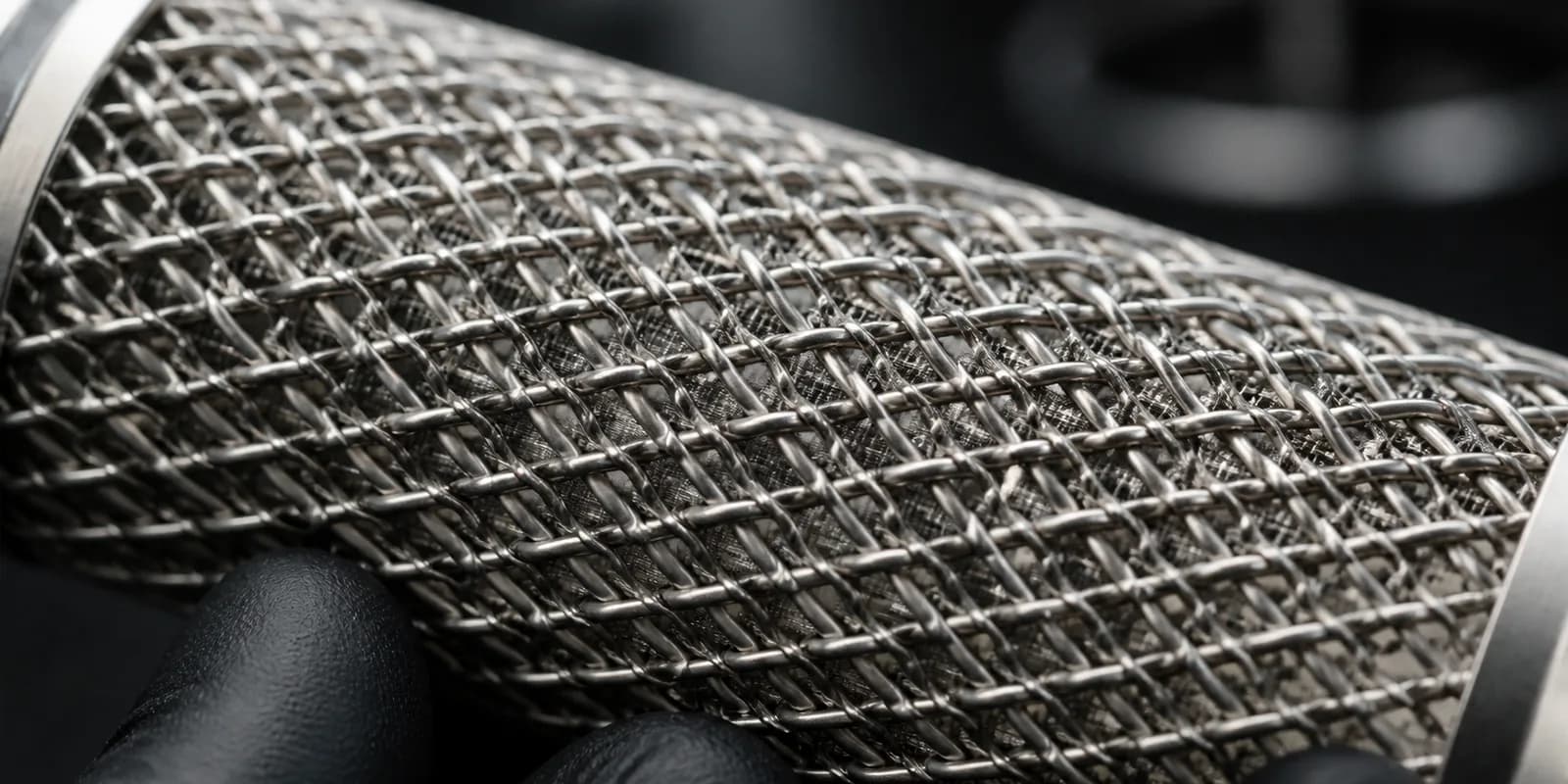
Filtersafe prints the 80-500 µm filtration degree as a micron rating and says the screen "automatically filters out all particles above the chosen micron rating",[1] with no retention percentage, efficiency figure or test method printed;[5] the technology deep dive reads that sentence. It claims nothing about particles below the rating (this guide's reading), so fine, colloidal or dissolved matter is not the product's stated job.
The solids-handling figures are maker phrases, none defined in the documents retrieved: "Less than 1% Backwash Water Consumption",[5][6] "Highly Effective Cleaning with Over 99% Recovery Rate and Full Screen Recovery",[1][5] and the product page's statement that the nozzles "remove 100% of matter that builds upon the screen",[1] with no test basis printed for any of them. All three are questions for Filtersafe, and the technology deep dive linked above reads them. Cleaning starts on differential pressure, a timer or a manual flush, and the maker says all settings are determined by the controller; the documents retrieved publish no setpoint or interval.[5][6]
Size from site data, not Max Capacity
Sizing starts from the four models the brochure and catalog print:[5][6]
| Model | Flanges (in) | Max Capacity (m³/h) | Weight dry / wet (kg) | Nozzles |
|---|---|---|---|---|
| TRE0048 | 4-6 | 180 | 140 / 230 | 5 |
| TRE0072 | 6-8 | 280 | 180 / 350 | 7 |
| TRE0096 | 8-10 | 400 | 200 / 400 | 10 |
| TRE0120 | 10-12 | 600 | 230 / 470 | 12 |
Flange standards are DIN PN10/16, BSTD/E and ANSI B16.5 150PSI.[5][6] The catalog specification table lists all four as horizontal, and its Trident E feature list also says "Horizontal and Vertical Models Available",[6] but no vertical model is described, so vertical is a quote item.
No minimum flow is labelled as such in the documents retrieved. The product page prints 180-600 m³/h as an unlabelled feature line above its 600 m³/h maximum flow rate;[1] this guide reads it as the smallest and largest Max Capacity, and no document labels 180 as a minimum. A duty well below 180 m³/h is a question to Filtersafe, not an exclusion. Above 600, no multi-unit arrangement is described in the documents retrieved: the controllers are listed for one to four filters (Unitronics Jazz) or one (Siemens LOGO!),[6] so manifold, bypass and unit count are a quote item, as is a multi-screen filter, which the product page footer lists without saying whether the Trident E belongs to it.[1]
The worked run is illustrative, not a rating. [ASSUMPTION: a design flow of 300 m³/h, equal to the Max Capacity of no model; valid until replaced by the buyer's metered demand.] Margin is (rated − demand) ÷ rated, with Max Capacity as the rated figure: one TRE0072 gives (280 − 300) ÷ 280 = −7.1% and cannot carry the flow; one TRE0096 gives (400 − 300) ÷ 400 = 25.0%; one TRE0120 gives (600 − 300) ÷ 600 = 50.0%; two TRE0072 give 2 × 280 = 560 and (560 − 300) ÷ 560 = 46.4%, assuming an equal split. The TRE0120 carries stated differences: 10-12 in flanges, 12 nozzles against 10, 470 kg wet against 400, and a catalog minimum flush flow of 49 m³/h against 38.5 (the catalog labels the row 5 m³/h per nozzle, which its nozzle counts do not reproduce);[6] two TRE0072 mean two sets of interfaces (this guide's reasoning). The documents give no capacity by grade and no direction or number for the trade-off, so the run ends at one TRE0096, conditional on Filtersafe's written capacity at the buyer's grade, flange and water. Ordering on the 25.0% before Filtersafe writes its capacity at the grade leaves a margin whose basis nobody has stated.
Connection velocity compares flanges and is not a pass or fail; no velocity guidance is given in the documents retrieved, so no band is applied. The documents print the TRE0096 flange as 8-10 in with one head-loss curve per size and no data table, so whether the size is chosen or the two sizes are inlet and outlet is a question to Filtersafe.[5][6] [ASSUMPTION: nominal size taken as bore, 8 in as 203.2 mm and 10 in as 254 mm, because actual bores are unpublished.] At 300 m³/h (0.0833 m³/s), 8 in (0.0324 m²) gives 2.57 m/s and 10 in (0.0507 m²) gives 1.64 m/s.
Minimum operating pressure differs by document:[1][5][6]
| Document | Minimum pressure |
|---|---|
| Product page | 1.6 bar (23 psi) |
| Brochure, page 1 | 1.6 bar (23 psi) |
| Catalog cover | 1.6 bar (23 psi) |
| Catalog specification table | 1.5 bar |
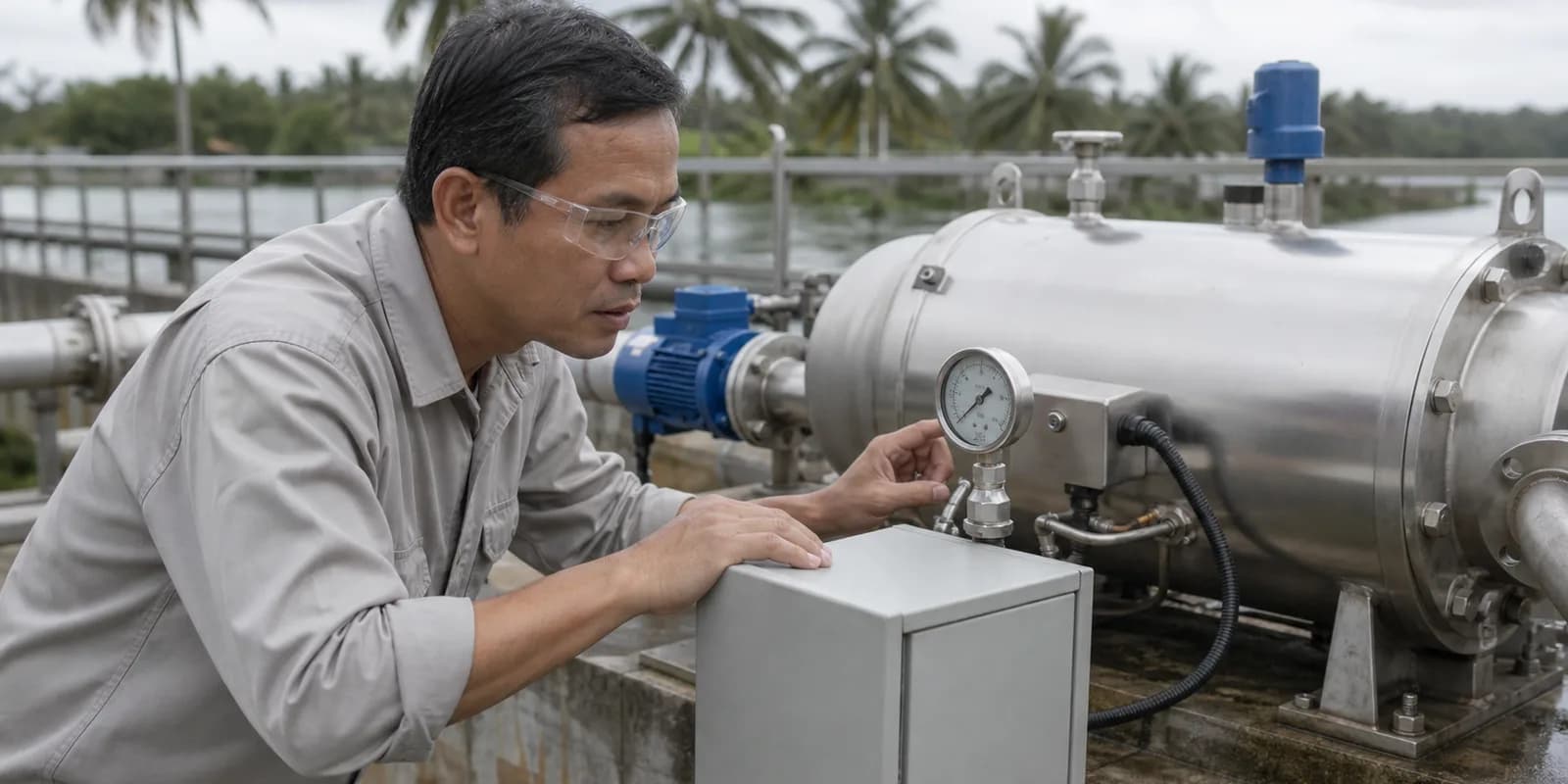
The brochure PDF's text layer also holds 2 bar (30 psi) and 60 °C, not shown on the rendered page; which Filtersafe intends is a question, not a third published figure.[5] Maximum pressure is 10 bar on the product page, brochure and catalog cover, the catalog attaching its filtration-degree, water-quality and inlet-size qualifier to the 10 bar.[1][5][6] Maximum temperature is 65 °C wherever it is printed visibly, and the catalog specification table has no temperature row.[1][5][6] [ASSUMPTION: a planning floor of at least 1.6 bar at the filter inlet in every state, including a flush, the strictest visible value and not a Filtersafe figure; the documents retrieved do not say where the minimum is measured; valid until Filtersafe states its value and measuring point.]
AD 2000 is a code, not proof
AD 2000 appears as the design code on the product page, the brochure and catalog covers and, as AD 2000 Merkblatt, in the catalog specification table.[1][5][6] DIN Media's pages describe it as a technical code for pressure equipment[3] that fulfils the conformity requirements of the Pressure Equipment Directive.[4] Neither page names Filtersafe or says what record a manufacturer must hold to claim the code for a product. The misreading is to take AD 2000 as a certificate. A code is a set of rules. A certificate or conformity record shows an assessment (this guide's reasoning). None was found for the Trident E, whether a CE marking, a conformity assessment or a notified-body document, in the documents retrieved.[2][1] Ask for the declaration or certificate and who issued it.
Filtersafe's certifications page lists ISO 9001:2015 under a facility heading, and the page also says Filtersafe's products "are manufactured according to international performance and quality standards (ISO 9001:2015, DNV 2009)",[2] a company-wide sentence that names no model. The page does not say which products that certificate covers, so ask which facility's certificate covers the unit supplied.[2] It also lists asbestos-free and hazardous material declarations for all models, contents not retrieved.[2] DNV, CCS and Bureau Veritas entries name BS-series and Manta-series models, US Coast Guard approvals name BallastSafe Series filters and control panels, and one NSF/ANSI/CAN 61 line ends "Health Effects, Titan Series".[2] No Trident E model code appears, so by this guide's reading the page lists no Trident E model under DNV, USCG, CCS or Bureau Veritas.
Two items on the maker's pages name no Trident E model. The catalog back page prints certifier logos (DNV, Lloyd's Register, CCS and others) with no text linking any logo to the Trident E.[6] The certifications page opens with two company-wide statements by Filtersafe: "Filtersafe filters meet both the IMO and USCG regulations for ballast water filtration."[2] and a claim of independent certification from "other leading certifiers, such as DNV and NSF".[2] Neither names a model.
If the specification names a type approval or a drinking-water listing, the page lists none for the Trident E: ask Filtersafe in writing which series holds it or whether a Trident E assessment exists, and do not accept a quotation against that clause until then. A project ordered against an assumed approval is left without the document its specification names. For a design-basis requirement alone, AD 2000 is the maker's stated basis and the declaration is what to request.
Ask these questions before ordering
Stop, or change the enquiry, when one of these five applies.
- No TSS distribution, or no downstream protection requirement: the documents retrieved give no retention figure and capacity depends on grade,[5] so the grade cannot be chosen. Next: seasonal sampling and the downstream stage's requirement in micrometres.
- Inlet pressure below 1.6 bar in any state, a flush included: the highest visible minimum, with its measuring point unpublished in the documents retrieved. Next: an inlet pressure log through a flush, and Filtersafe's written minimum and measuring point.
- No authorised route for the flush water, which leaves through a 2 in Victaulic connection;[6] nothing retrieved says whether it is trade effluent. Next: the national environment agency or the sewerage authority of the site's country confirms the route (this guide's reasoning).
- A specification that makes a written retention or removal figure a requirement Filtersafe cannot give, a gap and not an exclusion. Next: do not accept a quotation against that clause until Filtersafe states the figure in writing.
- A required type approval or drinking-water listing, none being listed for the Trident E. Next: ask Filtersafe in writing, as in the previous section.
Capacity at the buyer's grade, head loss at the design flow and retention data with its test basis are quote items for every duty: the documents retrieved give none, each blocks the order but not the enquiry, and Filtersafe's written figure closes it.
The catalog's minimum flush volumes of 131 to 368 L at 1 bar, its 27 s flush and its 6 mm pre-screen are table entries whose bases are undefined or unstated in the documents retrieved, not limits, settings or guarantees.[6] The catalog itself says "The data presented in this document is for general information only and cannot be used for quotation purposes.",[6] so a supplier-page figure starts the enquiry and is not a site result.
The enquiry names the model (the illustrative run's TRE0096, until replaced by the buyer's demand) and carries what the documents leave open:
- the minimum pressure, where it is measured and whether the text-layer 2 bar and 60 °C are superseded;
- flush flow and volume at the operating pressure, what 1 bar refers to, and whether flush water is additional to the filtered flow;
- the basis of less than 1%, over 99% and 100%;
- controller enclosure and hazardous-area ratings;
- the vertical model, and a multi-screen model above 600 m³/h;
- whether 8-10 in is a choice or an inlet and outlet pair;
- the internals' compatibility with the feed (the catalog lists NBR, PPH, POM-C, PP and PVC parts beside the 316L screen and body);[6]
- an outline drawing with named dimensions, and the AD 2000 declaration.
Lifecycle declarations go on the buyer's own baseline, with no price: the installation, operation and maintenance manual (the support page lists "Installation, Operation & Maintenance instructions" as a service and links none),[7] spares, any maintenance interval, flush water volume and the 0.18 kW motor.[6]
Re-measure the TSS distribution, the downstream requirement and the inlet pressure in every state whenever the source, the season or the duty changes. A pressure reading on a clean screen is not a reading taken during a flush (this guide's reasoning).
Send the design and peak flow, the TSS distribution and nature of the solids, the downstream requirement in micrometres, the pressure available in each state, the flange, the temperature, the flush route and the country. A complete reply names the model, flange and grade; the capacity at that grade, with the rated figure stated; the head loss; the flush data at the operating pressure; who supplies each interface; the lifecycle items; and which document governs.
Filtersafe Trident E Series
No certifications listedView product →Request a quote for the Filtersafe Trident E with this data pack; the questions above are for whichever supplier answers, Purionex included.
Sources
- [1]Filtersafe — Trident E Series product page, retrieved 2026-10-01 (applications sentence, feature lines, smartweave and EVER CLEAR text, minimum pressure)
- [2]Filtersafe — Standards, Approvals and Certifications page, retrieved 2026-10-01 (lists of certificates and statements)
- [3]AD 2000 online (DIN Media service) — what AD 2000 is, retrieved 2026-10-01 (describes the code in general; does not name Filtersafe)
- [4]DIN Media — AD 2000 Code product page, retrieved 2026-10-01 (relation to the Pressure Equipment Directive; does not name Filtersafe)
- [5]Filtersafe — Trident E Series brochure DOC-00560 ver.1 (2022), retrieved 2026-10-01 (model table, Max Capacity qualifier, headline figures; text layer holds a second pressure and temperature pair)
- [6]Filtersafe — Trident E Series catalog DOC-00561 (2022), retrieved 2026-10-01 (company spread, specification tables, head-loss charts, back page and disclaimer)
- [7]Filtersafe — Support page, retrieved 2026-10-01 (lists installation, operation and maintenance instructions and spare parts as services; links no manual)