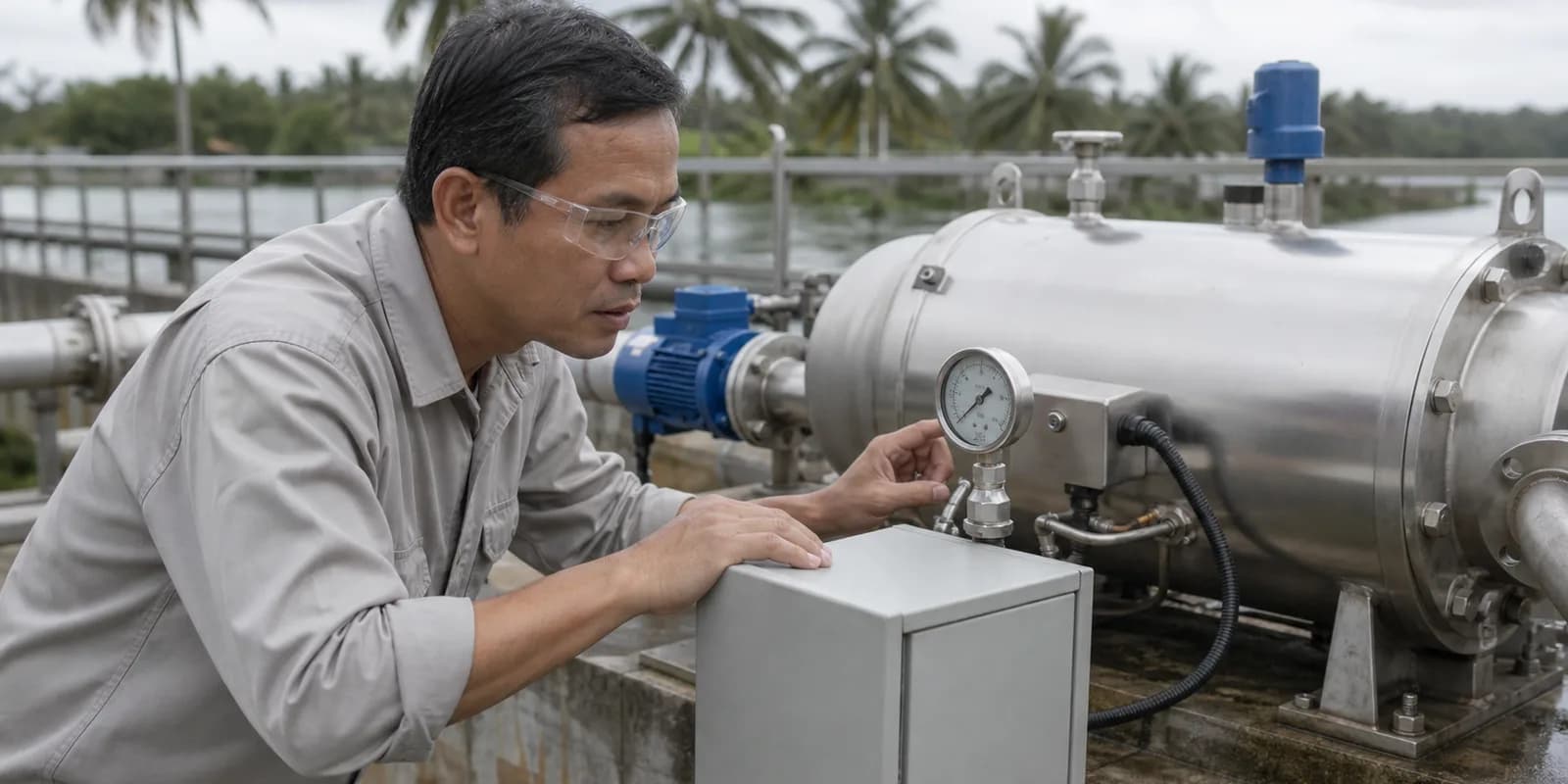
This reference design shows how one Filtersafe Trident E TRE0096 automatic self-cleaning screen filter could be configured for a 300 m³/h (83.3 L/s) raw-water intake at a Singapore industrial facility, at a 200 µm screen grade. Nothing was built, and no membrane, heat-exchanger or cooling-tower duty is claimed. The configuration begins at the discharge of an owner-supplied pump, so the unit is a pressurised in-line screen, not the coarse screen at an intake structure.
Fit depends on the unit's capacity at the chosen grade on this water, on inlet pressure in every state including a flush, and on where the flush water goes, not on a Max Capacity (400 m³/h for the TRE0096) or the family headline of Up to 600 m³/h, which is the TRE0120's Max Capacity[5]. The article can end three ways: fits, once Filtersafe's written capacity at 200 µm is in hand; a re-size, if that capacity is below 300 m³/h; or not this product. The verdict is provisional until Filtersafe answers on capacity, the pressure measuring point and the flush claims.
Trident E is a four-model screen filter
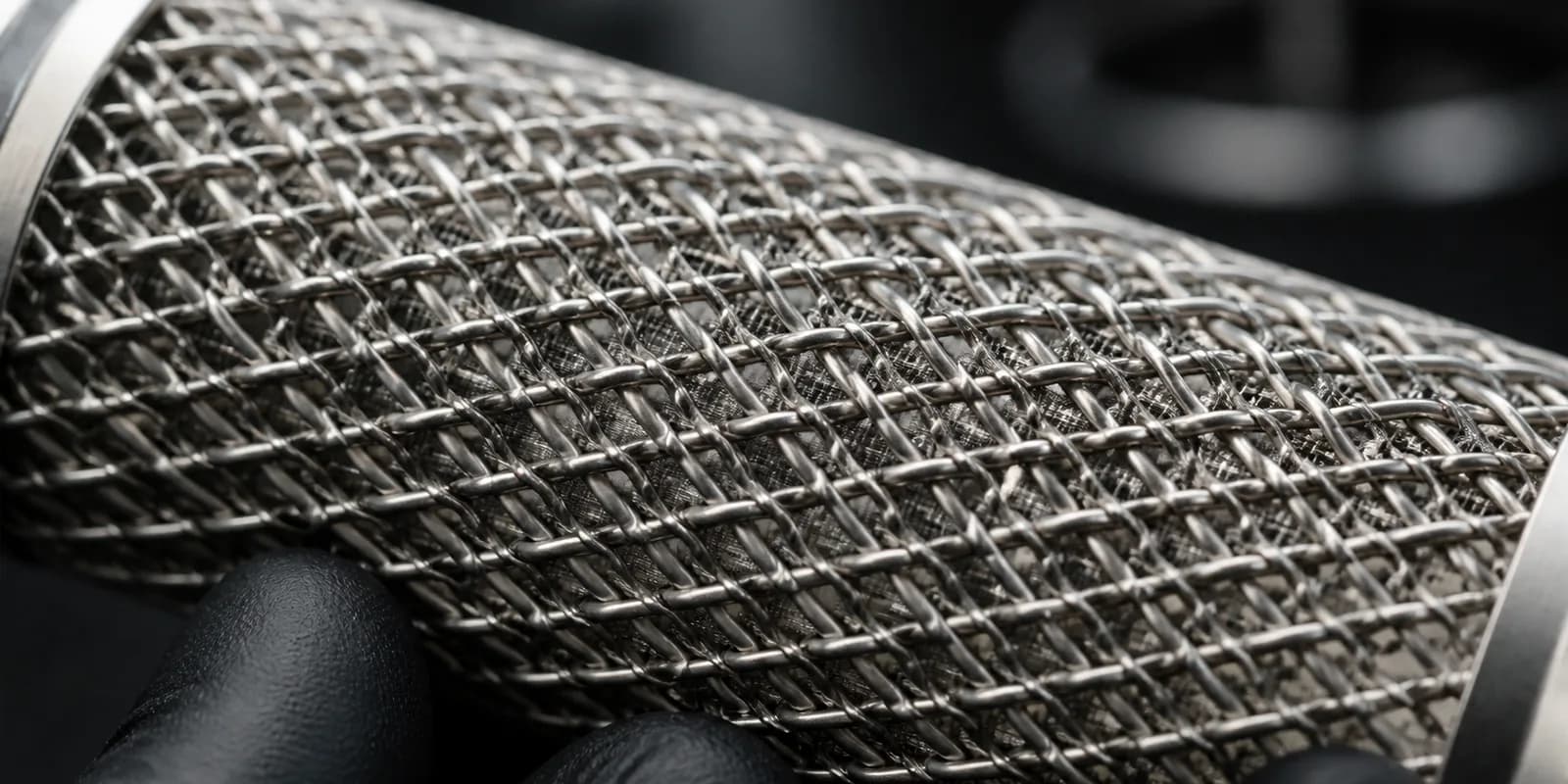
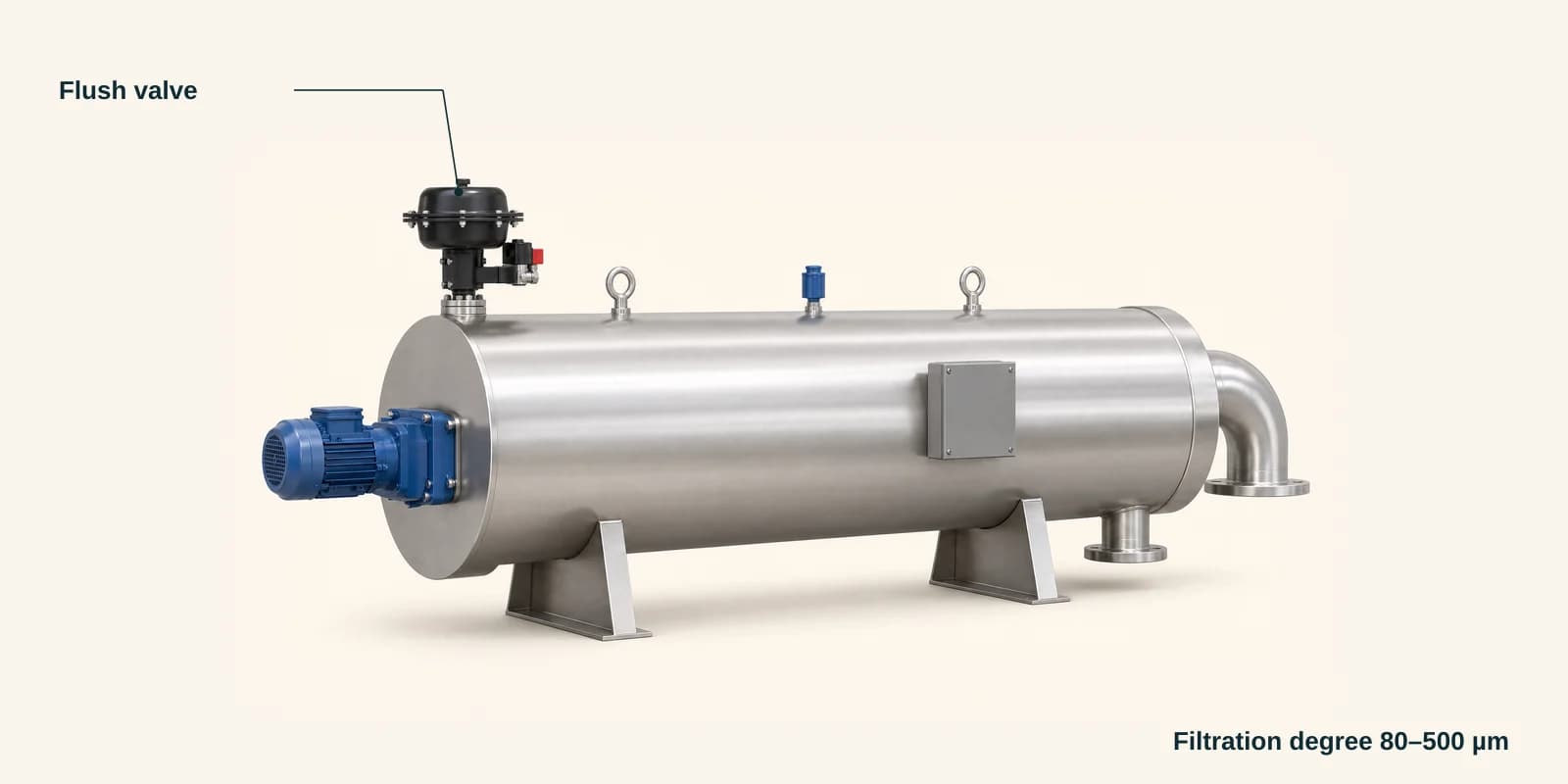
Filtersafe lists the Trident E Series as an automatic electric self-cleaning screen filter: a four-layer sintered stainless screen, a rotating, laterally moving cleaning mechanism, a flush valve and an external PLC controller[1]. Filtersafe states that "The filter remains online during the cleaning process allowing for a continuous flow of clean filtered water downstream without any interruption."[5] How the Trident E screen filter cleans itself is a separate article; this section states no performance.
The family has four models, TRE0048, TRE0072, TRE0096 and TRE0120, with Max Capacity of 180, 280, 400 and 600 m³/h and a filtration degree of 80–500 µm on all four[5][6]. The catalog's Trident 4800E is the brochure's 4800HE[5][6]. The brochure qualifies Max Capacity: "Dependent on filtration degree, water quality and inlet size. Contact us for more information."[5] This article therefore treats it as a ceiling whose conditions Filtersafe names but does not quantify. The headline Up to 600 m³/h carries no footnote[5][6] and equals the TRE0120's Max Capacity, which is the article's reading of it. The misreading is a headline capacity taken as what a unit delivers on a given water; the check is to ask for capacity at the grade, flange and water. In this article "the documents retrieved" means the Filtersafe pages, brochure and catalog cited and the two NEA documents, all read on 2026-10-01.
The reference unit is the TRE0096: a flange listed as 8 to 10 in, 9,600 cm² of screen (9,120 cm² effective), 10 nozzles, and 200 kg dry and 400 kg wet[5][6]. The options are a grade within 80–500 µm; flanges to DIN PN10/16, BSTD/E or ANSI B16.5 150 PSI[5]; a Unitronics Jazz controller (1 to 4 filters) or a Siemens LOGO! (1 filter), with optional Modbus TCP[6]; and screen alternatives of 316L, 904L and SMO254[5]. The specification table lists a horizontal configuration for all four models, and the catalog's "Horizontal and Vertical Models Available"[6] describes no vertical model, so the configuration is horizontal.
The brochure calls the unit a large preliminary screen "ideal for situations with challenging water and low pressure requirements, such as Greenhouses, Drip Irrigation, or other Industrial and Municipal needs with high loads of TSS"[5], and the product page repeats it[1]. That is a list of examples with no TSS figure[1]. These are stated uses, not results.
Filtersafe lists "Large Preliminary Screen Protection for Direct Primary Water Sourcing"[5] among the benefits[1] and names "Industrial and Municipal needs with high loads of TSS"[5] among its examples; an industrial raw-water intake is this article's reading of both and its chosen duty. Singapore is this article's choice. None of the maker's documents read[1][5][6], and none of two web searches on 2026-10-01, names a Trident E installation in Singapore, Malaysia or Indonesia[4]. A Filtersafe page about a Southern Johor refinery and petrochemical plant surfaced in one search summary and was not fetched; the summary does not name the Trident E.[4] So the article carries no facility, customer or result.
Filtersafe Trident E Series
No certifications listedView product →Duty, feed and pressure would set the model
In the Filtersafe Trident E TRE0096 reference design for a 300 m³/h industrial intake (the TRE0096 design), the unit would be judged by its capacity at the chosen grade on this water, because Max Capacity is a ceiling whose conditions Filtersafe names but does not quantify. The duty is 300 m³/h (83.3 L/s), with the downstream stage and end use unspecified. [ASSUMPTION: illustrative, replaced by the facility's metered demand.] It equals no model's Max Capacity, so the margins below are not zero by construction. No minimum filtration flow is labelled for any model in the documents retrieved[6], so turndown is not argued. The grade is 200 µm. [ASSUMPTION: mid-range inside 80–500 µm, matched to no downstream need, valid until Filtersafe confirms capacity at the grade and the downstream stage states its protection need.]
Choosing the model whose headline covers 300 m³/h treats a ceiling as a margin. Margin is (Max Capacity − demand) ÷ Max Capacity.
| Candidate | Max Capacity, m³/h | Margin at 300 m³/h |
|---|---|---|
| One TRE0048[5] | 180 | (180 − 300) ÷ 180 = −66.7% |
| One TRE0072[5] | 280 | (280 − 300) ÷ 280 = −7.1% |
| One TRE0096[5] | 400 | (400 − 300) ÷ 400 = 25.0% |
| One TRE0120[5] | 600 | (600 − 300) ÷ 600 = 50.0% |
| Two TRE0072 in parallel | 560 | (560 − 300) ÷ 560 = 46.4% |
The 560 m³/h is 2 × 280, a sum of two ceilings and not a published pair rating, assuming an equal split. The TRE0096's 25.0% margin is also the largest fall from its Max Capacity it can take: at 200 µm it carries 300 m³/h only if its capacity there is at least 75% of 400 m³/h (300 ÷ 400).
The TRE0096 is the reference because it is the smallest listed model whose Max Capacity exceeds 300 m³/h and one unit has the fewest interfaces, not a claim of optimum. Two TRE0072 are a quote alternative: the documents retrieved name no multi-unit architecture[6], the Jazz controller is listed for 1 to 4 filters[6], and the manifold and bypass layout would be the design's own assumption. The selection guide covers other placements and sizing from a buyer's data.
The feed is a labelled input, not a measurement. NEA's report assessing 2020 gives TSS guidelines of 50 mg/L for catchment waters and 300 mg/L for non-catchment waters[8]. They are ambient stream guidelines, not an intake concentration or an event peak, and the report prints no TSS value in its text. No raw-water TSS or turbidity distribution for any Singapore intake is in the documents retrieved, and Filtersafe states no TSS figure for its high loads[1]. The TRE0096 design takes 50 mg/L, the stricter guideline and so a low-end input, as the calculation input, and 300 mg/L, not a worst case, as the sensitivity.
Two minimum pressures are visible, with no measuring point: 1.6 bar on the product page, the brochure's first page and the catalog cover[1][5][6], and 1.5 bar in the catalog's specification table[6]. The TRE0096 design requires at least 1.6 bar at the inlet in every state, a flush included. [ASSUMPTION: the strictest visible value, not a published figure.] That is about 16.3 m of head (1.6 × 10⁵ ÷ (1,000 × 9.81)), so the TRE0096 design assumes a pump, not gravity. Supply at the inlet must cover the downstream requirement plus the filter's head loss at 300 m³/h. The catalog prints head-loss curves per model and flange but no numbers[6], so the budget closes only when Filtersafe states head loss at the flange and grade. The TRE0096 design keeps inlet pressure under the printed 10 bar, which the catalog qualifies as dependent on filtration degree, water quality and inlet size[6], and the feed under the printed 65 °C[1][5][6]. [ASSUMPTION: ambient surface water.]
One unit would need bypass and owner triggers
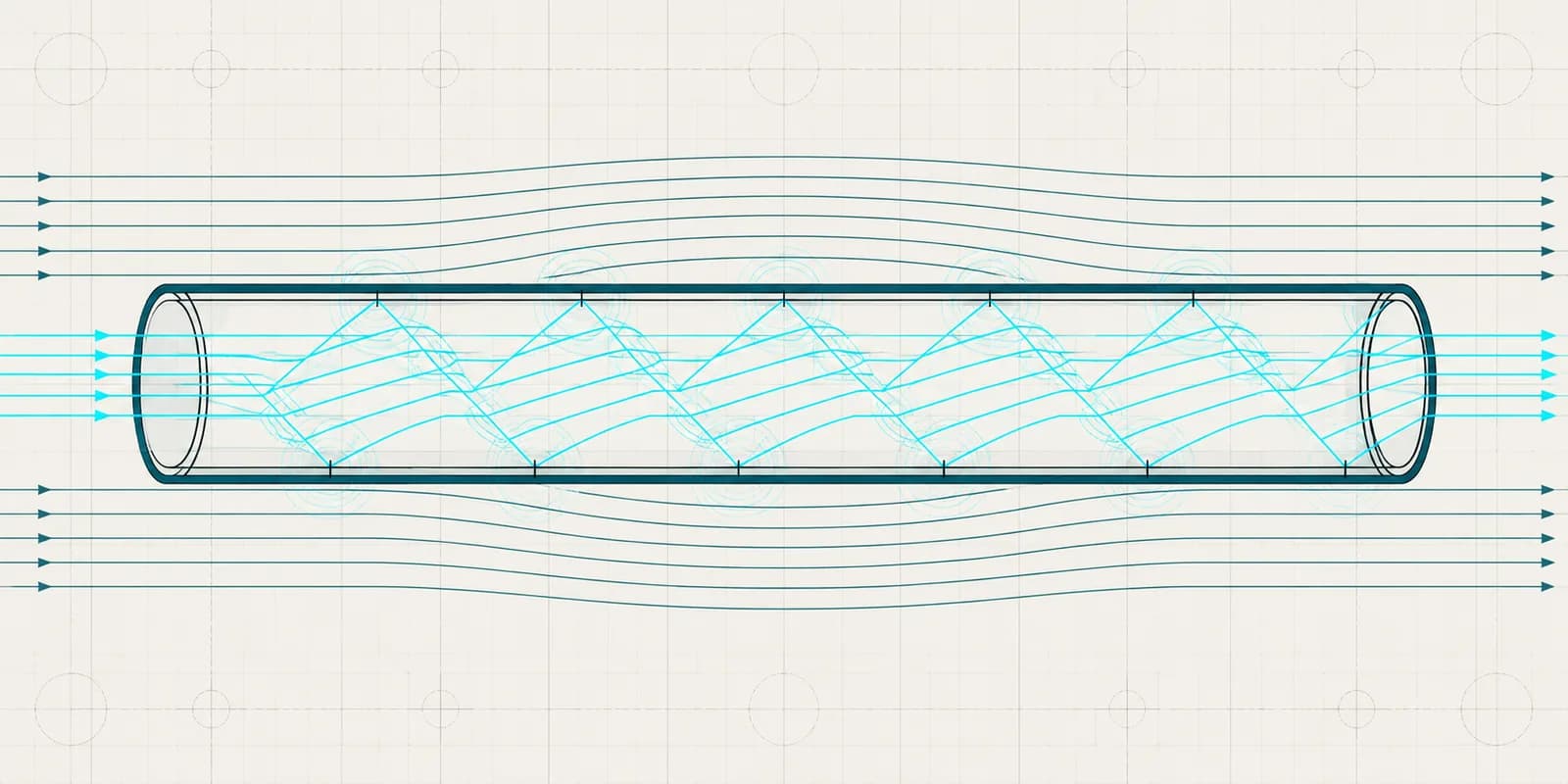
In the TRE0096 design, one unit sits behind a raw-water pump and coarse protection with a bypass around it, because the documents retrieved describe the filter and its controller and nothing about the pipework around it. The train runs from the source through coarse protection, the owner-supplied pump and isolation valves to the TRE0096 and the downstream stage; the flush outlet leaves to a route not yet settled. [ASSUMPTION: coarse protection upstream is generic practice. Filtersafe's only debris statement is the unit's own "coarse 6mm Pre screen"[6], whose hole size is not stated, so it is no basis for fibre protection.] Filtersafe says "The Filters are Plug & Play"[5], which this article does not read as pipework needing no engineering: the documents retrieved say nothing about bypass, isolation or sampling, so those valves are the design's practice, and the maker's flow diagram prints an "Air Release Valve" label[3]. A single unit needs a bypass to keep the intake running during service, which sends unscreened water downstream; that stage must tolerate it or be shut.
The flange is listed as 8 to 10 in, and the head-loss chart carries a curve for each of 8 in and 10 in[6], so the TRE0096 design treats them as alternatives, a reading to confirm. Taking nominal size as bore, because actual bores are not printed in the documents retrieved, 300 m³/h (0.0833 m³/s) is 2.57 m/s in 8 in (0.0324 m²) and 1.64 m/s in 10 in (0.0507 m²). The documents retrieved give no velocity guidance[6], so no band is claimed.
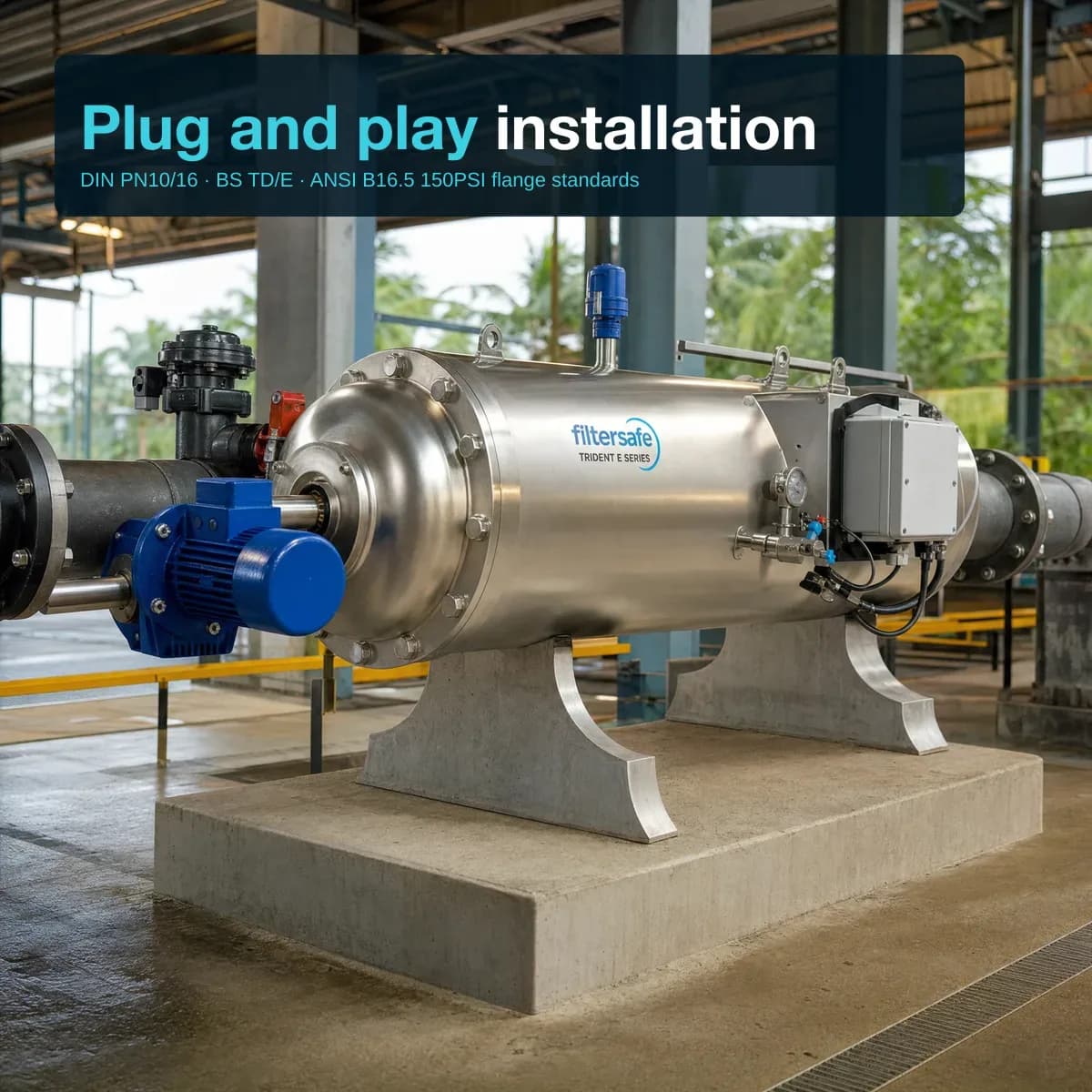
The controller is a Unitronics Jazz or a Siemens LOGO!, with 24 VDC control, a "Useful hard-wire interface for customer monitoring and operation."[6] and optional Modbus TCP[6]. The motor is 1,500 rpm, 0.18 kW and 0.5–0.65 A[6]. The controller table and a general-data row print different supply figures, and the motor row prints no voltage: the controller table prints 190–480 V and 190–415 V plus neutral, and the general-data row prints 380/415 VAC, 3 phase, 50 Hz[6]. The supply match is a quote item and the owner's check, as are enclosure, ingress and hazardous-area ratings, none printed in the documents retrieved[6].
Online, the TRE0096 design specifies inlet pressure, outlet pressure, their differential, filtered-outlet flow from a meter the TRE0096 design adds, and flush count and duration, read from the controller or a logger the TRE0096 design adds. Sampled are the drain volume per flush and the downstream particle check.
Filtersafe states: "All settings determined by controller. Cleaning cycle initiation possible via preselected DP level, specific time, or combination of both. Length of flush is customizable."[5] The owner therefore sets the differential-pressure level, the timer interval, the choice of either or both, and the flush length, none with a published default[5], plus the TRE0096 design's own alarms for high differential pressure and inlet pressure below the floor. [ASSUMPTION: alarm values are the design's.] Filtersafe lists a "Failsafe NC Flush Valve"[6] without defining its failure state, and the documents retrieved describe no power-loss behaviour or shutdown procedure[6]. Those are quote items, and nothing in the TRE0096 design relies on them. The design's response is the bypass. [ASSUMPTION: the bypass is specified as manually operable; a design choice, not a Filtersafe statement.]
The flush stream sets the discharge question
In the TRE0096 design, one minimum flush would use 289 L over 27 s, and where that flush goes is the question the documents leave open. The catalog's minimum flush flow is 38.5 m³/h for 27 s[6], and 38.5 × 27 ÷ 3,600 = 0.28875 m³, or 288.75 L. That reproduces the catalog's 289 L, printed "Min. Flush Volume (@ 1bar)"[6]. The 1 bar is not defined as inlet, differential or back pressure, and no other pressure appears in the documents retrieved[6]. The catalog marks the flush-flow row as dependent on filtration degree, water quality and inlet size, so 38.5 m³/h and 289 L are table entries, not values for 200 µm on this water[6]. The flow row's label says 5 m³/h per nozzle but its values work out to 3.5, 3.5, 3.85 and 4.08, so the arithmetic rests on the volume row and the 27 s[6].
The brochure and catalog print "Less than 1% Backwash Water Consumption"[5][6], and the product page and brochure print "Highly Effective Cleaning with Over 99% Recovery Rate and Full Screen Recovery"[1][5]. In the documents retrieved neither is defined[5], not as a fraction of throughput or of Max Capacity, not at what TSS or grade, and no relationship between them is asserted. If the 1% is a fraction of throughput, 300 m³/h allows less than 3 m³/h, or 3,000 L/h, of flush water. Then 3,000 ÷ 289 = 10.38, so fewer than 10.4 flushes an hour and at most 10 whole ones, an average of about 5.8 minutes apart at the bound. This is a bound, not the TRE0096 design's flush frequency, and the flush table is not proof of the 1%. The Trident E cleaning sequence treats both claims.
Reject concentration is η × C ÷ f, with C the feed TSS, f the flush water as a fraction of throughput and η the fraction of TSS the screen retains. The documents retrieved state no η, since 80–500 µm is a filtration degree, not a retention. At C = 50 mg/L, f = 1% and η = 1, the reject is 50 ÷ 0.01 = 5,000 mg/L (0.5% w/v); at 300 mg/L it is 30,000 mg/L. An η below 1 lowers it and an f below 1% raises it.
NEA's trade-effluent limits are a scale comparison, not a ruling: TSS of 50 mg/L to a watercourse and 30 mg/L to a controlled watercourse, and no discharge "without a written permission approved by the Director-General"[7]. Under those inputs, 5,000 mg/L would be 100 and 167 times those limits (5,000 ÷ 50 and 5,000 ÷ 30). The same page bars "refuse, garbage, sawdust, timber, human or animal waste or solid matter"[7] from trade effluent. Whether that reaches a screen flush is a classification question for the regulator, and the TRE0096 design does not say it applies. Nothing retrieved says flush water is trade effluent, and no sewer limit was found in the documents retrieved[7], so classification and route are for the regulator.
Flush supply and drain are open. Filtersafe says the flush works by "allowing water from the clean side of the screen to reverse back through the screen surface at high velocity"[5] while the unit remains online. The supply is then either the filtered flow, which makes delivery downstream during a flush the question, or additional raw flow, which means the pump carries duty and flush together. None of the documents retrieved says which, and the TRE0096 design states no sum. The 1.6 bar floor must hold through the flush. The catalog's Flushing row lists a 2 in Victaulic connection[6], which the TRE0096 design reads as the flush outlet; the drain route, its size and its capacity at other pressures are not stated in the documents retrieved[6]. Acceptance is the drain volume per flush, flush count and duration, logged against the 289 L and the bound.
Capacity at grade is the central open item
In the TRE0096 design, the first risk is the central gap: no capacity by screen grade appears in the documents retrieved, so the 25.0% margin at 300 m³/h rests on the ceiling alone. Filtersafe's written capacity for the TRE0096 at 200 µm, on its flange and this water, decides the answer. If it is below 300 m³/h, the answer is a re-size: the TRE0120 or two TRE0072 are priced and capacity at the grade is asked again. Only if no listed configuration clears 300 m³/h at the grade is the answer not this product. The pressure floor's measuring point and the flush supply are the second and third risks, asked in the same request with head loss at 300 m³/h.
A trial the owner can stop without rework has three stages. Stage 1 gathers the facility's raw-water TSS and turbidity distribution across seasons, Filtersafe's written answers, and the flush route with its consent in writing. Stage 2 puts one TRE0096 on a bypassed intake before the downstream stage depends on it. Stage 3 feeds the downstream stage through the unit with the bypass retained. Stopping after stage 1 or 2 leaves flanged tie-ins, valves, a controller and the unit, whose purchase terms are a quote item.
Acceptance names instruments: the filtered-outlet flow meter the TRE0096 design adds, which shows whether 300 m³/h is carried at the grade, with inlet and outlet pressure logged, passing if flow holds 300 m³/h while the differential stays within the head loss Filtersafe confirms at the grade and flange at the controller's trigger level; an inlet pressure transmitter logged through a flush, a pump start and a bypass changeover, passing if it never falls below 1.6 bar; the drain totaliser against the 289 L and the bound, once Filtersafe states what its 1% is a fraction of; and a particle check at the filter outlet by the downstream stage's own method. The trial stops if inlet pressure falls below 1.6 bar in any state, no authority accepts the flush route, or logged flush volume and count exceed the 1% once its basis is stated.
The documents retrieved include no installation, operation and maintenance manual: the support page offers "Installation, Operation & Maintenance instructions"[9] as a service and links none, and no maintenance interval or spares list appears for seals, nozzles or motor[6]. The catalog lists internals of NBR, PPH, POM-C, PP, PVC and AISI 316[6], and their chemical compatibility is not printed in the documents retrieved, so the TRE0096 design assumes a raw intake free of dosed oxidants. [ASSUMPTION: confirm with Filtersafe.]
On certification, Filtersafe prints AD 2000 as the design code, a design-basis statement with no certificate retrieved[6], and its certifications page lists no Trident E model under DNV, USCG, CCS or Bureau Veritas[2]. Where a marine or ballast specification requires a type approval, none is listed for the Trident E on those documents.
The unit would suit a Singapore industrial intake at 300 m³/h with written capacity at the grade of at least 300 m³/h, 1.6 bar at the inlet in every state, an authorised flush route and a downstream stage that needs no written retention figure. It stops where no listed configuration reaches 300 m³/h at the grade, where pressure is below the floor, where no flush route is authorised, where a downstream stage's specification requires a written retention figure that Filtersafe, asked, does not give, and where a marine specification requires a type approval none is listed for; head loss and capacity at the grade are quote items for every duty. A catalog is not a quotation: Filtersafe's catalog says "The data presented in this document is for general information only and cannot be used for quotation purposes."[6] Nothing here is a Filtersafe endorsement or a Filtersafe-published configuration.
The data pack is the metered demand and its seasonal range, a raw-water TSS and turbidity distribution, the downstream requirement, inlet pressure in every state, the flush route and consent, the flange standard, and the electrical supply and space. The quote request asks Filtersafe for capacity at the grade; the basis of the backwash-water and recovery-rate claims; the minimum pressure and where it is measured; head loss; flush flow and volume at 200 µm on this water, and whether the flush adds to the flow; the manual; and the failure state of the flush valve. Send the data pack with the quote request; the items above are the questions to put to Filtersafe, through whichever supplier quotes the unit, Purionex included.
Sources
- [1]Filtersafe — Trident E Series product page, as retrieved 2026-10-01 (static HTML text)
- [2]Filtersafe — Standards, Approvals and Certifications page, as retrieved 2026-10-01 (absence read from the lists; the page names no Trident E model)
- [3]Filtersafe — Trident E flow diagram and screen-layer graphic: labels printed on the images, with the author's visual reading (not a maker sentence)
- [4]Two web searches on 2026-10-01 for a Trident E installation or reference project in Singapore, Malaysia or Indonesia: negative-finding record
- [5]Filtersafe — Trident E Series brochure, DOC-00560 ver.1 (2 pages, rendered pages and text layer read 2026-10-01)
- [6]Filtersafe — Trident E Series catalog, DOC-00561 (5 pages, rendered pages and text layer read 2026-10-01)
- [7]NEA (Singapore) — Allowable Limits for Trade Effluent Discharge to Watercourse or Controlled Watercourse, as retrieved 2026-10-01
- [8]NEA (Singapore) — State of the Environment report, water-quality assessment of 2020 performance: TSS guideline values for catchment and non-catchment waters (paraphrased, two-column text)
- [9]Filtersafe — Support page, as retrieved 2026-10-01