This reference design shows how the Atlantium HOD UV system (RZ104-11) could be configured as a duty-plus-standby pair for a pre-RO process-water line in a small beverage plant. Fit depends on what removes the chlorine upstream, on flow and UV transmittance (UVT) staying inside the windows of one certificate, and on the dose actually delivered, not on Atlantium's application lists or its 4-log wording. Engineers and integrators drafting a request for quotation can use it to frame questions for Atlantium and set acceptance checks. It is a hypothetical configuration built from a product listed in the Purionex catalog and from published sources, with no installation or measured result behind it. It can end in a fit, once model-specific sizing and commissioning data are in hand, or in not this quote. It stays provisional because no document retrieved prints the delivered dose.
The Atlantium HOD UV system and its uses
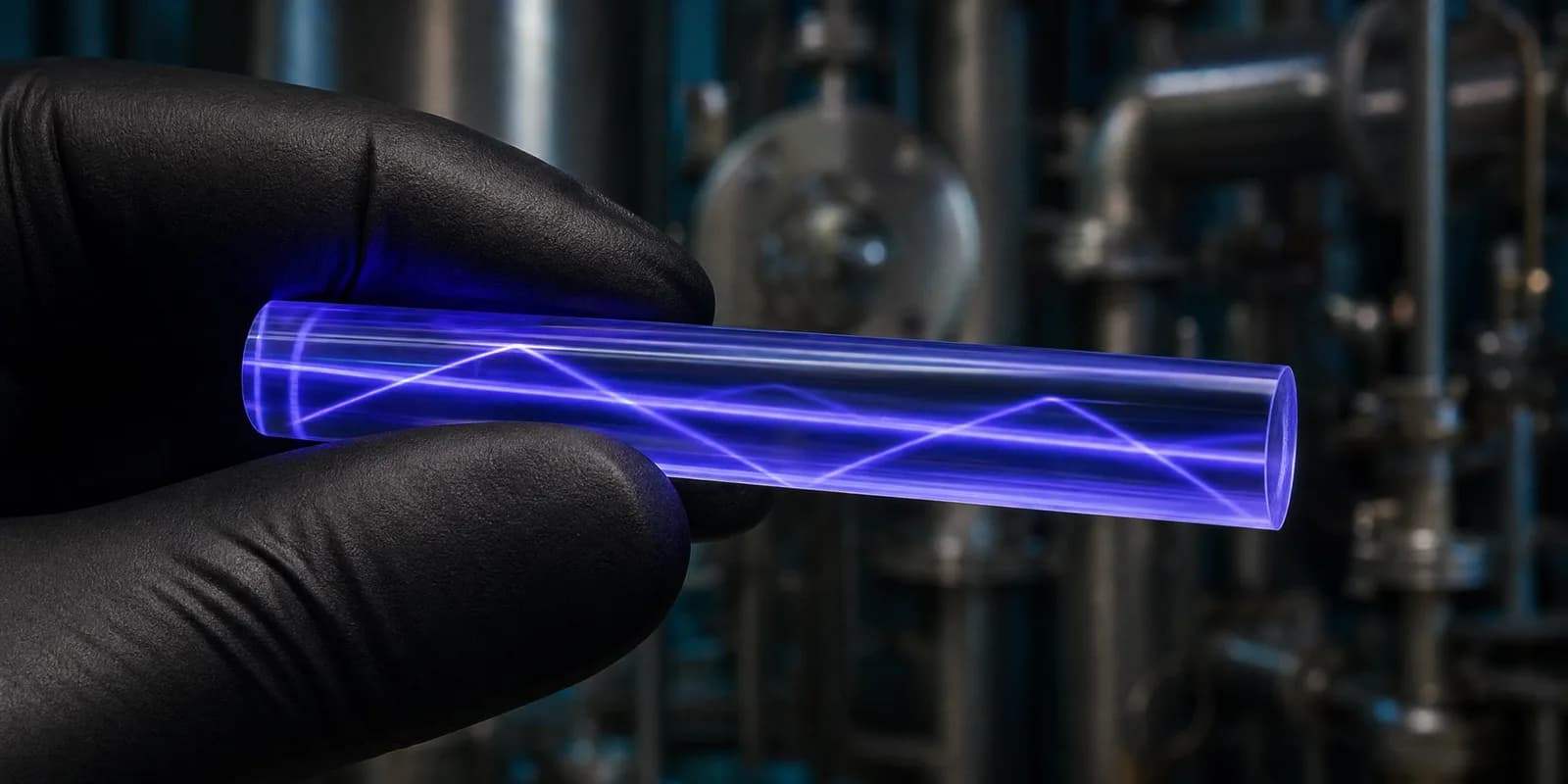
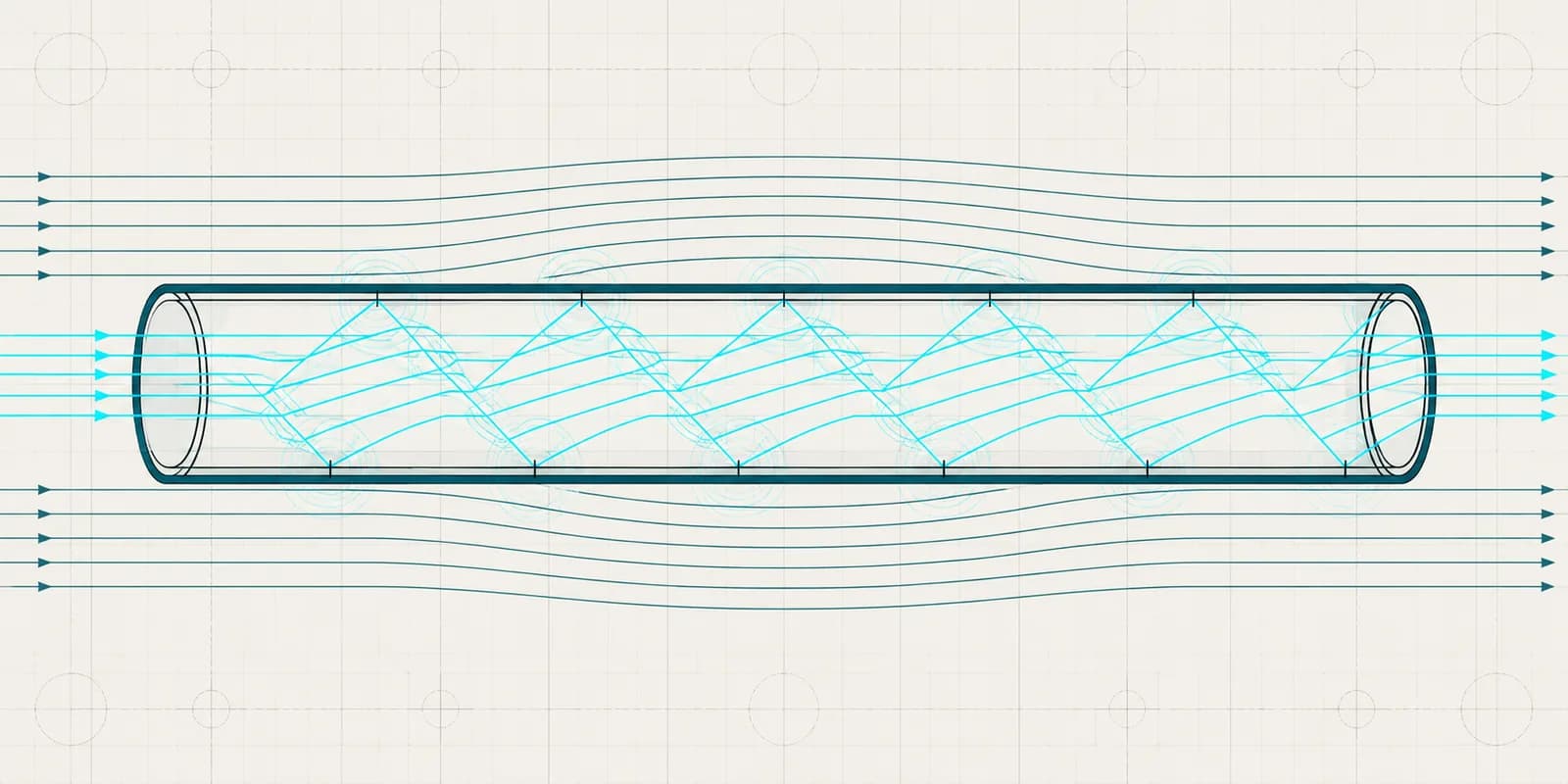
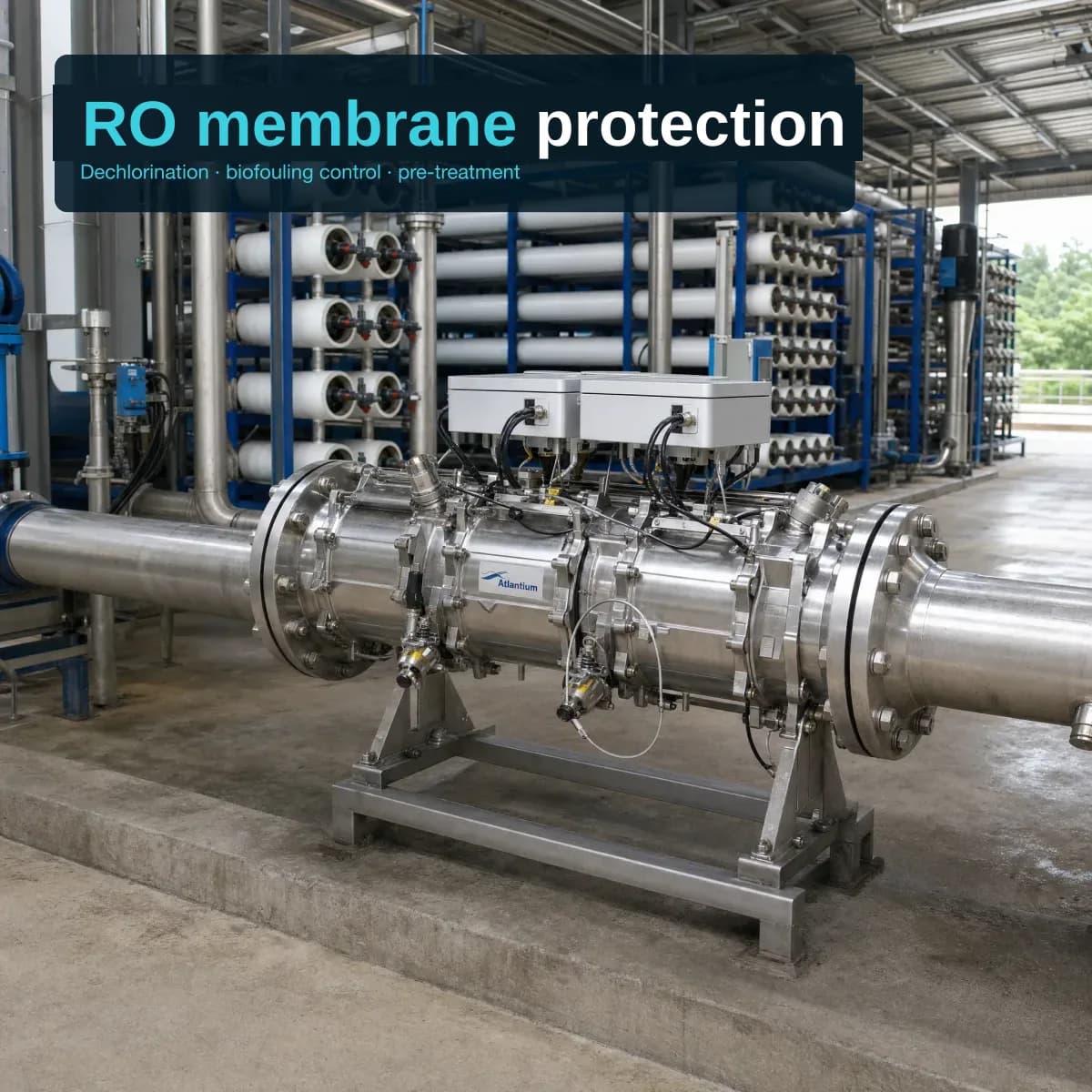
Atlantium's Hydro-Optic Disinfection (HOD) UV system is an inline reactor that the 2024 brochure tabulates in nine pressurised series, and the RZ104-11 is the one-lamp unit this reference design uses[2]. Atlantium describes a quartz chamber "surrounded by an air block"[1], medium-pressure lamps, a UV sensor on every lamp and one UVT sensor on each system[2], and a touch-screen All-in-One (AiO) controller showing lamp power, flow, UVT and dose[1]. The maker says the ray path and flow pattern create a "uniform UV dose distribution"[1]; no document retrieved measures it, and nothing here relies on it. The mechanics article on HOD UV holds the mechanism.
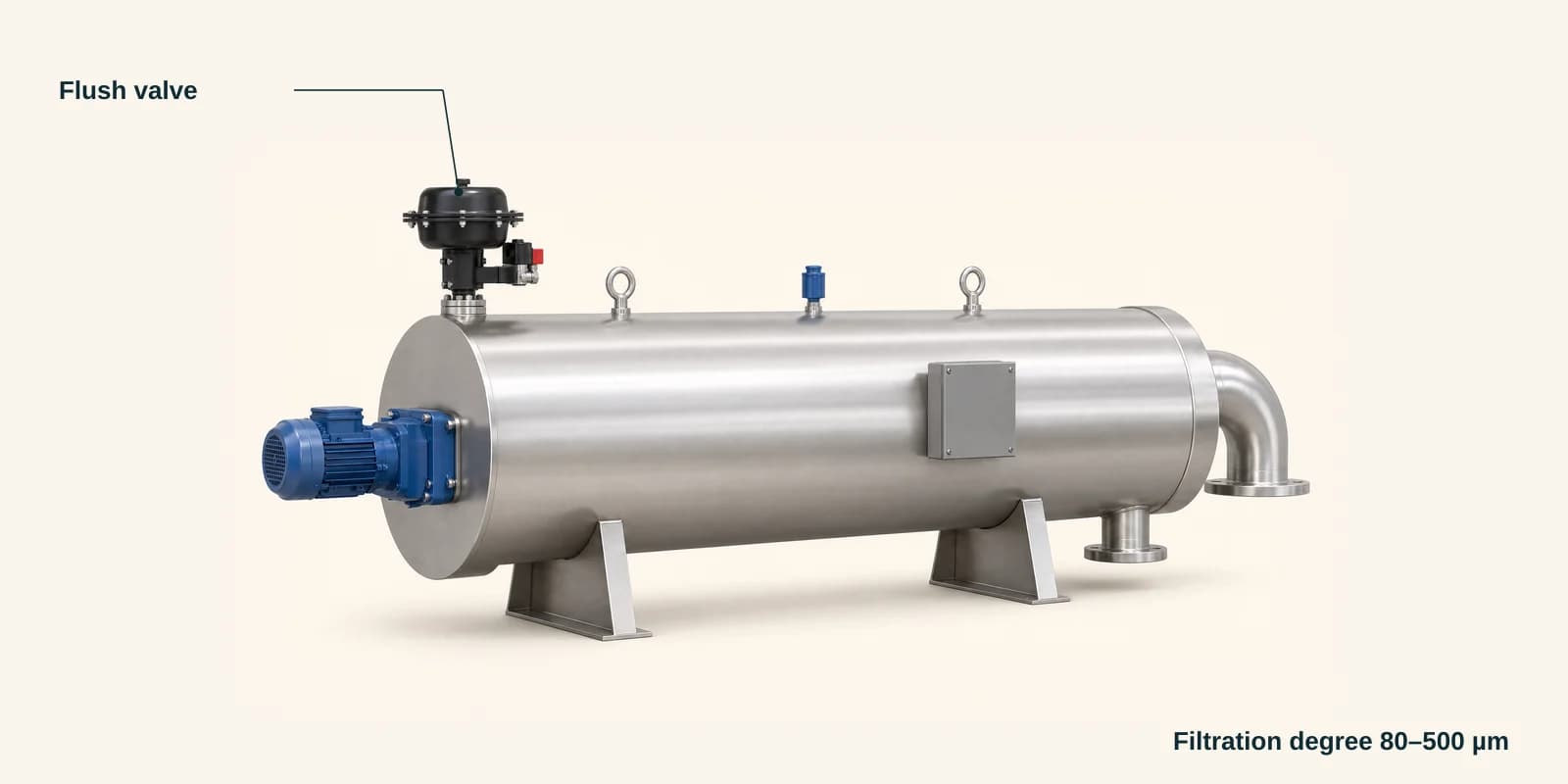
The RZ104-11 has one lamp, is 1039 mm long and 405 mm wide, weighs 37 kg, takes DN100 PN16 or 4 in 150 lb flange or ferrule connections, and is printed for a 10 bar (145 psi) maximum working pressure and a 60 °C maximum water temperature with the lamp on[2]. Its maximum lamp power consumption, lamps only, is 1 kW in a 2020 datasheet[15]. The two documents disagree on two lines: lamps-off temperature is 90 °C in the 2024 brochure[2] and 125 °C in the 2020 datasheet[15], and the housing is 316 or super duplex in the brochure[2] and 316L in the datasheet[15]. The RZ104-12 has two lamps (2 kW maximum lamp consumption[15], 1565 mm, 58 kg[2]). The next series up in the brochure is the RZ163, DN150 with one to four lamps[2]; no flow window or rating was retrieved for it, so whether it suits a higher flow is a quote question, and its role as the larger tier is this reference design's assumption. For the RZ104 flow the datasheet prints "Application dependent"[15]. The brochure's tables mark the automatic deposit prevention mechanism (DPM) "Optional" for the RZ163, RZ300 and RZB300[2] and carry no DPM row for the RZ104. Atlantium's Food & Beverage page lists 14 applications, including "Post-Granular Activated Carbon Treatment" and "RO Protection"[6]. Its technology page lists 26[1]. Its case documents give service points: a Coca-Cola plant in the Philippines with an RZ163-11 and a "250 gpm flow rate"[12], a wipes producer's RZ104-11 with a "maximum flow rate of 20 m3/h"[14], and PepsiCo Domodedovo, where new systems treat a "maximum flow rate capacity of 300 m3/h"[16]. These are service points, not ratings, and the lists name no model[6][1]. Why this duty? Atlantium's white paper, by a named Atlantium author, summarises "a compilation of Beverage Company Water Treatment Practices"[17] and recommends a HOD UV system before each RO[17]. The RZ104-11 is the anchor because, among the documents retrieved, it is the only inline model with a validator's window, a lamp power and a product-water service point (the wipes producer, 20 m³/h) all on file (the RZ104-12 has the first two)[9][15][14]. It stays provisional mainly because the delivered dose is unpublished and the certificate is undated, with its adenovirus model unstated[9].
Atlantium HOD UV
Carbon, flow and UVT would decide fit
In the Atlantium RZ104-11 reference design for a pre-RO beverage line (the HOD UV pair design), the UV stage would be judged by the chlorine the carbon leaves, by flow and UV transmittance relative to a certificate's windows, and by the dose it delivers, because a validation sentence is not a dose at a facility. The hypothetical scenario is a small beverage plant on chlorinated municipal-type supply needing 16 m³/h of RO feed at full rate and 12 m³/h at a reduced rate, 75% of full. [ASSUMPTION: illustrative demands, valid until the facility meters its RO feed.] Neither flow is a rating of the RZ104-11, and a demand set equal to a rating would show a 0% margin and prove nothing, so the pair design is checked against the certificate's windows.
The obvious reading misses twice. On its Industry page, for power, energy and industrial facilities, Atlantium writes that "HOD UV technology decomposes the free chlorine oxidant in process water"[7], and its Food & Beverage page lists RO Protection but not Dechlorination[6], although its FAQ names food and beverage among the places chlorine reduction is used, without a rate or a model[8].
The FAQ offers UV as an alternative "instead of sodium bisulfite or activated carbon"[8], so carbon upstream is the pair design's choice, with the UV after it as Atlantium's brewery brochure places UV for microbial breakthrough[11], and not a dechlorination rating, and the FAQ puts chlorine reduction at "hundreds of mJ/cm² versus tens for microbes"[8]. No document retrieved prints a removal rate, residual or per-model dose, so the pair design removes the chlorine with carbon upstream and takes no dechlorination credit. [ASSUMPTION: valid for a chlorinated supply, not for chloramine without confirmed carbon performance.]
The second miss is reading the unit as 4-log validated. Atlantium's technology page says its technology is designed to achieve 4-log virus inactivation, and the asterisks lead to a footnote naming organism surrogates (MS2, QB and T1UV) and adenovirus[1], which describes tested organisms and not a dose at this duty.
The dose target is 120 mJ/cm² reduction equivalent dose (RED), held by the controller. [ASSUMPTION: the design's choice, reading the white paper's "dose" as RED; invalid if the facility's brand standard or regulator sets another dose, or if the paper's figure is not an RED.] It follows Atlantium's white paper, which recommends a "HOD UV system on before each RO to provide 120 mJ/cm2 dose or higher"[17]. Two other sourced doses are not taken: EPA's 186 mJ/cm² for 4-log virus credit at US public water systems (post-filter in filtered systems, or unfiltered)[5] (OCR text), and the paper's 40 mJ/cm² where chlorine disinfection is part of the process[17]. None is an Atlantium rating.
The windows come from the RZ104 series validation certificate, an undated summary by HDR/HydroQual that Atlantium hosts[9]. Its Long Term 2 (LT2) envelope, from a US public-water rule[5], covers the RZ104-11 up to 605 GPM[9] (1 m³/h = 4.4029 GPM) [ASSUMPTION: GPM is read as US gallons per minute; the certificate prints GPM without defining the unit; valid for a certificate written for a US rule; invalid if imperial gallons were meant, which would shift every margin below.]. The adenovirus 4-log line is narrower, 44 to 248 GPM (10.0 to 56.3 m³/h), UVT 85.3% and higher, power 40% to 100%, measured "on the RZ104 model reactor"[9], model unstated. [ASSUMPTION: the adenovirus line, printed for the RZ104 model reactor with no model named, is read as covering the RZ104-11; valid until Atlantium names the model, invalid if only the RZ104-12 was tested.] The pair design uses that narrower line. 16 m³/h (70.4 GPM) sits (248 − 70.4) ÷ 248 = 71.6% below its top; 12 m³/h (52.8 GPM) is 52.8 ÷ 44 = 1.20 times its floor, and a turn-down of (52.8 − 44) ÷ 52.8 = 16.7% would reach it. A window is where the certificate applies, not an operating limit. The certificate ties no delivered dose to any flow and UVT point inside it; its 8.7 to 161.0 mJ/cm² are surrogate test doses[9].
The UVT basis is 90% at 254 nm over 1 cm after the carbon, used only to test the windows. [ASSUMPTION: no UVT dataset for Singapore, Malaysia or Indonesia was retrieved.] The margins are (90 − 85.3) ÷ 90 = 5.2% to the 85.3% edge and (90 − 77.9) ÷ 90 = 13.4% to 77.9%. UVT is not turbidity; Atlantium's FAQ says the two are rarely correlated[8].
The UV stage sits ahead of the RO feed pump, so the pair design keeps supply pressure below the printed 10 bar and the water below the printed 60 °C lamps-on maximum[2]. [ASSUMPTION: layout.] Both flows sit inside the adenovirus window, and 16 m³/h is (20 − 16) ÷ 20 = 20.0% below the 20 m³/h that Atlantium gives for the wipes producer's RZ104-11[14], a service point and not a rating.
- RO feed, full and reduced rateASSUMPTION16 m³/h = 70.4 GPM (16 × 4.4029) and 12 m³/h = 52.8 GPM (12 × 4.4029); the RZ104 flow is printed as application dependent, so neither equals a ratingsource
- Target doseASSUMPTION120 mJ/cm² RED held by the controller; 186 and 40 mJ/cm² shown, not takensource
- Design UVT after carbonASSUMPTION90% at 254 nm over 1 cm, used only to test the windowssource
- Absorbance at the UVT edgeASSUMPTION90% UVT is 0.0458 per cm and 85.3% is 0.0691, a 51% rise, so the margin to the edge is thinner than the percentages suggest; A = -log10 of the UVT fraction, 1 cmsource
- LT2 window, RZ104-11SOURCED10 to 605 GPM (2.3 to 137.4 m³/h); UVT 77.9% to 97.3%; lamp power 40% to 100% (m³/h converted at 4.4029 GPM per m³/h; GPM read as US gallons)source
- Adenovirus 4-log lineSOURCED44 to 248 GPM (10.0 to 56.3 m³/h); UVT 85.3% and higher; lamp power 40% to 100%; RZ104 model unstated (m³/h converted at 4.4029 GPM per m³/h; GPM read as US gallons)source
- Pressure and temperature at the unitASSUMPTIONPrinted maxima 10 bar and 60 °C lamps on; the design stays below bothsource
The standby covers a unit, not the feed
In the Atlantium RZ104-11 reference design for a pre-RO beverage line (the HOD UV pair design), the supply would pass activated carbon, then one of two parallel RZ104-11 branches, then the RO feed pump, because the chlorine must be removed before the UV and a lit branch must stay inside the certificate's flow window. The train is supply, strainer, filtration and the carbon bed, then two UV branches in parallel, each with isolation valves, a flow meter and one RZ104-11, then the RO feed pump and a generic RO train. [ASSUMPTION: strainer, filtration and carbon are generic practice; no document retrieved sizes them.] No document retrieved describes a purge or drain for the UV stage, so the pair design draws none. [ASSUMPTION: the RZ104-11 is an inline reactor with no purge; invalid if Atlantium names one.] The RO reject is the unsized RO train's, routed by the owner. Atlantium documents UV "immediately after the carbon filter"[11], before RO in older units[16] and after RO[13], and the selection guide for Atlantium HOD UV compares the positions.
Each branch is a full-flow unit. Sharing the flow across two lit units would put each at 16 ÷ 2 = 8.0 m³/h (35.2 GPM) at full rate and 12 ÷ 2 = 6.0 m³/h (26.4 GPM) at the reduced rate, inside the LT2 window but below the 44 GPM adenovirus floor[9], so the pair design runs one branch. The RZ104-12 is the quote alternative on lamp count, with an LT2 window of 16 to 601 GPM[9]. Two Atlantium documents speak on lamp swaps, each within its own scope. The 2024 brochure says replacement "does not require emptying of the water lines or depressurization"[2], and the bottled-water brief, whose model list names the RZ163, says it "can be safely performed during system operation!"[10]. Neither describes a swap in a one-lamp RZ104-11, so the lamp-out reading is a quote item. [ASSUMPTION: in a one-lamp RZ104-11 a lamp out leaves the branch without UV; valid until Atlantium describes the swap for that unit; invalid if a swap there is documented as keeping UV on.]
Why duty plus standby? The pattern is the design's choice. The nearest Atlantium precedent, PUB Singapore after RO, is listed in an Atlantium case document as "2 (+1 standby)"[13], a 2 + 1 arrangement and not the pair design's 1 + 1, and that document's table total of 947 m³/hr and its text figure of 1240 are not reconciled[13], so only the arrangement is used. The standby covers a unit out of service by lamp failure, swap or maintenance. Both branches share the supply, strainer, filters, carbon bed, UVT regime and RO feed pump, so a carbon breakthrough, a UVT fall or a supply upset reaches both alike. The misreading is a standby read as protection against a bad feed, and the check is what the two branches share.
Two units weigh 2 × 37 = 74 kg, and the brochure gives weights for reference only[2]. Their maximum lamp power consumption, lamps only, is 2 kW for the pair and 1 kW if the standby lamp is off[15]. Atlantium's FAQ says lamp life depends on working hours and ignitions, and that its systems have a "no flow" mode to minimise ignitions[8]. The pair design does not cycle the standby for exercise by default and logs its ignition count. [ASSUMPTION: the design's choice.] Whether a standby is held lit or dark, how long it takes to be ready, and the unit's head loss are not given in the documents retrieved. They are quote items.
Displayed dose would need independent checks
In the HOD UV pair design, the controller's displayed dose would be the unit's own calculation, and acceptance would add a flow meter on each branch, a bench UVT reading and counts before and after the UV stage. The chlorine reading and every trip value are commissioning settings owned by the operator, not Atlantium figures.
Why a flow meter on each branch? The datasheet says "User to provide a flow signal (flow switch/flow meter)."[15] The FAQ allows an existing meter if it reads reliably and there are "no diversions between the flow meter and the UV system"[8]. A header meter cannot tell which of two branches carries the flow, so the pair design meters each, with a meter and not a switch because it has two flow states. [ASSUMPTION: the design's reading of the FAQ for two branches; no document retrieved prints a two-branch rule.] The display cannot vouch for itself. Atlantium says the system adjusts lamp power so that the minimum dose set by the user "is guaranteed to be delivered"[1], which is the maker's word. No document retrieved gives the display's uncertainty or the UVT sensor's accuracy or calibration interval. The pair design therefore checks online UVT against a weekly bench reading, its own choice, at 254 nm over 1 cm by the procedure the FAQ describes[8], and the tolerance between the two is a quote item. A count after the UV stage is not the dose either: the white paper notes that a treated organism may be unable to reproduce, and so absent from a plate count, yet still be seen by a polymerase chain reaction (PCR) swab test[17]. Every dose reading is logged with the branch, flow, online UVT, bench UVT and lamp power, and the standby's readings are logged on their own, applying the rule in the mechanics article on HOD UV for what a dose figure must carry. The pass conditions are the design's judgment and not Atlantium's, and a shortfall is first a question for Atlantium and not a rejection.
- Displayed doseASSUMPTIONAt least 120 mJ/cm² RED in each logged state; read on the controller of each branchsource
- Branch flowASSUMPTION10.0 to 56.3 m³/h; read on the flow meter of that branchsource
- UVTASSUMPTION85.3% or higher; online UVT sensor, checked by a weekly bench reading at 254 nm over 1 cmsource
- Lamp powerASSUMPTIONInside 40% to 100%; read from the controller logsource
- Pressure and temperatureASSUMPTIONInlet below the printed 10 bar and water below the printed 60 °C; pressure and temperature readings at each branch inletsource
- ChlorineASSUMPTIONNone reaching the UV stage; online free-chlorine reading and sampled total chlorine at the carbon outlet, before extended running and then at an agreed intervalsource
- CountsASSUMPTIONTotal counts before and after the UV stage, read in the trial; the pass limit is the facility's own count limit, set with its QA, and not an Atlantium figuresource
The power window is narrower than the range Atlantium's page gives for lamp power. That page says lamp power "can vary between 25-100% according to the production stage and condition"[1], while the certificate's windows cover 40% to 100%[9], so any logged reading under 40% is outside the certificate's window. Whether the user can set a 40% floor is not stated in any document retrieved. If that range applies to this model, which the page does not say, a low-flow, high-UVT hour could take the controller there, so the log is checked for it and the floor is a question for Atlantium.
The duty branch controller's alarm output would be wired as a permissive to the RO feed pump, no dose, no feed. [ASSUMPTION: Atlantium documents user settings for alarm signals[2], but no document retrieved assigns the relay.] The pair design has isolation valves and this permissive only, with no changeover logic. A failed or sub-setpoint branch drops the permissive and stops the RO feed, and the operator then opens the standby's valves and isolates the duty branch. Changeover is by hand, so the installer re-points the permissive to the new duty branch's output. An isolated, dark standby shows no dose, so how its controller behaves in that state is a quote item. Commissioning is Atlantium's: "System commissioning must be performed by an Atlantium technical representative."[8]
The delivered dose is the open gap
In the HOD UV pair design, the central gap comes first: no document retrieved prints the dose an RZ104-11 delivers at 16 or 12 m³/h and the facility's measured UVT, so 4-log inside a window describes test conditions and not a dose at the pair design's point. Two routes are named. One is Atlantium's answer to the inputs its FAQ lists for sizing[8], returned as a model-specific sizing. The other is the white paper's note that Atlantium can build a table of log reductions per organism "at a specified flow rate and UV transmittance value"[17]. A trial the owner can stop without rework would close it. Commission the duty branch with the standby isolated, log displayed dose, flow, UVT and lamp power for an agreed period, take a weekly bench UVT, and count before and after the UV stage. [ASSUMPTION: the design's own trial plan.] If the trial stops, the second unit must be commissioned before the line can run on it; until then it has not been run. The off-ramp is the pair design's rule: a displayed dose that cannot hold 120 mJ/cm² without lamp power at 100% (no headroom left), or a UVT under 85.3% (the certificate's adenovirus line no longer covers the water), ends the trial. The next step is Atlantium's model-specific sizing, for a unit with more lamps (the RZ104-12 or the RZ163, neither with a dose figure retrieved) or for a different position.
The facility owns the target dose, the target organism and the acceptance data. Atlantium's page says the minimum dose is set by the user and also that the dose and operational mode are "tailored by Atlantium’s team"[1], so the setpoint is agreed with Atlantium at commissioning. The installer owns piping, flow-signal wiring and the interlock, and after handover the operator owns every trip value.
- Carbon breakthroughASSUMPTIONChlorine reading above the commissioning setting stops the RO feed; operator actssource
- UVT under 85.3%ASSUMPTIONAlarm; the adenovirus line no longer covers the water; facility actssource
- Branch flow outside 10.0 to 56.3 m³/hASSUMPTIONAlarm; facility actssource
- Lamp failure on the duty branchASSUMPTIONPermissive drops and the RO feed stops; operator changes over by handsource
- Dose below setpointASSUMPTIONPermissive drops and the RO feed stops; facility decides on changeoversource
- Branch inlet pressure at 10 bar or aboveASSUMPTIONAlarm; operator acts; surge and shut-off pressure are not in the documents retrieved, so nothing in the design relies on them and both are quote itemssource
- Water at 60 °C or above with the lamp onASSUMPTIONAlarm; operator acts; the printed lamps-on maximum is 60 °Csource
- Power lossASSUMPTIONUV and RO feed pump both stop; restart time not given in the documents retrieved; owner actssource
The misreading is the NSF/ANSI/CAN 61 listing, or a validation sentence, read as performance of the running line. The listing names the RZ104 among ten trade designations, is a health-effects standard for drinking water system components, and is "for use in municipal water treatment plants only"[3], and Atlantium does not appear on the NSF/ANSI 55 listing page retrieved[4]. Beyond the items flagged above, these stay open until Atlantium answers, scoped to the documents retrieved: inline lamp life in hours, the RZ104 cleaning regime and DPM, the chlorine tolerance of the wetted materials, and orientation, clearances and the drawing the brochure footer points to[2].
The pair design would stay inside the certificate's adenovirus line, read as covering the RZ104-11, for a chlorinated supply cleared by carbon, an RO feed from 10.0 to 56.3 m³/h and UVT at 85.3% or higher, with a dose target the facility confirms. It stops where the certificate's adenovirus line no longer covers the water (UVT under 85.3%, with under 77.9% leaving the LT2 window too, or an RO feed outside 10.0 to 56.3 m³/h), for water over 60 °C with the lamp on, for a duty that needs the UV stage to remove chlorine, and for a requirement for NSF/ANSI 55 performance certification. None fires on 16 and 12 m³/h at the assumed UVT of 90%. The data pack is a supply analysis, the metered RO feed range, the target organism and dose standard, and the process flow diagram. The quote request should ask for Atlantium's model-specific sizing, a validation letter of the kind the white paper describes[17], the open items above, and the commissioning scope, answered in writing by Atlantium through whichever supplier responds. Nothing here endorses Atlantium or claims availability. Send the data pack with the quote request; the items above are the questions to put to whichever supplier responds.
Sources
- [1]Atlantium — Technology and Applications page, as retrieved 2026-10-01: mechanism wording, AiO controller, lamp power range, 26-item application list
- [2]Atlantium — HOD UV Technology & Products brochure (290524): series tables, RZ104 table, DPM option, ICD footer
- [3]NSF International — NSF/ANSI/CAN 61 listing for Atlantium Technologies (health effects of drinking water system components; municipal-only footnote)
- [4]NSF International — NSF/ANSI 55 listing page, as retrieved 2026-10-01 (Atlantium does not appear on it)
- [5]US EPA — Ultraviolet Disinfection Guidance Manual, final, November 2006 (EPA 815-R-06-007): Table 1.4 and its stated scope, OCR text
- [6]Atlantium — Food & Beverage market page: 14-item application list
- [7]Atlantium — Industry market page: dechlorination and RO protection statements
- [8]Atlantium — FAQ page: sizing inputs, flow signal, UVT, chlorine reduction, lamps, commissioning
- [9]HDR/HydroQual — Validation Test Certification, Atlantium RZ104 Series UV System (hosted by Atlantium; undated summary certificate)
- [10]Atlantium — Bottled Water application brief (RZ163 series model list; lamp replacement statement)
- [11]Atlantium — Breweries brochure: UV placement after the carbon filter
- [12]Atlantium document — Coca-Cola Philippines case document (RZ163-11, maker's caption)
- [13]Atlantium document — PUB Singapore post-RO case document (2 duty plus 1 standby; text and table totals differ)
- [14]Atlantium — news brief on a wipes producer's product water loop (RZ104-11, 2020)
- [15]Atlantium — RZ104 Series datasheet (2020): lamp power, flow-signal footnote, lamps-off temperature and housing lines that differ from the 2024 brochure
- [16]Atlantium — news brief on the PepsiCo Domodedovo plant (2020)
- [17]Atlantium — white paper on HOD UV in beverage water treatment (named Atlantium author; summarises one unnamed beverage company's practice)