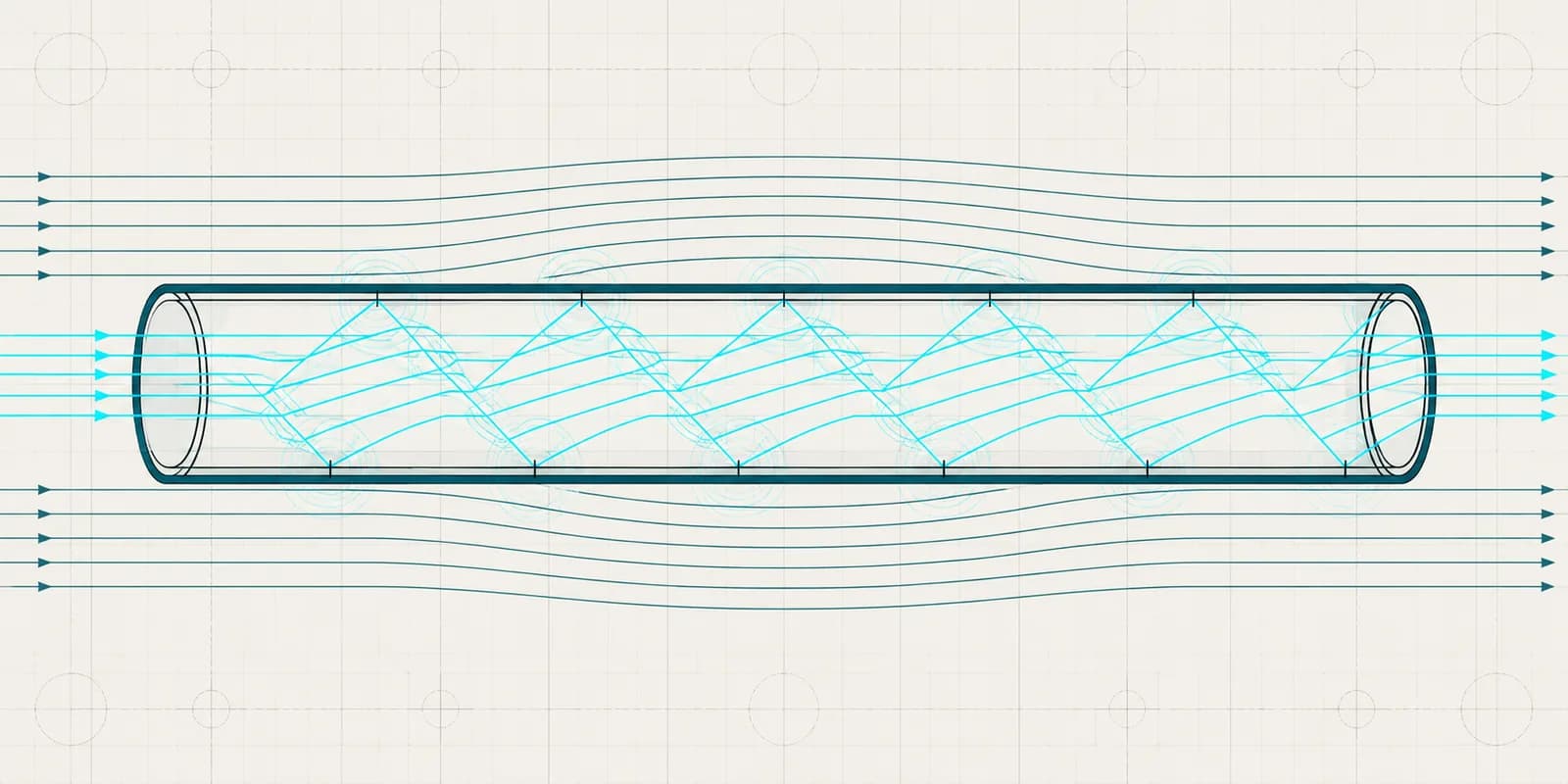
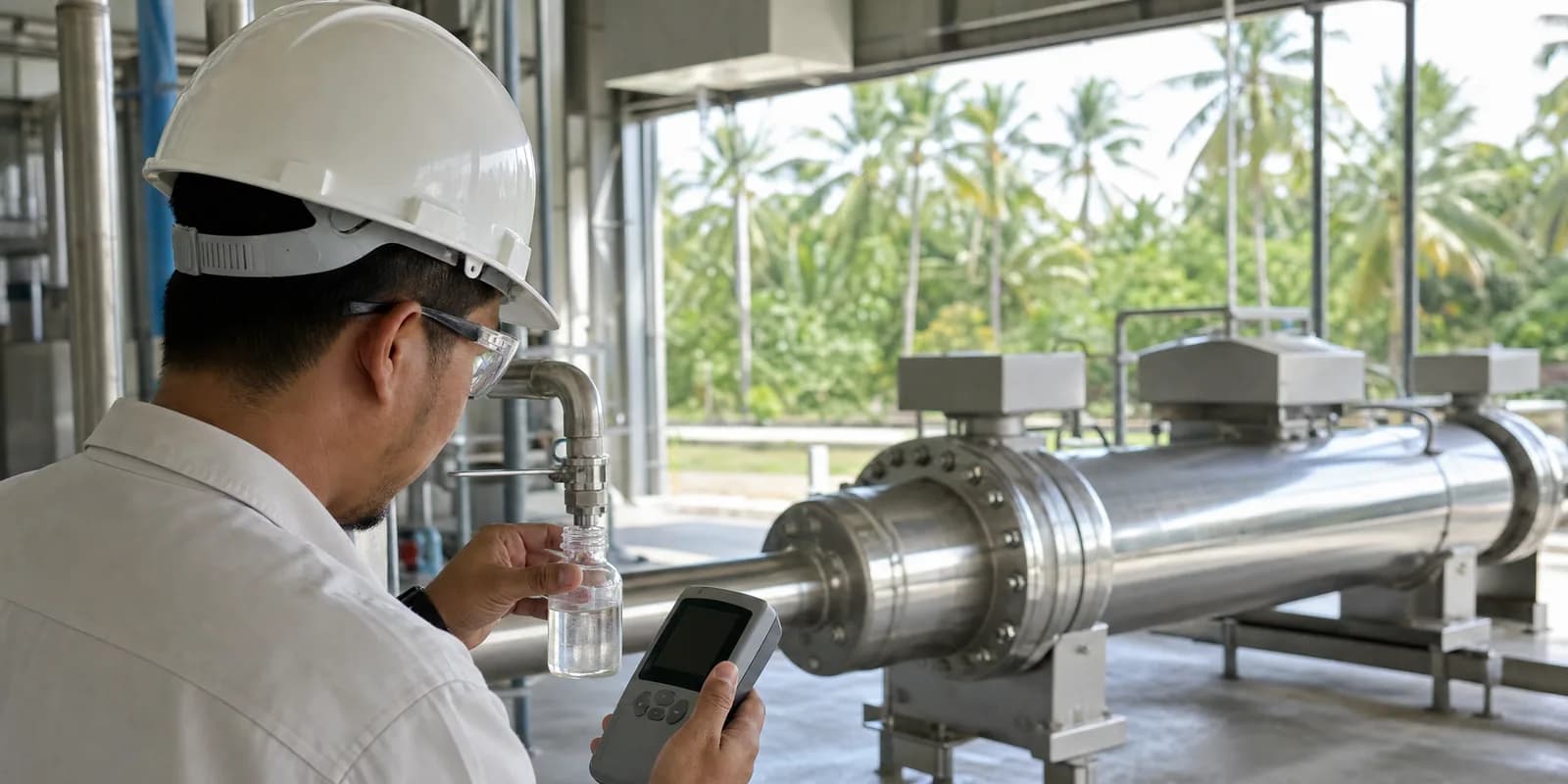
Atlantium's Hydro-Optic Disinfection (HOD) UV passes water through a quartz chamber lit by medium-pressure lamps. What shows it working is the dose the water receives, in mJ/cm², proven as the log inactivation of a named organism at a stated flow, UV transmittance (UVT) and lamp power.[12][6][18] Two phrases invite a misreading: Total Internal Reflection as a measured, narrower dose distribution than other reactors have, and 4-log as a rating of the product. Atlantium calls its dose uniform and homogenous[1][2], but no document retrieved measures it for any Atlantium reactor. The 4-log figure is tied to named organisms, a dose, a flow window, the window's lower UVT limit, a lamp-power range and, in the one certificate retrieved, the RZ104 only.[11]
Atlantium describes a quartz chamber surrounded by an air block, medium-pressure lamps (200 to 415 nm), a UV sensor for each lamp, one UVT sensor for each system, a user-supplied flow signal, and lamp power adjusted so that a user-set minimum dose is delivered.[1][2][14] The inline series is covered, not the open-channel OC series. Sizing sits in the selection guide and the worked design in the beverage reference design.
Atlantium claims an even dose from reflection
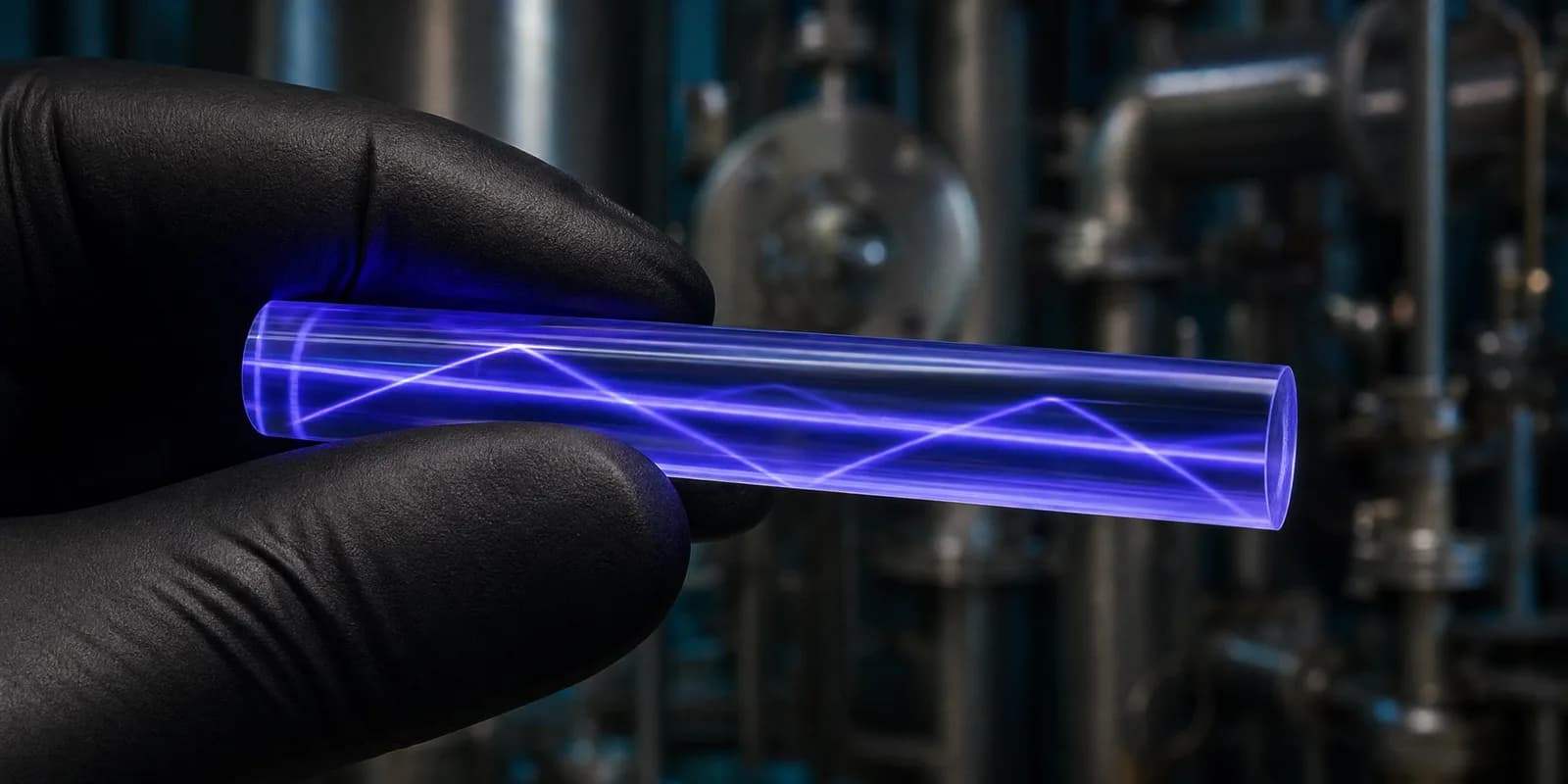
Atlantium's technology page describes "a disinfection chamber made of quartz and surrounded by an air block"[1], which helps trap the light's rays and "forces them to repeatedly bounce inside the chamber"[1] in a phenomenon it names Total Internal Reflection (TIR), with "an optical amplification mechanism"[1] recycling photons. A long ray path and an engineered water flow, it says, "creates a uniform UV dose distribution"[1], and the brochure says the design "ensures homogenous UV dose distribution"[2].
EPA's 2006 manual (OCR text of the final) says "UV dose delivered to the microorganisms passing through the reactor is best described using a dose distribution"[6], that "A narrow dose distribution (Figure 2.7a) indicates a more efficient reactor"[6], and that "the average log inactivation a reactor achieves with a given microorganism is strongly affected by microorganisms that receive the lowest UV doses"[6]. An even dose would matter most to the water that gets least. Atlantium's page claims 4-log inactivation throughout all the water in the chamber,[1] and only a measured histogram or reduction equivalent dose (RED) spread would test that. None is in the documents retrieved. Narrower than other reactors is an inference, not a finding.
The water limits recycling (bounded physics, derived here). UVT is the share of 254 nm light that survives 1 cm.[10] Take absorption as the only loss ([ASSUMPTION A2]). Each further 10 cm of path then leaves UVT raised to the tenth power: 34.9% at an illustrative 90% UVT ([ASSUMPTION A1], 0.90 to the tenth power), 20.4% at 85.3% and 8.2% at 77.9%, the certificate's two lower UVT edges.[11] On this absorption-only reading, a long path returns most of its light only in clear water.
A power claim does not show an even dose. Atlantium says medium-pressure lamps convert electricity to UV at "about one-third of that of low-pressure lamps"[1]. It adds that recycling makes HOD "even more power-efficient than low-pressure Systems"[1]. At equal dose, against a low-pressure reactor, that needs recycling to raise the share of lamp UV that becomes dose by more than 3 times (derived here, [ASSUMPTION A3], valid only if a watt of medium-pressure UV is as germicidal as a watt of low-pressure UV). The FAQ's "potentially reducing power consumption by 2-4 times"[10] compares with "traditional systems"[10], a class and not a reactor type, and the page's "In some cases, 2 to 4 medium-pressure lamps can replace more than 50 low-pressure lamps"[1] counts lamps, not dose.
The sleeve claim has no baseline either: Atlantium says its sleeve is "5 times thicker than conventional quartz sleeves"[2] and states no conventional thickness, and the page does not describe the "optimally engineered" water pattern in the documents retrieved.[1] The check is the RED at the duty's flow, UVT and lamp power (section 4).
Atlantium's dose claim is tied to a window
The one published window belongs to the RZ104. HDR/HydroQual's certificate, an undated summary and not the report, prints for the RZ104-11 a flow of 10 to 605 US gallons per minute (GPM; 2.3 to 137.4 m³/h), UVT of 77.9% to 97.3% and lamp power of 40% to 100% under LT2, the US Long-Term Enhanced Surface Water Treatment Rule.[11] LT2 is a US rule for public water systems;[6] these documents do not settle whether a given beverage line falls under it. Its adenovirus line is "restricted to flow rates between 44 GPM to 248 GPM, UV Transmittance Values 85.3% and higher"[11], "on the RZ104 model reactor"[11], model unstated. At 0.22712 m³/h per GPM that is 10.0 to 56.3 m³/h, so the LT2 flow top is 605 ÷ 248 = 2.44 times the adenovirus top.
A window is where the certificate applies, not where the unit may run: it is no minimum UVT and no rated flow, and outside it the unit runs without that certificate behind it. It prints no dose inside, and the 2020 datasheet gives maximum flow as "Application dependent"[14]. So 4-log is tied to live adenovirus 2, a dose table, a flow window, the window's lower UVT limit, a power range and the tested reactor.[11] The certificate names UVDGM Dose Requirements Table 1-4 without an edition;[11] this article reads it as the 2006 final's Table 1.4 ([ASSUMPTION: edition]): 186 mJ/cm² for 4.0-log virus,[6] "applicable only to post-filter applications of UV disinfection in filtered systems and to unfiltered systems"[6]. The certificate does not print 186. If its surrogate doses, reductions between 8.7 and 161.0 mJ/cm², are the test doses ([ASSUMPTION A5]), they stop 186 − 161.0 = 25 mJ/cm², 13.4% of 186, short, so, on these readings, the 4-log line is carried by the adenovirus test.[11]
Three variables set the dose and move together. Atlantium writes "The UV Dose depends on three parameters: UVT, flow rate, lamp power."[12] EPA's version names UV intensity, flow rate and UVT.[6] Take the RZ104-11's 9 L unit volume[2] as water-side volume ([ASSUMPTION A4]; if it includes lamp and sleeve volume, the true figure is shorter). Residence is then 9 ÷ 4.444 L/s = 2.0 s at an illustrative 16 m³/h and 9 ÷ 3.333 L/s = 2.7 s at 12 m³/h. Atlantium says the system "automatically adjusts lamp power when conditions fluctuate so that the minimum required dose set by the user is guaranteed to be delivered"[1], and that "lamp power can vary between 25-100% according to the production stage and condition"[1]. At 100% no authority is left, and the certificate's 40% to 100% leaves the 25% to 40% band uncovered if the page's range applies to the RZ104, which it does not say.
Holding the dose spends lamp life at a rate no retrieved document gives. Atlantium says lamp longevity "depends on working hours and the number of ignitions"[10]. No inline lamp life in hours was retrieved. Whether power stays at or above 40% depends on the controller's logic, which no retrieved document gives. That edge, like a minimum UVT none of the retrieved documents prints, is a quote question.
Atlantium's brochure lists a dedicated UV sensor for each lamp and one UVT sensor per system,[2] the datasheet leaves the flow signal to the user,[14] and the FAQ's condition for reusing a meter is "no diversions between the flow meter and the UV system"[10]. The page says the system can activate alarms below a set minimum lamp intensity.[1] No retrieved document describes a sensor for dose distribution or turbidity, or one that separates lamp ageing from sleeve or window fouling. A falling intensity reading is therefore ambiguous, since EPA says window fouling "affects measured UV intensity and dose monitoring"[6]. Check hours and ignitions against the intensity history, a bench UVT, and how the window is checked.
The one certificate found covers one tier
The RZ104 certificate summary is what Atlantium's page cites as its third-party validation;[1] Atlantium calls the RZ104 validation third-party and, in a 2020 brief, describes a 4-log and 5-log validation as accredited;[15] nothing retrieved names an accreditation body or scope, or shows the validator's independence beyond Atlantium's wording. By its own text the RZ104 was tested with surrogates and live adenovirus 2, RED was credited following EPA's manual and windows were defined. It prints no delivered dose, date, RZ104 model for the adenovirus line or report.[11] For the other eight series (RS104, RZ163, RZ300, RZB300, EP600, EP900, RZM200, RZM350)[2] no validation or flow window was retrieved, and the only lamp-power figure is the RZ104 datasheet's 1 kW and 2 kW.[14]
For another model: Atlantium's 2013 release says the R-200 was "awarded the prestigious US EPA Environmental Technology Verification (ETV) for achieving 4-log virus credit"[8], while EPA's archive page (read through a text-condensing tool, so paraphrased) records a data review for the R-200 and says the report and verification statement would be available soon;[19] this article's search did not find the statement. Maker statement only: Atlantium's post says Carollo Engineers validated the OC series "as per the NWRI and IUVA"[7], with no report retrieved. As of 30 September 2026, NSF's NSF/ANSI/CAN 61 listing shows ten Atlantium trade designations at two facilities ([ASSUMPTION: NSF's R200 listing, one of the ten designations, is the release's R-200; no retrieved document says they are the same product]), certified to a health-effects standard for drinking water system components, with one facility's footnote reading "For use in municipal water treatment plants only."[4] RZM200, EP600, EP900 and OC are absent. The NSF/ANSI 55 page retrieved (21 manufacturers, 374 products) has no Atlantium entry, an absence from one page only.[5]
Headline wording is the maker's. The page says the system is "designed to achieve" 4-log[1], not validated to, with one footnote on both that and "third-party validated to undetectable microbial level in 1000ml"[1]; no document says whether that is one claim or two. The FAQ's adenovirus validation[10], the food and beverage page's validation to regulatory standards[9] and a brochure graphic's list of EPA, FDA, NVI and PMO standards[3] name no model. The 2020 bottling brief claims accredited validation for 4-log virus and 5-log microbial inactivation[15], repeated in two more 2020 documents[16][17] but not in the technology page or the 2024 and 2025 brochures.[1][2][3] A 2024 case study states a 5-log goal[13] and the white paper refers to 4-5 log reductions,[18] neither with a certificate.
A low plate count after UV is ambiguous. Atlantium's white paper says UV-treated organisms that cannot reproduce may miss a plate count yet might still be seen in faster PCR swab tests.[18] [ASSUMPTION: a clean feed or the method's detection limit can also give a low count; generic reasoning, not the paper's; valid as a reason to check the method's limit; invalid as a finding about any plant; promoted by the laboratory's stated detection limit.] Check counts before and after UV against the displayed dose, flow, UVT and lamp power, and the method's limit.
Check delivered dose with site readings
A log-inactivation claim and a delivered-dose reading each reproduce only with named conditions. For a validation letter, Atlantium's white paper, which compiles an unnamed beverage company's practice, lists six fields: validation conditions, protocol (USEPA UVDGM, DVGW or ÖNorm), approach (UV intensity set point or calculated dose), organism, log inactivation or RED, and UVT and flow envelope.[18] This article adds four: lamp-power range, reactor model, validator and date. A dose reading needs the displayed dose with flow, UVT, lamp power and per-lamp status read together, plus the setpoint and last calibration date.
Read the controller against the water. It displays lamp power, flow, UVT, dose and each lamp's status, hours and ignitions;[1] the page gives an event log of up to 1000 events and the brochure logging up to six months.[1][2] The documents retrieved do not say whether delivered dose is a validated RED or a calculated mean. In that company's practice, as the white paper sets it out, validated units give a stated dose to all the water and non-validated ones give an average, and the displayed RED should match or exceed the documented dose.[18] Atlantium describes a bench UVT method (spectrophotometer, quartz cuvettes, reference water, 254 nm, 1 cm).[10] Reading online UVT against a bench reading is this article's check, not an Atlantium procedure; a mismatch can be the sample, the bench instrument or the online sensor, so repeat with a fresh sample.
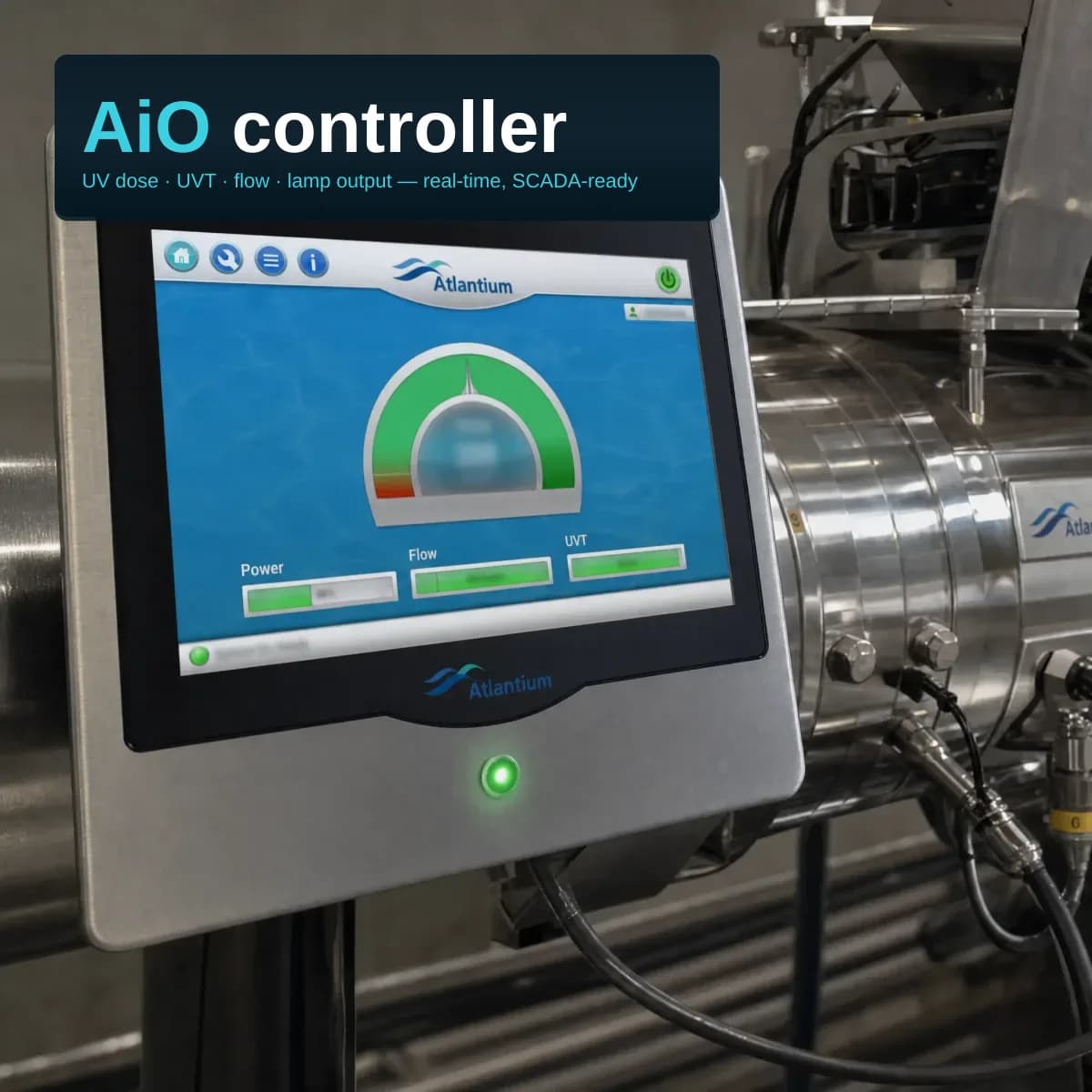
The cause of a low reading may lie outside the unit: a bypass in the flow signal, a UVT below design after a pretreatment change, lamps near the end of their hours or a fouled sensor window are among the things to rule out first.
The certificate statements are: for the RZ104 adenovirus line (model unstated), 10.0 to 56.3 m³/h, UVT of 85.3% and higher and power of 40% to 100%; and under LT2 for the RZ104-11, 2.3 to 137.4 m³/h, UVT of 77.9% to 97.3% and power of 40% to 100% (the RZ104-12 is 16 to 601 GPM at the same UVT and power).[11] They are where that certificate applies, not operating limits. They do not cover the other eight series, conditions outside those windows, power below 40%, the even-dose claim, or the displayed dose as an accurate reading. Fit and process design sit in the selection guide and the reference design linked above.
Send what Atlantium itself asks for: UVT at 254 nm, maximum and minimum flow, required dose, target pathogens, key water quality and application, with a process flow diagram.[10] Agree a model-specific validation letter with the ten fields above; the RZ104 model the adenovirus test used; the RED predicted at the stated flows, UVT and power; what the controller displays; who sets dose and mode (the page says the dose is set by the user and also "tailored by Atlantium’s team"[1]); displayed dose against setpoint at commissioning (this article's ask; Atlantium's FAQ says who commissions[10]); and sensor accuracy and calibration interval.
Atlantium HOD UV
Sources
- [1]Atlantium — Technology and Applications web page (page stamp 2026-02-05) — TIR account, headline claim, controller, lamp claims, certification link labels
- [2]Atlantium — HOD UV Technology & Products brochure (290524) — chamber, lamps, sensors, logging, unit volumes
- [3]Atlantium — Corporate brochure (291225) — graphic caption on validation
- [4]NSF International — NSF/ANSI/CAN 61 listing for Atlantium Technologies Ltd., current as of 2026-09-30 — trade designations, footnotes
- [5]NSF International — NSF/ANSI 55 listing page, current as of 2026-09-30 — no Atlantium entry on this page
- [6]US EPA — Ultraviolet Disinfection Guidance Manual, November 2006 final (EPA 815-R-06-007), NEPIS OCR text — dose distribution, lamp ageing, fouling, Table 1.4 (generic UV reference, not an Atlantium document)
- [7]Atlantium — news post, OC series validated for US (page stamp 2025-09-11) — maker statement, no report
- [8]Water Online — Atlantium press release on the R-200 and EPA ETV, 10 June 2013 — maker's claims carried by trade press
- [9]Atlantium — Food & Beverage market page (page stamp 2025-09-15) — validation wording
- [10]Atlantium — FAQ page — UVT definition, flow signal, lamp life, TIR efficiency, inputs, commissioning
- [11]HDR/HydroQual — Validation Test Certification, Atlantium RZ104 Series UV System (undated summary, hosted on atlantium.com) — flow, UVT and power windows
- [12]Atlantium — Bottled Water application brief (280724) — the three-parameter dose sentence
- [13]Atlantium — case study, beverage bottler in Punjab, India (120324) — a 5-log disinfection goal, no measured result
- [14]Atlantium — RZ104 Series datasheet (2020 vintage) — maximum flow wording, flow-signal footnote, lamp kW, unit volume
- [15]Atlantium — Market Insights, Bottling (April 2020) — 4-log and 5-log sentence
- [16]Atlantium — Market Insights, Carbonated Soft Drinks (April 2020) — the same sentence
- [17]Atlantium — news brief, PepsiCo Domodedovo plant (May 2020) — the same sentence
- [18]Atlantium — white paper on HOD UV for microbiological control (author byline 1 August 2022; uploaded 2024) — validation-letter fields, RED, plate counts
- [19]US EPA archive — ETV Highlights page, R-200 data review (condensed fetch; paraphrased only)