A buyer asks of an Atlantium HOD UV unit: what flow does it handle? For the RZ104, the 2020 datasheet answers "Application dependent" and asks the user to provide a flow signal.[15] The flows met elsewhere are not ratings: NSF/ANSI/CAN 61 certified minimum flows,[3] windows on one certificate,[8] connection sizes and case-study service flows. What decides fit is the dose delivered at the buyer's UVT, flow range and lamp power, which no document retrieved ties to a named model at a stated UVT, flow and lamp power.
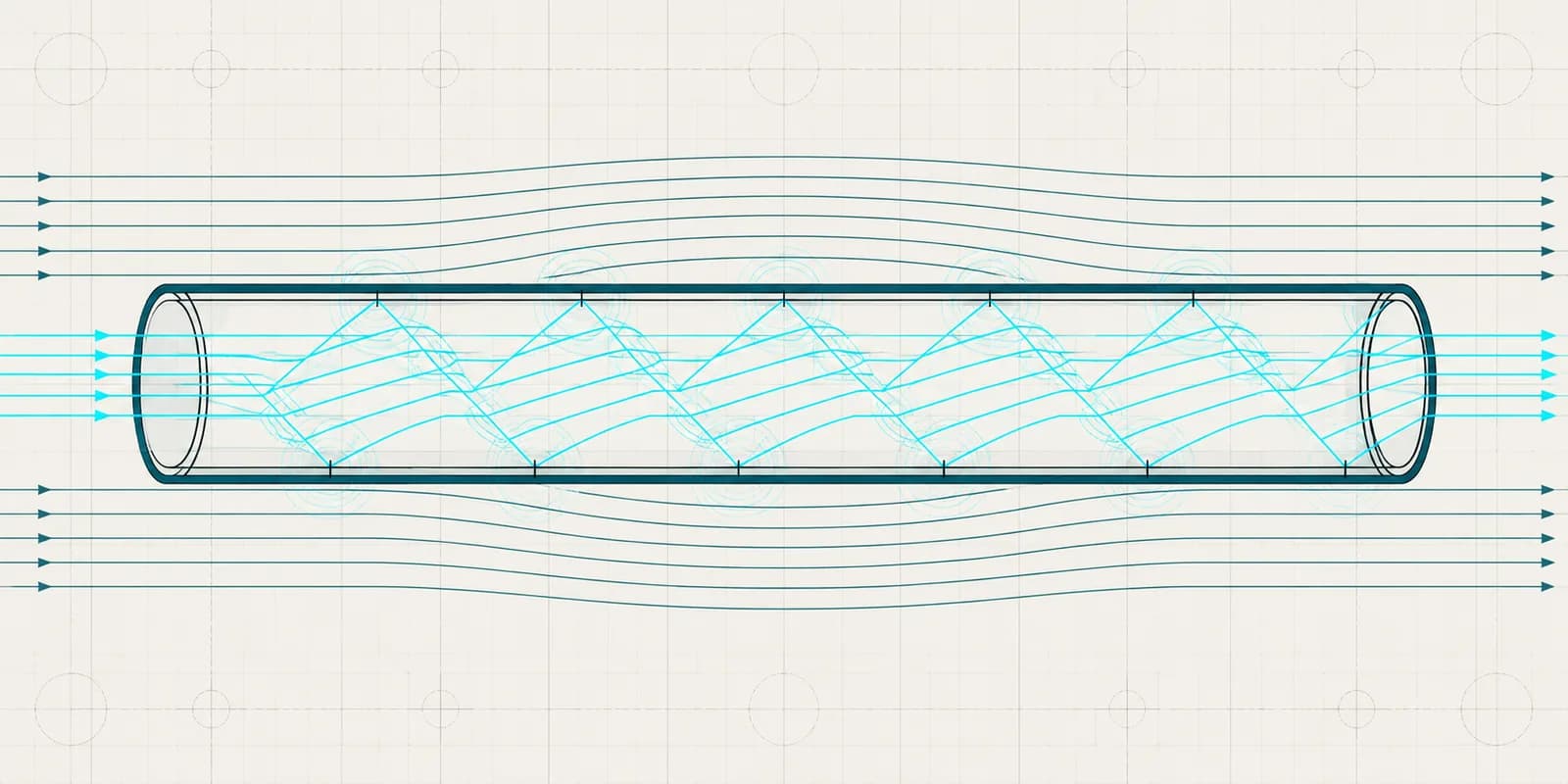
This guide is a procedure from measurement to a valid quote, ending in one of three answers: (1) an RZ104-11 inside its certificate's windows, with the delivered dose still owed by a model-specific sizing from Atlantium; (2) a larger tier with no window retrieved, needing its own validation letter; or (3) not this quote. An illustrative run of 16 and 12 m3/h at UVT 90% fires no stop [ASSUMPTION: activated carbon upstream removes the chlorine and the UV takes no dechlorination credit; invalid for chloramine without confirmed carbon performance]. Scope is the inline pressurised series. The mechanics article covers the chamber and the evidence, and a reference design works one RZ104-11 line.
Measure UVT and flow before reading any figure
UV acts on the organisms its dose reaches and leaves no residual; the FAQ notes that regulations in many regions often require a chlorine residual in distribution networks.[7] It is not a particle measure: the FAQ calls UVT and turbidity rarely correlated.[7] Atlantium puts the dose for chlorine at "hundreds of mJ/cm² versus tens for microbes".[7] No chlorine-removal dose, rate or residual is printed for any model in the documents retrieved, so a chlorine duty is a separate sizing question and a stop below.
Read symptoms as trends. Counts rising after a carbon stage (compare before and after, across seasons) point at the carbon bed (this guide's reasoning): Atlantium's brewery brochure calls carbon a breeding ground for bacteria and puts UV immediately after the carbon filter,[10] and its white paper, in its own risk-and-remediation section, says the position after the carbon tower carries the tower's microbial load.[19] Counts rising only downstream of the UV point at regrowth, since UV leaves no residual (this guide's reasoning). A continuous feed puts UVT and minimum flow first; recirculation puts temperature first, with lamps on to 60 C[2] and heating a risk;[19] an intermittent duty puts ignitions first, since lamp life depends on working hours and ignitions.[7]
Atlantium's input list adds pathogens, water-quality parameters, application type and a flow diagram to UVT, flow range and dose.[7] Inputs group by what each decides. UVT, pressure, temperature and any chlorine duty eliminate a tier; UVT, flow range and dose size it; supply, connection and space fit it. The rest only Atlantium can supply; none is printed in the documents retrieved.[2][15]
UVT is the percentage of 254 nm light passing through 1 cm of water,[7] not turbidity in NTU. Flow appears as GPM, gpm, m3/h and m3/hr; 1 m3/h is 4.403 GPM. Dose is mJ/cm2 RED tied to an organism.[19] A UVT margin can mislead [ASSUMPTION: UVT 90% after the carbon stage, used only to test the windows; invalid as a measurement of any real water]: 90% is 4.7 points above the certificate's 85.3% adenovirus edge, yet absorbance per cm is 1.51 times higher at 85.3% (0.0691 ÷ 0.0458): in absorbance terms the edge is closer than 4.7 points suggest (this guide's reasoning; no document prints how dose varies with absorbance).
Measure on a spectrophotometer at 254 nm in quartz cuvettes, or send a sealed 100 ml sample to Atlantium's salesperson.[7] Measure after the carbon stage, across seasons and flow states (this guide's reasoning). No regional UVT dataset or dose rule for Singapore, Malaysia or Indonesia was retrieved.
Screen by printed limits, size by dose
Screen tiers on the 2024 brochure. Maximum working pressure is 10 bar (145 psi) for RS104, RZ104 and RZ163; 7 bar (102 psi) for RZ300, RZB300, RZM200 and RZM350; 4 bar for EP900; 2 bar for EP600.[2] The worked UV sits before the RO feed pump, under 10 bar [ASSUMPTION: design layout]. Every inline table prints 60 C lamps on and 90 C lamps off; the 2020 RZ104 datasheet prints 125 C lamps off.[2][15] Housing is 316 or 316L, with super duplex offered on most 2024 tier tables, and 316L in the 2020 RZ104 datasheet; the electricity rows carry a "* Transformer required" note.[2][15] EPA's Table 1.4 (OCR-read) gives 186 mJ/cm2 for 4-log virus in US public water systems, not a beverage rule.[5] Atlantium's white paper, a compilation of beverage-company practices, lists for medium-pressure UV, each per the validation document or a minimum of that figure, for a process with no chlorination step: 100 mJ/cm2 RED after conventional chemical treatment, 120 after in-line flocculation with direct filtration, 100 after micro- or ultrafiltration; 40 is a reduction for a validated unit where chlorine disinfection is included.[19] Its remediation text recommends "HOD UV system on before each RO to provide 120 mJ/cm2 dose or higher"[19] and, for recirculating stored water, triples the RED of at least 40 that its stored-water guidance asks for.[19] PUB Singapore's case study sets a goal of 90 after RO, 60 to 90 in its table.[13] The FAQ's tens for microbes does not say which organisms or standard it covers,[7] and the white paper lists 40 to 120 by process.[19] The run takes 120 [ASSUMPTION: the reference design's choice; invalid if the facility's brand standard or regulator sets another].
The flow numbers printed in the documents retrieved are not ratings. The RZ104 datasheet prints "Application dependent".[15] NSF/ANSI/CAN 61 prints certified minimum flows of 11,520 GPD (8.0 GPM, 1.8 m3/h) for RZ104 and RS104, 17,280 GPD (12 GPM, 2.7 m3/h) for RZ163, and 115,200 GPD (80 GPM, 18.2 m3/h) for RZ300 and RZB300 (GPD ÷ 1,440 gives GPM). The listing does not say what they represent, lists RZM350 without one, omits RZM200, EP600, EP900 and the open-channel series, and is a health-effects standard certified "for use in municipal water treatment plants only".[3] Case-study flows, taken from Atlantium's own case studies and news briefs, are service points: Coca-Cola Philippines' RZ163-11 at "250 gpm flow rate" (56.8 m3/h);[11] a wipes producer's RZ104-11 at a "maximum flow rate of 20 m3/h";[14] and PUB Singapore's Kranji NEWater plant at 474 m3/hr per duty unit, 947 m3/hr in the table and 1240 in the text, unreconciled.[13]
One tier has a validated window, and it is a window, not a limit. The RZ104 certificate, undated and hosted by Atlantium, calls its adenovirus validation "restricted to flow rates between 44 GPM to 248 GPM, UV Transmittance Values 85.3% and higher, and power levels between 40% and 100%",[8] or 10.0 to 56.3 m3/h, on an RZ104 reactor whose model it does not give. The LT2 window for the RZ104-11 is 10 to 605 GPM (2.3 to 137.4 m3/h) at UVT 77.9% to 97.3%.[8] No window was retrieved for the other eight inline tiers, so a quote must bring its own letter. A window is not a minimum UVT. Atlantium's 2020 briefs say "accredited validation for 4-log virus and 5-log microbial inactivation"[16][17][18] with no certificate named for the 5-log figure; any log figure above 4 needs a named document.
The worked run is illustrative, not a rating [ASSUMPTION: RO feed of 16 m3/h full and 12 m3/h reduced rate, one RZ104-11 per branch (1 lamp, 1 kW[15]), at the 90% UVT and 120 mJ/cm2 above; invalid as a recommended duty] [ASSUMPTION: the adenovirus line, printed for the RZ104 model reactor with no model named, is read as covering the RZ104-11; valid until Atlantium names the model, invalid if only the RZ104-12 was tested]. 16 m3/h is 70.4 GPM (16 × 4.403), (248 - 70.4) ÷ 248 = 71.6% below the adenovirus top. 12 m3/h is 52.8 GPM, 1.20 times the 44 GPM floor, a headroom of (52.8 - 44) ÷ 52.8 = 16.7% of the 12 m3/h duty: the tighter edge, which a turned-down RO train could cross. Both sit inside the LT2 window, and 90% is 12.1 UVT points above 77.9%. The run ends with the flows inside the windows, not with a sized unit: whether one lamp holds 120 mJ/cm2 without lamp power pinned at 100% is a delivered dose that no document retrieved ties to a named model at a stated UVT, flow and lamp power. No derating curve for UVT, lamp age or fouling, and no turndown ratio, appears in the brochure, datasheet, certificate, FAQ or technology page.[2][15][8][7][1] Atlantium's technology page says the system adjusts lamp power to deliver the minimum dose set by the user, which it calls "guaranteed", and, in the same paragraph, that lamp power can vary between 25 and 100%; it does not say which model that describes.[1] The certificate's window is 40% to 100%,[8] so the quote must say whether the setpoint keeps lamp power inside it. A lower UVT or an older lamp spends lamp-power headroom, and a unit at 100% has none left (this guide's reasoning).
Choose a position, then read the quote
Each position has an advantage and a blind spot [ASSUMPTION: this guide's option set; Atlantium prints no tie-in rule in the documents retrieved]. The brewery brochure places UV immediately after the carbon filter;[10] the white paper places it before each RO and describes that location as post GAC;[19] the technology page lists post-granular activated carbon treatment and RO protection as separate applications.[1] Between the carbon stage and the RO, UV meets the carbon bed's load and leaves no residual downstream of the RO (this guide's reading). After the RO, Atlantium's Singapore case study describes three RZ Series systems, two duty and one standby;[13] that protects product water, not the RO membranes upstream (this guide's reasoning). A firewall UV ahead of the line, as the India bottler's case study describes, guards against a source event (this guide's reading), but the case study reports no measured result, only that production will commence shortly.[12] Recirculating stored water protects the tank; heat is its blind spot against 60 C lamps on.[19][2]
Interface and upset items are quote items, each with a named party. The flow signal is the user's to provide.[15] The FAQ wants a reliable meter reading with no diversion between meter and UV,[7] so duty plus standby needs a meter per branch (this guide's reading). Atlantium does not install;[7] piping is the installer's, and wiring and any pump interlock the facility's to settle (this guide's reading; none is assigned in the documents retrieved). The Singapore table is a maker precedent for duty plus standby, with no design rule; a standby covers a unit out of service, not a bad feed.[13] The brochure says lamp replacement needs no emptying of the lines or depressurisation,[2] yet a single-lamp RZ104-11 still raises the question of what the water receives meanwhile; ask that, and for head loss, restart time and the ICD drawing: "All dimensions and weights for reference only; ICD drawing should be used for design purposes."[2]
Decode the flow in every quote. A flow or capacity can be a certificate window, an NSF minimum, a service point or a connection size; none is the flow at which the unit delivers a stated dose, and Atlantium itself says "The UV Dose depends on three parameters: UVT, flow rate, lamp power."[9] Ask for the figure's UVT, dose, organism and lamp power, and for the validation letter's fields as the white paper lists them: conditions, protocol, approach, organism, log inactivation or RED, and the UVT and flow envelope.[19] Treat "Validated to regulatory standards"[6] as the maker's words, not adopted.
Lifecycle declarations carry no price. Atlantium lists "extra lamps, O-rings, connectors, and RO sleeves"[7] as consumables and a warranty of one year after installation or 18 months after shipment, whichever comes first (terms not retrieved).[7] The FAQ gives spare-part delivery of 24 to 72 hours for regions other than North America, subject to third-party shipping delays, and recommends storing essential consumables on site; it names no lead time for Singapore, Malaysia or Indonesia specifically.[7]
Who sets the dose is a quote line: Atlantium's technology page says the minimum dose is set by the user and also tailored by Atlantium's team, with commissioning by its representative.[1][7] The quote should name who sets it, on what organism and standard, and whose acceptance data closes it.
Keep UVT in the window, or stop quoting
Atlantium says "Commissioning includes system inspection, component checks, calibration, functionality testing, and training."[7] Record a baseline of displayed dose, flow, UVT and lamp power from the controller.[1] A weekly bench UVT on a spectrophotometer against the online reading is this guide's own check; sensor accuracy and calibration interval were not retrieved, so the tolerance is a quote item.
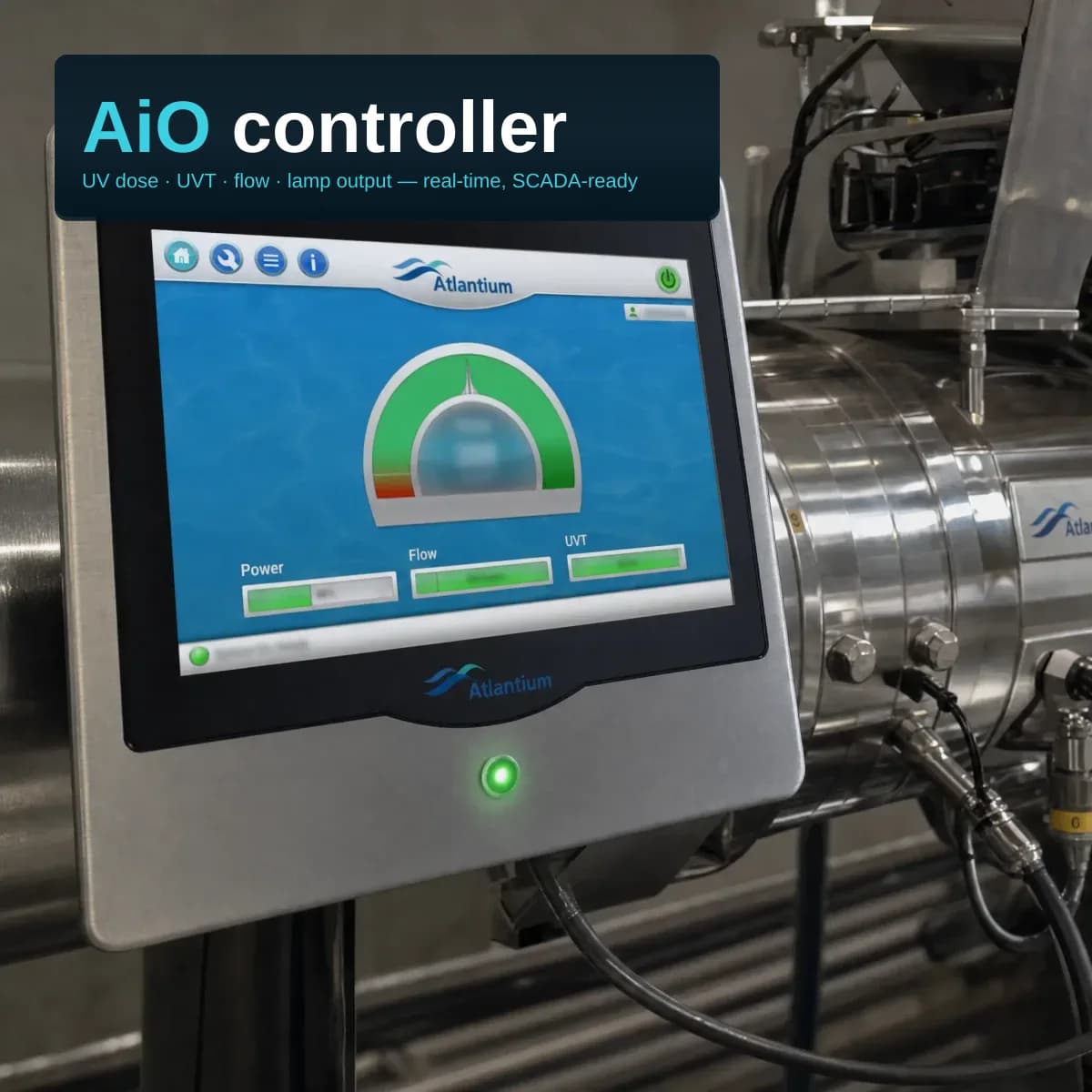
No maintenance interval, inline lamp rated duration or deposit prevention mechanism (DPM) service interval was retrieved. Lamp replacement alerts come from measured dose;[7] the lamp budget is a quote declaration. Re-measure UVT, flows, temperature, pressure, chlorine, chloramine and the dose standard whenever the source, season, duty or upstream stage changes. Staying inside a validated window is not a printed delivered dose at the buyer's flow, UVT and power point (this guide's reading): the certificate prints no dose delivered at any such point, only surrogate tests of 8.7 to 161.0 mJ/cm2.[8] A low plate count after UV is not a dose reading either (see the mechanics article).
Five stop conditions follow; none fires on the worked run (UVT 90%, 16 and 12 m3/h, carbon upstream, supply well below 60 C [ASSUMPTION: no regional temperature source was retrieved; invalid for a heated loop or a recirculation tank]).
- Measured UVT under 85.3%: no certificate cover for the 4-log line, and under 77.9% the LT2 window is gone too.[8] Next: ask for the letter's UVT envelope.
- Flow below 10.0 or above 56.3 m3/h: the adenovirus window ends.[8] Next: a model-specific letter, or no 4-log claim.
- A duty needing UV to remove chlorine: no per-model dose is printed, and Atlantium puts the dose class in the hundreds of mJ/cm2.[7] Next: a separate sizing request, or carbon upstream.
- Water over 60 C with lamps on, the printed limit.[2] Next: cool the stream or change position.
- A requirement for NSF/ANSI 55 performance certification: Atlantium is absent from the listing page retrieved, a dated snapshot of 21 manufacturers.[4] The standard's scope was not retrieved. Next: ask Atlantium for the listing; one page supports asking, not refusing.
An answerable enquiry sends the UVT trend after carbon by season, flows and the flow signal, dose with organism and standard, temperature, pressure, chlorine, chloramine and pH, the flow diagram, application type and supply. A competent reply names the model and lamp count, the delivered dose with the letter's fields, the RZ104 model behind the adenovirus test, head loss, restart time, lamp-swap behaviour, the ICD drawing and the lamp budget.
Atlantium HOD UV
Send this data pack with the quote request; the items above are the questions to put to whichever supplier answers.
Sources
- [1]Atlantium - Technology and Applications page, retrieved 2026-10-01 (26-item application list, AiO controller, lamp power range, dose-setting sentences)
- [2]Atlantium - HOD UV Technology & Products brochure 290524: inline spec tables for RS104 to RZM350, DPM row, ICD footer
- [3]NSF International - NSF/ANSI/CAN 61 listing for Atlantium Technologies, current as of 2026-09-30 (ten designations, minimum-flow footnote, municipal-plants footnote)
- [4]NSF International - NSF/ANSI 55 listing page, current as of 2026-09-30 (21 manufacturers; Atlantium not present)
- [5]US EPA - UV Disinfection Guidance Manual, November 2006 final 815-R-06-007 (OCR; Table 1.4 scope and virus values, lamp-aging sentence)
- [6]Atlantium - Food & Beverage market page, retrieved 2026-10-01 ('validated to regulatory standards' sentence)
- [7]Atlantium - FAQ page, retrieved 2026-10-01 (sizing inputs, UVT and turbidity, flow meter, commissioning, warranty, spares, consumables, lamp life)
- [8]HDR/HydroQual - Validation Test Certification, Atlantium RZ104 Series UV System (undated, hosted by Atlantium): LT2 and adenovirus windows
- [9]Atlantium - Bottled Water application brief 280724 (three-parameter dose sentence)
- [10]Atlantium - Breweries brochure 010125 (post-carbon placement, 50 m3/hr trial on spiked sterile water)
- [11]Atlantium - Coca-Cola Philippines case study 010124 (RZ163-11, 250 gpm, position after polishing filters)
- [12]Atlantium - beverage bottler India case study 120324 (firewall, 5-log goal, no measured result)
- [13]Atlantium - PUB Singapore post-RO case study 120224 (2 duty plus 1 standby, 474 m3/hr units, 947 and 1240 m3/hr)
- [14]Atlantium - news brief, wipes producer on RZ104-11, August 2020 (maximum 20 m3/h)
- [15]Atlantium - RZ104 Series datasheet QDSE0A00U-03.20 (2020): 'Application dependent' flow, 1 kW and 2 kW, 125 C lamps off, 316L
- [16]Atlantium - Market Insights, Bottling, April 2020 (5-log sentence, no certificate)
- [17]Atlantium - Market Insights, Carbonated Soft Drinks, April 2020 (same 5-log sentence)
- [18]Atlantium - news brief, PepsiCo Domodedovo plant, May 2020 (300 m3/h, old units before RO, same 5-log sentence)
- [19]Atlantium - white paper on HOD UV for microbiological control and chlorine replacement in beverage water treatment, byline 1 August 2022 (dose table, remediation text, validation-letter fields, recirculation)