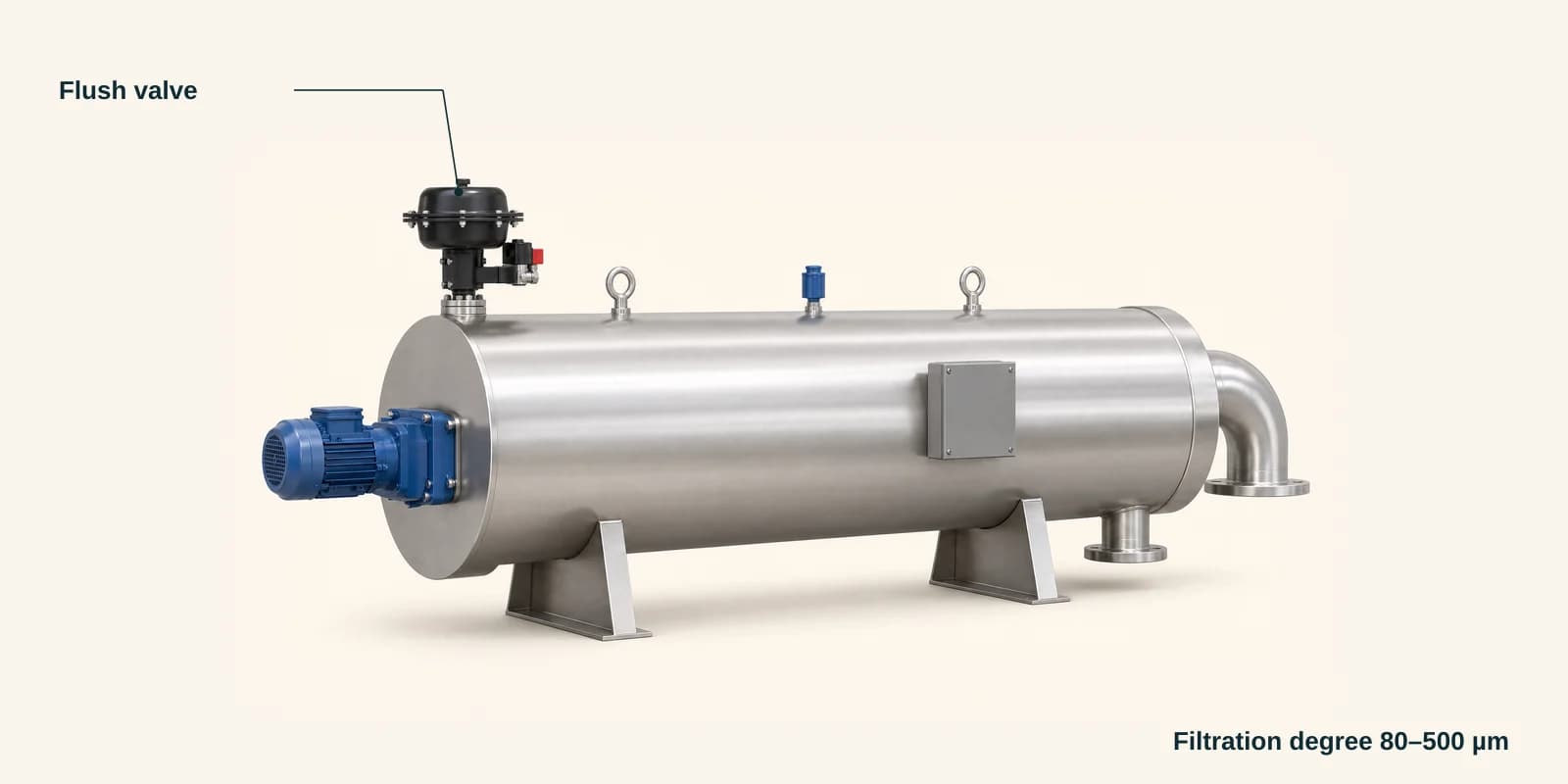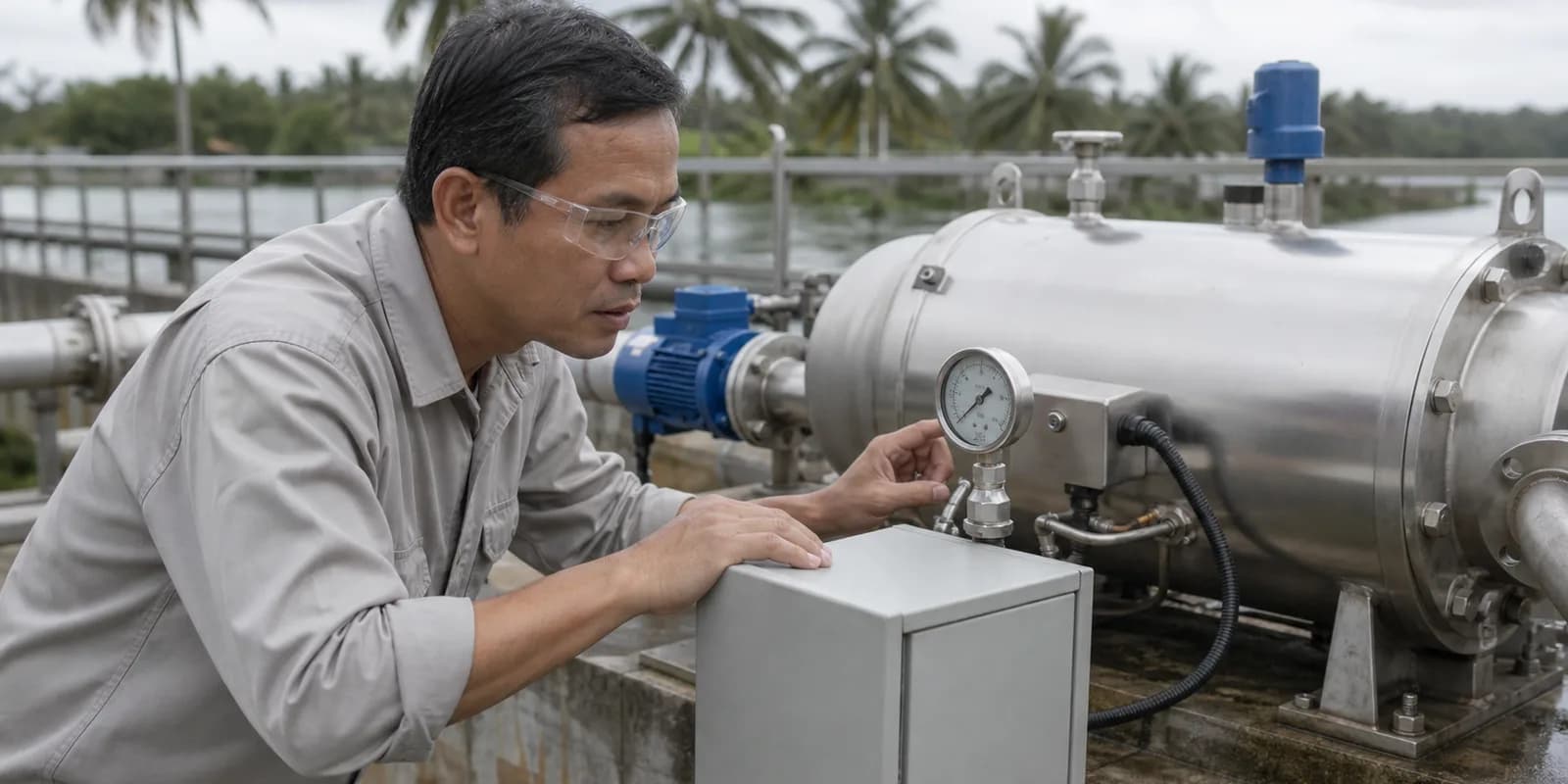
An automatic self-cleaning screen filter is built to hold back particles above its screen's rated grade and to clear the screen by a flush while it stays online.[1] Filtersafe says its Trident E starts cleaning on pressure difference across a dirty screen, on a timer or by a manual flush.[5] The pressure difference then falls back after each flush, which would show the filter working. That is the author's reading from generic hydraulics, not a Filtersafe statement. The other measure is the water each flush costs. Filtersafe's brochure builds the product from nozzlex proximity nozzles plus a four-layer smartweave sintered screen, which it names the EVERCLEAR automatic self-cleaning process.[5]
The cleaning words invite a misreading, that they are measured performance. The product page says the nozzle has "absolutely ZERO wear on the screen, due to the firm but minimal force the nozzle is calculated to have with the screen"[1] and that the nozzles "remove 100% of matter that builds upon the screen".[1] The page and the brochure give "Over 99% Recovery Rate".[1][5] Each is the maker's statement. The product page, brochure and catalog, retrieved on 2026-10-01, give a cleaning sequence and the minimum water one flush uses. They give no test basis for contact, retention or recovery.[1][5][6]
Four questions follow: the grade, the cycle, the cost of one flush and what must be measured on site. Model choice is the selection guide's question; a hypothetical configuration is the industrial reference design's.
The screen's grade is rated, not measured
Filtersafe's catalog prints an 80-500 um filtration degree range for all four models,[6] and the product page says the screen "automatically filters out all particles above the chosen micron rating".[1] The range reads as the span from which a rating is chosen. Which rating a unit carries, and any retention percentage, beta ratio or test method, is not stated in the documents retrieved. The misreading is to take 80-500 um as how much of a particle size is removed. The check is a written removal figure, with its test basis, at the chosen grade, before a downstream stage depends on it.
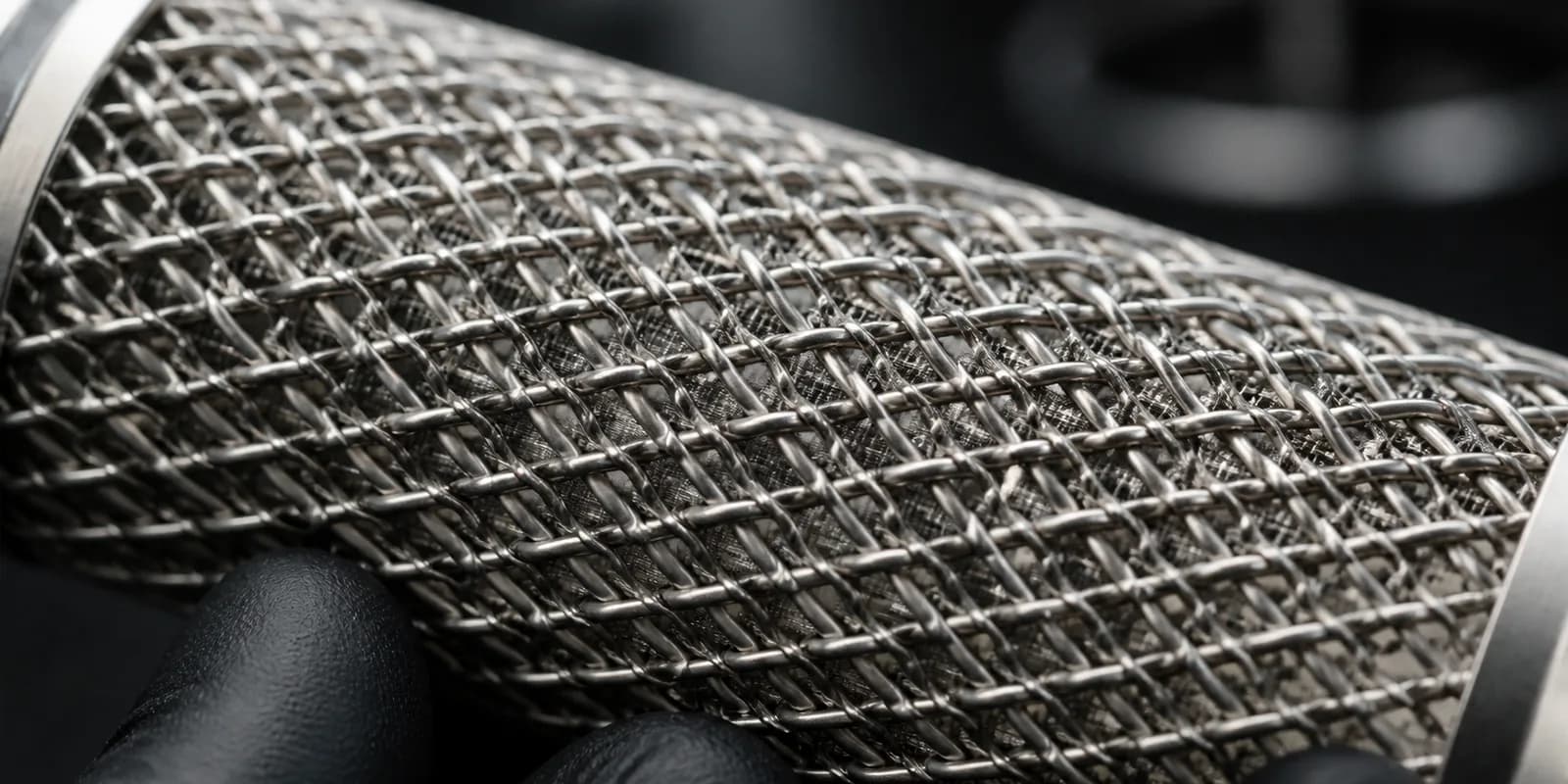
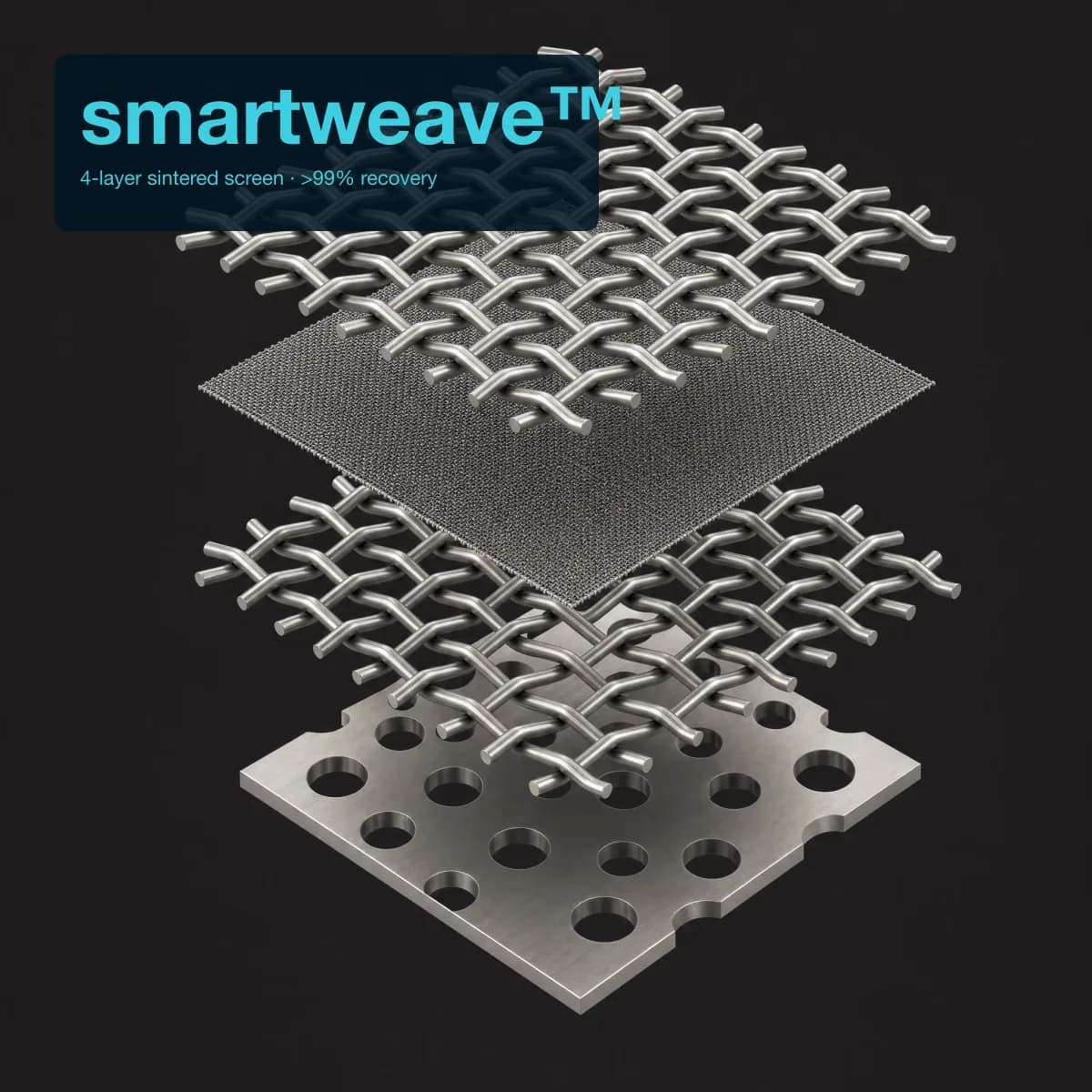
The product page describes four stainless-steel weave-wire layers in a multi-layered sintered structure.[1] Filtersafe's layer graphic labels them, top to bottom, protective, filtration control, protective and reinforcement, and draws the last as a perforated plate. It prints no mesh openings and does not say which face meets the raw water, so which layer sets the grade is a reading of a label.[3] The maker's flow diagram draws raw water passing a coarse screen, filling the bore and passing outward through the smartweave screen to the clean-water outlet.[3] No Filtersafe sentence says inside-out, so the direction is the author's reading. The catalog says the fine screen is "protected by coarse 6mm Pre screen",[6] and does not say what 6 mm measures or what that stage protects against.
What decides whether the screen keeps working is the solids reaching it against the cleaning that clears it. The mass reaching the screen each hour is flow Q (m3/h) times feed solids C (mg/L, which equals g/m3) times the fraction retained, eta, in g/h (derived here; eta is unpublished). Filtersafe says cleaning starts as differential pressure (DP), the pressure lost across the screen, builds up "when it's dirty".[5] A heavier feed, or a screen that retains more of it, therefore reaches the trigger sooner and costs more flushes (section 3; generic reasoning, not a Filtersafe statement). On the author's reading, a steady DP after a flush shows the screen is being cleared. It cannot show what passed. A screen with openings larger than rated would read the same (generic reasoning, not a Filtersafe statement). The check is a downstream solids measure, by the buyer's own method, taken at the same time.
The brochure does not say whether Max Capacity is a loading rating. The brochure prints Max Capacity of 180, 280, 400 and 600 m3/h over effective screen areas of 4,560, 6,840, 9,120 and 11,400 cm2, units read as cm2 because the last two print without the square.[5] Dividing gives 180 / 0.456 = 395, 280 / 0.684 = 409, 400 / 0.912 = 439 and 600 / 1.140 = 526 m3/h per m2, so the TRE0120 is 33% above the TRE0048 (derived here). The brochure's footnote on Max Capacity reads "Dependent on filtration degree, water quality and inlet size",[5] so it is a ceiling of unstated basis.
The brochure's construction line reads "Full 316 Stainless Steel Construction".[5] The catalog lists internals and seals under codes the author reads as polymer and rubber, beside AISI 316L body and screen,[6] so not every listed part is stainless, and their chemical compatibility is not stated in the documents retrieved.
Cleaning is documented, wear is only claimed
Filtersafe states that a cleaning cycle starts on differential pressure across the fine screen, on a timer or by a manual flush, controlled by an external PLC.[5] It adds that "Cleaning cycle initiation possible via preselected DP level, specific time, or combination of both"[5] and that "Length of flush is customizable".[5] No DP setpoint, interval or default is published in the documents retrieved, so the cleaning point is a number set at the controller. The catalog names two controllers, a Unitronics Jazz for one to four filters and a Siemens LOGO! for one.[6] The documents retrieved name no pressure sensor or range.
The sequence, in the maker's words, begins when the flush valve opens, "allowing water from the clean side of the screen to reverse back through the screen surface at high velocity".[5] Dislodged particles go to the cleaning nozzles and are expelled from the filter, in the maker's passive wording.[5] These sentences describe a reverse flow.[5] A drive motor rotates the cleaning mechanism, "moved laterally with the cleaning nozzles".[5] The product page says the unit provides "an uninterrupted supply of clean filtered water even during the flushing cycle".[1] Because the flush water comes from the clean side, the pressure available at the filter plausibly matters in every state (generic hydraulics, not a Filtersafe statement); the selection guide carries the pressure figures.
What the cycle acts with is listed: 5, 7, 10 and 12 nozzles for the TRE0048, TRE0072, TRE0096 and TRE0120, a 0.18 kW motor at 1,500 rpm and a 2 inch Victaulic flushing connection,[6] and a "Failsafe NC Flush Valve"[5] whose NC and fail-safe action are not defined in the documents retrieved. The documents retrieved name no sensor for particles passing the screen or for the volume a flush uses; the triggers the maker states are pressure, time or a manual command.
Zero wear is not no contact. The product page says "absolutely ZERO wear on the screen, due to the firm but minimal force the nozzle is calculated to have with the screen",[1] and the brochure lists "Zero screen wear + reduced nozzle wear".[5] The first says a force the nozzle is "calculated to have" acts between nozzle and screen; the second lists "reduced nozzle wear". Neither says the nozzle stays clear. Proximity is the maker's name for the nozzle, not a measurement, and, on the author's reading, the maker's diagram cannot show contact.[3] No wear test, service life or replacement interval appears in the documents retrieved. The check is to ask Filtersafe for the contact and wear basis in writing, and to inspect nozzles and screen at an agreed running time (generic practice).
The "100%" removal sentence likewise has no test basis in the documents retrieved, so it is never read as a removal rate.[1][5]
Flush volume is published, frequency is not
The catalog prints, per model, a minimum flush flow of 17.5, 24.5, 38.5 and 49 m3/h, a minimum flush volume at 1 bar of 131, 184, 289 and 368 L, and a 27 s flush on all models.[6] The volumes reproduce as flow times 27 s over 3,600: for the TRE0096, 38.5 × 27 / 3,600 = 0.28875 m3 = 289 L (derived here). The misreading is to take a table entry as a setting or a site cost. Min. reads as a floor, so a real flush may use more (author's reading), flush length is customizable,[5] and the catalog does not define @ 1bar as inlet, differential or back-pressure. No other pressure basis for the flush volume is published in the documents retrieved, and the catalog attaches "Dependent on filtration degree, water quality and inlet size" to the flush-flow row.[6]
That row disagrees with its own label. The label reads 5 m3/h per nozzle, but 17.5 / 5, 24.5 / 7, 38.5 / 10 and 49 / 12 give 3.5, 3.5, 3.85 and 4.08 m3/h per nozzle (derived here).[6] The volume row is consistent with the flow row and the 27 s duration; the per-nozzle label is the part that does not fit. The budget below uses the volume row as printed.
Two maker phrases carry the water claim. "Less than 1% Backwash Water Consumption" is on the brochure's first page[5] and the catalog cover.[6] "Over 99% Recovery Rate" is on the product page[1] and the brochure's first page.[5] Neither says what it is a percentage of, at what solids or grade, or whether recovery means water, particles or screen condition. They are not read against each other. One flush's volume does not corroborate the 1%, because whether consumption is below 1% depends on how often flushes happen.
What would the 1% allow, if it were a fraction of throughput? That is a labelled reading, derived here. Take a TRE0096 passing 300 m3/h, the industrial reference design's illustrative duty. Then 1% of 300 m3/h is 3 m3/h, or 3,000 L/h. At 289 L a flush, 3,000 / 289 = 10.4, so on average fewer than 10.4 flushes an hour, which allows at most 10 whole flushes, one every 60 / 10.38 = 5.8 minutes at the quickest. Those flushes use 10.38 × 27 s = 280 s of each hour, 7.8% of the clock. In general the allowed count is 10 × Q / V per hour, with Q in m3/h and V in L, so a flush of more than 289 L lowers it.
The coupled pair is the trigger setting against water. A lower preselected DP or a shorter timer means flushes sooner and more often, and flush water per hour is the count times the volume per flush. A higher DP lets solids build and the pressure lost across the screen rise (generic reasoning), a cost the catalog's head-loss charts, which have no data table, cannot quantify.[6] On that reading the 1% holds only where cleaning is needed no more often than that bound, a site test. No maximum flush frequency, minimum interval or maximum trigger DP is published in the documents retrieved.
Maker claims stay unproven until measured on site
The evidence on file is Filtersafe's own: a product page, a brochure and catalog marked 2022, and diagrams the author reads. No independent laboratory report, test report or retention result for the Trident E appears in the maker's documents read,[1][5][6] and web searches on 2026-10-01 returned no result naming a Trident E installation in Singapore, Malaysia or Indonesia.[4] The support page lists installation, operation and maintenance instructions as a service and links none.[7] As read on 2026-10-01, Filtersafe's certifications page lists no Trident E model code under its DNV, USCG, China Classification Society or Bureau Veritas entries or its NSF/ANSI/CAN 61 entry, which names the Titan Series.[2] The catalog says its data is "for general information only and cannot be used for quotation purposes".[6]
The first ambiguous reading is a pressure difference that does not fall back after a flush. It can be incomplete cleaning, a higher flow than the earlier reading, since loss through a fixed path rises with flow (generic reasoning), a heavier feed, or a change downstream; the list of causes is the author's diagnostic reading, not Filtersafe guidance. The check is to compare readings at the same flow, log what triggered each flush, and log feed solids.
The second is flushes per hour, or drain volume per flush, that look high or low. A high count can come from heavier solids, a low DP preselect or a short timer. A volume above the catalog figure can come from a longer flush or a higher pressure than the 1 bar basis; below it, from a lower pressure (generic reasoning). The check is to meter or tank-measure the drain per flush, log pressure at the filter during it, and compare the count with 10 × Q / V at the site's own flow.
On the author's reading, a cleaning claim is reproducible only with the pressure difference before and after the flush at one flow, the flush count by trigger type, and the flush duration and drain volume with the pressure logged; a retention claim is reproducible only with the screen grade, flow, feed solids, inlet pressure and the downstream measure the buyer's own stage requires, read at the same time. Acceptance names its instruments: inlet and outlet pressure, flow, a metered drain, the controller log and the downstream method.
The record supports three things as description: the catalog's minimum flush figures at their stated basis, the trigger options and sequence, and the grade as a rating. It does not hold for retention, contact, wear, the 1% and 99% claims, flush frequency, capacity at a grade or head loss at a duty.
The data to send is the flow range, the grade wanted, feed solids across seasons, the pressure available at the filter during a flush, and the downstream protection requirement. The terms to agree are the basis of Less than 1% and Over 99% Recovery Rate, flush volume at the operating pressure and what @ 1bar is, head loss clean and at the trigger DP, retention by grade, the contact and wear basis, and the acceptance readings and pass limits.
Filtersafe Trident E Series
No certifications listedView product →Sources
- [1]Filtersafe — Trident E product page (retrieved 2026-10-01) — benefits list, smartweave and nozzlex text, cleaning steps, settings note
- [2]Filtersafe — Standards, Approvals and Certifications page (read 2026-10-01) — model codes listed under each entry; absence of any Trident E code
- [3]Filtersafe — Trident E flow diagram and screen-layer graphic (maker images, labels as printed; flow direction and layer reading are the author's)
- [4]Negative search record, 2026-10-01 (two web searches) — no result naming a Trident E installation, and no Trident E installation manual, returned
- [5]Filtersafe — Trident E Series brochure, DOC-00560 ver.1 (2022) — headline table, composition line, cleaning sequence, settings, Max Capacity footnote
- [6]Filtersafe — Trident E Series catalog, DOC-00561 (2022) — specifications, flush rows, controllers, materials, head-loss charts, disclaimer
- [7]Filtersafe — Support page (retrieved 2026-10-01) — installation, operation and maintenance instructions listed as a service, none linked