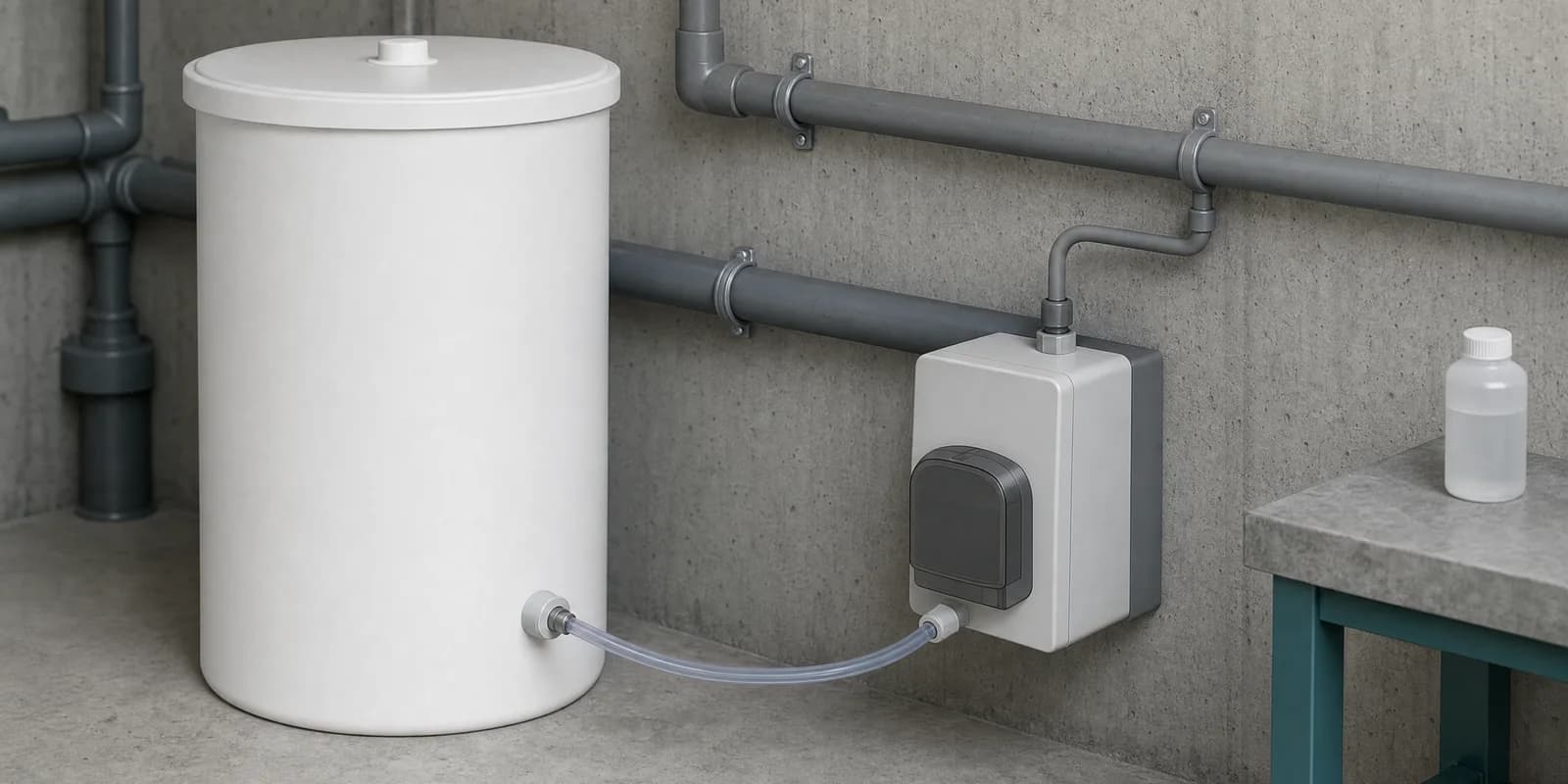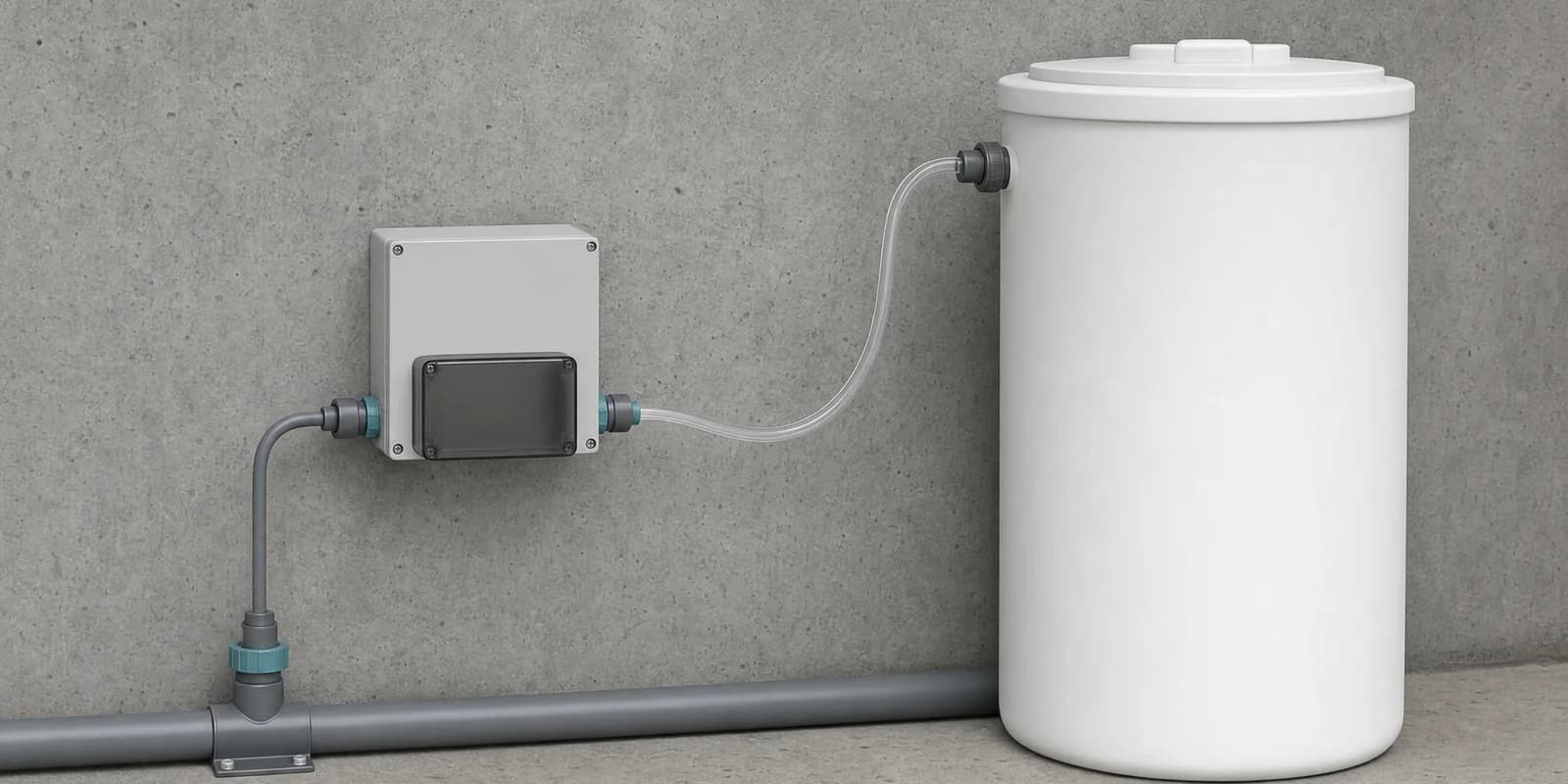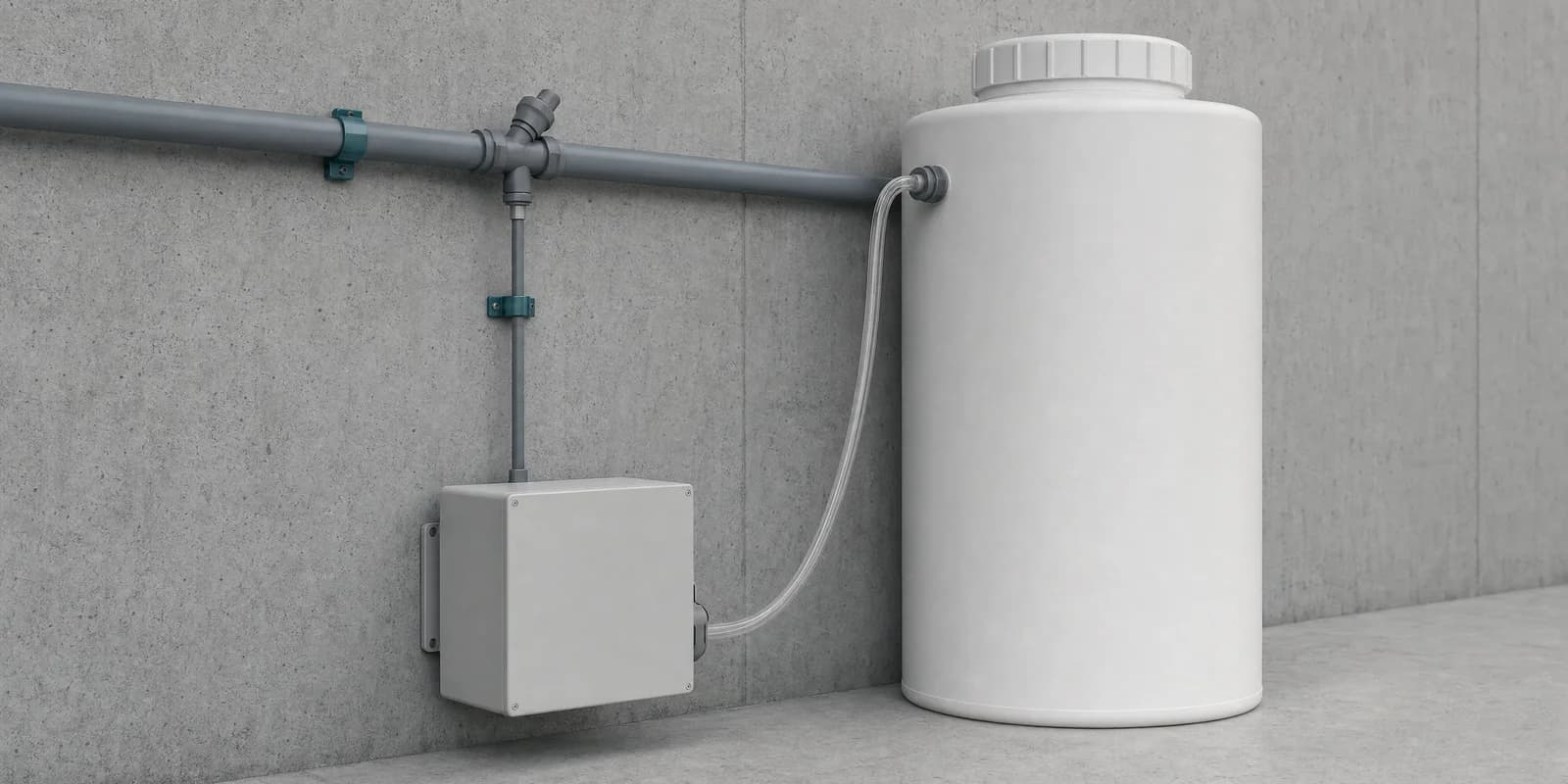
A peristaltic metering pump delivers a set volume per minute by moving liquid through a replaceable flexible tube (this article's wording), and the data sheet of the Blue-White FLEXFLO A-100N peristaltic metering pump, in its A-100NV (digital) version, states that volume in mL/min for each tube and motor speed[9], for running water at 70 °F at sea level, the manual's table heading.[10] Blue-White's help center calls it a positive displacement pump (condensed return).[2] It combines a DC motor, a replaceable tube assembly, an injection fitting with a check valve, tube failure detection (TFD, called TFD+ on later builds) and an input for an optional flow sensor.[10]
The misreading is to take Blue-White's feature line "Cannot vapor lock or lose prime."[9] to mean the pump cannot lose delivery. The product page attributes the claim to the peristaltic pump design.[1] Read against the manual's text on suction, gas and the injection fitting, it can hold only for the pump head; that scope is this article's reading, not Blue-White's wording. In one trade guide's description (condensed return), vapor lock is a pump that keeps running but stops moving liquid because gas has collected.[5] Four questions follow: what the claim covers, what the rated flow assumes, what the evidence shows and what to measure. The selection guide and the pool reference design hold the rest. Short answers: the claim can hold for the head, carries no gas volume and leaves flow following the suction line; the line has a check valve; no independent test was found; calibration at the site's suction line shows delivery there.
The claim reads as a pump-head claim
Blue-White's data sheet states "Cannot vapor lock or lose prime."[9] beside "Does not have valves that can clog requiring maintenance."[9] The manual states "Self priming under maximum pressure. Cannot vapor lock."[10] beside "Peristaltic Pump Tube does not require valves."[10] No Blue-White document read uses the word head for the claim; on this article's reading it can hold only for the pump head's tube-and-roller action, not the line from tank to pipe.
The Chlorine Institute's Sodium Hypochlorite Manual (pamphlet 96, 2006) is a North American trade-association document, no newer edition was checked, and it does not discuss pump types.[11] It says decomposition cannot be avoided but its rate can change. A slower pathway forms oxygen, "a very slow side reaction",[11] and metal ions such as nickel, copper and cobalt speed it. UV light also decomposes hypochlorite, mainly to oxygen and chlorate, and at similar temperature, pH and metal content weaker solutions are more stable.[11]
The pamphlet says hypochlorite stored at 15 °C decomposes 14 times slower than at 35 °C; derived here, its Table 3-1 gives 23.1 ÷ 1.65 = 14.0 in the 15.89% column and 14.8 to 18.2 in the other four.[11] The table prints no unit, so this is the decomposition rate of the stored solution, not a gas volume [ASSUMPTION: the columns compare for direction only, not as a rate for any site solution].
One trade guide, author and date not returned and read in a condensed return, tells the head designs apart (statements, not a test result). In a conventional diaphragm pump bubbles collect under the discharge check valve and "the pump loses prime while continuing to run";[5] in a peristaltic pump "gas bubbles simply pass through with the liquid".[5]
On Blue-White's own wording the head needs no valves; the line has a check valve. The standard injection fitting holds a ceramic check ball and a half-psi spring.[9][10] The manual says "This fitting will require periodic cleaning, especially when injecting fluids that calcify such as sodium hypochlorite."[10] Deposits "can clog the fitting, increase the back pressure and interfere with the check valve operation".[10] No cleaning interval appears in the data sheet, manual or 2026 catalog pages read.[9][10][13] It installs upward: "To prevent trapped gases, install the fitting in an upward direction."[10]
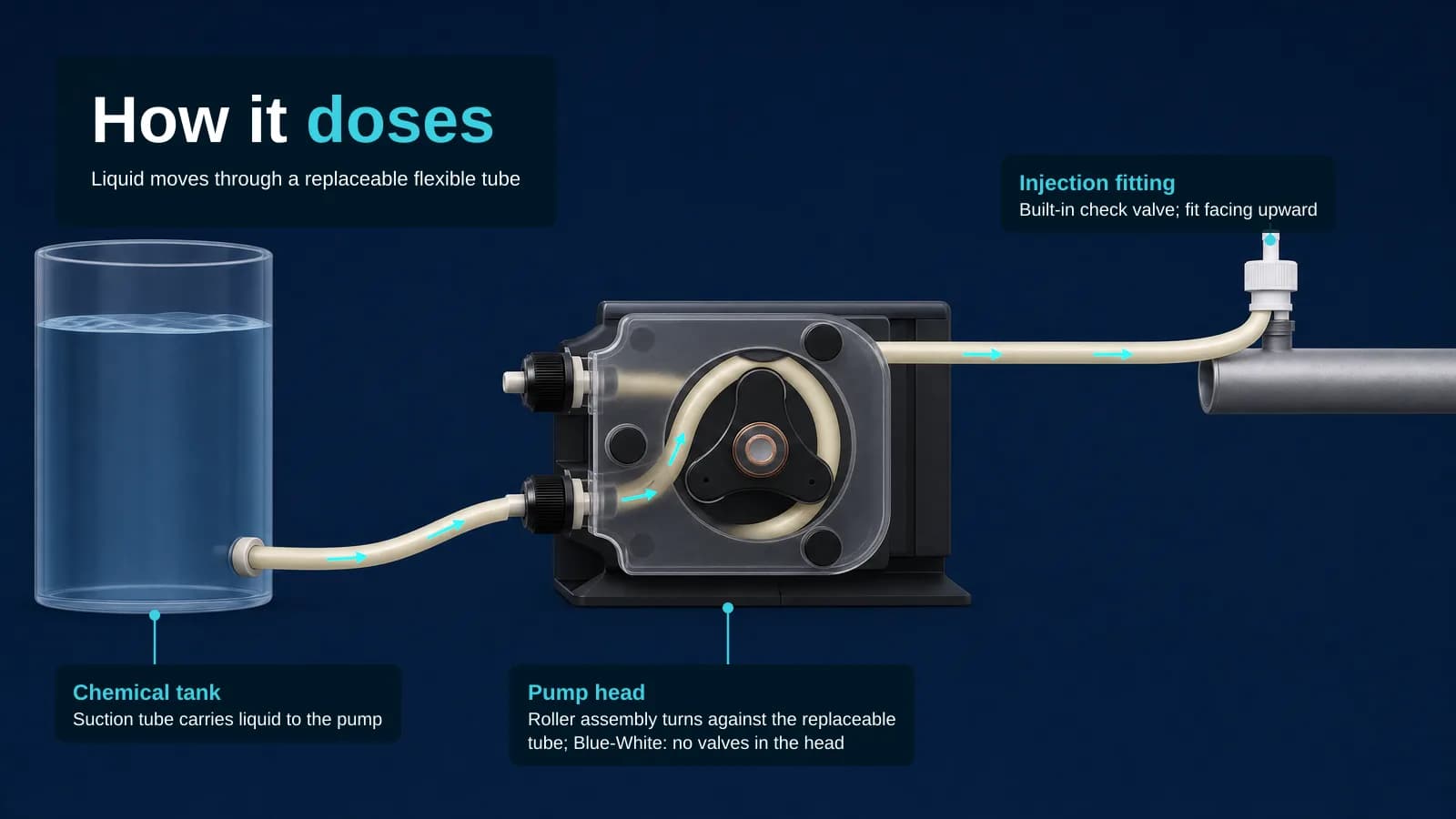
The limit is the tube, a wearable part: "The tube has been designed for a minimum service life of 500 hours."[10] This article reads tube replacement as the maintenance cost of a head with no valves (reasoning), and the same trade guide, in a condensed fragment, mentions scheduled tube replacement.[5] A running pump with no alarm and a falling residual does not show the head is fine: the solution may have weakened, the tank may be empty or the suction line leaking air, the fitting may be calcified, the tube worn, or demand risen (reasoning). Check with a calibration-cylinder run at the discharge, the tank level, a strength test of the delivered solution and a look at the fitting.
The rated flow is a water figure
The data sheet's maximum-flow table is, in the manual's heading, based on running water at 70 °F at sea level.[10] Tube 4 (Flex-A-Prene, 1/4 inch OD) is rated at most 6.0, 13, 21 and 25 mL/min at 14, 30, 45 and 60 RPM, at 100 psi (6.9 bar), or 75 psi at 60 RPM.[9] The sheet also prints 130 °F (54 °C) fluid, 5,000 centipoise and 30 ft suction lift at sea level.[9] The table's maxima run from 0.36 to 19.56 L/h across tubes and speeds, never one pump's range.[9] Blue-White states "Blue-White tests its products with water only."[10] Its compatibility chart states a 28-day immersion basis at 73 °F and says its information was supplied to Blue-White, so a hypochlorite rating there rates the tube material, not pumping and not a Blue-White pump test.[12]
The feature line "Output volume is not effected by changes in back pressure."[9] has no figure behind it: the data sheet, manual and 2026 catalog pages read show no flow-against-pressure curve and no accuracy figure.[9][10][13] The manual says "Longer tubing increases the back pressure at the pump tube."[10] and a calcified fitting raises it.[10] The manual, which covers both versions, also says "The A-100NV pump flow rate will vary depending on the suction line conditions and solution viscosity."[10] Calibration results should be similar to the flow rating but can vary with chemical, lift, viscosity, temperature and elevation, and flooded suction reduces output error from lift.[10] A pump that keeps its prime can still deliver a different volume on two installs (reasoning).
Tube failure detection stops the pump when chemical enters the head.[10] Blue-White lists "Includes Flow Verification System (FVS) - sensor sold separately."[10] The FVS alarm delay "allows the pump to clear any gases that may have accumulated during stopped operation",[10] so the maker treats gas as something that can collect (reasoning); the manual does not say where. The A-100NV's prime runs 99 seconds, and its troubleshooting list has the entry "Air is entering the pump."[10] Without a flow sensor the pump cannot see delivered flow, and the optional sensor checks that flow pulses arrive, not the volume (reasoning).[10] It does not read solution strength or tube wear (reasoning), and the A-100NV's SERVICE icon counts running time.[10]
The pair is gas tolerance against tube changes. The trade guide's side: auto-degassing heads are close to mandatory on hypochlorite for diaphragm pumps.[5] Blue-White's side is the head's gas tolerance, with no published gas volume, and the tube: "Tube Assemblies may last only a few days/weeks, or can last longer than a year in a specific application."[10] and "However, Tube Assemblies should be replaced at least once a year."[10] Derived here from the 500-hour minimum for a pump running continuously [ASSUMPTION: 24 hours a day; a pump stopped for part of the day takes proportionally longer]: 500 ÷ 24 = 20.8 days, and one year is 8,760 hours, 17.5 times that minimum. The manual's "a few days/weeks" begins below 20.8 days, so at the short end the manual prints both statements and does not reconcile them; 17.5 changes a year is not a ceiling and no typical life appears in the documents read.[10] Blue-White offers an estimate for a stated duty, a quote item.[10]
Each edge is a published limit or a stated absence: no document read gives a gas volume or flow beyond which the head or the line stops delivering. Outside the pump: a covered tank with the pump never directly over it, because fumes may damage the unit, but beside or lower than the container; lower also gives flooded suction, with a shut-off;[10] an opaque tank, since UV forms oxygen;[11] and cooler storage, which slows decomposition (direction, from Table 3-1).[11]
No independent test of the claim was found
The evidence retrieved for the A-100N's claim is Blue-White's own data sheet (Rev 11, 23 December 2025), manual (Rev 22, 26 December 2025) and product pages, which state it.[9][10][1] Its test statements are water only and a factory pressure test with clean water.[10] No independent test of vapor-lock immunity, gas volume, accuracy or tube life by chemical was retrieved from any source.
Four vendor-tier statements, each retrieved in a condensed return, give statements rather than numbers: the trade guide above; a distributor's blog about another maker's pump, whose statement that it has no check valves describes that pump;[7] a peristaltic-pump maker's marketing manager in 2007, who says hypochlorite's entrained gas can vapor-lock diaphragm pumps and whose claim of thousands of hours of hose life is about industrial-duty hose pumps, not the A-100N;[6] and a diaphragm-pump maker's article, which says roller-pump hose degrades and, unless the unit has leak protection, a rupture can leak (about roller pumps in general, not Blue-White's).[8]
Blue-White's own diaphragm page says its dual-diaphragm design "will not lose prime" (condensed return).[4] The same maker uses similar words for two pump classes, and this article found no measurement behind either.
The NSF International NSF/ANSI/CAN 61 listing for Blue-White Industries, current as of 1 October 2026 by its own header and read that day, lists water-contact materials for the pattern A1Nabc-de-f-ghij.[3] Its model key allows tube codes 4, 6, 7 or 8 and the letter X,[3] which the data sheet's matrix gives as an ordering option on tubes -4T, -6T, -7T and -8T only, shipped without strainer, weight, tubing and injection fitting.[9][10] Materials were evaluated with the diluted chemical at its maximum use level.[3] The page says nothing about gas handling, accuracy or delivered flow and does not name the A-100NF or A-100NV.[3] The selection guide holds the option's scope.
A dark SERVICE icon does not mean the tube is fine. "After approximately 500 hours of accumulated running time, the SERVICE icon will light."[10] It can be reset to add 500 hours. The manual calls it a reminder that the tube is nearing its minimum life; it counts time and does not read tube condition (reasoning), and tube life depends on the chemical, back pressure, temperature, viscosity and motor speed.[10] Do the weekly check the manual asks for; cracking or discoloration in the first week signals severe chemical attack.[10]
A tripped leak test does not mean every leak will be seen. The manual's test, run with the tube and roller assembly removed, is to "Place a small amount of the chemical in the bottom of the pump head - just enough to cover the sensor."[10] and expect a stop after a five second confirmation, which shows that unit, that chemical and that quantity. Pumps made before 5 January 2026 use standard TFD, later ones TFD+ with an optical sensor.[10] Blue-White's help center describes standard TFD as conductivity across two sensors and, in its polymer-pump FAQ, TFD+ as optical refraction.[2] No detection threshold appears in the documents read; the only timing is the five-second confirmation in the test, and the response to a dilute or slow leak is not stated.
Prove delivery by calibration at your suction line
Delivered flow at a setting is reproducible only when the figure carries the chemical and its strength with its basis; the suction arrangement (flooded or lift, line length, strainer); the discharge pressure at the pump tube, fitting included; the temperature; the tube, its matching roller assembly and its age; and the motor speed (reasoning). Acceptance is therefore a calibration run at the site's own suction line, not the maker's water table: connect that line, discharge into a cylinder, run a set speed for a minute, record the volume, then repeat or run a second speed.[10] Strength needs its basis: trade percent is grams per litre divided by 10, so 12.5 trade percent is 125 g/L,[11] and the pump documents do not say which basis a supplier's label uses.
As engineering judgment, tube 4 at 30 RPM tops out at 13 mL/min;[9] at the manual's 10% working floor that is 1.3 mL/min,[10] so a one-minute run collects 1.3 mL, too little to read well, while a 30-minute run collects 39 mL [ASSUMPTION: flow is proportional to speed; valid when the two-speed calibration confirms it, invalid if the two speeds disagree].
Leak detection is reproducible only with the unit's build date, the chemical, the quantity and the manual's test (reasoning). Ask Blue-White for the build date and a detection threshold; none is published in the documents read.
The envelope, as Blue-White states it and on this reading: the head has no valves in the tube path; the flow figures are for the named tube, speed and water at 70 °F; the manual's test is stated to stop the pump for its quantity. The documents read do not support delivery independent of the suction line, no valves for the line, any gas volume, an icon as tube condition, a certification as performance or a published accuracy figure.
Send the chemical, its strength and basis, tank and pump temperature, suction arrangement, injection-point discharge pressure, model code and daily running hours. Agree a written calibration at the site's suction line with repeats, a buyer-set tolerance before order (none appears in the documents read), a tube life estimate for the stated duty, the unit's build date, and the fitting's cleaning interval and material compatibility. The selection guide holds the quote clauses and the pool reference design the alarm and the daily test.
Blue-White FLEXFLO A-100N Peristaltic Metering Pump
Sources
- [1]Blue-White Industries — A-100N product page, raw text read 2026-10-01 (the claim as printed)
- [2]Blue-White Industries — help-center pages for the A-100NV, condensed return read 2026-10-01 (positive displacement description; TFD and TFD+ sensing basis)
- [3]NSF International — NSF/ANSI/CAN 61 listing for Blue-White Industries, current as of 1 October 2026 by its own header
- [4]Blue-White Industries — MD3 multi-diaphragm metering pump page, condensed return (the maker's own diaphragm claim)
- [5]Water & Wastewater — Chemical Metering Pumps for Wastewater: Selection and Sizing Guide (trade guide, author and date not returned, condensed return)
- [6]Chemical Online — Peristaltic Pumps: A Simple Solution For Metering The Most Corrosive Chemicals, 26 January 2007 (vendor-authored by a peristaltic-pump maker's marketing manager, condensed return)
- [7]Empowering Pumps and Equipment — Eliminate Vapor-Lock When Metering Disinfection Chemicals, 9 February 2018 (distributor blog about another maker's pump, condensed return)
- [8]Graco — Peristaltic Pumps vs Diaphragm Pumps (diaphragm-pump maker's article, date not returned, condensed return)
- [9]Blue-White Industries — A-100N FLEXFLO data sheet 85000-197 Rev 11, 23 December 2025 (flow table, ratings, feature lines)
- [10]Blue-White Industries — A-100NF and A100NV operating manual 80000-381 Rev 22, 26 December 2025
- [11]The Chlorine Institute — Pamphlet 96, Sodium Hypochlorite Manual, Edition 3, April 2006 (trade-association manual, copy hosted by a Pennsylvania state agency)
- [12]Blue-White Industries — Tube Chemical Compatibility chart, page dated 08/11/2025
- [13]Blue-White Industries — Industrial Catalog 2026, A-100N pages