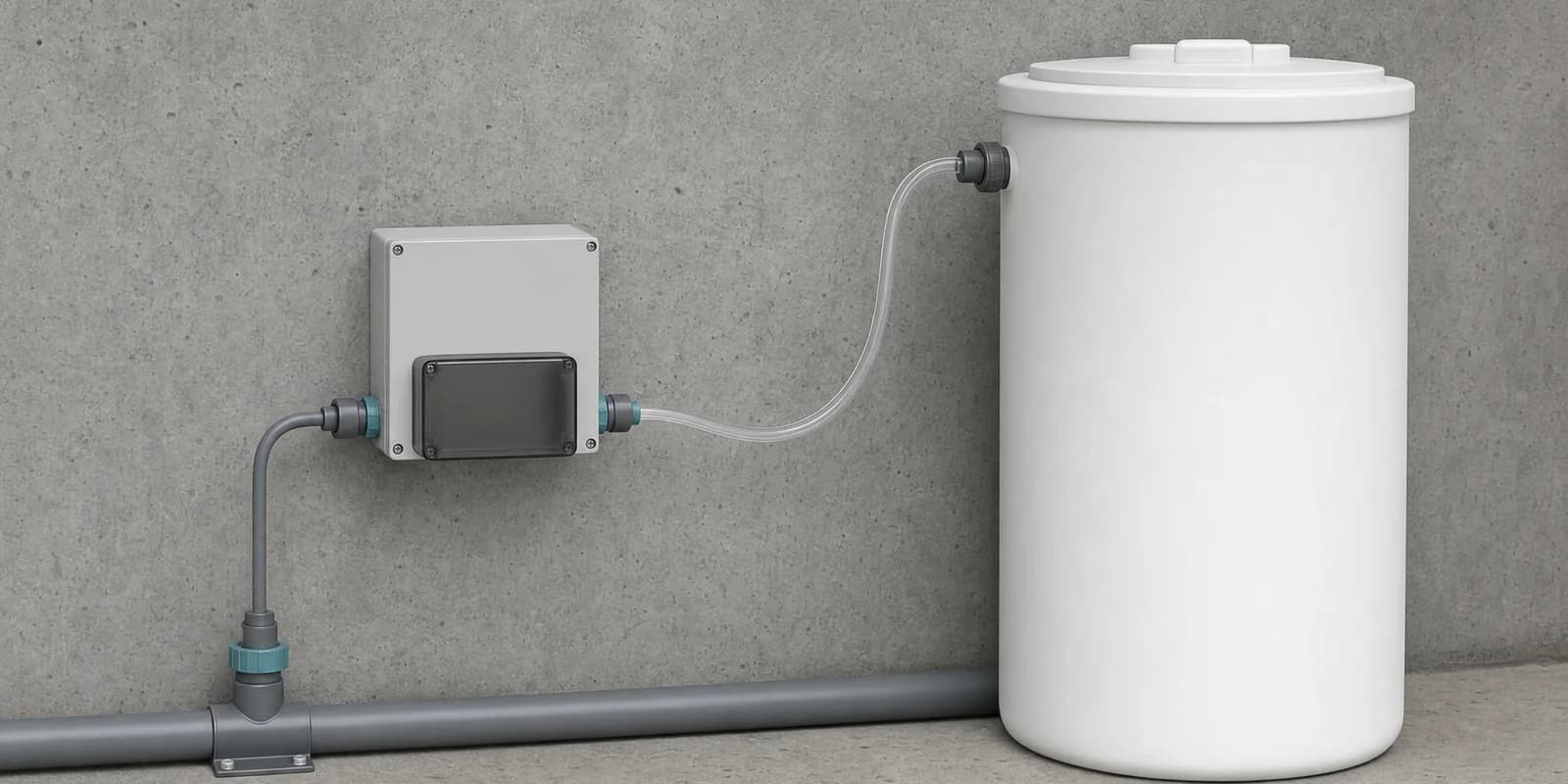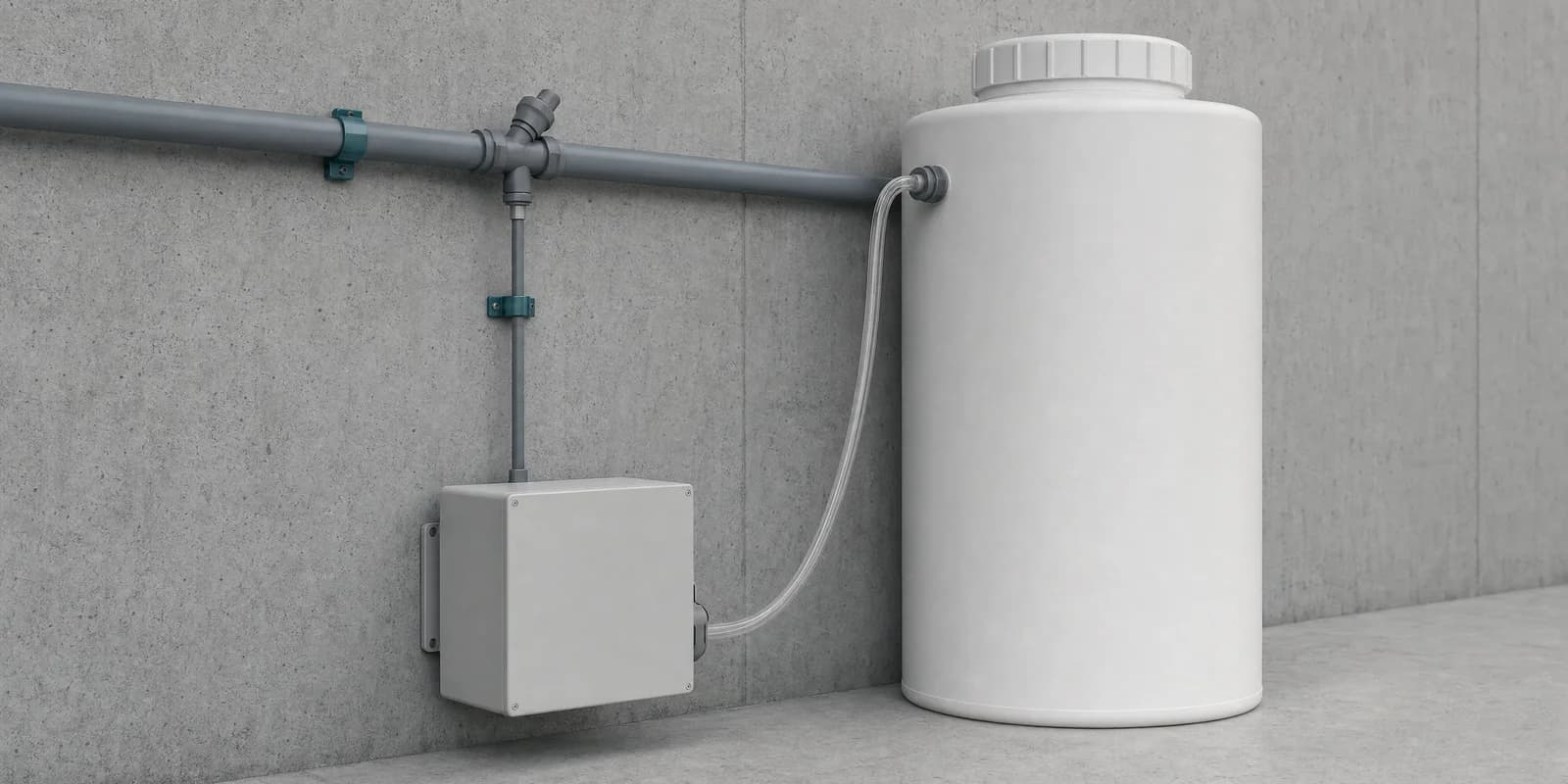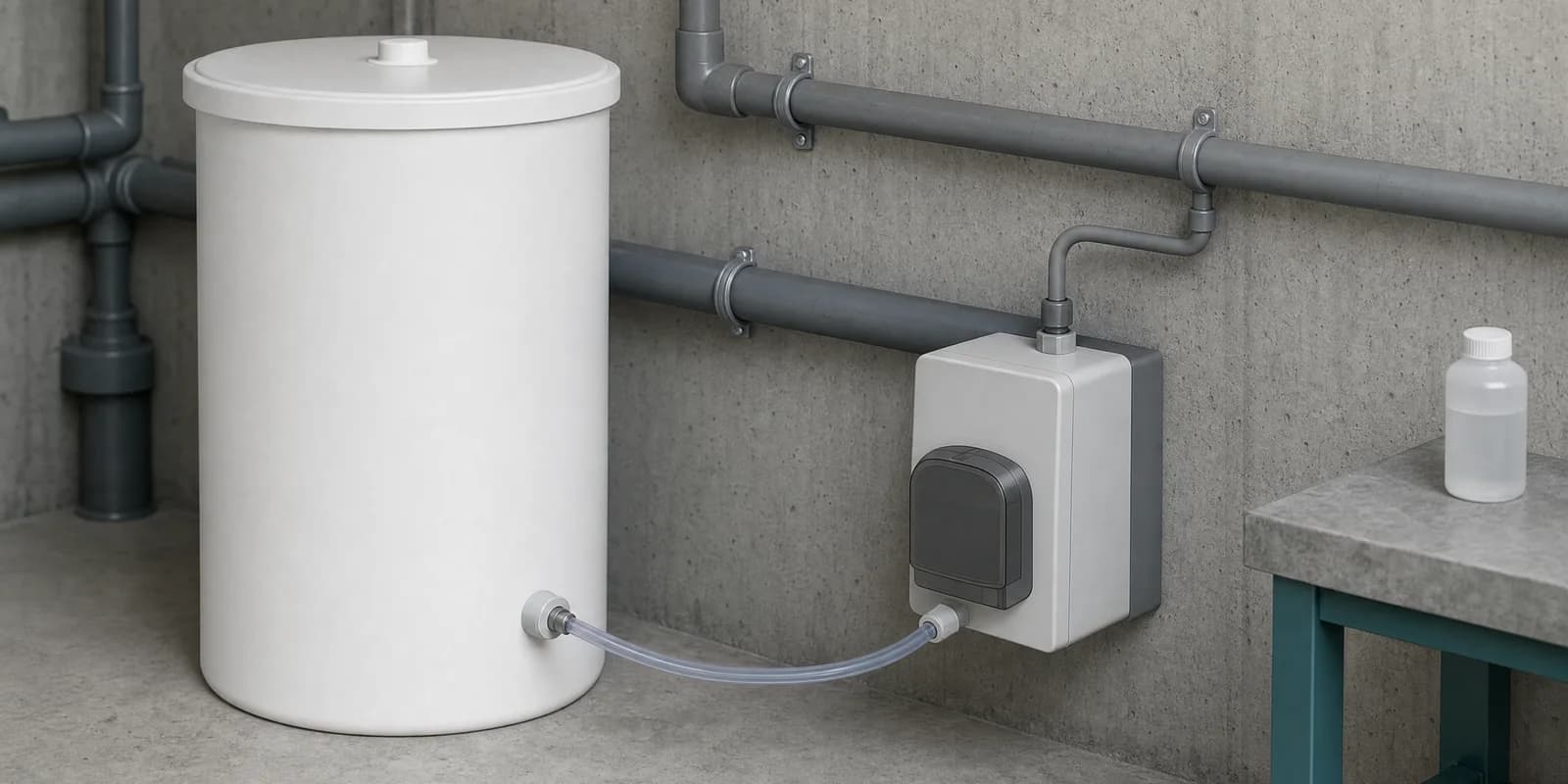
This reference design shows how the Blue-White FLEXFLO A-100N peristaltic metering pump, in its A-100NV (digital) version, could be configured to feed sodium hypochlorite to one commercial swimming pool. Fit depends on whether one tube and speed cover the pool's small daily dose between the pump's floor and ceiling, and on what its single alarm contact can report, not on the contact's mere presence. The answer can be one pump with a spare tube assembly, a no (if the owner needs a pump whose page lists NSF/ANSI 50, flow verification at this dose or incident dosing), or an item held open until Blue-White answers in writing. Engineers and integrators drafting a request for quotation can use it to frame questions and set acceptance checks. It is a hypothetical configuration built from a catalogued product and published sources, with no installation, commissioning date or measured result behind it.
A peristaltic pump, not Blue-White's pool model
The Blue-White FLEXFLO A-100N is a peristaltic metering pump, and the version this reference design uses, the A-100NV, is its digital variant, not Blue-White's pool-labelled model. Blue-White's manual says the pump is "designed to inject chemicals into piping systems"[7]. It lists patented tube-failure detection (TFD, called TFD+ on builds after 5 January 2026) that stops the pump if chemical enters the pump head, an input for a flow-verification sensor (FVS) sold separately, and fluid to 130 °F (54 °C) and ambient 14 to 110 °F[7]. Blue-White is based in California[6]. It states the peristaltic design "cannot vapor lock or lose prime"[1], which this article reads as a claim about the pump head; the technology deep dive tests that reading.
The A-100NV takes a 4-20 mA, 0-10 VDC or pulse-frequency input and has a service timer[7]. The manual describes its alarm output as a 1 amp relay (dry contact)[7], where the dial-knob A-100NF has an open collector[6]; the data sheet's specification row and the manual's wiring text also print an open-collector alarm output for the V version[6][7], so the type is a quote item.
Blue-White lists a variable-speed DC motor, a roller assembly and a replaceable tube assembly[6]. The model code sets speed (14, 30, 45 or 60 RPM), supply, control and tube (Flex-A-Thane for 1 to 3, Flex-A-Prene for 4, 6 and 7, Flex-A-Chem for 8); tube ratings run from 50 psi (tubes 3, 7 and 8) through 65 psi (1 and 2) to 100 psi (4 and 6, or 75 psi at 60 RPM)[6]. NSF/ANSI 61 is an ordering option, letter X, on tubes -4T, -6T, -7T and -8T only[6], shipped without strainer, weight, tubing and injection fitting[7]; NSF's NSF/ANSI/CAN 61 listing, read on 1 October 2026, lists water-contact materials for the pattern A1Nabc-de-f-ghij[4]. The reference design does not order it. The supply and any CE or cETLus certificate are quote items.
Blue-White's manual says the pump can handle "a variety of chemicals and solutions"[7]. Its help center, in a condensed return, names sodium hypochlorite among chemicals that off-gas[2]. Its product page files the A-100N under industrial metering pumps[1], while its A-100NA page labels that model "Swimming Pool"[3]. No Blue-White document read says the A-100N is used in pools. These are stated uses, not performance results.
Blue-White's A-100NA page lists NSF/ANSI 50, a maker statement[3]; NSF's pool-listing page for Blue-White, read on 1 October 2026, returned no matching product, for that page only[5]. The page describes "delivery of liquid chlorine and acid to pools and smaller aquatics features"[3], and lists "Manual, Remote Analog" control methods[3]. It says nothing about an alarm output or a service timer, and its data sheet and manual were not read, so no claim is made that it lacks them; its two flow ranges disagree, so no figure is used[3]. The A-100NV is taken for its own documented alarm output, service timer and signal inputs, though this reference design uses none of the inputs (Mode 1)[7]. Whether Blue-White recommends it for a pool is a quote question. If the owner needs the pump whose page lists NSF/ANSI 50, the answer is not this reference design: ask Blue-White for the A-100NA and its listing evidence.
The labels invite two misreadings: that the A-100NV is Blue-White's pool pump, and that NSF/ANSI 61 has a pool role. NSF's scope note limits its listing: "Unless otherwise indicated for Materials, Certification is only for the Water Contact Material shown in the Listing"[4]. The check is the model label and listing scope on their own pages. The duty is a choice, not Blue-White's recommendation: Singapore's Regulations set a numeric chlorine window[8], Blue-White's help center names sodium hypochlorite[2], and one pool with one pump keeps the arithmetic checkable. The Blue-White A-100NV reference design for one pool is provisional: no printed flow-sensor range reaches the dose, and the A-100NA contrast rests on one page.
Blue-White FLEXFLO A-100N Peristaltic Metering Pump
Daily dose, not residual, would set the targets
In the Blue-White A-100NV reference design for one pool (the pool dosing design), the pump would be judged on the dose it must deliver each day, because the Regulations set a window and a daily test but not a method[8]. The hypothetical is one commercial Singapore pool with one pump feeding hypochlorite solution into the recirculation return. A volume of 250 m³ is an assumed round number so every figure can be checked; they describe no facility. That the pool is licensable is assumed, because the order defining a swimming pool was not retrieved.
The targets come from the Environmental Public Health (Licensable Aquatic Facilities) Regulations 2021, an informal consolidation in force from 1 April 2026 (the Gazette governs)[8]: a non-gaseous chlorine-based disinfectant, pH 7.2 to 7.8 and free chlorine of 1 to 3 parts per million (treated here as mg/L, for arithmetic only), tested "at least once a day"[8] with a kit that is "calibrated and accurate"[8], and no operation outside the limits. They name no sodium hypochlorite, pump, controller or NSF listing (a text search of the file), so reading a hypochlorite solution as a non-gaseous chlorine-based disinfectant is an assumption. NEA's guidance, stamped 27 January 2023, says results should be "recorded and kept for 12 months"[10]. No Malaysian or Indonesian source was retrieved.
The arithmetic is dose mass, not a residual. An assumed demand of 2.0 mg/L of available chlorine a day (invalid as a typical value; none was retrieved) over 250 m³ is 2.0 × 250 = 500 g. Trade percent is grams per litre divided by 10[9], so an assumed 12.5 trade percent is 125 g/L, and 500 ÷ 125 = 4.0 L, or 4,000 mL, a day; a label's 12.5% may instead mean weight percent[9], a quote item. The mean is 4,000 ÷ 1,440 min = 2.78 mL/min; if the day's dose is delivered in 12 hours (an assumed peak, to give margin a meaning) it is 4,000 ÷ 720 min = 5.56 mL/min. Misreading: pump output is the pool residual; the residual comes from the daily test, never from the pump setting.
The obvious fix, a bigger pump, raises the floor above the dose. The manual puts the V version's working range at 10 to 100% of motor speed, and says the motor "may not start to rotate below 10% motor speed"[7], so the pool dosing design takes a 10% floor, a 10:1 turndown (highest to lowest usable output). Tube 2 at 14 RPM has a 32 mL/min ceiling[6], so its floor is 3.2 mL/min against a 2.78 mL/min mean. The data sheet's 20:1 covers only 14 and 30 RPM models with tubes 1, 2 or 4[6]; the application guide argues it. The tube and speed maximum must be at most 10 × 2.78 = 27.8 mL/min for the mean to be reachable, and at least 2 × 5.56 = 11.1 mL/min for the peak to have margin. Both rules are this article's engineering judgment, not Blue-White's.
Each target has its check at its own point: the daily kit test at the pool; a calibration cylinder and tank drawdown for about 4.0 L a day at the pump; the manual's test at the pump head. The display and speed setting are not acceptance instruments.
Tube floor and ceiling would decide the pump
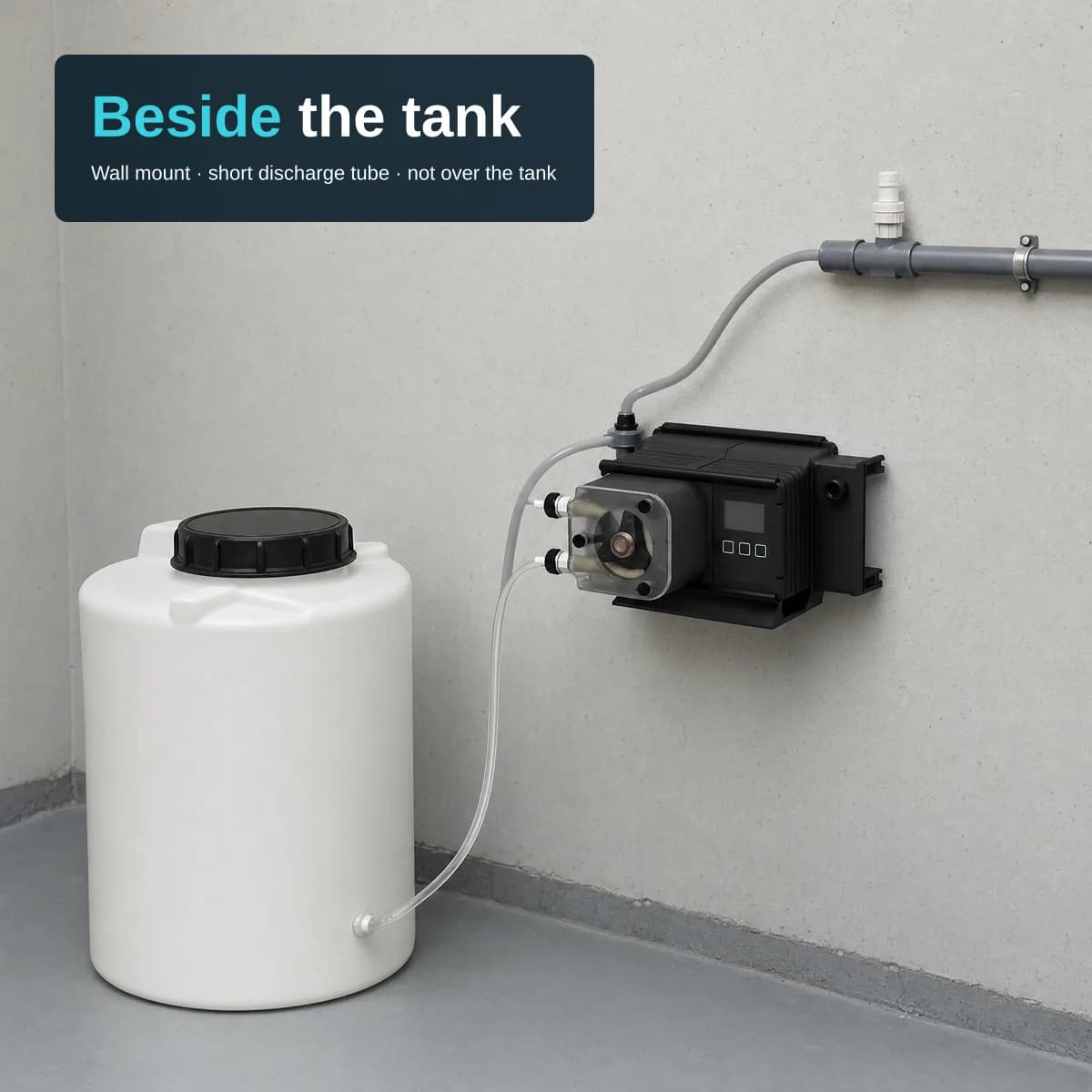
The Blue-White A-100NV reference design for one pool would hang one pump beside a covered day tank and let the tube's floor and ceiling pick the configuration, because most of the 28 tube-and-speed combinations in Blue-White's table have a floor above 2.78 mL/min. The manual says "Wall mount to a solid surface only"[7], close to the injection point, since "Longer tubing increases the back pressure at the pump tube"[7]. It says to mount the pump "off to the side or at a lower level than the chemical container"[7], never directly over the tank, so the tank sits beside or above the pump, with flooded suction and a shut-off valve or pinch clamp for servicing. The tank is covered, and opaque by the pool dosing design's choice, since opaque non-bulk containers "will prevent or minimize"[9] UV decomposition of hypochlorite. The manual asks for a back-flow prevention check valve[7]; whether the supplied injection fitting meets that line is a quote question. The fitting installs in an upward direction[7]. Lift suction and discharge routing are in the application guide.
In Blue-White's table[6], 22 of the 28 combinations exceed 27.8 mL/min and six do not: tube 4 (Flex-A-Prene, 1/4 inch OD) at 14, 30, 45 and 60 RPM (6.0 and 13 mL/min at 14 and 30 RPM), tube 6 at 14 RPM and tube 1 at 14 RPM. Tube 4 at 14 RPM fails the peak rule: margin (6.0 − 5.56) ÷ 6.0 = 7.3%. Tube 4 at 30 RPM passes with (13 − 5.56) ÷ 13 = 57.2% and the lowest floor of those that clear it: 1.3 mL/min × 1,440 min × 125 g/L ÷ 1,000 mL/L ÷ 250 m³ = 0.936 mg/L/day.
The result is code A1N1xV-4T[6], the cord digit x a quote item; the NSF option is not ordered. The basis was chosen to fit, so it fits proves nothing about a real pool.
The pressure at the pump tube is the assumed 2.0 bar (29.0 psi) at the injection point plus the fitting's half-psi spring[12][7], 29.5 psi, against tube 4's 100 psi: (100 − 29.5) ÷ 100 = 70.5%. The sum assumes the spring rating is the check valve's opening pressure and adds to line pressure (a reading; Blue-White to confirm). Line losses are excluded, as no line-loss figure appears in the documents read, and the fitting's and discharge tubing's ratings are quote items. Blue-White's chart rates Flex-A-Prene E (excellent) for 12.5% sodium hypochlorite in water on 28-day immersions at 73 °F, using information it says "was supplied to Blue-White by reputable sources"[11]; Blue-White "tests its products with water only"[7]. The chart's percentages are by volume, not the trade percent used here, and rate the tube material, not pumping life[11]. Nothing in the documents read states what the pump does against a blocked discharge, so nothing relies on a relief or shut-off.
The 13 mL/min is a water figure at 70 °F at sea level[7]; flow "will vary depending on the suction line conditions and solution viscosity"[7], so the pool dosing design calibrates at the actual suction line.
The pool dosing design has one pump and a spare tube assembly on the shelf, and no standby. The box holds one spare[12], and no changeover logic appears in the documents read. By reasoning, a second pump on the same tank, suction line and fitting would not cover a weak solution, an empty tank or a clogged fitting. The tube is designed for "a minimum service life of 500 hours"[7], 20.8 days of continuous running (500 ÷ 24; arithmetic, not Blue-White's statement); separately, tubes "may last only a few days/weeks, or can last longer than a year"[7], which at the short end sits below that minimum. In the documents read, nothing leaves the pump except the dosed solution, 4.0 L a day; a leaking tube puts chemical in the pump head, where the leak detector meets it.
No flow sensor, no lost-feed alarm
In the pool dosing design, with no flow sensor fitted, the A-100NV would sense only a leak in its own pump head, so a running pump and a silent contact would say nothing about a tank that has run dry or a solution that has gone weak. Free chlorine, pH, strength, tank level and delivered flow are not online. No flow-verification sensor is fitted and the alarm delay is set to 000: "an alarm delay value of 000 disables the FVS system"[7].
The speed is set by hand in Mode 1 from the daily test; no signal input is used. TFD stops the pump and activates the single alarm output[7]; its type and rating are the quote items named earlier. The pump stays stopped until the Run/Standby key is pressed twice after the tube is replaced[7]; the manual does not say how the contact behaves meanwhile. The same output serves TFD and FVS, so the cause cannot be read from it (reasoning). With FVS off it reports a ruptured tube and nothing else the documents list, and the manual says "the TFD can be disabled"[7], so whether it is on is part of acceptance. A worn tube with no leak (the SERVICE icon only), an empty tank, air in the suction line, a calcified fitting, a falling strength and a pump stopped by a person or lost power all leave that contact silent (reasoning from the manual's two alarm triggers, TFD and FVS).
On power loss feed stops, and restart is an unpublished quote item. No remote start or stop input appears in the manual text read[7]. With no remote stop, dosing into a stopped recirculation line is the risk; an owner interlock on the pump's supply would address it (reasoning, not a published feature). Manual operation is the Run/Standby key and a 99-second prime at full speed[7].
Misreading: the daily test is continuous control. At the assumed 2.0 mg/L/day demand a no-feed event loses 2.0 ÷ 24 = 0.0833 mg/L an hour, so from 2 ppm it reaches 1 ppm in 12 h and from 3 ppm in 24 h (linear, assumed demand); a once-a-day test cannot guarantee finding it in time. A second daily test and a tank-level reading at each test are the pool dosing design's own measures (engineering judgment).
The Blue-White A-100NV reference design for one pool would be accepted in stages that name their instruments. Paper first: the code, the manual revision and the build date (TFD or TFD+) from the supplier, a quote item. Bench: the manual's test, with tube and roller assembly removed and a little chemical in the pump head, where "the pump will stop after a five second confirmation period"[7], and the alarm output must reach the owner's alarm input; the head must be cleaned afterwards[7], and tube replacement then is a Blue-White question. Calibration: at the actual suction line, with a measuring cylinder and a stopwatch. One minute at 2.78 mL/min delivers about 2.8 mL, hard to read, so a longer run and a second speed are used (judgment); the manual says "For best accuracy, run more than one calibration"[7]. The pass tolerance is the buyer's, agreed before order, because Blue-White's data sheet, manual and 2026 catalog pages for the A-100N state no accuracy figure[6][7][12]. In service: a site gauge against 29.0 psi.
Each acceptance figure carries its conditions: chemical and strength, suction type, tube pressure, temperature, repeat runs; the leak test carries build date, chemical and quantity. The technology deep dive holds that rule.
Flow verification would remain the central gap
The first risk in the pool dosing design is the central gap: no flow-sensor range Blue-White prints reaches the pool's dose, so the A-100NV would deliver with nothing watching that it does. The FV-101 starts at 30 mL/min, 2.3 times the pump's 13 mL/min ceiling; below that "the sensor will not detect chemical"[7]. The MS61 starts at 10 mL/min, 3.6 times the 2.78 mean and 1.8 times the 5.56 peak, so it would cover only speeds from 10 ÷ 13 = 76.9% of the ceiling up (assuming flow is proportional to speed)[7]. The data sheet says "Contact factory for sensor options"[6], and no Blue-White document read lists a sensor for 1.3 to 13 mL/min. It would flip go or no-go if the owner needs an alarm on no flow. Blue-White's written answer closes it.
Blue-White owns the pump and its published limits; the owner holds the speed setting, strength, tank, injection point, alarm panel and response, spare tubes and test. Items left open go to Blue-White: the build date, a tube-life estimate, who certifies the strength, blocked-discharge behaviour, restart and the accuracy basis. Blue-White's manual prints "100 psig (most models)"[7] against six of 28 combinations at 100 psi in the data sheet's table[6].
An out-of-limit daily reading goes to the maintenance contractor to retest before opening[10]. A ruptured tube stops the pump and closes the contact; the tube must be replaced and the head cleaned[7]. The reference design does not use the pump for incident dosing. The guidance's faecal and vomitus response says "Chlorine residual levels should be maintained at 20 ppm for at least 8 hours"[10]; raising 250 m³ from 3 to 20 ppm takes 17 × 250 ÷ 125 = 34.0 L, 43.6 h at the 13 mL/min ceiling and 94.4 h at 6.0 mL/min, and the hold would need further dosing (not computed).
The owner's staged trial can be stopped without rework: paper answers, then the bench leak test, then calibration with the actual solution off the pool, then connection at the set speed with two tests a day. Stages one to three cost a pump, a tank and possibly the spare tube; before stage four nothing is dosed.
The Blue-White A-100NV reference design for one pool fits one pool and one pump with a 2.78 mL/min mean and a peak up to 6.5 mL/min (half of tube 4 at 30 RPM's 13 mL/min ceiling, the article's own 2:1 rule), at pump-tube pressures inside the tube's 100 psi rating. It stops at a need for the pump whose page lists NSF/ANSI 50, flow verification at this dose, a published A-100N accuracy figure (none in the documents read), a remote stop or incident dosing; at a peak above 6.5 mL/min (13 mL/min is the ceiling, with no margin left); at a pressure above the tube's rating; and at a floor above the pool's lowest demand (0.936 mg/L/day) with no acceptable stop routine (Run/Standby by hand; a remote stop is a quote item), after which tube 4 at 14 RPM (floor 0.432 mg/L/day) would need a smaller peak, as its 7.3% margin fails the 2:1 rule. The off-ramp is the A-100NA, as above, or another configuration. None fires on the worked example. It does not mean that Blue-White recommends the pump for pools, that the pool is licensed or compliant, that a residual is controlled, or a Purionex warranty.
Send pool volume, injection-point pressure, demand as solution drawdown, the chemical, strength and certifier, tank, the ambient at the pump and the solution temperature, supply, alarm input and licence status. The quote request should ask Blue-White for the exact code, the manual revision and written answers on the open items above; Purionex would pass on what it receives. The application guide holds the tender clauses. Request a quote for the Blue-White FLEXFLO A-100N with this data pack.
Sources
- [1]Blue-White, A-100N product page, raw text, retrieved 2026-10-01 (stated filing under industrial metering pumps)
- [2]Blue-White, help center A-100NV pages, condensed return, retrieved 2026-10-01 (maker's stated use; paraphrase only)
- [3]Blue-White, A-100NA product page, raw text, retrieved 2026-10-01 (the pool-labelled model; NSF/ANSI 50 stated on its page)
- [4]NSF International, NSF/ANSI/CAN 61 listing page for Blue-White, current as of 1 October 2026 per its header
- [5]PM raw capture, 2026-10-01, of NSF's pool-listing page for Blue-White (company code C0052956, standard 050); scoped to that one URL
- [6]Blue-White, A-100N engineering and technical data, 85000-197 Rev 11, 20251223 (primary data sheet)
- [7]Blue-White, A-100NF and A-100NV operating manual, 80000-381 Rev 22, 20251226 (primary manual)
- [8]Singapore Statutes Online, Environmental Public Health (Licensable Aquatic Facilities) Regulations 2021, informal consolidation in force from 1/4/2026 (the Gazette governs)
- [9]The Chlorine Institute, Pamphlet 96 Sodium Hypochlorite Manual, edition 3, April 2006 (trade association; North American)
- [10]National Environment Agency, Guidelines for Managing Aquatic Facilities in Singapore, updates as of 27 January 2023
- [11]Blue-White, Tube Chemical Compatibility chart, page date 08/11/2025 (data supplied to Blue-White by reputable sources)
- [12]Blue-White, Industrial Catalog 2026, A-100N pages 16 and 17