The data sheet for the Blue-White FLEXFLO A-100N peristaltic metering pump, in its A-100NV (digital) version, prints "up to 100 PSI", a 19.56 L/h maximum, a 10:1 or 20:1 turndown (full output over lowest output) and an NSF/ANSI 61 mark; it covers the A-100NV and the dial-knob A-100NF.[4] Each figure belongs to some of the table's 28 tube and motor-speed combinations, or to an ordering option, not to every pump. The deciding question is which tube, at which RPM, carries the site's pump-tube pressure and chemical at peak flow, with a lowest flow the pump can still deliver.
This guide ends in one of three answers: a named tube and RPM for sodium hypochlorite (the worked run reaches A1N1xV-4T on illustrative inputs, cord digit left to the quote); another tube or RPM; or not this product (a pool listing, flow verification, a published A-100N accuracy figure, a remote stop or incident dosing). Scope: one A-100N feeding one commercial pool in Singapore; the reference design argues control, upsets and the daily test.
Measure the duty before reading A-100N figures
The National Environment Agency (NEA) writes that "The daily testing is important to ensure that free residual chlorine is at the optimal pH range".[8] Reading a low chlorine result with pH inside the 7.2 to 7.8 that Singapore's Licensable Aquatic Facilities Regulations 2021 set (informal consolidation; the Gazette governs)[6] as a dose, demand or strength question is this guide's reasoning; the day tank's daily drawdown against the pump setting separates a delivery shortfall from demand or strength; only a strength test of the solution separates those. A pH outside that range is not something this pump controls, and no source read says whether the dosing moves pool pH. The delivery window (continuous or daytime-only feed) is an input.
Inputs that eliminate a tube: the chemical and its strength, the pressure at the pump tube, fluid at 130 °F (54 °C) or below, ambient 14 to 110 °F,[4] and any listing needed. Worked run, illustrative throughout: 2.0 bar at the injection point is 29.0 psi, plus the fitting's 1/2 psi spring, 29.5 psi.[10][5] [ASSUMPTION: the spring rating is the check valve's opening pressure and adds to line pressure; Blue-White to confirm.] [ASSUMPTION: solution and ambient temperature inside those limits.] Line losses are unpublished in the documents read and excluded.
Sizing inputs: 250 m³ at 2.0 mg/L of available chlorine per day [ASSUMPTION: no demand figure retrieved; the supplier's 12.5% is trade percent; the day's dose is fed within 12 hours] is 500 g, or 500 ÷ 125 = 4.0 L of 125 g/L solution a day: a mean of 4,000 ÷ 1,440 = 2.78 mL/min and a 12-hour peak of 4,000 ÷ 720 = 5.56 mL/min. The site measures its own demand as the solution drawn down while daily tests stay inside the Regulations' 1 to 3 ppm,[6] ppm being mg/L for arithmetic only.
A misreading is that 12.5% is a value; it is a unit with three bases: trade percent (12.5 trade percent is 125 g/L),[7] the chart's "Concentrations of room temperature liquids are given in % volume",[9] and the supplier's label. Ask which applies and who certifies it.
Fit inputs: suction arrangement and lift (30 ft of water at sea level is the printed limit),[4] supply voltage and cord (quote items), the owner's alarm input and a solid wall.[5]
Second misreading: the data sheet's "0.3 - 326 mL/min" flow adjustment range is one pump's.[4] Its lower end is 5% of the smallest tube maximum (0.05 × 6.0 = 0.30) and its upper end is tube 3 at 60 RPM, a span across configurations (this guide's reading; both ends reproduce). Check: read the table row for the tube and RPM. Running this step late builds sizing on invented inputs.
Tube and RPM fix flow, pressure, turndown
The headline figures are not one pump's: the 19.56 L/h maximum is tube 3 at 60 RPM, rated 50 psi. The 100 psi rating belongs to 6 of the 28 combinations, 75 psi to tubes 4 and 6 at 60 RPM, 65 psi to eight and 50 psi to twelve.[4] The highest flow at 100 psi is tube 6 at 45 RPM, 63.1 mL/min (3.8 L/h); at 65 psi or more, tube 2 at 60 RPM, 140 mL/min (8.4 L/h).[4] Flows below are mL/min in the manual's table, running water at 70 °F at sea level;[5] the documents read publish no flow-against-pressure curve.[4]
| Tube | Rating (psi) | 14 RPM | 30 RPM | 45 RPM | 60 RPM | Hypochlorite (28-day immersion) |
|---|---|---|---|---|---|---|
| 1 | 65 | 15 | 35 | 54 | 67 | G |
| 2 | 65 | 32 | 75 | 115 | 140 | G |
| 3 | 50 | 73 | 173 | 261 | 326 | G |
| 4 | 100 (75 at 60 RPM) | 6.0 | 13 | 21 | 25 | E |
| 6 | 100 (75 at 60 RPM) | 18.4 | 42.1 | 63.1 | 79.2 | E |
| 7 | 50 | 57.0 | 138 | 200 | 250 | E |
| 8 | 50 | 40.0 | 84 | 140 | 180 | E |
Blue-White's chart rates sodium hypochlorite at 12.5% and 25% E for Flex-A-Prene (tubes 4, 6, 7) and Flex-A-Chem (tube 8) and G for Flex-A-Thane (tubes 1, 2, 3) on "28 Day Immersions at 73 °F",[9] with data "supplied to Blue-White by reputable sources",[9] while Blue-White "tests their products with water only".[9] That is an immersion rating, not a pumping-service or tube-life rating. NSF lists hypochlorite at 15% under Flex-A-Prene only,[2] and the chart rates tubes only, not check ball, spring or fitting.[9] At 29.5 psi every tube clears; margins (rated − 29.5) ÷ rated are 70.5% for tubes 4 and 6 up to 45 RPM, 60.7% at 60 RPM, 54.6% for tubes 1 and 2, 41.0% for tubes 3, 7 and 8.
Size to the lowest flow-path rating, then the ceiling. The tube's pressure rating is the lowest published in the documents read; the fitting's and discharge tubing's are not.[5] This guide's rule, a decision and not a Blue-White rule: the maximum at most 27.8 mL/min (10 × 2.78) so the mean is reachable at 10% of speed, the ceiling at least twice the peak, then the lowest minimum feed. Worked run: tube 4 at 30 RPM, ceiling 13 mL/min. The mean uses 2.78 ÷ 13 = 21.4% and the peak 5.56 ÷ 13 = 42.8%; margins are (13 − 2.78) ÷ 13 = 78.6% and (13 − 5.56) ÷ 13 = 57.2%; pressure margin 70.5%; the 10% floor is 1.3 mL/min, 0.936 mg/L/day or 46.8% of the mean demand. Result: A1N1xV-4T, NSF option not ordered, cord digit open.
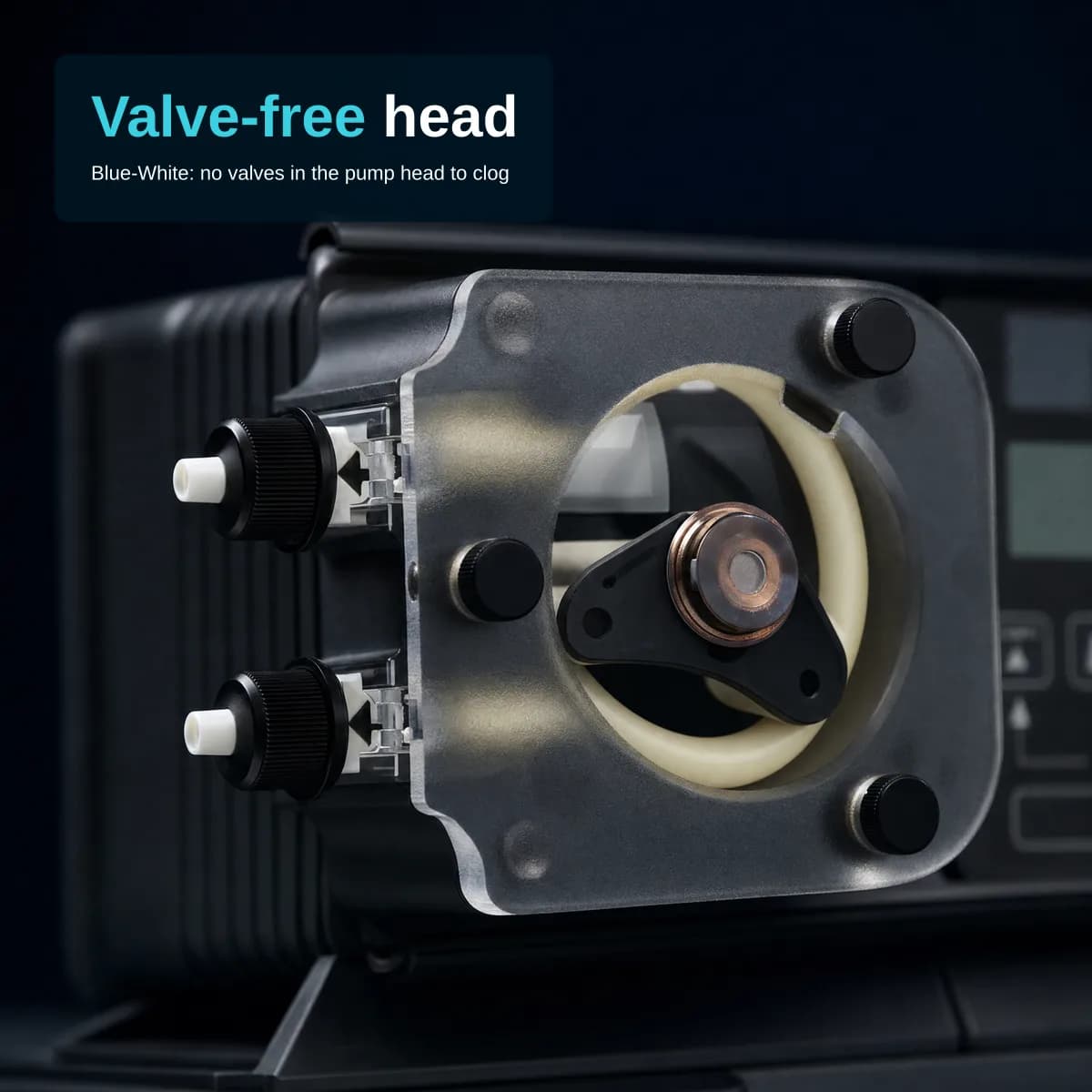
Blue-White FLEXFLO A-100N Peristaltic Metering Pump
Six combinations have a maximum at or below 27.8 mL/min and the other 22 top it, so their 10% floor is above the mean flow. The six, with peak margin (maximum − 5.56) ÷ maximum and the 10% floor in mg/L/day:[4]
| Combination | Maximum (mL/min) | Peak margin | 10% floor | Outcome |
|---|---|---|---|---|
| Tube 4 at 14 RPM | 6.0 | 7.3% | 0.432 | fails the ceiling rule |
| Tube 4 at 30 RPM | 13 | 57.2% | 0.936 | selected |
| Tube 4 at 45 RPM | 21 | 73.5% | 1.512 | passes, higher floor |
| Tube 4 at 60 RPM | 25 | 77.8% | 1.80 | passes, higher floor, 75 psi |
| Tube 1 at 14 RPM | 15 | 62.9% | 1.08 | passes at the cost of a G rating, a one-year tube shelf life and no NSF option[4][5] |
| Tube 6 at 14 RPM | 18.4 | 69.8% | 1.32 | passes, higher floor |
The basis was chosen to fit, so the fit proves nothing about a real pool.
Turndown has two statements: the sheet's "14 RPM & 30 RPM Models with 1, 2, or 4 tubes have 20:1 turndown",[4] and the manual's working range of 10 to 100%, with no start guaranteed below 10%,[5] so the design uses 10:1. On the data sheet's matrix, the NSF option (tubes -4T, -6T, -7T, -8T) and 20:1 turndown (tubes 1, 2, 4 at 14 or 30 RPM) overlap only at tube 4 at 14 or 30 RPM, 6.0 or 13 mL/min (0.36 or 0.78 L/h).[4] The only derating in the documents read is "-4, -6 Tubes max pressure for 60 rpm model is 75 psi".[4]
Along tube 4, more headroom costs a higher minimum feed. Check the site's lowest-demand day.
Place the pump, then compare quotes
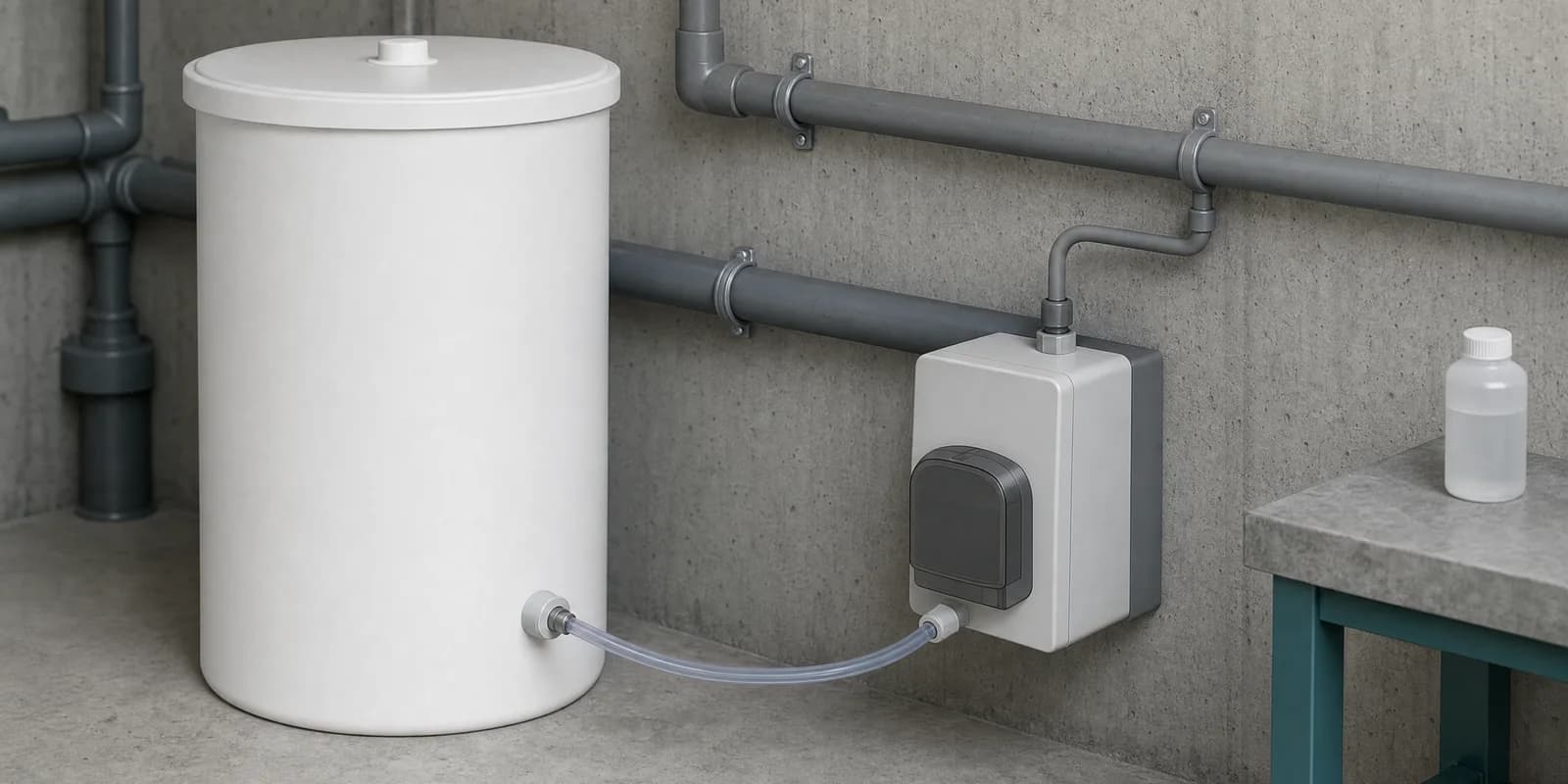
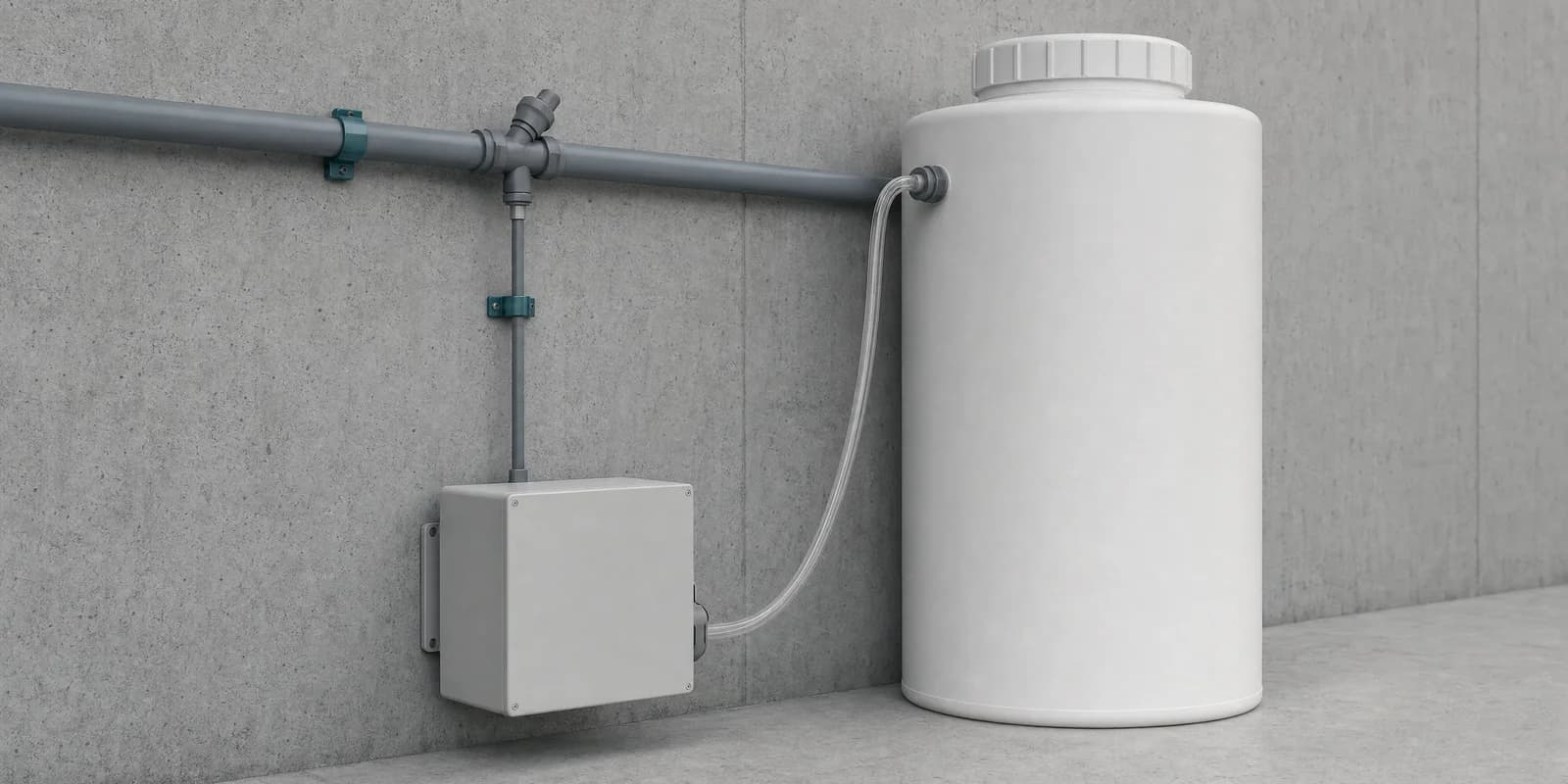
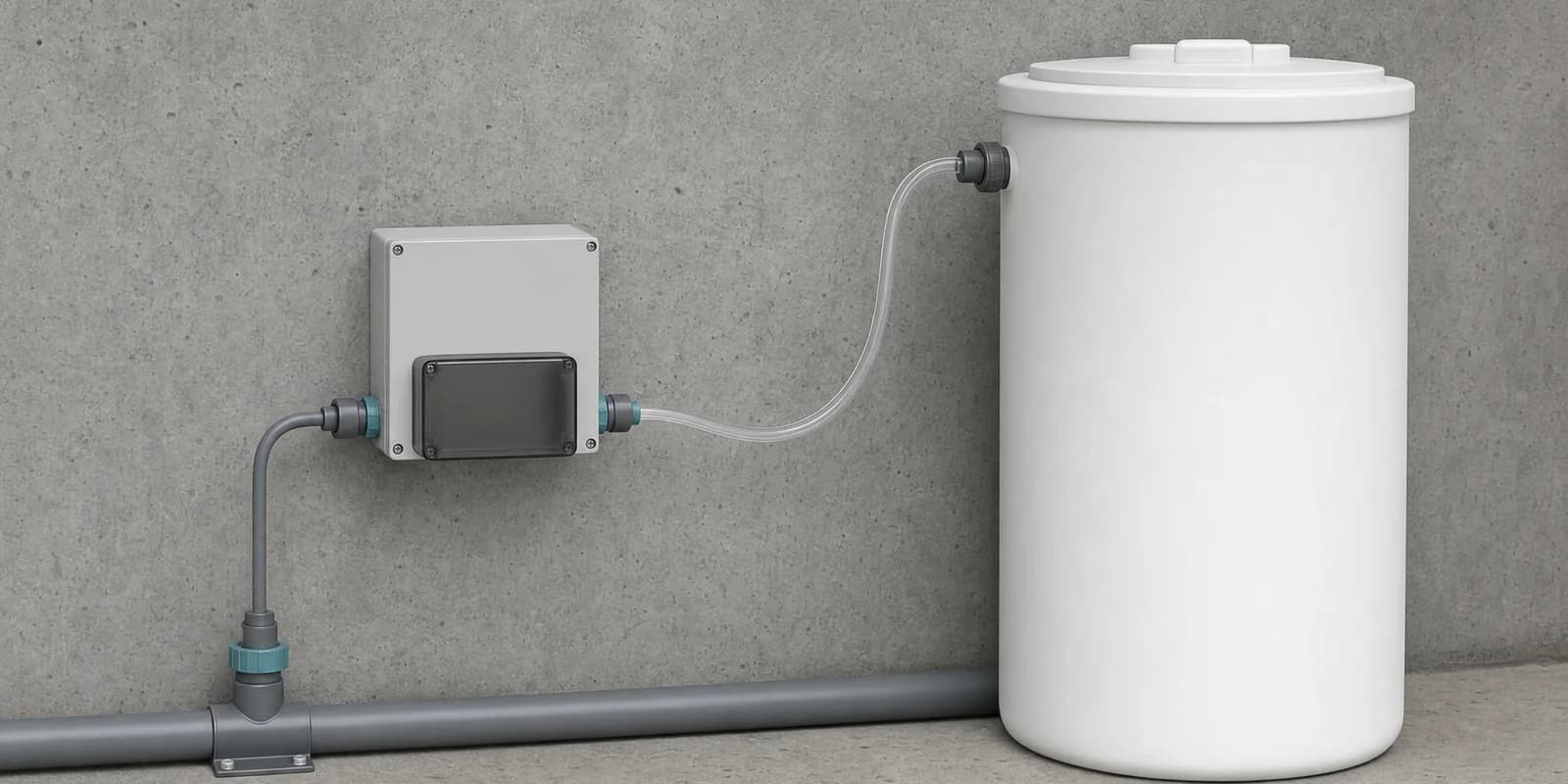
Flooded suction mounts the pump lower than the tank's liquid level and off to one side, never directly over the tank; the manual says this "will reduce output error due to increased suction lift" and requires a shut-off valve or pinch clamp for servicing.[5] Blind spot: the gravity head also feeds a leaking tube (this guide's reasoning). Lift puts the pump beside the tank above its liquid level: no gravity head, but output error grows with lift[5] and the table is water at sea level.
For discharge, a short tube with the pump beside the injection point follows the manual: "Longer tubing increases the back pressure at the pump tube."[5] A longer run beside the tank adds 48.3 mL, 17.4 minutes of the mean flow, per further 5 ft of 1/4 in ID tube (arithmetic from the catalog's stated 1/4 in ID; no volume is printed),[10] felt at first fill or a solution change. The upward-facing injection fitting needs periodic cleaning on hypochlorite.[5]
The box holds the pump, two tube assemblies (one spare), 5 ft suction and discharge tubing, strainer, weight and an injection fitting with a 1/2 psi check.[10] Another misreading is that an NSF-option pump is a complete pump: option X is an ordering option, letter X, on tubes -4T, -6T, -7T and -8T only, shipped without strainer, weight, tubing and injection fitting;[4][5] the NSF/ANSI/CAN 61 listing read on 1 October 2026 lists water-contact materials for the pattern A1Nabc-de-f-ghij, evaluated with the diluted chemical, not performance, accuracy or NSF/ANSI 50.[2] The site supplies a covered tank (opaque, to keep out UV),[5][7] the shut-off, wall, supply, alarm input and sample point. The reference design argues three quote items: blocked-discharge behaviour, restart behaviour, and the alarm output type, which the data sheet prints as contact closure on page 1 and open collector on page 2, and the manual as contact closure on page 8 and open collector on page 15.[4][5]
The headline is four figures from four configurations, so a quote must state tube, RPM, chemical and strength basis, pump-tube pressure and suction arrangement. Misreading: a flow sensor can verify the small tubes that carry 100 psi, tube 4 and tube 6 at 14 RPM. The FV-101 starts at 30 mL/min, above every tube-4 output (6.0, 13, 21, 25) and tube 6 at 14 RPM (18.4); the MS61 starts at 10 mL/min, which tube 4 at 30 RPM reaches only above 10 ÷ 13 = 76.9% of speed, assuming flow is proportional to speed.[5]
Lifecycle: "The tube has been designed for a minimum service life of 500 hours."[5] That is 20.8 days of continuous running (500 ÷ 24). Blue-White also says "Tube Assemblies may last only a few days/weeks, or can last longer than a year in a specific application", which at the short end sits below its own minimum, and that tubes be replaced at least yearly (8,760 hours, 17.5 times the minimum if continuous).[5] The warranty is 1 year from purchase, tube assemblies and rubber components excluded, start date a quote item.[5]
One request-for-quote paragraph names the A-100NV with model code A1N1xV-4T, its tube, RPM and pump-tube pressure, and lists what the answer decides: whether Blue-White recommends the A-100NV for pool hypochlorite feed, strength basis, fitting and discharge-tubing pressure ratings, a flow sensor for 1.3 to 13 mL/min, alarm output type, build date of the leak sensor, tube-life estimate, a published accuracy figure, restart behaviour, cord and supply, the matching roller assembly, the manual revision and a CE declaration for the code and market. Blue-White figures start the enquiry; what a figure must state is in the deep dive on figure conditions.
Keep it valid, and know when to stop
Commissioning: "Calibrate the pump with actual suction line conditions."[5] Run at a set speed and divide volume by time, then repeat at a second speed.[5] At the worked mean setting a one-minute run delivers about 2.78 mL, so a longer run is this guide's judgement. Read the injection-point pressure on a site gauge and, on the A-100NV, set the flow-verification delay to 000 where no sensor is fitted.[5] A calibration "similar to the flow rating for the pump tube"[5] proves less than it seems: the rating is water at 70 °F, the manual gives no tolerance for similar, and the data sheet, manual and catalog pages state no accuracy figure for the A-100N.[4][5][10]
The manual says "the pump and all accessories should be checked weekly"; the A-100NV's SERVICE icon lights after about 500 hours of running as a resettable reminder.[5] Fitting and strainer cleaning have no interval in the documents read.[5]
The re-test rule: "Any change in chemical, flow, pressure, duty, or piping will require re-evaluating the Tube Assembly’s fit for purpose."[5] Re-measure the strength basis when the supplier changes, demand as the daily drawdown, pump-tube pressure, the suction condition, and the tube and RPM. A 10% strength or dose mismatch is 0.10 × 2.0 = 0.2 mg/L/day, which takes a 2 ppm pool to 1 ppm in 1 ÷ 0.2 = 5 days (linear; assumed demand).
Seven stop conditions, none firing on the worked run.
- Pump-tube pressure above the tube's rating. No tube exceeds 100 psi;[4] at 99.5 psi at the injection point tube 4 has no margin before line losses. Next: another tube, or not this pump.
- Peak above half the ceiling (the 2:1 rule) of every tube that clears pressure and chemistry. Next: a larger tube or RPM at a higher floor, or not this pump.
- A floor above the site's lowest demand when the owner accepts no stop routine (Run/Standby by hand; a remote stop is a quote item).[5] Here 0.936 against the 2.0 mg/L/day mean, which stands in for an unset lowest-demand day. Next: tube 4 at 14 RPM only for a smaller peak (its 7.3% margin fails the 2:1 rule).
- A pool listing required. Ask Blue-White about its A-100NA, whose page lists NSF/ANSI 50 (a maker statement);[1] NSF's pool-listing page tried on 1 October 2026 returned no Blue-White product (that URL only),[3] so ask for the listing evidence too.
- Flow verification required at the mean or peak flow (2.78 or 5.56 mL/min), when no printed sensor range reaches it.[5] Next: ask in writing, or not this pump.
- A published A-100N accuracy figure or a remote stop required, when none appears in the data sheet, manual or catalog pages read. Next: as for 5.
- Incident dosing by this pump: taking 250 m³ from 3 to 20 ppm needs 17 × 250 ÷ 125 = 34.0 L, which is 34,000 ÷ 13 ÷ 60 = 43.6 hours at tube 4 at 30 RPM, full speed, before the 8-hour hold NEA lists could begin (guidance stamped 27 January 2023).[8] Next: a separate arrangement.
The data pack is the first section's inputs plus any listing, flow-verification, accuracy or remote-stop need. A competent reply gives the full code, the tube's maximum and pressure rating, margins as (rated − demand) ÷ rated, the binding component, tube-life and spares items, acceptance checks, and may conclude another pump, tube or no pump yet.
Request a quote for the Blue-White FLEXFLO A-100N with the tube, RPM and pump-tube pressure above and this data pack.
Sources
- [1]Blue-White Industries, A-100NA product page (raw page text, 2026-10-01); one clause: the page lists NSF/ANSI 50
- [2]NSF International, NSF/ANSI/CAN 61 listing for Blue-White Industries, current as of 1 October 2026; scope and chemicals
- [3]PM raw capture, 2026-10-01, of NSF's pool-listing page for Blue-White (company code C0052956, standard 050); scoped to that one URL
- [4]Blue-White, A-100N data sheet 85000-197 Rev 11 (20251223); highlights, ratings, flow table, model matrix
- [5]Blue-White, FLEXFLO A-100NF and A-100NV operating manual 80000-381 Rev 22 (20251226); installation, calibration, maintenance, warranty
- [6]Singapore Statutes Online, Environmental Public Health (Licensable Aquatic Facilities) Regulations 2021, informal consolidation in force from 1 April 2026; targets and daily test (the Gazette governs)
- [7]The Chlorine Institute, Pamphlet 96, Sodium Hypochlorite Manual, 3rd edition, April 2006; trade percent and UV
- [8]NEA, Guidelines for Managing Aquatic Facilities in Singapore (stamped 27 January 2023); daily test and incident hold
- [9]Blue-White, Tube Chemical Compatibility chart (page dated 08/11/2025); hypochlorite ratings and basis
- [10]Blue-White, Industrial Catalog 2026, A-100N pages; what is in the box and the fitting check