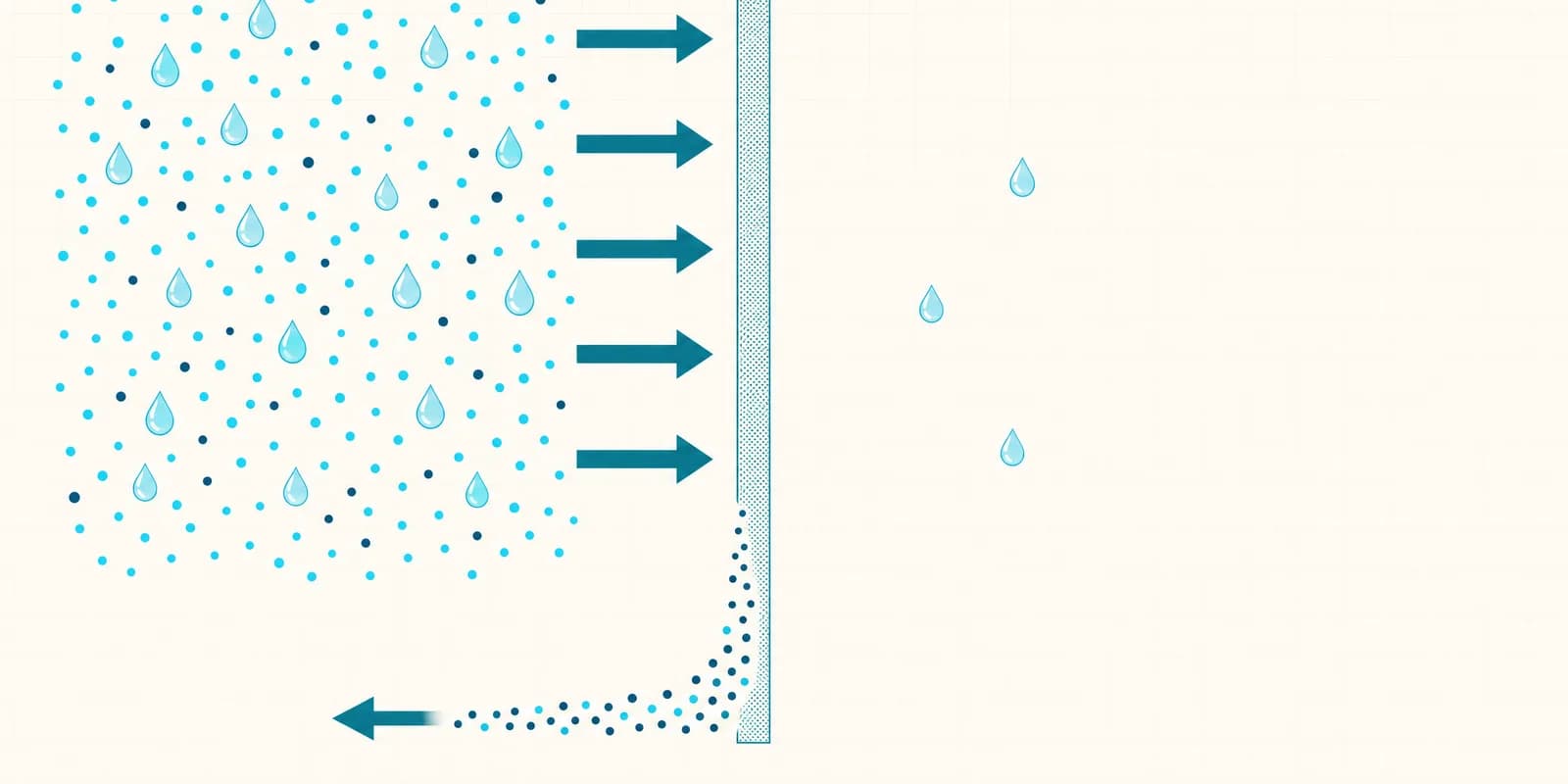
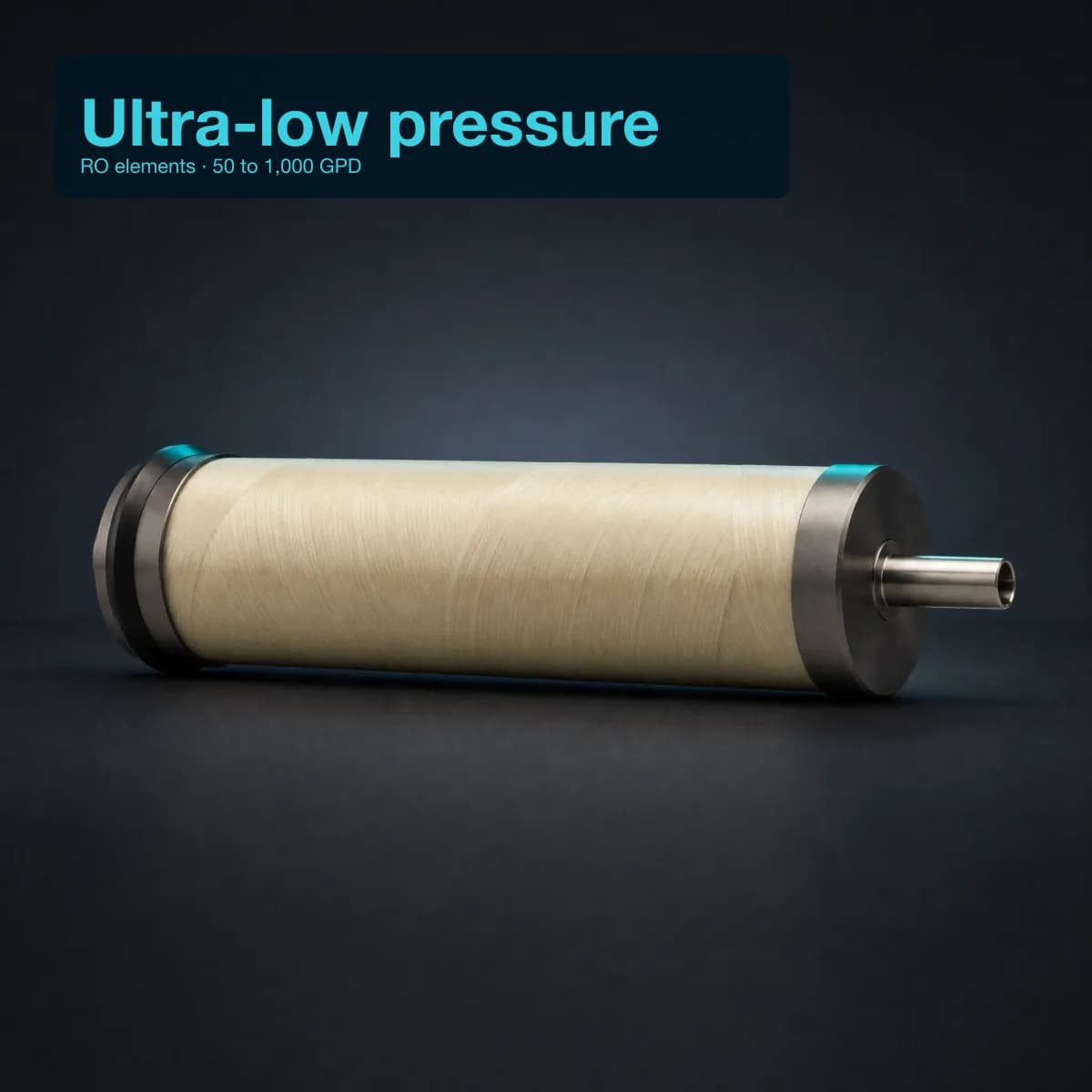
Reverse osmosis (RO) desalts water by pressing it through a semipermeable membrane at a pressure that first exceeds the feed's osmotic pressure.[8] A Vontron ULP element, which Vontron's sheets call an RO element, shows that in two numbers: permeate flow in gallons per day (GPD) and salt rejection. Each is rated at a stated pressure, salt concentration and recovery, and on the sheets a temperature.[2] The name does not state a pressure any site can supply; Vontron's rows print test lines, and its page says its information is for reference only.[1] On what extra low pressure means, Vontron's ULP2012-100 sheet says only: "Working under extra low pressure, it is applicable to water purifying devices for residence, hospital and laboratory."[2] The ULP3013-400 sheet names dispensers and residential water machines instead.[4] Vontron's household page lists 19 ULP-prefixed elements, 50 to 1,000 GPD, tested at 60 psi (7 rows) or 100 psi (12 rows).[1] The two-thirds pressure comparison Vontron does print sits on industrial sheets and names no reference pressure.[5] Four questions follow: what decides flow and rejection; what a rated point assumes and what warmth costs; what the evidence proves; what to measure on site. Sizing belongs to the selection guide, a skid to the light-commercial reference design.
Pressure and recovery decide flow and rejection
Osmosis pulls water toward the saltier side, so applied pressure must win that contest. FilmTec's manual states: "The applied pressure must first overcome the osmotic pressure inherent in the chemical solution in order to produce any flux."[8] Its design equation makes permeate flow proportional to membrane area times the net driving pressure, the applied pressure less the osmotic pressure.[8] That is FilmTec's general statement: the household documents retrieved print no flow-against-pressure curve.[1][2][3][4]
Vontron's household rows print 250 ppm NaCl, and its ULP2012-100 and ULP1812-75 sheets add 25 °C.[1][2][3] Assuming 250 mg/L and 25 °C for every row, an ideal-dilute van't Hoff estimate gives the osmotic pressure (derived here, ignoring polarization and pressure drop; general physics with no retrieved source, so not a rating):
osmotic pressure = 2 ions × (0.250 g/L ÷ 58.44 g/mol = 4.278 mol/m³) × 8.314 J/(mol·K) × 298.15 K
                 = 2 × 4.278 mol/m³ × 2,478.8 J/mol = 21,208 Pa
That is 0.212 bar, or 3.1 psi. The reject end is more concentrated by a factor of 1 ÷ (1 − recovery): about 3.6 psi at the 60 psi rows' 15% recovery and about 6.2 psi at the 50% recovery of seven 100 psi rows.[1] The 3.6 and 6.2 psi are each about 6% of the applied pressure, so the bench pressure mostly drives flow rather than clearing a threshold. This article reads ultra-low as a claim about flow per psi, not a pressure floor (derived, not Vontron's statement).
Vontron's household page gives no comparator; industrial sheets do. The ULP31-4021 sheet says "It operates under approximately two thirds of the operating pressure of regular low-pressure composite membranes"[5], the ULP22-8040 sheet repeats it[7], and the ULP21-2521 sheet says about 2/3.[6] No sheet prints the pressure it is two thirds of. Household rows are tested at 60 and 100 psi, industrial sheets at 150 psi.[1][5][6][7] Derived here from FilmTec's proportionality, equal flow from equal area at two thirds of the pressure needs at least 1.5 times the flow per unit of net driving pressure. On this derivation, two thirds of the pressure is a permeability claim that these documents cannot check.
A 100 psi rating does not carry to a lower supply. Suppose flow is proportional to net driving pressure (an assumption; the documents retrieved print no curve). An illustrative 40 psi supply at the same feed and 50% recovery then leaves about 34 psi of net driving pressure against about 94 psi, about 36% (derived here, ignoring pressure drop and tank back-pressure). The 36% is not a flow figure; the check is to ask Vontron for flow at the site's pressure, read at the element inlet.
Recovery, permeate flow divided by feed flow,[12] is the cost that travels with the rating. FilmTec states that as recovery rises, permeate flux falls and stops once the concentrate's osmotic pressure equals the applied feed pressure, and that rejection drops, so salt passage (100% less rejection) rises.[8] Concentration polarization also cuts permeate flow and risks scaling or fouling.[9] Vontron's rows do not isolate the effect: the seven 60 psi rows all test at 15% recovery, the twelve 100 psi rows at 15% (2), 40% (3) or 50% (7).[1] The trend runs one way: pushing recovery costs flow, rejection and scaling margin. The household page and sheets retrieved print no maximum pressure or operating recovery.[1][2]
A table row also proves less than it seems. Vontron's ULP3012-400 at 40% recovery prints 96.5% minimum rejection and its ULP3013-400 at 50% prints 97.5%.[1] That does not contradict the recovery effect: they are different elements, and only one element run at two recoveries tests it.
What a rating assumes, and what warmth costs
A rating row is a five-part test line: GPD, rejection, pressure, NaCl concentration and recovery.[1] The page prints no temperature or pH; the single-model sheets print 25 °C and pH 6.5 to 8.5.[2][3][4] 250 ppm NaCl is a laboratory salt solution, not the dissolved solids or conductivity of a site's water. ULP3113-1000 has only a page row.[1]
The ULP3013-400 has two documents that print the same 400 GPD at 100 psi on different test lines. The page prints 98.5% listed and 97.5% minimum rejection at 250 ppm NaCl and 50% recovery; the Waterequip-hosted sheet prints 95% stable and 94% minimum at 500 ppm and 15%.[1][4] At each document's own line the implied permeate salt is 250 mg/L × (1 − 0.985) = 3.75 mg/L against 500 mg/L × (1 − 0.95) = 25 mg/L, 6.7-fold higher (derived here, taking rejection as one minus permeate over feed concentration). FilmTec's Table 1 lists a higher feed salt concentration and a higher recovery as each raising salt passage.[8] The sheet has the higher concentration and the lower recovery, so the effects oppose and the text cannot show that test conditions explain the gap. Neither prints a date, so neither is called current or older. Until Vontron says which governs, this article accepts no tighter than the 94% minimum; flow is unaffected.
The 400 GPD is an average: "The permeate flow of single membrane element is within a tolerance not exceeding ±20% of the nominal value."[4] The ULP2012-100 and ULP1812-75 sheets also print ±20%.[2][3] Among the industrial sheets, ULP21-2521 prints ±20% while ULP31-4021 and ULP22-8040 print ±15%.[6][5][7] No tolerance is printed for ULP3113-1000, so ±20% there is a transfer. For 400 GPD, ±20% is 320 to 480 GPD at 25 °C, with no temperature credit.
FilmTec's Eq. 73, printed for 25 °C and above, gives the flow multiplier as exp[2640 × (1/298 − 1/303)] = 1.157 at an illustrative 30 °C against 25 °C; its Table 50 prints 0.866 at 29.9 °C, its last row, reciprocal 1.155.[10] The ULP3013-400's 400 GPD would become about 463 GPD. The other arm is WQA's estimate that salt passage rises about 6% for every 1 °C,[13] about 30% over five degrees. On that basis the page's 97.5% minimum (passage 2.5%, becoming 3.25%) becomes about 96.75%, and the sheet's 94% (passage 6.0%, becoming 7.8%) about 92.2% (derived here). Warmth buys about 63 GPD and costs about 1.8 points on the 94% line, so warmer means more flow is a half-truth. Table 50 normalises measured flow to 25 °C rather than derating it.[10] Two assumptions bound this: DuPont's correction is transferred to a Vontron element whose retrieved documents print none, and 30 °C fails for a chilled line. No sizing credit is taken.
In the documents retrieved, every limit is an absence: the household page and the ULP2012-100, ULP1812-75 and ULP3013-400 sheets print no maximum pressure, maximum feed temperature, operating pH range, SDI or chlorine tolerance, and the sheets defer to a technology manual that was not obtained.[1][2][3][4] Industrial limits are not carried across, so a 30 °C supply has no published ceiling to check and the answer stops at asking Vontron. The selection guide lists what to ask.
The NSF/ANSI 58 listing covers element materials only
The maker's statement, the page rows and sheets, shows what Vontron prints at each test line, not what an element does on a buyer's water.[1] The certifier record is one NSF listing: as of 2026-09-30, NSF's listing under NSF/ANSI 58 for Vontron Technology Co., Ltd. shows 150 products across its Membrane Elements and Membrane Sheet blocks, including the ULP3013-400, ULP3113-1000, ULP1812-75 and ULP2012-100 codes, and the element entries carry the footnote "Certified to Standard 58, material requirements only. Membranes require a 24-hour flushing before use."[14] The membrane-sheet entries carry other footnotes; the naming key defines no diameter code 31.[14] No independent laboratory report or field record was retrieved; those tiers are absent.
Rejection here is NaCl rejection by one bench element at its test line. The documents retrieved print no particle, turbidity or bacteria retention figure, and the page says its information is for reference only, not a performance guarantee.[1] The page's introduction describes the RO element as designed for water with oxidant substances and high microbe loads. It names no model, and the table also lists an HOR (high-oxidation-resistant) row that NSF's key separates from ULP. Those documents print no numeric chlorine tolerance for household ULP elements.[1][14]
A same-format comparator shows what a published limit looks like, not a ranking. The right column is DuPont's own figures:[3][15]
| 75 GPD element | Vontron ULP1812-75 | DuPont FilmTec BW60-1812-75 |
|---|---|---|
| Test pressure | 60 psi (0.41 MPa) | 50 psig (3.4 bar) |
| Test solution, recovery, temperature | 250 ppm NaCl, 15%, 25 °C | 250 ppm softened tap water, 15%, 25 °C |
| Rejection, listed / minimum; flow tolerance | 98.0% / 96.0%; ±20% | 99% / 96.0%; ±20% |
| Published operating limits | none in the household documents read | six: temperature, pressure, feed flow, pH, SDI, free chlorine |
Vontron's test pressure is 20% above DuPont's and the solutions differ, so a low test pressure alone does not show a lower-pressure membrane; the limits row shows only what each datasheet read prints, and Vontron's sheets refer to a technology manual that was not obtained.
One reading is ambiguous: high permeate salt on the first sample after start-up or idle. WQA describes an alternative, TDS creep, salt appearing in product water when differential pressure across the membrane falls, as after a shutdown.[13] The start-up flush matters too: the ULP2012-100 sheet instructs, "Discharge the permeate water produced during the first hour after system start-up."[2] NSF's footnote asks for 24 hours.[14] Warmth and recovery add passage too. The check is to sample again at steady state after the flush, logging feed conductivity, temperature and recovery.
A second reading, flow below nameplate, is ambiguous too. A cold feed cuts it (FilmTec: a 4 °C drop lowers permeate flow by about 10%[10]), and so do low supply pressure, the ±20% spread, fouling and early chlorine attack. FilmTec says: "The first sign of chlorine attack on RO/NF membrane is loss of membrane flux followed by an increase in membrane flux and salt passage."[11] It is read here as generic RO behaviour; the household documents retrieved print no chlorine figure. An element shows only permeate flow and permeate conductivity, so a rise in passage is late evidence of oxidant damage. The check is to normalise flow to 25 °C at the logged element-inlet pressure and follow it over weeks.
Site proof needs logged flow and conductivity
A rejection claim is reproducible only with its test pressure, feed concentration, recovery and temperature, read on one element's own permeate after the flush, at steady state. On site the reading is an apparent rejection: one minus permeate over feed conductivity. It approximates mixed-ion water against a NaCl rating, so a gap from the datasheet minimum first calls for comparing conditions.
A flow claim is reproducible only with measured flow, feed temperature, element-inlet pressure and recovery, normalised to 25 °C by an agreed method. GPD is gallons per 24 hours, an average rate: 400 GPD is about 1.05 L/min, and 320 to 480 GPD is about 0.84 to 1.26 L/min (derived here). A litre jug and a timer at each element's permeate port can read that (generic practice, not a Vontron procedure).
The cause of a low reading may lie outside the element: supply pressure, pressure drop, feed temperature and a stale first sample are checked before an element is blamed.
The envelope holds only on printed test lines: the ULP3013-400's 400 GPD at 100 psi on two lines, within ±20% for a single element per its sheet;[4] a rejection percentage at the pressure, NaCl concentration, recovery and temperature (if any) its document prints; and NSF's membrane-element entries, certified for material requirements only. It does not hold at other pressures, recoveries or temperatures, for the disputed ULP3013-400 rejection figure, any ULP3113-1000 tolerance or any household limit. The 30 °C multipliers and the 36% at 40 psi are derived illustrations outside it, not ratings. Fit to a given demand is the selection guide's question.
The site data to send is the feed conductivity or TDS range, temperature range, element-inlet pressure, recovery chosen and chlorine species present. The terms to agree are which ULP3013-400 document governs (or the 94% line), the acceptance test line, the flow-correction method, the tolerance, a sample port per element, and Vontron's written household limits for pressure, recovery, temperature, pH, SDI, chlorine and feed TDS.
Vontron ULP Series RO Membrane Element
Sources
- [1]Vontron — Residential RO Membrane product page (retrieved 2026-09-30) — household ULP rows, test lines, page disclaimer; paraphrase only
- [2]Vontron — ULP2012-100 RO Element datasheet (distributor-hosted copy) — introduction, test line, tolerance, first-hour discard
- [3]Vontron — ULP1812-75 RO Element datasheet (retailer-hosted copy) — test line and tolerance (comparator's Vontron side)
- [4]Vontron — ULP3013-400 RO Element datasheet, Waterequip-hosted copy — second test line, tolerance, introduction
- [5]Vontron — ULP31-4021 industrial element datasheet (prest.ro copy) — two-thirds wording, 150 psi test line, tolerance
- [6]Vontron — ULP21-2521 industrial element datasheet (HSC Water copy) — about 2/3 wording, 150 psi test line, tolerance
- [7]Vontron — ULP22-8040 industrial element datasheet (prest.ro copy) — two-thirds wording, 150 psi test line, tolerance
- [8]DuPont — FilmTec Reverse Osmosis Membranes Technical Manual, Rev. 20 — osmotic pressure, net driving pressure, recovery, temperature (generic RO reference, not a Vontron document)
- [9]DuPont — FilmTec Technical Manual, Rev. 20 — concentration polarization and recovery (generic RO reference)
- [10]DuPont — FilmTec Technical Manual, Rev. 20 — temperature correction equation, Table 50, flow change with temperature (generic RO reference)
- [11]DuPont — FilmTec Technical Manual, Rev. 20 — order of signs of chlorine attack (generic RO reference)
- [12]Water Quality Association — Reverse Osmosis (RO) Fact Sheet (2019) — recovery definition
- [13]Water Quality Association — POU Reverse Osmosis Performance and Sizing (2013) — temperature effects on flow and salt passage, TDS creep
- [14]NSF International — NSF/ANSI 58 listing for Vontron Technology Co., Ltd., current as of 2026-09-30 — footnotes, model codes, product count
- [15]DuPont — FilmTec BW60-1812-75 Element Product Data Sheet, Rev. 7 (December 2022) — same-format comparator, DuPont's figures