This reference design shows how two Vontron ULP reverse osmosis elements, the ULP3113-1000 and the ULP3013-400, could be configured for a light-commercial RO duty of 900 GPD on a peak day. Fit depends on removing the oxidant in the supply before the elements, on the recovery at which they run, and on their flow at the tolerance floor, not on the GPD printed on an element or on Vontron's page-level sentence about oxidant substances, which names no model. Engineers and integrators drafting a request for quotation can use it to frame questions for Vontron and set acceptance checks. It is a hypothetical configuration built from a product listed in the Purionex catalog and from published sources, with no installation, commissioning date or measured result behind it.
The element, two models and stated uses
Vontron's household product page lists 30 reverse osmosis elements under five model prefixes (HT3, M, ULP, HOR and HP), and 19 carry the ULP prefix this reference design uses[1] (counts derived here). Vontron's datasheets describe a bare RO element that works under extra low pressure[2], printing dimensions and test conditions but no housing, pump or system.
Vontron's page says it shows only some models, so each count, largest and smallest here holds for the page as retrieved on 2026-09-30, not for Vontron's whole range[1]. The 19 ULP rows run from 50 GPD (ULP1812-50) to 1,000 GPD (ULP3113-1000); seven small formats are tested at 60 psi and twelve at 100 psi[1]. NSF's naming key calls ULP a "Regular ultra-low pressure residential element"[10] and HOR a "High-oxidation-resistant residential element"[10]: different products.
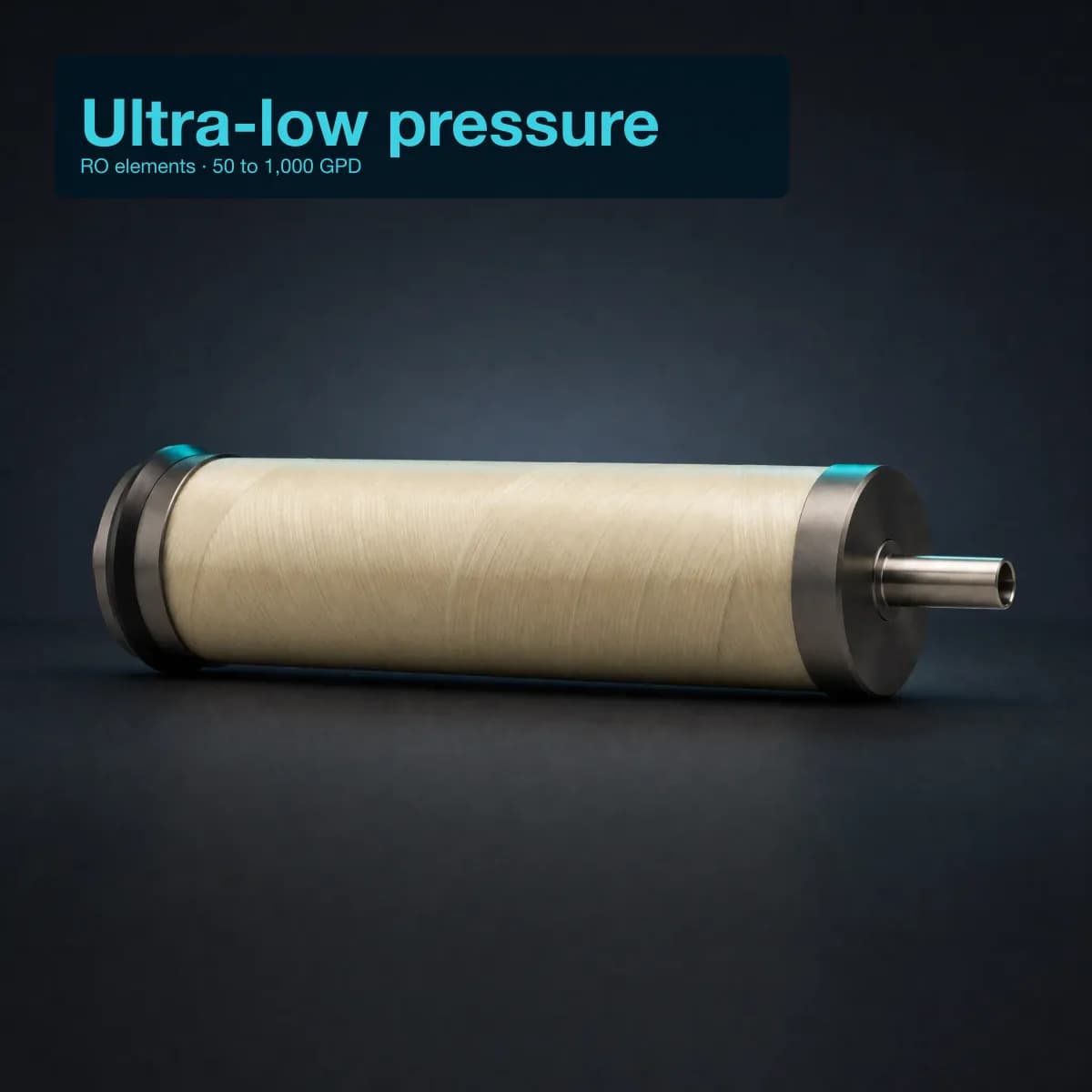
The reference design uses two rows tested at 100 psi and 250 ppm NaCl: ULP3113-1000 (1,000 GPD, 3.78 m³/d), the largest ULP row, and ULP3013-400 (400 GPD, 1.51 m³/d), the smallest of the seven ULP rows tested at 50% recovery[1]. NSF's key reads the 30 and 13 in ULP3013 as a 3.0 in diameter and a 13 in length, and defines no code 31, so ULP3113 is undefined[10]. The key also lists suffixes P, Q and F[10]; none is stated for either row, so suffix and seal direction are quote items.
The household page introduction describes the RO element as designed for water containing oxidant substances and high microbial contamination, and as applicable to water purifying devices for residence, hospital and laboratory[1]; it names no model, and its table includes an HOR row. The ULP1812-75 and ULP2012-100 sheets say "designed for treatment of low-salinity water resources such as tap water, well water, etc."[2][3], and the ULP3013-400 sheet says "applicable to automatic water dispenser and residential pure water machine, etc."[4]. These are stated uses, not results, and no retrieved Vontron document names a skid, a clinic or a dental office. The check is which document, and which model, each use belongs to.
900 GPD exceeds the small formats: the largest 60 psi ULP row is 125 GPD (ULP2012-125), so 900 GPD would take at least eight (900 ÷ 125 = 7.2)[1]. [ASSUMPTION: the ±20% flow tolerance printed on the ULP2012-100, ULP1812-75 and ULP3013-400 sheets[2][3][4] applies to every page row without a sheet, including ULP3113-1000 and the 800 GPD rows.] At that tolerance floor (20% below nominal, 1,000 × 0.8 = 800 GPD) no single row reaches 900 GPD. The clinic, dental-office or laboratory setting is the reference design's assumption, not Vontron's. The Vontron ULP pair reference design is provisional: the documents read, which defer to a manual not obtained, give no operating recovery or household limits; ULP3013-400 has two conflicting documents, neither dated; and ULP3113-1000 has no datasheet or dimensions.
Vontron ULP Series RO Membrane Element
Oxidant, recovery and floor flow would decide fit
In the Vontron ULP pair reference design for a 900 GPD light-commercial RO duty (the ULP pair design), the elements would be judged by the water they receive and the recovery they run at, because a nameplate GPD is a test-line rate, not a prediction for a supply. In the hypothetical scenario a small facility on treated municipal supply needs 900 GPD (3.41 m³/d) on a peak day and 300 GPD (1.14 m³/d) on a low-demand day. [ASSUMPTION: illustrative demands, valid until the facility meters its own.] Neither equals the nameplate of any element the ULP pair design judges it against; a demand equal to a rating would show a 0% margin and test nothing.
Two obvious fixes miss. The first is the largest element: Vontron says a single element's permeate flow is "within a tolerance not exceeding ±20% of the nominal value"[2], printed also on the ULP1812-75 and ULP3013-400 sheets[3][4]. ULP3113-1000 has a 10.0% margin on 900 GPD at its 1,000 GPD nameplate ((1,000 − 900) ÷ 1,000) but at its assumed ±20% floor of 800 GPD is 100 GPD short, a margin of −12.5% ((800 − 900) ÷ 800). The second fix reads the household page's oxidant sentence as a chlorine tolerance, so pretreatment looks optional. It is the page introduction, it names no model, its table includes the only HOR row (HOR2012-50), and the ULP2012-100, ULP1812-75 and ULP3013-400 sheets do not carry it[1][2][3][4]. No retrieved Vontron document gives a numeric chlorine tolerance for household ULP elements, so oxidant removal is a target of the ULP pair design, not an option.
PUB reports plant-output chlorine of 2.27 mg/L (range 1.43 to 2.87) and monochloramine of 2.10 mg/L (1.29 to 2.70) for 2025, without labelling the chlorine row free or total[11]. DuPont's BW60-1812-75 datasheet prints a free-chlorine tolerance of below 0.1 ppm[12], so PUB's chlorine range is 14 to 29 times that figure (1.43 ÷ 0.1, 2.87 ÷ 0.1), indicative only and not a Vontron limit. The target is the ULP pair design's own: no free chlorine detectable at the carbon outlet, by ORP electrode online and test kit sampled. Carbon can reduce free chlorine[6], but no retrieved source shows it removing monochloramine, so that removal and its detection are open quote items.
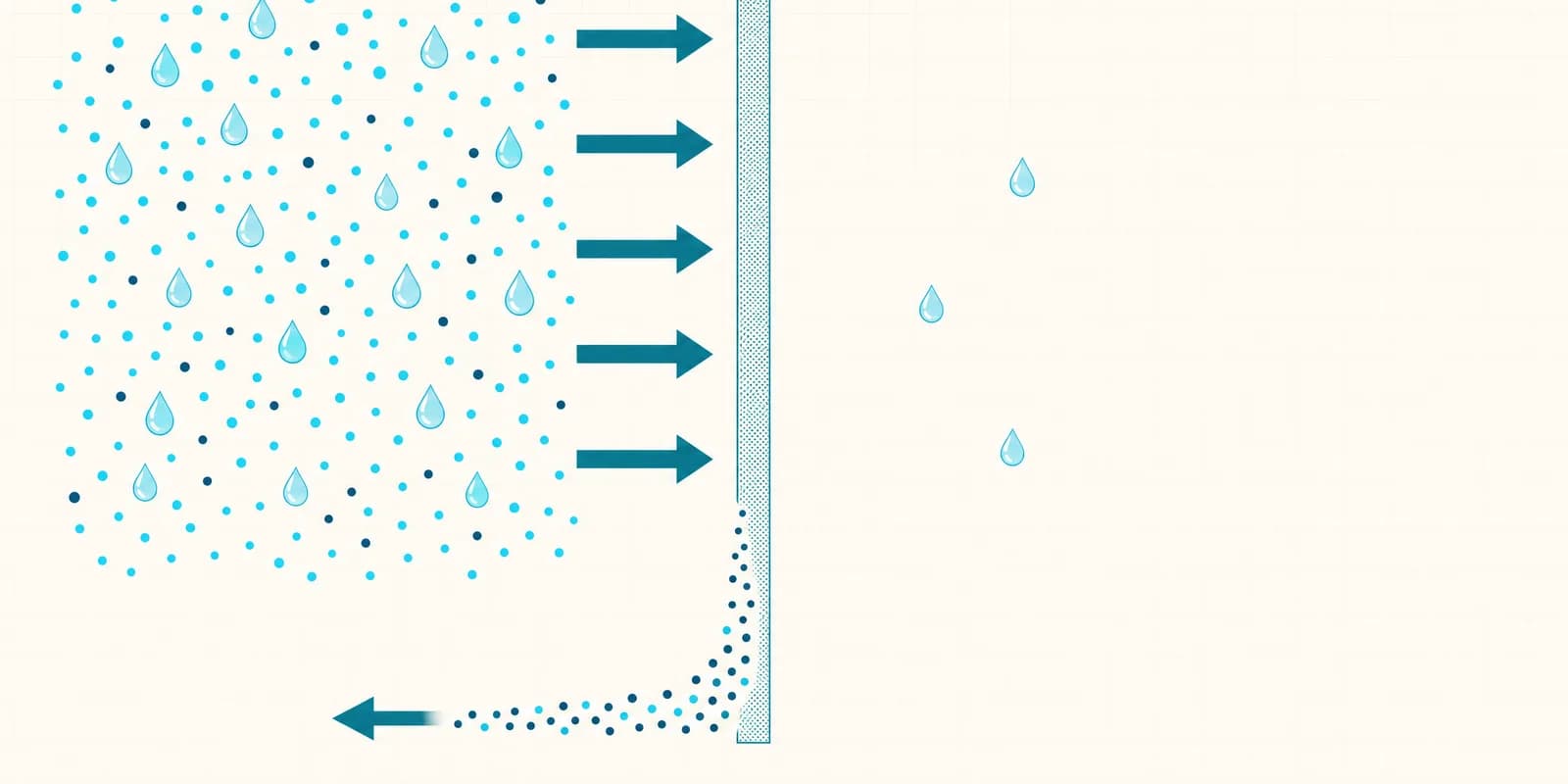
Recovery is permeate flow divided by feed flow[8]. The ULP pair design adopts 50%, the page's test recovery for both rows and not an operating limit: ULP rows are tested at 15% to 50%, the distributor-hosted ULP3013-400 sheet tests at 15%, and no retrieved document gives an operating recovery for household elements[1][2][4]. At 50%, 900 GPD of permeate takes 1,800 GPD of feed (6.81 m³/d) and rejects 900 GPD (3.41 m³/d). Reject is concentrated by 1 ÷ (1 − 0.5) = 2: about 232 mg/L TDS on PUB's 116 mg/L average and 1,084 mg/L at its 542 mg/L top[11].
Bench rejection applied to PUB's 116 mg/L average gives permeate estimates of 1.7 to 7.0 mg/L across both elements and readings at 25 °C[1][4][11]. These are NaCl rejections at a test line applied to a mixed-ion feed, not a guarantee, and no retrieved Vontron document gives a particle, turbidity or bacteria retention figure.
[ASSUMPTION: 30 °C, valid for an uncooled supply, not a chilled line; 100 psi at the element; an unboosted supply of 2.5 to 3.5 bar (36 to 51 psi); a 10-hour, six-day open pattern for storage sizing only.] PUB's figures are plant output, not a measurement at a facility's tap, and do not transfer to Malaysia or Indonesia.
- Peak-day demandASSUMPTION900 GPD (3.41 m³/d); equals no row on the pagesource
- Low-demand dayASSUMPTION300 GPD (1.14 m³/d); equals the nameplate of ULP3012-300, which is not usedsource
- Design recoveryASSUMPTION50%, the test recovery of both rows; not an operating limitsource
- Feed and reject at 900 GPD permeateASSUMPTION50%: 1,800 and 900 GPD; 40%: 2,250 and 1,350 GPD; 30%: 3,000 and 2,100 GPD (feed = permeate ÷ recovery)source
- Element-inlet pressureASSUMPTION100 psi (6.9 bar), the bench-test pressure; no maximum printed in the documents readsource
- Feed temperatureASSUMPTION30 °C, illustrative; FilmTec Table 50 stops at 29.9 °Csource
- Feed waterASSUMPTIONTDS 116 mg/L (63 to 542), chlorine 2.27 mg/L, monochloramine 2.10 mg/L; PUB plant output, January to December 2025source
- Oxidant targetASSUMPTIONNo free chlorine detectable at the carbon outlet; the ULP pair design's own decisionsource
- ULP3113-1000 permeate at 116 mg/L feedASSUMPTION2.3 mg/L typical (116 × 2%) to 4.6 mg/L at minimum rejection (116 × 4%) at 25 °C; 3.0 to 6.0 mg/L at 30 °C (passage × 1.30)source
- ULP3013-400 permeate at 116 mg/L feedASSUMPTIONPage: 1.7 to 2.9 mg/L (116 × 1.5%, 116 × 2.5%); other sheet: 5.8 to 7.0 mg/L (116 × 5%, 116 × 6%); at 25 °C, times 1.30 at 30 °Csource
Both would run at peak, one covering service
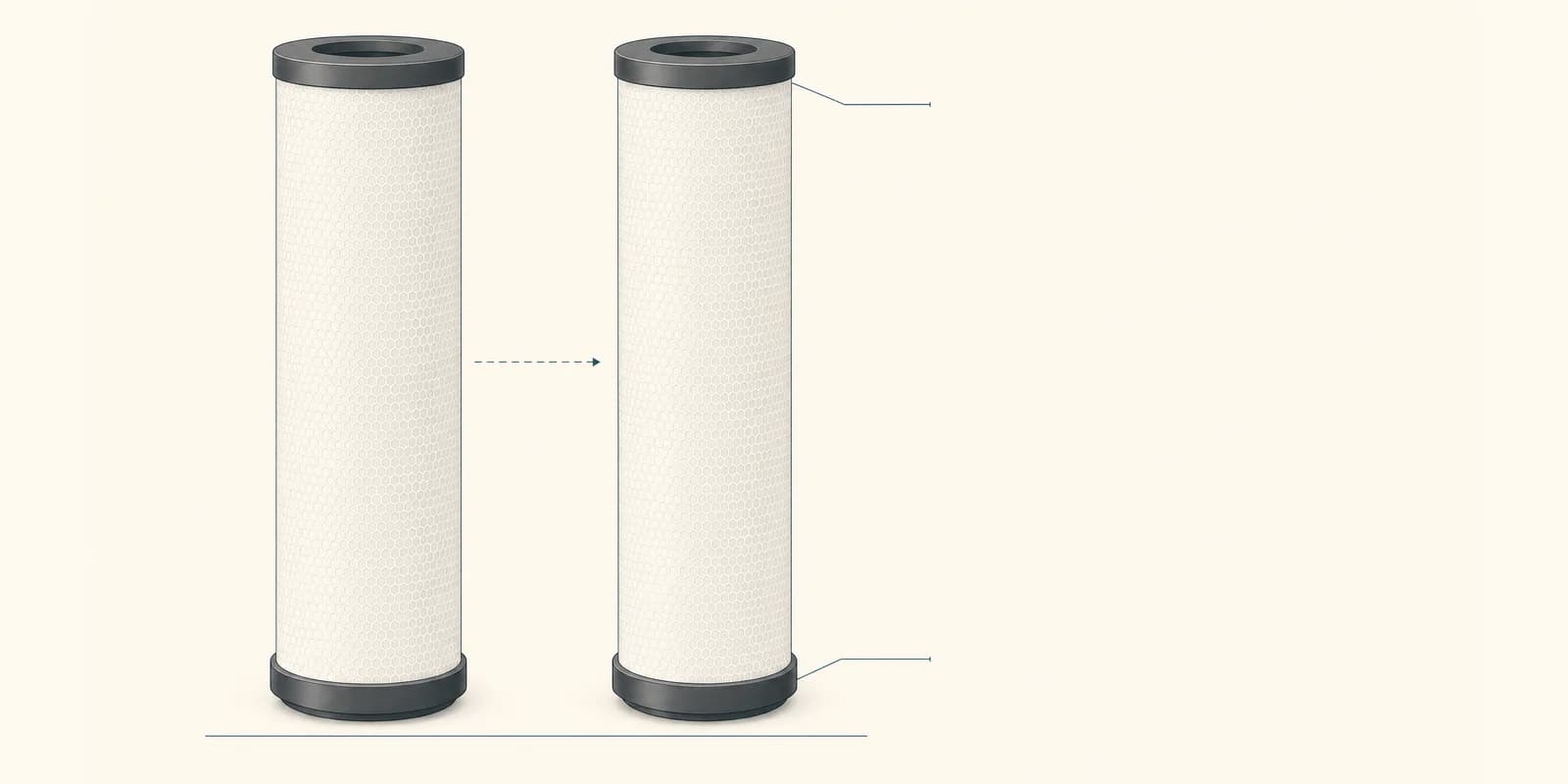
In the Vontron ULP pair reference design, supply would pass a sediment filter, an activated-carbon bed and a polish cartridge, then a booster pump, before two single-element housings in parallel, each with isolation, permeate check, concentrate control and sample valves (generic RO practice, assumed), so either element can be isolated and run alone by hand. Each concentrate control would hold its own element's recovery, since the two might not split the shared reject in proportion to the 50% design (reasoning); its size is a quote item from Vontron's operating recovery. Acceptance also needs specified permeate and concentrate flow points at each element (meter, or bucket and timer at the sample valves) and a feed thermometer; continuous logging is an owner decision. Permeate would go to an atmospheric storage tank with a distribution pump and reject to the owner's drain, and nothing bypasses the carbon. Reaching 100 psi (6.89 bar) from a 2.5 to 3.5 bar supply needs a booster adding 6.89 − 3.5 = 3.4 bar to 6.89 − 2.5 = 4.4 bar, before pretreatment losses (the supplier's) and element losses (none printed). The selection guide for Vontron ULP elements compares tank-fed point-of-use and other placements.
Both elements are needed. Margin is (rated − demand) ÷ rated against 900 GPD, with each floor 20% below nameplate.
| Candidate | Nameplate, GPD | Floor, GPD (±20% assumed) | Margin, nameplate | Margin, floor |
|---|---|---|---|---|
| ULP3113-1000 alone[1] | 1,000 | 800 | 10.0% | −12.5% |
| Any one 800 GPD row[1] | 800 | 640 | −12.5% | −40.6% |
| ULP3113-1000 + ULP3013-400 (reference pair) | 1,400 | 1,120 | 35.7% | 19.6% |
| Two ULP3113-800[1] | 1,600 | 1,280 | 43.8% | 29.7% |
The reference pair covers 900 GPD at any tolerance up to 35.7% (1,400 × (1 − t) = 900), so the borrowed ±20% is safe for the pair but not for ULP3113-1000 alone.
The second element covers a service window, not a bad feed. On the 300 GPD day, ULP3013-400 alone has a 25.0% margin at nameplate and 6.25% at its 320 GPD floor, and ULP3113-1000 alone has 62.5% at its 800 GPD floor (each (rated − 300) ÷ rated). Either can be taken out for service: with ULP3013-400 out, ULP3113-1000 carries 300 GPD comfortably; with ULP3113-1000 out, ULP3013-400 carries it with almost no margin, and the trial, like any service window on ULP3113-1000, uses that second case. On the design's assumption of a storage tank, low demand is met by the RO cycling off against it (no minimum flow is printed); the smaller element is a service-window resource, not a turndown device. Both share the supply, carbon bed, booster, permeate header and conductivity sensor, so a carbon breakthrough, a pump trip or a header fault reaches both alike.
Two ULP3113-800 elements are the alternative to price: their margins beat the reference pair's, and one alone carries 300 GPD at (640 − 300) ÷ 640 = 53.1%. The reference stays 1,000 + 400; the choice belongs at quote stage, since each rests on a documentation gap: ULP3113-1000 (no sheet) and ULP3013-400 (two conflicting documents) against ULP3113-800 (no sheet).
Those two ULP3013-400 documents disagree. The household page lists 98.5% typical and 97.5% minimum rejection at 250 ppm NaCl and 50% recovery[1]; the distributor-hosted sheet lists 95% and 94% at 500 ppm and 15%[4]; both print 400 GPD at 100 psi. Neither prints a date, and the text does not show which governs or why. The ULP pair design sizes flow on 400 GPD, which both print, shows quality on both readings, and sets the ULP3013-400 acceptance limit no tighter than the sheet's 94% until Vontron says which governs. The deep dive on ultra-low-pressure membranes holds the full treatment.
Warmer water is a coupled trade-off, not free capacity. At 30 °C the flow multiplier against 25 °C is 1.157 (FilmTec's Eq. 73 as transcribed; derived here)[5], which would lift the reference pair's floor to 1,120 × 1.157 = 1,296 GPD, a margin of (1,296 − 900) ÷ 1,296 = 30.6%. The ULP pair design does not rely on it: salt passage rises about 30% over the same five degrees[9], and the equation is DuPont's, applied to a Vontron element by assumption.
GPD is a 24-hour rate: 900 GPD averages 37.5 gal/h, while the reference pair at its floor makes 46.67 gal/h. Drawn evenly over a 10-hour day (90 gal/h), the open day needs 433 gal (1.64 m³) of storage at the floor or 317 gal (1.20 m³) at nameplate; on the ULP pair design's assumption, a break tank with a distribution pump.
- Flow multiplier at 30 °CASSUMPTION1.157 = exp[2640 × (1/298 − 1/303)]; FilmTec's Eq. 73 as transcribed, transferred to a Vontron element by assumptionsource
- Storage at the pair floorASSUMPTIONAverage 900 ÷ 24 = 37.5 gal/h; floor 1,120 ÷ 24 = 46.67 gal/h; 900 ÷ 46.67 = 19.3 h; (90 − 46.67) × 10 h = 433 gal (1.64 m³); refill 46.67 × 14 h = 653 galsource
- Storage at the pair nameplateASSUMPTION1,400 ÷ 24 = 58.33 gal/h; (90 − 58.33) × 10 h = 317 gal (1.20 m³)source
Acceptance would rest on per-element sampling
In the Vontron ULP reference design, the online readings would be an ORP electrode at the carbon outlet that trips the booster, booster suction (low stops the booster) and element-inlet pressure (low trips or alarms), header conductivity with divert to drain when high, storage level (low starts, high stops the train) and pretreatment differential pressure (high raises a service alarm). Sampled would be chlorine by test kit at the carbon outlet, turbidity and SDI at the polish outlet, monochloramine, hardness, alkalinity and each element's own permeate conductivity. Every trip value is a commissioning setting, and none is a Vontron figure. Booster shut-off head and a high-pressure trip are also commissioning items, since no maximum pressure is printed.
The header reading blends the two elements, so one failing element can hide in it; the check is to sample each element. No retrieved source shows an ORP electrode responding to monochloramine, which PUB reports at about the level of chlorine[11]. Salt passage rises late in chlorine attack; FilmTec says, for its own membranes, that lost flux comes first[6].
On power loss the booster would stop, by the ULP pair design's assumption. The ULP2012-100 sheet says: "Discharge the permeate water produced during the first hour after system start-up."[2] NSF's listing for Vontron elements is for material requirements only and notes a 24-hour flush before use[10]. The two instructions are not reconciled, so the ULP pair design applies 24 hours at first commissioning and one hour after each later start-up. Permeate after an idle period would be diverted and sampled, since WQA describes TDS creep after a shutdown[9]. Vontron recommends soaking wet elements "not used for a long time"[2] and the ULP3013-400 sheet names "system standby"[4], but neither defines a period; whether a weekly closure needs a soak is a question for Vontron. None of the three sheets read prints a shutdown procedure.
Acceptance would be at each element's own permeate sample valve, so the header cannot flatter it. Each reading records element-inlet pressure, the element's recovery from its measured permeate and concentrate flows (50% design), simultaneous feed conductivity, feed temperature (30 °C basis) and time since start-up, as the deep dive on ultra-low-pressure membranes sets out. The pass conditions are the ULP pair design's judgment, not Vontron's: a permeate conductivity limit built from each element's minimum rejection raised 30% for 30 °C, and flow normalised to 25 °C (measured × 0.864 at 30 °C) inside the ±20% windows. A shortfall is first a question for Vontron, not a rejection.
- ULP3113-1000 permeate conductivityASSUMPTIONAt most 5.2% of feed conductivity: (1 − 0.96) × 1.30, from the 96% minimum rejectionsource
- ULP3013-400 permeate conductivityASSUMPTIONAt most 7.8% of feed conductivity: (1 − 0.94) × 1.30, from the other sheet's 94% minimum rejectionsource
- ULP3113-1000 normalised flowASSUMPTION800 to 1,200 GPD, the ±20% window on 1,000 GPDsource
- ULP3013-400 normalised flowASSUMPTION320 to 480 GPD, the ±20% window on 400 GPDsource
Feed checks before extended running: no free chlorine at the carbon outlet by kit and ORP; SDI15 at the polish outlet below 3, the level FilmTec recommends for RO feed generally[7]; and turbidity there against FilmTec's general guideline that feedwater "should be less than 1 NTU"[7]. The monochloramine pass condition is set with the pretreatment supplier, since no maker limit or ORP response is shown. The household documents read print no SDI limit, and PUB's plant output averages 0.15 NTU, top 0.48[11]. PUB's total hardness of 42.7 and alkalinity of 35 mg/L as CaCO3[11], doubled at 50% recovery (42.7 × 2 = 85.4; 35 × 2 = 70), give about 85 and 70 mg/L in the reject (derived here); scaling is a check against the facility's own analysis, as no index is computed.
Where it would fit, and what stays open
In the Vontron ULP reference design, the central gap comes first: the documents read give no operating recovery for household elements, so the 50% used here is a test recovery adopted as a choice, not a maker limit. They give no maximum pressure or temperature, operating pH range or chlorine tolerance; the sheets' 25 °C and pH 6.5 to 8.5 are test-solution conditions. The ULP2012-100, ULP1812-75 and ULP3013-400 sheets print no Operating Limits table and defer to a technology manual and design guide, stating "Any specific application must be limited within the Operating Limits and Conditions."[2] The household page states none[1]. Feed, drain, reject TDS and permeate quality all follow the recovery, so Vontron's written answer must close the gap before order. No other series' or maker's limit is carried over. A trial the owner can stop has three stages. Stage 1 analyses the supply and obtains Vontron's answers. Stage 2 runs ULP3013-400 alone at 50% recovery behind the pretreatment, sampling its permeate and recording normalised flow; it carries the 300 GPD day at 25.0% margin at nameplate and 6.25% at its floor. A failed floor there is a finding about that element, not the pair. Stage 3 adds ULP3113-1000 and the storage for a full 24-hour day. Stopping after stage 1 or 2 leaves a housing, a booster and instruments. An answer below 50% recovery, a feed limit below the supply's TDS, or a failed acceptance check ends the trial; the response is a different element or configuration.
Two interfaces stay open. On housing, the ULP3013-400 sheet's legend prints length A as 13.11 in (333.0 mm) and dimension B as 57.8 mm and as 2.67 in (67.8 mm), 10.0 mm apart. The legend does not name B, and neither value matches the 3.0 in (76.2 mm) diameter NSF's key reads from the code[4][10]. No dimensions exist for ULP3113-1000, so outline drawings are needed before any housing is specified. On dosing, Vontron's sheets say "it is strictly prohibited to dose any chemical medicament that may be harmful to membrane elements"[2], so an antiscalant needs Vontron's word first, and the ULP pair design doses none.
Concentrate, storage and end use are the owner's. The 900 GPD (3.41 m³/d) reject, at about 232 mg/L TDS on the average feed, needs a drain route and any consent; no discharge instrument was retrieved. The ULP pair design has no disinfection stage for stored permeate and claims no microbiological barrier. Each end use's requirement is the facility's to state, and the permeate is not assumed to meet any.
The ORP trip on carbon breakthrough is unproven for monochloramine, and low element-inlet pressure is a commissioning setting, since no minimum is printed. The integrator sets every trip value before handover, and the operator owns it after.
The ULP pair design could be taken to quote for a 900 GPD day on a dechlorinated supply, with demand up to the reference pair's 1,120 GPD floor (900 GPD sits 19.6% inside it), at least 1.64 m³ of storage at the floor (1.20 m³ only at nameplate), with no reserve allowance, and Vontron's written recovery. It stops where feed TDS exceeds the household limit Vontron confirms in writing, where chlorine or chloramine is not shown removed, where demand exceeds 1,120 GPD, or where a tender needs a written household pH, pressure, SDI or chlorine limit. A nameplate GPD is not a facility's output: Vontron's page says its information is for reference only and cannot be the basis of a performance guarantee[1], and nothing here is a Vontron endorsement of the pair or a guarantee of permeate quality.
The data pack is a supply analysis (with monochloramine, SDI15, temperature and tie-in pressure), metered daily demand, each end use's requirement, and the drain route. The quote request should ask Vontron for its household technology manual and design guide, operating recovery and limits, the feed TDS limit, outline drawings, the ULP3113-1000 tolerance, which ULP3013-400 document governs, and the idle-soak and flush periods. It should ask the pretreatment supplier to size the carbon bed, monochloramine included. Send the data pack with a quote request to Purionex.
Sources
- [1]Vontron — Residential RO Membrane product page, as retrieved 2026-09-30: household element table and page text (paraphrased, not quoted)
- [2]Vontron — ULP2012-100 RO element datasheet (third-party CDN copy): test conditions, tolerance, start-up, storage and dosing notices
- [3]Vontron — ULP1812-75 RO element datasheet (retailer CDN copy): same template and notices as the ULP2012-100 sheet
- [4]Vontron — ULP3013-400 RO element sheet hosted by a distributor (Waterequip); conflicts with the product page on rejection, test concentration and recovery; carries no date
- [5]FilmTec Reverse Osmosis Membranes Technical Manual, Rev. 20 — Table 50 and the temperature correction equations (comparator maker; the equation is DuPont's, not Vontron's)
- [6]FilmTec Reverse Osmosis Membranes Technical Manual, Rev. 20 — chlorine, dechlorination and ORP monitoring (comparator maker, generic reference)
- [7]FilmTec Reverse Osmosis Membranes Technical Manual, Rev. 20 — turbidity and SDI guidelines (comparator maker, generic reference)
- [8]WQA — Reverse Osmosis (RO) Fact Sheet, Technical Application Bulletin (2019): recovery definition
- [9]WQA — POU Reverse Osmosis Performance and Sizing, Annual Education Kit Vol. X, Article 4 (2013): temperature effects, TDS creep, biological contamination
- [10]NSF Product and Service Listings — Vontron Technology Co., Ltd., NSF/ANSI 58, current as of 2026-09-30 (footnotes and naming key)
- [11]PUB (Singapore) — Drinking Water Quality report, January to December 2025: plant-output water quality table (not a tap measurement)
- [12]DuPont — FilmTec BW60-1812-75 Element Product Data Sheet, Form No. 45-D01705-en, Rev. 7 (comparator only: DuPont's figure, not Vontron's)