A Vontron ULP element's nameplate invites one question: which model gives a facility's daily demand in GPD? The question that decides fit is what that GPD assumed. For the ULP3113-1000 and ULP3013-400 rows on Vontron's household product page, the GPD is printed for one element at one test line: 100 psi, 250 ppm NaCl and 50% recovery. No storage tank appears among the conditions.[1] The ULP3013-400 sheet adds a flow tolerance of ±20% at a different test line,[5] and the page says its information is for reference and cannot be the basis of a performance guarantee.[1] This guide can end in three answers: an element set at a stated margin, dechlorination or a written Vontron answer first, or not this product. Scope is household-format ULP elements on tank-fed point-of-use and small light-commercial duty. A two-element reference design works one such duty, and the mechanics article covers test lines and tolerances.
Confirm the problem, then measure feed and demand
An RO element answers dissolved salt; three look-alike complaints are not its job. Chlorine is removed before the element: FilmTec requires it upstream of its own membranes, and no Vontron document retrieved states a household chlorine tolerance.[10][1] Particles need a clean feed: FilmTec asks for turbidity below 1 NTU.[11] Microbiological safety is not its job either: WQA says small home RO systems should never be the primary means of removing biological contamination.[12] Vontron's rejection column is salt rejection at the test line, and no Vontron document retrieved prints a particle, turbidity or bacteria retention figure.[1][3][5]
For low output, read the trend and check feed pressure at the element against the 60 or 100 psi test pressure, then feed temperature, then the tank air charge (Whirlpool names a low charge as a cause on its own WHER25),[13] before suspecting fouling. A cool spell mimics fouling: FilmTec puts a 4 °C drop in feed temperature at about 10% less permeate flow.[9] A salty first draw after idle can be TDS creep, which WQA says sometimes occurs after a shutdown.[12] Salt that rises after flux has fallen fits chlorine attack, which FilmTec describes as "loss of membrane flux followed by an increase in membrane flux and salt passage",[10] and a chlorine and monochloramine test at the carbon outlet is the first check (this guide's reasoning). Tank-fed duty puts idle behaviour first; on-demand duty puts instantaneous GPD first.
Inputs group by what they decide. To eliminate: feed TDS, chlorine and monochloramine as separate species, turbidity and SDI. To size: peak-day demand, dynamic pressure at the element and feed temperature. To fit: storage, drain and housing space. Only Vontron can supply the rest, and the household page and the three sheets read print none of it: maximum feed TDS, chlorine tolerance, operating recovery, maximum pressure, pressure drop, operating pH, maximum SDI, maximum temperature, minimum concentrate flow, cleaning interval and service life. The ULP2012-100, ULP1812-75 and ULP3013-400 sheets print no Operating Limits table and refer to a technology manual; the household page states none.[3][4][5][1] Three unit traps matter. GPD is a 24-hour rate: 1,000 GPD is 1,000 ÷ 24, or 41.7 gal/h (0.158 m³/h), and 1 gpm is 1,440 GPD. ppm NaCl is one salt, while a TDS in mg/L sums all ions. NTU is not SDI.
PUB's report of water produced by Singapore's waterworks and desalination plants, January to December 2025, gives TDS 116 mg/L on average (63 to 542), chlorine 2.27 mg/L (1.43 to 2.87), and monochloramine 2.10 mg/L, a starting point and not a site measurement.[16] Malaysia's Ministry of Health table is undated, cites WHO guidelines of 1984, 1993/96 and 1998, and lists free residual chlorine at 0.2 to 5.0 mg/L and TDS at 1,000 mg/L.[15] No feed-water dataset was retrieved for Indonesia, so none is assumed.
Size an illustrative day to the tolerance floor
Screening eliminates nothing on a Vontron limit, because none appears in the household documents retrieved. DuPont's BW60-1812-75 sheet prints six limits[17] and Vontron's industrial ULP31-4021 sheet prints a table.[6] They show what kind of limit exists and are not carried across. The household page's introduction says, in paraphrase, that its RO element treats water with oxidants and heavy microbial load.[1] It names no model, and its table includes an HOR row, which NSF's naming key defines as "High-oxidation-resistant residential element"[14] against "Regular ultra-low pressure residential element" for ULP,[14] so the sentence cannot be read as a chlorine tolerance for a ULP element. The ULP2012-100 sheet says "low-salinity water resources such as tap water, well water".[3]
The household page prints 1,000 GPD for the ULP3113-1000 (96% minimum rejection) and 400 GPD for the ULP3013-400. A distributor-hosted ULP3013-400 sheet that prints no date gives the same 400 GPD at 500 ppm NaCl, 15% recovery and 25 °C.[1][5]
Vontron prints a flow tolerance of ±20% on the household ULP2012-100, ULP1812-75 and ULP3013-400 sheets and on the industrial ULP21-2521 sheet, and ±15% on the industrial ULP31-4021 and ULP22-8040 sheets.[3][4][5][7][6][8] No sheet was found for ULP3113-1000 or ULP3113-800, so [ASSUMPTION: ±20% is transferred to both from the ULP3013-400 sheet, though tolerance varies by model; valid as a design basis, invalid as a Vontron statement]. The two ULP3013-400 documents differ; this guide sizes on the 400 GPD both print and asks the quote to say which governs.
The run below is illustrative, not a rating. [ASSUMPTION: a 900 GPD (3.41 m³/d) peak day for a small clinic, dental office or laboratory, a 30 °C feed at PUB's 116 mg/L TDS average, 100 psi at the element and 50% recovery; valid until the facility meters its demand, invalid as a site measurement, for a chilled line, or for Malaysia and Indonesia.] The 900 GPD equals the nameplate of no element it is judged against. Among the rows the page shows (it says it shows only some models), only the ULP3113-1000 reaches 900 GPD at nameplate: (1,000 − 900) ÷ 1,000 is a 10.0% margin. At its assumed ±20% floor of 800 GPD, 1,000 × 0.8, the margin is (800 − 900) ÷ 800, or −12.5%, a shortfall of 100 GPD.[1][5]
| Set | Nameplate GPD | Margin at nameplate | Floor GPD (±20% assumed) | Margin at floor |
|---|---|---|---|---|
| ULP3113-1000 alone | 1,000 | 10.0% | 800 | −12.5% |
| Pair: ULP3113-1000 + ULP3013-400 | 1,400 | 35.7% | 1,120 | 19.6% |
| Two ULP3113-800 | 1,600 | 43.8% | 1,280 | 29.7% |
The pair clears 900 GPD at its 1,120 GPD floor by (1,120 − 900) ÷ 1,120 = 19.6%. It breaks even at a 35.7% tolerance, (1,400 − 900) ÷ 1,400, and the ULP3113-1000 alone at 10%. Two ULP3113-800 rows clear it. Each set rests on page rows or one disputed sheet. Only the element has a published flow rating, so it is the first capacity check. This result holds only if none of the five closing stop conditions applies.
Flow is sized at the floor and fit is checked at the ceiling. At the 50% test recovery, 900 GPD of permeate needs 900 ÷ 0.5 = 1,800 GPD of feed and rejects 900 GPD; at 30% recovery that becomes 3,000 and 2,100. The 50% is a borrowed test recovery. The pair at its plus 20% ceiling, 1,680 GPD at 25 °C, draws 3,360 GPD of feed at 50%. At the run's 30 °C the ceiling is 1,680 × 1.157 = 1,944 GPD and the feed 3,888 GPD, or 2.70 gpm (10.2 L/min), which the booster and drain must carry. [ASSUMPTION: an unboosted supply of 2.5 to 3.5 bar (36 to 51 psi), representative, not measured] is 36% to 51% of the 100 psi test pressure. No Vontron document retrieved prints a pressure-flow curve, so the run assumes a booster delivering 100 psi and no credit above it.
No Vontron document retrieved prints a temperature curve either, so the factor is derived: FilmTec's Equation 73 gives 1.157 at 30 °C against 25 °C, lifting the pair's floor from 1,120 to 1,296 GPD.[9] No credit is taken: the equation is FilmTec's, a named assumption for a Vontron element. The price is salt: WQA puts the rise in salt passage at about 6% per °C, about 30% over five degrees.[12] On the 116 mg/L feed, a 96% minimum rejection gives at most about 6.0 mg/L at 30 °C (116 × 0.04 × 1.30), as bench rejection on a mixed-ion feed.
Tank-fed delivery can fall below bench recovery: WQA gives differential pressure as feed pressure less osmotic pressure and tank back pressure.[12] Whirlpool's WHER25, a different product, prints 22.9% recovery with the tank bypassed against 12.2% efficiency in typical use, both at 50 psi, 77 °F and 750 TDS: 12.2 ÷ 22.9 is about 53%, on Whirlpool's definitions.[13] No Vontron document retrieved prints a minimum flow, so low demand is a duty-cycle question. [ASSUMPTION: a 300 GPD weekend day, valid until metered.] On it the ULP3013-400 alone has a 25.0% margin at nameplate and 6.25% at its 320 GPD floor, so at the floor it runs 300 ÷ 13.3 = 22.5 of 24 hours. On the 900 GPD day the pair at its floor runs 900 ÷ 46.7 = 19.3 hours (80%), so storage, not the elements, absorbs the peak.
Choose a placement, then question each quoted GPD
No Vontron document retrieved gives tie-in facts, so the three placements below are [ASSUMPTION: this guide's option set, not Vontron's]. Behind a tank, the elements are sized to a daily volume and cycle off when the tank is full. The blind spot is the tank. Its back pressure cuts the differential pressure, WQA gives 5 to 10 psi as the usual pre-charge, and TDS creep can follow a shutdown of some length.[12] On the assumed 10-hour draw of the reference design, 900 GPD needs 433 gal of storage at the floor: [ASSUMPTION: an atmospheric tank with a distribution pump or a vessel of another class, not a residential bladder tank; the design's own, no retrieved source].
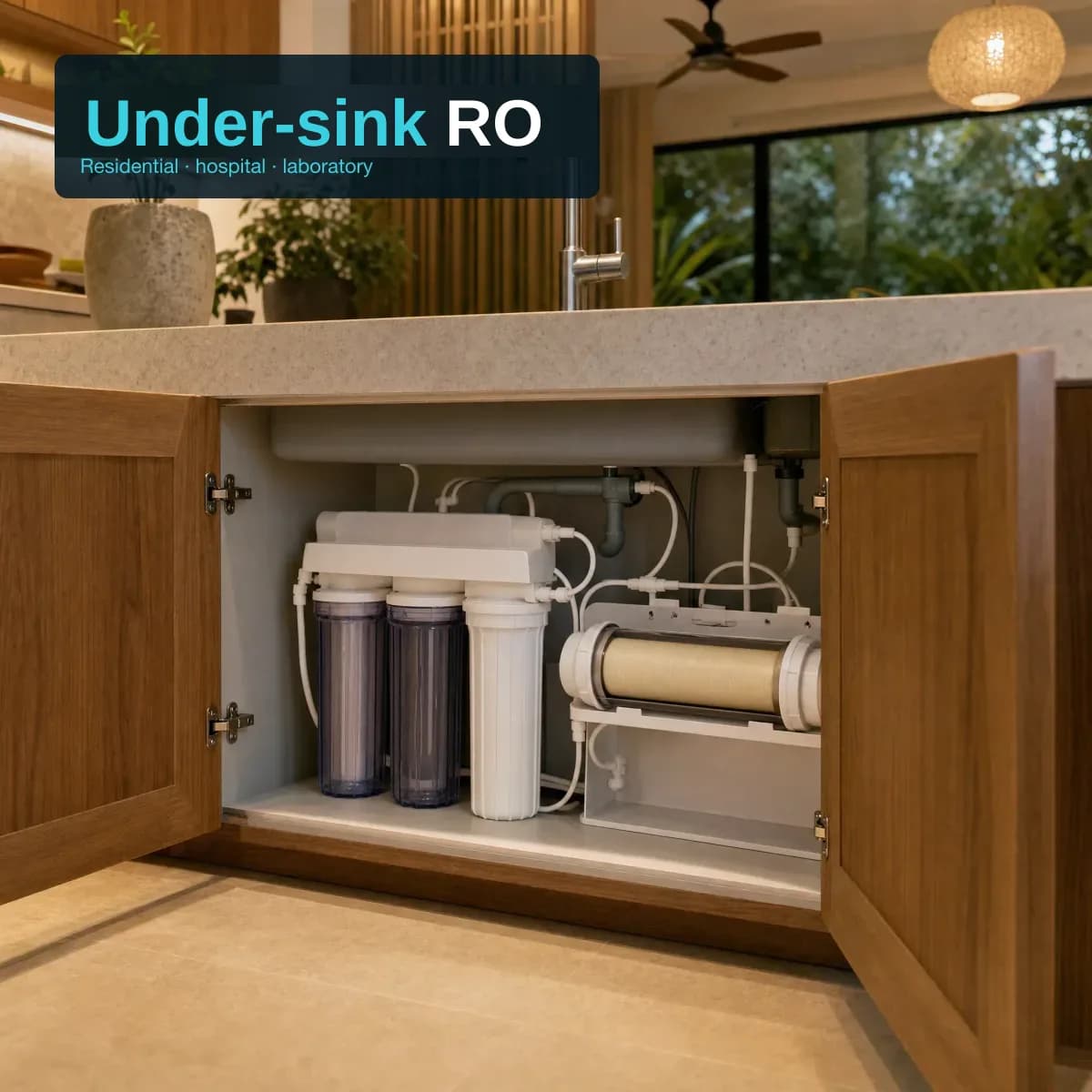
On demand avoids tank losses, but the elements must then meet the instantaneous draw. The pair is 1,400 GPD at nameplate, only 0.97 gpm (1,400 ÷ 1,440), and 0.78 gpm at the floor, so one 1 gpm draw, 1,440 GPD, exceeds it. Two elements in parallel give a service window, since the ULP3013-400 alone covers a 300 GPD day. Both share the feed, carbon bed, booster and permeate header, so a standby covers an element out of service and not a bad feed.
Ask who supplies dechlorination sized to the chlorine and the monochloramine: FilmTec's carbon reaction is written for free chlorine,[10] and no retrieved source covers monochloramine removal by carbon. Ask what stops the booster on oxidant breakthrough: FilmTec's practice is an ORP electrode downstream of the mixing line that shuts down the high-pressure pump,[10] and no retrieved source says it responds to monochloramine. Also ask about low-pressure and power-loss behaviour, per-element concentrate control, storage and drain. Housing size is unresolved: the ULP3013-400 sheet's dimension B contradicts itself (57.8 mm and 2.67 in are 10.0 mm apart), its legend does not name it, and the ULP3113-1000 has no dimensions. Request the outline drawing and outer diameter of both before specifying a housing.[5]
The ambiguous figure in every quote is the GPD. A quoted 400 GPD for a ULP3013-400 is one element at the page's test line or at the sheet's, which calls it an average value, within a tolerance.[1][5] A pair quoted at 1,400 GPD is the nameplate sum, 1,120 GPD at the floor. Vontron's own page says its rows cannot support a performance guarantee, so the reply must restate them at the site's line. Ask for lifecycle and acceptance declarations on the reader's baseline, without prices: element replacement, cleaning and service life; water lost (drain equals permeate at 50% recovery; Whirlpool's figures, derived here, mean 3.4 and 7.2 gal per gal[13]); booster energy; carbon replacement; and a permeate acceptance limit at the site's own pressure, recovery and temperature. The request names the ULP3113-1000 and ULP3013-400 codes, each rating's document and test line, the printed tolerance and which ULP3013-400 document governs.
Re-measure on change, and when to stop quoting
Vontron's sheets say: "Discharge the permeate water produced during the first hour after system start-up."[3] Record per-element flow, pressure, temperature, recovery and conductivity as the baseline. A ULP3013-400 reading from 320 to 480 GPD is inside its ±20% band only at the sheet's test line (100 psi, 500 ppm NaCl, 15% recovery, 25 °C).[5] A site at another line has no printed band, so read the trend at like conditions.
No Vontron document retrieved gives a cleaning, replacement or service-life interval for household elements. Its sheets recommend soaking in 1.0% sodium bisulfite when elements are "not used for a long time", and the ULP3013-400 sheet adds system standby, but none defines a duration,[3][5] so whether a nightly or weekend idle triggers a soak is a question for Vontron. Re-measure TDS, chlorine, monochloramine, pressure, temperature and demand whenever the source, season or duty changes. A first draw after idle can read saltier than the same element in service, the TDS creep WQA describes,[12] so an acceptance limit must say which sample it means, and a chlorine reading must say free or total.
Stop, or change the enquiry, when one of these five applies:
- No written Vontron household feed-TDS limit, or a feed TDS beyond the 250 to 500 ppm NaCl of its household test lines.[1][5] No household limit appears in the documents retrieved: 2,000 ppm is the industrial series page's normally-suitable wording, not a household ceiling.[2] WQA's 500 ppm is its own sizing baseline, and PUB's 542 mg/L range top is 8.4% above it.[12][16] Next: ask Vontron in writing.
- Measurable chlorine or chloramine with no dechlorination planned. PUB's chlorine of 1.43 to 2.87 mg/L is 14 to 29 times DuPont's below-0.1-ppm free-chlorine figure for its BW60-1812-75, indicative only because PUB's row is not labelled free or total.[16][17] Next: dechlorination sized to the residual first.
- A single-element quote for demand above that element's floor, as 900 GPD against its assumed 800 GPD. Next: size up or use a multi-element set, which the reference design works.
- A tender that needs a written pH, pressure, SDI or chlorine limit for the household element. The sheets print no operating limit; pH 6.5 to 8.5, pressure and temperature appear only as test conditions.[3][4][5] Next: Vontron's household technology manual in writing.
- An end use whose water-quality requirement nobody has stated, or one that would treat RO as a microbiological barrier.[12] Next: the facility states the requirement first.
An enquiry that can be sized sends demand in GPD with draw hours, TDS, chlorine and chloramine trends, temperature range, dynamic pressure, SDI or turbidity, the end-use requirement, storage plan, drain and country. A competent reply names the elements; the margin as (rated − demand) ÷ rated with the rated figure stated; the component that limits flow; the interface split; lifecycle items; acceptance checks; and which Vontron document governs. It may conclude that dechlorination comes first, that an industrial-series element is needed, or that this is not the product.
Vontron ULP Series RO Membrane Element
Request a quote for the Vontron ULP elements with this data pack.
Sources
- [1]Vontron — Residential RO Membrane household product page, retrieved 2026-09-30 (rows, disclaimer, 'shows only some models' footnote; condensed extraction, paraphrased only)
- [2]Vontron — Ultra Low Pressure Elements (industrial ULP series) product page, retrieved 2026-09-30 (2,000 ppm 'normally suitable' statement; paraphrased only)
- [3]Vontron — ULP2012-100 RO element datasheet (distributor-hosted copy): test conditions, tolerance, notices
- [4]Vontron — ULP1812-75 RO element datasheet (retailer-hosted copy): tolerance, notices
- [5]Vontron — ULP3013-400 RO element datasheet (Waterequip-hosted copy, prints no date; conflicts with the product page): test conditions, tolerance, notices
- [6]Vontron — ULP31-4021 industrial element datasheet (prest.ro copy): Operation Limits table, plus/minus 15% tolerance (industrial comparator, not a household limit)
- [7]Vontron — ULP21-2521 industrial element datasheet (HSC Water copy): plus/minus 20% tolerance (industrial comparator)
- [8]Vontron — ULP22-8040 industrial element datasheet (prest.ro copy): plus/minus 15% tolerance (industrial comparator)
- [9]DuPont — FilmTec Reverse Osmosis Membranes Technical Manual, temperature correction (Equation 73, p.131; 4 °C feed-temperature drop, p.130; generic reference, not a Vontron statement)
- [10]DuPont — FilmTec Technical Manual, chlorine attack and dechlorination, pp.64-67 (generic reference, FilmTec's own membranes)
- [11]DuPont — FilmTec Technical Manual, feed turbidity, p.57 (generic reference)
- [12]Water Quality Association — POU Reverse Osmosis Performance and Sizing (Annual Education Kit Vol. X, Article 4, 2013): temperature, tank back pressure, TDS creep, sizing baseline
- [13]Whirlpool — WHER25 Installation and Operation Manual (a packaged residential RO system, not a Vontron product): recovery, efficiency, troubleshooting
- [14]NSF — Product and Service Listings, Vontron Technology, NSF/ANSI 58, current as of 2026-09-30 (footnote [2] naming key: ULP and HOR; raw-HTML checked)
- [15]Malaysia Ministry of Health — Drinking Water Quality Standard tables (undated PDF; reference key cites WHO 1984, 1993/96, 1998)
- [16]PUB Singapore — Singapore Drinking Water Quality, January to December 2025 (water produced by the waterworks and desalination plants; not a tap measurement)
- [17]DuPont — FilmTec BW60-1812-75 Product Data Sheet (comparator only: DuPont's limits, not Vontron's)