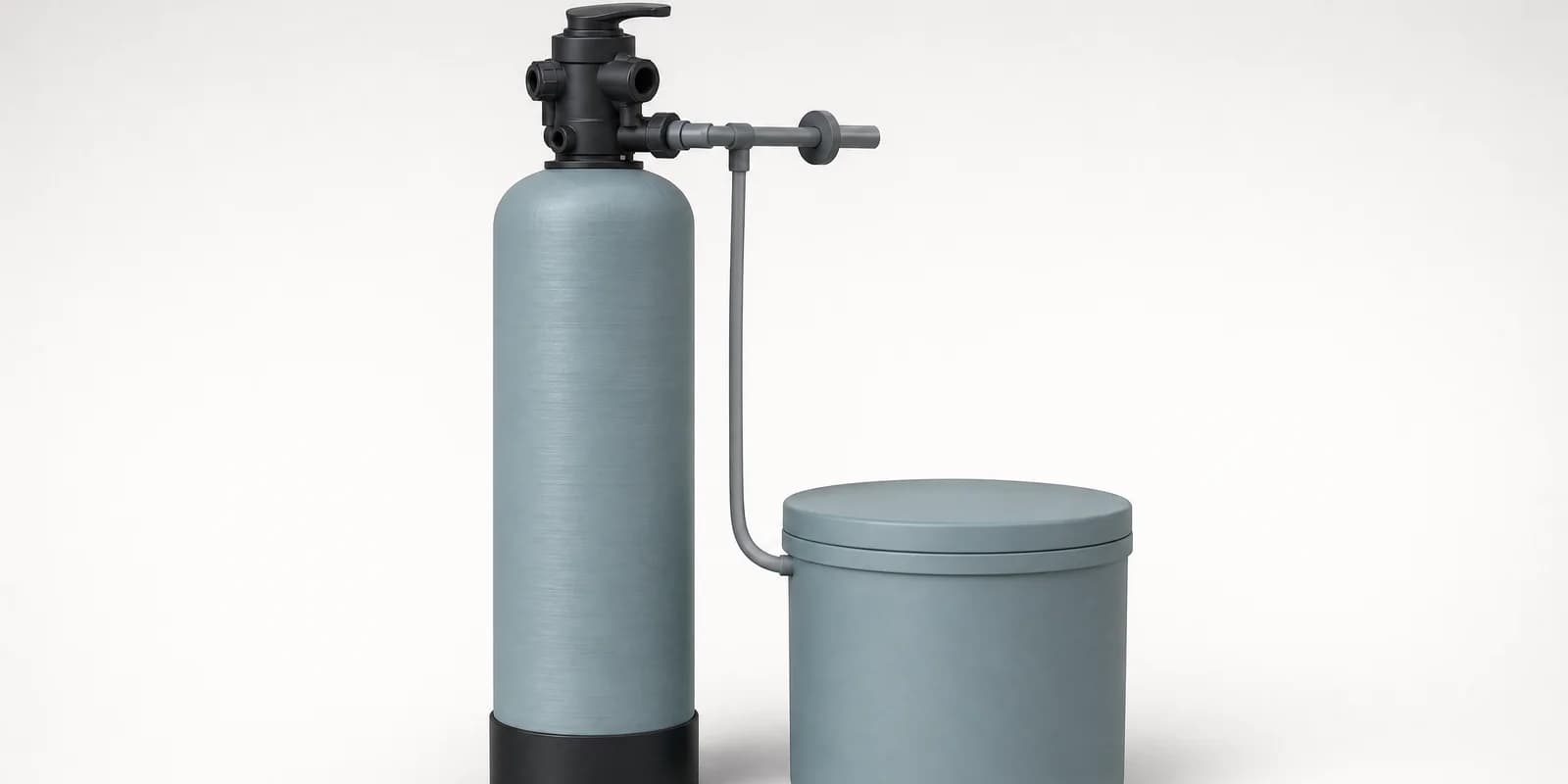
The Runxin F112A3 automatic multi-port softener valve (maker's model 63640B, the F112A3 below) invites one question: how much flow does it pass? The maker's page says it "features a flow rate of 40m³/h",[9] and the F112 manual's (Rev.A.2011) table prints "Flow Rate m3/h @0.2MPa" against 40 without saying what that pressure is.[5] This guide's sizing rule is to size to the lower of the tank's table flow and the valve's printed figure. The maker's tank table, a calculation at a bed velocity of 25 m/h, gives 28.0 t/h for a φ1200 tank, 70% of the printed 40, and 44.0 for φ1500, above it.[5]
Three things decide the answer: the tank's table flow against demand, the feed against the manual's limits, and whether a single valve's pause during regeneration is acceptable. This guide covers one softener stage feeding RO in a commercial building, on Singapore water data only. It ends in one of three answers: this valve on a named tank (25 m³/h on a φ1200 tank, a 10.7% margin on its table flow and 37.5% on the printed 40); a larger tank, a stage upstream or a pump first; or not this valve. The reference design works the same duty with two interlocked valves.
Measure the water and pressure before sizing
A hard-water complaint or an RO supplier's wish for softened feed does not alone call for a softener. Check raw hardness in the manual's own unit, mmol/L, where its table prints first grade under 6.5 and second grade under 10,[5] and get the supplier's feed requirement in writing. The worked duty assumes [ASSUMPTION: raw hardness 3 mmol/L; an RO supplier who requires softened feed; demand 25 m³/h of RO feed]. [ASSUMPTION: supply at least 0.2 MPa at the valve inlet in service and in regeneration; free chlorine under 0.1 mg/L at the softener inlet, which is the buyer's upstream design requirement (dechlorination sized to deliver below the valve's limit, confirmed by test), not a sourced performance; iron, turbidity, CODMn and temperature inside the limits below; all hypothetical, valid for the arithmetic only]. A soft feed ends the answer at no softener.
PUB's 2025 table gives total hardness averaging 42.7 mg/L as CaCO3, with a range of 7.24 to 191.[6] The average is in the USGS soft class of 0 to 60,[1] and the top of the range is 6.1% above the USGS very-hard line of 180,[1] so a site's own analysis decides. The manual's hardness limits are upper limits, so no threshold below which softening is pointless can be derived. PUB's chlorine, 1.43 to 2.87 mg/L, is not stated as free or total;[6] against the valve's free-chlorine limit of 0.1 mg/L[5] that is 14.3 to 28.7 times, an indicative gap that sends a stage upstream when the supply carries a residual. No Malaysian or Indonesian figure was retrieved, and this guide uses none.
An existing softener that delivers hard water is not always a valve fault. The manual says to "Test the outlet water and raw water hardness at regular time."[5] Compare the raw figure with the one the capacity was set for. Its row "Softener supply hard water." lists "Bypass valve is open or leaking." and "No salt in brine tank." among the causes, and, paraphrased, an incorrect regeneration time, or raw water whose quality has deteriorated.[5] The last mimics a valve fault: a capacity set for the old hardness runs out early. That rests on the manual's row; PUB's range does not show change over time.
For a feed that cannot stop, such as RO pretreatment, continuity comes before size, because "No water passes the valve during regeneration in single tank type."[5] Regeneration takes the valve out of service for four positions (backwash, brine draw, slow rinse, fast rinse); brine refill runs in service.[5] A continuous duty needs the choice below.
Measure first the inputs that eliminate a valve: free chlorine, under 0.1 mg/L; iron (Fe2+), under 0.3 mg/L; turbidity, under 5 FTU; CODMn (the manual's oxygen-demand limit), under 2 mg/L; water and ambient temperature, 5 to 50 °C; and supply pressure at the valve inlet, 0.2 to 0.6 MPa.[5] Above 0.6 MPa the manual says a pressure-reducing valve must be installed, and over 5 FTU an inlet filter should be.[5] Read pressure in service and during regeneration, because an inlet pressure under 0.15 MPa is the manual's case "which makes backwash or brine drawing difficult".[5] Sizing first would rest the run on an invented hardness.
Demand is the RO unit's feed flow in m³/h, not its permeate flow. The manual's mmol/L and the mg/L as CaCO3 of PUB and USGS are never converted: the manual states no molar basis in the pages read, so the analysis must be in its unit and the basis is a question for the maker. [ASSUMPTION: the tank table's t/h reads as m³/h for water.] Turbidity in FTU is not a solids concentration. The drain pipe, which "should not exceed 5m", and the DN65 connection are fit items.[5]
Size to the lower of two flows
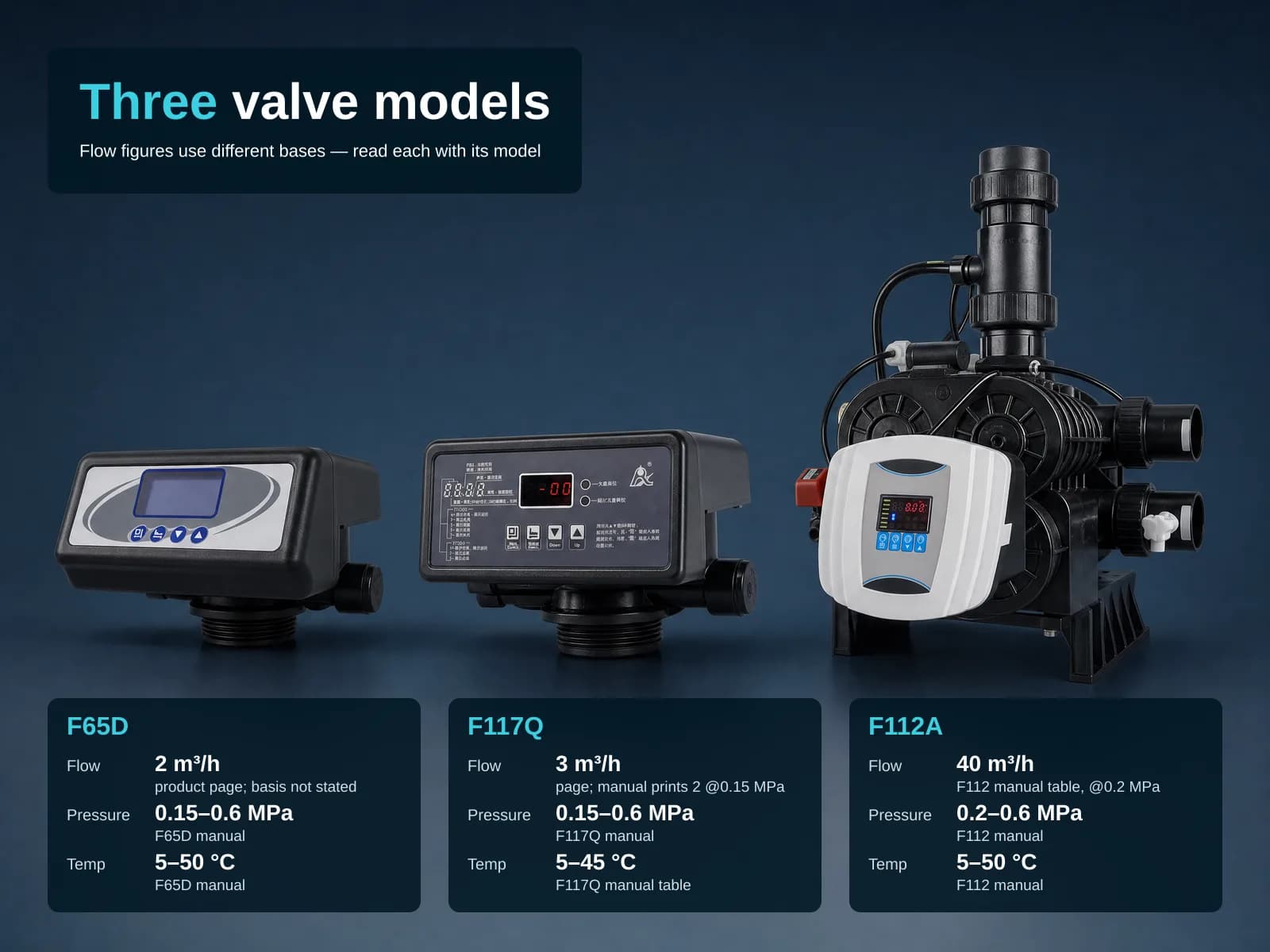
Limits eliminate first, and the flow figures of the four models, on page and manual, are not one scale.
| Model | Maker's page | Manual's table |
|---|---|---|
| F112A1/A3 | 40 m³/h, no basis[9] | 40 at "@0.2MPa"[5] |
| F65D | 2 m³/h, no basis[9] | no rating in the pages read[2] |
| F65P | 2 m³/h[10] | 2.0 at "@0.3MPa"[3] |
| F117Q | 3 m³/h[10] | 2 at "(@0.15MPa)"[4] |
A 25 m³/h duty at the maker's 25 m/h basis needs a 1.0 m² bed and a 1.128 m tank, or 44.4 in (derived here): outside the F65D page's 6 to 18 in tank range,[9] inside the F112A page's 24 to 60 in.[9] The F65D is out by tank range; the F65P and F117Q are out by their printed 2 and 3 m³/h against 25, on brackets no document read defines. Ask each quote for its bracket.
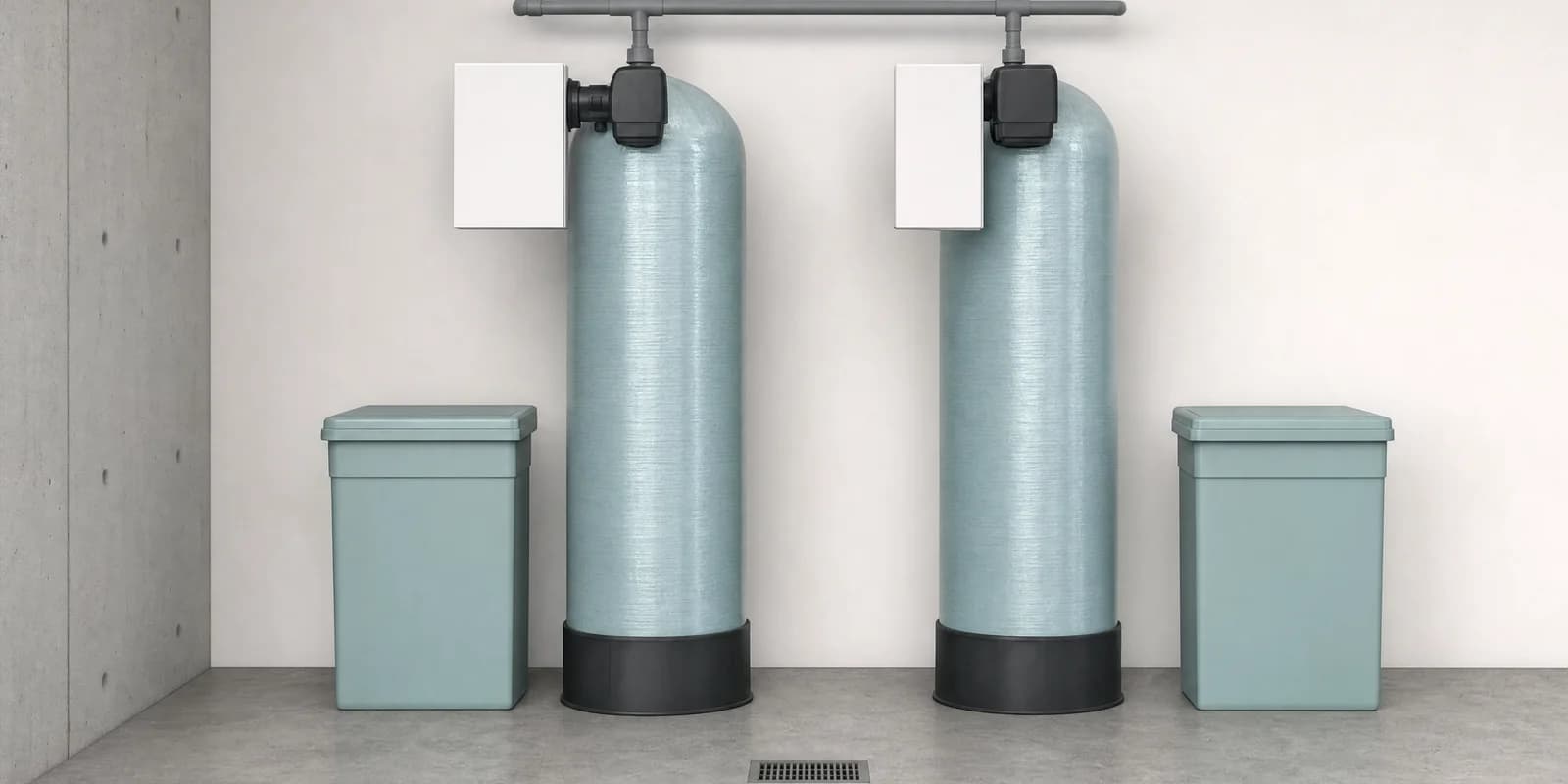
The maker tabulates two softener tanks only: 28.0 t/h for φ1200 × 2400 mm (1,500 L resin) and 44.0 for φ1500 × 2400 mm (2,500 L), with the note "The flow rate calculation is based on linear velocity 25m/h".[5] The 25 m/h is the table's basis, not a printed limit: it reproduces both figures within 1.0% from the bed areas [ASSUMPTION: internal diameters]. Applied to other diameters (derived here), it puts the crossover at 1.427 m, or 56.2 in; for φ1500, 44.0 is 10% above 40, so 40 binds. This guide sizes to the lower of the tank's table flow and the printed 40. Running 40 m³/h through the φ1200 tank would be 35.4 m/h, 41% above that basis; no limit is stated in the pages read, so ask the maker.
The worked run is illustrative, not a rating. At 25 m³/h the φ1200 tank leaves a margin of (28.0 − 25) ÷ 28.0 = 10.7% on the table flow and (40 − 25) ÷ 40 = 37.5% on the printed 40; the φ1500 tank is limited by the 40, also 37.5%.
The softener valve's curve is labelled with a Kv of 36.91, assumed to be in m³/h per square root of bar.[5] By the square law, (Q ÷ Kv)² with Kv constant, the derived drop across the valve alone is 0.46 bar at 25 m³/h, 0.58 at 28.0 and 1.17 at 40; the first two lie below the plotted part of the curve (about 30 to 65 m³/h, read from the page image), so they are extrapolated.[5] If the label is in m³/h per √bar and constant with flow, a 2 bar drop would pass 52.2 m³/h, so "@0.2MPa" would not be the drop at 40.[5]
The maker's formula for capacity per run is resin volume × exchange factor ÷ hardness, with a factor of 400 to 750 for down-flow regeneration and "If the inlet water hardness is higher, the factor is smaller."[5] At 3 mmol/L and 1.5 m³ of resin that is 200 to 375 m³ per run. The maker calls this calculation procedure "only for industrial application" and its calculation of parameters for each step "only for reference".[5] The factory capacity setting of 400.0 m³ should follow the site's analysis (this guide's reasoning).[5]
Runxin Automatic Multi-Port Control Valve
No certifications listedView product →The printed 40 stops holding in four places: "@0.2MPa" is undefined; the injector and drain-line table is tested at 0.3 MPa and "only for reference";[5] capacity falls with hardness; and no derating beyond the service table (0.2 to 0.6 MPa, 5 to 50 °C, outside which the warranty is void) and no minimum service flow is printed for the valve in the pages read.[5] Flow trades against valve drop and bed velocity, both rising with it (derived); the effect of higher velocity on softened water is undocumented.
The F112A1 (63540B) is the time-clock sibling; adding an outlet flow meter gives the meter-type structure,[5] so keep it only where demand is steady enough for a day-count, as it has no volume trigger (this guide's reasoning).
Decide the tie-in, then compare quote bases
Single tank or interlocked pair is the first choice, and each has a blind spot. One valve on one tank is simplest, but, as above, storage or a pause must cover the regeneration; the reference design works the storage figure for its duty. An interlocked pair keeps all but one valve in service while one regenerates,[5] but that is continuity, not cover for a fault, and firm capacity is one tank's table flow, not the sum of two (derived). Queue order, behaviour when both valves call and the position on power loss are unpublished in the pages read.
The feed is the second choice. The documents disagree on pumps: the F112A page says "the F112A3 is equipped with a booster pump",[9] while the manual says "a diaphragm pump must be installed in front of the water inlet" below 0.2 MPa and suggests a booster pump below 0.15 MPa.[5] With a diaphragm booster pump on the inlet the maker says the drain cut-off will cause inlet pressure to rise too fast and damage the valve, and offers a pressure-relief output;[5] pump scope is a quote item, and the reference design carries the stop and the test.
Who supplies what is a quote question. The manual installs the A3's outlet meter in the pipeline,[5] so its supplier is a quote item; the maker's documents also show a default injector, a drain-line flow control table and a power adapter,[5] so the split of body, controller, injector, tank, resin, pump and power is for each quote to state. Queue order, two valves calling, power loss and pump surge are quote items too.
Each quote must give the flow figure's basis: the pressure and what it means, the tank and resin assumed and the bed velocity at the design flow. A supplier-page figure starts the enquiry, not the site's result; what a figure must carry is set out in the deep dive. The documents read are the F112 manual and selected pages of three image-only manuals (F65P Rev.A.2003; F65D and F117Q revisions not read); the maker's own domain was unreachable on 2026-10-01, so product text is from its export site.
Lifecycle items sit on the buyer's baseline: coarse salt "at least 99.5% pure" and a 225 kg minimum per regeneration for the φ1200 row at the table's 150 g/L,[5] and drain flow of 17.32 t/h in the maker's 0.3 MPa test, "only for reference".[5]
One request-for-quote paragraph names the Runxin F112A3 (63640B) and asks for the exact model code and manual revision, flow basis, tank row and bed velocity, pump scope, meter and control mode, injector and drain-line sizes, the hardness-unit basis and, if needed, a certificate document naming the exact model. The maker displays NSF/ANSI 44 and NSF/ANSI/CAN 61 certificates dated 30 April 2020 that name no model and remain valid only while the maker has products in listing;[8] the NSF/ANSI 44 category listing read on 2026-10-01 has no Runxin entry, in that file and on that date, and the NSF/ANSI 61 listing was not retrieved.[7]
Recheck the feed, and know when to stop
Commissioning follows the maker's own trial run: backwash 8 to 10 minutes with the inlet valve opened slowly, since "If water inflows too fast, the media in tank will be damaged.";[5] brine and slow rinse about 60 minutes; then fast rinse 10 to 15 minutes, with outlet water tested: "if the water hardness reach the requirement, and the chloridion in the water is almost the same compared with the inlet water" the run moves on.[5] Instruments: a hardness test, a chloride comparison and an inlet pressure gauge read in service and during regeneration.
No document read gives a service interval for resin, injector or seals, and the manual gives no figure for "regular time".[5] Re-measure hardness, free chlorine, iron, turbidity, inlet pressure and demand whenever the supply, season, upstream stage or duty changes. A capacity set for 3 mmol/L runs at least 25% shorter at 4 mmol/L, since the manual says the factor falls as hardness rises.[5] Two results mislead: a pass on commissioning day after raw hardness has risen, and a pass while chloride in the softened water exceeds the inlet's.
Five stop conditions bound the worked result:
- Raw hardness at or above 6.5 mmol/L: the manual says the outlet will "hardly" reach its boiler-feed figure and suggests a second-grade softener, with no RO figure.[5] Next: a second-grade softener or another stage.
- Free chlorine at the softener inlet at or above 0.1 mg/L with nothing upstream to remove it. Next: a stage upstream, its performance the supplier's.
- Supply under 0.2 MPa at the valve inlet, in service or during regeneration, with no pump the maker confirms in writing.[5] Next: a pump within the maker's written scope.
- A site needing a certificate naming the exact model, which no document read supplies. Next: that document, or not this valve.
- A need for continuous hardness assurance or an alarm: the valve acts on time and volume, and an external contact is "equivalent to pressing the manual button".[5] Next: an analyser outside the valve, or another product.
Demand above one tank's table flow is a sizing outcome, not a stop: a larger tank up to the printed 40, and above 40 another valve. The worked run, by assumption, fires none.
The data pack holds the feed analysis in mmol/L with dates, free chlorine, iron, turbidity, inlet pressure in service and during regeneration, RO feed flow, whether the feed can stop, tank and resin volume, drain pipe length, the supplier's feed limit, the market (SG, MY or ID) and any certificate required. A competent reply gives the exact model code and manual revision, the flow basis and table flow, the margin against demand, the binding component, the valve drop, the pump scope, the capacity setting with its factor, who supplies each item, the lifecycle items and the acceptance checks, and may conclude that no softener is needed or that this is not the valve. The deep dive sets out the capacity formula and figure conditions.
Request a quote for the Runxin F112A3 softener valve with this data pack.
Sources
- [1]USGS Water Science School — Hardness of Water (hardness classes, condensed fetch)
- [2]Runxin — F65D instruction manual (service limits, selected pages)
- [3]Runxin — F65P user manual, Rev.A.2003 (flow table bracket, selected pages)
- [4]Runxin — F117Q user manual (flow table bracket, limits, selected pages)
- [5]Runxin — F112 series user manual, Rev.A.2011 (limits, tables, curves, interlock, trial run, trouble-shooting)
- [6]PUB — Singapore Drinking Water Quality, January to December 2025 (averages and ranges)
- [7]NSF — official listing, NSF/ANSI 44 category, read 2026-10-01 (NSF/ANSI 61 listing not retrieved)
- [8]Runxin — certification page and certificate images (described, not quoted)
- [9]Runxin — F112A and F65 product pages, English export site (raw text)
- [10]Runxin — F65P and F117Q product pages, English export site (raw text)