The Runxin F112A3 automatic multi-port softener valve (the maker's model 63640B, from Wenzhou Runxin Manufacturing Machine Co., Ltd.)[7] is a distribution valve that moves one resin tank through six positions.[4] On this article's reading of the manual's trouble-shooting rows and trial-run text, the result the trial run tests for is outlet hardness at the target with chloride about equal to the inlet's; the resin produces the first, and the manual lists the fast-rinse time among three causes of salt in the softened water.[4]
The misreading is that the valve softens the water because it is sold as a softener valve. The maker's manual says the F112 series is "Used for softening, demineralization or filtration water treatment systems".[4] Four questions follow: valve against resin, the printed 40 m³/h, what tests and certificates prove, and what a site must measure.
The finding: at the maker's default 10-minute fast rinse and its tested drain flow of 17.32 t/h at 0.3 MPa, a φ1200 mm tank with 1.5 m³ of resin receives 1.92 bed volumes (derived here; one bed volume is the resin volume), below the manual's 3 to 6, although the default sits inside the suggested 10 to 16 minutes[4]. Step times can decide whether a regeneration ends clean, a short fast rinse being one of three listed causes of salt in the softened water[4]; the printed flow figure does not. Sizing sits in the application guide on sizing and the applied duty in the reference design for interlocked softeners.
The valve sequences regeneration, the resin softens
The manual says the distribution valve "combines with Service, Backwash, Brine Draw, Slow Rinse, Fast Rinse and Brine Refill", so the valve schedules six positions while the resin does the exchange (reasoning).[4] The manual says the fast rinse should run until the outlet water meets the requirements.[4] It states "No water passes the valve during regeneration in single tank type."[4] An outlet solenoid valve is described for systems that cannot take hard water at the outlet during switching, backwash or brine draw.[4]
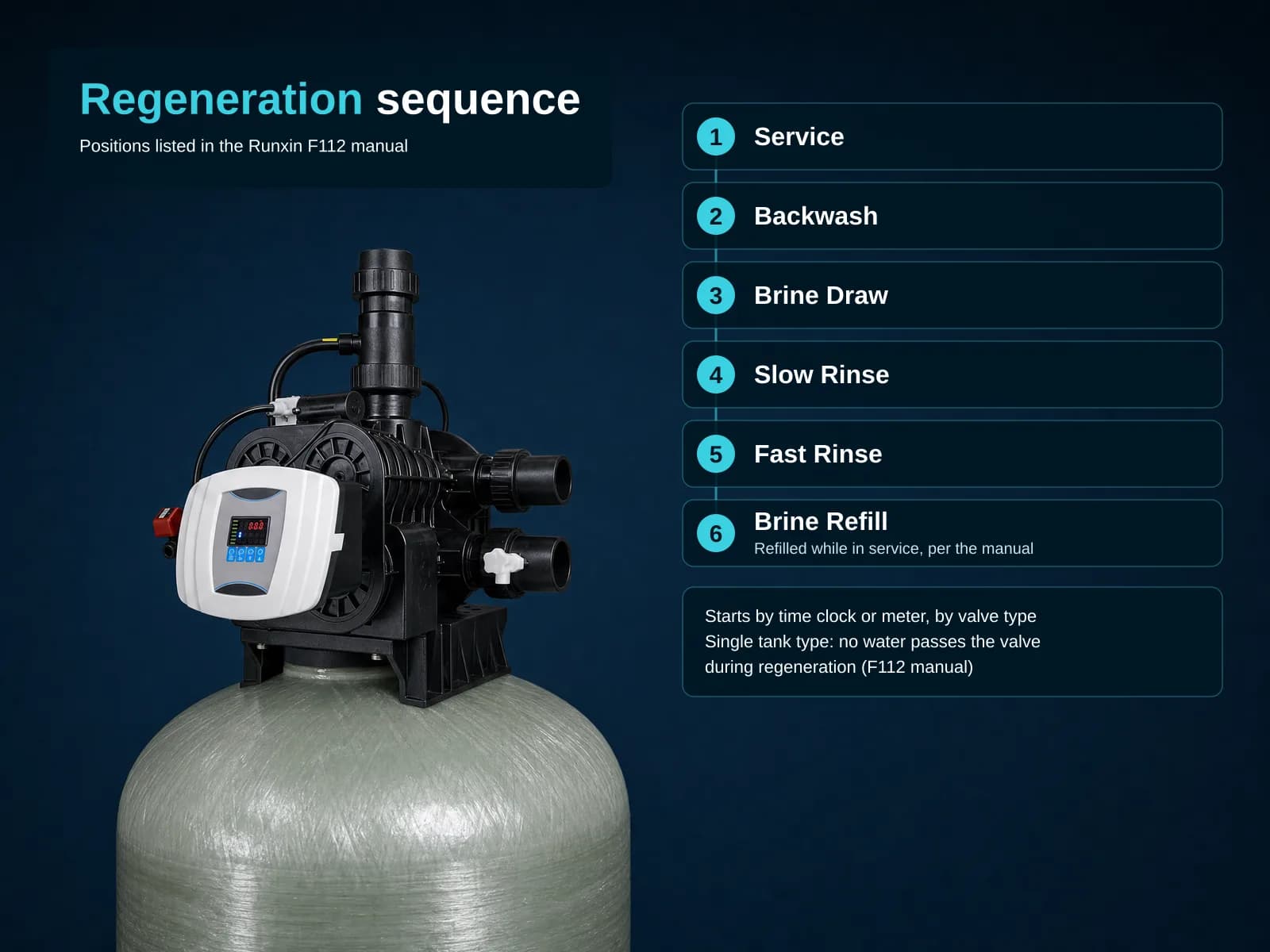
Brine refill differs: the manual says "Brine refill while in service status, so for fixed bed, the water for brine refill is hard water."[4] Reasoning from that, four of the six positions (backwash, brine draw, slow rinse and fast rinse) take the tank out of service and refill does not, so a fixed bed's brine is not made from softened water.
Capacity belongs to the resin. The manual's formula is Q = V_R × K ÷ Y_D: resin volume times exchange factor over raw hardness, with K 400 to 750 mmol/L for down-flow.[4] The formula has no valve term. [ASSUMPTION: 1.5 m³ of resin (the φ1200 row, diameter read as internal) and 3 mmol/L raw hardness in the manual's unit; valid for arithmetic only, invalid for any real supply.] The run is 1.5 × 400 ÷ 3 = 200 m³ to 1.5 × 750 ÷ 3 = 375 m³ per tank. The maker limits its calculation procedure to industrial application and calls its step calculation reference only, so this run is arithmetic on the reference design's commercial duty, not the maker's sizing.[4] The manual also says that blocking the brine connector and removing the drain connector means the valve "could be converted to filter system".[4] Reasoning from that, the valve body does not know the chemistry.
What the valve does decide is when a regeneration starts (outlet-meter volume, days or an outside signal), which position the tank is in and for how long.[4] For the φ1200 tank the maker's injector and drain-line table gives 17.32 t/h for backwash and fast rinse, with the notes "The above data in table is tested under pressure of 0.3MPa."[4] and "the above data are only for reference".[4] [ASSUMPTION: t/h reads as m³/h for water, in both tables, and the column is the drain flow in both steps, at 0.3 MPa; invalid if the maker's t is not a metric tonne.] The default step times sum to 125 minutes (10 + 60 + 45 + 10; refill runs in service), yet the step formula and trial-run text read brine draw and slow rinse as one stage of about 60 minutes, which gives about 80, and the manual says "The whole cycle for regeneration is about two hours."[4] Both readings stand; neither is picked.
Sealing is described three ways, not merged. The F112 manual says "hermetic head faces with high degree pottery and corrosion resistance for opening and closing".[4] The F112A product page says the passages are controlled through "pushing or pulling the hydraulically balanced pistons in the valve".[7] The F65P and F117Q product pages say the valve "adopts a planar and corrosion resistant gasket for opening and closing",[8] while their manuals print the head-faces wording.[2][3] No document read relates them for the F112A3, so no sealing type is named.
The limit has two sides. At the default 10:00 and 17.32 t/h the drain carries 0.289 m³ per minute, so 2.887 m³ in ten minutes, which is 2.887 ÷ 1.5 = 1.92 bed volumes. The manual says "Generally, the water for fast rinse is 3~6 times of resin volume."[4] The manual's formula T5 = 12 × HR (resin height 1.5 ÷ 1.131 = 1.326 m for a φ1200 mm bed) gives 15.9 minutes, 4.59 m³ and 3.06 bed volumes, and it suggests 10 to 16 minutes.[4] The default thus sits at the low end of that range and below 3 bed volumes at the tabled flow; both are the maker's, neither called an error.
A short rinse is one of three causes the manual lists for salt in the softened water: "Time of fast rinse is too short".[4] A long rinse costs drain water at 0.289 m³ per minute and out-of-service time; T5 adds 5.9 minutes and about 1.7 m³ per regeneration. The 17.32 t/h is a 0.3 MPa figure and, by orifice-flow reasoning, lower at lower inlet pressure (this article's inference; the manual gives no law).
Salt in the softened water is therefore not shown to be a valve leak: the manual's other two causes are foreign material in the injector or an injector that fails, and a brine valve that cannot be shut off.[4] The check is the manual's trial-run test: that "the chloridion in the water is almost the same compared with the inlet water".[4]
The printed 40 m³/h has no defined basis
The product page prints 40 m³/h for the F112.[7] The manual's table adds "@0.2MPa",[4] and no F112 manual page read defines that bracket as supply pressure, pressure drop or test pressure. The F65P and F117Q manuals print other brackets, so these three figures are not one rating (selected pages of image scans; the F65P manual is Rev.A.2003).[2][3]
The manual's pressure-flow curve for the softener valve is labelled with a Kv of 36.91, and no F112 manual text read gives the unit.[4] [ASSUMPTION: Kv is in m³/h per √bar; valid because the curve's axes are bar and m³/h, invalid if the maker defines Kv otherwise.]
drop (bar) = (flow in m³/h ÷ Kv)²
- 25 m³/h, the reference design's flow; extrapolatedASSUMPTION0.46 barsource
- 28.0 m³/h, tank table flow for φ1200 mm; extrapolatedASSUMPTION0.58 barsource
- 40 m³/h, the printed figure; within the plotted spanASSUMPTION1.17 barsource
- 44.0 m³/h, tank table flow for φ1500 mm; within the plotted spanASSUMPTION1.42 barsource
The manual plots the curve from about 30 to 65 m³/h (read from the page image)[4], so the first two are extrapolated by the square law. The application guide works what this means for the printed bracket.
Flow, drop and bed velocity are the coupled pair. The tank table's flows of 28.0 and 44.0 t/h rest on "The flow rate calculation is based on linear velocity 25m/h"[4]; no F112 document read states a bed-velocity limit. In a φ1200 mm tank (bed area 1.131 m²), moving from the table's 28.0 to the printed 40 m³/h raises the drop from 0.58 to 1.17 bar, about double, and the bed velocity from 24.8 to 35.4 m/h, 43% higher. The drop arm is the maker's Kv label; the velocity arm is geometry. The edges are the 0.2 to 0.6 MPa service range, 5 to 50 °C water,[4] and the 0.3 MPa test pressure; no maximum or minimum valve flow is printed in the pages read.
The manual states "This flow meter error range≤5%."[4] It does not say of what, and gives a testing range of 1 to 5 m/s.[4] The valve also senses the clock, an outside contact that acts like the manual button and an interlock cable that allows only one valve in regeneration at a time while the others serve.[4] It acts by turning to the next position, opening the brine ball valve and driving a signal output in one of two modes.[4] It senses no hardness, conductivity, chlorine or salt level in the pages read, so a volume trigger counts litres against a set capacity, not hardness; the exchange factor spans 400 to 750 and falls as hardness rises, and the meter's 5% is a separate error range.[4]
One signal is ambiguous: a delivered flow below 40 m³/h. The alternatives are the tank table's flow, a supply pressure near or under 0.2 MPa, and the valve's own drop, 1.17 bar at 40; the check is a flow-meter reading with gauges at the valve inlet and outlet, set against the derived drop.
Maker tests and certificates leave your site unproven
The evidence found for the F112A3 is the maker's own: a manual marked Rev.A.2011, product pages and certificate images, all read on 2026-10-01 from the maker's English export site.[4][7][6] The maker's own domain, www.run-xin.com, refused connections when fetched that day. No independent test, laboratory report, field record or installation record was found in the documents read. The injector and drain-line table is a maker test at 0.3 MPa and the tank table a calculation at 25 m/h; neither is a result on a buyer's water.
Another misreading is to take the factory defaults as the maker's recommendation for any water. The manual says the parameters were set at the factory and "Generally, it does not need to reset", while the proper step time follows adjustment by the exchanger supplier.[4] At 3 mmol/L and 1.5 m³ of resin the formula run tops out at 375 m³, so the 400.0 m³ default capacity is 6.7% above it, and the default fast rinse gives the 1.92 bed volumes already worked.[4]
Runxin's About page, which carries no certificate date, says "Since August 2010 till now, it has passed the National Sanitation Foundation certification."[1] Its nearest antecedent is the brand term Runxin valve, not a model, and the page separately says the company "has passed CE and RoHS certifications".[1] The maker's certification page shows NSF/ANSI 44 and NSF/ANSI/CAN 61 certificates dated 30 April 2020 that name no model and remain valid only while the holder has products in Listing.[6] NSF's NSF/ANSI 44 category listing, current on 2026-10-01, has no Runxin entry, and the NSF/ANSI 61 listing was not retrieved.[5] One other company's NSF/ANSI 44 valve entry is footnoted "Conforms to material and structural integrity requirements only".[5] The CE and RoHS documents shown are voluntary ISET verifications of the maker's own declaration for the designation TM.F, expiry shown 16/04/2025, before this reading, tied to no named model.[6] Emblems printed on the manual covers are marks the maker prints, not certificates.[4] A certificate on a page is therefore not a listing.
One reading is ambiguous: outlet hardness above target after a regeneration. The manual's own list for hard water runs to eight causes, among them an open bypass, no salt, a plugged injector, internal valve leaks and a blocked flow-meter turbine.[4] A reading above target does not prove a valve fault. The check is the manual's instruction to "Test the outlet water and raw water hardness at regular time."[4] Then check the bypass and salt level, then the meter total against the set capacity (this article's order).
Site proof needs gauge readings and water tests
The three lists below are this article's own rule for a reproducible figure (engineering judgment), not a maker procedure.
The derived drop needs the meter's flow reading with its error, gauges at the valve inlet and outlet, an inlet pressure within 0.2 to 0.6 MPa, water within 5 to 50 °C, and the maker's statement of the unit of Kv. A reading near (flow ÷ 36.91)² supports the label; a miss points to the unit, gauge position or pipework.
The capacity run needs raw hardness in the manual's unit by a named method, the resin volume, the factor chosen within 400 to 750 mmol/L and why, the meter total at the first outlet reading above target with the meter's error range, and the step times and flows actually run; the 400.0 m³ default is replaced from the analysis.
The clean rinse needs the fast-rinse time used, outlet chloride about equal to inlet chloride at the end of the rinse and outlet hardness at target, each by a method the site names, with a clock, a chloride test and a hardness test as instruments.
The envelope holds for six positions sequenced by the F112A3, a capacity from the manual's formula (reference only, by the maker's word) with measured hardness, and the labelled Kv drop by the square law with Kv constant and its unit assumed, extrapolated at 25 and 28.0 m³/h, within the 0.2 to 0.6 MPa service range. It does not hold for the printed 40 m³/h as a plant flow or drop basis, for table flows at lower inlet pressure, for default step times on a given site's water, or for any certification of this valve, because none is documented in the documents read. The printed 40 m³/h or a default setting settles no site question. Fit and sizing sit in the application guide and the applied duty in the reference design.
Send the exact model and manual revision, the Kv curve and its unit, the injector and drain-line parts delivered, the step times and capacity set at the factory, the water analysis in the manual's unit, and the inlet pressure in service and during regeneration. Agree who tests, by which method and on which day relative to a regeneration.
Runxin Automatic Multi-Port Control Valve
No certifications listedView product →Sources
- [1]Runxin — About us, company, NSF, CE and RoHS sentences, read 2026-10-01
- [2]Runxin — F65P manual Rev.A.2003, sealing wording and rating bracket (selected pages, transcribed from page images)
- [3]Runxin — F117Q manual, sealing wording (selected pages, transcribed from page images)
- [4]Runxin — F112 series user manual Rev.A.2011, with PM appendices from the page images
- [5]NSF International — NSF/ANSI 44 official listing, current as of 2026-10-01
- [6]Runxin — certification page and certificate images (transcribed by eye, described not quoted)
- [7]Runxin — F112A and F65 product pages, raw text, read 2026-10-01
- [8]Runxin — F65P and F117Q product pages, raw text, read 2026-10-01; the F117Q page is https://manufacturervalve.com/2-2-15-f117q-automatic-softener-valves.html