This reference design shows how the Runxin F112A3 automatic multi-port softener valve (maker's model 63640B) could be configured as an interlocked pair for RO pretreatment softening in a commercial building. It is for engineers and integrators drafting a request for quotation for this softener stage. Fit depends on how much flow one tank can carry while its partner regenerates, on what the interlock does when both valves call together, and on whether at least 0.2 MPa reaches each valve inlet, not on the valve's printed 40 m³/h. It can end in a two-tank pair, larger φ1500 tanks, no softener, or not this product. The configuration stays provisional until the maker states what a valve does when both call together. It is a hypothetical, with no installation, commissioning date or measured result behind it.
The F112A3 is a meter-type softener valve
The Runxin F112A3 automatic multi-port softener valve (maker's model 63640B) is a meter-type softener valve in the maker's F112 series[3]. The maker is Wenzhou Runxin Manufacturing Machine Co., Ltd., based in Wenzhou, Zhejiang by its manual's back cover[3]; no document read carries a made-in statement. The valve head steps a resin tank through six positions: service, backwash, brine draw, slow rinse, fast rinse and brine refill[3]. Four take the tank out of service; brine refill runs in service[3]. The page lists DN65 inlet, outlet and drain and side mounting[7]. The deep dive covers their sequence.
Runxin Automatic Multi-Port Control Valve
No certifications listedView product →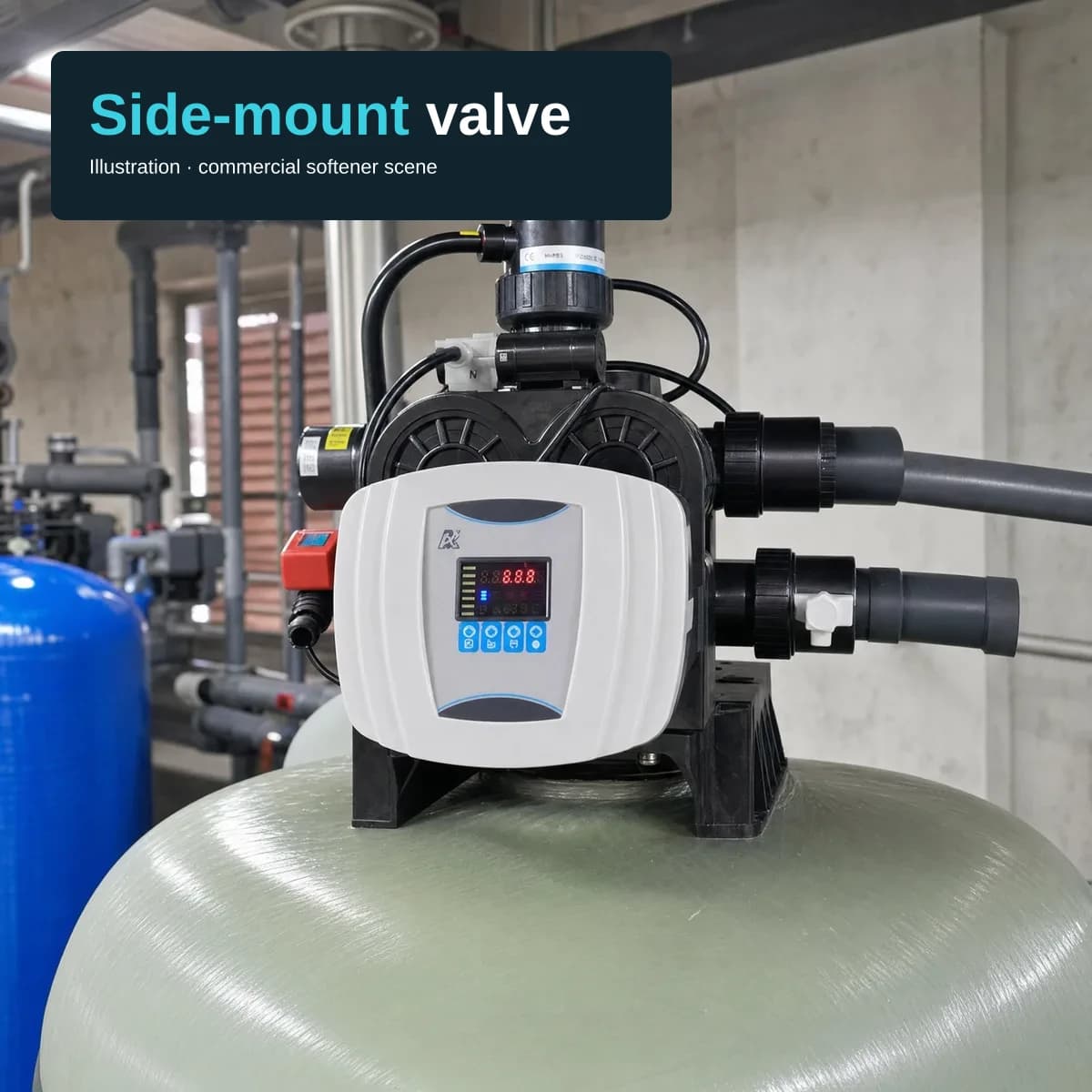
The product name covers a family, so the model code decides. One manual covers filter valves and down-flow softener valves, among them the F112A1 (63540B, time clock) and the F112A3 (63640B, meter type)[3]. The check is the exact code, 63640B. The F112A3 counts treated volume at its own outlet and regenerates on that count[3]; the filter versions and the F112A5 are left out, and the manual read does not describe the F112A5[3].
The options that matter are meter modes A-01 (delayed) and A-02 (immediate), an interlock cable, signal-output modes b-01 and b-02, and a remote input the manual equates with its manual button[3], plus the maker's tank rows: φ1200 × 2400 mm with 1,500 L of resin and injector 7803, or φ1500 × 2400 mm with 2,500 L and injector 7804[3].
For the softener models the manual lists a "Boiler softening water system" and an "RO pretreatment softening system"[3], and the F112A page says "This device can be used in boiler softening systems and softening in RO pretreatment."[7] These are stated uses, not results; no reference installation or boiler sizing source was retrieved, so boiler duty stays out. The manual's interlock row for RO pretreatment reads "water supply together but regeneration in turn"[3], and for parallel valves it keeps "(n-1) valves in service"[3]. Every F112 statement here is the Rev.A.2011 manual's; product text is from the maker's English export site.
Feed continuity and outlet hardness would set targets
In the Runxin F112A3 pair reference design for RO pretreatment (the F112A3 pair design), continuity of feed and outlet hardness would set the targets, because a softener stage is judged by what reaches the RO unit during a regeneration, not by the valve's printed flow.
The hypothetical duty is a commercial building's RO unit fed through filtration to under 5 FTU (turbidity units), a carbon stage and a softener stage. These assumptions serve the arithmetic only: the carbon stage is two φ1200 tanks on the maker's filter valves, named, not designed; the RO supplier requires softened feed; raw hardness is 3 mmol/L, the manual's own unit; free chlorine above 0.1 mg/L enters the carbon stage; iron is under 0.3 mg/L; the feed is 25 m³/h, flat over 24 hours for daily counts. They are round numbers, not a building.
The softener is a premise, not a finding. Misreading: the RO needs one. Nothing the maker prints in the documents read says so. PUB's 2025 average total hardness is 42.7 mg/L as CaCO3[4], inside the USGS soft class of 0 to 60 mg/L[2], though that is an annual average within a range of 7.24 to 191, with no sampling locations stated[4]. A soft analysis, or an RO supplier who accepts another scale-control approach, ends the answer at no softener. The manual prints upper hardness limits only, so no lower threshold can be computed[3]. The check is the RO supplier's written feed requirement.
One valve on one tank misses this duty: "No water passes the valve during regeneration in single tank type."[3] At 25 m³/h and 125 minutes out of service (the factory step times summed, 10 + 60 + 45 + 10, a decision rule)[3], one valve needs 25 × 125 ÷ 60 = 52.1 m³ of treated-water storage, or 33.3 m³ on the manual's other reading of about 80 minutes[3].
Four targets follow. Continuity: 25 m³/h held to the RO through every regeneration of either tank, read on the two outlet meters. Outlet hardness: at or below the RO supplier's figure, which no document read gives, by tests on raw and outlet water in the manual's unit, including while the partner regenerates. Pressure: at least 0.2 MPa at each valve inlet[3], by a gauge at each inlet. Feed limits at the softener inlet (5 to 50 °C, under 5 FTU, free chlorine under 0.1 mg/L, iron under 0.3 mg/L)[3], by the owner's samples.
The basis is not a rating. 25 m³/h sits near one tank's table flow, the maker's 28.0 t/h for φ1200 (read as m³/h), a calculation based on "linear velocity 25m/h"[3]. Margins: (28.0 − 25) ÷ 28.0 = 10.7% against that table, and (40 − 25) ÷ 40 = 37.5% against the valve's printed 40; neither is 0%. No minimum service flow is printed for the valve, so turndown is a stated absence there.
One tank's flow would set pair capacity
The Runxin F112A3 pair reference design for RO pretreatment would put two interlocked valves between a carbon stage and the RO unit, and one tank's table flow, not the valve's printed 40 m³/h, would set its capacity.
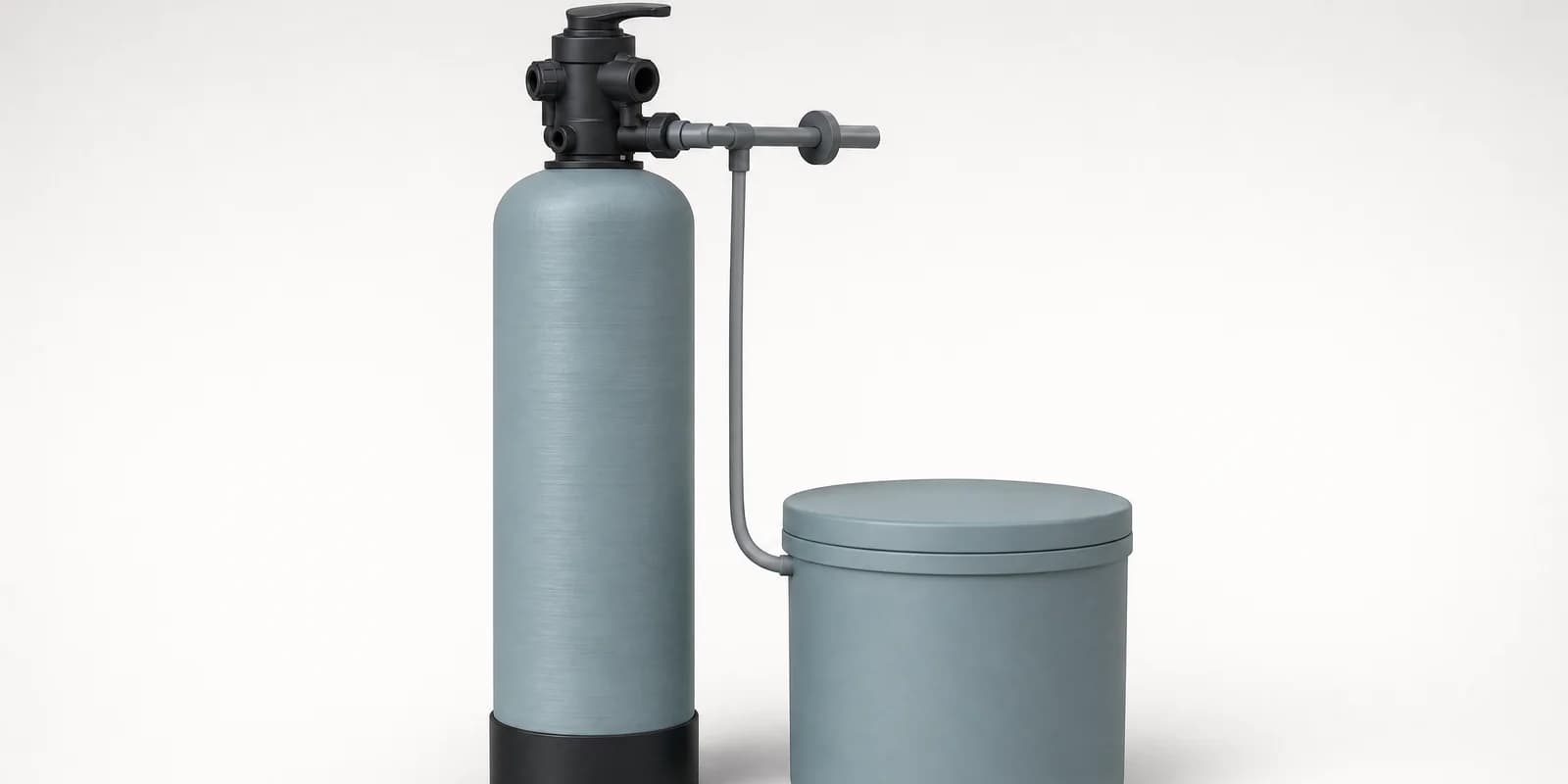
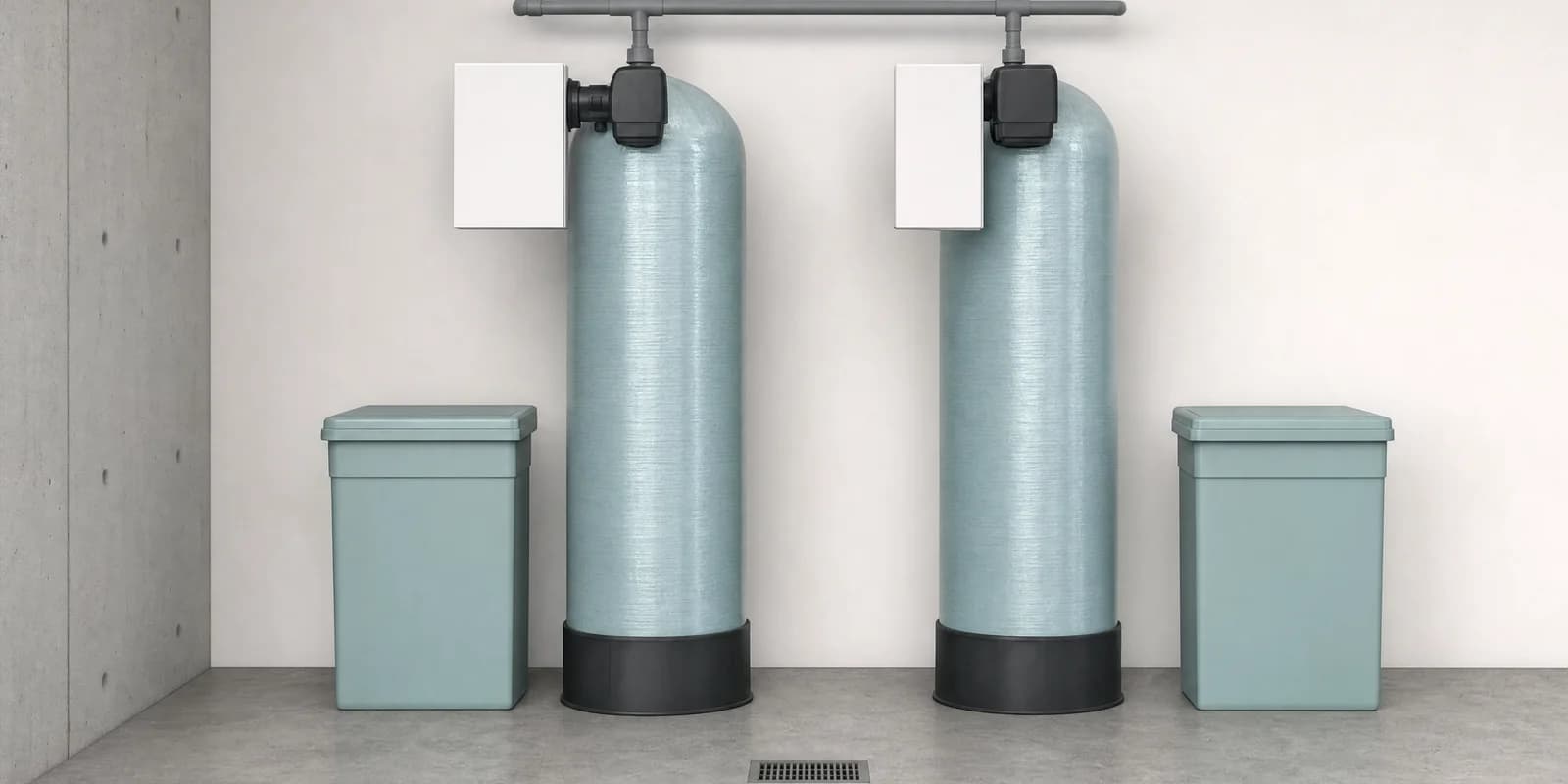
The configuration is two F112A3 valves in parallel on two φ1200 × 2400 mm tanks of 1,500 L resin, joined by the interlock cable from CN8 to CN7 of the next valve in the loop[3], each reading its own outlet meter, an assumption until the maker confirms it. No bypass is in the F112A3 pair design, and any bypass fitted stays closed, since the manual lists an open or leaking one first among causes of hard water[3]. Isolation valves and sample points are owner-supplied plumbing; the filter and carbon stages are named, not designed. The choice of one valve with storage, and φ1500 tanks, are weighed in the selection guide; valves in series and more than two valves are outside the F112A3 pair design.
The F112A3 pair design takes one tank's table flow as its firm capacity, its own decision rule: the interlock keeps "(n-1) valves in service"[3], and no document read states 28.0, or the 25 m/h behind it, as a limit. It takes the lower of the tank's table flow and the valve's printed 40 as its working figure: 28.0 m³/h, not 56.0 and not 40. The printed 40 carries a bracket, "@0.2MPa"[3], that the manual never defines. On φ1500 tanks the table's 44.0 is 10% above 40[3], so 40 is the lower figure, and the maker's drain flow there is 27.12 t/h (read as m³/h)[3], so the upstream peak at 40 m³/h would be 67.12 m³/h. A demand from 28.0 to 40 m³/h is a sizing outcome (choose φ1500), not a refusal; at exactly 28.0 the margin would be 0%.
The worked run uses the maker's formula, resin volume times exchange factor over hardness[3], over the factor's whole 400 to 750 span for down-flow[3]. At 3 mmol/L: 1.5 × 400 ÷ 3 = 200 m³ to 1.5 × 750 ÷ 3 = 375 m³ per tank run. The pair regenerates 3.0 to 1.6 times a day; a tank is being regenerated, one at a time, for 6.25 to 3.33 hours of the day (26.0% to 13.9%). The maker calls its step calculation "only for reference" and this calculation procedure "only for industrial application"[3], so this is arithmetic for a commercial duty, not the maker's sizing.
The pair gives continuity during one valve's regeneration, not protection against a fault. Misreading: an outage can never reach the RO. During each regeneration the partner passes 52.1 m³ (25 × 125 ÷ 60). The maker's note offers an outlet solenoid for systems that strictly need no hard water at the outlet while a valve switches or runs backwash or brine draw[3]; the F112A3 pair design fits none. Both valves share the supply and carbon stage (a chlorine breakthrough reaches both beds), the common outlet and RO unit, the salt stock, shared power and the interlock cable: the maker states that a disconnected cable divides the system into two individual systems[3], which by reasoning could then regenerate together.
The pressure chain starts at 0.30 MPa at the carbon-stage inlet, an assumption for convenience. The two filter valves would cost 0.012 MPa at 12.5 m³/h each and the softener inlet needs 0.2 MPa, leaving 0.088 MPa for carbon beds, strainers and piping, which no document prices (0.066 MPa at the 42.32 m³/h peak: 0.300 − 0.034 − 0.200, each filter valve at 21.16 m³/h); the softener valve would cost 0.046 MPa at 25 m³/h. These drops are derived by the square law from the maker's Kv labels (36.91 for the softener valve, 36.17 for the filter valve in service)[3], assumed in m³/h per √bar and constant with flow, and extrapolated: the manual plots curves from about 30 m³/h up, read from the page image[3], and 12.5, 21.16 and 25 m³/h lie below. On pumps the documents disagree: the manual says "a diaphragm pump must be installed in front of the water inlet" under 0.2 MPa[3] and suggests a booster pump below 0.15 MPa[3], while the F112A page says the F112A3 "is equipped with a booster pump"[7]. The F112A3 pair design assumes at least 0.2 MPa at each inlet and tests it; a lower reading stops the design as drawn.
Each valve drains 17.32 t/h (4.81 L/s) in backwash and fast rinse, tested at 0.3 MPa and "only for reference"[3]: 2.89 m³ per step at 10-minute defaults[3]. The manual limits a softener's drain pipe to 5 m[3]. Misreading: a carbon stage sized for 25 m³/h is enough. During a partner's backwash or fast rinse the stage upstream passes 25 + 17.32 = 42.32 m³/h (less at lower pressure, by orifice-flow reasoning: this article's inference, the manual gives no law), about 1.6 times 27.0 m³/h (two φ1200 carbon tanks at the maker's 13.5 m³/h each, a calculation at a 12 m/h basis and not a limit)[3]. Drain quality and destination are the owner's to settle with the local authority; no trade-effluent source for Singapore, Malaysia or Indonesia was retrieved.
Meters count volume, so acceptance would test hardness
In the Runxin F112A3 pair reference design for RO pretreatment, each outlet meter would count treated volume, so hardness would be tested by the owner's samples and not read from the valves.
Online, each outlet meter counts treated volume. The maker states an error range of at most 5%[3] without its basis, so ±1.25 m³/h at 25 m³/h holds only if it is of volume and inside the meter's 1 to 5 m/s testing range[3]; with both valves in service each meter reads about 12.5 m³/h, 1.05 m/s in a nominal 65 mm line (the meter's bore is not printed), just above that range's 1 m/s floor, so a pair demand below about 24 m³/h falls outside it. No online hardness or chlorine instrument is in the F112A3 pair design.
In mode A-02 each valve regenerates as soon as its remaining treated volume reaches zero, subject to the interlock[3]. The factory default A-01 waits for the set regeneration time, 02:00[3], and the manual does not say what the outlet delivers meanwhile. Misreading: A-01 protects the RO until regeneration. The F112A3 pair design sets A-02; the price is a regeneration that can start in a peak hour with the partner carrying the load. The F112A3 pair design takes its capacity setting from the analysis, 200 to 375 m³, not the 400.0 m³ default, though the manual says of factory parameters "Generally, it does not need to reset."[3]
Misreading: a volume count is a hardness measure. A harder raw water exhausts the resin before the count reaches zero, and nothing in the F112A3 pair design sees it. The manual's remedy is to "Test the outlet water and raw water hardness at regular time."[3] The manual prints an error code on the display (for example -E1-) but describes no alarm output and no hardness detection[3].
After an outage over three days the time of day flashes and "The process will continue to work after powering on."[3] The manual's trouble-shooting names two states: power off during backwash or fast rinse leaves water running to drain, and power failure during brine draw without a safety brine valve leads to excessive water in the brine tank[3]. The manual requires a brine valve in the brine tank[3] and names a safety brine valve as the remedy, so the F112A3 pair design fits one in each, reading the two as one device (an assumption, and a quote item). Valve position after power loss mid-regeneration is a quote item; whether the partner keeps delivering then, and whether the manual button queues, are unpublished.
Acceptance of the F112A3 pair design runs in stages: the maker's written answers; one valve alone through the manual's trial run[3]; both valves with the cable fitted and a forced double call, hardness read at the common outlet during and just after the partner's regeneration, which tests whether an outlet solenoid is needed; then the first cycles in service, with outlet hardness read late in a run to test the capacity setting. The forced call, reading times and tolerances are engineering judgment; the documents read give no acceptance procedure for an interlocked pair. Pass: the first three targets above, including during the partner's backwash and fast rinse; feed limits are the owner's samples.
The manual's trouble-shooting lists "Time of fast rinse is too short" among the causes of salt water in softened water[3], and the deep dive shows why step times can decide a clean rinse end. The F112A3 pair design does not assume the 10:00 default is wrong: the rinse time is confirmed or reset by a chloride comparison of outlet with inlet water, tolerance agreed beforehand. Each figure carries its conditions; the deep dive carries the rule.
The simultaneous call is the central gap
The first risk in the Runxin F112A3 pair reference design for RO pretreatment is the central gap: no document read for the F112 states what a valve does when both call together, the queue order, whether the waiting valve keeps delivering and at what quality, or the valve position after power loss mid-regeneration beyond the two states in the manual's trouble-shooting. On this article's arithmetic it bites whenever the partner holds less than 52.1 m³ when the first valve calls; the maker's written answer and the forced double-call test would settle it.
[ASSUMPTION: this design's commissioning rule, not a maker instruction and not sourced industry practice] Offset the two counters at commissioning so the partner holds at least 52.1 m³ when the first valve calls, valid for an equal split and flat demand; the offset drifts when either changes. The F112A3 pair design is not this product as configured if the waiting valve sends hard water to the RO, if the common outlet shows hard water during or just after either valve's regeneration, or if both valves go out of service; the outlet solenoid then becomes a quote item.
The owner or integrator sizes the carbon stage and supply for the 42.32 m³/h peak and schedules the carbon stage's own backwash away from a regeneration. The water-exchanger supplier sets step times[3]; after handover the owner holds the capacity setting, mode A-02, the hardness tests and the salt ("at least 99.5% pure"[3]).
The manual's actions for upsets: a second-grade softener above 6.5 mmol/L, where the outlet will hardly reach its boiler-feed figure of 0.03 mmol/L and no RO figure is given[3], and closing or repairing an open or leaking bypass[3]. Above 0.6 MPa the manual requires a pressure-reducing valve; above 5 FTU it says a filter should be installed on the inlet[3]. Free chlorine of 0.1 mg/L or more needs a stage upstream (the carbon stage or another), the F112A3 pair design's addition.
The About page says "Since August 2010 till now, it has passed the National Sanitation Foundation certification."[1] Its nearest antecedent is the brand term Runxin valve, not a model; it names no standard or listing and carries no certificate date, and the page separately says the company "has passed CE and RoHS certifications"[1]. The F112A page carries no NSF, CE or RoHS statement[7]. The CE and RoHS documents the maker displays are voluntary ISET verifications for the designation TM.F, expiry shown 16/04/2025, before the reading date[6]. No certificate the maker displays shows that these statements cover this valve; the F112 manual's front cover prints a CE mark and RoHS and ISO 9001 emblems[3], marks the maker prints, not certificates. The NSF/ANSI 44 and NSF/ANSI/CAN 61 certificates the maker displays are dated 30 April 2020, name no model and stay valid only while the holder has products in Listing[6]; the NSF/ANSI 44 listing read on 2026-10-01 has no Runxin entry (NSF/ANSI 61 not retrieved)[5]. One NSF/ANSI 44 valve-component entry, for another company, is footnoted "Conforms to material and structural integrity requirements only"[5]. Reasoning, not the maker's statement: a certificate that names no model is not type approval of this valve.
The owner's staged acceptance can be stopped after any stage, with the RO isolated until the double call passes. The off-ramp is one valve with 52.1 m³ of storage, or another valve.
The F112A3 pair design fits a premise-confirmed RO duty below one tank's table flow (28.0 m³/h on φ1200 tanks, with a margin the owner sets) or, on φ1500 tanks, below the printed 40 m³/h, with raw hardness under 6.5 mmol/L, 0.2 to 0.6 MPa at each inlet and 5 to 50 °C. It stops at demand above 40 m³/h, supply under 0.2 MPa without a pump the maker confirms, free chlorine of 0.1 mg/L or more with no stage upstream, hardness above 6.5 mmol/L, hard water at the common outlet during a regeneration, and a need for hardness alarms. Operation outside 5 to 50 °C or 0.2 to 0.6 MPa "voids the warranty" in the manual's words[3], an operating condition, not a Purionex term. It does not mean a 40 or 80 m³/h plant.
The owner sends the raw analysis in the manual's unit across the seasons; free chlorine, iron, turbidity and CODMn at the softener inlet; the RO supplier's feed hardness and pressure; the demand profile; inlet pressures; the drain point; tank size; model code and manual revision. A quote request for the Runxin F112A3 (63640B) should carry that data pack and put these questions to the maker: the basis of "@0.2MPa"[3], the pump, the double call, the outlet solenoid, power loss, the hardness unit's molar basis and any model-level certification document. Purionex would pass on the answers received; it does not promise them.
Sources
- [1]Runxin, About page (company description; the maker's NSF sentence, attributed)
- [2]USGS, Hardness of Water (hardness classes, condensed; paraphrase only)
- [3]Runxin, Multi-functional Flow Control Valve for Water Treatment Systems, user manual for models 63640B (F112A3) and siblings, Rev.A.2011, with PM appendices and page-image transcriptions
- [4]PUB Singapore, Drinking Water Quality 2025 (total hardness row)
- [5]NSF official listing files read 2026-10-01 (NSF/ANSI 44 category listing; NSF/ANSI 61 not retrieved)
- [6]Runxin, certification page and certificate images (described, not quoted)
- [7]Runxin, F112A automatic softener valve product page, English export site, raw text