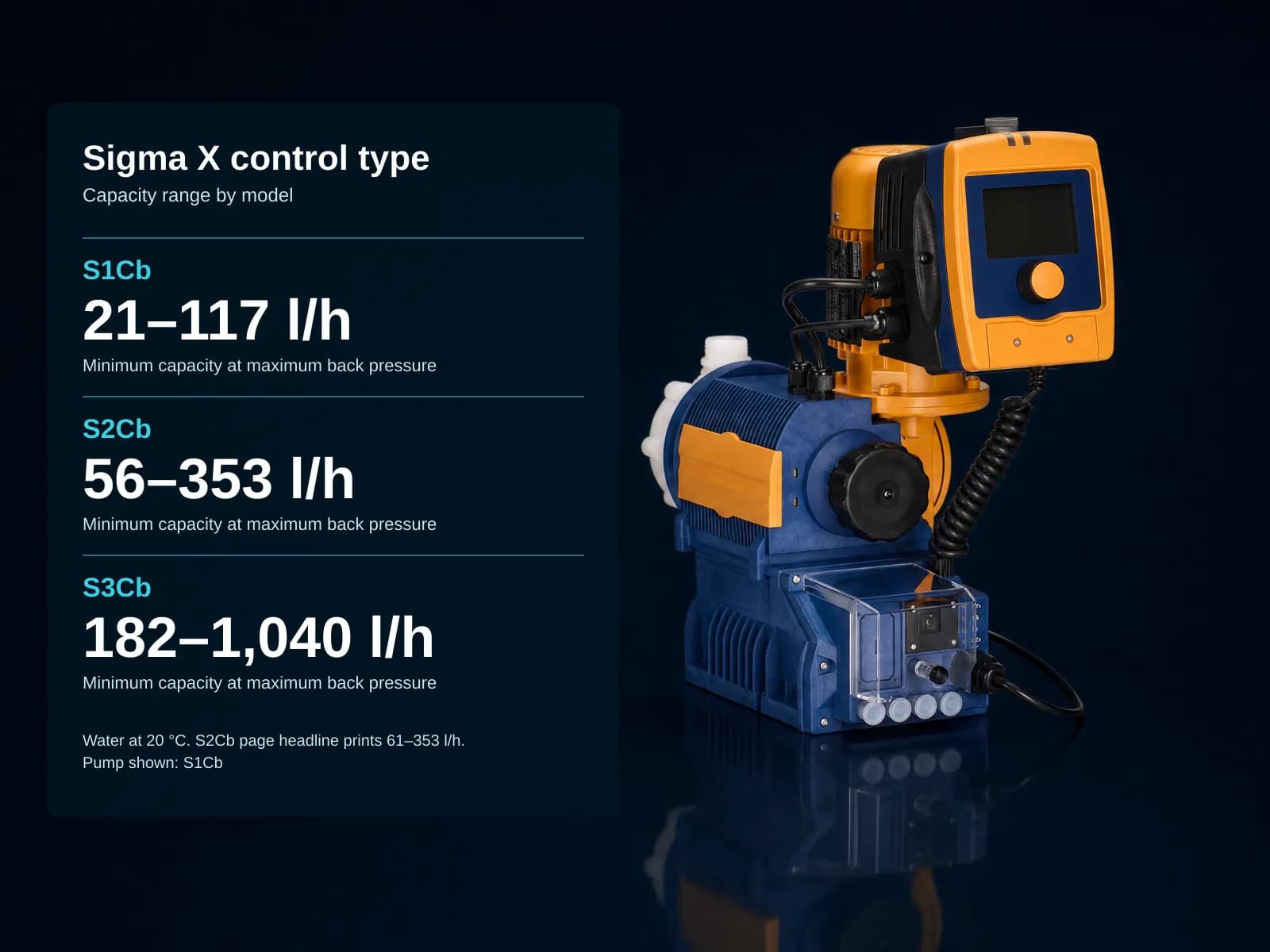
ProMinent's web page for the Sigma X control type pump prints a span of "21 to 1,040 l/h" across three sizes, S1Cb, S2Cb and S3Cb.[1] What decides fit is the l/h in one table row. The manual heads that column "Minimum pump capacity at maximum back pressure" and notes "All figures refer to water at 20 °C."[5] It is a place in the table to set demand against, not the flow at the site's line pressure. In the worked run (every input illustrative: 200 m³/h of process water, 4 mg/L as available chlorine, a 100 g/L product, a 3.0 bar logged line-pressure minimum) demand is 8.0 L/h, 38.1 % of the 21 l/h printed for S1Cb type 12017 PVT, a margin of 61.9 % against a minimum at 10 bar.[5] [ASSUMPTION: round numbers, not statements about any real facility; site values replace them.] The capacity-against-pressure chart is not in the text read, so none is stated.
ProMinent GmbH, Heidelberg, Germany, is the maker named in the manual's declaration excerpt.[5] For one industrial facility's process water, with one pump and one injection point, the guide ends in one of three answers: this row as a candidate, on stated conditions; another row or size, or a smaller pump; or not this product. The S1Cb is the worked variant; the Basic types (Sigma/ 1, /2 and /3 Basic) are outside its scope. The reference design covers the back-pressure and protection set-up.
Fix the demand before reading the table
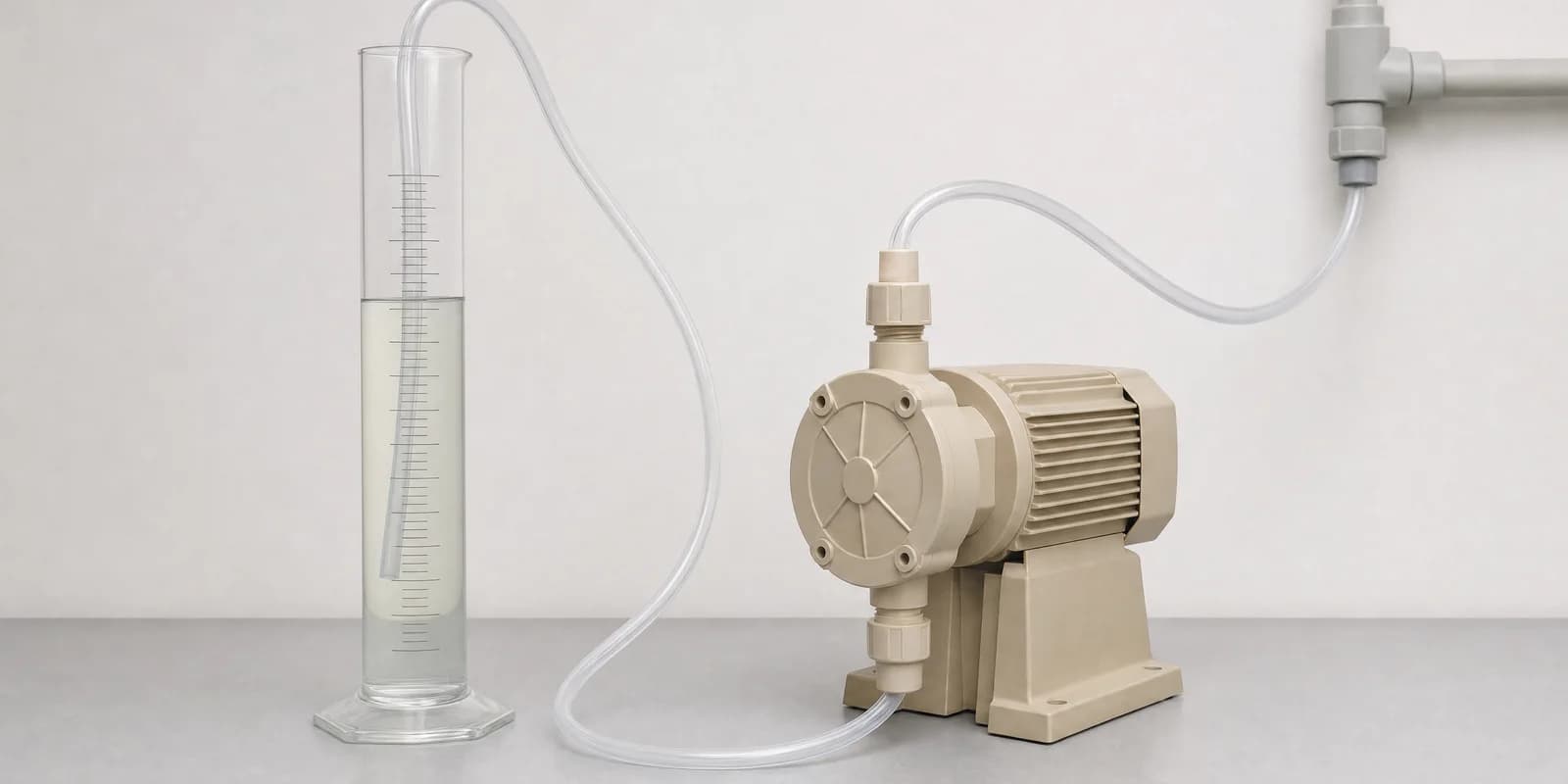
A dose below target has three terms: the volume each stroke delivers, the product's strength and the water flow the meter reports (an identity, this guide's reasoning). A residual below target adds the water's own chlorine demand, which no pump setting changes (reasoning). Check the first term at operating pressure: the manual leads the suction hose into a measuring cylinder holding the feed chemical, the pump draws from it with the discharge hose installed at operating pressure, and the volume drawn over at least 200 strokes is the volume pumped.[5] The manual says "Normally the pump does not have to be calibrated."[5] A shortfall points at the pump or its suction, a match at strength, flow or the water's demand (reasoning).
Gas can mimic under-dosing. ProMinent's June 2021 news item, about a solenoid-driven pump, says gas bubbles can occur "when dosing outgassing media such as sodium hypochlorite" and that too much gas in the dosing head of an oscillating displacement pump can disrupt dosing.[3] No Sigma document read says how a Sigma behaves. Check whether the shortfall follows a standstill; prime and re-measure. Duty class reorders the checks (reasoning): an intermittent duty idles between runs, so gas comes first; a continuous duty lies outside the manual's maintenance basis of "normal loading (approx. 30% of continuous operation)", so the interval comes first.[5]
Dosing that rises or continues while the pump is stopped has more than one cause. The manual names excessive priming pressure, which lets feed chemical press through the pump in an uncontrolled manner; the maximum is 1 bar on every S1Cb row.[5] It also says back pressure, spring-loaded injection, relief and foot valves and the liquid end are not "absolutely leak-tight closing elements", and names a shut-off valve, solenoid valve or vacuum breaker for isolation,[5] so backflow past one is another cause (reasoning). Check with a manometer at the suction connector and for an isolation device. 1 bar is about 10 m of water column, fewer for a denser solution.
Inputs that eliminate a candidate come first: the chemical and its strength by weight; viscosity (standard liquid end 0 to 200 mPa s); particles (valves may not close above 0.3 mm); gas or solids in the feed; an explosive area or unprotected outdoor mounting; the manual's "The pump is only intended for industrial use.", which the facility must meet and the documents read do not define; supply of 100 to 230 V ±10 % or 240 V ±6 %; ambient −10 to +45 °C; media up to 65 °C long-term for a PVT head at maximum operating pressure; and the line-pressure window at the injection point.[5][1]
Inputs that size the duty are peak and low-end water flow, dose, product strength and the meter's pulse value. Unit traps: a dose in mg/L of the water, a strength in g/L of available chlorine in the product and a strength in percent by weight are three quantities. The first links to the second through water flow and feed rate (800 g/h ÷ 100 g/L); the second to the third needs a density no document read gives. The web's "pre-pressure" is the manual's priming pressure, not back pressure.[1][5] Sizing before the strength is known invents the litres per hour.
Strength moves demand inversely: 800 g/h of chlorine is 8.89 L/h at 90 g/L, 42.3 % of the 12017 PVT's 21 l/h, against 8.0 L/h at 100 g/L (illustrative). Size on the weakest strength the supplier's certificate allows (this guide's rule).
Read the table's l/h as a minimum
ProMinent's resistance list rates a stainless 1.4404 head "-" and a PVDF head "+" for sodium hypochlorite at 12 % by weight, and calls itself an "initial guide"; a rating with a percentage holds only up to it.[8] So the S1Cb SST and SSH rows drop out at 12 % by weight (the SSH head, 1.4435, is in the list's 1.4404 column)[1][8], and the PVT rows stay if the product is at or below 12 % by weight, which only the supplier's certificate can show. Ceramic balls, which the PVT head carries, are unrated in that list, and no hypochlorite gas handling is published for the Sigma in the documents read: quote items, not stops.[1][8]
The S1Cb web page heads the column "Capacity at max. back pressure" and, in the text read, names no test fluid.[1] For 12017 PVT the manual prints 90 strokes/min and 3.8 ml/stroke.[5] The printed l/h is not always ml/stroke × strokes/min: 3.8 × 90 × 60 ÷ 1,000 = 20.52 against 21; 12035 (4.0 ml, 170 strokes/min) gives 40.8 against 42; 10022 (5.0 ml, 90 strokes/min) gives 27.0, the printed figure.[5] The S2Cb headline "61 – 353 l/h, 16 – 4 bar" is not a row: its 61 l/h matches the PVT row at 10 bar, its 16 bar the SST row, which prints 56 l/h.[2][6]
The pump is the only flow-path item chosen here; its printed minimum capacity is the first check: 8.0 ÷ 21 = 38.1 %, margin (21 − 8.0) ÷ 21 = 61.9 %. The S2Cb neighbour is the 16050 PVT at 61 l/h, 13.1 % (its SST row, 56 l/h, 14.3 %, is a stainless head); the 12035 and 10022 PVT rows and the smallest S3Cb row (182 l/h), all printed at 10 bar, take 19.0 %, 29.6 % and 4.4 %.[6][7][5] Nothing in the documents read removes the larger rows; they cost a smaller share of a larger rating, with no statement in the documents read that they serve better.
ProMinent Sigma X Motor-Driven Diaphragm Metering Pump
No certifications listedView product →The 3.0 bar minimum is a floor, not the line's maximum. Headroom to the PVT head's 10 bar is 10 minus the logged line maximum, the injection-valve opening pressure and surge (unpublished in the documents read): at most 7.0 bar, and only if the line never exceeds 3.0 bar. The 4 bar PVT rows (101 and 117 l/h) leave at most 1.0 bar on the same terms, so a site maximum above 4 bar removes them.[5]
The stroke window, whose working and values sit in the technical deep dive, puts the lowest usable stroke length at 39.0 % at the 90 strokes/min cap, with 80 % as this guide's design setting. Stroke length and strokes a minute trade off at a fixed dose: a shorter stroke needs more strokes (this guide's identity). [ASSUMPTION: the printed 3.8 ml is the 100 % value and volume scales with the setting, no slip; a counting basis, not a flow rating; invalid if calibration differs; calibration at operating pressure closes it.] The rate cap is reached first, before the 30 % stroke length, the lowest setting in the conditions of the manual's reproducibility figure, not an operating limit.[5]
Below the table, 60 m³/h at 2 mg/L (illustrative) needs 1.2 L/h (20 mL/min), 5.7 % of 21 l/h, so the smallest S1Cb row is 17.5 times the duty. Here the 30 % stroke length is reached first (the rate-cap floor, 20 mL/min ÷ (3.8 × 90), is 5.8 %, below 30 %): at that setting the pump makes about 17.5 strokes a minute (19.5 % of its cap), one stroke every 34 s if the water flow falls to 10 % of 60 m³/h. Under a table headed "Precision" the manual prints "Reproducibility ±2 %" for correct installation, constant conditions, at least 30 % stroke length and water at 20 °C.[5] The web page prints "Under correct, constant conditions, correct installation and calibration, the precision is better than ±1 %, based on maximum stroke volume."[1] It names no stroke-length condition, so what it covers below 30 % is not stated, and neither gives a figure against stroke rate. This guide does not relate the two. No minimum dose rate is published in the documents read: a quote question for a smaller pump, not a stop.
Derating is the viscosity table, which lowers the stroke-rate ceiling as viscosity rises (180 strokes/min for the standard liquid end, above 12017's own 90); the S1Cb performance table prints 200 strokes/min for three types where the viscosity table prints 180, so ask which governs.[5] No turndown figure is published in the documents read: 30 % to 100 % is 3.33 to 1 on stroke length, not a capacity ratio.
Settle suction and discharge before comparing quotes
Suction has two options, this guide's assumed set. Flooded suction, the tank above the pump, takes the 7 m lift out of play; that figure applies to "a filled suction line and filled liquid end", water at 20 °C, not to lifting from a dry line.[5] Its blind spot is the priming-pressure ceiling above. A lift arrangement suits a tank that cannot stand above the pump (this guide's reasoning); the documents read print no NPSH value (the suction-side pressure margin a pump needs) for the Sigma and no suggested suction arrangement for hypochlorite, and Blue-White, another maker, says that high suction lift or insufficient inlet pressure can also promote vapour locking.[4]
Discharge has two options. A pressurised injection point clears both manual thresholds on a logged minimum: 3.0 bar is 2.0 bar over 1 bar and 1.0 bar over approx. 2 bar; its blind spot is the site's maximum against the row's rating. Atmospheric discharge needs a back pressure valve at approx. 1.5 bar, which meets the manual's "Precise metering is only possible when the back pressure is maintained above 1 bar at all times." but is below the approx. 2 bar under which, the manual says, no diaphragm-rupture signal is generated.[5] These statements are read from the S1Cb manual only; the S2Cb and S3Cb manuals were read for technical data, intended use, back pressure and calibration.
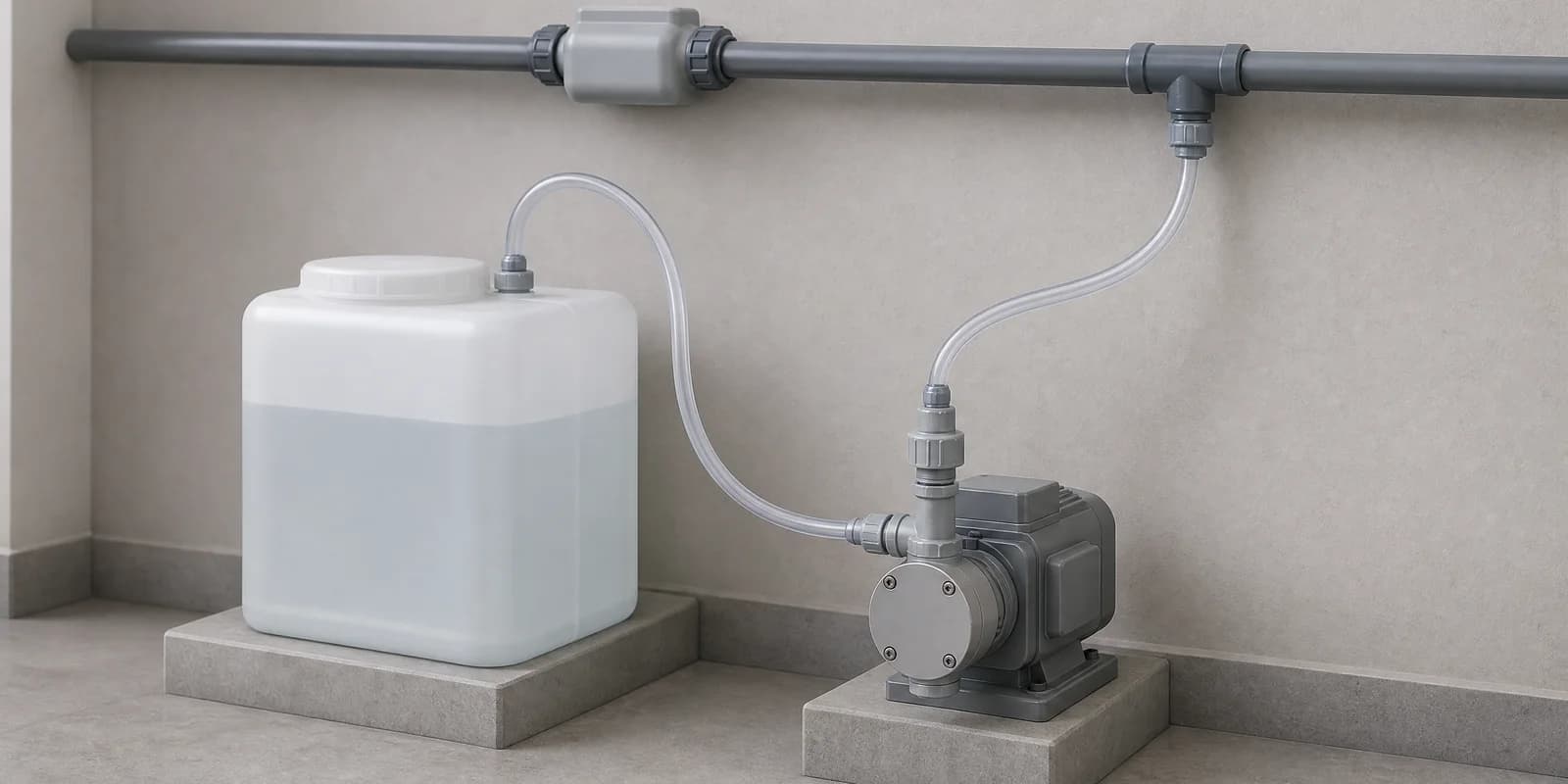
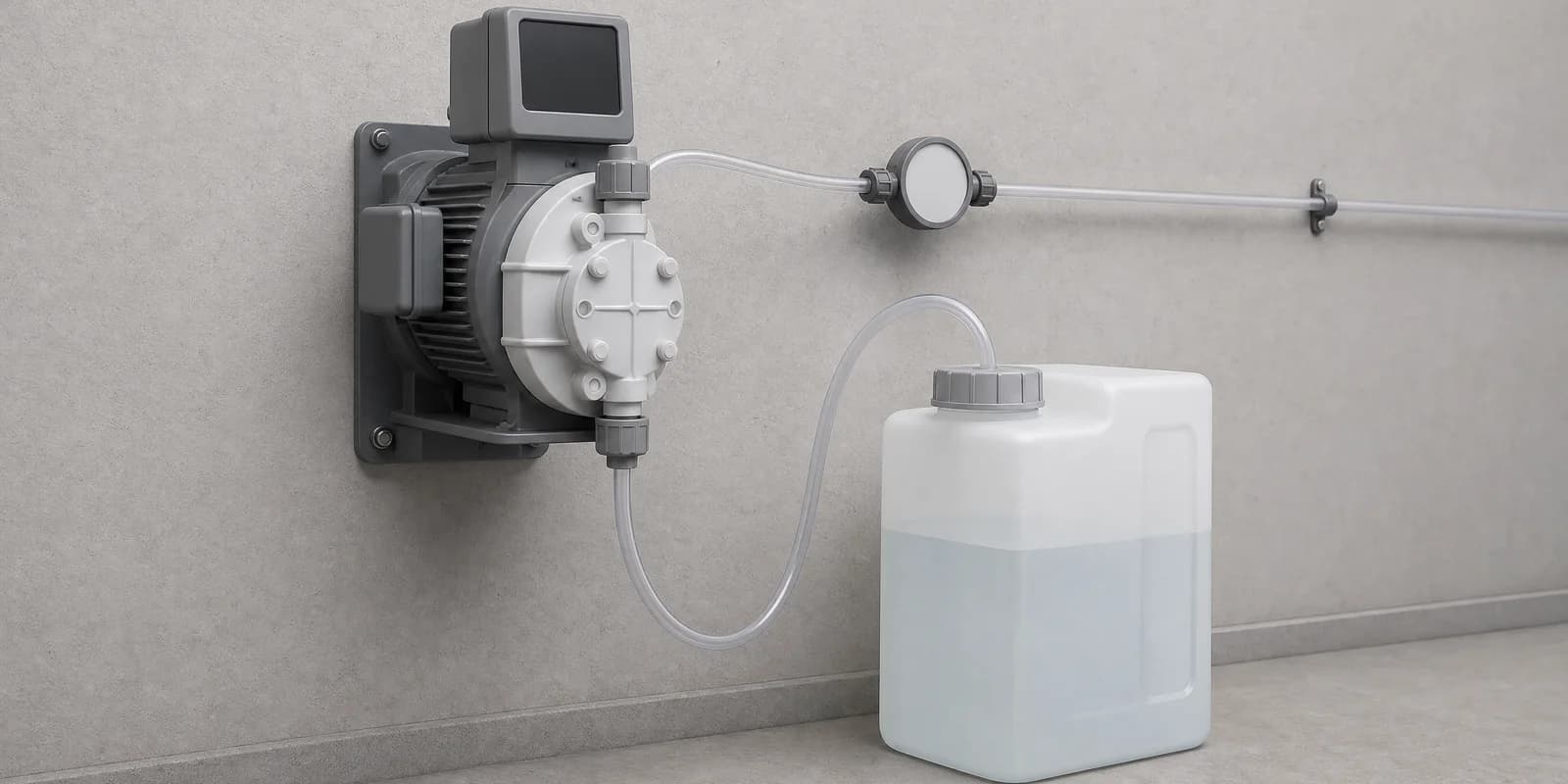
The interface split is this guide's, to confirm in the quote. A supplier's quote covers the pump and the options its identity code lists; the site or installer supplies the suction filter, injection and back pressure valves, overflow line, manometers, water meter and an isolation device. The S1Cb manual requires a relief valve that limits pressure to the system's maximum and says its integral valve protects motor and gear only.[5] The S2Cb manual says "The overload shut-down is used to protect the pump, not the system. It does not replace a relief valve."[6] The S3Cb installation chapter was not read, so ask the supplier.
Decode the l/h in every quote: which row, at what back pressure, with which head and seals, on what basis. The supplier's and the web's l/h start the enquiry and are not the site's flow. Any precision figure carries both ProMinent statements and their conditions, read as the deep dive sets out.
For certification, each manual prints a Declaration of Conformity excerpt to the Machinery Directive 2006/42/EC and the EMC Directive, dated 20.06.2016 in the S1Cb manual.[5][6][7] No ProMinent document read states a CE mark or any third-party listing, and absence from the documents read is not proof of absence. IP 65 is ProMinent's own statement, not a test result seen here.[5]
The manual's quarterly interval holds under normal loading and shortens under heavy loading, such as continuous operation or aggressive feed chemicals. It calls the diaphragm "a wearing part" whose life depends on system back pressure, operating temperature and feed chemical properties.[5] No interval for a continuous hypochlorite duty is published in the documents read.
Re-test pressure and strength, or do not quote
Commission by calibrating at operating pressure, over at least 200 strokes, because the dose needs a stated basis (figures in the reference design). Read manometers at the suction and pressure connectors against the 1 bar priming ceiling and the 1 bar and approx. 2 bar back-pressure thresholds.[5]
Re-measure product strength on a new delivery or supplier, and re-check the line-pressure minimum and maximum, the water-flow range and the tank position whenever one changes, because each moves the litres per hour, the stroke setting or the pressure window.
Two readings mislead (this guide's reasoning). A calibration against an open discharge or short hose does not carry the operating pressure the manual requires and can pass a pump that under-delivers on the line. A stronger delivery can offset an under-delivering pump, so a residual that looks right does not confirm the setting.
Six stop conditions bound the worked result:
- Gas or solids as the feed, which the manual says the pump is not intended for.[5] Next: another pump class.
- Viscosity above 200 mPa s with the integral relief valve, which then no longer operates reliably.[5] Next: valve springs for 200 to 500 mPa s at 130 strokes/min[5] and a relief arrangement outside the pump (reasoning), or another product.
- Particles above 0.3 mm with no suction filter, so the valves may not close.[5] Next: a suitable suction filter.
- Back pressure that cannot be held above 1 bar, or a rupture signal wanted below approx. 2 bar with no back pressure valve possible (precise metering needs above 1 bar; no rupture signal below approx. 2 bar).[5] Next: a back pressure valve, or not this arrangement.
- A stainless head for 12 % hypochlorite, rated "-".[8] Next: the PVT head, ceramic balls a quote item.
- A site maximum above the row's printed maximum (10 bar for 12017 PVT), an explosive area, unprotected outdoor mounting, or a facility outside the manual's industrial-use statement.[5] Next: another row or product.
None fires on the worked run.
The data pack holds what changes a decision: the eliminating and sizing inputs of the first section; line-pressure minimum and maximum; suction arrangement; supply, ambient and mounting; market. A useful reply names the row and identity code, demand over printed minimum capacity with margin, capacity at the site's pressure, the binding gate, the interface split, answers to the quote items, lifecycle items and acceptance checks. It may conclude that this is not the product, or that a smaller pump is needed.
Request a quote for the ProMinent Sigma X control type pump with this data pack.
Sources
- [1]ProMinent — product page, Motor-Driven Metering Pump Sigma X Control Type S1Cb, retrieved 2026-10-01 (span, precision statement, column heading, supply)
- [2]ProMinent — product page, Sigma X Control Type S2Cb, retrieved 2026-10-01 (capacity headline, overload shut-down line)
- [3]ProMinent — news, Accurate dosing quantities even with outgassing media, June 2021 (about a solenoid-driven pump, general statement on gas in the dosing head)
- [4]Blue-White Industries — Causes and Solutions for Vapor Locking in Chemical Metering Pumps (another pump maker, general statement, not about a ProMinent product)
- [5]ProMinent — operating instructions, Sigma X Control Type S1Cb, part no. 982568, version 10/21 (technical data, limits, installation, calibration, maintenance, declaration excerpt)
- [6]ProMinent — operating instructions, Sigma X Control Type S2Cb, part no. 982541, version 07/18 (technical data, overload shut-down, declaration excerpt)
- [7]ProMinent — operating instructions, Sigma X Control Type S3Cb, part no. 982514, version 07/18 (technical data, neighbour row, declaration excerpt)
- [8]ProMinent — Product Catalogue 2023, volume 1, excerpts (chemical resistance list, pp. 397 to 403)