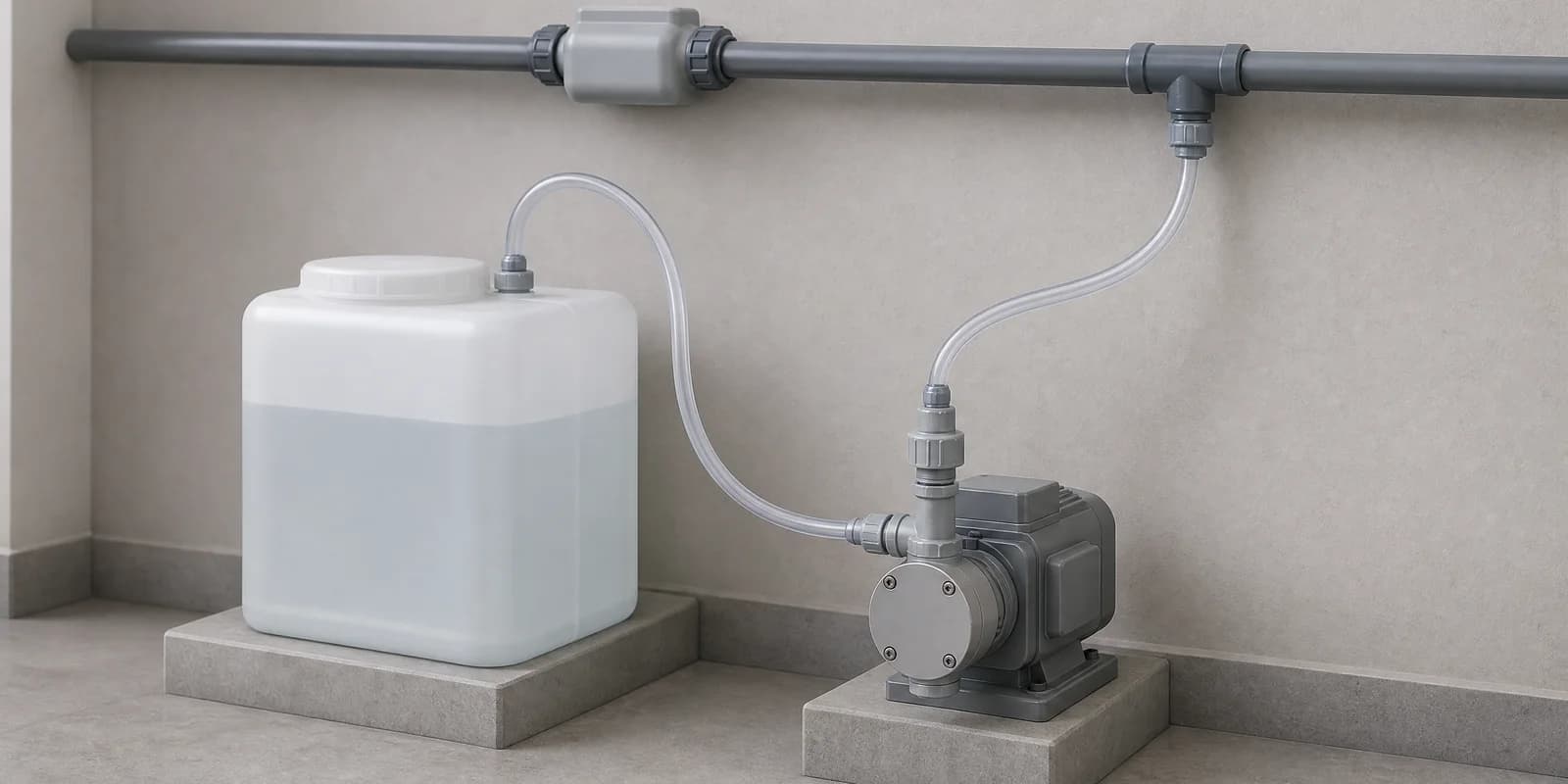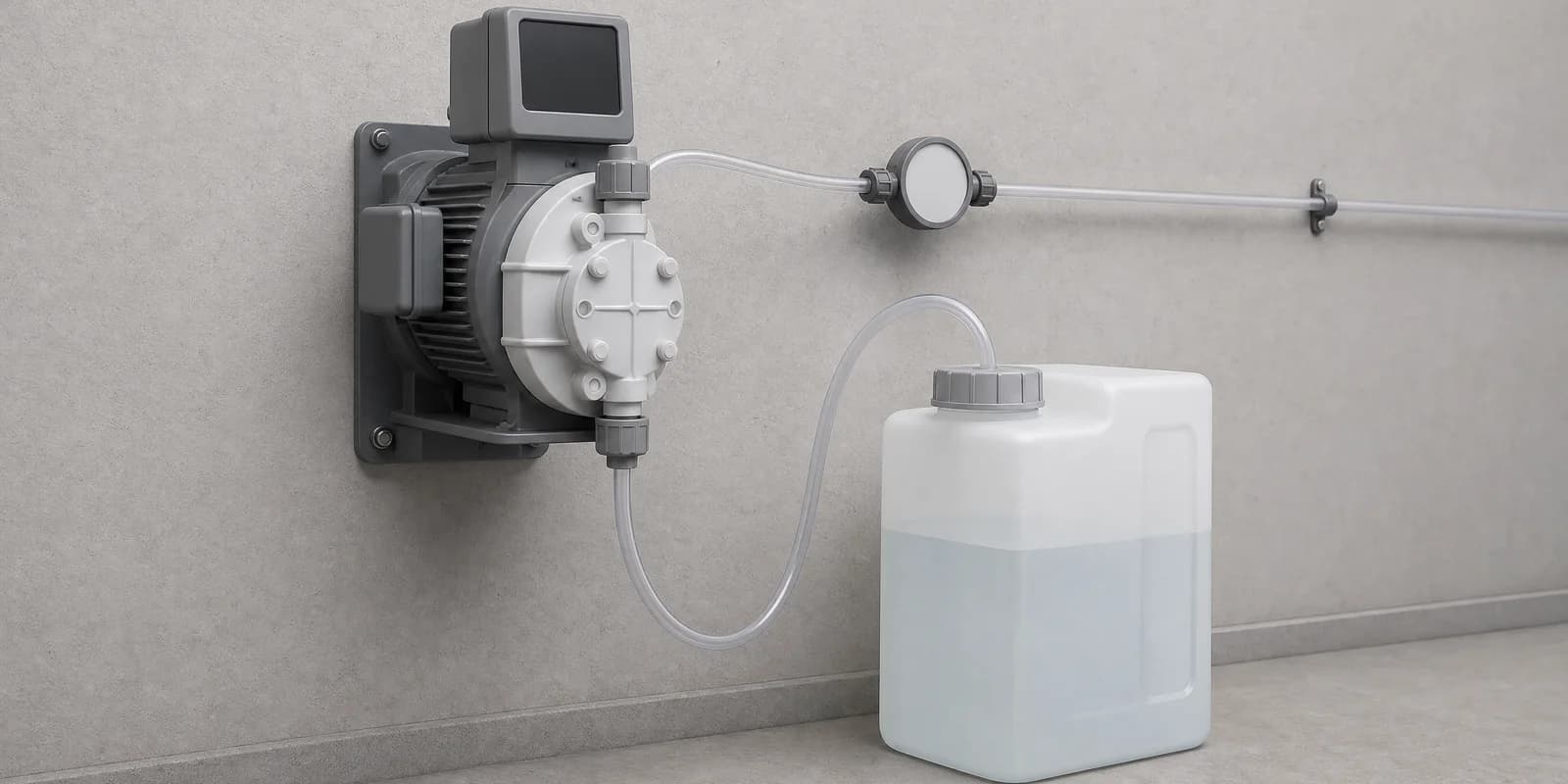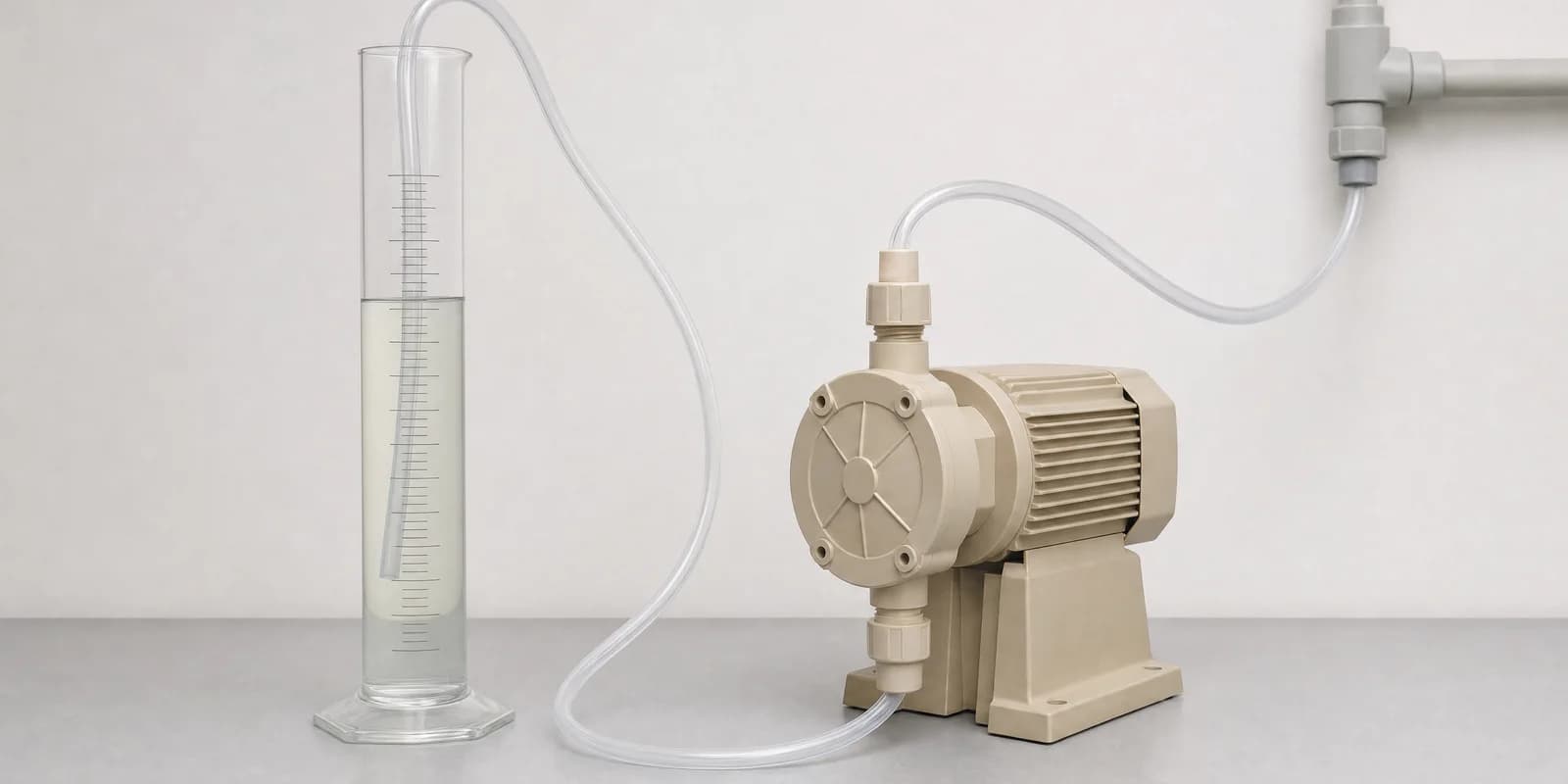
A motor-driven diaphragm metering pump such as the ProMinent Sigma X control type from ProMinent GmbH of Heidelberg, Germany[7] (the S1Cb is the variant used) delivers a set volume per stroke, and the measurable result is that volume, drawn from a measuring cylinder through the suction hose over a counted number of strokes while the discharge hose stays at operating back pressure (reasoned from the manual's calibration procedure).[7] ProMinent describes an oscillating diaphragm pump with adjustable stroke length and an electric motor.[7]
The misreading is to read a printed percentage as the dose error in service. The S1Cb web page states a precision better than ±1 %, under correct, constant conditions, installation and calibration and based on maximum stroke volume,[1] and the three manuals print a table headed "Precision" whose one row reads "Reproducibility ±2 %" with its footnoted installation, stroke-length and water conditions:[7][8][9] different figures and conditions under one word, and only the web statement names a base.
Four questions follow: what decides the volume per stroke; what each statement covers; what evidence stands behind them; and what to measure and agree. On an illustrative duty [ASSUMPTION: 4 mg/L chlorine, 200 m³/h, 100 g/L available chlorine, ±10 % strength swing; arithmetic only], a ±10 % swing in product strength moves the dose five times as far as a ±2 % pump term, if that percentage is of delivered volume. Sizing is in the selection guide, the applied duty in the reference design.
Stroke length and back pressure decide delivered volume
In the S1Cb an electric motor drives a slide rod that moves the diaphragm,[7] the dial sets stroke length in 1 % steps over 0 to 100 on a 4 mm stroke,[1] and the operating mode (manual, contact, analogue or batch) sets stroke rate.[7][1] The 12017 PVT row prints 3.8 ml/stroke and 90 strokes/min at most,[7] so delivered volume starts as stroke volume times stroke count. [ASSUMPTION: the 3.8 ml belongs to the 100 % setting and volume scales with the dial, with no slip; a counting basis only, as the table names no stroke length behind it.]
Two valves must seat: the suction valve closes as the diaphragm moves in and the discharge valve as it moves back.[7] ProMinent says particles above 0.3 mm may stop them closing and says to fit a suction filter.[7] An unseated stroke is a volume loss the count cannot show (reasoning).
Back pressure sets a window. ProMinent says precise metering is only possible above 1 bar at all times, and advises about 1.5 bar from a back pressure valve when discharging to atmosphere.[7] The upper edge is the row's maximum, 10 bar for the 12017 PVT (12 for the SST).[7] Too little removes the precise-metering condition; too much leaves the rated envelope, and a closed discharge may reach several times the permissible pressure.[7] The passages read give no reason for the 1 bar figure.
Three profiles reshape the stroke: Normal; metering optimised (long discharge, quick suction stroke); priming optimised (long suction stroke, selected "to minimise the NPSH value as well").[7] NPSH is the suction-side margin a pump needs; no value is printed. Each is ineffective below a Start/Stop switch-over frequency the documents read do not give.[7] The manual does not say a profile changes volume per stroke or either precision figure.
On gas, ProMinent's documents conflict. The S1Cb page claims "Accurate and complication-free metering of viscous and gaseous media by adjustment of the movement profile."[1] The catalogue says adjustment of the movement profile "guarantees precise and trouble-free metering even with viscous and gaseous media",[10] and the manual's priming-optimised line says it facilitates metering of viscous and gaseous media,[7] yet the manual states "The pump is not intended for the metering of gaseous media and solids."[7] It does not say whether a liquid that evolves gas counts as gaseous media, so this article says neither that sodium hypochlorite is excluded nor that it is permitted. ProMinent's 2021 news, about its gamma/ X solenoid pump, names sodium hypochlorite as an outgassing medium and says too much gas in the dosing head of an oscillating displacement pump can disrupt dosing;[4] Blue-White, another maker, says high suction lift or insufficient inlet pressure can promote vapor locking.[5] Neither is a Sigma statement; no Sigma gas figure appears in the documents read, so no source read shows the priming-optimised profile to be a hypochlorite remedy.
One reading proves less than it seems: a calibration run delivering less per stroke than the table's ml/stroke times the dial setting. Gas in the head, an unseated valve, slip at back pressure (general physics), the unstated ml/stroke base or a dial that is not the stroke made would each cause it. The check (this article's reasoning, not a ProMinent instruction): bleed the head, confirm the suction filter, repeat the calibration at pressure.
Two precision statements carry different conditions
The rated point is a condition, not a site result: for the S1Cb 12017 PVT row, the 21 l/h is the manual's minimum pump capacity at maximum back pressure, 10 bar, with water at 20 °C.[7]
The web figure carries correct, constant conditions, installation and calibration and a base of maximum stroke volume;[1] the manual's row carries correct installation, constant conditions, at least 30% stroke length and water at 20 °C.[7] The catalogue's S1Cb chapter says precision "exceeds" ±1 %[10] where the web pages say "better than" ±1 %,[1] and no document read says the verbs mean the same. No document read defines the web basis, states what the manual's percentage is of, or says whether the two measure the same thing. "Accuracy" is this article's word; neither figure is ranked, merged or read as a tolerance on the other. The S2Cb and S3Cb documents repeat these, each variant with its own row.[8][9][2][3]
Arithmetic about bases only, applied to neither figure and resting on the dial assumption above: a given percentage of maximum stroke volume equals that percentage ÷ s of the volume actually delivered at stroke length s, a factor of 1 ÷ s: 3.33 at 30 %, 2.56 at 39 %, 1.25 at 80 %, 1.00 at 100 %. Below 30 % stroke length no figure is printed in the documents read, and the web's claim of high precision across the frequency range has none.[1] The question for ProMinent is percent of what.
The 30 % to 100 % range is a stroke-length ratio, 100 ÷ 30 = 3.33 to 1, not turndown, which Wanner, another pump maker, defines as rated capacity over the minimum capacity holding its specified accuracy, repeatability and linearity.[11] Neither ProMinent figure carries a capacity or frequency condition, so no turndown figure follows.
Stroke length s and stroke rate N are coupled at a fixed dose, D being demand in mL/min and v the volume per stroke at full stroke:
N = D ÷ (v × s)
On the illustrative duty D is 133.3 mL/min (800 g/h of chlorine ÷ 100 g/L = 8.0 L/h) and v is 3.8 mL, so N is 35.1 at s = 100 %, 43.9 at 80 %, 58.5 at 60 %, 90.0 at 39 % and 117.0 at 30 %, which exceeds the 90 strokes/min cap; at 80 % it is 48.7 % of the cap (derived). The rate cap, not the 30 % stroke length (the manual's condition for its figure, not an operating limit), sets the lowest stroke length that meets peak demand, on the dial assumption: s = 133.3 ÷ (3.8 × 90) = 39.0 %, or 41.0 % if delivery per stroke is 5 % lower. The sourced arm is the manual's 30 % condition and 90 strokes/min, and the catalogue's viscous-filler example, which names a Sigma X as its solution, advises "If the filling volume varies, select as large a stroke length as possible to improve precision."[10] At 80 % the S1Cb stroke rate has 2.05 times headroom to its cap, a water flow of 410 m³/h, and 20 % over peak needs s of at least 46.8 %. At 10 % of peak, 80 % stroke length makes 4.4 strokes/min, one every 13.6 s; no minimum stroke rate is published in the documents read.
The pump detects its own stroke movement and holds it to the profile;[7] it takes contact pulses or an analogue signal and stops on level, a metering monitor and fault conditions.[7][1] A displayed l/h is a calculation from a calibration, not a flow measurement (this article's reading of the manual).[7] The manual lists Pump blocked and Overload faults for a constricted or closed discharge and states no pressure value for either in the sections read.[7] No document read says the S1Cb senses water flow, chlorine, strength or gas in the head.

On the illustrative duty a ±10 % strength swing is ±0.40 mg/L on 4 mg/L; a ±2 % pump term, applied to delivered volume [ASSUMPTION: the manual does not say what its percentage is of; valid only to size the term against the swing], is ±0.08 mg/L, a ratio of 5.0. The meter's own error is a further term, with no figure retrieved.
No test or field record was retrieved
ProMinent's three web pages, catalogue and three manuals (S1Cb revision 10/21, S2Cb and S3Cb 07/18) state the figures and conditions and name no test method; the web pages' downloads sections list no documents.[1][2][3][10][7][8][9] No independent test report or field record for the Sigma X was among the documents retrieved, and no targeted search was run. A statement with conditions is not a result.
The catalogue's viscous-filler example lists "Dosing precision ± 2 %" under its problems and requirements, names a Sigma X as its solution and prints no measured result: a requirement is not a test result, and the catalogue's S1Cb chapter line that metering profiles "guarantee optimum metering results" is a maker claim.[10]
API 675 is not the Sigma's standard on any document read. Wanner, writing about its own pumps, says "Diaphragm pumps that use direct mechanical actuation are excluded."[11] Wanner defines steady state accuracy as "Flow variation expressed as a percentage of Mean Delivered Flow under fixed system conditions; applies over the turndown ratio."[11] Pumps & Systems lists steady state accuracy and turndown ratio among the standard's terms.[6] ProMinent cites no such standard for the Sigma in the documents read. The S1Cb web page's installation sentence refers to "mechanically actuated" pumps;[1] the S2Cb and S3Cb pages and the catalogue's S1Cb chapter say "mechanically deflected".[2][3][10] This article reads each as an overflow-device instruction for a class of pumps, not a statement of the Sigma's drive class; neither uses Wanner's words "direct mechanical actuation".[11] API 675 itself was not retrieved; on Wanner's definition a stated accuracy would carry a base, fixed conditions and a capacity range.[11]
The manuals read on 2026-10-01 print a ProMinent Declaration of Conformity excerpt, dated 20.06.2016 for the S1Cb and 20.04.2016 for the S2Cb and S3Cb, and no certificate or listing; it says nothing about dose accuracy.[7][8][9] The reference design says what to request. The S2Cb and S3Cb manuals were read for technical data, back pressure, calibration lines and declaration pages only.
A missing rupture signal is ambiguous. The S1Cb manual says "Only above approximately 2 bar system back pressure is a signal generated in the event of the rupture of a diaphragm."[7] The alternatives are no rupture; no signal generated below about 2 bar (the sentence names neither optical nor electrical sensing); and an electrical sensor ordered but not installed, which the manual says is still required.[7] The check is the pressure at the pressure connection under operating conditions; the manual's option is a back pressure valve set to at least 2 bar.[7]
Prove volume by calibrating at operating pressure
By this article's rule, drawn from the manual's calibration procedure, a volume-per-stroke figure from the S1Cb is reproducible only with the stroke setting, the suction hose led into a measuring cylinder of the feed chemical, the discharge hose at operating pressure, at least 200 strokes, the volume taken as the fall in the cylinder's level, a stroke rate not too low, and the manual's precautions for a hazardous feed chemical.[7] The manual says normally no calibration is needed and says to calibrate for viscous feed chemicals or extremely high accuracy, so calibrating is a decision: the dose needs a stated basis.[7] The reference design works the run: 608 mL from 200 strokes at s = 80 %, in 4.6 minutes (on the dial assumption). Calibration enters a measured volume and is not described as changing the stroke, so landing the dose is a separate setting (this article's reasoning).
Calibration is maintained across the stroke rate range and "when the stroke length is altered by up to ±10% scale divisions", and a warning appears when a calibrated pump's dial is turned by more than 10 % while the menu is blocked.[7] The manual gives no figure for a stroke rate too low for calibration, so a run at about 4.4 strokes/min is a question for ProMinent.
Second claim, by this article's rule: the delivered dose is reproducible only with the calibrated volume per stroke, the water meter's pulse value and factor, and the product strength per batch from the supplier's certificate. The pump sees neither the strength nor the water volume behind a pulse.
Holds, as ProMinent states: calibration across the rate range and dial changes, and precise metering above 1 bar. Holds, if volume per stroke scales with the dial: calibration at operating pressure measures it. Not supported by any document read: either percentage as a dose error, ±2 % below 30 % stroke length, any precision figure against stroke rate, any turndown figure, or a profile shown as a gas remedy.
Send the back pressure range at the injection point, the stroke setting and rate at design, the product with strength and batch certificate, the meter's pulse value and the exact identity code. Agree calibration at operating pressure with at least 200 strokes, who records the dial setting and when to recalibrate, and ProMinent's written answers on the web percentage's base, how the two statements relate, precision below 30 % stroke length, and hypochlorite gas handling for the exact code.
ProMinent Sigma X Motor-Driven Diaphragm Metering Pump
No certifications listedView product →Sources
- [1]ProMinent: Sigma X S1Cb product page (precision sentence, movement-profile line, stroke dial, installation sentence, downloads section), read 2026-10-01
- [2]ProMinent: Sigma X S2Cb product page (precision sentence, installation sentence), read 2026-10-01
- [3]ProMinent: Sigma X S3Cb product page (precision sentence, installation sentence), read 2026-10-01
- [4]ProMinent: news item, Accurate dosing quantities even with outgassing media (June 2021; about the gamma/ X solenoid pump, not the Sigma)
- [5]Blue-White Industries: Causes and Solutions for Vapor Locking in Chemical Metering Pumps (6 December 2024), another pump maker's general article
- [6]Pumps & Systems: API Standard 675 for Positive Displacement Pumps (11 April 2019), trade article, one sentence used
- [7]ProMinent: Sigma X Control Type S1Cb operating instructions, part 982568, version BA SI 102 10/21
- [8]ProMinent: Sigma X Control Type S2Cb operating instructions, part 982541, version BA SI 079 07/18 (read for technical data, intended use, back pressure, calibration lines and declaration pages)
- [9]ProMinent: Sigma X Control Type S3Cb operating instructions, part 982514, version 07/18 (read for technical data, intended use, back pressure, calibration lines and declaration pages)
- [10]ProMinent: Product Catalogue 2023 Volume 1 (S1Cb chapter pp. 61 to 64, application example p. 102)
- [11]Wanner Engineering: Hydra-Cell Glossary of Terms (file stamp 2006), another pump maker's glossary about its own pumps