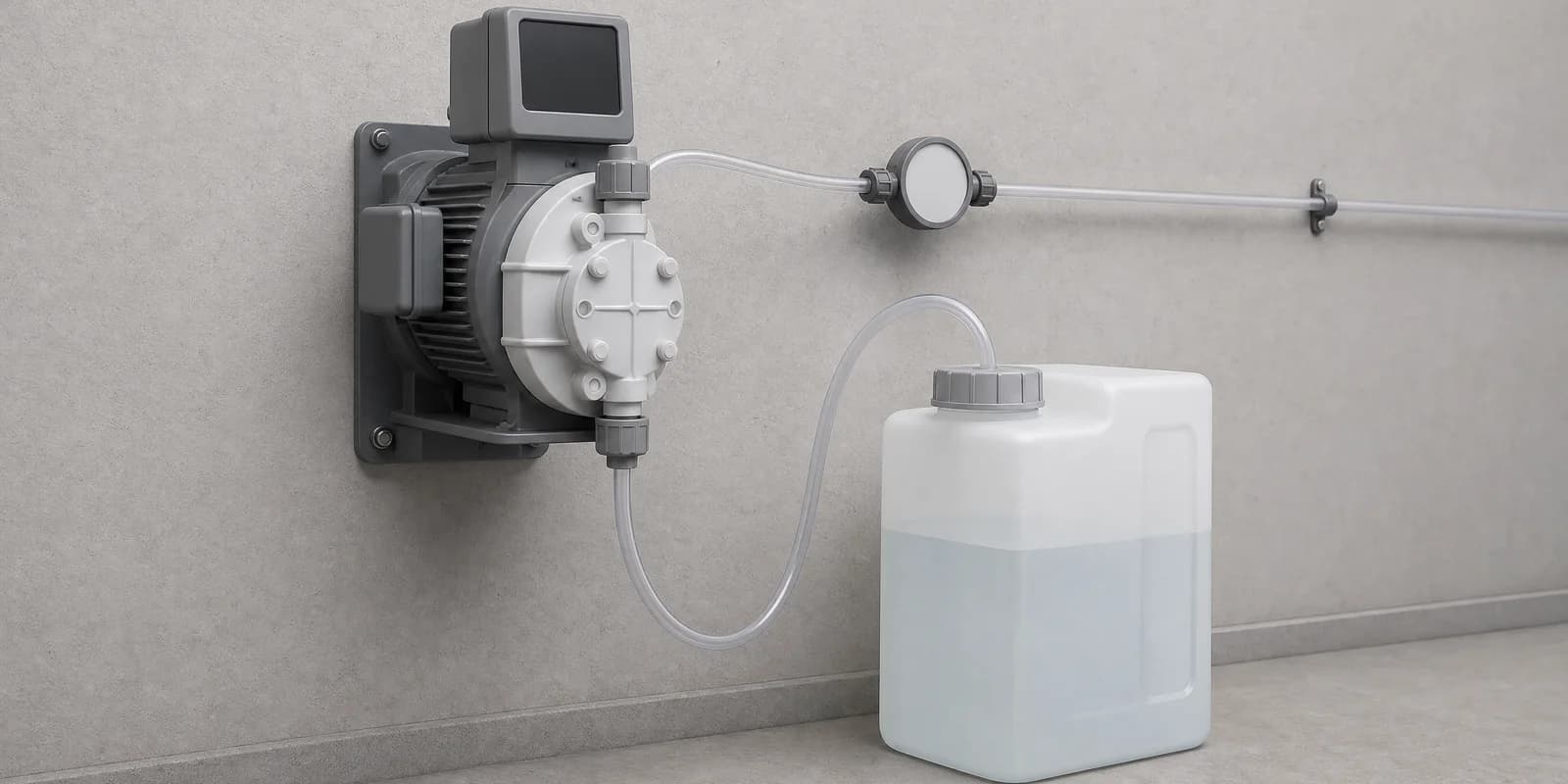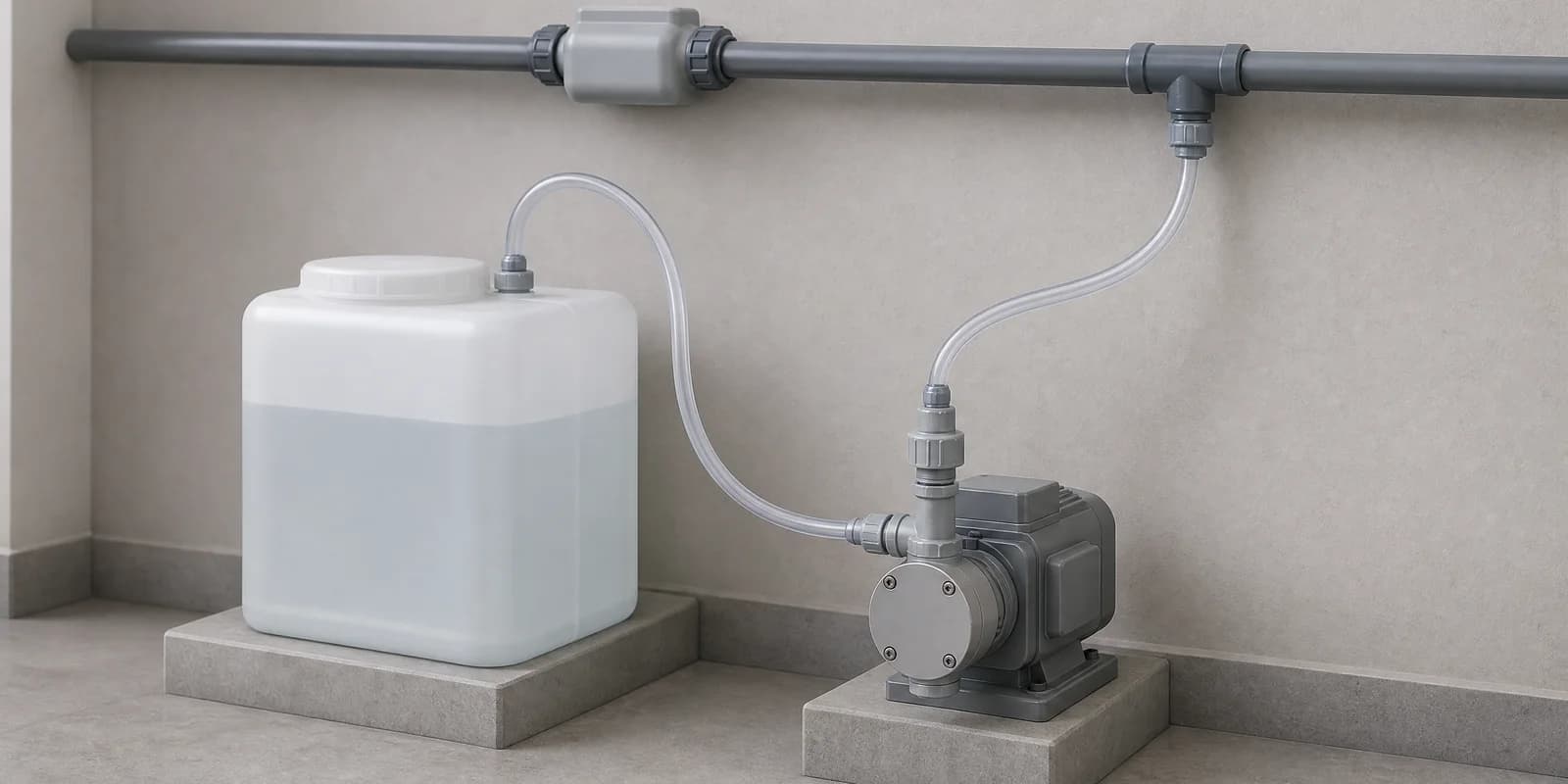
This reference design shows how the ProMinent Sigma X control type, in its S1Cb version, could be configured for sodium hypochlorite dosing into one industrial facility's process-water supply. Fit depends on the line pressure at the injection point, the stroke length the duty needs, what ProMinent will say in writing about gas, and which checks the owner runs outside the pump, not on printed capacity or the word proportional. Engineers and integrators can use it to frame questions for ProMinent and to set acceptance checks. It is a hypothetical configuration built from a catalogued product and published sources, with no installation, commissioning date or measured result behind it, and no drinking-water claim.
A motor-driven metering pump in three versions
ProMinent GmbH of Heidelberg, Germany, the address on its declaration of conformity[5], describes the Sigma X control type as a motor-driven oscillating diaphragm metering pump[5]; the version used here is the S1Cb, type 12017 with a PVDF liquid end[1][5]. ProMinent lists a multi-layer safety diaphragm with optical rupture signalling and an integral relief valve[1]. No document retrieved states where the pump is made. This article treats the Sigma/ 1, /2 and /3 Basic types as a different range and uses none of their figures.
ProMinent states that the Sigma X covers 21 to 1,040 l/h in versions S1Cb, S2Cb and S3Cb[1]. Type 12017 with the PVDF head (code PVT) has the lowest l/h figure in the three tables, 21 l/h against 56 for the S2Cb and 182 for the S3Cb[1][2][3], each a minimum capacity at maximum back pressure[5][6][7]. The S1Cb manual is the source for installation and operating limits[5]; the S2Cb and S3Cb manuals were read only for technical data, intended use, back pressure and calibration lines, so none of their installation statements is used.
The PVT code carries ceramic balls and a PVDF relief valve with an FKM or EPDM elastomer[1]. Modes include Manual, Batch and Contact, which takes pulses from an external contact such as a water meter[1][5]. The identity code presumably fixes these options, so it is a quote item; the food-contact variants ProMinent lists[1] are not part of this configuration.
ProMinent introduces its S1Cb application list as "general examples of generally suitable applications for this product"[1]. For water treatment the list gives "Proportionate addition of chemicals in water treatment, e.g. sodium hypochlorite for disinfection of drinking water"[1], and the 2023 catalogue prints the example for potable water[8]. That line is a stated use, not evidence that any head or strength suits any water, and not a potable-water claim. All three manuals state "The pump is only intended for industrial use."[5][6][7] The S1Cb manual adds that the pump is not intended for unprotected outdoor use or explosion-risk areas[5], and "The pump is not intended for the metering of gaseous media and solids."[5]
Hypochlorite dosing is the first water-treatment example ProMinent names[1], and it tests two over-readings: a pump that does not measure the dose, and back pressure. The product page's downloads section lists no data sheet[1], so the operating instructions and the 2023 catalogue stand in.
ProMinent Sigma X Motor-Driven Diaphragm Metering Pump
No certifications listedView product →Proportional dosing is not verified dosing
In the ProMinent Sigma X S1Cb reference design for hypochlorite dosing (the S1Cb hypochlorite design), the pump would be judged on the delivered dose and the checks around it, because in Contact mode it converts water-meter pulses into strokes[5] and measures neither the water nor the chlorine. The manual describes control by potential-free contacts such as a contact water meter, with a scaling factor, remainders added and an optional Memory function for unprocessed strokes[5]. No document read gives the pump a chlorine or water-line flow measurement, so proportional is not verified.
The duty uses round numbers chosen so every figure can be checked, and each is illustrative: a peak water flow of 200 m³/h, a low-end flow of 20 m³/h (10% of peak), 4 mg/L as available chlorine (4 g/m³), a contact water meter giving 1 pulse per 100 L, and product at 100 g/L available chlorine. None is a rating or a fact about any facility; the owner's water-treatment specialist sets the real dose, and the set is invalid for several injection points, a standby pump, a pool, a cooling tower or any drinking-water duty.
ProMinent's own hypochlorite scheme, for its solenoid-driven beta pump in a potable-water example, pairs a contact water meter in the main line with "Monitoring of chlorine content after metering"[8]. [ASSUMPTION: that arrangement carries to a Sigma in Contact mode; promoted if ProMinent confirms it.]
The first target is a product rate: 200 m³/h × 4 g/m³ = 800 g/h, which at 100 g/L is 8.0 L/h, or 133.3 mL/min, or 40 mL of product per cubic metre of water (derived here). The 100 g/L is not the 12% by weight in ProMinent's resistance list[8], and no density converts one into the other. The low end, 20 m³/h, needs 0.8 L/h or 13.3 mL/min; the 10 to 1 span is the duty's range, not a pump turndown figure.
Product strength is an input the pump cannot see: chlorine delivered scales with strength, so a product 10% weaker at an unchanged setting would give 3.6 mg/L instead of 4 mg/L. Each target is therefore paired with a check before equipment is chosen: a measuring cylinder, the water-meter total, pressure at the pump connectors and the owner's downstream chlorine reading. The pump's display is not an acceptance instrument.
Line pressure and stroke length would decide fit
The ProMinent Sigma X S1Cb reference design for hypochlorite dosing would inject into a pressurised process-water line from a flooded day tank, because ProMinent's manual ties precise metering to back pressure above 1 bar and the diaphragm rupture signal to about 2 bar[5]. At an illustrative line minimum of at least 3.0 bar the margin over 1 bar is 2.0 bar. Headroom to the PVT head's 10 bar rating[5] is 10 bar minus the line's maximum pressure, the injection valve's opening pressure and surges; no document read publishes the last two, so it is at most 7.0 bar, reached only if the line never exceeds 3.0 bar. The owner's logged maximum is a quote question.
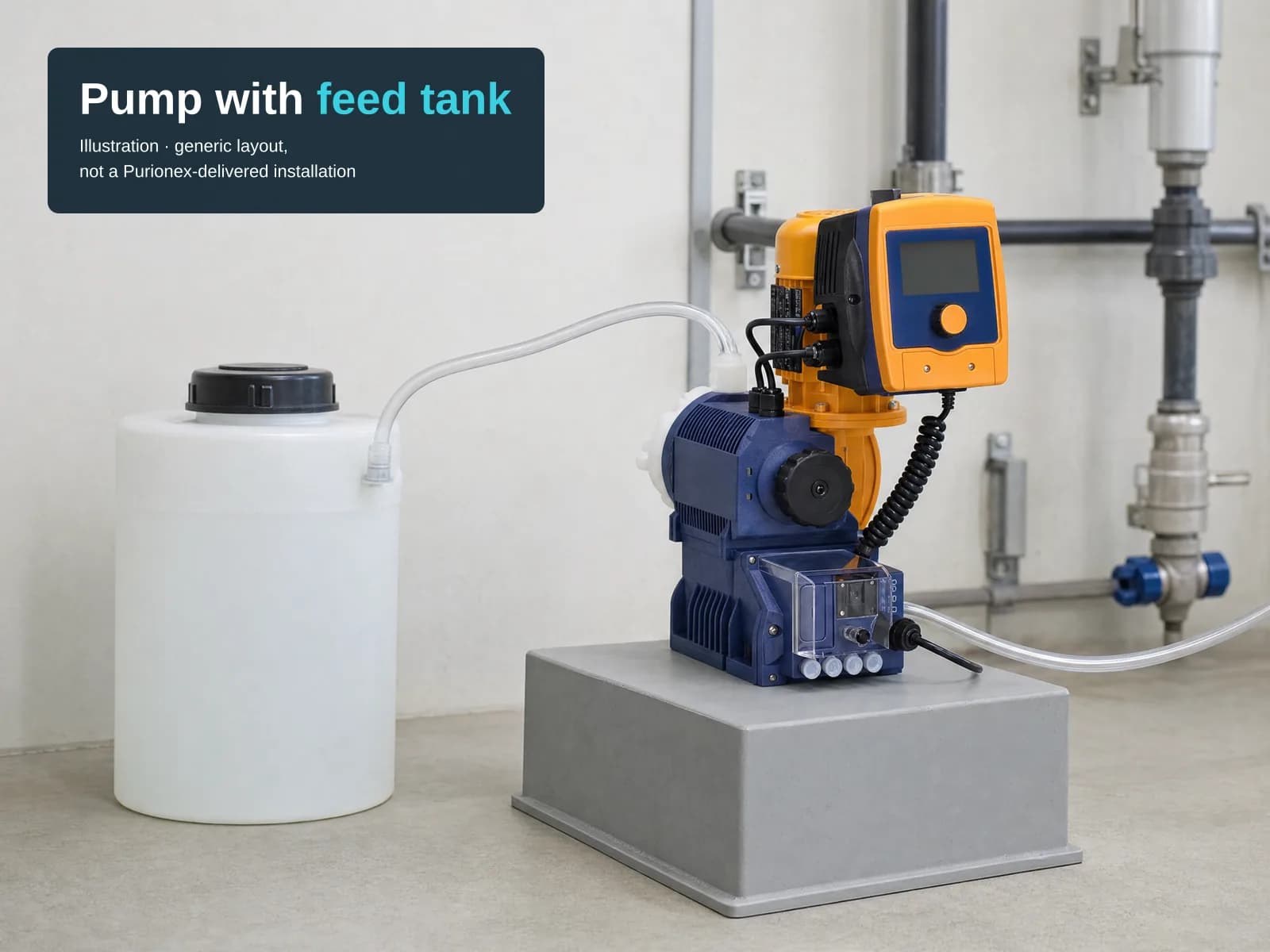
Flooded suction, the tank above the pump, is this article's design decision, not a ProMinent statement about hypochlorite. A ProMinent catalogue example for a viscous filler advises feed "so that the suction line is always filled with liquid even after long periods of idleness"[8], and Wanner, another pump maker, writes that "flooded suction is required for most reliable and consistent performance"[9]. The manual caps suction-side pressure, which it calls priming pressure, at 1 bar on every S1Cb row, warning that excess lets chemical press through the pump[5]. A 1 m column of water is about 0.098 bar, and a manometer at the suction connector decides. Particles above 0.3 mm need a suction filter[5]. Back pressure, injection, relief and foot valves "do not represent absolutely leak-tight closing elements"[5], so isolation is a shut-off valve, a solenoid valve or a vacuum breaker.
The printed 21 l/h is ProMinent's minimum pump capacity at maximum back pressure, for water at 20 °C, for type 12017 PVT at 10 bar[5]. The 8.0 L/h demand is 8.0 ÷ 21 = 38.1% of it, a 61.9% margin, a table position, not a prediction of flow at the owner's pressure. ProMinent's resistance list calls itself "an initial guide"[8] and "does not claim to offer any guarantees"[8]. In it, PVDF is rated resistant and stainless steel 1.4404 not resistant for sodium hypochlorite at 12% by weight, at 20 °C and 1,013 mbar[8]. That is a test basis, not a limit for a warmer plant room, so product temperature at the pump is a quote item. A rating "only applies up to this concentration"[8], so the 100 g/L product is not covered by inference. Ceramic balls are not rated in the list; EPDM is rated resistant in all three hypochlorite rows while the three FKM entries read o, + and +[8], so the S1Cb hypochlorite design assumes the EPDM relief-valve option[1].
Neighbouring rows are set against printed minimum capacity in the same way[5][2][3]. Capacity removes none of them, since a larger row uses a smaller share of a larger rating; the stainless S2Cb row goes on material and the 4 bar rows are tight on pressure. The selection guide for the Sigma X covers how the larger rows compare and how to read the table.
| Row (PVT head)[5][6][7] | Minimum capacity at maximum back pressure, l/h (10 bar unless stated) | 8.0 L/h as share |
|---|---|---|
| S1Cb 12035 | 42 | 19.0% |
| S1Cb 10022 | 27 | 29.6% |
| S1Cb 04084, 4 bar | 101 | 7.9% |
| S1Cb 04120, 4 bar | 117 | 6.8% |
| S2Cb 16050 | 61 | 13.1% |
| S3Cb 120145 | 182 | 4.4% |
The S2Cb's smallest table row, 56 l/h at 16 bar (14.3%), has a stainless 1.4404 head[2][1], which the list rates not resistant[8], so it is out on material, not capacity. The 4 bar rows leave at most 4.0 − 3.0 = 1.0 bar above a 3.0 bar line, before the line maximum, injection valve and surges. A pump discharging to atmosphere should have a back pressure valve[5][4].
[ASSUMPTION: volume per stroke equals 3.8 mL × the stroke-length setting, valid only for counting; calibration at operating pressure replaces it.]
The S1Cb hypochlorite design specifies 80% stroke length, 3.04 mL per stroke, so 133.3 mL/min needs 43.9 strokes/min: 48.7% of the pump's 90 strokes/min cap, 2.05 times headroom, or 410 m³/h of water at the same dose. The cap sets the lowest stroke length that meets peak demand, 133.3 ÷ (3.8 × 90) = 39.0%, or 41.0% if each stroke delivers 5% less. The 30% stroke length is the lowest setting in the conditions the manual attaches to its reproducibility figure, not an operating limit[5]; the span from 30% to 100% is a 3.33 to 1 range of stroke length, not a turndown figure. The 8.0 L/h is a basis this article chose, not a product rating.
The S1Cb hypochlorite design uses one pump and no standby. A stopped pump means no dose, and a second identical pump on the same tank, suction line and injection point would share the same exposure. What leaves is 8.0 L/h of hypochlorite solution into a 200 m³/h line, giving 4 mg/L (illustrative); apart from that, the only outflow is the overflow line from the relief and bleed valves, back to the tank[5].
Acceptance would check the dose, not the pump
In the ProMinent Sigma X S1Cb reference design for hypochlorite dosing, the pump would measure no chlorine and no product strength (judgment; the manual describes no such measurement): the contact water meter, the manometers, a measuring cylinder and the owner's downstream chlorine reading would be the instruments for the dose, and acceptance would test the delivered dose at operating pressure. The manual lists a two-stage level-switch input, a metering-monitor input for the Flow function, and stops on 'Pump blocked' and 'Overload' for a constricted or closed discharge, with no pressure value stated in the sections read[5]. None of these checks the chlorine dose (judgment).
One pulse per 100 L means 4.0 mL of product per pulse. At 3.04 mL per stroke the factor is 4.0 ÷ 3.04 = 1.316, entered as 1.32, inside the manual's step-up range of 1.01 to 99.99[5]. The manual prints the range, not the step. [ASSUMPTION: two-decimal entry, to confirm in the pump's menu.] At peak that is 2,000 pulses/h, 0.56 pulses/s (2.2% of the input's 25 pulses/s maximum[5]) and 44.0 strokes/min; at 10% of peak it is 3.3 pulses/min and one stroke every 13.6 s. The input needs a contact of at least 20 ms[5], so the meter's pulse width is a quote item. Changing from Manual to Contact keeps the stroke rate[5], so it is checked after the change. In Batch mode the manual says a stop key press or the Pause function clears the Memory, and its Contact-mode caution reads 'Only with ‘Memory’ - ‘off’'[5], so a remote stop may discard stored strokes. What a stop does with Memory on, and the restart after a mains loss, are not described in the lines read, so nothing relies on them.
The manual warns that a closed discharge can drive pressure to several times the permissible figure and instructs "Install a relief valve that limits the pressure of the pump to the maximum permissible operating pressure of the system."[5] The integral relief valve "can only protect the motor and the gear"[5], never the system, so the system relief valve in the S1Cb hypochlorite design is design practice built on that instruction. Its setting must sit above the line's maximum operating pressure, or it opens in service, and no higher than the owner's lowest permissible figure and the PVT head's 10 bar (engineering judgment); the opening pressure ProMinent sets was not read. The overflow returns to the tank, never into the suction line, where it blocks the bleed function, the valve used to bleed air from the liquid end, and never through a metal line on a PVT head, which can crack[5].
ProMinent states "Only above approximately 2 bar system back pressure is a signal generated in the event of the rupture of a diaphragm."[5] At 3.0 bar the margin is 1.0 bar. A back pressure valve at about 1.5 bar, the manual's figure for metering at atmospheric pressure, meets precise metering (0.5 bar over 1 bar) but not the rupture signal (0.5 bar short of 2 bar); the manual's other option is a valve set to at least 2 bar where the installation allows[5]. Silence below about 2 bar is not proof the diaphragm is intact.
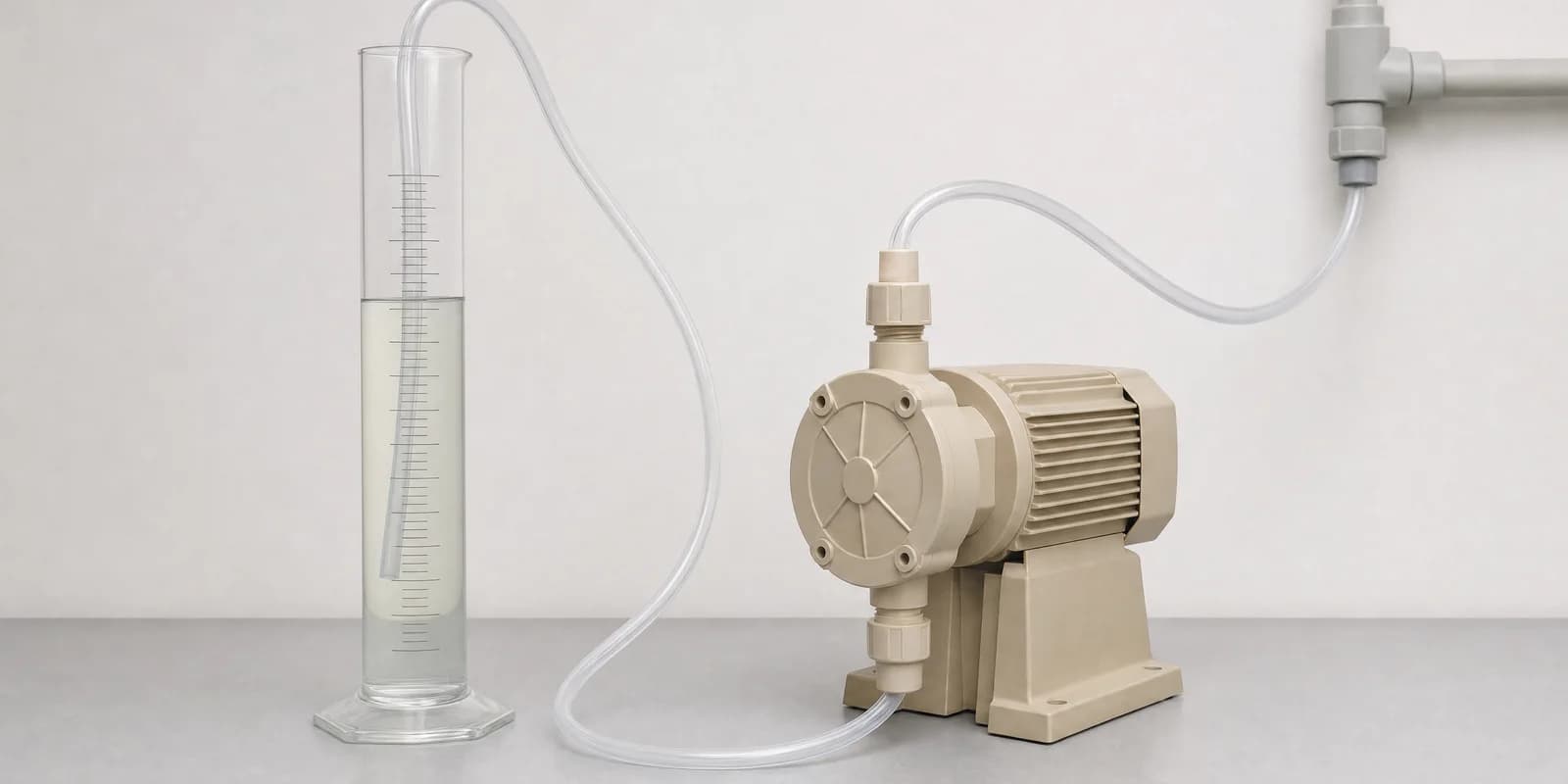
Acceptance would use the manual's calibration: the suction hose leads into a measuring cylinder holding the feed chemical while the discharge hose stays at operating pressure, for at least 200 strokes at a stroke rate that is not too low, with safety precautions if the chemical is hazardous[5]. The S1Cb hypochlorite design therefore provides a valved connection on the suction line for a temporary graduated cylinder. At 80% stroke length and 43.9 strokes/min, 200 strokes of 3.04 mL are an expected 608 mL in about 4.6 minutes, and the measured volume replaces the proportional-stroke assumption. The manual says calibration is normally not needed[5]; here the dose needs a stated basis. Pulses are checked against the water-meter total, line pressure against a manometer log (never below 1 bar, above about 2 bar if the rupture signal is relied on), and the dose against the owner's chlorine reading downstream at peak and at the low end, with pass values agreed before order.
A delivered volume names its stroke length, stroke rate and pressure; the chlorine reading names its sample point and method and is taken after mixing, with readings straight after a change set aside (judgment). The deep dive on the Sigma X accuracy figures sets out what ProMinent's two precision statements cover; acceptance here relies on calibration at operating pressure.
Gas behaviour on hypochlorite is the open question
The first risk in the ProMinent Sigma X S1Cb reference design for hypochlorite dosing is the central gap: no ProMinent document read states how a Sigma behaves with a liquid that evolves gas, and ProMinent's web page and manual word gaseous media differently. The web page says "Accurate and complication-free metering of viscous and gaseous media by adjustment of the movement profile."[1] The manual says "The pump is not intended for the metering of gaseous media and solids."[5] The manual does not say whether a liquid that evolves gas counts as gaseous media, and no NPSH value or gas figure for the Sigma appears in the documents read. The closing route is ProMinent's written statement for the exact identity code and the intended hypochlorite; if ProMinent states the pump is not suited, the answer is not this product.
The pump's documents leave the tank, suction filter, system relief valve, isolation device, water meter and its pulse type, manometers, calibration connection and chlorine reading to the owner or integrator. After handover the owner holds the dose set point, factor, stroke length, relief setting and acceptance limit on the downstream reading. No document read describes a chlorine alarm on the pump, and the S1Cb hypochlorite design claims no controller alarm, link or interlock beyond the manual's own functions[5].
| Upset | What happens | Who acts |
|---|---|---|
| Tank runs low, owner-fitted two-stage level switch | Warning at stage one; 'Level error' and pump stop at stage two[5] | Owner refills |
| Water flow stops | No pulses, so no new strokes; if the line also drops below 1 bar, precise metering ends[5] | Owner, from the pressure log |
| Gas blocks metering | ProMinent's catalogue describes an air bubble interrupting metering in another pump[8]; the downstream reading would show it (judgment) | Owner |
The owner's staged commissioning trial can be stopped at any stage: ProMinent's written answers and the exact identity code on paper; the pump on water at operating pressure as a mechanical check (judgment; the manual's procedure has no water stage); the manual's calibration run on product, which doses product into the line; the meter contact and factor; product at a low stroke setting with the downstream reading; then the design setting. Stopping before the calibration run leaves a pump and a tank and no chemical dosed. The off-ramp is a different pump.
The S1Cb hypochlorite design fits one injection point and one pump on a pressurised process-water line whose logged minimum is at least 3.0 bar and maximum known, with a PVT head and a downstream chlorine reading the owner can take. It stops at the limits below. It does not mean a verified dose, drinking-water or regulatory compliance, ProMinent's endorsement, suitability for hypochlorite, or a certification.
| Variable | Threshold | Consequence |
|---|---|---|
| Line pressure, minimum | Below 1 bar with no back pressure valve[5] | Precise metering not possible |
| Line pressure, rupture signal | Below about 2 bar[5] | No signal, so none relied on |
| Head material | Stainless steel 1.4404[8] | Rated not resistant |
| Product strength | Above 12% by weight[8] | Outside the list's rating |
| Viscosity | Above 200 mPa s[5] | Integral relief valve unreliable |
| Temperature | Ambient outside -10 to +45 °C; PVT media above 65 °C long-term at maximum pressure[5] | Outside the manual's range |
| Placement | Explosion-risk area or unprotected outdoor use[5] | Outside intended use |
ProMinent prints in the S1Cb manual a Declaration of Conformity excerpt to the Machinery Directive 2006/42/EC and the EMC Directive, dated 20.06.2016, and states IP 65 in accordance with IEC 529, EN 60529 and DIN VDE 0470 Part 1[5]. A missing statement is not proof there is no mark. The data pack to send is the minimum and maximum line pressure, peak and low-end flows, dose, product strength, basis and viscosity from the supplier, the meter's pulse value, width and type, tank height, product and ambient temperature at the pump and the exact identity code.
ProMinent's quarterly check interval carries the footnote "Under normal loading (approx. 30% of continuous operation)"[5], so continuous duty needs its own interval. A Purionex quote would state the exact identity code and the acceptance plan, and would pass on any written answers ProMinent gives on gas handling, ceramic-ball resistance, the strength basis for the head, opening pressures, the Memory caution and restart behaviour, and how its two precision statements relate. Request a quote for the ProMinent Sigma X with this data pack; whether Purionex supplies this exact code is for the quote to confirm.
Sources
- [1]ProMinent GmbH — Motor-Driven Metering Pump Sigma X Control Type, Sigma/ 1 - S1Cb, product page, retrieved 2026-10-01 (features, field of application, options, technical table)
- [2]ProMinent GmbH — Sigma X S2Cb product page, retrieved 2026-10-01 (technical table rows for the neighbour check)
- [3]ProMinent GmbH — Sigma X S3Cb product page, retrieved 2026-10-01 (technical table row for the neighbour check)
- [4]ProMinent GmbH — Back Pressure Valves/Relief Valves for Motor-Driven Metering Pumps, accessory page, retrieved 2026-10-01 (purpose of a back pressure valve)
- [5]ProMinent GmbH — Operating instructions, Diaphragm motor-driven metering pump, Sigma X Control Type, Sigma/ 1 S1Cb, part no. 982568, BA SI 102 10/21 EN (primary: limits, installation, set-up, calibration, technical data)
- [6]ProMinent GmbH — Operating instructions, Sigma X S2Cb, part no. 982541, BA SI 079 07/18 EN (read for technical data, intended use, back pressure and calibration lines only)
- [7]ProMinent GmbH — Operating instructions, Sigma X S3Cb, part no. 982514, rev. 07/18 (read for technical data, intended use, back pressure and calibration lines only)
- [8]ProMinent GmbH — Product Catalogue Volume 1, 2023 edition (excerpts: S1Cb chapter, application examples, chemical resistance list)
- [9]Wanner Engineering (Hydra-Cell) — Glossary of Terms (another pump maker, about its own pumps; one sentence on flooded suction); 2006 file stamp, copy hosted by a pump distributor (depcopump.com)