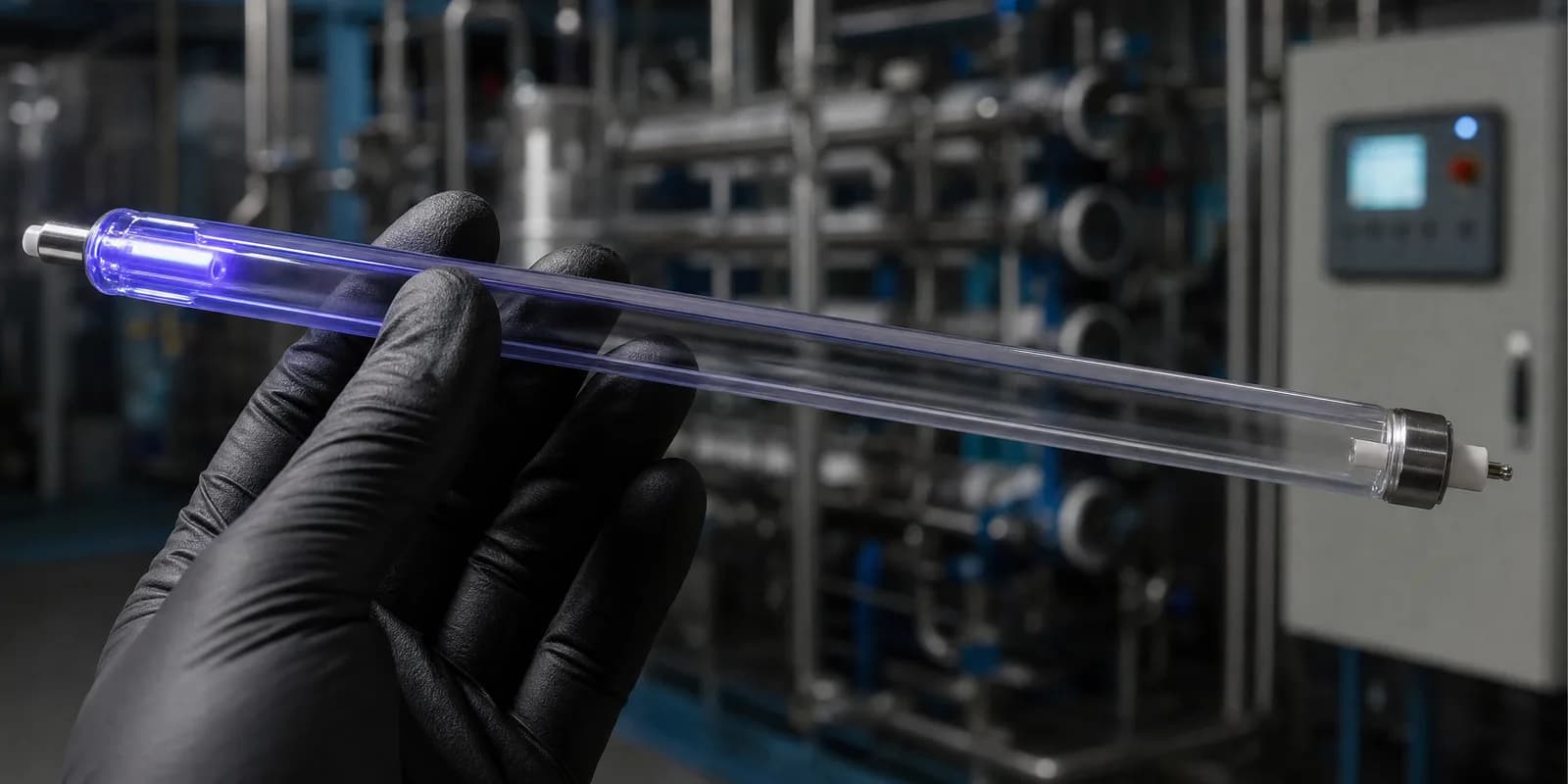
A DULCODES model code such as 4x350 reads like a flow rating, and it is not one. ProMinent prints four different flows for that code on four product pages: 317 m³/h on the DULCODES LP table,[2] 251 on the certified table,[3] 80 on the F&B table[4] and 250 on the LP-PE table.[5] The question that decides fit is which table a number comes from and what that table's footnote says the number assumes.
The guide is a procedure with three possible endings: a named line and size at a stated margin (the illustrative run below reaches the DULCODES LP certified 1x350, 48 against 40 m³/h, a 16.7% margin), ProMinent's written flow first, or not this product.
Scope is four of the six lines on ProMinent's family page:[1] the DULCODES LP (the line ProMinent's chart labels "Not certified"),[9] LP certified, LP F&B and LP-PE. The medium-pressure MP and syrup LP TL are left out.[1] Purionex lists one DULCODES UV record, whose headline specifications are the DULCODES LP's, so the four-line scope is this guide's choice. A process-water reference design works one duty, and a lamp-and-dose mechanics article covers what a flow figure must carry. No document retrieved names a Singapore, Malaysian or Indonesian rule for UV devices.
Confirm the problem, then measure the water
UV acts on organisms: ProMinent describes UV-C attacking germ DNA with no chemical added,[1] and lists photochemical reduction of ozone, chlorine and chloramine as separate applications this guide leaves out.[1][8] UV does not remove particles, salts or colour (reasoning), and EPA says particles lower UV transmission and can shield organisms,[6] so turbidity is a pretreatment question. On drinking-water duty ProMinent's notes add a downstream shut-off and a rinse valve to the check; process water does not.[8]
The first case is a positive downstream sample with a normal sensor signal. The sensor reads intensity at its own window, while EPA says dose depends on intensity, flow rate and UV transmission (UVT, the share of light passing through water) together.[6] Check in order (reasoning): sample upstream and downstream together from the two sample valves ProMinent places 3 to 5 pipe diameters either side of the reactor;[8] look for contamination after the reactor; compare the flow then with design flow; measure UVT and particle load.
The second is a signal that falls across a season. Lamp ageing, sleeve fouling, a fouled sensor window and lower UVT all reduce it,[6] and one intensity signal cannot name a single cause (reasoning). ProMinent says the LP-PE sensor monitors tube contamination, lamp ageing and water transmission;[5] no document extends that to other lines. Check operating hours first (the catalogue says the Compact controller shows them),[8] then a photometer reading at 254 nm,[8] then sleeve and window cleaning.
A clean sample can mislead when drawn at low flow, which lengthens exposure time (reasoning; EPA defines dose as intensity times exposure time).[6]
ProMinent's design notes require the application, maximum flow and minimum UVT by laboratory measurement at 254 nm, and its questionnaire adds, among other fields, pressure, turbidity, particles, hardness, iron and temperature.[8] The certification claim, saline or thermal duty, hygienic design, pressure and temperature eliminate lines. Maximum flow and the lowest expected UVT size the unit.[8] Orientation, space to pull the lamp and tube,[8] and cabinet ambient fit it. ProMinent's questionnaire accepts UVT as %/1 cm, %/10 cm or SAC 254 nm (no retrieved document defines it),[8] so 98% UVT without a path length is ambiguous: 98 %/cm is 81.7 %/10 cm [ENG-CALC: 0.98 to the tenth power, absorbance scaled with path length]. EPA measures unfiltered water without pH adjustment, whereas Standard Method 5910B filters and adjusts pH,[6] so a laboratory following it can report higher transmission than the reactor sees (reasoning); ask which method and whether the sample was filtered.
Pick the line, then size to its footnote
Name the claim the duty needs, from the buyer's specification or regulator, then compare each page's claim as that page's. The certified page says "for drinking water disinfection", certified to DVGW/SVGW/UVDGM standards and type-tested to DIN 19294-1:2020-08, and prints no certificate number, certifying body, laboratory, date, tested dose or list of sizes tested.[3] The F&B page claims DIN-DVGW, SVGW, ACS and EPA-UVDGM certification[4] while ProMinent's chart marks that line for food and beverage only;[9] the page does not say which application the certification covers. The DULCODES LP and LP-PE pages make no certification statement,[2][5] while the DULCODES LP page lists potable water treatment[2] and the chart marks the line for drinking water.[9] The catalogue flags NSF/ANSI/CAN 50-2024 against five of the eight DULCODES LP sizes;[8] no NSF listing was retrieved, and the mechanics article explains why the query does not test the flag.[7]
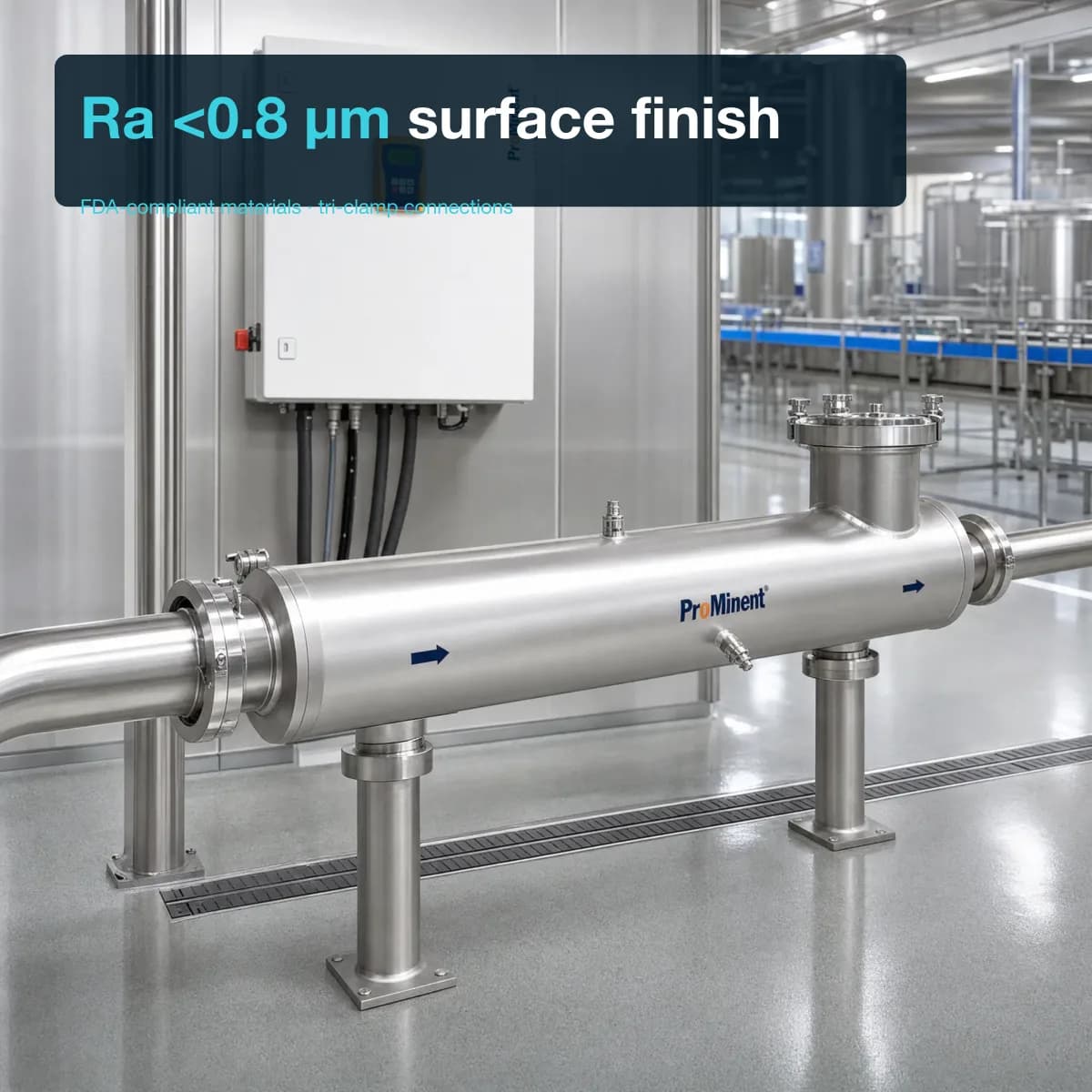
The envelope is ProMinent's printed permissible values: DULCODES LP and LP certified 10 or 16 bar and 2 to 70 °C (16 bar models not identified in the documents retrieved);[2][3] LP F&B 10 bar and 2 to 70 °C;[4] LP-PE 4 bar and 5 to 30 °C.[5] The LP-PE page is the one written for "saline/seawater or thermal water",[5] a term the page does not define, and its column is the only one the chart marks for salt water.[9]
The same code carries different flows (m³/h).[2][3][4][5]
| Code | DULCODES LP | LP certified | LP F&B | LP-PE |
|---|---|---|---|---|
| 1x80 | 8.8 | 6.4 | n/a | n/a |
| 1x230 | 35 | 20.7 | n/a | n/a |
| 1x350 | 53 | 48 | 48 | 35 |
| 2x350 | 123 | 109 | 109 | 123 |
| 3x230 | 155 | 86 | n/a | n/a |
| 3x350 | 232 | 168 | 168 | 252 |
| 4x350 | 317 | 251 | 80 | 250 |
| 6x350 | 523 | 406 | 136 | 505 |
| Printed basis | none | 98 %/cm | 98 %/cm; ozone duty at 80 and 136 | none |
The certified table prints "98 %/cm transmission; flows certified to DIN-DVGW 19294 / SVGW / ACS",[3] as does the F&B table's first footnote;[4] the F&B 4x350 and 6x350 values print "98 %/cm transmission, UV dose 1200 J/m² for the elimination of dissolved ozone in water",[4] so 80 and 136 are ozone-duty flows, not general-disinfection flows (reasoning). Every certified row is lower than the DULCODES LP row of the same code, from 9.4% on the 1x350, (53 − 48) ÷ 53, to 44.5% on the 3x230, (155 − 86) ÷ 155.[2][3] The documents retrieved do not say why, so no derating factor carries across rows.
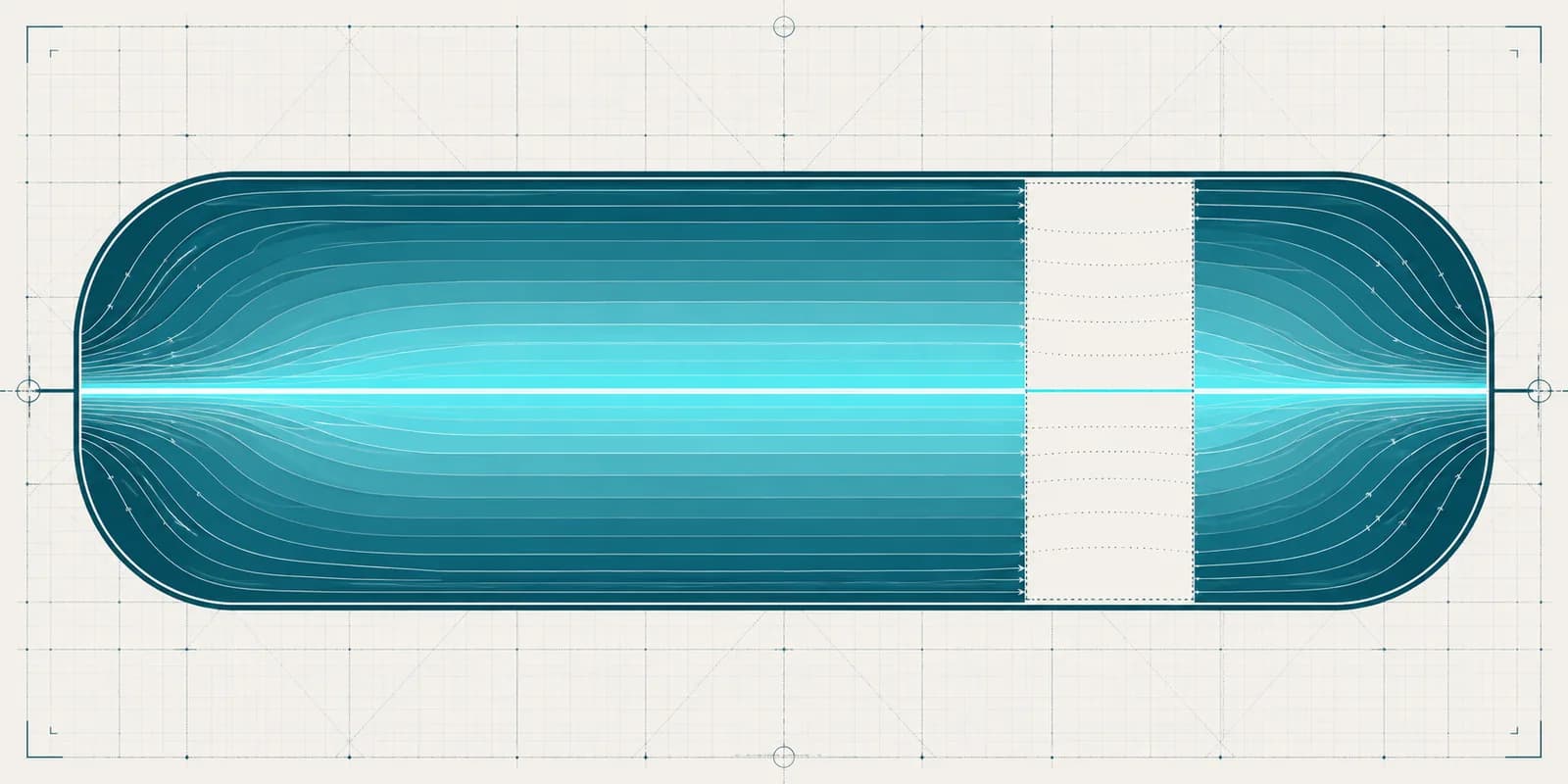
ProMinent's selection chart gives its output axis a basis of 400 J/m² (40 mJ/cm², since 10 J/m² is 1 mJ/cm²)[6] at 98 %/cm transmission, as transcribed from the chart image.[9] The DULCODES LP rows print no basis,[2] so reading them at that basis is [ASSUMPTION: the chart caption read as the basis of all eight DULCODES LP rows; no ProMinent page says so. For it: one caption covers all the chart's columns. Against it: the certified rows are lower and no document says why]. 98 %/cm is the basis of a flow, not a minimum UVT (reasoning); no page retrieved prints a minimum UVT or says the unit fails below it. A lower measured value needs ProMinent's written flow at that value; none of the documents retrieved gives one for any LP line.
The run is illustrative, not a rating. [ASSUMPTION: a building supply whose specification names a certified line, 40 m³/h peak, 15 m³/h low, site minimum UVT 98 %/cm so the table applies as printed (ProMinent's own basis, not a typical value); pressure and temperature unassumed, so the pick stands only within 10 bar, 2 to 70 °C and cabinet ambient 5 to 40 °C (Comfort) or 5 to 35 °C (Compact); valid until the building meters its demand; invalid for saline, thermal or hygienic duty.][3] Margin is (rated − demand) ÷ rated on the certified table.[3] The 1x230 at 20.7 is 19.3 m³/h short: (20.7 − 40) ÷ 20.7 = −93.2%. The 1x350 at 48 clears: (48 − 40) ÷ 48 = 16.7%, so it is the pick. It needs 1,465 mm of free space to pull the tube and lamp, and a DN 100 connector.[3] The 2x350 at 109 gives 63.3% and the 3x230 at 86 gives 53.5%, kept as options at 835 W and 825 W connected load against 430 W.[3] LP F&B 1x350 prints the same 48,[4] but the chart marks that line for food and beverage,[9] so it goes to ProMinent as a question. The DULCODES LP 1x350 (53)[2] and LP-PE 1x350 (35)[5] do not state the claim the specification names. The 16.7% is flow margin on a printed basis, not disinfection headroom.
Lamp ageing and sleeve fouling lower delivered dose over time (EPA);[6] the documents retrieved give no ProMinent factor, so none is applied. At 15 m³/h the flow is 15 ÷ 48 = 31.3% of the 1x350's rating. ProMinent lists dimming for seven of the eight sizes (not the 1x80),[8] says lamps dim over a range of up to 50% of nominal power,[2] and says certification confirms a "precise 50-100% control range";[3] the documents retrieved print no dose at part load, minimum flow or control law. EPA says lower UVT cuts dose and that dose depends on flow rate.[6]
Place the reactor, then decode the quote
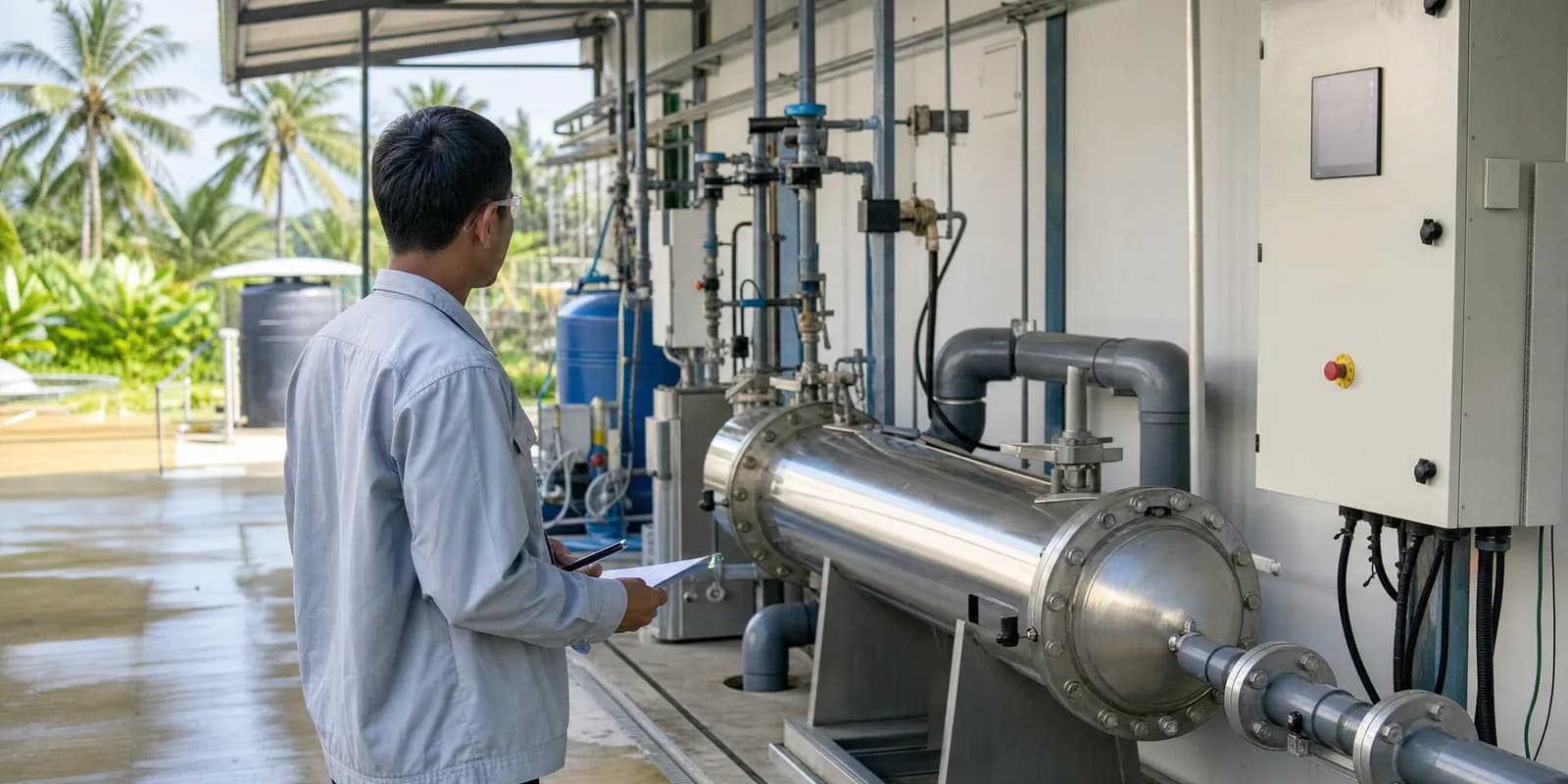
Three placements are possible, a bounded [ASSUMPTION: option set; the documents retrieved state no permitted tie-ins beyond vertical or horizontal installation and the planning notes].[2][8] One reactor on the full flow is simplest, with one set of valves and sample points; its blind spot is that one reactor, controller and sensor window serve everything. Two reactors in parallel let one be serviced or fail while the other carries the duty (two certified 1x350 each carry 40 m³/h, at 860 W against 430 W);[3] the blind spot is the shared feed, since low UVT, particles or fouling reach both. Reactors at points of use repeat the controller and lamp service at each outlet (reasoning).
Each interface item needs a named supplier. ProMinent's planning notes call for sample valves either side of the reactor and a manual shut-off upstream. For drinking water they add an electrically controlled shut-off downstream that closes on power failure, and a rinse valve; for process water a manual isolating valve is "normally sufficient".[8] ProMinent lists a UVT photometer, a reference radiometer described for certified DULCODES LP systems, a 1/2 inch drain kit listed only for 3x350 LP to 6x350 LP, and a chemical cleaning system on request.[8] The documents retrieved publish no flush volume, cleaning-waste volume, chemical or destination.
Upsets become quote items. For the Comfort controller the catalogue documents contact outputs for warnings and alarms, a 0/4-20 mA sensor signal, two 4-20 mA inputs for flow and for turbidity or combined chlorine, outputs for a flush and shut-off valve and a feed pump, and pause, external-fault and emergency-mode inputs.[8] The documents retrieved do not say whether it closes a valve on the minimum-radiation condition or what emergency mode does. The quote must say who acts on a fault.
The ambiguous specification is the flow: 1x350, 48 m³/h can be the certified table, the F&B table, or a misreading of the DULCODES LP's 53 or the LP-PE's 35. A quote states the line, the table, the UVT with path length and sample method, the dose and standard, and the lamp and sleeve condition. The DULCODES LP page's Downloads tab showed 0 operating instructions and 0 data sheets, then printed "Service Unavailable", in the capture of 1 October 2026,[2] so the quote names the document behind each figure.
ProMinent prints "Guaranteed lamp service life of 14,000 operating hours (pro rata)"[2] without the pro-rata terms; EPA's typical 8,000 to 12,000 guaranteed hours for low-pressure lamps[6] is a comparator, not a confirmation. The catalogue lists a wiper for four of the eight DULCODES LP sizes and none of the eight certified;[8] how a certified size is cleaned is a question for ProMinent. Spent lamps contain mercury (EPA);[6] no take-back is described in the documents retrieved: ask who takes them. EPA's typical guaranteed lives for sleeves and sensors are 1 to 3 years and 1 year (ask ProMinent for its own).[6]
Keep it valid, and when to stop
Commissioning sets the baseline: record the sensor signal and operating hours (the Compact display shows hours; the Comfort controller logs events to an SD card; the signal is a 0/4-20 mA output, read by a meter the quote names).[8] Measure UVT at 254 nm with a photometer the same day, and sample upstream and downstream at design flow, read on a flow meter the quote names, against a pass limit the owner sets. The documents retrieved state no commissioning dose test.
The documents retrieved publish no sensor calibration interval, sleeve-cleaning interval or wiper cycle rate. One benchmark exists and is not ProMinent's: EPA's 2006 manual reports 5 to 12 month pilot studies, where standard cleaning sufficed below 140 mg/L total and calcium hardness and 0.1 mg/L iron;[6] the catalogue lists no wiper for any certified size,[8] so the benchmark is not a statement about them; the mechanics article gives the detail. Re-measure UVT, hardness, iron, particles, flow and pressure whenever the source, season or duty changes. A commissioning pass is the best case, a new lamp and clean sleeve; ageing and fouling lower dose later (EPA),[6] so it is not a pass at 14,000 hours.
Five conditions end the quote or change the enquiry, and none fires on the worked run; the 1x350 pick stands only while none applies. Three depend on a measured or specified value:
- A measured minimum UVT below 98 %/cm against a flow from a 98 %/cm table:[3][4] ProMinent's written flow at that UVT, with its dose, decides.
- Saline or "thermal" water above 4 bar or outside 5 to 30 °C, the LP-PE page's printed limits:[5] ProMinent comes first, as the chart marks no other column for salt water.[9]
- A specification naming the drinking-water claim and a hygienic design (Ra under 0.8, no gaps or dead space, cleaning in place) together: the certified page states the drinking-water claim,[3] the F&B page states certification and the hygienic design without naming the application it covers,[4] and no page states the drinking-water claim and the hygienic design together, so ProMinent confirms one line in writing.
Two are quote conditions that depend on ProMinent's reply:
- A specification needing the certificate number, body, laboratory, date or sizes tested, none of which the certified page prints[3]: ask ProMinent in writing, and make no quote against that clause until it is answered.
- A tender needing a written oxidant tolerance, pressure loss or dose at part load, none of which appears in the documents retrieved: ask in writing.
The data pack gives the application and required claim, maximum and low flow, maximum pressure, the lowest UVT with path length and method, turbidity and particles, hardness in mg/L (ProMinent's form offers mmol/l or degrees dH),[8] iron, manganese, chloride, temperature and cabinet ambient. A competent reply names the model and line, the flow at the measured UVT with its dose and standard, the controller, accessories and pressure loss, and what ProMinent does not publish. It may conclude that a written answer from ProMinent is needed first, that another line fits, or that this is not the product.
ProMinent DULCODES UV System
No certifications listedView product →Request a quote for a ProMinent DULCODES UV system with this data pack.
Sources
- [1]ProMinent — UV Systems family page, retrieved 2026-10-01 (six product cards; UV-C and photochemical-application text; the selection-chart image is src-44)
- [2]ProMinent — DULCODES LP (not certified) product page, retrieved 2026-10-01 (flow table with no footnote, envelope, lamp guarantee, Downloads tab)
- [3]ProMinent — DULCODES LP certified product page, retrieved 2026-10-01 (eight-row flow table with its 98 %/cm footnote, certification wording, envelope)
- [4]ProMinent — DULCODES LP F&B product page, retrieved 2026-10-01 (flow table with two footnotes, certification wording, hygienic design, envelope)
- [5]ProMinent — DULCODES LP-PE Plastic product page, retrieved 2026-10-01 (flow table with no footnote, saline and thermal water wording, 4 bar and 5 to 30 °C envelope)
- [6]US EPA — Ultraviolet Disinfection Guidance Manual, EPA 815-R-06-007, November 2006 (Purdue-hosted copy; general UV engineering reference, not a ProMinent statement)
- [7]NSF — Certified Drinking Water Treatment Units, company query 'ProMinent': No Matching Products Found, current as of 2026-09-30 (negative result; Standard 50 not queried)
- [8]ProMinent — Product Catalogue 2026 Volume 3, section 1.1 UV Systems DULCODES (controllers, planning notes, design questionnaire, design-version tables, accessories)
- [9]ProMinent — family-page selection chart image, transcribed by eye (column labels, application marks, 400 J/m² and 98 %/cm caption)