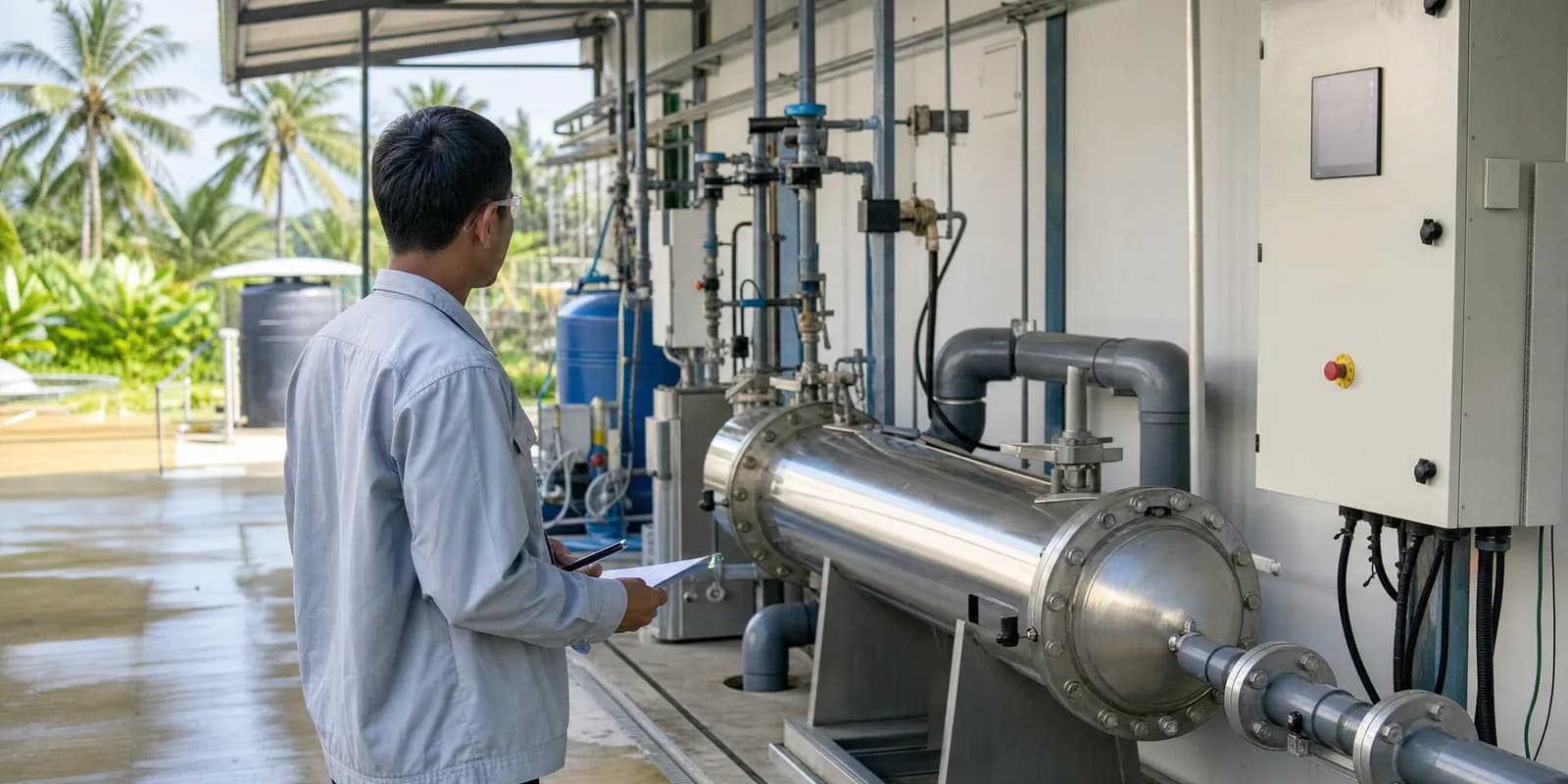
This reference design shows how a ProMinent DULCODES LP 3x350 could be configured for continuous, full-flow process-water disinfection of 140 m³/h at peak and 60 m³/h on a low-demand day. Fit depends on the facility's lowest UV transmission at 254 nm (UVT), on how fast its water fouls the lamp sleeves and on the owner's own microbiological limit, not on the 232 m³/h in ProMinent's table: the 39.7% margin that figure gives over 140 m³/h, (232 − 140) ÷ 232, is a margin of flow, and the DULCODES LP table prints no UVT or dose for it. It is hypothetical, built from a product listed in the Purionex catalog and from published sources, with no installation or measured result behind it, and its engineering verdict is provisional: no ProMinent page retrieved ties a flow, a UVT or a dose to a DULCODES LP table row, and none gives a pressure loss for this line; the chart caption's basis is read below only as an assumption. It can end in a fit, with ProMinent's written flow at the measured UVT in hand, or in not this line: a UVT at which that flow falls short of 140 m³/h, a peak above 232 m³/h, supply above 10 bar, saline or hygienic duty, a certification requirement, or a tender needing a written oxidant tolerance, pressure loss or part-load dose.
DULCODES LP, its sizes and stated uses
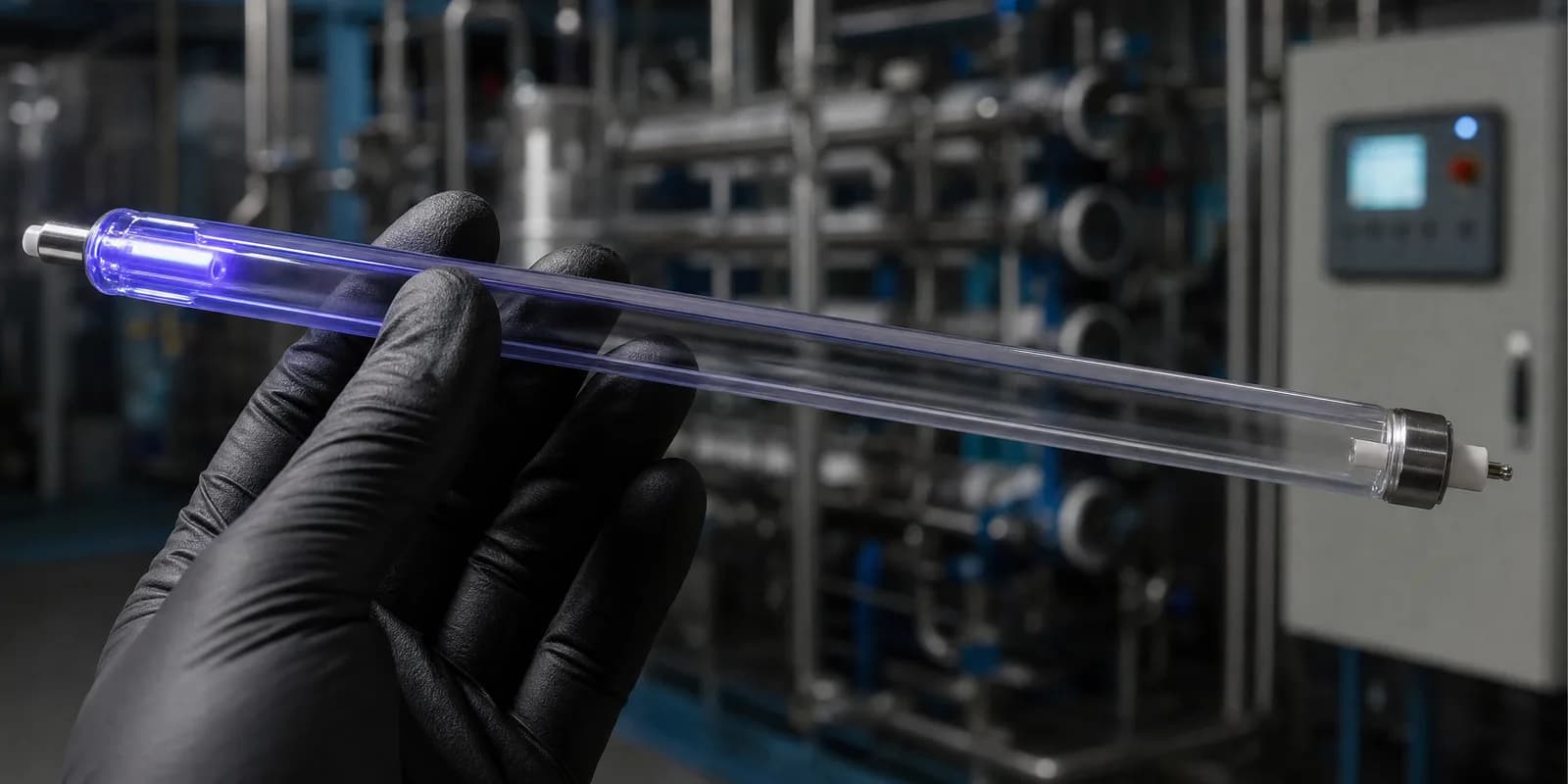
ProMinent's DULCODES UV systems are inline UV reactors. ProMinent's catalogue describes a stainless-steel or UV-resistant plastic radiation chamber, quartz lamp protection tubes, lamps with a high UV output in the 254 nm range, UVC sensors, and controllers and electronic ballasts in a control cabinet[9]. The DULCODES LP line, which ProMinent's family-page chart labels "Not certified"[10] (the catalogue version calls the column "Standard"[9]), is the line this reference design uses; below it is called the DULCODES LP design. ProMinent says UV-C light attacks the DNA of germs directly[1] and offers "Immediate and safe disinfection without the addition of chemicals"[1]. How dose is delivered is covered in the mechanics article.
The family page shows six cards[1]. Purionex lists one DULCODES UV record whose key-spec panels cover more than one line; this article takes the base DULCODES LP rows from ProMinent's own product page, and the choice of line is this article's, not the catalog's. The DULCODES LP table lists eight sizes, 1x80 to 6x350, and the DULCODES LP design uses the 3x350[2].
- Listed flowSOURCED232 m³/h; the flow column has no footnotesource
- Lamps and connected loadSOURCED3 × 370 W lamps; 1,240 Wsource
- ReactorSOURCED1.4404/316L stainless steel; listed diameter 324 mm; DN 200 connectorsource
- Chamber and free spaceSOURCED1,885 mm radiation chamber; 1,565 mm free space needed for maintenancesource
- EnvelopeSOURCEDWater 2 to 70 °C; pressure 10 bar or 16 bar, without saying which models are 16 bar; ambient 5 to 40 °C with the Comfort controller; IP 66source
- Lamp lifeSOURCEDGuaranteed 14,000 operating hours, pro ratasource
The chart's caption, "400 J/m², 98%/cm transmission"[10], sits beside the output axis of all five chart columns. Reading the DULCODES LP rows, whose flow column has no footnote, at that basis is [ASSUMPTION: the chart caption read as the basis of the eight DULCODES LP rows; no ProMinent page says so]. The certified rows print a basis the DULCODES LP rows do not, and their flows differ without explanation[3][2]; the chart draws both lines under the one caption[10], so no factor is applied.
The 3x350 takes the Comfort controller only (Compact is listed for the 1x80, 1x230 and 1x350). Dimming is listed for seven of eight sizes (all but the 1x80), and an optional wiper for four (1x350, 2x350, 3x350, 4x350; not the 3x230)[9]. The catalogue flags NSF/ANSI/CAN 50-2024 and UL/CSA for the 3x350[9]; no listing was retrieved, so the article claims no certification.
The DULCODES LP page lists potable water treatment, food and beverage production and swimming pool water as general examples[2]. The process-water use comes from the family-page chart, which marks the Not certified column for drinking, process and swimming pool water[10]; the catalogue's list covers all DULCODES UV systems[9]. These are stated uses, not results, and none names a facility or a flow. The duty needs a multi-lamp reactor, since 140 m³/h is far past the largest single-lamp size, the 1x350 at 53 m³/h[2]. ProMinent's planning notes call a manual isolating valve "normally sufficient" for process water[9], which the DULCODES LP design departs from knowingly.
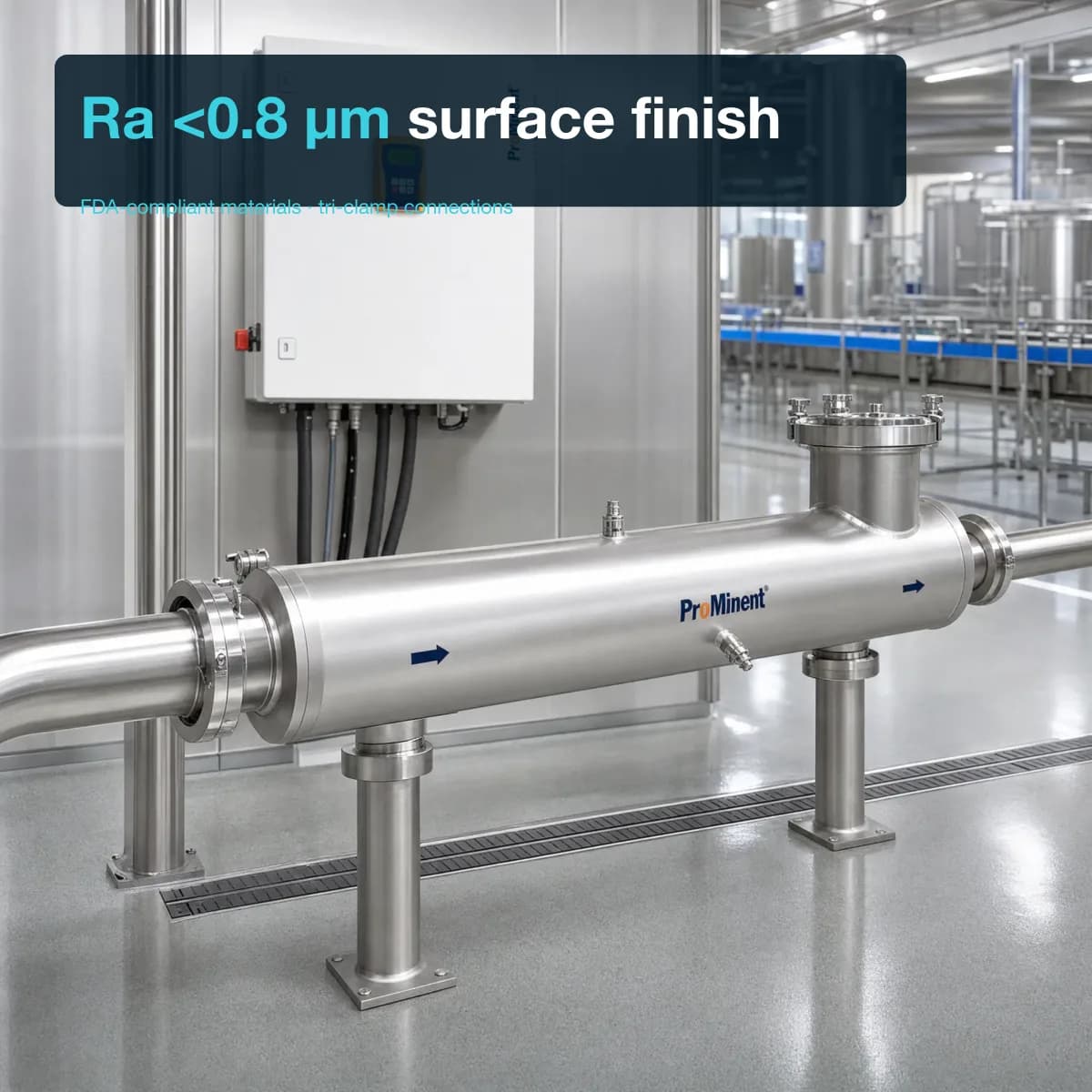
ProMinent DULCODES UV System
No certifications listedView product →Lowest UVT, not flow, would decide fit
In the ProMinent DULCODES LP reference design for a 140 m³/h process-water duty, the reactor would be judged by the water it receives, because a flow in a maker's table is a rate at a stated condition, not a prediction for a supply. [ASSUMPTION: a continuous municipal or treated-groundwater line passing 140 m³/h at peak and 60 m³/h on a low-demand day, valid until the facility meters its own demand.] Neither figure is a rating in any ProMinent table, so the margins below are real, not the 0% of a demand equal to a rating.
The 3x350 lists 232 m³/h, a 39.7% margin over 140 m³/h[2], but that is flow through a pipe: EPA names UVT, sleeve fouling and lamp ageing as governing the dose a reactor delivers[6], and none is in the DULCODES LP table. The chart's 98%/cm is its caption's stated basis, not a minimum UVT; none of the documents retrieved says the unit fails below it. Where ProMinent does print a basis, the footnote "98 %/cm transmission; flows certified"[3] on the certified rows, the same model codes carry flows 9.4% to 44.5% lower[3][7][2] (1x350: (53 − 48) ÷ 53; 3x230: (155 − 86) ÷ 155), and the documents retrieved do not say why. Target one is ProMinent's written flow for the 3x350 at the facility's measured minimum UVT, with the dose and standard it is stated at. ProMinent's planning notes say to design for the highest flow and the lowest expected UV transmission, and its questionnaire also asks for pressure, turbidity, hardness, chloride, manganese, iron and temperature[9]. No ProMinent page retrieved ties a DULCODES LP size's table flow to a stated UVT (the chart caption's 98%/cm is read above only as an assumption), so this is the central gap.
UVT is a method as well as a number: a quote should give the path length and say whether the sample was filtered, as the selection guide sets out. ProMinent's planning note says UVT is to be determined by "a laboratory measurement of the absorption at 254 nm", and its questionnaire takes the value in %/1 cm, %/10 cm or SAC 254 nm[9]; neither names filtering. Target two is a fouling check. EPA lists hardness, alkalinity, temperature, ions, redox potential and pH as drivers of sleeve fouling[6]. EPA's 2006 guidance manual for US surface-water rules reports pilot studies in which standard cleaning protocols and wipers sufficed for total and calcium hardness below 140 mg/L and iron below 0.1 mg/L[6]. That is a benchmark, not a ProMinent limit, and its sentence states no hardness basis, so the laboratory reports mg/L with its basis and in the unit of ProMinent's form, mmol/l or °dH[9].
Target three is the owner's own microbiological limit (organism, count, sample method), because no ProMinent page retrieved ties a dose to a DULCODES LP table row (the chart caption's 400 J/m² is read above only as an assumption). [ASSUMPTION: water at 30 °C, inside the printed 2 to 70 °C, invalid for a chilled line; supply at or below 10 bar, inside "10 bar or 16 bar"[2], invalid above 10 bar until ProMinent confirms the model; ambient air of 5 to 40 °C as printed with the Comfort controller, which the page does not tie to the cabinet or reactor, so the plant-room value is a measurement.] The feed's UVT, hardness, iron, turbidity, chloride and manganese are unknown: measured inputs and acceptance gates, not assumed values. No retrieved document gives them for a Singapore, Malaysian or Indonesian supply, so the DULCODES LP design is location-free.
One reactor, no bypass, no standby
In the ProMinent DULCODES LP reference design for a 140 m³/h process-water duty, one reactor would sit behind a coarse strainer, with isolation and sample valves and an automatic shut-off valve, and no bypass, because the owner decides whether undisinfected water may reach the end uses. A flow meter (feeding the controller's 4 to 20 mA input[11] and the owner's PLC) and manual isolation valves each side of the reactor complete the line, the meter and the second valve being the DULCODES LP design's own choices; ProMinent's planning notes call for sample valves upstream and downstream spaced at 3 to 5 times the pipe diameter[9]. The fail-closed automatic valve, driven by the owner's PLC, is the DULCODES LP design's own choice, and a bypass would send undisinfected water to the end use. The strainer is also its choice: EPA says particles lower UVT and shield microorganisms[6], and no retrieved ProMinent document gives a mesh requirement, so mesh is a quote item. The selection guide weighs other placements.
- DULCODES LP 2x350SOURCED123 m³/h: (123 − 140) ÷ 123 = −13.8%, 17 m³/h shortsource
- DULCODES LP 3x230SOURCED155 m³/h: (155 − 140) ÷ 155 = 9.7%source
- DULCODES LP 3x350SOURCED232 m³/h: (232 − 140) ÷ 232 = 39.7%source
- DULCODES LP 4x350SOURCED317 m³/h: (317 − 140) ÷ 317 = 55.8%source
- LP-PE 3x350, out on envelopeSOURCED252 m³/h: (252 − 140) ÷ 252 = 44.4%source
- Certified 3x350, sensitivity onlySOURCED168 m³/h: (168 − 140) ÷ 168 = 16.7%source
- Certified 3x230, sensitivity onlySOURCED86 m³/h: (86 − 140) ÷ 86 = −62.8%, 54 m³/h shortsource
At 140 m³/h the 2x350 falls short. The 3x230 has the thinnest margin of the sizes that clear 140, the widest unexplained gap to its certified row (86 against 155 m³/h)[3][2] and no wiper option[9]. At the 168 m³/h ProMinent prints for the same code on the certified table [ASSUMPTION: the certified-table flow for the same code, used as a sensitivity, not an estimate], the 3x350 would still clear 140 m³/h and the 3x230 would not.
The 3x350 costs +415 W of connected load against the 3x230 (1,240 against 825 W, +50.3%), +700 mm of chamber, +409 mm of free space and a DN 200 rather than DN 150 connector[2]; both need the Comfort controller[9]. No inline pressure loss is published for any size in the documents retrieved, so the pressure budget cannot close: the loss at design flow is a quote item and pump head the integrator's. No surge rating is published either; the valve closing time and the strainer, flow-meter and valve losses are quote items, and nothing here relies on them. ProMinent lists process water for the LP-PE too[5], so that line is out on envelope: 4 bar against a supply allowed to 10 bar, and 5 to 30 °C[5] with the DULCODES LP design's 30 °C at the ceiling. The LP F&B is a hygienic design for a different duty[4]. The certified 3x350 is a row that prints a 98 %/cm basis[3], at a 16.7% margin, with no wiper option[9]; whether it suits this duty is a question for ProMinent.
Low flow is the 60 m³/h day: 25.9% of the 3x350's 232 m³/h (60 ÷ 232) and 38.7% of the 3x230's 155. ProMinent says the lamps can be dimmed over a range "up to 50% of the nominal electrical power"[2], read here as a 50% floor, as the older 2016 sales folder also says[8]. No retrieved document gives a minimum flow, a dose at part load or the rule linking lamp output to the flow signal. The baseline, not an estimate: [ASSUMPTION: lamp output proportional to electrical power, with no output curve published, and all three lamps dimming together, which no document describes]. Lamps at the 50% floor and 60 m³/h then run at 0.50 ÷ 0.2586 = 1.93 times the output per unit of flow of the rated point (1.29 on the 3x230). ProMinent says "Efficiency even increases in dimmed mode"[2]; the source does not define efficiency or give an amount, so the ratio above is a baseline and nothing more. The direction is more output per unit of flow; no dose is claimed.
One reactor, one controller, one set of ballasts, one sensor window and one feed: any of them failing weakens disinfection for the whole flow. No retrieved document describes behaviour with a lamp out, so none is claimed. A second reactor in parallel covers a reactor failure or a lamp or sleeve service, not a feed that is bad for both, such as low UVT, particles or heavy fouling. The DULCODES LP design has no standby or bypass; whether the process tolerates an outage (the valve closes) or needs a second reactor is the owner's decision.
Acceptance would rest on UVT and sampling
In the ProMinent DULCODES LP reference design for a 140 m³/h process-water duty, the reactor's own sensor would show light at its window, and only samples across the reactor and a measured UVT would show whether the water is being treated. The Comfort controller documents three contact outputs (warning, common alarm, operating messages), a 4 to 20 mA sensor output, two 4 to 20 mA inputs (flow, and turbidity or combined chlorine), temperature monitoring, an SD-card diary, three switched outputs (valve, pump) and four contact inputs (pause, external fault, emergency mode, setpoint)[11]. Online are the sensor signal, flow and contact states; the controller monitors reactor temperature itself, and no output carrying its value is listed, so water temperature stays a hand or logged reading; lamp hours come from the owner's run record, since the Comfort text retrieved lists no hours counter[11]. Sampled are UVT (no UVT input is listed), microbiology, hardness and iron.
The catalogue controller text does not say what the valve output does at minimum radiation, what emergency mode does, how the unit behaves with a lamp out, how lamp output follows the flow signal, or the contact states on power loss[11]. So the owner's PLC takes the protective action: it reads the common-alarm and operating-message contacts and the sensor signal and holds the shut-off valve open only while they are healthy. Every trip value is set by the commissioning engineer and then owned by the operator, none a ProMinent figure. Power loss closes the valve and de-energises the lamps; restart behaviour and the wiper's manual or automatic form are quote items.
The sensor reads intensity at its window, not the dose organisms receive. A falling signal can be lamp ageing, sleeve fouling, a drop in the water's UVT or fouling on the sensor window, which EPA says affects measured UV intensity and dose monitoring[6]; the signal cannot tell them apart. The response, in order: lamp hours from the run record, a photometer reading at 254 nm, inspection and cleaning of sleeve and window, then a reference reading. ProMinent's reference radiometer is described for certified systems[11]; the documents retrieved do not say whether it suits the DULCODES LP, so it is a quote item, not the acceptance method. By inference from where the sensor reads, a steady signal does not show that particles are not shielding organisms[6].
Acceptance runs in the stages below, each with its instrument. Pass conditions are the DULCODES LP design's judgment, not ProMinent's: the downstream count meets the owner's limit while the upstream count shows organisms are present (a clean sample from an already clean feed proves nothing), and the measured UVT is at or above the value at which ProMinent's written flow clears 140 m³/h. With a clean upstream, the microbiological stage cannot show reduction and the reactor has no challenge method, so acceptance then rests, as the DULCODES LP design's judgment, on the measured UVT, the sensor baseline and the alarm path; a challenge test is a question for ProMinent, and no method or dose is claimed.
- Before orderingSOURCEDUVT at 254 nm, 1 cm path, on a stated method, by ProMinent's UVT P200 photometer (5 to 100 %/cm, ±0.5%, 0.1% resolution) or a laboratorysource
- Commissioning baselineSOURCEDWith new lamps and clean sleeves: the sensor signal (4 to 20 mA output) read by the PLC, lamp hours from the run record, water temperature by hand thermometer at a sample valve, at a flow read from the flow metersource
- MicrobiologySOURCEDSamples from the upstream and downstream sample valves ProMinent's planning notes call for, analysed by the owner's laboratory at 140 and at 60 m³/hsource
- Alarm pathSOURCEDAn external fault input and a power cut, confirming that the PLC closes the shut-off valvesource
Each reading would carry flow, temperature, UVT with path length and method, lamp hours, sleeve condition, the sensor reading and the sampling method, as the mechanics article's rule requires.
Flow at the facility's UVT stays open
In the ProMinent DULCODES LP reference design for a 140 m³/h process-water duty, the first risk is the central gap: no ProMinent page retrieved ties the 3x350's table flow to a stated UVT (the chart caption's 98%/cm is read above only as an assumption), so the 232 m³/h in the table is not yet a flow for any particular water. Also absent from the table rows are dose, a UVT range, dose at part load, pressure loss, minimum flow, oxidant tolerance, a wiper cycle rate and behaviour with a lamp out; the selection guide's stop conditions and enquiry cover the ones a quote must settle. ProMinent's written answer closes the gap before order.
A trial the owner can stop would run in three stages: measure UVT and the questionnaire inputs and send them to ProMinent with the duty; commission one reactor with isolation and sample valves, record the sensor baseline and sample across it; run to peak and test the alarm path. It stops if the measured UVT is below the UVT at which ProMinent's written flow clears 140 m³/h and ProMinent's figure at that UVT does not clear 140 m³/h. Stopping after the first stage costs a photometer reading and a letter.
An inline reactor has no reject stream, but it can still flush and produce waste: the controllers have flushing functions, a drain kit is listed for the 3x350, and a chemical cleaning system is listed with its order number column given as on request[11]. No retrieved document gives a flush volume, chemical or destination. ProMinent's rinse-valve note is for drinking water disinfection "and similar applications"[11]; whether this duty is one is a quote question, and the DULCODES LP design takes no rinse valve. ProMinent's lamps are amalgam lamps[2], which EPA defines as alloys of mercury[6], so lamp disposal is a quote item: no retrieved ProMinent document states the lamps' mercury content, describes take-back or gives a Singapore, Malaysian or Indonesian rule. ProMinent's "Guaranteed lamp service life of 14,000 operating hours (pro rata)"[2] is 14,000 ÷ 8,760 = 1.6 years of continuous running, with the terms not in the documents retrieved.
The documents retrieved give no chlorine tolerance for the quartz, seals, stainless parts or sensor, so a chlorinated municipal supply makes tolerance a quote item. The reactor adds no residual; any residual the supply carries passes through, changed by an amount no retrieved document gives. EPA notes that "UV leaves no residual that can be monitored to determine UV dose and inactivation credit"[6]; whether a residual is needed downstream is the owner's decision.
On upsets, a falling sensor signal brings the warning contact, answered in the order set out for the sensor signal. The catalogue controller text does not say how the controller reacts to reactor over-temperature, and the Comfort text lists no end-of-lamp-life contact, though the Compact text does[11], so the maintenance plan counts hours.
The DULCODES LP design would suit a clean-sleeved process-water line with a measured UVT at which ProMinent's flow clears 140 m³/h, a peak at or below 232 m³/h, supply at or below 10 bar, ambient air within the printed 5 to 40 °C, and an owner's limit it can sample against. It stops at a UVT at which ProMinent's figure falls short of 140 m³/h; flow above 232 m³/h (the next sizes list 317 and 523)[2]; supply above 10 bar; ambient above 40 °C; total or calcium hardness at or above 140 mg/L or iron at or above 0.1 mg/L[6] (EPA's pilot benchmark, not a ProMinent limit), where it needs ProMinent's word on the wiper and cleaning system; saline duty (LP-PE)[5]; hygienic duty (LP F&B)[4]; a certification requirement, where the reader asks ProMinent which line and size carries the certificate; and a tender needing a written oxidant tolerance, pressure loss or part-load dose. None of this is a ProMinent endorsement or a ProMinent-published configuration.
Send the data pack to Purionex with a quote request. The pack is UVT with its method, the questionnaire inputs, metered peak and low flows, pressure and temperature range, the owner's limit, end uses, space, and drain and lamp-disposal routes. The quote request should ask ProMinent for the written flow at the measured UVT with its dose and standard, pressure loss at 140 m³/h, the unpublished items above, the cleaning-system scope and the lamp pro-rata terms.
Sources
- [1]ProMinent — UV Systems family page, as retrieved 2026-10-01: six product cards and the UV-C and chemical-free statements
- [2]ProMinent — DULCODES LP product page, as retrieved 2026-10-01: eight-size table (no footnote on the flow column), envelope, dimming and lamp statements
- [3]ProMinent — DULCODES LP certified product page, as retrieved 2026-10-01: eight-row table and its 98 %/cm footnote
- [4]ProMinent — DULCODES LP F&B product page, as retrieved 2026-10-01: hygienic design and envelope
- [5]ProMinent — DULCODES LP-PE Plastic product page (URL slug dulcodes-k), as retrieved 2026-10-01: 4 bar and 5 to 30 °C envelope, field of application
- [6]US EPA — Ultraviolet Disinfection Guidance Manual for the Final LT2ESWTR, EPA 815-R-06-007 (November 2006), copy hosted by Purdue: general UV engineering reference, not about any DULCODES product
- [7]ProMinent — DULCODES LP certified cut sheet (EU edition, 2025): the same eight-row table in print
- [8]ProMinent — DULCODES LP sales folder (2016, older edition): dimming to as low as 50 % of nominal power
- [9]ProMinent — Product Catalogue 2026 Volume 3, section 1.1 UV Systems DULCODES: description, design-version table, planning notes, questionnaire, spare parts
- [10]ProMinent — family-page selection chart (image on the UV Systems page), transcribed by eye: column heads, application marks and the 400 J/m², 98%/cm transmission caption
- [11]ProMinent — Product Catalogue 2026 Volume 3: Compact and Comfort controller text, rinse and shut-off notes, accessories and cleaning system (addendum to the src-30 note)