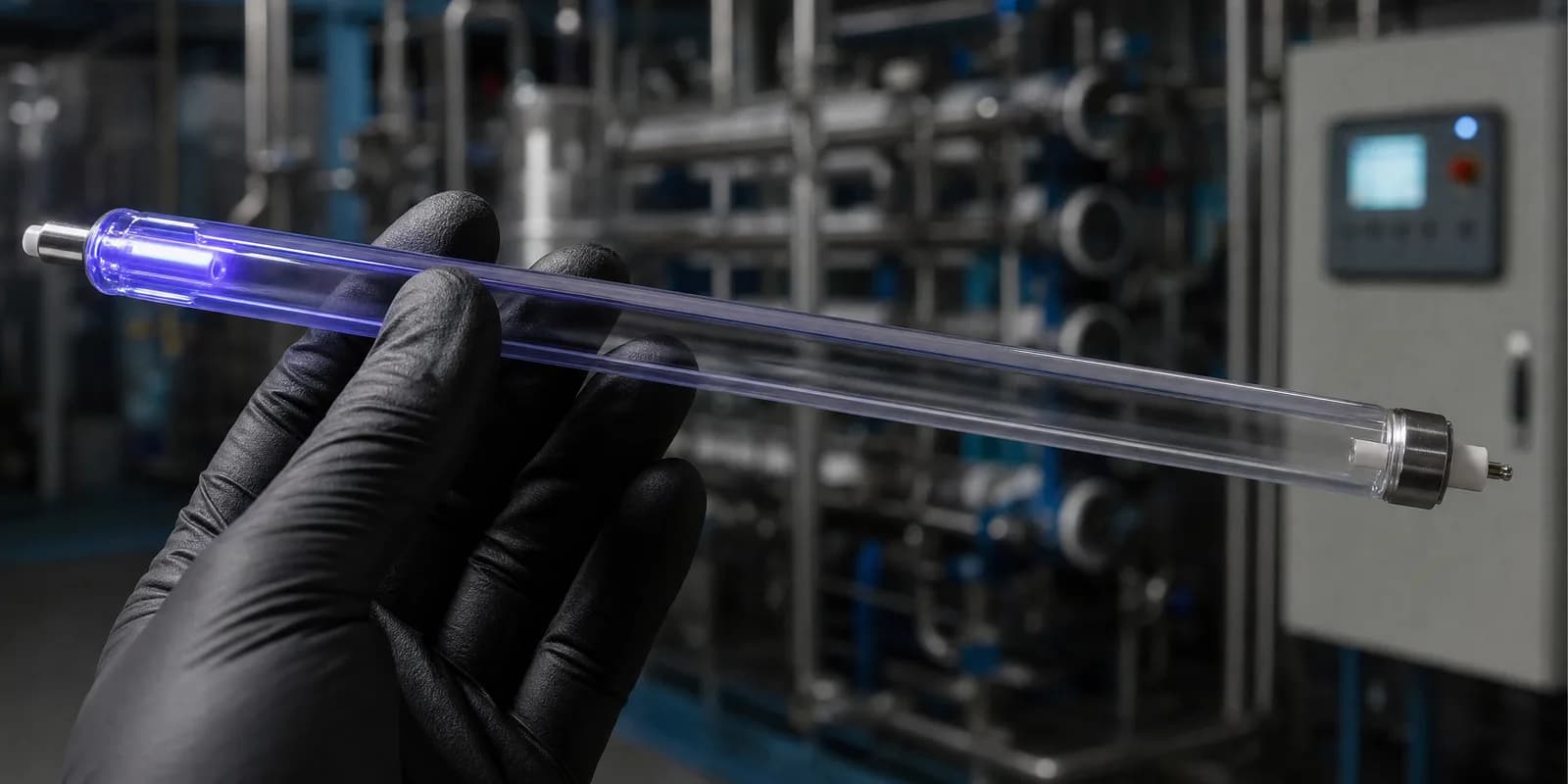
A ProMinent DULCODES UV system disinfects water with UV-C light, which ProMinent says "attacks the vital DNA of the germs directly".[1] The EPA's guidance describes the measurable result as the log inactivation of a surrogate organism, stated as a reduction equivalent dose (RED).[9] ProMinent's catalogue lists stainless steel or plastic chambers, quartz lamp tubes, lamps with high output near 254 nm, UVC sensors, controllers and ballasts.[15]
Dose is easily heard as something a lamp or a model has, but ProMinent's DULCODES tables print a flow in m3/h per model.[2] The table for the DULCODES LP (the line ProMinent's chart labels Not certified)[16] prints no dose and no UV transmittance basis.[2] A UV sensor measures intensity (at its own window, the article's reading).[9] In a flowing reactor, dose is a spread of values, established by test-organism inactivation.[9]
Four questions follow: what decides dose, what a flow figure assumes and what fixing one variable costs, what the evidence proves, and what to measure. The article can end at ask ProMinent for the flow at your measured UV transmittance, with its dose, organism and standard, or at not this rating. Choosing a DULCODES line and size and designing it into a process-water line are separate questions.
Dose is a distribution the reactor produces
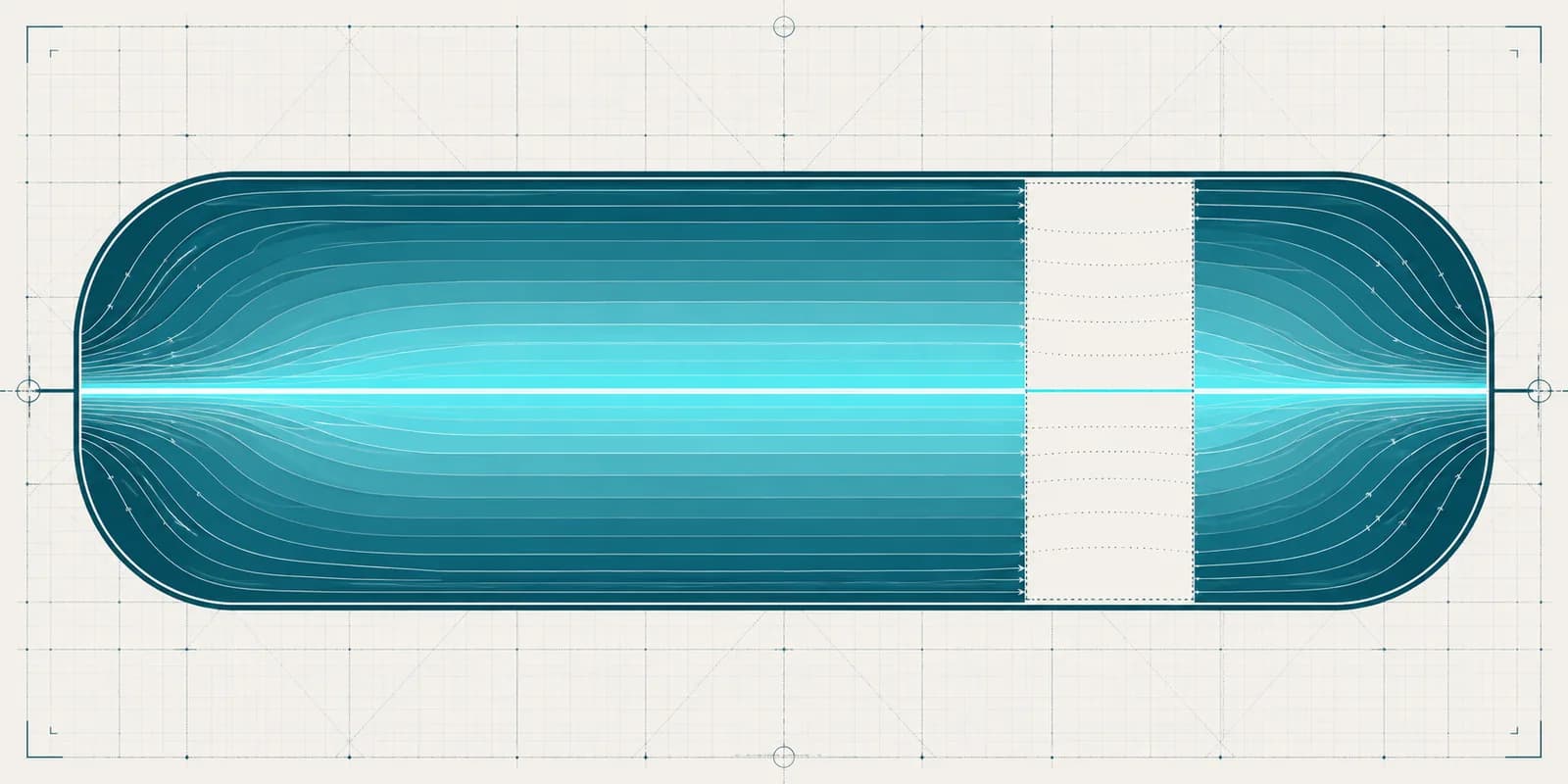
In a flowing UV reactor the EPA describes dose as a distribution across the organisms passing through,[9] while ProMinent describes the DULCODES LP dose as uniform and homogeneous[2] and prints no distribution. A single dose figure describes a rating condition and not what each organism receives. ProMinent says UV-C light of 240 to 280 nm attacks the DNA of germs and that UV disinfects "without the addition of chemicals".[1] That is its band for the action on DNA, not a low-pressure lamp's emission.[9] The EPA lists low-pressure lamps as monochromatic at 254 nm and medium-pressure lamps as polychromatic.[9] Dose is intensity times time at constant intensity, and 10 J/m2 equals 1 mJ/cm2, so 400, 600, 1,200 and 1,300 J/m2 are 40, 60, 120 and 130 mJ/cm2.[9]
The misreading is a dose figure read as what every organism receives. Some organisms pass near the lamps and others near the walls, so the EPA says dose is "best described using a dose distribution",[9] and the average log inactivation is strongly affected by the organisms receiving the lowest doses.[9]
Dose is established by biodosimetry: the EPA says a surrogate organism's log inactivation through the reactor is related to a RED by its dose-response curve,[9] so a RED is an inactivation equivalent, not an instrument reading. ProMinent says the DULCODES LP flow "has been optimised in a reactor based on intensive computer simulation",[2] and the EPA says models estimate while biodosimetry is often used to verify.[9] The ProMinent pages and catalogue retrieved print no dose distribution or biodosimetric result for the DULCODES LP.[2][15] The check is to ask ProMinent for the organism, the RED basis and the test report behind any dose figure.
The limit is particles, which lower UV transmittance and can shield organisms.[9] The EPA reports that small floc particles can enmesh and protect MS2 bacteriophage, and potentially other viruses, and that particle-associated coliforms are inactivated more slowly.[9] It adds that shielding can flatten the dose-response curve at higher inactivation levels.[9] It also reports that for unfiltered source waters, turbidity up to 10 NTU did not affect the dose-response of separately added (seeded) organisms,[18] so the concern is particle-associated organisms (the article's reading). [ASSUMPTION: more lamp output does not buy back shielded organisms in proportion, and a high sensor reading shows window light, not the dose shielded organisms received; reasoning, not an EPA statement; valid as a caution; invalid as a measured result; promoted by biodosimetry on the reactor.]
ProMinent's rated flow holds only at its basis
ProMinent's selection chart (read from the image) captions its output axis for all five columns 400 J/m2, 98%/cm transmission, but the DULCODES LP and LP-PE flow rows print no basis: the 400 and the 98 attach to a chart, not a table row.[16][2][7] The LP certified flow-column footnote prints "98 %/cm transmission; flows certified" to DIN-DVGW, SVGW and ACS.[5] [ASSUMPTION: the DULCODES LP rows are read at 400 J/m2 and 98 %/cm; valid only as a reading aid beside the chart caption; invalid as a ProMinent statement; promoted by ProMinent stating the basis for those rows.] The chart prints no flow number for that line's bar,[16] and the certified rows of the same codes are lower; no retrieved document says why.[2][5]
A basis is not a limit: 98 %/cm is where a flow is stated, not a minimum UV transmittance. ProMinent's planning notes say to design for the highest flow and the lowest expected UV transmission,[15] yet no retrieved document gives a flow at a lower transmittance for the DULCODES LP, certified, F&B or LP-PE lines.[2][5][6][7] The coupled pair is flow against the transmittance floor at a fixed dose. The EPA gives the direction: lower UV transmittance cuts intensity and so dose,[9] and higher flow shortens the mean time in the reactor (volume divided by flow, derived here, fixed volume), so, at fixed dose and fixed lamp output, a lower floor would have to be paid for with a lower flow. For magnitude, ProMinent's LP TL table, another line, gives the same LP TL reactor row at 1,300 J/m2, 36 m3/h above 38 %/cm and 20.7 m3/h above 20 %/cm.[4] All six rows scale by 0.575 (2.3 ÷ 4 to 20.7 ÷ 36), a flow 1 - 0.575 = 42.5% lower at the lower floor.[4] That is sugar syrup in thin-film reactors: it shows how ProMinent states the trade, not what a DULCODES LP loses.
The medium-pressure (MP) table shows why a table is not a curve. Its two flow columns differ in dose and transmittance together: 600 J/m2 at 95 %/cm for combined chlorine, 400 J/m2 at 98 %/cm for disinfection.[3] In the product-page and EU tables the flow ratio is 1.50 on every row (30 ÷ 20.0 to 853 ÷ 569.0), equal to the dose ratio 600 ÷ 400, so the table shows no separate transmittance effect (the article's reading).[12][3] ProMinent's US data sheet prints 1.41 to 1.46 for the same two columns (149 ÷ 102 to 290 ÷ 205), which dose alone does not explain.[14] The largest flow is 853 m3/h in the product-page table and 809 in the page headline and the US data sheet; no retrieved ProMinent document says which governs.[3][14] Lamp output moves with the water. On its low-pressure VARIO-Flux lines (not the 1x80 LP, per the catalogue[15]) ProMinent says the lamps dim over a range of up to 50% of nominal electrical power;[2] the certified page says certification confirms a 50-100% control range.[5] No retrieved document gives dose at part load.
Ageing and fouling erode dose after commissioning.[9] The EPA says lamp output falls with hours, on/off cycles, power per unit length, water temperature and heat transfer.[9] On its low-pressure VARIO-Flux lines ProMinent prints "Guaranteed lamp service life of 14,000 operating hours (pro rata)",[2] with no pro-rata terms in the documents retrieved. For sleeve fouling, the EPA's 2006 manual cites pilot studies (Mackey et al.) in which 1 to 12 cleaning cycles per hour overcame it at total and calcium hardness below 140 mg/L and iron below 0.1 mg/L;[9] that is not a ProMinent limit. ProMinent offers a wiper on selected DULCODES LP sizes[2] and publishes no wipe rate or fouling limit in the documents retrieved.[2][15]
The unit senses less than dose. ProMinent documents a UVC sensor signal (online as 0/4-20 mA) and reactor temperature; the catalogue excerpt retrieved shows operating hours on the Compact controller's display only.[15] The Compact controller, the only option on the 1x80 LP, has a sensor-signal output and contacts; the Comfort controller adds minimum-radiation reporting by contact, an event log and 4-20 mA inputs for flow and for turbidity or combined chlorine.[15] For other lines ProMinent describes the sensor as also tracking water transmission[7] or clarity;[13] its DULCODES LP page says only "Long-term stable UVC sensor for continuous monitoring of the system".[2] [ASSUMPTION: one intensity signal cannot separate lamp, sleeve, window and water effects; reasoning, not a ProMinent statement; valid as a reading of the documented signals; invalid as a statement about any controller's diagnostics; promoted by ProMinent documenting such separation.]
The published evidence stops short of site dose
The evidence on file for a DULCODES unit is ProMinent's own tables and claims, certification statements for several lines with no certificate printed, a negative NSF query and the EPA's general guidance; none shows dose on a given site's water. ProMinent's tables and footnotes print a transmittance and sometimes a dose, never a distribution, an organism or a RED,[5][6][3] and the DULCODES LP page claims a "Homogeneous UV dose"[2] without showing a result. DVGW's German topic page, retrieved 2026-10-01, describes a type test using biodosimetry at different flows, irradiances and UV transmittances, a certificate listing maximum flow and UV transmittance or minimum irradiance, and a RED of at least 400 J/m2 (40 mJ/cm2) for Bacillus subtilis at 254 nm for German public supply.[8] ProMinent's LP certified page says the line is type-tested to DIN 19294-1:2020-08 and prints no certificate number, body, laboratory, date, tested dose or list of sizes.[5] None of this extends to another line, and no retrieved ProMinent document ties its chart's 400 J/m2 to DVGW's.[16]
The LP certified page presents the line as "for drinking water disinfection"[5] and certified to DVGW/SVGW/UVDGM standards. The LP F&B page claims DIN-DVGW / SVGW / ACS / EPA-UVDGM certification.[6] ProMinent's chart marks that line for food and beverage only.[16] The DULCODES LP page states none, and the LP-PE page names only a DVGW factory calibration of its sensor.[2][7] The catalogue flags NSF/ANSI/CAN 50-2024 against five of eight DULCODES LP sizes, and the MP page names Standard 50;[15][3] ProMinent's US MP data sheet names IAPMO beside it.[14] An NSF drinking-water treatment-unit query for ProMinent returned "No Matching Products Found" as of 30 September 2026,[10] but it covers the drinking-water treatment-unit category, no IAPMO listing was queried and no retrieved document defines Standard 50 or says which listing category it falls in, so it does not test the flag. A catalogue flag is not a listing.
No independent laboratory report and no field record for a DULCODES unit was retrieved. No product page, table or data sheet retrieved states a dose, a transmittance range, dose at part load or an oxidant tolerance for the DULCODES LP. The DULCODES LP page's Downloads tab returned no documents when retrieved on 2026-10-01.[2]
A falling UVC sensor reading is ambiguous. Lamp ageing, sleeve fouling, a fall in water transmittance, a fouled sensor window (the EPA says it affects measured intensity)[9] and deliberate dimming would each do it.[9][2] A suggested order, the article's and not ProMinent's: operating hours; readings at the same flow and power setting; a photometer reading at 254 nm; sleeve and window inspection; a reference reading. ProMinent lists a reference radiometer for its certified DULCODES LP systems[15] and the catalogue excerpt retrieved is silent on the other lines. Opsytec's 12-month advice is for its own reference radiometers;[11] ProMinent publishes no interval for the device sensor in the documents retrieved.
Accept a unit on UVT, baseline and samples
A DULCODES dose or flow claim is reproducible only with its organism and dose basis (a RED, J/m2 or mJ/cm2 named), its UV transmittance at 254 nm with path length and sample treatment, its standard and edition, and the lamp age and sleeve condition it applies to. DVGW's page names DIN 19294-1:2020-08 for low-pressure devices and DIN 19294-2:2026-04 for medium-pressure.[8]
UV transmittance is a method as well as a number; the selection guide sets out the forms ProMinent accepts[15] and its derived 98 %/cm to 81.7 %/10 cm conversion. The EPA says to measure absorbance on the water to be treated, unfiltered and without pH adjustment, where Standard Method 5910B filters first.[17] A filtered sample may read clearer than the reactor's water; that is this article's reasoning.
A microbiological result, the second claim type, is reproducible only with its sampling points (ProMinent's planning notes: sample valves upstream and downstream, spaced 3 to 5 pipe diameters),[15] the organism counted, the flow, sensor reading and lamp hours at that moment, and the same-day transmittance. Acceptance names its instruments: the site's flow meter, the controller's 4-20 mA sensor-signal output, and a 254 nm photometer (ProMinent lists the UVT P200).[15] The sensor baseline is logged against a measured transmittance at commissioning.
ProMinent states each flow at its table's basis, and the EPA gives the direction of effects; no retrieved document shows a stated flow delivering its dose on a given site's water. That is not shown for the DULCODES LP rows at 400 J/m2 and 98 %/cm unless ProMinent says so. Nor is it shown at a lower transmittance, at part load, from the sensor signal alone, or for any certification claim beyond the LP certified page's own wording. The answer is not this rating if ProMinent will not state the flow at the measured minimum transmittance with its dose basis, or will not supply a required certificate's number, body and sizes tested.
The data to send ProMinent: the lowest expected UV transmittance, highest flow, pressure, water temperature, turbidity, suspended particles, total and carbonate hardness (mmol/l or dH, as its form asks), iron, manganese, chloride, and whether quality is constant or fluctuating.[15] The terms to agree: ProMinent's written flow at that transmittance with its dose, organism and standard edition; pro-rata lamp terms, a sleeve allowance, and a wiper rate and fouling limit for the site's hardness and iron; sensor warning thresholds and the baseline; how the device sensor is checked, and against what; the sampling plan and pass limit; the certificate where required.
ProMinent DULCODES UV System
No certifications listedView product →Sources
- [1]ProMinent - UV Systems family page (retrieved 2026-10-01) - UV-C mechanism sentence, advantages
- [2]ProMinent - DULCODES LP (base) product page (retrieved 2026-10-01) - lamp, dimming, simulation and dose claims, sensor, wiper, flow table with no basis
- [3]ProMinent - DULCODES MP product page (retrieved 2026-10-01) - two-basis flow table, footnotes, headline flow, Standard 50 wording
- [4]ProMinent - DULCODES LP TL product page (retrieved 2026-10-01) - sugar-syrup flow table at two transmission floors
- [5]ProMinent - DULCODES LP certified product page (retrieved 2026-10-01) - flow-column footnote, certification wording, control range
- [6]ProMinent - DULCODES LP F&B product page (retrieved 2026-10-01) - flow-table footnotes, certification claim
- [7]ProMinent - DULCODES LP-PE Plastic product page (retrieved 2026-10-01) - flow table with no basis, sensor description
- [8]DVGW - topic page on UV disinfection devices (German, retrieved 2026-10-01) - type test, certificate content, RED threshold, DIN 19294 editions; paraphrased
- [9]US EPA - Ultraviolet Disinfection Guidance Manual, EPA 815-R-06-007 (November 2006), Purdue-hosted mirror - generic UV engineering reference, not a ProMinent document
- [10]NSF International - Drinking Water Treatment Units listing query for company ProMinent (current as of 30 September 2026) - no matching products
- [11]Opsytec - DVGW reference radiometer page (third-party vendor, secondary) - calibration advice for its own reference radiometers
- [12]ProMinent - DULCODES MP cut sheet, EU edition (12-6-2025) - flow table with 95 and 98 %/cm columns
- [13]ProMinent - DULCODES MP ELD US flyer (17-6-2026) - largest flow 853 m3/h; sensor wording
- [14]ProMinent - DULCODES MP ELD US technical data sheet (Rev. 4, 03/19/2026) - flow table with largest flow 809 m3/h, IAPMO wording; disagrees with the flyer on the largest flow
- [15]ProMinent - Product Catalogue 2026 Volume 3, section 1.1 UV Systems DULCODES - components, controllers, planning notes, questionnaire, design-version flags, accessories
- [16]ProMinent - UV Systems family selection chart (image on the family page, transcribed by eye; paraphrased)
- [17]US EPA - UV Disinfection Guidance Manual (2006), Purdue-hosted mirror - how UV absorbance at 254 nm is measured (addendum note to src-15)
- [18]US EPA - UV Disinfection Guidance Manual (2006), Purdue-hosted mirror - turbidity and the UV dose-response (addendum note to src-15)