This reference design shows how the EcoWater ECR3702 Series, a two-tank, salt-regenerated cation-exchange water softener, could be configured for one house on a pressurised private supply. Fit depends on the house's hardness and iron load against capacity per recharge, on the supply voltage and on the water's safety, not on the certified flow, which barely separates the three sheet models. Engineers drafting a request for quotation can use it to frame questions for EcoWater and to set acceptance checks. It can end in one ECR3702R30 stated as provisional, in not this product for a location, or in an item held open until EcoWater answers. It is hypothetical, with no installation, commissioning date or measured result behind it, and it stays provisional because EcoWater's documents print a 120 V input.
The ECR3702 is a two-tank salt softener
The EcoWater ECR3702R30 reference design for one house uses the ECR3702R30 variant of the ECR3702 Series. EcoWater's sheet calls it a "WATER CONDITIONER"[7], NSF's listing and WQA's lookup (run 1 October 2026) call it a softener[2][11], and EcoWater's explainer uses conditioning for a salt-free method[3], which this product is not. No document read gives the ECR3702 a chlorine claim, so it is not called a refiner, though EcoWater's web list does[1].
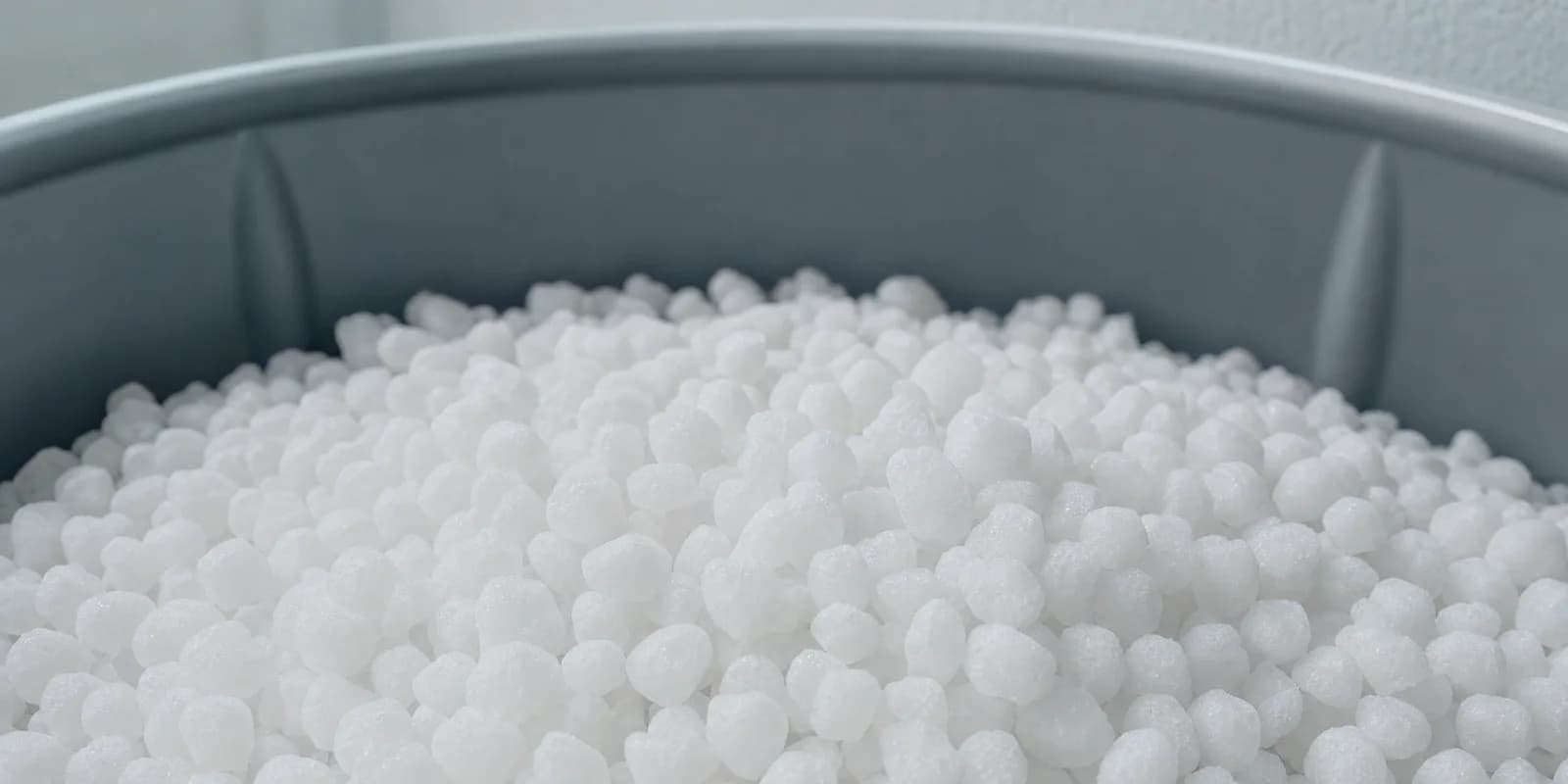
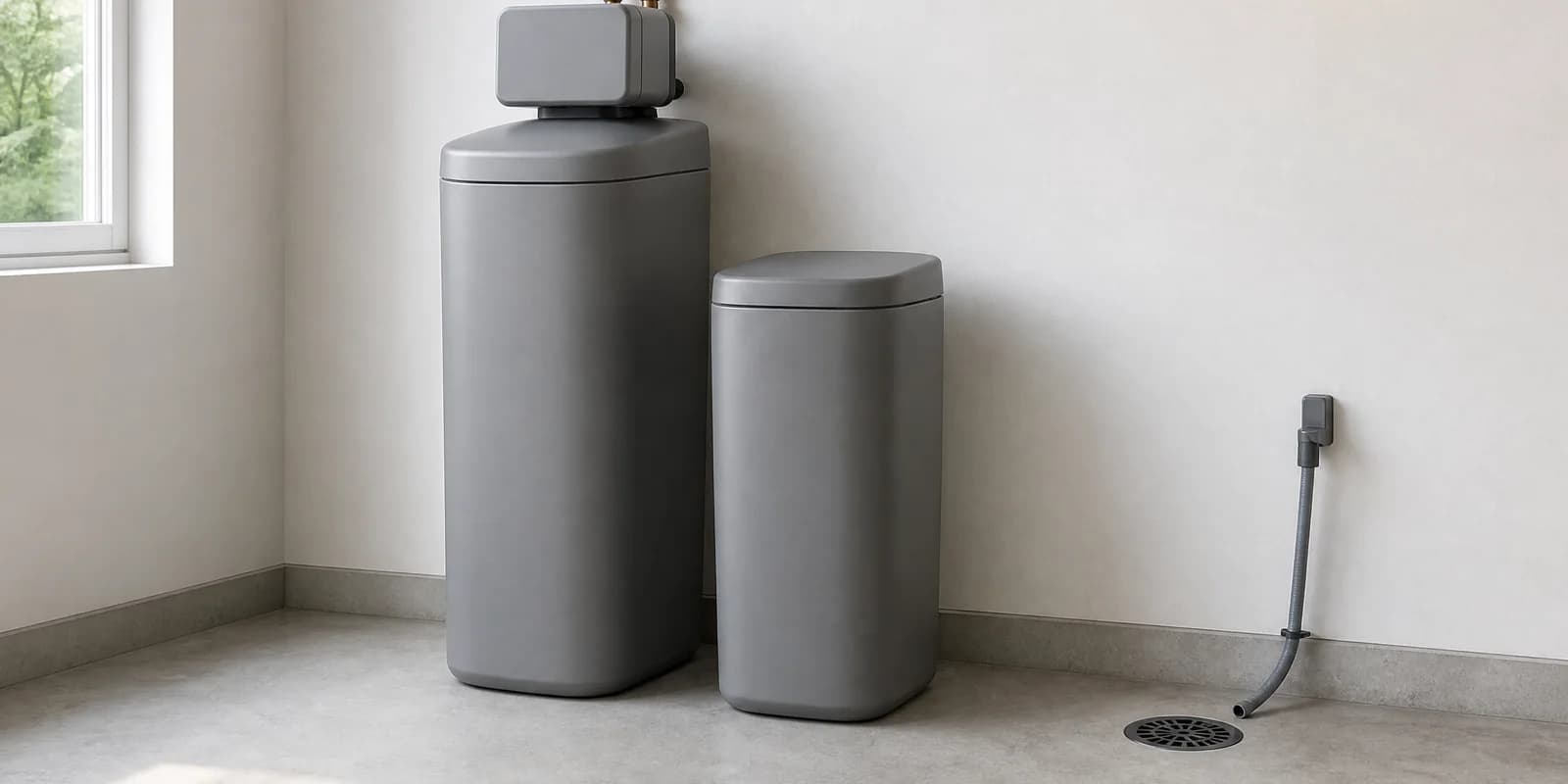
Two-tank means one resin tank carrying the controller and one brine tank, not a duplex or standby arrangement; the manual's table is headed "Two-Tank Models"[8]. For the R30 the sheet lists a nominal 10 in by 35 in (254 by 889 mm) resin tank, a 47 lb (21.3 kg) stratified resin bed and 300 lb (136 kg) of salt storage[7]. WQA describes strong acid cation resins as exchanging calcium and magnesium for sodium or potassium[10], and EcoWater prints no resin type for this product; how salt dose trades against capacity covers the rest.
The 3700 series also holds the ECR3700 and the ERR refiners, all in one manual (Rev. E, 2017, a third-party-hosted copy)[8]. The sheet has columns R30, R40 and R70[7]; NSF's listing and the manual also list an R50S[2][8]. The suffix is not the product: the manual prints the ERR3702R30 at 8.0 gpm service flow against the ECR3702R30's 11.0[8], so the full model code goes on the quote.
The options are the model, HydroLink Plus Wi-Fi monitoring or the HydroLink remote, a battery remote on non-Wi-Fi systems[7][8], Auto adjusting (the default, marked Recommended), sodium or potassium chloride and a 2:00 a.m. default start, with 1 to 15 days allowed between recharges[8]; the reference design takes the R30, sodium chloride, Auto adjusting and the default start, and no document read says which Wi-Fi configuration is sold in Singapore, Malaysia or Indonesia.
EcoWater's sheet says the one-inch riser "ensures that household demand is adequately met"[7], and the manual's warranty states "This warranty applies to consumer-owned installations only."[8] NSF's brochure describes its standard as for "residential cation exchange water softeners"[9], NSF's scope and not the maker's. The sheet's certified flows are 11, 12 and 12 gpm[7]; this article reads them as one dwelling's scale (reasoning, not a maker statement). No document read names a commercial, industrial, membrane or building duty; the one boiler mention is an example in the manual's High capacity setting text, not a duty[8]. NSF's listing, current as of 1 October 2026, lists ECR3702R30, R40, R50S and R70 under NSF/ANSI 44[2], which says nothing about the buyer's water.
The duty is one detached house on a pressurised private supply, with the bore or well pump and pressure tank outside the design. [ASSUMPTION: the duty where every printed input and limit applies; valid for one house and one unit, invalid for a building, several dwellings or any commercial use.] No document read says private supplies are common in those markets.
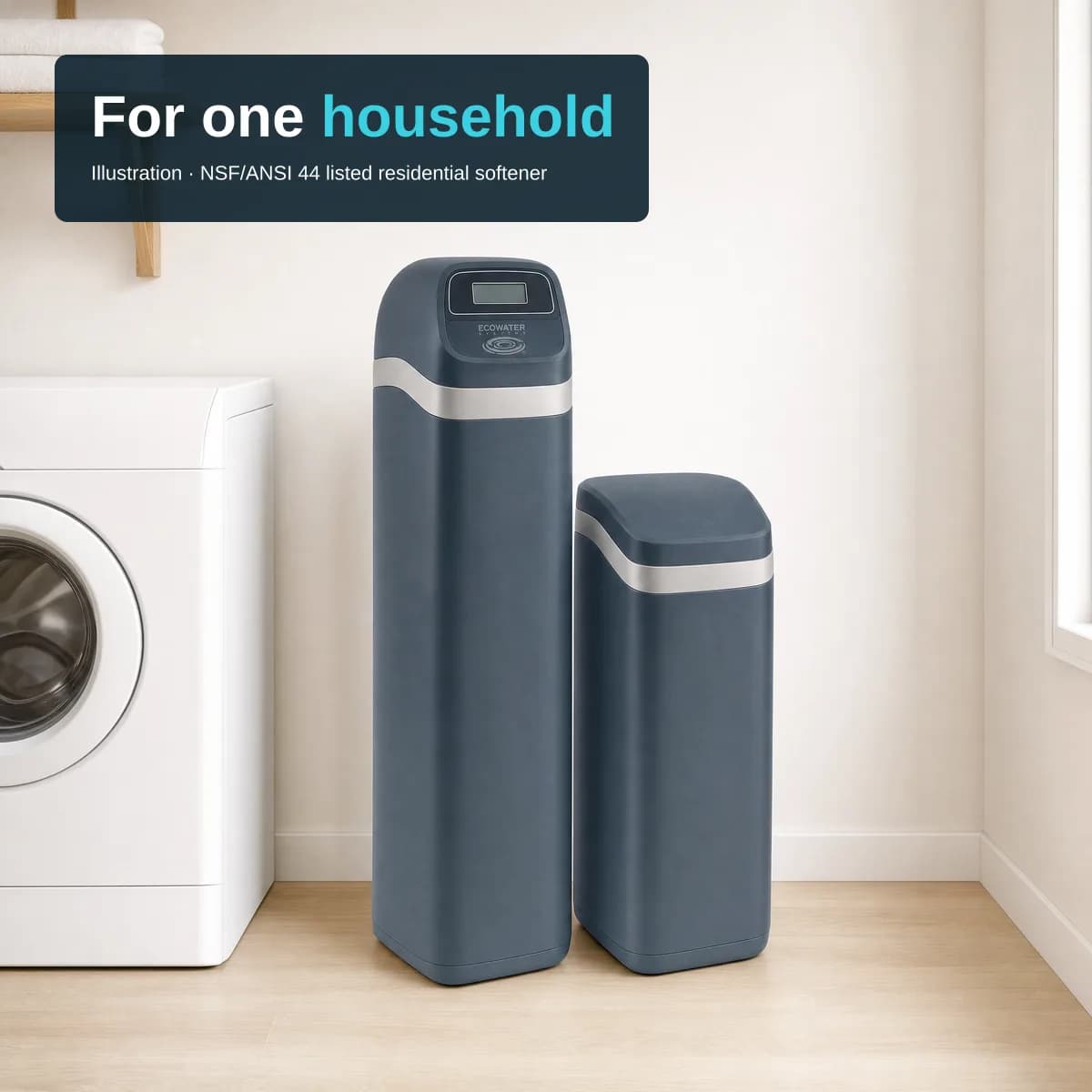
EcoWater ECR3702 Series
Hardness load sets the targets, not flow
In the EcoWater ECR3702R30 reference design for one house (the R30 house design), the targets would follow the grains of hardness and iron the house adds each day, because three models share an 11 to 12 gpm certified flow and the printed maximum hardness carries no stated basis[7].
Choosing by certified flow misses, because the sheet prints 11, 12 and 12 gpm for the R30, R40 and R70[7]. The maker's evidence for that flow is a test: "These softeners have been proven to deliver soft water for at least ten continuous minutes at the rated service flow rate."[8] At 11 gpm that is 110 gal (416 L). The documents state no longer duration, and neither limits the rating to ten minutes: the manual bars a sustained flow above the listed rating[8], and the sheet says continuous operation above the certified flow may affect capacity and efficiency[7].
[ASSUMPTION: one detached house; hardness 20 grains per gallon (gpg), or 342 mg/L as CaCO3 at 17.1 mg/L per gpg[10]; clear water iron 1 ppm; use 200 gal (757 L) a day; a peak of 9 gpm (34.1 L/min); a lowest dynamic inlet pressure of 35 psi (2.41 bar); no disinfectant in the water; hardness and iron sit inside the R30's printed 60 gpg and 12 ppm maximums[7]; the owner's measurements replace all.] The 200 gal sits inside 104 to 244 gal a day, derived here from Penn State Extension's US per-use figures[4] (25 to 60 gal a bath or shower plus 1 gal a person, for [ASSUMPTION: four occupants, one bath or shower each a day]: 4 × 25 + 4 and 4 × 60 + 4), a floor for a house because laundry, toilets and garden are excluded. No private-supply hardness or iron figure for the three markets was retrieved.
The four targets, each with its check:
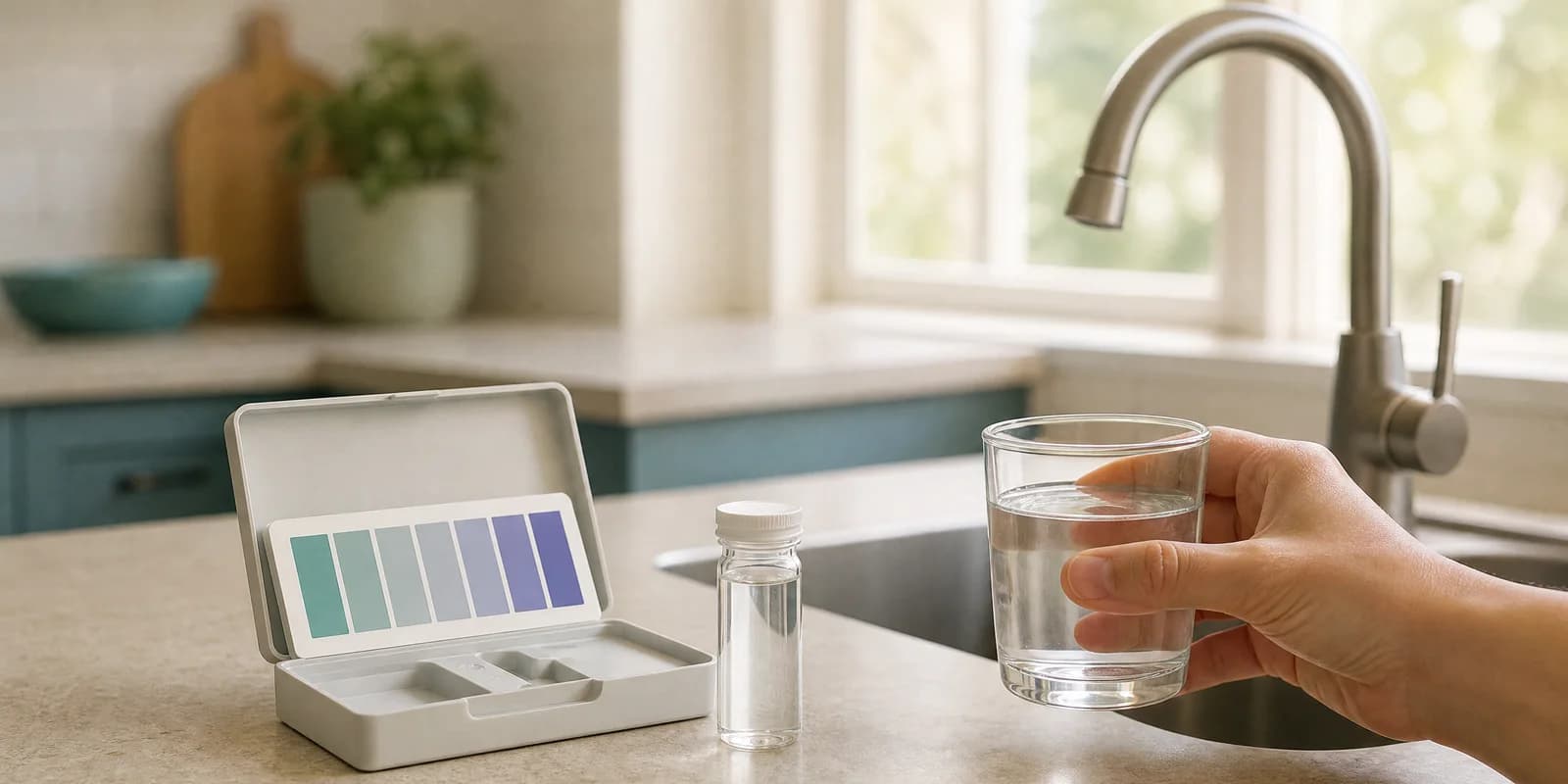
- Hardness: conditioned hardness below 1 gpg (17.1 mg/L as CaCO3), by hardness test kit on raw and conditioned cold-water samples taken together with the bypass in the service position, not during a recharge, after the start-up flush. The line is WQA's typical softening target[10], this article's pass line, not an EcoWater guarantee.
- Interval: NSF's listing pairs 1,000 grains with 64.8 g[2], so a grain is 64.8 mg. The manual gives "3 grains per ppm of clear water iron"[8], so 1 ppm adds 3 gpg and the load is 20 + 3 = 23 gpg [ASSUMPTION: the control adds that conversion, which the manual does not publish as a formula; valid if EcoWater confirms; conservative]. Then 200 gal × 23 gpg = 4,600 grains a day, and Auto adjusting targets a 3 to 4 day interval[8], so each recharge would need 13,800 to 18,400 grains; without iron the load is 4,000 grains a day and the model choice is unchanged. The check is the Last recharge and Total recharges screens over several weeks; the method is a fit check, not a prediction.
- Flow and pressure: the 9 gpm peak sits above the 3 gpm the supply must deliver[8], below the R30's 11 gpm certified flow[7]. From 35 psi, the R30's printed 8 psi pressure drop at its 11 gpm certified flow[8] leaves 27 psi (1.86 bar) at the unit's outlet, before house piping and fixtures.
- Iron: clear water iron, read here as ferrous iron, which the Minnesota Department of Health describes as clear at the tap and red or brown after standing[5]; red iron clogs resin[4] and is outside the design. The sheet prints 12 ppm as the R30's maximum[7], and the manual's footnote says "Capacity to remove clear water iron is substantiated by independent laboratory test data."[8] Neither prints the test conditions or the iron level tested, and no pass level for iron in conditioned water is printed, so the check is an iron test kit the owner names.
One R30 would fit, pending the supply
The EcoWater ECR3702R30 reference design for one house would put one ECR3702R30 at the house's point of entry behind a bypass and ahead of the water heater, because the R30's printed capacities bracket the maker's 3 to 4 day recharge target at 23 gpg and 200 gal a day, and nothing stands behind it; fit on supply voltage is open.
The manual says "ALWAYS INSTALL either an EcoWater Systems bypass valve"[8] or a 3-valve bypass, and the maker's valve is not included with the unit[8]. The drain needs a 1.5 in (38 mm) minimum air gap and a 1/2 in I.D. hose, raised no higher than 8 ft (2.4 m), or 14 ft (4.3 m) when inlet pressure exceeds 50 psi[8]. The unit needs a grounded, continuously live 120 V outlet[8]. How a household softener is selected and quoted weighs alternative tie-ins.
A dose is the pounds of salt used in one recharge. Dividing the manual's printed capacities by 4,600 grains a day gives days between recharges at each model's three printed doses (derived here)[8].
| Model | Smallest dose | Middle dose | Largest dose |
|---|---|---|---|
| R30 | 8,100 grains at 1.6 lb, 1.76 days | 20,100 at 6.3 lb, 4.37 days | 27,100 at 11.0 lb, 5.89 days |
| R40 | 10,900 at 2.2 lb, 2.37 days | 27,000 at 8.5 lb, 5.87 days | 36,300 at 14.8 lb, 7.89 days |
| R70 | 32,900 at 6.2 lb, 7.15 days | 57,600 at 12.8 lb, 12.52 days | 71,500 at 25.6 lb, 15.54 days |
The 13,800 to 18,400 grain target sits inside the R30's span of 8,100 to 27,100 grains and the R40's. The R70's smallest printed capacity, 32,900 grains, is 1.79 times the four-day load (32,900 ÷ 18,400): even at its smallest dose it would recharge about every 7.15 days against the maker's 3 to 4 day target, so this article's fit rule (the target must lie inside a model's printed span) eliminates it; no published limit does. The R40 stays as an alternative at a stated cost: a 13 psi printed pressure drop against 8[8], 65% against 40% of the printed 20 psi minimum supply pressure, for 1 gpm more flow.
At 9 gpm the margin is (11 − 9) ÷ 11 = 18.2% on the R30 and (12 − 9) ÷ 12 = 25.0% on the R40 and R70; the 9 gpm basis equals no rating, so it does not show the R30 suffices. The printed windows are 20 to 125 psi (1.38 to 8.62 bar), and 40 to 120 °F (4 to 49 °C)[7], with a 3 gpm minimum inlet flow[8]. No document read prints a minimum service flow or turndown. The maker's two documents disagree. The sheet (Rev. B, 02/17) prints R30 efficiency 5160 grains per pound at the minimum dose and 30,200 grains at the maximum dose, R40 5150 and 40,100[7]; the manual (Rev. E, 2017) prints 5,030 at the minimum dose for both, with 27,100 and 36,300 at the maximum[8]; the R70 agrees. The design basis is the manual's lower figures, which hold on the sheet's (R30 6.57 days, R40 8.72): a design basis, not a ruling.
One unit means hard water reaches the house during a recharge. The manual describes the bypass output as active "when the conditioner’s valve is in bypass and hard water is going to the house"[8]. Hot water drawn during a recharge refills the heater with hard water, and after installation the heater holds hard water for a few days of use unless drained after the second, sanitising recharge, so the first hot-water sample is not a test[8]. Salt used up before refill, a bypass left in bypass or a clogged nozzle also give hard water[8], and a second unit would share the owner omissions (reasoning).
What leaves is about 38 gal (144 L) per recharge at 35 psi on the sheet's basis, dose unstated[7]; the manual's 4.5 gal per 1,000 grains gives 62 to 83 gal at this design's 13,800 to 18,400 grains (derived)[8], at up to 3.0 gpm (11.4 L/min)[8]. The brine's chloride cannot be quantified from any document read, the destination is the owner's decision, and no discharge rule for the three markets was retrieved.
Acceptance would test the water, not the screen
In the EcoWater ECR3702R30 reference design for one house, the controller would count gallons and compute the capacity left from the hardness and iron entered at setup, so acceptance would rest on the owner's tests at a cold tap, not on the screen.
Online, the controller counts gallons from a turbine meter and shows Water available, Current water flow, Last recharge and Total recharges; it also senses salt level, which drives a low-salt alarm defaulting to 20 days[8]. Water available does not measure the water: by reasoning from the manual's entries, it is computed from entered hardness and iron and gallons counted, and the manual text read describes no hardness or iron sensor. The manual lists a too-low hardness setting among the causes of hard water[8], so a stale entry is a cause to check.
The R30 house design enters hardness (20 gpg) and iron (1 ppm) and leaves the maker's defaults: Auto adjusting, a 2:00 a.m. start, the 97% feature off and second backwash off, a commissioning choice the owner revisits if iron appears[8]. The sheet says the demand module captures historical usage patterns to predict needs[7]; how it decides is unpublished, so it is given no reserve or window. Of the second backwash the manual says "Set this feature On if your water supply contains a lot of sediment or iron."[8] and prints no threshold. The manual read does not describe what the control does at the 15-day maximum between recharges[8].
An unchanged conductivity reading is no test: ions are exchanged, not removed[10], as how salt dose trades against capacity explains.
On power loss the manual says settings such as hardness are retained, but if the time is lost the Current Time screen appears and the owner resets it; until then a 2:00 a.m. start follows a wrong clock (reasoning)[8]. The valve's state if power fails mid-cycle is not stated in the pages read, so it is a quote item. The owner can start Recharge now or use the bypass[8].
The stages follow the manual's start-up[8]; the checks are judgment. The sequence is the pressure test, with the bypass in bypass; setup, entering hardness and iron; a first recharge, with the bypass moved to service once the unit is in backwash; the suggested bleach step into the brinewell with a second recharge; and 50 gal (189 L) through a downstream cold faucet over at least 20 minutes.
Each reading names the ECR3702R30, instrument, sample point, units, state, flow and pressure, as the rule for what a figure must carry sets out. The checks:
- Conditioned hardness below 1 gpg on paired raw and conditioned cold samples, bypass in service, by the owner's kit.
- Pressure drop from two temporary gauges at the inlet and outlet connections, with fixtures opened until Current water flow (accuracy unpublished) reads about 11 gpm, because the R30's printed 8 psi belongs to that flow; pass is a drop no larger than 8 psi, an engineering-judgment method. If fixtures and hose taps cannot reach about 11 gpm, or at the 9 gpm peak where a lower drop is expected, the drop is recorded, not passed.
- Entered hardness and iron equal to the measured values, and Last recharge and Total recharges inside the 3 to 4 day target over several weeks.
- Iron from the owner's kit, with resin cleaning every six months or sooner if iron appears[8].
The supply voltage keeps it provisional
The first risk in the EcoWater ECR3702R30 reference design for one house is the central gap: EcoWater's documents print a 120 V input, and no document read states any configuration for a 230 V, 50 Hz supply.
The sheet prints "120V, 50/60Hz" with a 24 V DC supply included[7], and the manual says to "plug it into a nominal 120V, 60 Hz household outlet"[8]. SP Group states Singapore's low-voltage supply as "230V, single-phase"[12] at 50 Hz, and Wikipedia, a tertiary source, lists Malaysia and Indonesia at 230/400 V and 50 Hz[6]. No document read documents a 230 V variant, adaptor or transformer; the answer waits for EcoWater's written statement of the electrical configuration for the exact order and the location's mains, and is not this product for that location if the reply names none.
Water safety is the maker's exclusion and the owner's decision: "This system is not intended to be used for treating water that is microbiologically unsafe or of unknown quality without adequate disinfection before or after the system."[8] The reference design specifies no disinfection method, dose or position. NSF's listing covers hardness reduction, efficiency, and barium and radium 226/228 reduction[2], so it does not say the water is safe.
If the R30 house design were ordered, the owner would hold disinfection, the entered hardness and iron, the salt, the bypass position (a bypass left in bypass is returned to service), the drain destination and the outlet. If the well's hardness moves, the entered value is stale: re-test and re-enter. A long draw is a capacity draw: one hour at 9 gpm is 540 gal, 12,420 grains at 23 gpg, more than the R30's smallest printed capacity of 8,100; the manual describes a manual recharge for unusually high use[8]. If salt runs out the water is hard: the low-salt alarm is the trigger, the owner adds salt, and the manual recommends no more than half a brine tank[8], about 150 lb of the sheet's 300 lb[7] (derived).
A staged commissioning trial could be stopped without rework: EcoWater's written supply statement comes first, then a dry fit, start-up and the recharges, the hardness and pressure checks, and weeks of recharge counts. The unit, bypass, drain run and outlet would be bought before the dry fit; stopping before start-up would leave the house's water unchanged.
The R30 house design would fit one house, one unit, a supply inside the printed 20 to 125 psi and 40 to 120 °F windows with water the owner has made safe, hardness and iron inside the printed maximums (60 gpg and 12 ppm), a peak below 11 gpm and a confirmed supply. A peak above 11 gpm is a sizing outcome that moves the choice to the R40, which serves to 12 gpm; the R70 stays out at this load. It stops at a peak above 12 gpm, where no sheet model serves and the R50S is a quote alternative[2]; at hardness or iron above the printed maximum; at a chlorine-reduction, boiler, membrane, commercial or building duty; and at a negative supply reply. It does not mean the water is safe, that the unit recharges every 3 to 4 days, that Wi-Fi alerts protect the house, or that EcoWater supports it in the three markets.
Send measured hardness and iron (units, sample point, clear or red), pressure range, peak and daily use, supply type and disinfection, water temperature, drain destination and the outlet's voltage and frequency. Through the quote request, ask EcoWater for the exact model code, the electrical configuration, the manual revision and which document holds the R30 and R40 ratings, the thread standard, chlorine and chloramine tolerance, the valve's state if power fails mid-cycle, Wi-Fi availability and display language (Rev. E's setup figure shows English, Spanish and French and its setting text lists 18 languages, none of them Malay, Indonesian or Chinese)[8] and whether the quoting party is an authorised channel for the product in the buyer's market. No document cited here names an ASEAN dealer, service or stock. Request a quote for the EcoWater ECR3702R30 with the data pack above; Purionex would pass on whatever answers it receives.
Sources
- [1]EcoWater - water softeners and refiners product pages, US site, condensed extraction (web product label only)
- [2]NSF International - certified-products listing for EcoWater Systems LLC under NSF/ANSI 44, current as of 1 October 2026
- [3]EcoWater - explainer on softening, conditioning and filtering, condensed extraction (meaning of conditioning)
- [4]Penn State Extension - Water Softening, updated 8 September 2025, US extension guidance, condensed extraction (per-use water figures, red iron)
- [5]Minnesota Department of Health - iron in well water, US state health agency, condensed extraction (ferrous iron)
- [6]Wikipedia - Mains electricity by country, tertiary source (Malaysia and Indonesia supply voltage and frequency)
- [7]EcoWater Systems LLC - ECR3702 spec sheet 0602927, Rev. B 02/17, primary product datasheet
- [8]EcoWater Systems LLC - owner's manual 7365150, Rev. E 11/3/17, series 3700 and 3702, third-party-hosted copy (labelled fallback)
- [9]NSF International - Technical Requirements of NSF/ANSI 44, undated brochure (scope of the standard, not the standard text)
- [10]Water Quality Association - Ion Exchange technical fact sheet, 2013, trade association (secondary)
- [11]Water Quality Association - certified-product lookup for EcoWater ECR3702, run 1 October 2026 (product type only)
- [12]SP Group - How to Apply For Electricity Connection, January 2026, Singapore utility handbook (supply voltage and frequency)