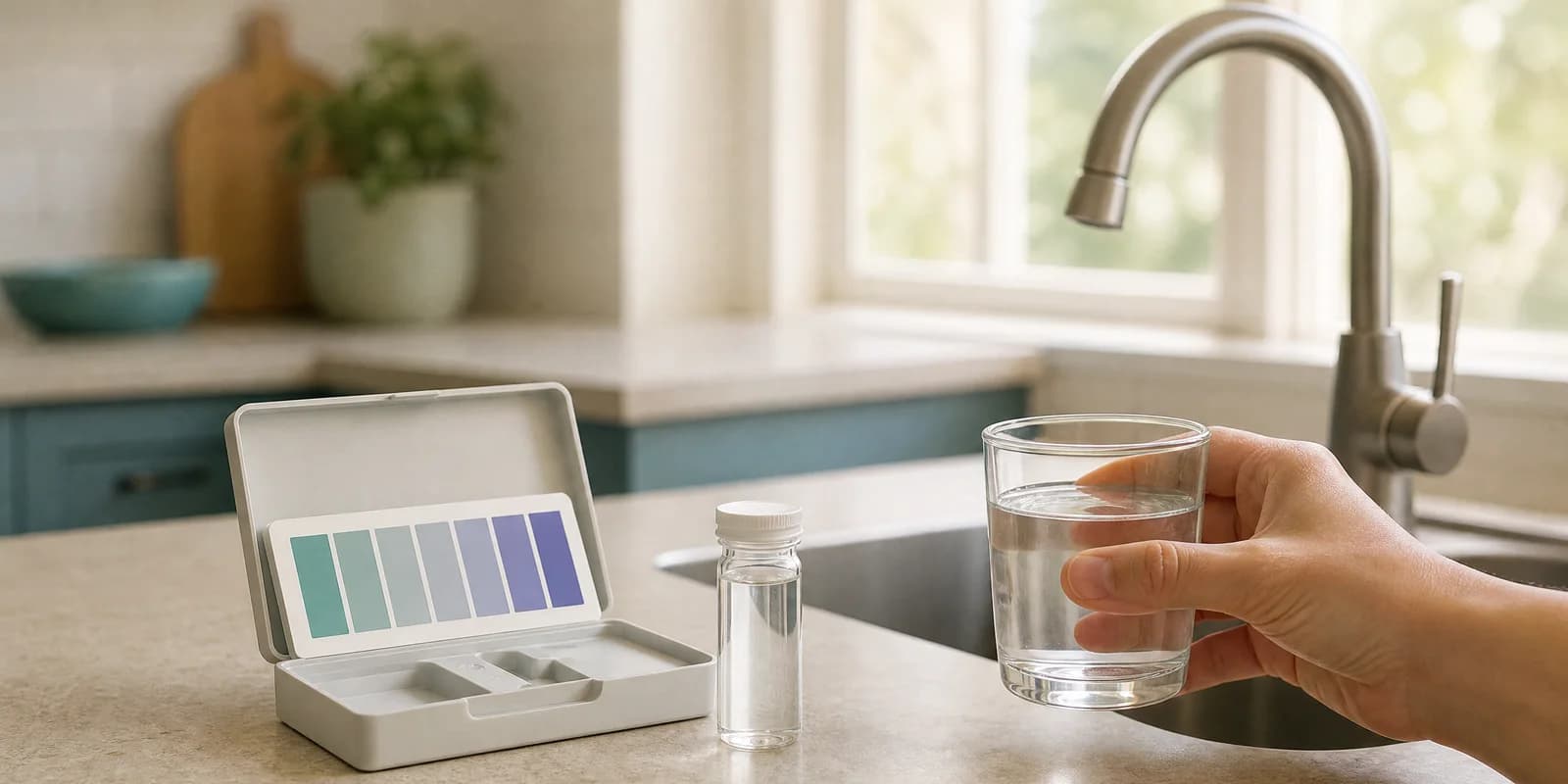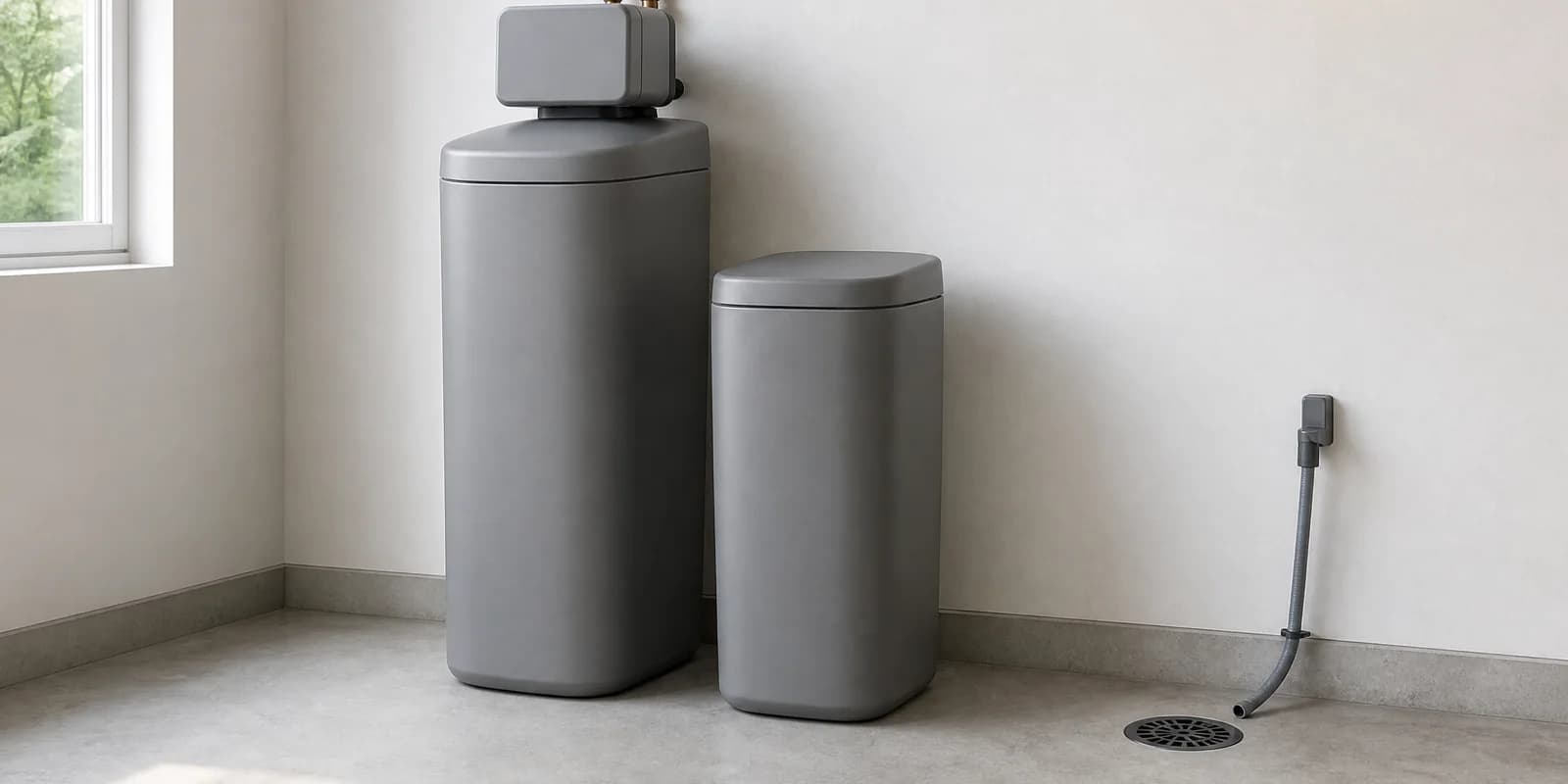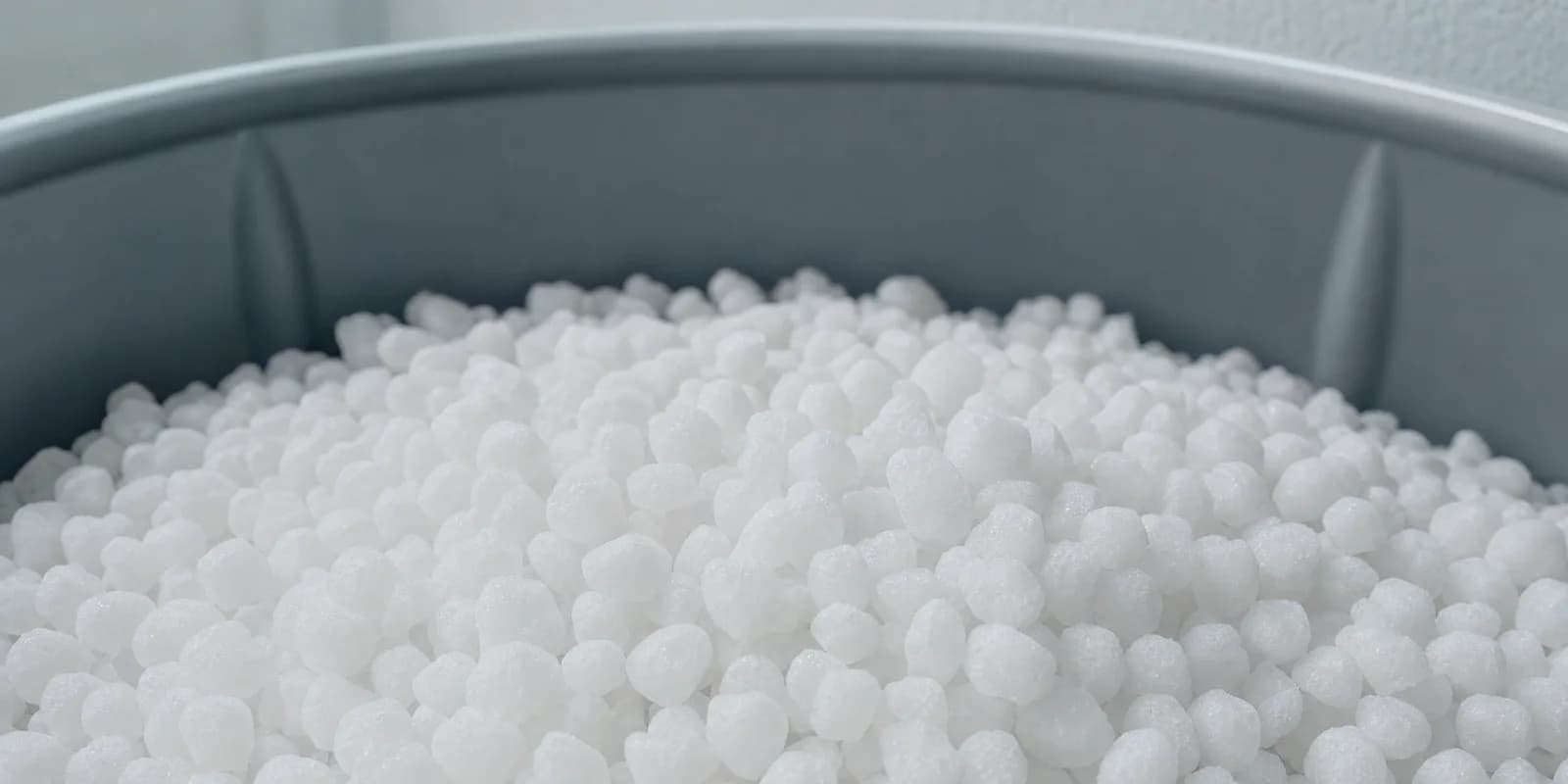
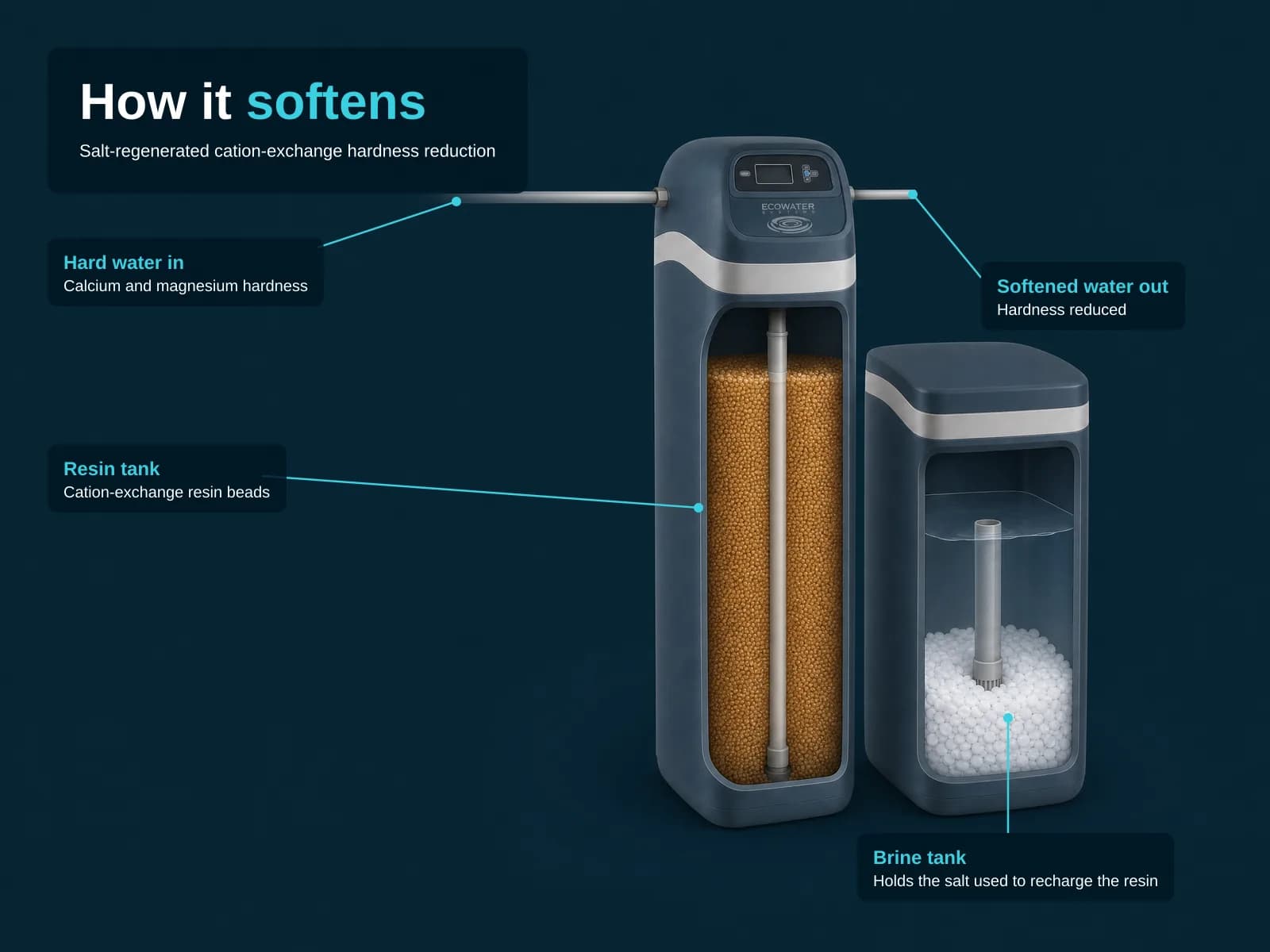
A salt-regenerated softener such as the EcoWater ECR3702 Series (a resin tank carrying the controller, plus a brine tank)[6] swaps calcium and magnesium for sodium or potassium on a resin and restores it with salt.[8] The result that shows it working is a hardness test on the conditioned water, not a change in dissolved solids; the Water Quality Association (WQA) fact sheet of 2013 names under 1 grain per gallon (17.1 mg/L) as the typical target.[8]
The sheet says: "One-inch diameter for increased flow rates, which ensures that household demand is adequately met."[5] It lists layered resin, quartz underbedding and a demand module.[5]
The misreading is to read the ECR3702R70's printed efficiency, 5,310 grains of hardness per pound of salt, as what the unit delivers at its printed capacity of 71,500 grains. The sheet (Rev. B 02/17) and the manual (Rev. E 11/3/17, a third-party-hosted copy) agree on the R70's efficiency, capacity, certified flow and drop, so the R70 carries the argument;[5][6] dose here means pounds of salt used in one recharge. The article asks what sets capacity, what the efficiency describes, what a listing covers and what to measure, and answers that a quoted capacity needs its dose, a listing covers ratings and not a supply, and the proof is a paired hardness test. Sizing sits in the selection guide, the applied duty in the reference design.
More regeneration salt buys more capacity
A salt-regenerated softener is restored with salt, and the manual's three printed dose and capacity pairs for the ECR3702R70 (32,900 grains at 6.2 lb, 57,600 at 12.8 lb and 71,500 at 25.6 lb) show capacity rising with the salt used in each recharge.[6] EcoWater does not publish this product's resin type in the documents read, so the mechanism is WQA's general 2013 account: "This resin is commonly used for softening and is regenerated with salt (sodium or potassium chloride)."[8] Capacity therefore depends on how fully a recharge restores the resin, which the dose sets (reasoning). A water-treatment chemicals supplier's 2019 blog states the same direction, though its worked example is not this unit's dose.[4]
The return falls as the dose rises. WQA says "Typically, resins have a higher selectivity for multiply charged ions than for singly charged ions",[8] and this article's reading, which neither WQA nor EcoWater states about this unit, is that restoring the resin toward sodium takes more salt for each further grain. That fits the direction of the return, not its size.
More salt buys more capacity, with a falling return, and the manual's High capacity text names the cost: "This setting will consume higher quantities of salt."[6] The manual prints three points per model,[6] and no document read gives a capacity below the smallest or above the largest printed dose, says which dose the control uses at a recharge, or describes a point where more salt stops adding capacity.
Two readings prove less than they seem. WQA states: "Softeners do not reduce the total dissolved solids (TDS) or dissolved mineral content of water."[8] Ions are swapped, not removed, so an unchanged TDS or conductivity reading (reasoning) cannot tell a working unit from a failed one; the check is a hardness test. And the sheet's title word water conditioner is not the salt-free conditioning of EcoWater's explainer;[2] the manual describes salt regeneration.[6]
Efficiency is rated at the smallest salt dose
For the ECR3702R70 the sheet prints 5310 grains per pound at 6.2 lb, the smallest dose.[5] The manual states: "The efficiency rating is valid only at the minimum salt dose and the service flow rate."[6] The figure is one point of a three-row table, not the unit's output at 71,500 grains. The manual ties the 3,350 grains per pound floor to sodium chloride, so this article reads the 5,310 as a sodium chloride rating and potassium chloride as outside it (reasoning).[6]
The certified flow of 12 gpm at 11 psi, which the manual prints as the R70's service flow rate, has this evidence: "These softeners have been proven to deliver soft water for at least ten continuous minutes at the rated service flow rate."[6] That is at least 120 gallons (454 L). The manual bars operating at "a sustained maximum service flow rate greater than their listed rating",[6] and the sheet says continuous operation above the certified flow may affect capacity and efficiency.[5] Neither document limits the rating to ten minutes or states a longer test, so a ten-minute proof is not evidence of any other duration; the 11 psi drop is printed at that flow only.
Derived here from the manual's R70 rows, efficiency is capacity ÷ dose:
| Dose (lb) | Capacity (grains) | Grains per lb | Salt per 1,000 grains (lb) | Recharges per million grains |
|---|---|---|---|---|
| 6.2 | 32,900 | 5,306.5 | 0.188 | 30.4 |
| 12.8 | 57,600 | 4,500.0 | 0.222 | 17.4 |
| 25.6 | 71,500 | 2,793.0 | 0.358 | 14.0 |
Capacity rises 71,500 ÷ 32,900 = 2.17 times while salt rises 25.6 ÷ 6.2 = 4.13 times, so the per-pound figure falls 47.4%. The R50S falls the same way, from 4,800.0 to 2,873.6 (manual rows only). On the manual's R30 and R40 rows the printed efficiency differs from capacity ÷ dose by up to 1.5%, so the quotient is a check, not the rating.[6]
The last two columns are 1,000 ÷ grains per lb and 1,000,000 ÷ capacity, each recharge taken at its full printed capacity, and form a coupled pair. From the smallest to the largest dose, salt per 1,000 grains rises 1.90 times while recharges per million grains fall from 30.4 to 14.0, so the smallest dose recharges 2.17 times as often. A low dose costs recharges, each an interval (duration unpublished) when a single unit supplies hard water to the house,[6] and a high dose costs salt. The manual's 2.9 gallons per 1,000 grains and the sheet's 104 gallons name no dose, and no other dose is printed.[6][5]
The R70 gains 3,742 grains per added pound from 6.2 to 12.8 lb (24,700 ÷ 6.6) and 1,086 from 12.8 to 25.6 lb (13,900 ÷ 12.8): interval averages, not a curve. The manual's rows for the other three models fall the same way.[6] The manual's Salt efficient setting "limits available salt doses to maintain 4000 grains/lb. of salt efficiency"[6] and California units must use it. [ASSUMPTION: the setting's salt efficiency is capacity ÷ dose on the printed basis, for the R30, R40 and R50S as well as the R70; valid if EcoWater confirms that definition, invalid otherwise.] On that basis the R70's middle row (4,500.0) is above 4,000 and its largest (2,793.0) below, so its largest printed dose is not a Salt efficient dose, while the other three models' middle doses are already below 4,000 (manual rows only); the crossing is not printed. The High capacity text adds "Such applications include water for boilers."[6] That is setting text, not a boiler duty, and WQA says higher-pressure boilers may need demineralized water, which a softener does not make.[8]
The controller counts gallons with a turbine meter, is told hardness and iron at setup, reads the salt level and holds a salt dose figure for its out-of-salt estimate.[6] It starts recharges at 2:00 a.m. by default, within a 1 to 15 day maximum, at 97% of capacity used if that feature is on, or manually; in Auto adjusting, the default, "It automatically adjusts salt doses to target a 3-4 day interval between recharges."[6] No sensor for hardness or iron in the water supplied to the house is described in the sheet or the manual text searched, so no raw-water change is described as reaching the control; the Water available screen can only reflect the entries and gallons counted (reasoning), and no screen on the manual's system-information or diagnostics lists shows the dose behind a recharge. The sheet says of the demand module: "Sophisticated, yet easy-to-use electronics capture historical usage patterns to predict future needs for precise regenerations."[5] No document read states how it decides, its reserve, window or horizon.
The sheet says more clear water iron can reduce efficiency and prints iron maximums of 12, 15 and 15 ppm for the R30, R40 and R70; the manual's footnote says capacity to remove clear water iron is substantiated by independent laboratory test data, with no conditions printed.[5][6] The hardness maximums of 60, 75 and 125 gpg have no stated basis, and no document read states whether both limits apply together. Potassium chloride lengthens fill time 25% and brine and slow rinse times 12%.[6]
A listing covers the ratings, not your water
NSF's listing, current as of 1 October 2026, lists ECR3702R30, R40, R50S and R70 under NSF/ANSI 44 with the claims Hardness Reduction, Efficiency Rated, and Barium and Radium 226/228 Reduction.[1] Efficiency Rated means at least 3,350 grains per pound and at most 5 gallons of regenerant water per 1,000 grains; Hardness Reduction means "the published capacity ratings for reducing hardness have been verified"[1]. Its footnotes (NSF/ANSI 372; California efficiency-rating requirements)[1] are not assessed here, and residential comes from NSF's undated brochure, "residential cation exchange water softeners",[7] not the listing.
Efficiency Rated sets a floor at the rated point, not operating efficiency. The R70's 5,310 is 58.5% above 3,350 and the R50S's 4,800, the lowest of the four ECR3702 models in the manual, 43.3% above.[6] The manual says the tests represent the maximum possible efficiency and that operational efficiency "is typically less than the rated efficiency"[6].
The maker's two documents disagree on the R30 and R40, the sheet against the manual, and agree on the R70 figures compared, so it carries the figures here.[5][6] The listing prints no capacity for any model, so it cannot show which document's R30 or R40 figure Hardness Reduction verified.[1] WQA's lookup, run 1 October 2026, lists the four models under CSA B483.1 in the category Canadian Certifications with no reduction claims; it returned no NSF/ANSI 44 entry, a result of one keyword query, not of what WQA holds.[9] The manual's cover says WQA tested and certified the systems against CSA B483.1: the maker's statement, while the lookup is the independent record.[6]
A 2013 trade-press report on a 2013-era edition of the standard, whose text was not read, says capacity is tested on 20 gpg water at half the rated service flow to one grain of breakthrough.[3] Rated capacity is a laboratory number: the manual says "While testing was performed under standard laboratory conditions, actual performance of the system may vary based on local water conditions."[6] No field record and no independent laboratory report on this unit was retrieved.
One signal is ambiguous: recharges come more often than the manual's 3 to 4 day target. Candidates are the Salt efficient setting, an entered hardness or iron level above the real one (reasoning: the control works on its entries, so a higher entry uses up the stated capacity sooner), heavier use, the 97% setting, a low maximum-days setting or a manual recharge.[6] Intermittently hard water has five manual causes, among them a hardness setting too low, hot water drawn during a recharge and a real rise in hardness.[6] The check is to read the mode and settings, test the raw water against the entries, and read Daily average water used, Total recharges and Last recharge.[6]
Prove softening with paired hardness tests
By this article's rule, a hardness result is reproducible only when a raw and a conditioned cold-water sample are taken together, in service and not during a recharge, after the maker's start-up flush (50 gallons through a cold faucet, at least 20 minutes),[6] in named units and with a kit the buyer names. The pass line, under 1 gpg (17.1 mg/L), is WQA's typical target, not a maker guarantee.[8] A hot tap is not a sample point in the first days, because the water heater fills hard.[6]
A printed efficiency carries over only with the minimum dose, the service flow and, by this article's reading, sodium chloride, and a printed capacity only with its dose, which no screen on the manual's system-information or diagnostics lists (Rev. E) shows.[6] On site, Total water used since a reset, divided by the rise in Total recharges over the same period, gives gallons per recharge; times the measured effective hardness (raw hardness plus 3 grains per ppm of clear water iron), it gives grains per recharge.[6] [ASSUMPTION: an illustrative 20 gpg, and that the control adds the iron term to the hardness; valid for arithmetic only, invalid as a regional value, and for iron only if EcoWater confirms it.] At 20 gpg the R70's printed 32,900 and 71,500 grains are 1,645 gallons (6,226 L) and 3,575 gallons (13,531 L). A cycle above the largest printed capacity points (reasoning) to an entered hardness below the measured one, a meter error or a printed figure that does not hold; a cycle below proves nothing alone, since any reserve is unpublished and modes and manual recharges also start recharges.
The printed drop holds only at its flow, 11 psi for the R70 at its certified 12 gpm, the flow the maker tested for at least ten continuous minutes; checking it needs inlet and outlet pressures and the flow, from the Current water flow screen (accuracy unpublished) or a separate meter.[5][6]
The R70's 5,310 grains per pound holds at the minimum dose, the service flow and, by this article's reading, sodium chloride, not at its largest printed dose (2,793.0). The listing covers four models' named claims, not a house's water, and does not settle which maker figure governs the R30 or R40; fit sits in the selection guide.
Send the measured raw hardness (units, method, sample point, date), clear water iron in ppm, the unit's Daily average water used, peak flow, inlet pressure, salt type, the exact model code and the maker document and revision behind each figure. Agree the dose behind any quoted capacity, the efficiency mode, the hardness test method and pass line, and the dates of the paired tests.
EcoWater ECR3702 Series
Sources
- [1]NSF International — certified-products listing, EcoWater Systems LLC, NSF/ANSI 44 Cation Exchange Water Softeners, current as of 1 October 2026
- [2]EcoWater — resource page, Water Softening vs Conditioning vs Filtering (manufacturer explainer, condensed extraction)
- [3]WC&P Online — Rick Andrew, The Hard Facts about NSF/ANSI 44, 3 February 2013 (trade press about a 2013-era edition of the standard, condensed extraction)
- [4]Solenis — How to Calculate Softener Capacity, 18 June 2019 (water-treatment chemicals supplier blog, condensed extraction)
- [5]EcoWater Systems LLC — ECR3702 spec sheet 0602927 Rev. B 02/17, the authority for the sheet figures
- [6]EcoWater Systems LLC — Owner's manual 7365150 Rev. E 11/3/17, Series 3700 and 3702 (third-party-hosted copy), the authority for the manual figures
- [7]NSF International — Technical Requirements of NSF/ANSI 44, brochure LDW-1045-1119 (undated, not the standard text)
- [8]Water Quality Association — Ion Exchange technical fact sheet (copyright 2013, general guidance)
- [9]Water Quality Association — Find Products lookup, EcoWater Systems LLC, keyword ecr3702, run 1 October 2026