EcoWater prints a maximum water hardness of 60 grains per gallon (gpg) for the ECR3702R30, 75 for the R40 and 125 for the R70, and does not say what that figure is a limit of.[6] The water PUB's plants produced in Singapore in 2025 averaged 2.50 gpg and reached 11.17 gpg at the top of its range,[8] so the smallest of the three ceilings is 5.4 times that top value (60 ÷ 11.17). Within PUB's plant-output range the printed ceiling excludes no water.
The question that decides fit is the hardness this house's tap receives, measured at the tap, against 7 gpg, above which the Minnesota Department of Health says a household might need a softener.[4] This guide adopts 7 gpg as its own screening line, not as a standard.
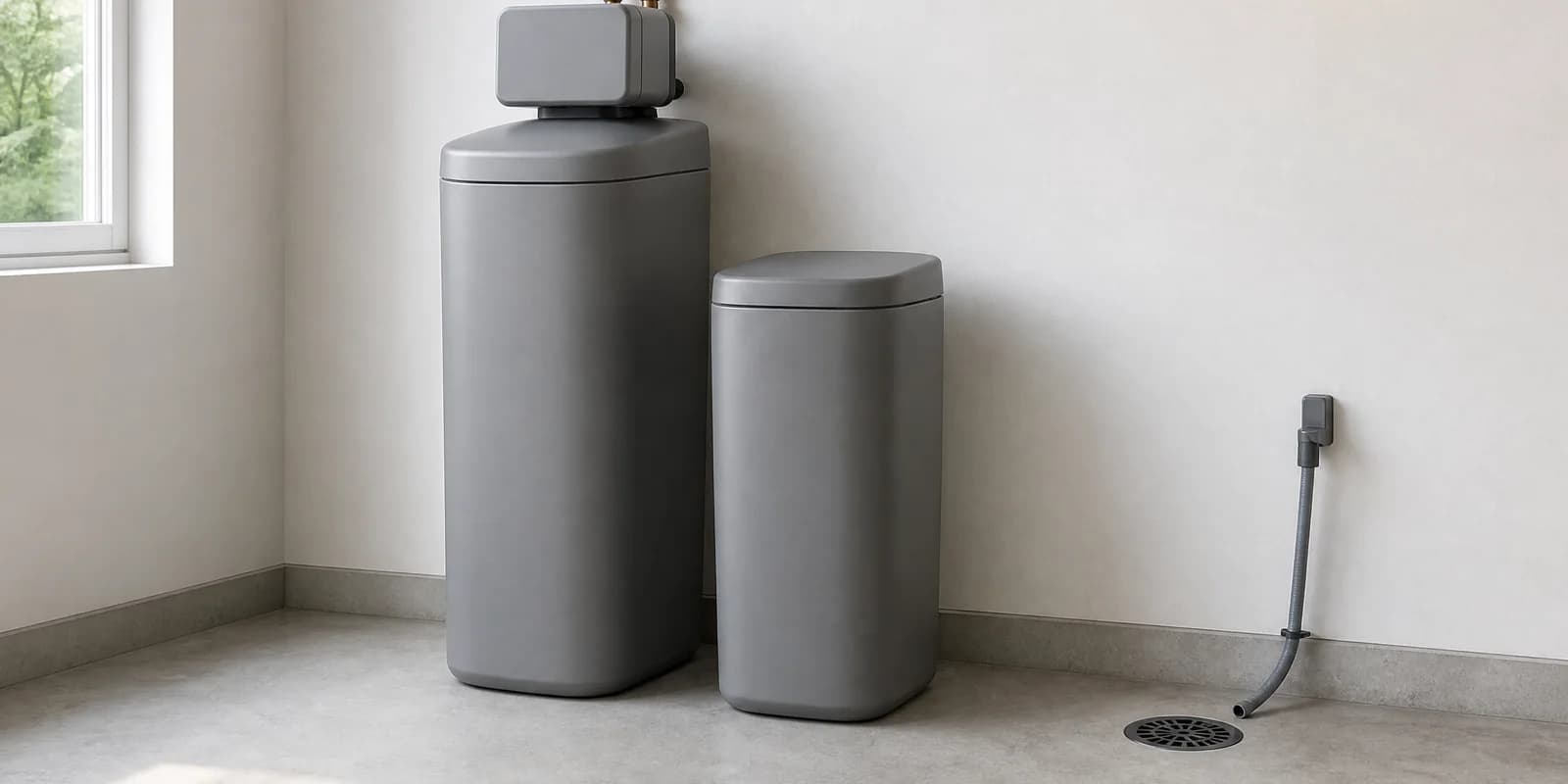
The guide ends in one of three answers: an ECR3702 model (the R30 in the worked run at 11.17 gpg, with an 18.2% flow margin at an illustrative 9 gallons per minute (gpm), if the maker confirms a supply and states chlorine and chloramine tolerance, and the tap measurement replaces the illustrative hardness); another model or treatment first; or not this product, as at 2.50 gpg with no hardness complaint. It covers one house with one EcoWater ECR3702 Series (a two-tank, salt-regenerated cation-exchange water softener)[1][7]; the reference design sets one out in full, and the deep dive explains why a quoted capacity needs its salt dose.
Measure tap hardness before reading any ceiling
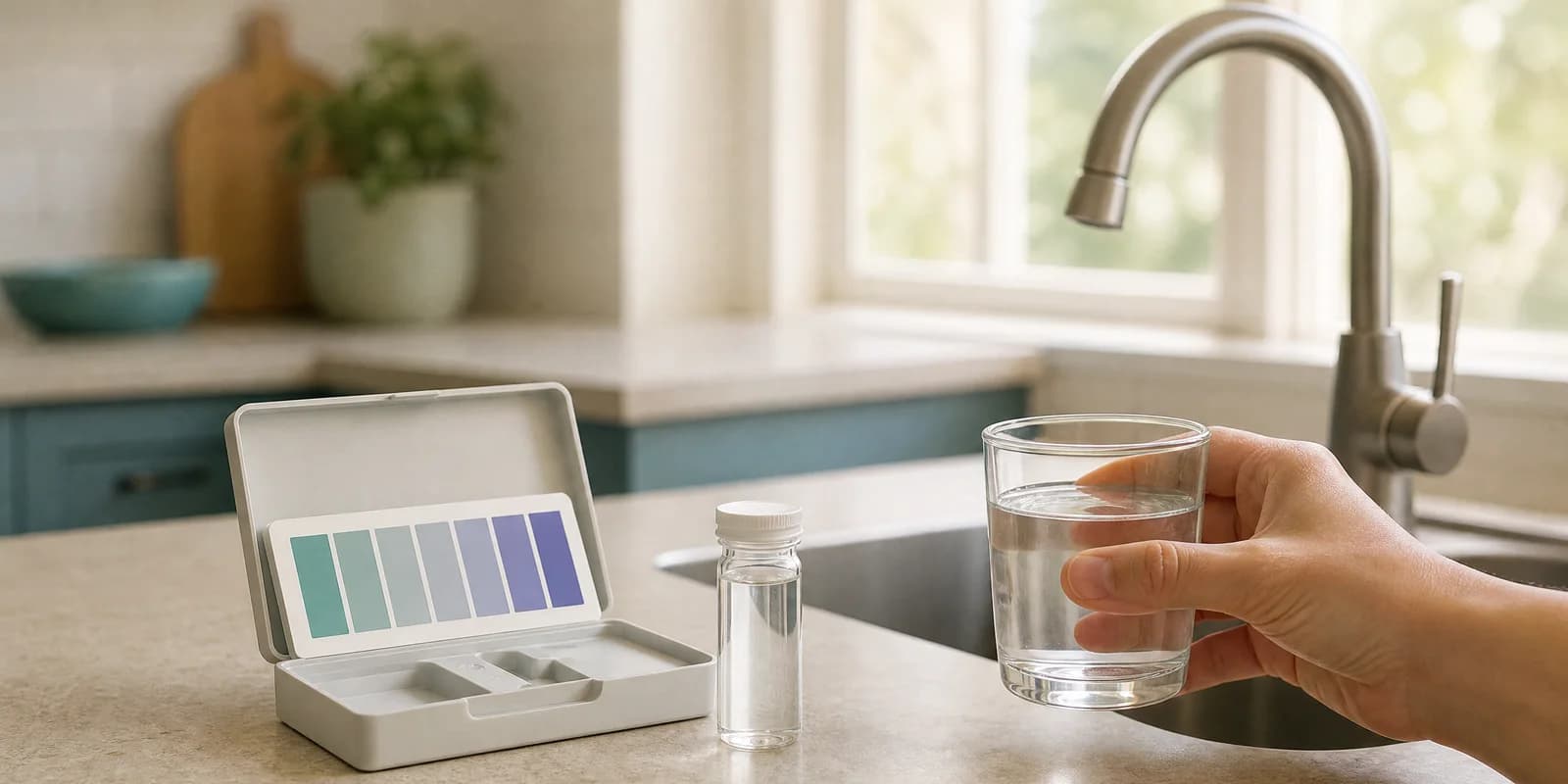
A scale complaint is a symptom, and a hardness test on a cold-tap sample is the check. WQA's 2013 fact sheet says hardness can scale heating coils and boilers and is "safe to consume in drinking water".[9] A TDS or conductivity meter is not that test; the deep dive explains why.
A grain of hardness is 64.8 mg, NSF's own conversion,[1] so 1 gpg is 17.1 mg/L as calcium carbonate (CaCO3; 64.8 mg over 3.785 L per US gallon), and ppm and mg/L as CaCO3 are the same number.[9][3] The US Geological Survey classes soft to 60 mg/L, moderately hard to 120, hard to 180 and very hard above;[2] converted here at 17.1, those limits are 3.5, 7.0 and 10.5 gpg. Minnesota's 7 gpg (120 mg/L) is advice that a household above it might need a softener, and the same page says softening is not required.[4]
Orange staining with low hardness points to iron first (this guide's reasoning). Clear (ferrous) iron leaves the water clear at the tap and turns it red or brown on standing; red (oxidized) iron arrives red or yellow.[4] The sheet's iron limit is for clear water iron only, 12, 15 and 15 ppm for the R30, R40 and R70;[6] red iron clogs resin[3] and is outside it (stop 4). Draw a glass and watch it stand.
The application class is one dwelling, so peak demand outranks daily averages because the lowest flow rating binds first (this guide's reasoning). EcoWater writes of "household demand"[6] and its warranty applies to "consumer-owned installations only".[7] Group the inputs by what they decide: eliminate (water safety, iron form, pressure, temperature), size (tap hardness, iron, daily use, peak demand), fit (supply voltage, drain, bypass). Only the maker can state what the maximums rest on, chlorine and chloramine tolerance and the supply configuration; the rest is measured on site.
PUB's table is plant output, not a tap value: hardness averaged 42.7 mg/L (2.50 gpg) across its waterworks and desalination plants, range 7.24 to 191 mg/L (0.42 to 11.17 gpg), and the table prints no site, timing, sample count or hardness limit.[8] No Malaysian or Indonesian hardness was retrieved. Singapore is soft settles nothing: the sample at the buyer's own tap does, and sizing before it builds the run on plant output.
Peak and daily demand are the buyer's to measure: fixtures running at once, in gpm, and daily use. [ASSUMPTION: 200 gal a day (757 L), 9 gpm (34.1 L/min) and 35 psi at the inlet with a tap running are illustrative for one house; valid for the arithmetic only, each replaced by the measured value; none is a rating.] The unit's own daily-average screen replaces the 200 once it runs.[7]
Flow rating first, then capacity per recharge
EcoWater prints supply pressure of 20 to 125 psi and water of 40 to 120 °F (4 to 49 °C).[6] The manual requires at least 3 gpm at the inlet and says the system is not intended for treating water that is "microbiologically unsafe or of unknown quality without adequate disinfection before or after the system".[7]
| Model | Certified flow, gpm (L/min) at psi drop | Outlet at 35 psi input, psi | Maximum hardness, gpg |
|---|---|---|---|
| ECR3702R30 | 11 (41.6) at 8 | 27 | 60 |
| ECR3702R40 | 12 (45.4) at 13 | 22 | 75 |
| ECR3702R70 | 12 (45.4) at 11 | 24 | 125 |
The table's hardness maximums state no basis, so they are ceilings, not a fit range.[6] The iron maximums carry a manual footnote that capacity to remove clear water iron is "substantiated by independent laboratory test data", with no test conditions printed.[7] Whether the hardness and iron limits apply together is not stated in the sheet or the manual, and neither is any chlorine or chloramine tolerance, though PUB's plant output carries both.[8] Those are quote items; they cannot eliminate.
The first capacity check is the lowest flow rating of anything the water passes through: the certified flow in the table, with the drop from the manual.[6][7] The maker's evidence is a test of "at least ten continuous minutes at the rated service flow rate"[7]; the documents state no longer duration. The sheet warns: "Continuous operation at flow rates greater than the certified flow rate may affect capacity and efficiency performance."[6] The manual bars a sustained flow above the listed rating.[7] Intermittent flows are not service flow.[6]
Outlet pressure is the 35 psi input less each printed drop, before house piping. The R40 buys 1 gpm (9.1%) for 5 psi more drop than the R30; the R70 gives 12 gpm at 11 psi, 2 psi less than the R40.[7] Neither document publishes a drop below certified flow.
Worked run (illustrative, not a rating). PUB's plant figures stand in for a measured tap value, and the run assumes a public supply that arrives disinfected, which plant output cannot show. [ASSUMPTION: valid for a public supply with iron at PUB's plant average of 0.009 mg/L[8]; invalid for a private supply with no disinfection (stop 3) or with red iron (stop 4).] At the top of PUB's range, 11.17 gpg × 200 gal is 2,234 grains a day, and the default Auto adjusting mode targets a 3 to 4 day interval,[7] which needs 6,702 to 8,936 grains per recharge. The R30's smallest capacity is 8,100 grains in the manual; the sheet prints no capacity at that dose, but its efficiency and dose imply 8,256 (5160 × 1.6).[6] That gives 3.63 days (manual) or 3.70 (sheet-implied), both inside the target, with a flow margin of (11 − 9) ÷ 11 = 18.2% at 9 gpm. The R40's smallest capacity gives 4.88 days (manual 10,900) or 5.07 (sheet-implied 11,330), above the 4-day end on either document, and a 25.0% margin: the alternative, at its extra drop. The R70's smallest capacity, 32,900 grains (manual) or 32,922 (sheet-implied, 5310 × 6.2), is 3.68 times the 8,936 grains a four-day interval needs: eliminated by arithmetic, not by a published limit. The run points to an R30, conditional on the maker's supply and chlorine-and-chloramine answers; it is a fit check, not a forecast of recharges.
EcoWater ECR3702 Series
The same method at PUB's average, 2.50 gpg, is a stop if the house has no hardness complaint: 500 grains a day, so the smallest R30 capacity lasts 16.2 days (manual) or 16.5 (sheet-implied), beyond the 15-day setting range,[7] and the water is below 7 gpg and USGS-soft.[2]
The sheet also says more clear water iron can reduce efficiency;[6] no derating figure is published in either document. No turndown floor is published either; the 3 gpm is a supply condition, not a minimum draw (this guide's reading).
A quoted capacity needs its salt dose
This section places the unit, then reads a quote for the dose, document and supply behind each figure. Two placements bound the choice (this guide's option set, valid where the plumbing can be split). Whole-dwelling at the point of entry covers every tap and the water heater, and NSF's listing classifies the models as point-of-entry.[1] The cost: hard water reaches the house during every recharge (the manual describes the valve as in bypass then).[7] A softened branch for selected fixtures uses fewer gallons (this guide's reasoning), but the split is in no maker document read and the other taps stay hard.
The interface split is this guide's. The unit comes with a plug-in 24 V DC supply; the bypass valve is not included; the manual says to always fit the maker's or a 3-valve bypass.[7] The owner or installer supplies the drain, a grounded outlet, the pipe (thread standard not stated in either document) and salt. The manual says nighttime pressure may exceed 125 psi if daytime pressure is over 80 psi, and to use a pressure reducing valve if necessary, which may reduce flow.[7] Power loss, the valve's state mid-cycle, an empty salt tank (hard water)[7] and local remote alerts are quote items; the reference design argues them.
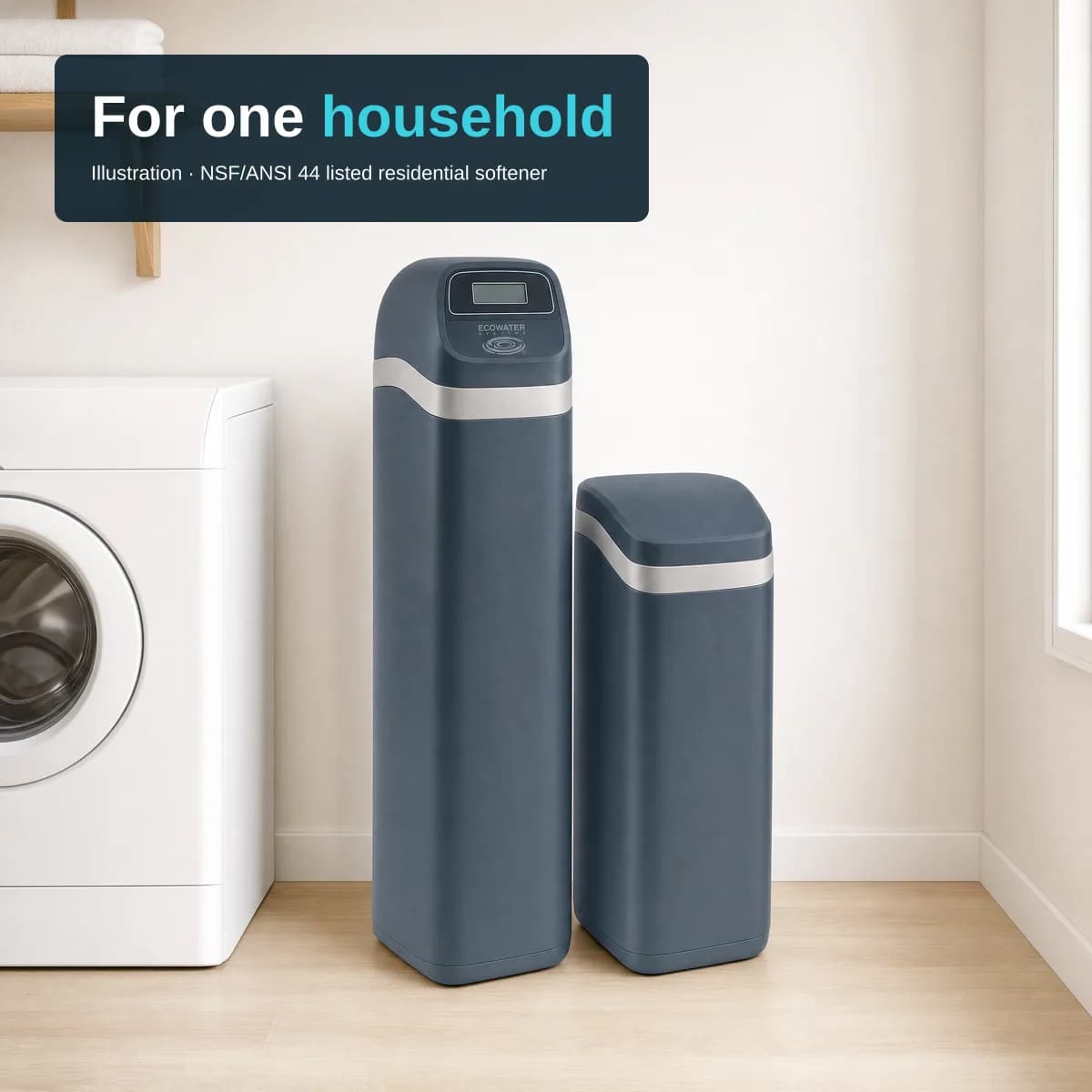
A quoted capacity is one point on a curve. The manual prints three doses (pounds of salt per recharge) for the R30: 8,100 grains at 1.6 lb, 20,100 at 6.3 lb and 27,100 at 11.0 lb.[7] The maker says "The efficiency rating is valid only at the minimum salt dose and the service flow rate."[7] A quote with a capacity and no dose, hardness and flow cannot be compared with another; the deep dive explains why.
R30 names more than one product (the manual's table lists ECR3702R30, ECR3700R30 and ERR3702R30 separately;[7] the reference design sets out the differences and figures), so the quote carries the full model code. The sheet (Rev. B, 02/17) and the manual (Rev. E, 11/3/17) disagree for the R30 and R40, on efficiency and maximum-dose capacity.[6][7] A supplier or catalogue figure only starts the enquiry.
Lifecycle items for the quote: sodium chloride is the default salt; the manual recommends no more than half full, about 150 lb of the sheet's 300 lb storage (derived).[7][6] The R30 uses about 38 gal (144 L) per recharge at 35 psi, dose unstated.[6] The warranty text (Rev. E, 2017) is the maker's, not an offer: tanks for the original owner's life, valve body ten years, electronic faceplate seven, other parts five, and it names no country.[7] Neither document names a dealer, service partner, stock or lead time for Singapore, Malaysia or Indonesia, so supply and service are unconfirmed. Ask whether the warranty applies to a unit supplied into those markets, and whether the quoting party is an authorised channel for it in the buyer's market and for the manual's first-year replacement guarantee.[7]
The sheet prints "120V, 50/60Hz"[6] with a 24 V DC supply included; the manual a nominal 120V, 60 Hz outlet.[7] Neither names 230 V or describes a 230 V variant. Singapore's low-voltage supply is "230V, single-phase" at 50 Hz (SP Group, January 2026);[10] Malaysia and Indonesia list 230/400 V at 50 Hz in a tertiary table.[5] The quote must name the maker's configuration for the site's mains. The request for quote names the ECR3702R30 by full code and carries each item above: the document and revision behind each figure, capacity at each printed dose with its hardness and flow, the supply configuration, chlorine and chloramine tolerance, water per recharge with its dose basis, the thread standard, the Wi-Fi configuration, the display languages and the NSF listing entry for the exact model.
Re-test hardness when the supply changes
This section sets the first checks, the re-test rule and the six conditions that end the quote. Commission with a hardness test kit on a raw and a conditioned cold-tap sample drawn together, in service and not during a recharge, after the manual's start-up flush of 50 gal (at least 20 minutes).[7] The guide's pass line is conditioned hardness under 1 gpg (17.1 mg/L), the target WQA names,[9] not a maker guarantee. Also check that the entered hardness and iron equal the measured values, and that the Last recharge and Total recharges screens sit near the 3 to 4 day target.[7]
Two results mislead. The first hot-water sample is not a test: the heater was filled hard (the reference design explains).[7] A sample drawn during a recharge or before the start-up flush is no result either (this guide's reasoning); repeat it cold, in service.
The manual describes a service reminder settable up to 24 months and, apart from resin cleaning every six months on clear water iron, prints no prescribed interval for other parts.[7] The control is told hardness and iron and counts gallons,[7] and no sensor for either is described in the two documents read, so a changed raw water leaves the entered value stale. Re-measure hardness, iron form, peak demand and pressure with a tap running when the source, a pump or the household changes.
Six conditions end the quote, each with its next step:
- Measured hardness under 7 gpg with no hardness complaint: the guide's screening rule, since Minnesota states only the above-7 side.[4] Next: no softener quote; if a complaint persists at that hardness, find its cause first.
- Peak demand over 12 gpm for the sheet models. Next: the R50S (20 gpm, 75.7 L/min; manual and NSF listing, no sheet column)[7][1] as a quote alternative, or split the demand.
- Water of unknown quality with no disinfection step, the maker's exclusion.[7] Next: the owner's water test and disinfection decision first.
- Red iron, or clear iron above the printed maximum.[7][3] Next: another treatment first.
- The maker's reply names no supply configuration for the site's mains.[6][7] Next: not this product for that site.
- A need for chlorine reduction, boiler or membrane feed, or commercial duty; no document read names such a duty for the ECR3702, and the maker's one boiler mention is an example in the manual's High capacity setting text.[7] Next: another product family.
None fires on the 11.17 gpg run on those assumptions, and stop 5 stays open until the maker replies.
Send the data pack: tap hardness (date, point, raw, cold; gpg and mg/L), clear and red iron, peak flow and daily use, inlet pressure with a tap running, water temperature, mains voltage and frequency, water source and disinfection, drain destination (no rule retrieved) and the market. A competent reply names the full code and revision, capacity at a stated dose, the interval against 3 to 4 days, the flow margin and drop, the supply configuration, water per recharge and warranty applicability, and may conclude not this product, or not yet. The reference design works one such house through, and the deep dive gives the conditions a quoted capacity must carry.
Request a quote for the EcoWater ECR3702 with this data pack.
Sources
- [1]NSF International, certified-products listing for EcoWater Systems LLC under NSF/ANSI 44, current as of 1 October 2026 (point-of-entry classification, grain conversion in the efficiency footnote, R50S entry)
- [2]US Geological Survey, Hardness of Water (condensed extraction; hardness classes in mg/L as calcium carbonate)
- [3]Penn State Extension, Water Softening (condensed extraction; oxidised iron clogs the resin)
- [4]Minnesota Department of Health, Home Water Softening FAQ (the url; the 7 gpg sentence) and Iron in Well Water (https://www.health.state.mn.us/communities/environment/water/wells/waterquality/iron.html; ferrous and ferric iron), condensed extraction
- [5]Wikipedia, Mains electricity by country (tertiary; Malaysia and Indonesia supply voltage and frequency)
- [6]EcoWater Systems LLC, ECR3702 spec sheet 0602927 Rev. B 02/17 (maximums, certified flow, electrical line, footnotes)
- [7]EcoWater Systems LLC, owner's manual 7365150 Rev. E 11/3/17, series 3700 and 3702 (third-party-hosted copy of the maker's manual; specifications, warranty, setup, upkeep)
- [8]PUB, Singapore Drinking Water Quality, January to December 2025 (water produced by the waterworks and desalination plants, not a tap measurement)
- [9]Water Quality Association, Ion Exchange technical fact sheet, 2013 (hardness scales but is safe to drink; 17.1 ppm per grain; target under one grain)
- [10]SP Group, How to Apply For Electricity Connection, January 2026 (Singapore low-voltage supply)