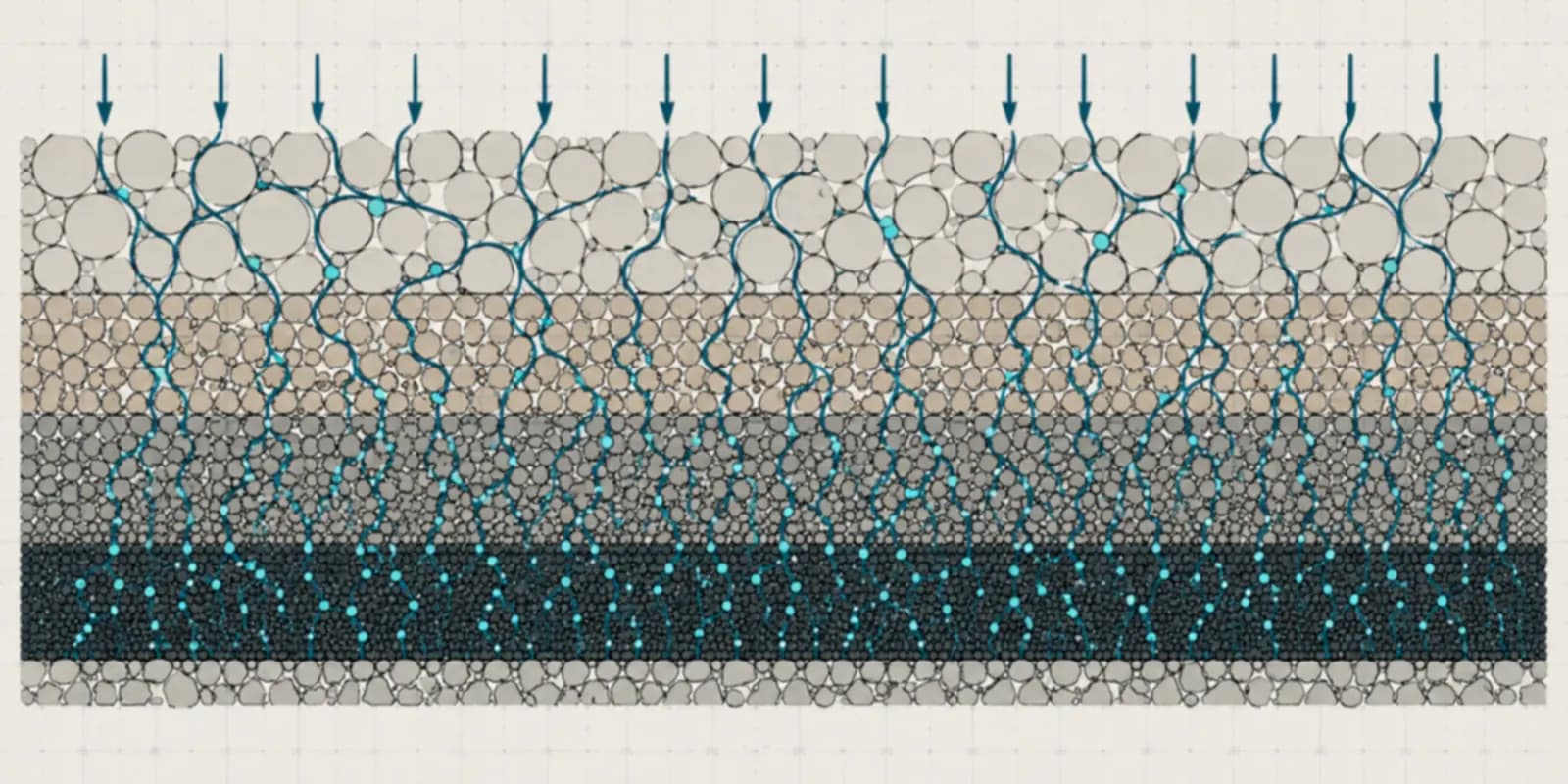
A Culligan CTM depth filter invites one question: which model passes a given flow? Culligan's brochure, the 8/17 revision (Part No. 39011) retrieved 2026-09-29, prints each flow as a point on a rate class, Normal at 10 gpm/ft², recommended for suspended solids up to 20 ppm, or Peak at 15 gpm/ft², recommended up to 10 ppm, based on a 2 in flow adapter and paired with a pressure drop measured on new media at 60 °F.[2] The printed flow is therefore not the site's capacity. What decides fit is whether the rating holds at the site's solids load, adapter and bed condition, and whether the plant can carry the backwash draw. This guide makes those checks in order and ends with one of three outcomes: this model at this size, pretreatment or another product first, or not this product. A reference design for a membrane feed line works one duty end to end, and how the granular bed captures particles explains the mechanism.
Confirm the problem, then measure solids and flow
Downstream cartridge or membrane fouling that worsens after rain or a change of source points to solids above what the bed was sized for (reasoning offered here); the check is the suspended-solids and turbidity trend on those dates, not one grab sample. Outlet solids that rise before the differential-pressure trigger is reached would be breakthrough, which a university course note describes as the stage where "breakthrough occurs, carrying solids out".[3] This guide's inference: a backwash triggered by differential pressure alone cannot see that, so filtered-water turbidity has to be read beside it. Fouling that persists while measured solids stay in range may suggest biological growth (reasoning offered here). UC ANR reports for agricultural sand filters that "Biological matting can occur in the filter", a different duty and medium, so on a CTM it is a check to run, not a finding.[4] A taste or chlorine complaint points to Culligan's Carbon group, whose table lists taste and odor removal and dechlorination; the depth table lists neither.[2]
Read trends, not samples. Compare solids and turbidity across a wet and a dry period, and sample both the CTM inlet and its outlet before blaming the source: a fouled cartridge downstream can equally come from a leak, and a clean inlet with solids at the outlet points to something between the two samples, such as breakthrough of the bed, the tank internals or a sample point, while solids at the inlet point to the source or a bypass (reasoning offered here). The duty class reorders the priorities (reasoning offered here): on a continuous process feed, flow interruption and turndown come first; on an intermittent duty, the backwash trigger does. Culligan lists "RO, Softener, and DI Pretreatment" among its example applications, a list spanning its filter families rather than the depth family alone.[2]
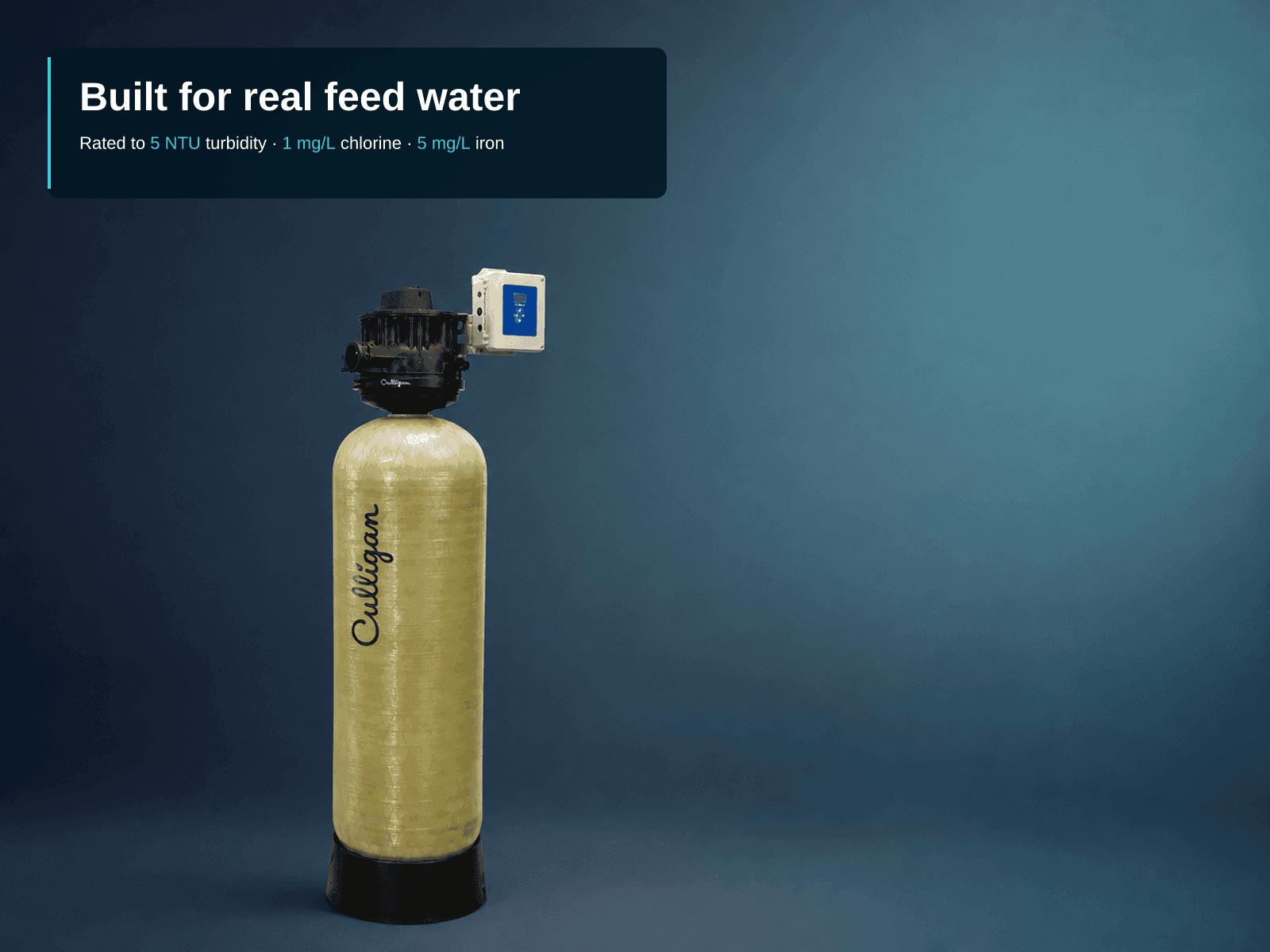
Six printed system limits, from a table that is brochure-wide and not depth-only, rule a site out before any sizing: turbidity 5 NTU maximum, chlorine 1 mg/L maximum, iron 5 mg/L maximum, feed temperature 40–120 °F (4–49 °C), and dynamic inlet pressure 35–125 psig (240–860 kPa), with vacuum listed as None.[2] The first three carry the footnote "See media specification for details", which is not in the brochure, so they are printed maxima with an unpublished basis.[2] PUB's page on Singapore's drinking-water regulation states no numeric turbidity limit as retrieved,[5] and none was retrieved for Malaysia or Indonesia; a drinking-water rule would not be a pretreatment feed limit anyway, so the reader's own measurements decide these gates, not a regional typical.
Three inputs size the filter (this guide's method): suspended solids in ppm select the rate class, and adapter size, 1.5 in or 2 in, selects the rating basis,[2] while peak simultaneous flow sets the flow to pass (reasoning offered here). Suspended solids in ppm are a mass concentration and turbidity in NTU an optical reading; they correlate only at a given site, through paired samples, so neither is converted into the other. Culligan's Peak is a rate class, not the site's peak demand, and 45 gpm is not asserted to be a peak, so ask for the simultaneous peak in gpm and m³/h (45 gpm is 10.2 m³/h).
Size to Normal, then check its assumptions
The order is rule out, then size, then fit, because sizing a unit that a limit excludes wastes the arithmetic. The run below is illustrative and is not a rating. [ASSUMPTION: a continuous 45 gpm process feed, 12 ppm suspended solids, 3 NTU turbidity, 0.5 mg/L chlorine, 0.1 mg/L iron, 30 °C water and 60 psig dynamic supply; valid only for this run, chosen to sit inside the printed limits with solids between the two class bands; invalid for any real site until its own measurements replace them.] Turbidity, chlorine, iron, temperature and pressure all sit inside the printed limits. The 12 ppm solids exceed the 10 ppm Peak band and sit below the 20 ppm Normal band, so only the Normal class is within Culligan's recommended band.[2]
CTMDF30 is rated 50 gpm at Normal on the 2 in adapter, so 45 gpm loads it to 90% of that rating, a margin of (50 minus 45) divided by 50, or 10%.[2] It is the smallest of the four depth models whose Normal rating reaches 45 gpm; only CTMDF30 and CTMDF36 do.[2] CTMDF21 tops out at 36 gpm at Peak, 9 gpm short.[2] CTMDF24 is rated 32 gpm at Normal and 48 gpm at Peak, so it reaches 45 gpm only at Peak, a 6.25% margin, in the 10 ppm band that 12 ppm solids exceed.[2] CTMDF36 gives a 36.6% margin at its 71 gpm Normal rating, but its 90 gpm backwash is 29% above CTMDF30's 70 gpm and its 1,895 lb of media is 54% above 1,230 lb, and Culligan prints the same 20 ppm Normal band for it, so it does not change the class (this guide's reasoning).[2] The backwash draw is the fit check: 70 gpm (15.9 m³/h) at Culligan's 50 °F basis must be carried by the drain, the storage and any concurrent demand, and duration and volume per cycle are not published.[2]
Sixty psig less CTMDF30's 7 psi at 50 gpm Normal is 53 psig, a best case, because the brochure says all pressure drop figures are "based on new filter media" at 60 °F.[2] The 7 psi is printed at 50 gpm; a value at 45 gpm would be interpolation, so none is given.[2] The loaded drop at the backwash trigger is not published, so downstream needs must be met at that trigger point and not at 53 psig, and the differential pressure switch and gauge are optional accessories.[2]
The 10% is a flow margin only, and three things decide what it protects. Adapter: besides the rate class and the single-model basis, the 2 in adapter is the only condition Culligan attaches to the flow rating, and flows may be "slightly lower" on the 1.5 in adapter, though Culligan elsewhere calls the impact minimal; neither is quantified, so with a 10% margin a 1.5 in adapter should not be accepted without Culligan's figure.[2] Temperature: the 60 °F and 50 °F bases attach to the pressure budget and the backwash draw, not to the flow rating. The 30 °C water is 86 °F, 14.4 °C above the 60 °F pressure-drop basis and 20 °C above the 50 °F backwash basis, and Culligan says "A different backwash rate may be required" at other water temperatures while the brochure prints no derating curve, so this guide states no direction of change.[2] Low flow leaves the margin alone but changes the backwash trigger, and no minimum flow is published. An inference, not Culligan's statement: solids arrive at flow times concentration, so halving the flow halves the mass reaching the bed each hour, and the bed needs backwashing less often per hour and about as often per volume treated. If the feed concentration holds steady, a time-clock trigger would then over-backwash at low flow, while a differential-pressure trigger follows bed loading. Culligan lists a flow-meter input too but the brochure does not describe it, so its low-flow behaviour is a quote question.[2] Sizing up trades load for backwash draw and media: CTMDF36 would carry 45 gpm at 63% of its Normal rating, with no pressure benefit claimed because its drop at 45 gpm is not printed.[2]
Place on the discharge side, question the quote
[ASSUMPTION: this guide's three placement options, bounded by the brochure's control-valve options, single downflow and multi-tank downflow, and vacuum limit; not Culligan's list.] A single tank on the pump discharge, with treated-water storage after it, keeps the single-model table directly applicable; its blind spot is that the brochure does not say whether service stops or is bypassed during backwash, so storage must cover a backwash duration that is also unpublished. Two tanks on the multi-tank downflow valve can add Progressive Flow, an optional feature and Culligan's published answer to varying demand, which the brochure describes as the Smart Controller monitoring flow demand and bringing "additional filter tanks on-line or offline as flows increase or decrease", and which Culligan calls patented; its inclusion is a quote item.[2] Its blind spot is that "Specifications shown are for single models", so two-tank pressure loss, staging logic, changeover and manifold design are unpublished.[2] If the second tank carries the full 45 gpm during a backwash, a CTMDF30 pair runs at 90% of Normal, as a single tank does, while a CTMDF24 pair runs at Peak only (derived here).[2] If backwash water is drawn from the feed, which the brochure does not state, the plant sees 45 plus 70, or 115 gpm (26.1 m³/h), at once.[2]
The third choice, position relative to the pump, matters most. Inlet pressure must lie between 35 and 125 psig dynamic, and the vacuum limit is None, with a footnote that "FRP tank warranty is void if subject to vacuum".[2] A pump's suction side can fall below atmospheric pressure, which is reasoning and not a Culligan statement, so the filter belongs on the discharge side, never on a suction side that can go into vacuum. Culligan supplies the Smart Controller, integrated flow meter, vacuum breakers and pressure relief valves, with the differential pressure switch, gauge and remote display optional;[2] the site or installer supplies the pump, isolation, drain line and its capacity, sample points, storage, 120 V power and the downstream stage (this guide's split; confirm in the quote). The brochure does not say how the unit behaves on low supply, a feed excursion, power loss or flow-meter failure, so the quote should state each and who acts.
Two quotes for the same CTMDF30 can differ by 24 gpm and both be right, because 50 gpm is the Normal class and 74 gpm the Peak class, with its 10 ppm solids band and higher pressure loss.[2] Ask which class, adapter and bed condition the flow assumes. The 90 gpm on Culligan's filters page, which says the CTM offers "backwash capabilities up to 90 gallons per minute", is a backwash flow, not a service flow.[1] The 90 gpm equals the CTMDF36 backwash flow in the brochure, an inference from the matching figure because the filters page states no basis; the brochure's backwash and service ratings are test-basis values (rate class, 2 in adapter, 60 °F and 50 °F, as footnoted) that a reply must restate at the site's conditions, and Culligan "reserves the right to change the specifications referred to in this literature at any time, without prior notice", so the brochure revision date is a quote item.[2] Also require the media replacement interval and backwash water per cycle (neither published), the differential pressure package, and the warranty term for this filter tank in this duty: the brochure gives a limited two-year warranty and a separate five-year term for softener tanks.[2]
Re-measure on change, and when not to quote
At commissioning, record baseline differential pressure at a recorded flow, since later readings compare only at that flow; that needs the optional differential pressure package or site-fitted gauges, so specify one in the quote. Measure backwash flow and duration on the site's own drain measurement, because the brochure describes the integrated flow meter only as giving "highly accurate reporting" and does not say it registers backwash water.[2] Confirm which trigger is configured; Culligan lists "Backwash initiation based on either time clock, flow meter or differential pressure inputs".[2] The brochure prints no service interval, only that "Operational, maintenance and replacement requirements are essential for this product to perform as advertised".[2] Re-measure solids, turbidity, chlorine, iron, temperature, dynamic pressure and peak flow whenever source, season or duty changes, because the 12 ppm in the worked run is a snapshot. Two readings mislead: differential pressure at a flow other than the baseline, and a clear sample drawn just after a backwash (reasoning offered here).
Five conditions mean the right reply is not a price:
- Suspended solids above 20 ppm, or above 10 ppm where only a Peak rating clears the flow, sit outside Culligan's recommended bands. Next: a clarification step, or another product; Culligan's filters page presents OFSY for "removing high turbidity from surface waters" when paired with chemical treatment, a turbidity claim and not a solids band, so a lead and not a sizing basis.[1]
- Turbidity above 5 NTU, chlorine above 1 mg/L or iron above 5 mg/L at the inlet exceeds the printed maxima. Next: ask Culligan for the media specification behind them, or condition the feed.[2]
- Dynamic inlet pressure below 35 psig under flow, or any vacuum at the tank, is outside the printed limits. Next: move to the pump discharge, or boost.[2]
- Demand above 71 gpm, CTMDF36's Normal rating, on one tank, or a duty that cannot stop with no storage or second tank. Next: a multi-tank quote with the staging logic stated, or storage.[2]
- A drain or supply that cannot carry the backwash draw, 70 gpm on a CTMDF30 plus concurrent demand. Next: rework drain and storage first.[2]
A sizable enquiry carries solids and turbidity trends through wet and dry periods, free chlorine, iron, temperature range, dynamic pressure at design flow and at minimum, continuous and simultaneous peak flow, duty hours and interruption tolerance, drain capacity, storage, power, the downstream stage's feed limits and the country. A reply from whichever supplier answers should name the model, rate class and margin as (rated minus demand) divided by rated, the binding component, who supplies each interface item, the lifecycle items above, the acceptance checks, the backwash rate at the site temperature, the adapter effect and, for several tanks, the staging logic. It may conclude that pretreatment must come first or that a CTM is not the product; for a worked membrane-feed duty, see the reference design.
Culligan Top Mount (CTM) Depth Filter
Send the data pack with a quote request; the reply, from whichever supplier answers, should contain the items above.
Sources
- [1]Culligan — Pre-Treatment Solutions / Filters listing page, fetched 2026-09-29 (CTM backwash wording; OFSY blurb)
- [2]Culligan — Top Mount (CTM) Series water filter system brochure (Part No. 39011, 8/17), re-downloaded 2026-09-29
- [3]University of Memphis, CIVL 1101 course notes — Introduction to Water Filtration (general granular-media comparator, not CTM-specific)
- [4]UC Agriculture & Natural Resources — Maintenance of Microirrigation Systems: Sand Media Filters (agricultural comparator, not CTM-specific)
- [5]PUB Singapore — Drinking Water Quality page (regulatory framework only; no numeric turbidity limit stated)