This reference design shows how the Culligan Top Mount (CTM) Depth Filter could be configured as pretreatment for a reverse osmosis (RO) train drawing a steady 50 gpm. Fit depends on the feed's turbidity and suspended-solids load, the water temperature, the backwash supply and drain, and the membrane maker's inlet requirement, not on the filter's flow rating. Engineers and integrators drafting a request for quotation can use it to frame questions for Culligan and to set acceptance checks. It is a hypothetical configuration built from a product listed in the Purionex catalog and from published sources, with no installation, commissioning date or measured result behind it.
The CTM depth filter and its stated uses
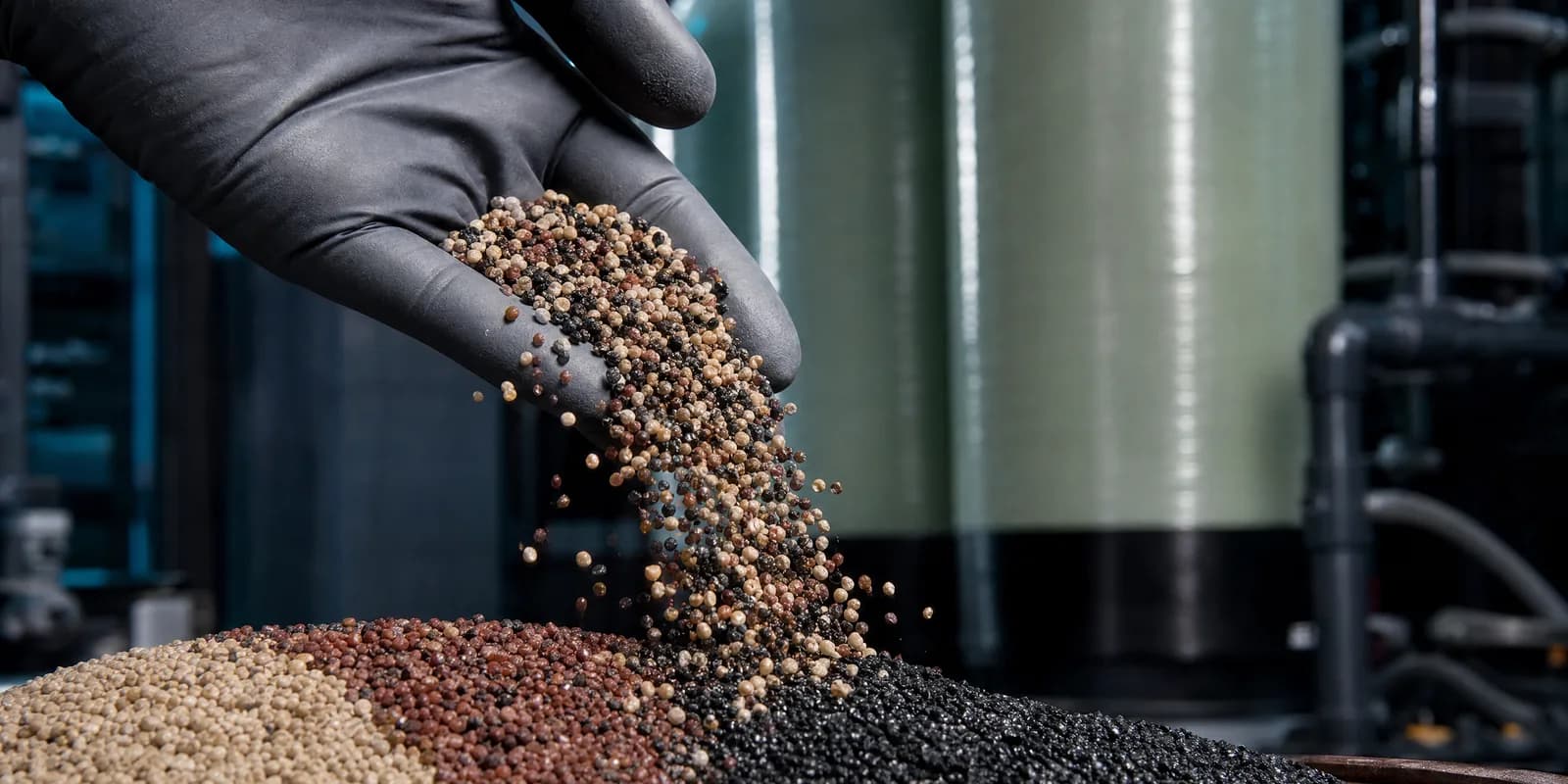
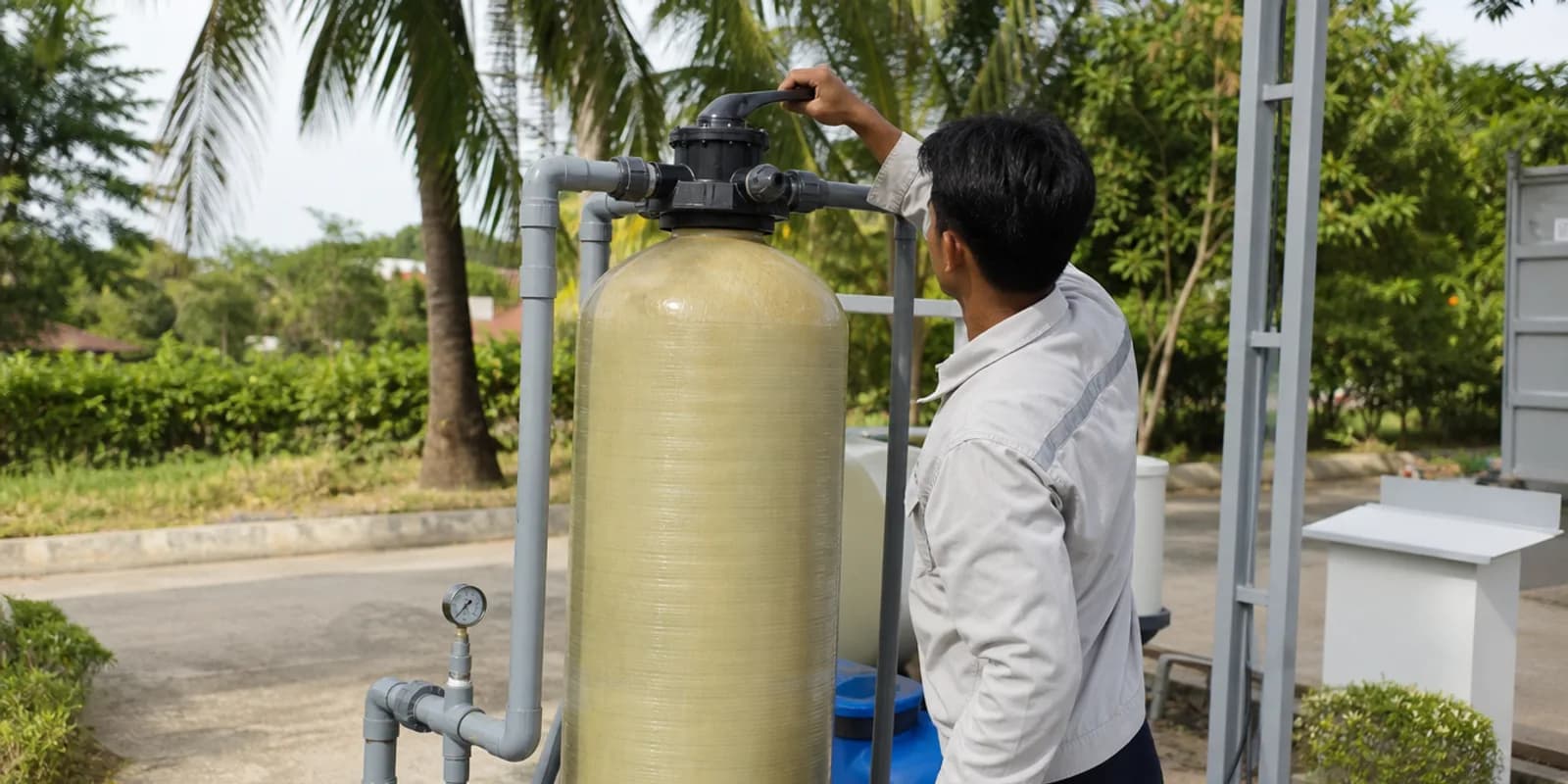
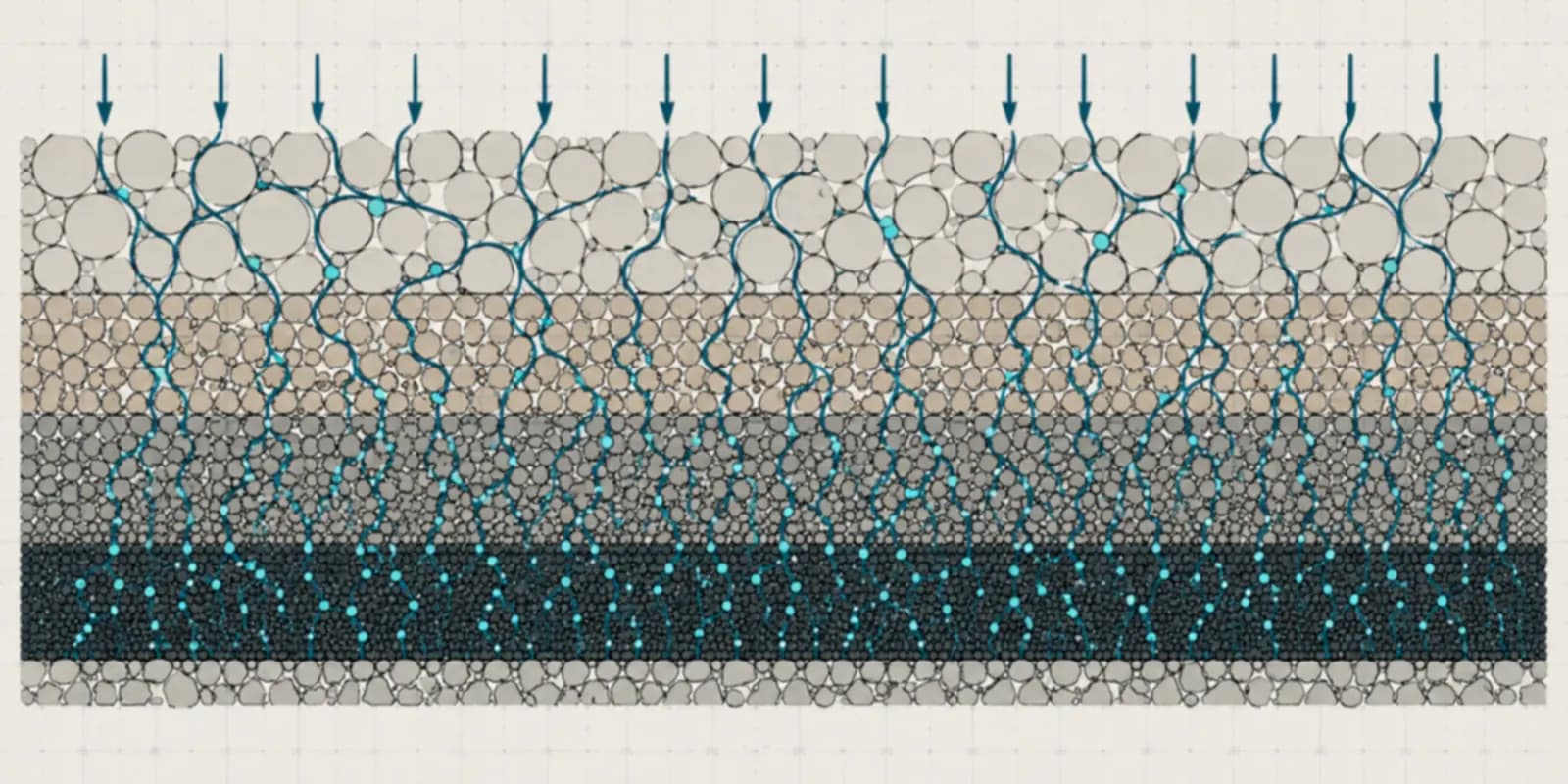
Culligan's Top Mount (CTM) Series is a water filter system for commercial and industrial applications, with the control valve mounted on top of the tank[1]. Culligan refers to an FRP tank[1], and Culligan lists integrated vacuum breakers, pressure relief valves and a flow meter, with each unit operated by a Culligan Smart Controller[1]. Three media groups share this platform, Depth, Carbon and Greensand/Cullsorb, and this reference design uses the Depth group, four models from CTM-DF21 to CTM-DF36[1]. How a depth bed captures suspended particles is covered in the depth filtration mechanics article.
Culligan lists single or multiple tank configurations, and its optional, patented Progressive Flow brings additional tanks on line or off line as flow demand changes[1]. The brochure names markets from clinics, hospitals, hospitality and food service to food and beverage production, manufacturing, energy and power, oil and gas and municipal drinking water, and its examples of filter applications include "RO, Softener, and DI Pretreatment"[1]. Both lists cover the whole brochure, all three media groups and not only the Depth group, and they are uses Culligan states, not results. This article takes RO pretreatment because there the membrane maker, not Culligan, sets the water-quality bar, as the next section argues.
Turbidity and SDI would judge the RO feed
In the Culligan CTM-DF30 pair reference design for a 50 gpm RO feed (the CTM pair design), the pretreatment stage would be judged by the water it delivers to the membrane, because a filter can pass its rated flow and still hand the membrane a feed it cannot accept. FilmTec's RO/NF Technical Manual, a comparator maker's document, states that feedwater turbidity "should be less than 1 NTU as one of the minimum requirements of feedwater"[3] and that the Silt Density Index (SDI) "correlates with the fouling tendency of RO/NF systems"[3]. Its guideline is to maintain SDI15, from a 15-minute test on a 0.45 µm pad, at 5, with SDI15 below 3 recommended to minimise fouling.[3] The comparison sign before the 5 does not render in the copy consulted, so "5 or below" is read here as an upper limit, an inference from the manual's next sentence, which gives the tighter figure of 3 as the recommendation. These are the membrane-inlet targets; the chosen membrane maker's own requirement governs and is not known here.
Culligan's brochure (Part No. 39011, August 2017 edition; Culligan reserves the right to change specifications without notice[1]) lists RO pretreatment as a use, but prints no filtered-water turbidity or SDI figure at any feed and no particle-removal figure beyond one comparison sentence, "Depth filters are capable of 10 microns effluent water quality"[1], which sets depth filters against the brochure's other filter types. Its feed limits, 5 NTU turbidity, 1 mg/L chlorine and 5 mg/L iron, sit in a specifications table shared by all the filter families and are each footnoted "See media specification for details"[1], a specification that was not retrieved. The turbidity limit is up to five times the 1 NTU membrane-inlet ceiling (5 ÷ 1, derived here), and how much of that the filter removes is a figure the brochure does not print.
The flow basis cannot fill that gap. The illustrative duty of 50 gpm equals the CTM-DF30's Normal service flow of 50 gpm[1], so the margin is 0% ((50 − 50) ÷ 50, derived here) and the basis tests nothing about capacity: a filter at its rating has shown its rating and nothing about the water. Nor does the 10-micron statement: the brochure does not define it as a pore size or give a method, so it cannot evidence an SDI value read on a 0.45 µm pad.
[ASSUMPTION: 50 gpm continuous, valid only as a test of the argument and replaced by the real demand in any request for quotation.] The other basis values are assumptions inside Culligan's envelope: 30 °C within 4–49 °C, and 60 psig within 35–125 psig, which Culligan states as dynamic inlet pressure[1], so 60 psig is assumed to hold during the backwash draw described below. Culligan recommends the Normal flow class for suspended solids loads up to 20 ppm[1]; NTU and ppm cannot be converted, so a 5 NTU feed is not shown to sit inside 20 ppm. No minimum flow is published, so the duty is held constant.
- Design flowASSUMPTION50 gpm (11.4 m³/h), continuous; equal to the CTM-DF30 Normal flow, 0% marginsource
- Feed water temperatureASSUMPTION30 °C, inside the published 4–49 °C rangesource
- Supply pressure at the tie-inASSUMPTION60 psig, assumed dynamic at the tie-in, inside the published 35–125 psig rangesource
- Membrane-inlet turbidity targetSOURCEDBelow 1 NTU (FilmTec guideline; the chosen membrane maker's requirement governs)source
- Membrane-inlet SDI15 targetSOURCEDGuideline value 5, comparison sign unreadable in the copy consulted and read here as an upper limit; below 3 recommended (FilmTec guideline; the chosen membrane maker's requirement governs)source
Culligan Top Mount (CTM) Depth Filter
Standby may cover backwash, not a bad feed
In the Culligan CTM-DF30 pair reference design, the two filters sit in line on a pressurised supply, upstream of the RO booster pump, within Culligan's 35–125 psig dynamic inlet range[1]. Culligan footnotes its vacuum entry with "FRP tank warranty is void if subject to vacuum"[1], so the booster needs a low-suction-pressure interlock (engineering judgment) whatever the integrated vacuum breakers do. The design also needs isolation valves on each unit's inlet, outlet and drain; a sample tap on each unit's outlet and one on the common header; no path around the filters, since a bypass would send unfiltered water to the membrane; and a backwash supply and drain. The single-tank and Progressive Flow alternatives are outlined above, and the sizing guide for the Culligan CTM gives the buyer's sizing method. The brochure describes no duty/standby sequence, changeover logic or manifold design[1], so the CTM pair design is this article's own architecture, not a Culligan configuration.
The CTM-DF30 is the smallest depth model whose Normal flow reaches 50 gpm.[1] Margin in the table is (rated − demand) ÷ rated at 50 gpm, derived here from the printed flows.
| Model | Normal flow, gpm (margin at 50 gpm) | Peak flow, gpm (margin at 50 gpm) | Backwash flow, gpm |
|---|---|---|---|
| CTM-DF21[1] | 24 (−108%) | 36 (−38.9%) | 30 |
| CTM-DF24[1] | 32 (−56.3%) | 48 (−4.2%) | 48 |
| CTM-DF30[1] | 50 (0%) | 74 (32.4%) | 70 |
| CTM-DF36[1] | 71 (29.6%) | 107 (53.3%) | 90 |
The CTM-DF21 and CTM-DF24 fall short at every rated point, the DF24 by 2 gpm even at Peak, the class Culligan describes with increased pressure loss[1]. The CTM-DF36 would lift the margin to 29.6%, but its 90 gpm backwash raises the concurrent draw described below from 120 to 140 gpm, and its pressure loss is printed only at 71 and 107 gpm. The CTM pair design accepts 0% margin to keep the smaller backwash, relying on the Normal class, which Culligan describes as "Best quality effluent at specified flow"[1], a supplier's claim and not a measured outlet.
Three conditions qualify those ratings. The flows assume the 2 in adapter and, Culligan says, "may be slightly lower" with the 1.5 in adapter[1], an unquantified reduction that could turn the 0% margin negative. The 7 psi loss at 50 gpm is for a single tank, and Culligan states that "All pressure drop figures are based on new filter media"[1] and 60 °F (15.6 °C) water. So 60 psig less 7 psi leaves 53 psig (3.65 bar), a clean-bed 60 °F figure (derived here); the water here is 30 °C (86 °F), and the effect of that difference is unpublished. Loading and pair header losses lower it further, so 53 psig is not a design pressure.
The second unit adds no capacity. Each CTM-DF30 would carry the full 50 gpm, so, where the backwash supply allows (see the next paragraph), the standby holds the duty while the first unit is in backwash, and it is not protection against a bad feed: both units share the feed, supply, drain, backwash source and undisclosed media, so a turbidity, iron or chlorine excursion reaches both alike. The brochure describes no duty and standby arrangement for two tanks[1], so changeover is a quote item. [ASSUMPTION: changeover to the standby shifts flow gradually, because a sudden increase can release solids a bed has already held; generic media-filter practice, not a CTM statement; valid as a commissioning setting for the changeover logic; invalid as a Culligan specification; promoted by Culligan's written changeover guidance.] Power loss, on the assumption of one shared supply, takes both units.
Backwash sets the supply. Culligan prints 70 gpm (265 lpm) for the CTM-DF30, at 12–14 gpm/ft² and 50 °F (10 °C) water, and adds that "A different backwash rate may be required" depending on water temperature[1]. At 30 °C the printed rate is unconfirmed. The brochure does not state the backwash water source, and the standby claim depends on it. If it is the feed, the supply must deliver the unit in service (50 gpm) plus the unit in backwash (70 gpm), 120 gpm or 27.3 m³/h (derived here). If it is filtered water, from the header or the parallel unit, the in-service unit passes 50 gpm to the RO plus 70 gpm to backwash, 120 gpm against a Peak rating of 74 gpm[1], so the standby covers a backwash only with a feed-fed or separate backwash supply. [ASSUMPTION: the common header has a 2.067 in bore, taken as nominal 2 in Schedule 40 pipe; valid only as an order-of-magnitude check; invalid as a pipe specification; promoted by the integrator's line-size design.] A 120 gpm draw is 3.50 m/s in that bore (derived here), so the common header would likely need to be larger; no velocity band was retrieved, a question for the integrator. Duration and volume per cycle are unpublished. [ASSUMPTION: a rinse to drain before a unit returns to service adds to the backwash volume; generic practice, not a CTM statement; valid where the operator rinses before return to service; invalid as a Culligan procedure; promoted by Culligan's start-up and backwash instructions.] In filtration only filtered water leaves; in backwash 70 gpm leaves for an unpublished period, to the owner's drain.
Backwash on differential pressure, accept at RO inlet
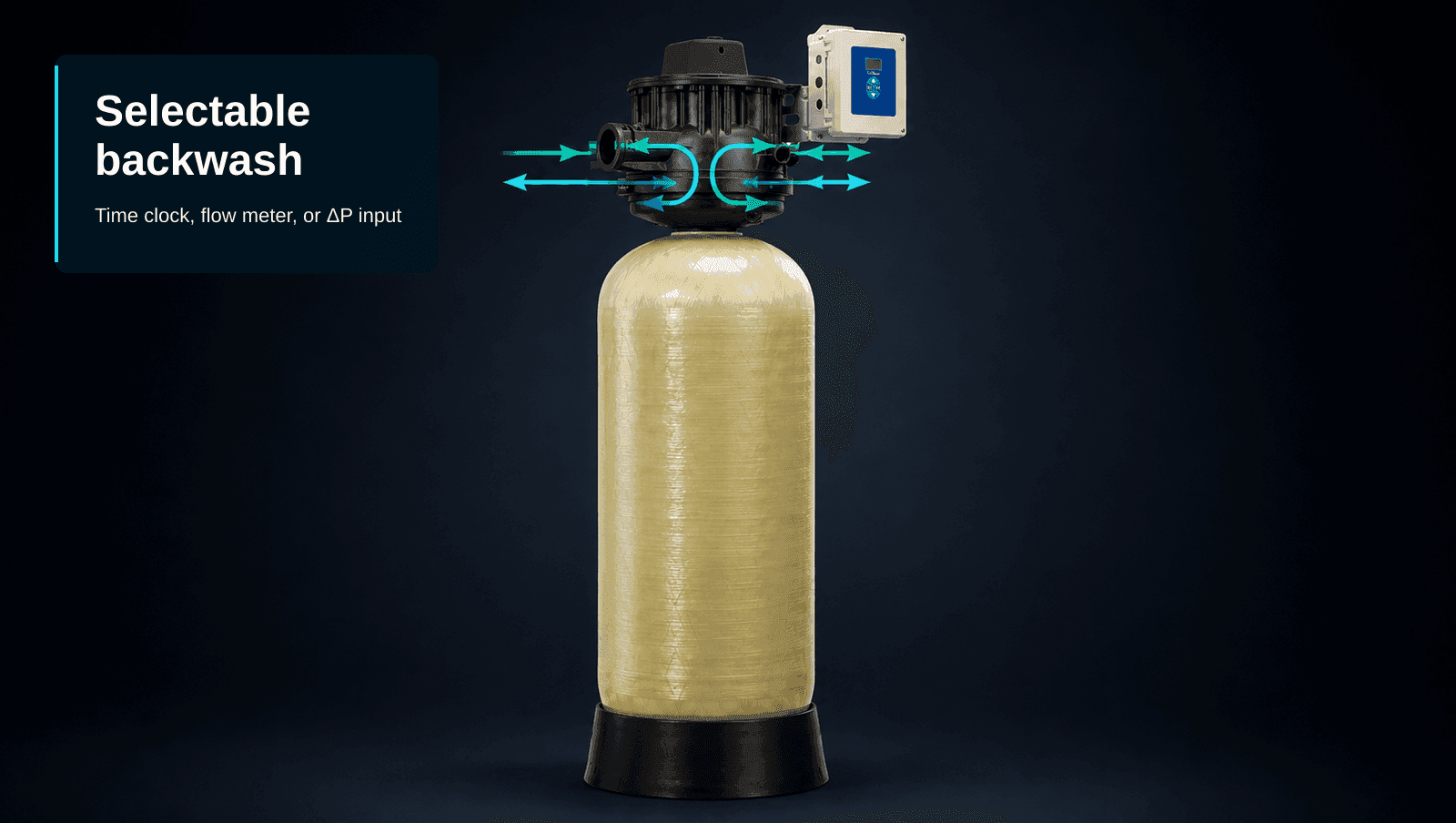
Culligan lists "Backwash initiation based on either time clock, flow meter or differential pressure inputs"[1], and in the CTM pair reference design differential pressure would be the input chosen, because the solids reaching the bed vary with the feed. A time clock backwashes on schedule whatever the load, and, if the feed concentration holds steady, would over-backwash at lower flow, since solids arrive at flow times concentration (derived here). A flow-meter trigger presumably counts volume, an inference, since Culligan says only that the meter gives "highly accurate reporting"[1], and volume ignores concentration. Culligan lists "Differential pressure switch and pressure gauge packages" among its optional features[1], so whether the input comes with the base valve is a quote item, and the trigger value, unpublished, is a commissioning parameter.
Online, the CTM pair design would read inlet and outlet pressure and differential pressure per unit, service flow, booster suction pressure, and filtered-header turbidity on an external turbidimeter. Iron, chlorine, SDI15 and temperature are sampled, as the brochure lists none of them as reported by the CTM.[1] One common outlet sample cannot say which unit passes a failing stream, so each unit's outlet carries its own tap and the standby is tested before it is needed. The signals have limits. Differential pressure in range is not good water, because a loaded bed can break through, and a granular-media source notes that "breakthrough occurs, carrying solids out"[2]. The flow meter is not stated to register backwash water,[1] so it is not the backwash measure. Turbidity below 1 NTU does not establish SDI: turbidity is an optical measure of scattered light and SDI a plugging rate on a 0.45 µm pad[3].
Each control action needs a trigger, a response and an owner. The operator sets the differential-pressure trigger at commissioning. Transfer to the standby follows logic the brochure does not describe, a quote item, so an external controller or PLC, through the optional RS232, RS485 or Modbus output[1], is the integrator's. High filtered turbidity on an external analyser stops the RO train at the operator's setpoint, and low suction pressure stops the booster. Culligan lists "Multiple Alarm Recognitions"[1] without naming them, so the alarm set is a quote item. The valve position on power loss, and any manual backwash or bypass, are unpublished quote items nothing here relies on; the booster stops on power loss regardless.
The CTM pair reference design would be accepted at the RO inlet, on the filtered water of the unit in service, because a sample from the backwash drain or a bypassed line would flatter the result. Readings are taken before, during and after a backwash, since no source retrieved says how outlet quality moves through a run. Every turbidity reading must fall below 1 NTU. SDI15 must meet the guideline value of 5 (read as an upper limit, see above), with below 3 recommended, sampled three times a day, the frequency FilmTec recommends "for surface waters"[3], adopted because the feed source is unstated. The brochure carries no start-up procedure and no installation manual was retrieved, so this sequence is engineering judgment. Each figure is recorded with its conditions: for turbidity, instrument, sample position and time relative to backwash; for SDI15, the 0.45 µm pad, 207 kPa (30 psi) test pressure, timed 500 mL collections, water temperature and position in the run[3]; for differential pressure, flow, temperature and media age, so that a reading at 30 °C is a baseline and not a pass or fail against 7 psi.
The backwash share cannot be stated in advance. At 50 gpm continuous the CTM pair design passes 72,000 gal (272.5 m³) a day, and one backwash-minute at the printed 70 gpm uses 70 gal (265 L), 0.097% of daily flow; ten backwash-minutes a day would be 0.97% (derived here, illustrative, not a Culligan figure, valid only at the printed rate). The minutes per day are unpublished, so a totalising drain-line meter or a timed collection (an assumed method) measures each cycle at acceptance.
Where it fits, and what stays open
In the CTM pair reference design the first risk is the central gap: nothing retrieved shows what the membrane would receive at the 5 NTU feed limit, because the brochure prints no outlet figure. That missing figure would decide whether the design goes ahead, and it closes with Culligan's written answer on the media specification behind the footnote and outlet data at stated feed conditions, or with the single-unit trial below.
Four items stay open until the answers are in. The brochure does not state the backwash water source. Drain capacity and any discharge consent are the owner's to confirm with the local authority, since no trade-effluent or discharge instrument was retrieved for this article. The differential-pressure trigger value and the alarm set are commissioning and quote items, and after handover the operator or integrator owns them. Culligan says its operational, maintenance and replacement requirements are "essential for this product to perform as advertised"[1] but not who performs them; the CTM pair design assigns maintenance to the owner (an assumption), and no service intervals or media life are published.
Upsets divide the same way. Culligan lists integrated vacuum breakers, but its warranty is void if the tank sees vacuum,[1] so the design relies on the booster interlock and treats the breakers as secondary. The brochure lists no protective action for a turbidity, iron or chlorine excursion beyond its limits. Only turbidity is monitored online, so an external analyser stops the RO train on high turbidity under the operator's authority; a stop on iron or chlorine needs an analyser the design does not include, an owner decision. Any chlorine and iron limits the membrane maker sets apply at the RO inlet whatever the depth filter does, and a feed beyond Culligan's limits needs another stage first. On warranty, Culligan states a limited two-year term and a five-year term worded for softener tanks, and whether the second reaches CTM tanks is not stated; the brochure says "See printed warranty for details"[1], and that text governs.
The trial can be stopped at any stage without exposing the membrane. Stage 1 characterises the feed: turbidity, suspended solids, iron, chlorine, temperature and raw SDI15 across its observed range. Stage 2 runs one unit with the RO train isolated and filtered water sent to drain, measuring outlet turbidity, SDI15, differential pressure and backwash volume against the targets; it needs one CTM-DF30 installed, bought, hired or loaned, and no source retrieved says whether Culligan or a dealer offers a trial unit. Stage 3 connects the membrane with the interlock live. Stopping after Stage 1 or 2 leaves that unit, temporary instruments and a drain line, and if the outlet fails, the response is to add or replace a stage designed for the feed, not to raise the flow rating.
The CTM pair design falls inside Culligan's published envelope for a steady feed of about 50 gpm at 4–49 °C and 35–125 psig, with turbidity, chlorine and iron inside Culligan's limits and a drain that can take the backwash; outlet quality within that envelope is unconfirmed. Demand above 50 gpm continuous moves the CTM-DF30 into the Peak class (74 gpm at 11 psi, recommended for suspended solids up to 10 ppm)[1] or to the CTM-DF36; feed above 5 NTU, 1 mg/L chlorine or 5 mg/L iron, or suspended solids above the 20 ppm recommended for the Normal class, needs a stage ahead; the 1.5 in adapter could push the 0% margin below zero; and a membrane maker's requirement tighter than the trial shows calls for a polishing stage. It does not mean a guaranteed RO feed quality or a Culligan-endorsed pair. Nor does it carry any certification: the August 2017 brochure shows a WQA badge naming NSF/ANSI 61 and 372 and states that the Greensand/Cullsorb filters are not tested or certified by WQA[1], and nothing here extends that to an assembled pair.
The data to send is the feed's turbidity, suspended solids, iron, chlorine and temperature range; the supply pressure range at the tie-in; the flow pattern; the membrane maker's feed requirements, including any chlorine and iron limits, and warranty terms; the drain capacity and any consent; the backwash water source; power; the adapter size; and any SDI15 record.
A Purionex proposal should contain the confirmed model and count against the rate class, the acceptance plan and the three-stage trial. The quote request should also ask whichever supplier answers to confirm Culligan's current specifications and to answer in writing on the quote items above: the media specification behind the feed limits, outlet turbidity and SDI at the stated feed, backwash rate and volume at the operating temperature, valve position on power loss, the alarm set, changeover and pair control, and the printed warranty. Send the data pack with the quote request; the items above are the questions to put to that supplier, Purionex included.
Sources
- [1]Culligan — The Culligan Top Mount Series, Water Filter System brochure (Part No. 39011, August 2017 edition), full text as re-downloaded 2026-09-29 — primary CTM datasheet
- [2]University of Memphis, CIVL 1101 course notes — Introduction to Water Filtration (independent engineering reference; breakthrough)
- [3]FilmTec Reverse Osmosis Membranes Technical Manual, Form No. 45-D01504-en, Rev. 20 — turbidity and SDI guidelines (comparator maker)